HR Manager Resume Format, with 3 Full Samples
An HR manager is hired on evidence of attrition brought down, hiring cycles shortened and people programmes that changed a number the business cares about, yet most HR resumes read like a job description of duties performed. Below are three complete resumes, one for an HR manager with six years running the generalist function for a mid-size company, one for a senior HR manager owning the people agenda for a 1,200-person org, and one for an HR business partner sitting with a business unit's leadership. After the samples come the format rules, the difference between listing responsibilities and proving outcomes, the terms a parser matches literally, and the mistakes that end a screening before a human reads the page.
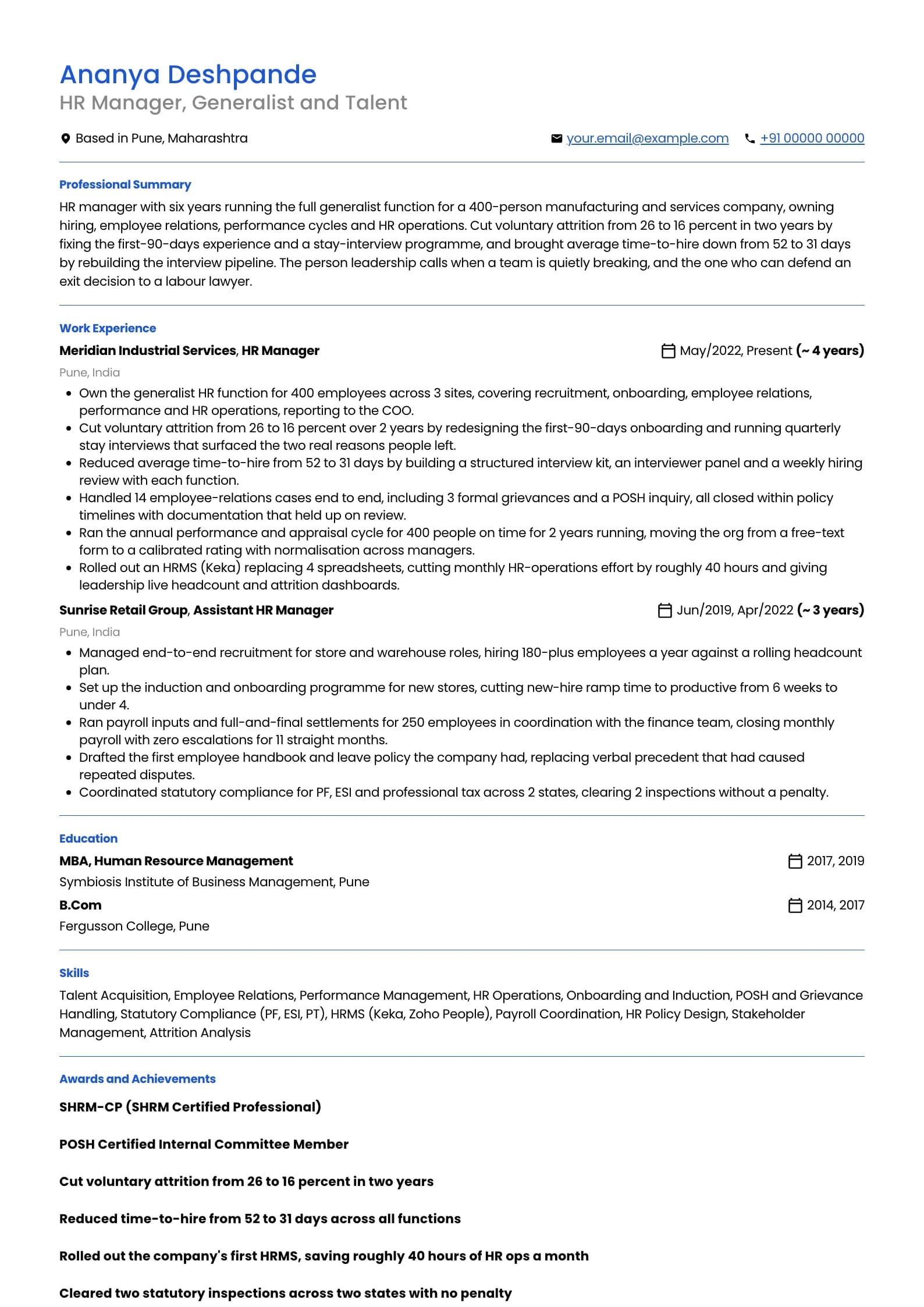
Build my resumeHR Manager resume example, HR Manager (6 years)
professional templateIs your resume good enough?
Upload the resume you have now and see what an applicant tracking system reads before a hr manager recruiter ever does.
Free to run. Sign in with your mobile number to see your score.
HR Manager resume example, Senior HR Manager (10 years)
header-band template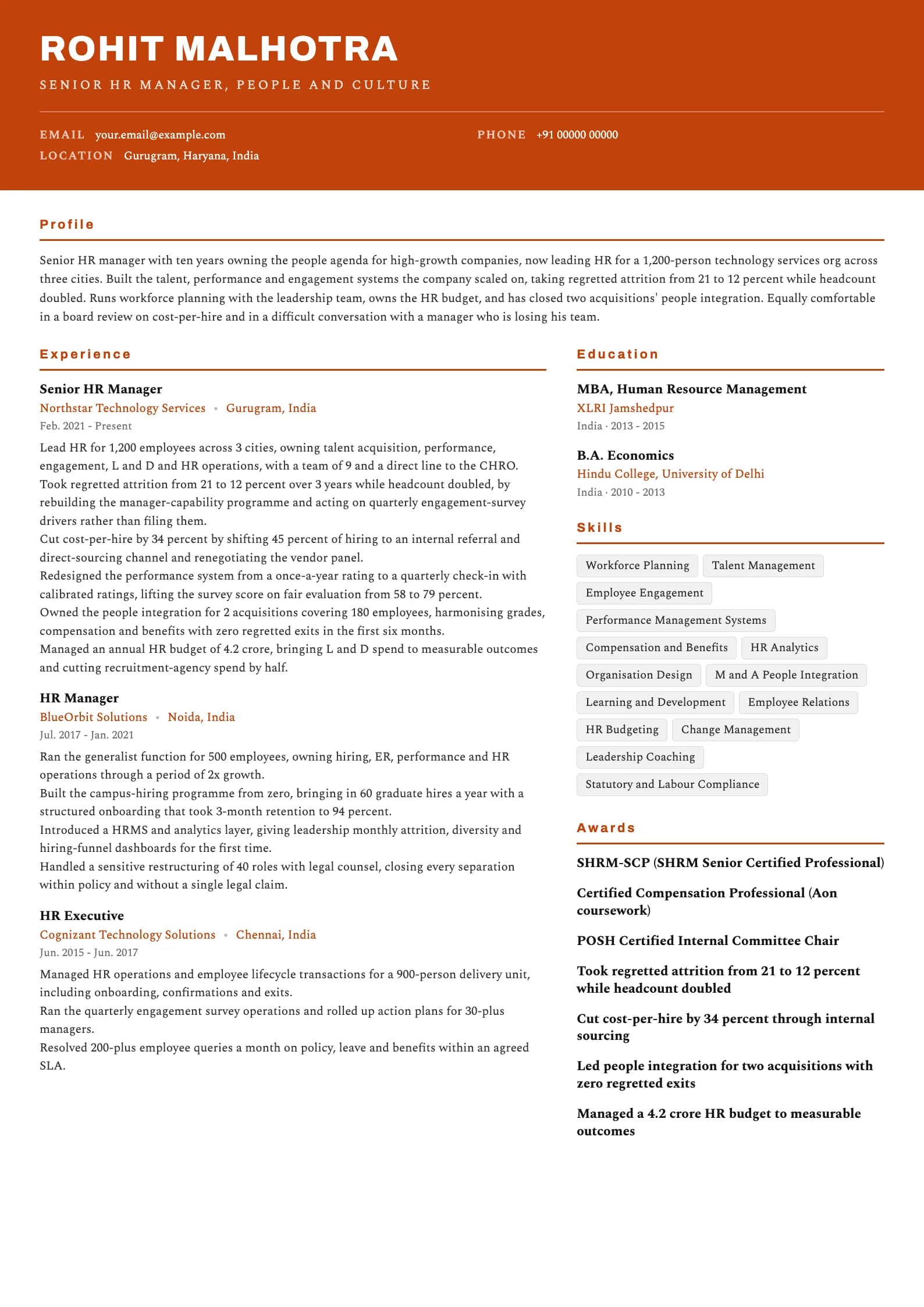
Want this structure with your own details? Build it in the resume builder.
HR Manager resume example, HR Business Partner (8 years)
modern template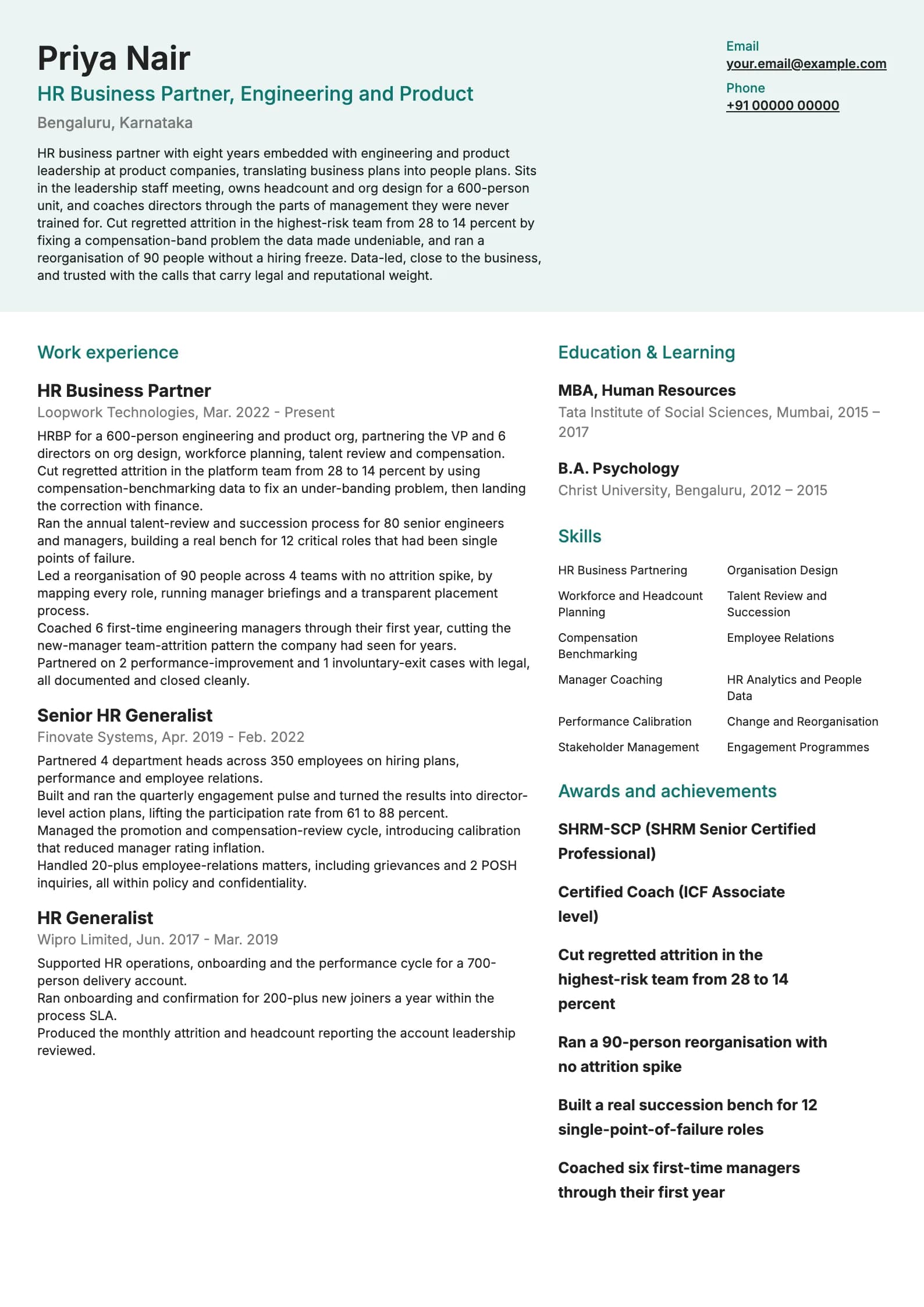
The format that works for HR manager resumes in India
Reverse chronological is the layout to use. Most recent role first, work backwards, dates in plain view. A functional resume that hides dates under skill headings reads, to an HR audience of all people, as an attempt to conceal a gap or a short stint, and HR reviewers are the least likely to miss it. One honest line explains a gap better than a layout that buries it. Length is set by evidence, not tenure. One page carries an HR manager up to roughly eight years. A senior HR manager or HRBP with a decade of programmes, budgets and integrations earns a second page, provided it holds real outcomes rather than a longer list of HR sub-functions. A second page built from a philosophy statement and a values paragraph is a padded one-pager. HR resumes attract a particular kind of filler: soft-skill adjectives. People-oriented, passionate about people, excellent interpersonal skills. An HR manager selling those to other HR professionals is selling water to a fish. Cut every adjective that cannot be checked and let a result stand in its place. Send a PDF unless the posting asks for DOCX, name the file with your own name and the target role, and keep it single-column so the parser reads it in order. The table below sets out the section order.
| Section | Where it goes | Why |
|---|---|---|
| Name and headline | Top, above everything | The headline is the role you want, HR Manager or HRBP. Recruiters and HR leaders match on it. |
| Professional summary | Directly under the header | Three lines. Scope of people owned, years, and the single strongest people outcome. |
| Work experience | Next, the core of the page | Most recent first. Newest role gets the most bullets, each an HR outcome. |
| Key achievements | Optional, below summary or experience | Three or four headline numbers: attrition, time-to-hire, cost-per-hire, engagement. |
| Skills | Below experience | Grouped: talent, ER and compliance, HR ops and systems, leadership. |
| Education | Bottom, unless early-career | MBA HR or equivalent, institution, years. Drop the percentage after your first role. |
| Certifications | After education, or beside skills if only one or two | SHRM-CP, SHRM-SCP, POSH. Name, body, year. |
Listing responsibilities is not the same as proving outcomes
The single most common HR resume failure is a page of responsibilities: handling recruitment, managing employee relations, overseeing performance appraisals, ensuring statutory compliance, driving employee engagement. Every HR manager in the country handles those. A parser matches the terms, but a hiring leader reads the list and learns nothing that separates you from the other forty applicants who wrote the same words. The fix is to convert each responsibility into the outcome it produced. You handled recruitment, so what happened to time-to-hire or cost-per-hire. You managed employee relations, so how many cases and were they closed clean. You drove engagement, so what did the survey score move to. The mid-level sample writes attrition from 26 to 16, time-to-hire from 52 to 31, an HRMS that saved 40 hours a month, precisely because those are outcomes a business feels, not duties anyone can claim. HR has honest numbers even when people assume it does not. Attrition and regretted attrition, time-to-hire, cost-per-hire, offer-acceptance rate, engagement and eNPS, absenteeism, internal-mobility rate, training-completion, payroll accuracy, compliance-inspection results, case-closure timelines. Pick the ones true for your work and put a before and after on them. Where a number would breach confidentiality, give scope instead. "Handled 14 employee-relations cases including a POSH inquiry, all closed within policy timelines" carries weight without naming a person or a settlement. That is the line between a strong ER bullet and an indiscreet one.
For every responsibility on your resume, ask: what number moved because I did this. If you cannot answer, it is a duty, not an achievement. Either find the number or cut the line.
Writing a summary an HR leader actually reads
The block under your name is the part most likely to be read, so it must carry three facts: the scope of people you own, how long you have done HR, and the strongest thing that changed because of your work. Three or four lines, no unverifiable adjectives. The old objective, seeking a challenging HR role in a reputed organisation to utilise my people-management skills, tells the reader nothing they had not assumed. Replace it with a summary. An objective describes what you want, a summary describes what you have already delivered, and only one is evidence. Scope is the fastest signal on an HR summary. "Owning HR for 1,200 employees across 3 cities" places you immediately, where "experienced HR professional" does not. Follow scope with the years and then the single result you would lead a conversation with, whether that is an attrition number, a cost-per-hire cut or a clean acquisition integration. A practical test: read your summary and ask whether another HR manager with the same MBA could paste it onto their resume unchanged. If they could, it describes the profession, not you. Add the specific headcount, the specific number and the specific ownership until it stops being transferable.
Professional summary, HR manager
Weak
Result-oriented and people-centric HR professional with 6+ years of experience in end-to-end HR functions, passionate about employee engagement and building a positive work culture.
Strong
HR manager owning the generalist function for a 400-person company, six years across hiring, ER and HR operations. Cut voluntary attrition from 26 to 16 percent and time-to-hire from 52 to 31 days.
The rewrite trades adjectives and a culture cliche for a scope, a tenure and two outcomes a business tracks.
Experience bullets: verb, HR action, business result
Every strong bullet in the samples follows the same shape. It opens with an action verb, names the specific HR action or programme you owned, and closes with what measurably changed for the business or the workforce. The verb establishes that you did it. The action tells an HR leader whether the work is relevant to their problem. The number does the persuading. Start with the outcome and work backwards. HR professionals usually write the activity first, then cannot attach a number, producing lines like "drove employee engagement initiatives across the organisation". Instead ask what was different after you ran it: the eNPS rose, attrition fell, participation climbed, a case closed clean, a cycle finished on time. Then write the sentence that ends in that fact. Vary the metric. A resume that is attrition, attrition, attrition reads as one lever pulled repeatedly. Across a real HR role you can honestly reach for attrition, time-to-hire, cost-per-hire, offer-acceptance, engagement score, participation rate, case count, compliance results, budget and headcount. The senior sample deliberately spreads across several so it reads as range. Where you lack a number, give scope: how many employees, how many sites, how many cases, how many managers coached, how long a cycle took. "Ran the annual performance cycle for 400 people on time for two years running" carries weight without an invented percentage. Allocate bullets by recency. Current role gets five or six, the previous role three or four, anything older two or three.
| Level | What bullets must prove | Typical metric |
|---|---|---|
| HR Executive / early | You run the HR process reliably and to SLA | Queries closed, onboarding time, payroll accuracy, cases supported |
| HR Manager (5 to 8 yrs) | You own the function and move its numbers | Attrition, time-to-hire, engagement, cycle delivered on time |
| Senior HR Manager | You own the people agenda and its budget | Regretted attrition, cost-per-hire, budget, integrations |
| HR Business Partner | You change business decisions with people data | Org design, succession bench, comp corrections, reorg with no spike |
Experience bullet, employee relations
Weak
Responsible for handling employee grievances and disciplinary matters and ensuring a healthy work environment.
Strong
Handled 14 employee-relations cases including 3 formal grievances and a POSH inquiry, all closed within policy timelines with documentation that held up on review.
"Responsible for" describes a job description; the rewrite gives volume, case types and the standard the work was held to, without naming anyone.
Experience bullet, engagement work
Weak
Drove various employee engagement initiatives which resulted in improved employee satisfaction across the organisation.
Strong
Lifted the engagement-survey score on fair evaluation from 58 to 79 percent by moving from a yearly rating to calibrated quarterly check-ins.
Names the exact driver moved, the before and after, and the specific programme that moved it, so a reviewer can ask a real follow-up.
If a bullet would read identically on another HR manager's resume, it is describing the profession, not you. Rewrite it until it only fits the programme you actually owned.
The skills section: grouped, honest, and short enough to defend
An HR resume's skills section has two audiences with opposite preferences. The parser wants literal terms it can match, employee relations and POSH and statutory compliance. A hiring leader wants a short, organised list that signals what kind of HR professional you are. Grouping satisfies both. Group by function rather than one long line. Talent and hiring, employee relations and compliance, HR operations and systems, and leadership and partnering is a grouping that works for almost every HR manager. The exact headings matter less than that structure exists. Write terms the way the industry writes them: POSH not Posh, HRMS not HRIS if that is your platform's name, and name the actual system, Keka or Darwinbox or Workday, because leaders hire for tool familiarity. Twelve to sixteen skills is the working range. Below eight it looks thin. Above twenty it stops being a signal, and HR resumes are prone to a specific padding: listing recruitment, talent acquisition, hiring, sourcing and staffing as five separate skills when they are one. The list is a contract, every item a question you have agreed to answer in the interview. Do not include a proficiency bar. Nobody agrees what four stars in employee relations means, and a rating invites an argument you cannot win. Let the experience prove the depth instead.
Skills section
Weak
Skills: Recruitment, Talent Acquisition, Hiring, Sourcing, Staffing, Employee Engagement, Employee Relations, Employee Grievance, HR, Human Resources, HR Management, People Management, Communication, Interpersonal Skills, Leadership, MS Office, MS Excel, Team Player, Hardworking
Strong
Talent: talent acquisition, structured interviewing, campus hiring. ER and compliance: employee relations, POSH, statutory compliance (PF, ESI). HR ops and systems: HRMS (Keka), payroll coordination, HR analytics. Leadership: performance management, stakeholder management.
Collapses the recruitment and HR synonyms into single real skills, cuts the personality adjectives, and groups the rest so a leader reads it in one pass.
The HR metrics worth putting on the page, and where to find them
HR professionals routinely believe their work does not quantify, then hand in a resume with no numbers on it. The truth is that HR is one of the most measured functions in a modern company, and the numbers already exist in the systems you run. The task is to pull them and put a before and after on the ones your work moved. The most persuasive HR numbers cluster in four areas. Retention: attrition, regretted attrition, first-year attrition, tenure. Hiring: time-to-hire, cost-per-hire, offer-acceptance rate, source-of-hire mix. Engagement: survey score, eNPS, participation rate, action-plan completion. Operations and compliance: payroll accuracy, query-closure SLA, inspection results, audit findings. Any of these, moved and stated honestly, outperforms a paragraph of adjectives. Use rates and directions, not just raw counts, where the count alone misleads. "Hired 180 people" says less than "cut cost-per-hire by 34 percent", because the first is a function of company size and the second is a function of you. Where only the count is honest, keep the count and add the constraint: 180 hires against a rolling plan, on time. Be careful with confidentiality and with attribution. Do not put a specific employee's separation terms, a named person's rating or an exact salary figure on a resume. And do not claim a company-wide number as solely yours when a team delivered it, because an interviewer will probe the boundary of what you personally owned, and an honest scope survives that probe where an inflated one does not.
| Area | Metric | Where it lives |
|---|---|---|
| Retention | Voluntary and regretted attrition, first-year attrition | HRMS attrition report, exit-interview data |
| Hiring | Time-to-hire, cost-per-hire, offer-acceptance rate | ATS or recruitment tracker, recruitment budget |
| Engagement | Survey score, eNPS, participation rate | Engagement-survey tool, pulse results |
| Operations | Payroll accuracy, query-closure SLA, cycle on-time delivery | Payroll register, HR helpdesk, cycle tracker |
| Compliance | Inspection and audit outcomes, case-closure timelines | Compliance register, ER case log |
Where education and certifications belong
Education goes at the bottom for anyone with a full-time HR role, and near the top only for a fresher or a very early-career HR executive who has nothing stronger to lead with. Degree, institution, years. For most HR managers the MBA in HR is the entry, and one line covers it. An HR degree from a strong institution, an XLRI, a TISS, a Symbiosis or an MDI, carries genuine brand weight in Indian HR hiring and is worth naming clearly. If yours is one of them, the institution line is doing real work. If it is not, the degree still belongs, it simply does not need to be foregrounded once you have programmes to point at. Drop the percentage or CGPA once you have your first full-time role. A number from your MBA competes for space with the attrition figure and the budget you have actually managed, both of which predict your next role far better. Certifications sit just below education, or beside skills if you hold only one or two. Write the full name, the issuing body and the year. For HR, SHRM-CP and SHRM-SCP carry the most cross-company recognition, POSH-committee certification is close to essential for anyone handling ER, and a compensation credential from Aon or Mercer helps for comp-heavy roles. An expired certification listed as current is a small dishonesty an HR reviewer is especially likely to catch, so renew it or remove it.
Getting through the applicant tracking system
An applicant tracking system is a parser and a search index, not a judge, and as an HR professional you have almost certainly run one. It reads your file, tries to break it into name, dates, employers, titles and skills, and stores the result so a recruiter can search across candidates. Almost every ATS problem is a parsing problem, and parsing problems come from layout, not wording. The layout rules are short. One column. Standard section headings, so use Work Experience rather than My HR Journey, and Skills rather than My Toolkit. No text inside images, because a logo strip or a skills wheel reads as empty space. No critical information in the header or footer region, which some parsers drop. Avoid text boxes and nested tables in the body. On wording, mirror the language of the job description where it is honest. If the posting says HR business partner, use that exact title in your headline rather than only generalist. If it says stakeholder management, statutory compliance or talent acquisition, use those literal terms. Include the expansion alongside an acronym at least once, for example "POSH (prevention of sexual harassment)", so both searches find you. Keyword stuffing does not work and is beneath the function. A hidden white-text block of every HR term is exactly the trick you would catch in a candidate, and it is caught quickly. Write real bullets that naturally contain the right terms, because a bullet describing a POSH inquiry you handled contains the word POSH in a context that survives human review too. Save as PDF from a tool that embeds real text, then open the file and confirm you can select and copy a sentence. If you cannot select the text, neither can the parser.
Test your own file before you send it. Copy the text out of the PDF into a plain text editor. Whatever you can read there is roughly what the parser sees, and anything scrambled is a real risk.
What gets HR manager resumes rejected
Most rejections at the resume stage are not close calls. They come from a small set of recurring problems, and all of them are fixable in an afternoon. The list below covers what leaders reviewing Indian HR manager resumes see most often, in rough order of how much damage each one does.
- A page of responsibilities with no outcome attached. Every HR manager handles recruitment and ER; the resume must show what changed.
- Soft-skill adjectives instead of results. People-oriented, passionate about people and excellent interpersonal skills persuade no HR reviewer.
- No numbers, when HR is one of the most measured functions. Attrition, time-to-hire, cost-per-hire, engagement, compliance results all exist in your systems.
- Recruitment, talent acquisition, hiring, sourcing and staffing listed as five separate skills to pad the list.
- A generic objective line. Replace it with a summary that states scope of people owned, years and one outcome.
- Breaching confidentiality to sound impressive: naming a terminated employee, an exact settlement or a specific rating. It reads as a liability, not a strength.
- A photo, date of birth, marital status or father's name. None of it belongs on a professional resume and it takes an achievement's space.
- Claiming a company-wide number as solely yours when a team delivered it. The interview probes the boundary and an inflated scope collapses.
- Inflated titles or dates that do not match your relieving letters. HR of all functions knows background verification is standard.
- Typos in HR terms and system names. Writing Darwinbox as Darwinbox or PoSH as Posh undoes an otherwise careful page.
Read your resume as if you were screening it for your own team. Any line you would push back on in a candidate is a line to cut or rewrite.
Skills to put on a hr manager resume
Technical
- Talent Acquisition
- Employee Relations
- Performance Management
- Compensation and Benefits
- Workforce Planning
- Organisation Design
- HR Analytics
- Statutory and Labour Compliance
- POSH and Grievance Handling
- Learning and Development
- Employee Engagement
- HR Policy Design
- Succession Planning
- Change Management
Tools and platforms
- Keka
- Darwinbox
- Workday
- SAP SuccessFactors
- Zoho People
- GreytHR
- Naukri and LinkedIn Recruiter
- MS Excel
- Power BI
- Google Workspace
Working skills
- Stakeholder management
- Difficult conversations
- Coaching and mentoring
- Influence without authority
- Discretion and confidentiality
- Decision-making under ambiguity
- Conflict resolution
- Business acumen
- Written communication
Certifications worth listing as a hr manager
| Certification | Full name | Worth it for |
|---|---|---|
| SHRM-CP | SHRM Certified Professional | The most portable HR certification across Indian and global employers, worth it for an HR manager in the operational and generalist band who wants a recognised credential. Signals that your practice matches a defined body of knowledge rather than only your company's way of doing things. |
| SHRM-SCP | SHRM Senior Certified Professional | The senior tier of the SHRM credential, aimed at HR managers and HRBPs operating at a strategic and organisation-wide level. Carries weight for roles that own budgets, org design and leadership partnering, and less for a purely transactional HR ops role. |
| PHR / SPHR | Professional / Senior Professional in Human Resources (HRCI) | The HRCI alternative to SHRM, still recognised in India especially by multinationals with a US parent. Useful if your target companies list it specifically; otherwise SHRM tends to have broader recognition in the Indian market. |
| POSH Committee | POSH Certified Internal Committee Member or Chair | Close to essential for any HR manager handling employee relations, since it certifies you can run an internal-committee inquiry within the law. A clean, defensible signal on any generalist or ER-heavy HR resume in India. |
| Aon / Mercer C and B | Certified Compensation and Benefits Professional (Aon or Mercer coursework) | Worth it for HR managers and HRBPs moving into compensation-heavy roles, where benchmarking, banding and pay-structure design are core. Pairs naturally with a role that owns the comp-review cycle. Less relevant for a hiring or ER-focused profile. |
| XLRI / ISB HR | Executive HR programme from XLRI, ISB or MDI | A brand-name executive programme carries real recognition in Indian HR hiring, particularly for a mid-career manager targeting a senior or HRBP role at a large company. Most valuable when your first degree lacks the brand and you want a signal that reads instantly. |
Keywords an ATS scans for in a hr manager resume
These are the literal terms a parser matches against the job description. Use the ones that are true of you, in the sentences where you did the work, not as a list at the bottom.
- hr manager
- human resources manager
- hr business partner
- talent acquisition
- employee relations
- performance management
- employee engagement
- attrition
- compensation and benefits
- statutory compliance
- POSH
- HRMS
- workforce planning
- onboarding
- HR analytics
- stakeholder management
- succession planning
- learning and development
- PF and ESI
- SHRM
HR Manager resume FAQ
What salary can an HR manager expect in India?
An HR manager with roughly five to eight years typically sits in the 8 to 18 LPA band, with the exact figure driven by company size, sector and city. Senior HR managers and HRBPs with ten years and above commonly earn 18 to 35 LPA, and more at large product companies or as a head of HR for a growing org. Comp, HR analytics and business-partnering depth push the top of every band upward, as does a strong-brand MBA and a recognised certification.
How long should an HR manager resume be?
One page up to about eight years of experience, two pages after that only if the second page carries real programmes, budgets and integrations rather than a longer list of HR sub-functions. Nobody has been rejected for a resume that was too easy to read. If you are struggling to fit one page, cut the oldest role to a single line, remove any HR-philosophy paragraph, and delete adjectives that describe you rather than your results.
What metrics should an HR manager put on a resume?
The numbers that persuade cluster in four areas: retention (attrition and regretted attrition), hiring (time-to-hire, cost-per-hire, offer-acceptance), engagement (survey score, eNPS, participation) and operations (payroll accuracy, SLA, compliance results). Pull them from the HRMS and trackers you already run, put a before and after on the ones your work moved, and vary the metric across bullets so the page does not read as one lever pulled repeatedly.
How do I show employee-relations work without breaching confidentiality?
Give scope, not identities. "Handled 14 employee-relations cases including 3 grievances and a POSH inquiry, all closed within policy timelines" shows real capability without naming a person, a settlement or a rating. Never put a specific employee's separation terms or an exact figure on a resume. The discretion itself is a signal, because an HR reviewer reads an indiscreet ER bullet as a liability rather than an achievement.
Do certifications like SHRM-CP or SHRM-SCP help an HR manager?
They help, and more than certifications do in some other fields, because HR hiring values a shared body of knowledge. SHRM-CP suits the operational and generalist band, SHRM-SCP the strategic and HRBP band, and a POSH-committee certification is close to essential for anyone handling ER. For senior roles, business impact and people data matter more than any badge, so keep the list short and let the programmes you have run be the credential.
What is the difference between an HR manager and an HRBP resume?
An HR manager resume can lead with owning the function: hiring, ER, performance and HR operations for a headcount, with the numbers those moved. An HRBP resume must lead with partnering the business: org design, workforce planning, talent review, and decisions changed with people data, framed in the leadership team's language rather than the HR-operations checklist. The HRBP sample above deliberately foregrounds a compensation correction and a reorganisation over transactional work for exactly this reason.
Should HR managers list every HRMS and tool they have used?
List the ones you have genuinely worked in and name them specifically, because leaders hire partly for tool familiarity and a Darwinbox or Workday shop wants to know you can operate their system. Two or three you can defend beat a wall of every HR platform. Avoid the padding trick of listing recruitment, talent acquisition, hiring, sourcing and staffing as five separate skills, since a reviewer reads it as one skill inflated to five.
Do I need a photo on an HR manager resume in India?
No. It takes space a result should occupy and it is exactly the kind of bias-inviting element the HR function is meant to design out of hiring. The same goes for date of birth, marital status, father's name, nationality and a declaration paragraph. These come from an older template that spread through campus placement cells and add nothing to a professional screen. The only exception is a role whose posting explicitly asks for a photograph.
How do I show engagement or culture work without sounding vague?
Attach it to a driver and a number. Instead of "drove employee engagement initiatives", write which survey driver you moved and to what, for example "lifted the fair-evaluation score from 58 to 79 percent by moving to calibrated quarterly check-ins". Engagement work quantifies through the survey tool you already run, so name the specific programme, the driver it targeted and the before-and-after, and it stops reading as a soft claim.
Related resume examples and guides
Build your own in any of these formats
Start from a blank resume or upload the one you have. Goodspace renders it in 24 templates and flags the HR keywords an applicant tracking system will look for, from attrition and time-to-hire to POSH and statutory compliance, and the responsibility filler it will not credit.
Build my resume