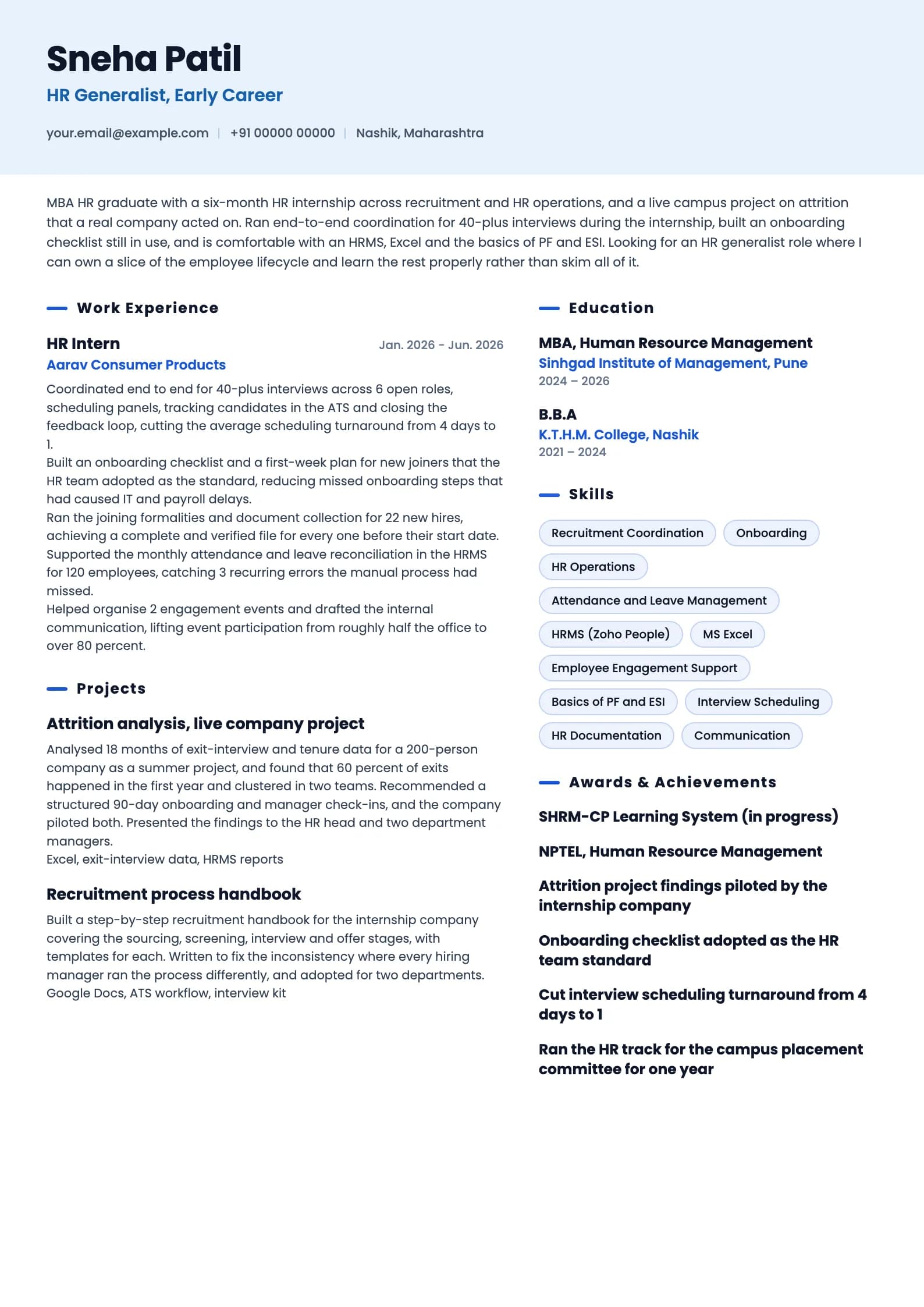
HR Generalist Resume Format, with 3 Full Samples
An HR generalist is hired to hold the whole employee lifecycle together, hiring, onboarding, payroll inputs, engagement, compliance and exits, yet most generalist resumes read as a flat list of everything HR does with no evidence of anything done well. Below are three complete resumes, one for a fresher moving into an HR generalist role, one for a generalist with four years across the full lifecycle, and one for a senior generalist owning HR for a whole location. After the samples come the format rules, the difference between listing the lifecycle and proving you ran it, the terms a parser matches literally, and the mistakes that end a screening before a human reads the page.
Build my resumeHR Generalist resume example, Fresher (0 years)
ai-era templateIs your resume good enough?
Upload the resume you have now and see what an applicant tracking system reads before a hr generalist recruiter ever does.
Free to run. Sign in with your mobile number to see your score.
HR Generalist resume example, HR Generalist (4 years)
minimalist template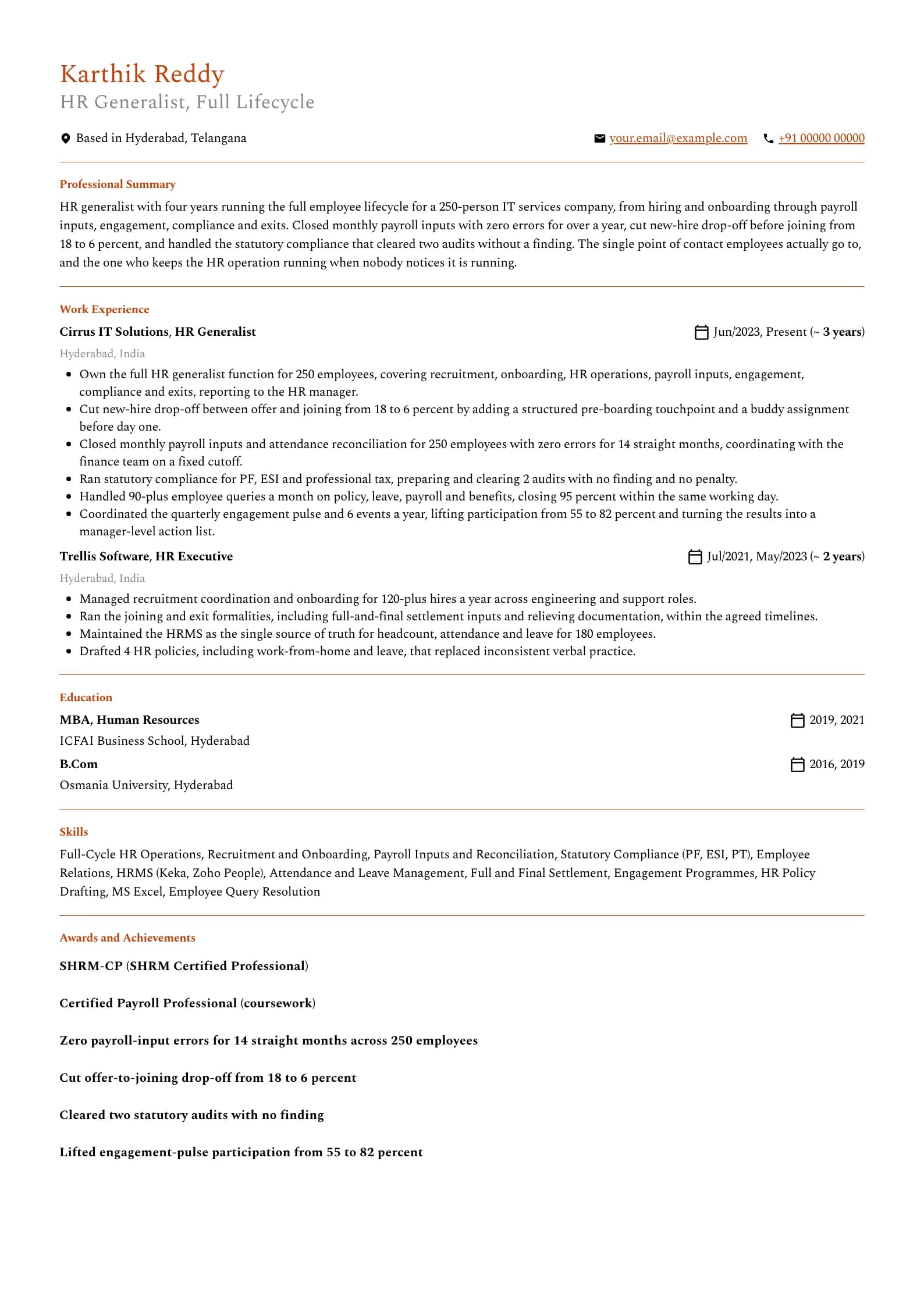
Want this structure with your own details? Build it in the resume builder.
HR Generalist resume example, Senior HR Generalist (8 years)
modern template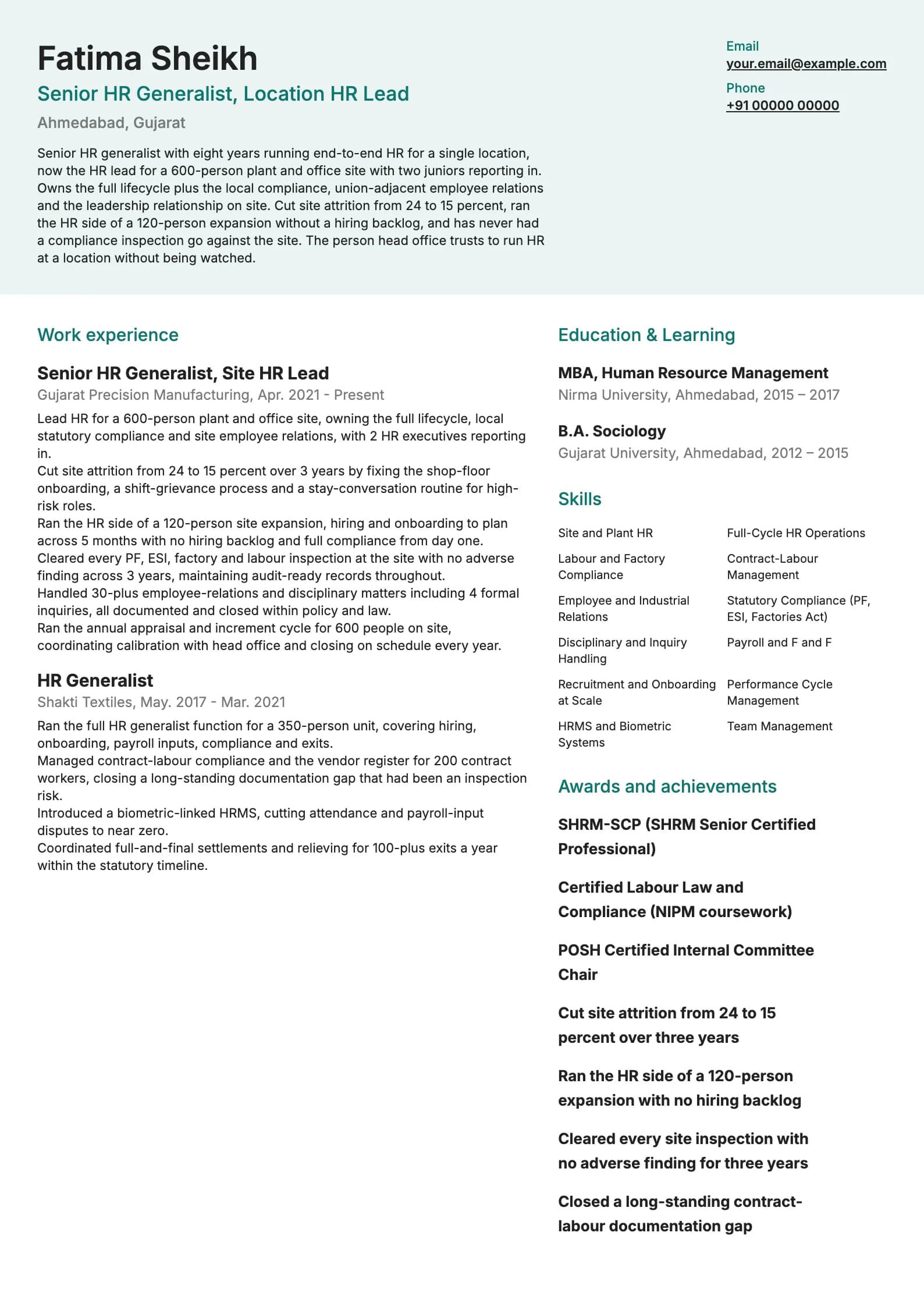
The format that works for HR generalist resumes in India
Reverse chronological is the layout to use. Most recent role first, work backwards, dates in plain view. A functional resume that groups the lifecycle under skill headings and drops the dates reads as an attempt to hide a gap or job-hopping, and an HR audience is the least forgiving one to try that on. A single honest line explains a gap far better than a layout that buries it. Length is set by evidence. One page holds a fresher and most generalists up to roughly seven years. A senior generalist running a whole site with compliance history and a team can justify a second page, provided it carries real outcomes rather than a longer list of HR verbs. A second page built from a values statement and a hobbies line is a padded one-pager. The HR generalist has a specific format trap: because the role touches everything, the resume tries to list everything, and ends up as a flat inventory of HR nouns with no depth anywhere. The fix is not to cover less of the lifecycle, it is to attach an outcome to each part you actually owned. Coverage without proof reads as a job description, not a resume. Send a PDF unless the posting asks for DOCX, name the file with your own name and target role, and keep it single-column so the parser reads it in order. The table below sets out the section order.
| Section | Where it goes | Why |
|---|---|---|
| Name and headline | Top, above everything | The headline is the role you want, HR Generalist. Recruiters match on it. |
| Professional summary | Directly under the header | Three lines. Headcount owned, years, and the single strongest outcome. |
| Work experience | Next, for anyone with a job | Most recent first. Walk the lifecycle, each part with a result. |
| Projects | Above experience for freshers, below it after that | For a fresher this is the evidence: an attrition study, a process built. |
| Skills | Below experience | Grouped: hiring, HR ops and payroll, compliance, engagement. |
| Education | Bottom, unless you are a fresher | MBA HR, institution, years. Drop the percentage after your first job. |
| Certifications | After education, or beside skills if only one or two | SHRM-CP, payroll, POSH. Name, body, year. |
Listing the lifecycle is not the same as proving you ran it
The single most common HR generalist resume failure is a page that lists the whole employee lifecycle as duties: managing recruitment, handling onboarding, processing payroll, ensuring compliance, driving engagement, conducting exits. Every generalist does all of that by definition of the role. A parser matches the terms, but a hiring manager reads the inventory and cannot tell whether you ran any of it well or merely stood near it. The fix is to convert each part of the lifecycle into the outcome it produced. You handled onboarding, so what happened to new-hire drop-off or ramp time. You processed payroll, so what was your error rate and for how long. You ensured compliance, so what did the audits find. The mid-level sample walks the same lifecycle every generalist claims, but attaches a number to each: drop-off 18 to 6, zero payroll errors for 14 months, two audits with no finding. That is the difference between coverage and evidence. The generalist has quieter numbers than a specialist, and they are worth more for being reliable. Payroll-input accuracy, query-closure rate and SLA, offer-to-joining conversion, onboarding completion, audit and inspection outcomes, attendance-dispute rate, cycle-on-time delivery. A run of these, stated honestly, beats a paragraph claiming you are a dependable all-rounder. Where a number would breach confidentiality, give scope. "Handled 30-plus employee-relations matters including 4 formal inquiries, all closed within policy" shows real capability without naming a person or an outcome. That discretion is itself a generalist signal.
The generalist temptation is to list all of HR to look complete. Resist it. One part of the lifecycle with a real outcome beats the whole lifecycle listed as duties.
Writing a summary a hiring manager actually reads
The block under your name is the part most likely to be read, so it must carry three facts: the headcount you support, how long you have done HR, and the strongest thing that changed because of your work. Three or four lines, no unverifiable adjectives. The old objective, seeking a challenging HR generalist role to apply my knowledge of the full HR spectrum, tells the reader nothing new. Replace it with a summary. An objective describes what you want, a summary describes what you have already delivered, and only one is evidence. For a generalist, scope and reliability lead. "Owning the full lifecycle for 250 employees, with zero payroll errors for over a year" places you and signals dependability in one line, where "versatile HR professional" does neither. Follow scope with the result you would open a conversation with. Freshers often think they have nothing to summarise. Look at the fresher sample: it names the internship, the interview volume coordinated, and a project a company actually acted on. That is a genuine summary built from one internship and a live project. What it avoids is claiming end-to-end mastery of a lifecycle nobody masters in six months, which an interviewer punishes. A practical test: read your summary and ask whether another generalist with the same MBA could paste it on unchanged. If they could, it describes the role, not you. Add the specific headcount, number and ownership until it stops being transferable.
Professional summary, HR generalist
Weak
Versatile and dedicated HR generalist with 4+ years of experience across the entire spectrum of human resources, seeking to leverage my skills in a dynamic and growing organisation.
Strong
HR generalist owning the full lifecycle for 250 employees, four years from hiring through payroll and compliance. Zero payroll-input errors for 14 straight months and offer-to-joining drop-off cut from 18 to 6 percent.
The rewrite trades "entire spectrum" and "dynamic organisation" for a headcount, a reliability record and a measured outcome.
Experience bullets: verb, HR action, result
Every strong bullet in the samples follows the same shape. It opens with an action verb, names the specific HR action you owned, and closes with what measurably changed. The verb establishes that you did it. The action tells a hiring manager which part of the lifecycle you can actually run. The number does the persuading. Start with the outcome and work backwards. Generalists usually write the activity first, then cannot attach a number, producing lines like "handled end-to-end HR operations for the organisation". Instead ask what was different after you ran it: drop-off fell, an audit came back clean, queries closed same-day, a cycle finished on time. Then write the sentence that ends in that fact. Vary the metric so the page does not read as one lever. Across a real generalist role you can honestly reach for offer-to-joining conversion, payroll accuracy, query SLA, onboarding completion, audit outcomes, attrition, participation and settlement timelines. The samples spread across several on purpose. Where you lack a number, give scope: how many employees, how many hires, how many queries, how many inquiries, how long a cycle took. "Closed monthly payroll inputs for 250 employees with zero errors for 14 straight months" is scope plus reliability, and it carries weight. Allocate bullets by recency. Current role gets five or six, the previous role three or four, anything older two or three.
| Level | What bullets must prove | Typical metric |
|---|---|---|
| Fresher | You can run an HR process reliably, even a small one | Interviews coordinated, scheduling time, onboarding steps, project impact |
| 1 to 3 years | You own a slice of the lifecycle without supervision | Hires onboarded, payroll accuracy, query SLA, documents closed |
| 4 to 6 years | You run the full lifecycle for a headcount | Drop-off, audit outcomes, attrition, participation, cycle on time |
| 7 years and up | You own HR for a site and manage a small team | Site attrition, inspection record, expansion delivered, team led |
Experience bullet, HR operations
Weak
Responsible for handling end-to-end HR operations including recruitment, onboarding, payroll and compliance for the organisation.
Strong
Closed monthly payroll inputs and attendance reconciliation for 250 employees with zero errors for 14 straight months, on a fixed cutoff with finance.
The wrong version lists the lifecycle; the rewrite picks one part and proves reliability with scope, an error rate and a duration.
Experience bullet, onboarding
Weak
Managed the onboarding process for new joiners to ensure a smooth joining experience.
Strong
Cut new-hire drop-off between offer and joining from 18 to 6 percent by adding a pre-boarding touchpoint and a buddy assignment before day one.
Names the exact conversion metric moved, the before and after, and the two specific changes that moved it.
If a bullet would read identically on another generalist's resume, it is describing the role, not you. Rewrite it until it only fits the process you actually ran.
The skills section: grouped, honest, and short enough to defend
An HR generalist's skills section has two audiences with opposite preferences. The parser wants literal terms it can match, payroll, PF, ESI, onboarding, HRMS. A hiring manager wants a short, organised list that signals which parts of the lifecycle you can actually run. Grouping satisfies both. Group by function rather than one long line. Hiring and onboarding, HR operations and payroll, compliance, and engagement and ER is a grouping that fits almost every generalist. The exact headings matter less than that structure exists. Write terms the way the field writes them: PF and ESI in full at least once, HRMS with the actual platform named, F and F for full-and-final. A parser matches on strings. Twelve to sixteen skills is the working range. Below eight it looks thin. Above twenty it stops being a signal, and generalist resumes are prone to a specific padding: listing recruitment, hiring, talent acquisition, sourcing and staffing as five items, or every HR verb as its own bullet, to look like the full spectrum. The list is a contract, every item a question you have agreed to answer. Do not include a proficiency bar. Nobody agrees what four stars in compliance means. Let the experience prove the depth instead.
Skills section
Weak
Skills: Recruitment, Hiring, Talent Acquisition, Sourcing, Staffing, Onboarding, Induction, Joining, HR, Human Resources, HR Operations, Payroll, Compliance, Engagement, Exit, MS Office, Excel, Communication, Team Player, Multitasking
Strong
Hiring: recruitment coordination, onboarding, pre-boarding. HR ops and payroll: HRMS (Keka), payroll inputs, full and final, attendance and leave. Compliance: PF and ESI, professional tax, audit readiness. Engagement and ER: pulse surveys, employee query resolution.
Collapses the hiring and onboarding synonyms into single real skills, cuts the personality adjectives, and groups the rest so a manager reads it in one pass.
Compliance and payroll: the generalist's quiet credibility
The part of the generalist role that separates a dependable hire from a risky one is the unglamorous half: statutory compliance and payroll. It is also the half most resumes reduce to the single word compliance. A generalist who can prove a clean compliance and payroll record is signalling that the business will not get a surprise inspection notice or a payroll dispute because of them, and that is worth more than any engagement initiative. Name the specific statutes and the specific systems. PF, ESI, professional tax, the Factories Act and contract-labour regulations for a plant, the Shops and Establishments Act for an office. A resume that names the actual acts reads as someone who has done the filings, where compliance alone reads as someone who has heard the word. Quantify the record with the metrics compliance actually has. Number of inspections or audits cleared, findings against you (ideally zero), penalties (ideally none), and the timeline you closed statutory tasks within. The senior sample leads its site work with "every inspection cleared with no adverse finding for three years" precisely because, for a location generalist, that is the headline result the business cares about most. Do the same for payroll. Error rate and the duration you held it, on-time closure, and dispute volume before and after a system you introduced. "Zero payroll-input errors for 14 straight months across 250 employees" is the kind of boring, verifiable line that wins a generalist role, because reliability is exactly what the role is hired to provide.
| Area | What to name | Metric that proves it |
|---|---|---|
| Statutory | PF, ESI, professional tax, Factories Act, S and E Act | Inspections cleared, findings (zero), penalties (none) |
| Payroll | Inputs, reconciliation, full and final settlement | Error rate, months held, on-time closure |
| Contract labour | Vendor register, contractor compliance, documentation | Documentation gaps closed, audit risk removed |
| Records | Audit-ready files, employee records, statutory registers | Audit readiness maintained, disputes reduced |
Where education and certifications belong
Education goes at the bottom for anyone with a full-time HR role, and near the top for a fresher, who has nothing stronger to lead with. Degree, institution, years. For most generalists the MBA in HR is the entry, and one line covers it. CGPA or percentage is worth keeping while you are a fresher and it is good, roughly 7.5 out of 10 and above, because early-career screening still filters on it. Once you have your first full-time HR role, drop it. A number from your MBA competes for space with a payroll-accuracy record and an audit history, both of which predict your next role better. Coursework and project lines are for freshers, and only when relevant to HR. A live attrition study or a process handbook belongs, an unrelated marketing elective does not. Skip school details once you have a degree. Certifications sit just below education, or beside skills if you hold only one or two. Write the full name, the issuing body and the year. For a generalist, SHRM-CP is the most portable credential, a payroll or labour-law certification is a strong differentiator because compliance is where generalists get judged, and a POSH-committee certification matters for anyone handling ER. An expired certification listed as current is a small dishonesty an HR reviewer catches quickly, so renew it or remove it.
Getting through the applicant tracking system
An applicant tracking system is a parser and a search index, not a judge, and as a generalist you have almost certainly run one yourself. It reads your file, tries to break it into name, dates, employers, titles and skills, and stores the result so a recruiter can search across candidates. Almost every ATS problem is a parsing problem, and parsing problems come from layout, not wording. The layout rules are short. One column. Standard section headings, so use Work Experience rather than My HR Story, and Skills rather than What I Bring. No text inside images, because a skills wheel or a logo strip reads as empty space. No critical information in the header or footer region, which some parsers drop. Avoid text boxes and nested tables in the body. On wording, mirror the language of the job description where it is honest. If the posting says HR generalist, use that exact title in your headline. If it says statutory compliance, payroll or employee lifecycle, use those literal terms. Include the expansion alongside an acronym at least once, for example "F and F (full and final settlement)", so both searches find you. Keyword stuffing does not work and is beneath the function you work in. A hidden block of every HR term is the trick you would catch in a candidate, and it is caught quickly. Write real bullets that naturally contain the right terms, because a bullet describing the payroll you closed contains the word payroll in a context that survives human review too. Save as PDF from a tool that embeds real text, then open the file and confirm you can select and copy a sentence. If you cannot select the text, neither can the parser.
Test your own file before you send it. Copy the text out of the PDF into a plain text editor. Whatever you can read there is roughly what the parser sees, and anything scrambled is a real risk.
What gets HR generalist resumes rejected
Most rejections at the resume stage are not close calls. They come from a small set of recurring problems, and all of them are fixable in an afternoon. The list below covers what hiring managers reviewing Indian HR generalist resumes see most often, in rough order of how much damage each one does.
- The whole lifecycle listed as duties with no outcome. Every generalist manages recruitment and payroll; the resume must show what changed.
- No numbers, when the generalist has quiet reliable ones. Payroll accuracy, audit outcomes, drop-off, query SLA all exist in your systems.
- Trying to look complete by listing every HR verb, which reads as breadth without depth. One part done well beats ten listed.
- Recruitment, hiring, talent acquisition, sourcing and staffing listed as five separate skills to pad the section.
- Compliance reduced to the single word compliance, with no statute or audit outcome named, when compliance is where generalists are judged.
- A generic objective line. Replace it with a summary that states headcount owned, years and one outcome.
- Breaching confidentiality: naming a terminated employee, a settlement or a rating. It reads as a liability, not a strength.
- A photo, date of birth, marital status or father's name. None of it belongs on a professional resume and it takes a result's space.
- Job-hopping hidden by a functional layout. An HR audience reads the dropped dates immediately; an honest line is safer.
- Typos in statutory terms and system names. Writing ESI as ESIC loosely, or Keka as Kekaa, undoes an otherwise careful page.
Read your resume as if you were screening it for your own HR team. Any line you would push back on in a candidate is a line to cut or rewrite.
Skills to put on a hr generalist resume
Technical
- Full-Cycle HR Operations
- Recruitment and Onboarding
- Payroll Inputs and Reconciliation
- Statutory Compliance (PF, ESI, PT)
- Employee Relations
- Full and Final Settlement
- Attendance and Leave Management
- HR Policy Drafting
- Employee Engagement
- Exit and Offboarding
- Labour and Factory Compliance
- Performance Cycle Coordination
Tools and platforms
- Keka
- Zoho People
- GreytHR
- Darwinbox
- SAP SuccessFactors
- Biometric Attendance Systems
- Naukri and LinkedIn
- MS Excel
- Google Workspace
Working skills
- Reliability and follow-through
- Employee query handling
- Discretion and confidentiality
- Multitasking across the lifecycle
- Coordination with finance and IT
- Clear written communication
- Conflict handling
- Attention to detail
- Time management
Certifications worth listing as a hr generalist
| Certification | Full name | Worth it for |
|---|---|---|
| SHRM-CP | SHRM Certified Professional | The most portable HR certification for a generalist, worth it once you have a few years and want a recognised credential that signals your practice matches a defined body of knowledge rather than only your employer's way of working. A clean differentiator on a generalist resume. |
| Payroll Certification | Certified Payroll Professional or equivalent payroll and statutory course | A strong differentiator for a generalist, because payroll and statutory accuracy is exactly where the role is judged and where risk sits. Worth it if payroll and compliance are a real part of your work, and it pairs naturally with a compliance-heavy generalist profile. |
| Labour Law | Certificate in Labour Laws and Compliance (NIPM or similar) | Valuable for generalists in manufacturing, plant or site roles where the Factories Act, contract-labour regulations and inspections are part of daily work. Signals you can keep a location audit-ready, which is the headline concern for a site HR role. |
| POSH Committee | POSH Certified Internal Committee Member | Important for any generalist handling employee relations, since it certifies you can run an internal-committee inquiry within the law. A defensible signal on any generalist resume that touches ER, and increasingly expected rather than optional. |
| SHRM-SCP | SHRM Senior Certified Professional | The senior tier of the SHRM credential, worth it for a senior generalist or site HR lead operating with more autonomy and a small team. More relevant than the CP once you own HR for a location or a business unit rather than a slice of the lifecycle. |
Keywords an ATS scans for in a hr generalist resume
These are the literal terms a parser matches against the job description. Use the ones that are true of you, in the sentences where you did the work, not as a list at the bottom.
- hr generalist
- human resources generalist
- hr operations
- employee lifecycle
- recruitment
- onboarding
- payroll
- statutory compliance
- PF and ESI
- employee relations
- HRMS
- full and final settlement
- attendance and leave
- employee engagement
- POSH
- HR policy
- exit formalities
- professional tax
- SHRM
- labour compliance
HR Generalist resume FAQ
What salary can an HR generalist expect in India?
A fresher moving into an HR generalist role typically starts around 2.5 to 4.5 LPA. A generalist with three to five years across the full lifecycle usually sits in the 5 to 9 LPA band, and a senior generalist or site HR lead with seven years and above commonly earns 9 to 16 LPA. Company size, sector, city and depth in payroll and compliance drive the figure, and a strong-brand MBA or a payroll and labour-law certification pushes the top of each band upward.
How long should an HR generalist resume be?
One page up to about seven years of experience, two pages after that only if the second page carries real outcomes, a compliance history and team management rather than a longer list of HR verbs. Nobody has been rejected for a resume that was too easy to read. If you cannot fit one page, cut the oldest role to a single line, remove any HR-philosophy paragraph, and delete adjectives that describe you rather than your results.
What is the difference between an HR generalist and an HR executive?
The titles overlap and vary by company, but broadly an HR executive supports specific processes under supervision, while a generalist owns the full employee lifecycle for a headcount with more autonomy. On a resume, the generalist signal is end-to-end ownership: hiring through exits, with the numbers each part moved. If your work is genuinely full-cycle, use the generalist framing and prove it with a bullet from each stage rather than only the parts you enjoy.
How does a fresher write an HR generalist resume with no experience?
Lead with projects and the internship, then education, then skills. Treat each project as real work: an attrition study a company acted on, a recruitment handbook that got adopted, an onboarding checklist teams used. An internship still goes in a separate experience section with quantified bullets, such as interviews coordinated or scheduling time cut. Be honest about depth, since claiming end-to-end mastery of a lifecycle nobody masters in six months reads worse than owning a slice well.
How much should payroll and compliance feature on the resume?
More than most generalists give them, because payroll accuracy and statutory compliance are where the role is judged and where the business fears risk. Name the specific statutes (PF, ESI, professional tax, Factories Act) and the specific systems, and quantify the record: audits cleared with no finding, months of zero payroll errors, disputes reduced. A clean, verifiable compliance and payroll record is often the single strongest signal a generalist can offer.
Do certifications like SHRM-CP or a payroll course help a generalist?
Yes, and a payroll or labour-law certification is an especially good differentiator because compliance is the generalist's high-risk zone. SHRM-CP signals your practice matches a recognised body of knowledge, a POSH-committee certification is increasingly expected for anyone handling ER, and a labour-law course helps for plant and site roles. Keep the list short, name the issuing body and year, and let a real bullet back each one up.
Should I list every part of the HR lifecycle in my skills?
List the parts you genuinely own, grouped, but do not inflate them. Listing recruitment, hiring, talent acquisition, sourcing and staffing as five skills, or every HR verb as its own bullet, reads as breadth without depth. Group them into hiring, HR ops and payroll, compliance, and engagement and ER, keep twelve to sixteen real skills, and remember that one part of the lifecycle proven with a number beats the whole lifecycle listed.
Do I need a photo on an HR generalist resume in India?
No. It takes space a result should occupy, and as someone working in HR you know it is exactly the bias-inviting element the function tries to remove from hiring. The same goes for date of birth, marital status, father's name, nationality and a declaration paragraph, all of which come from an older template that spread through placement cells. The only exception is a role whose posting explicitly asks for a photograph.
Related resume examples and guides
Build your own in any of these formats
Start from a blank resume or upload the one you have. Goodspace renders it in 24 templates and flags the HR generalist keywords an applicant tracking system will look for, from payroll and PF and ESI to onboarding and the full employee lifecycle, and the duty-list filler it will not credit.
Build my resume