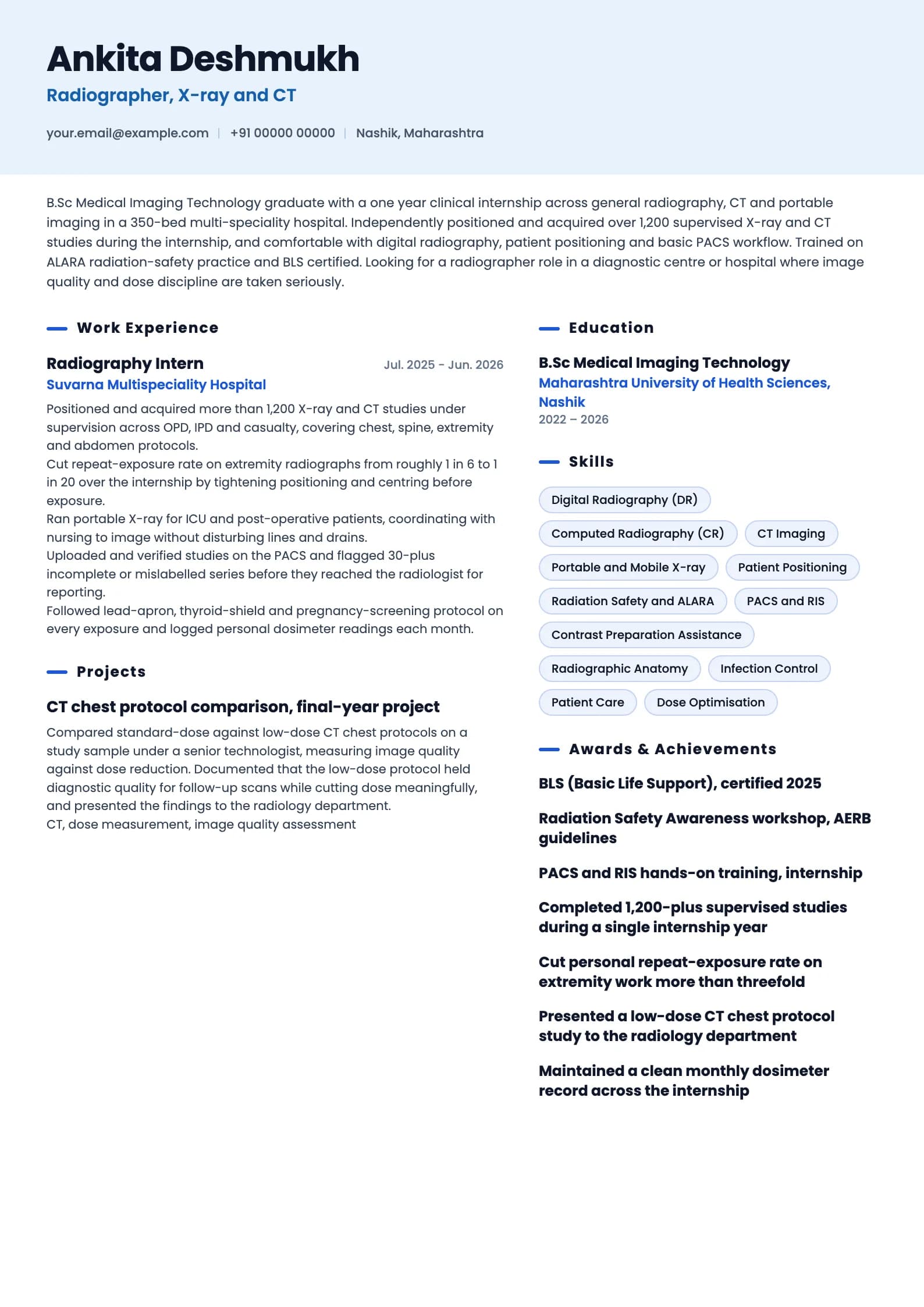
Radiographer Resume Format, with 3 Full Samples
A radiographer is hired on the modalities they can run unsupervised, the image quality they hold and the radiation dose they keep down, yet most resumes just say X-ray, CT and MRI and stop there. Below are three complete resumes, one for a fresher with a B.Sc in Medical Imaging Technology and a clinical internship, one for a CT and MRI technologist with five years across a busy radiology department, and one for a chief radiographer running a shift and a team. After the samples come the format rules, why naming modalities and daily volumes beats a machine list, the AERB and safety terms a hospital HR parser matches, and the mistakes that stop a screening before a radiologist ever reads the page.
Build my resumeRadiographer resume example, Fresher (0 years)
ai-era templateIs your resume good enough?
Upload the resume you have now and see what an applicant tracking system reads before a radiographer recruiter ever does.
Free to run. Sign in with your mobile number to see your score.
Radiographer resume example, CT and MRI Technologist (5 years)
professional template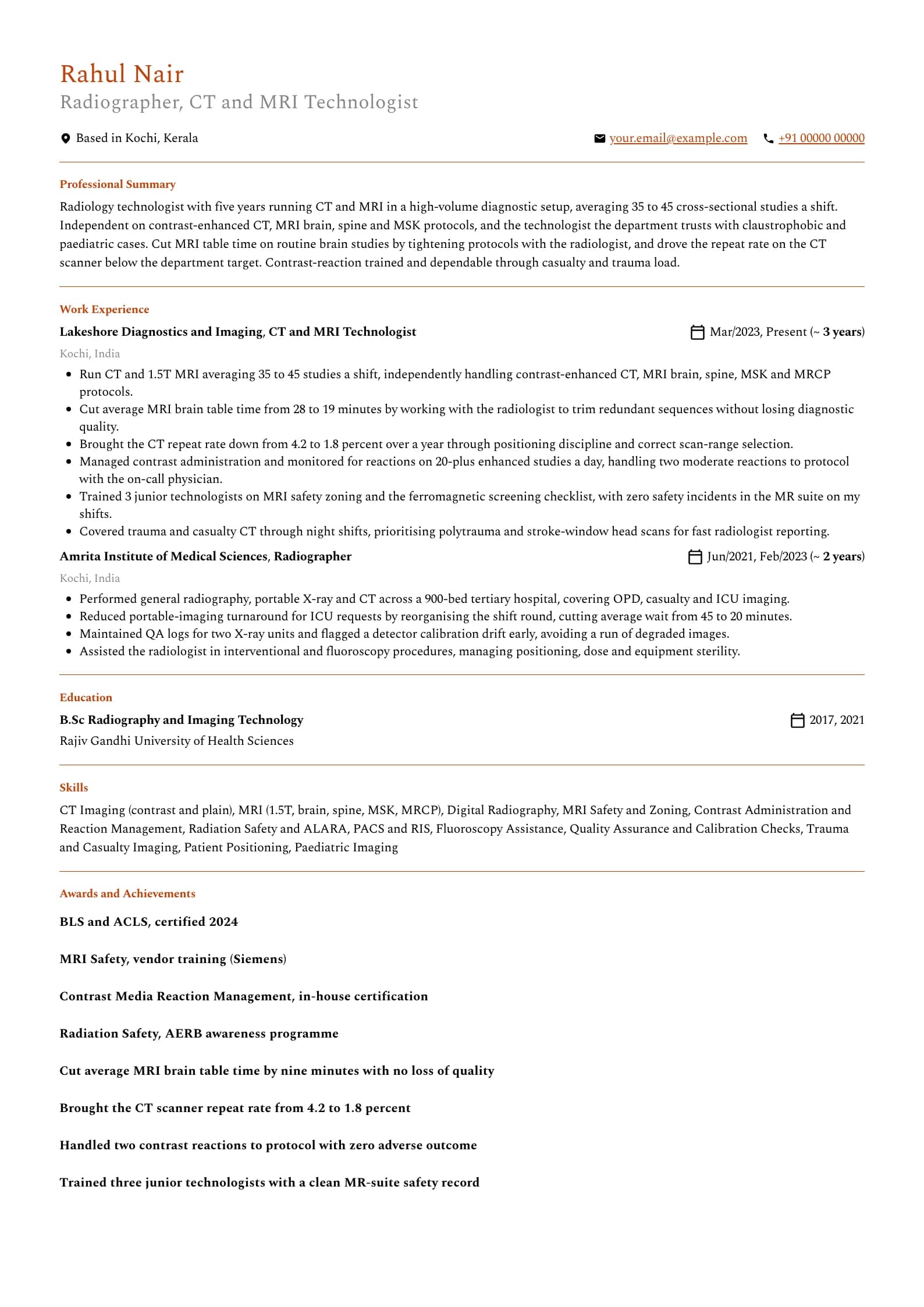
Want this structure with your own details? Build it in the resume builder.
Radiographer resume example, Chief Radiographer (12 years)
header-band template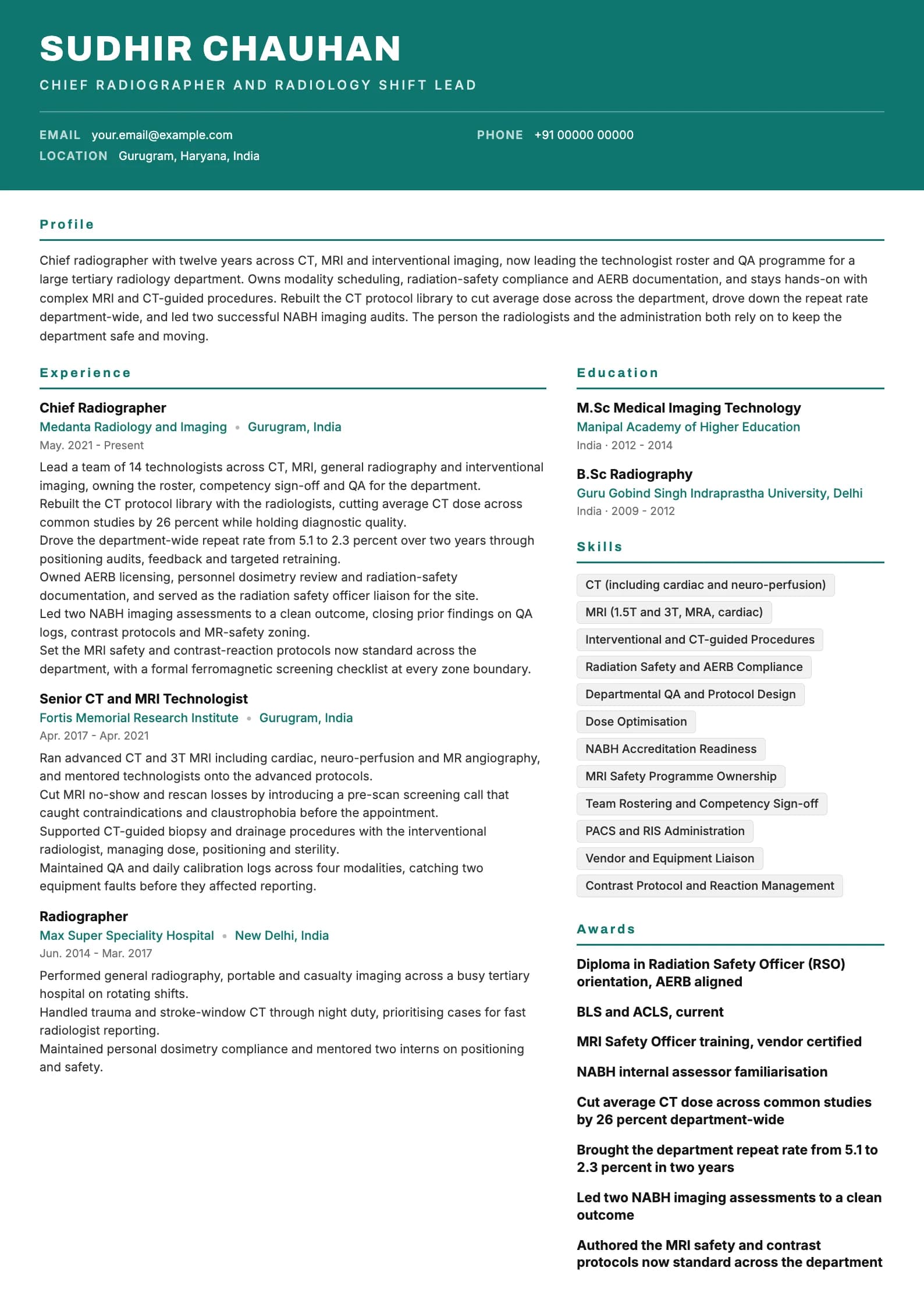
The format that works for a radiographer resume in India
Reverse chronological is the layout to use. Put your current role first, work backwards, and keep the dates in plain view. A functional resume that hides the dates under a skills grouping reads, to a hospital HR team, as an attempt to cover a gap, and they treat it that way. One honest line about a gap beats a layout built to disguise one. Length follows evidence. A fresher and most radiographers up to about seven years fit cleanly on one page. A chief or senior technologist with a real leadership and compliance record can run to a second page, provided page two carries protocol, QA and audit work and not a longer list of machines. Lead with what you can run unsupervised. A radiology manager reading a stack of resumes is staffing modalities: they need to know in the first few seconds whether you can be put on the MRI console alone tonight. So the headline and summary should name the modalities and the field strength, not a generic "medical professional" line. Leave off the photograph, date of birth, marital status and father's name. They come from an older campus template and add nothing to a clinical screen. Send a PDF unless the posting asks for DOCX, use a single column, and name the file with your own name and "radiographer" rather than resume_final. The table below sets the section order.
| Section | Where it goes | Why |
|---|---|---|
| Name and headline | Top, above everything | Headline names the modalities: X-ray, CT, MRI. HR staffs on it. |
| Professional summary | Directly under the header | Three lines: modalities, years, daily volume and one result. |
| Work experience | Next, for anyone with a job | Most recent first. Name modality, volume and safety record. |
| Skills | Below experience | Grouped by modality, safety, systems. Not a 30-item wall. |
| Certifications and licences | High, near skills | BLS, ACLS, MRI safety, AERB awareness. Safety-critical, so surface it. |
| Education | Bottom, unless a fresher | B.Sc or diploma, institution, years. Freshers keep the percentage. |
| Internship or clinical training | Above experience for a fresher | For a fresher the internship is the evidence. Give it real space. |
Name the modality, the volume and the field strength, not just the machine
The most common radiographer resume failure is a skills line that reads X-ray, CT, MRI, mammography, fluoroscopy with no bullet showing daily volume, protocol range or safety record. HR matches the words, but a radiology manager reading it cannot tell whether you scanned two MRIs a week under supervision or run a 40-study console alone. The fix is to let the experience carry the modality. If you write MRI, a bullet should state the field strength and the protocols, MRI brain, spine, MSK, MRCP, and roughly how many studies a shift. If you write CT, say whether you run contrast-enhanced studies independently and handle trauma and stroke-window head scans. The mid-level sample lists CT and MRI because the bullets prove volume, protocol range and a repeat rate, which is what makes both believable. Field strength and equipment class matter. Writing MRI (1.5T and 3T) or naming the CT slice count tells a department whether you can walk onto their scanner. A technologist who has only run 1.5T is a different hire from one comfortable on 3T cardiac, and the resume should say which. Do not pad with modalities you touched once. Listing PET-CT, DEXA, mammography and cath-lab when you shadowed each for a week reads as a wish list. Name what you can run alone, and note supervised exposure separately and honestly.
For every modality on your skills line, ask: is there a bullet naming the protocols, the volume and the field strength I actually ran. If not, either add it or move the modality to a "trained on" line. A wall of machine names helps HR search and tells the radiologist nothing.
Writing a summary a radiology manager actually reads
The block under your name is the part you can be reasonably sure gets read, so it must carry three facts: which modalities you run unsupervised, how long you have run them, and the strongest thing that happened because of your work, a lower dose, a lower repeat rate, a handled reaction. Three or four lines, no adjectives that cannot be checked. The old objective, seeking a challenging position in a reputed hospital to utilise my radiography skills, tells the reader nothing they had not already assumed. Replace it with a summary. An objective says what you want, a summary says what you have already done safely, and only one is evidence in a field where safety is the whole point. Freshers often think they have nothing to summarise. Look at the fresher sample: it names the degree, the internship length, the study count, the modalities and the safety training. That is a genuine summary built from one clinical year. What it avoids is "hardworking and passionate about healthcare", a line so common it now carries no information. A practical test: read your summary and ask whether a classmate with the same degree could paste it onto their resume unchanged. If they could, it describes the course, not you. Add the specific modality, the specific volume and the specific result until it stops being transferable.
Professional summary, CT and MRI technologist
Weak
Dedicated and hardworking radiographer with 5+ years of experience in X-ray, CT and MRI seeking a challenging position in a reputed hospital to utilise my skills.
Strong
Radiology technologist with five years running CT and 1.5T MRI at 35 to 45 studies a shift, independent on contrast CT and MRI brain, spine and MSK. Cut MRI brain table time by nine minutes and the CT repeat rate to 1.8 percent.
The rewrite trades a keyword list and self-praise for the modalities run unsupervised, the daily volume and two verifiable results.
Experience bullets: action, study, and what moved
Every strong bullet in the samples follows the same shape. It opens with an action verb, names the specific modality or study you ran, and closes with what measurably changed. The verb establishes you did it. The modality tells a radiology manager whether the work is relevant. The number does the persuading. Start with the outcome and work backwards. Technologists usually write the task first, then cannot attach a number, which produces bullets like "performed CT and MRI scans as per protocol". Instead ask what was different in the department after your work: the repeat rate fell, the table time dropped, a reaction was caught, the turnaround shrank, the dose came down. Then write the sentence that ends in that fact. Vary the metric. Radiographers reach naturally for study volume, repeat rate, table time, dose reduction, turnaround time, no-show reduction and safety-incident count. Using several across a role reads as range rather than one trick repeated. Where you lack a clean number, give scope: how many studies a shift, how many modalities, how many technologists you trained, how many procedures you supported. "Run CT and MRI averaging 35 to 45 studies a shift" carries weight without inventing a percentage. Allocate bullets by recency. Current role gets five or six, the previous role four, anything older two or three.
| Level | What bullets must prove | Typical metric |
|---|---|---|
| Fresher | You can position and acquire a diagnostic image safely | Supervised study count, repeat rate cut, protocols covered |
| 1 to 3 years | You run a modality unsupervised | Studies a shift, turnaround time, QA logs, portable volume |
| 4 to 7 years | You run CT or MRI independently and handle safety | Repeat rate, table time, dose, reactions handled, juniors trained |
| 8 years and up | You set protocol, own compliance and lead a team | Department dose, NABH audits, roster size, AERB compliance |
Experience bullet, CT work
Weak
Responsible for performing CT scans and maintaining the machine as per hospital protocol and doctor instructions.
Strong
Brought the CT repeat rate down from 4.2 to 1.8 percent over a year through positioning discipline and correct scan-range selection.
"Responsible for" describes a job description; the rewrite names the change made and the number it moved.
Experience bullet, MRI work
Weak
Worked on MRI machine and helped in reducing the scan time and improving patient experience.
Strong
Cut average MRI brain table time from 28 to 19 minutes by working with the radiologist to trim redundant sequences without losing diagnostic quality.
Names the before and after and how it was done, so a manager can ask a real follow-up instead of nodding at a vague claim.
If a bullet would read identically on any technologist's resume, it is describing the department, not you. Rewrite it until it only fits the console you actually ran.
The skills section: grouped by modality, safety and systems
A radiographer's skills section has two audiences. The HR parser wants literal terms it can match, CT, MRI, PACS, ALARA. A radiology manager wants a short, organised list that signals what kind of technologist you are. Grouping satisfies both. Group by function rather than one long line. Modalities, safety and compliance, systems, and patient care is a grouping that works for almost every radiographer. Write names the way the field writes them: PACS not Pacs, MRI not M.R.I, ALARA spelled out at least once. HR search matches on strings, and a radiologist reading the page wants structure. Twelve to sixteen skills is the working range. Below eight it looks thin. Above twenty it stops being a signal and starts reading as every acronym you have heard. Keep safety on the list and near the top: radiation safety, ALARA, MRI zoning and contrast-reaction handling are not optional extras in this field, they are the core of the job. Do not use star ratings or percentage bars. Nobody agrees what four stars in MRI means, and a bar invites a question you cannot win. Let the experience prove the depth instead.
| Group | What goes in it | How many |
|---|---|---|
| Modalities | X-ray, CT, MRI (with field strength), fluoroscopy, portable | 3 to 5 |
| Safety and compliance | Radiation safety, ALARA, MRI zoning, AERB, dosimetry | 2 to 4 |
| Systems | PACS, RIS, DR and CR, contrast injectors | 2 to 3 |
| Clinical | Positioning, contrast administration, reaction management | 2 to 3 |
| Patient and QA | Patient care, infection control, QA and calibration checks | 2 to 3 |
Skills section
Weak
Skills: X-ray, CT scan, MRI, PET, DEXA, mammography, fluoroscopy, ultrasound, cath lab, PACS, patient handling, hardworking, team player, MS Office, communication, punctual
Strong
Modalities: general radiography, CT (contrast and plain), MRI 1.5T (brain, spine, MSK). Safety: radiation safety and ALARA, MRI zoning, contrast-reaction management. Systems: PACS, RIS, DR. Clinical: positioning, contrast administration, patient care.
Cuts modalities you only shadowed and the filler adjectives, then groups the rest by function so a radiologist reads it in one pass.
Radiation safety and AERB: the section a hospital screens hardest
Radiography is the one clinical technologist role where an unsafe hire is a licensing and liability problem, not just a quality one. A hospital HR team and the radiation safety officer read your resume partly to answer one question: will this person keep dose down and follow the AERB rules. So the safety content is not a footnote, it earns a visible place. Name the safety practices you actually follow. ALARA, lead aprons and thyroid shields, pregnancy screening before exposure, collimation and correct exposure factors, and personal dosimeter monitoring. For CT, correct scan-range selection and dose-modulation use. For MRI, this is a different and even less forgiving safety world: ferromagnetic screening, zone control and implant checking prevent injuries and deaths, so state that you run the screening checklist at every zone boundary. AERB is the Atomic Energy Regulatory Board, which licenses and inspects diagnostic X-ray and CT installations in India. You do not personally hold the licence as a technologist, but knowing the framework, keeping dosimetry records and supporting the radiation safety officer are real signals. A senior technologist who has handled AERB documentation or an inspection should say so plainly. Contrast reactions are a safety event too. If you have monitored for and handled contrast reactions, name it, and pair it with a BLS or ACLS certification, because the two belong together. This is the content that quietly moves a radiographer resume from acceptable to safe to hire.
In radiography, safety is not a soft skill, it is the job. A resume that names ALARA, MRI zoning, dosimetry and contrast-reaction handling reassures the one reader, the radiation safety officer, who can veto a hire on safety grounds alone.
Education, licences and certifications: where they belong
Education goes near the top for a fresher, who has nothing stronger to lead with, and drops toward the bottom once you have clinical experience. Name the qualification exactly: B.Sc Medical Imaging Technology, B.Sc Radiography and Imaging Technology, or the Diploma in Medical Radiography (DMRT). The exact title matters, because HR and the radiologist both know the difference between a degree and a short diploma, and both are valid entry routes. Keep the percentage or class while you are a fresher and it is decent, roughly 60 percent and up, because early-career screening still filters on it. Once you have two years of clinical work, drop it: shipped study volume and a clean safety record predict far more than a mark from four years ago. Certifications sit high on this resume, not buried, because several are safety-critical. BLS and ACLS, MRI safety training, contrast-reaction management and any AERB radiation-safety programme all belong near the skills block where a screener sees them fast. Write the full name, the issuing body and the year, and never list an expired BLS as current, because it is trivially checked and reads as careless in a safety role. If you hold vendor training on a specific scanner, Siemens, GE, Philips, name it. A department running a GE CT reads GE console familiarity as a shorter ramp-up, and that can be the difference between two similar candidates.
Getting through the hospital applicant tracking system
Larger hospital chains and diagnostic groups screen radiographer applications through an applicant tracking system, which is a parser and a search index, not a judge. It reads your file, tries to break it into name, dates, employers, titles and skills, and stores the result so a recruiter can search. Almost every ATS problem is a parsing problem, and parsing problems come from layout, not wording. The layout rules are short. One column. Standard headings, so use Work Experience rather than My Career Journey, and Skills rather than My Expertise. No text inside images, because a scanner-logo strip reads as blank space. Keep critical information out of the header and footer region, which some parsers drop. Avoid text boxes and nested tables in the body. On wording, mirror the posting where it is honest. If it says CT technologist, write CT technologist. If it says MRI, write MRI and the field strength. Spell out an acronym alongside its short form at least once, for example "ALARA (as low as reasonably achievable)" and "PACS (picture archiving and communication system)", so both searches find you. Keyword stuffing does not work. A hidden block of every modality in white text is caught quickly and lands worse than an honest filter. Write real bullets that naturally contain the right terms, because a bullet describing the MRI protocols you run contains the word MRI in a context that survives human review too. Save as PDF from a tool that embeds real text, then open the file and confirm you can select and copy a sentence. If you cannot select the text, neither can the parser.
Section heading
Weak
My Healthcare Journey
Strong
Work Experience
Parsers look for standard headings; a creative one can push the whole employment block into an unclassified bucket the recruiter never searches.
Test your own file before sending it. Copy the text out of the PDF into a plain text editor. Whatever you can read there is roughly what the parser sees, and anything scrambled is a real risk.
What gets radiographer resumes rejected
Most rejections at the resume stage are not close calls. They come from a small set of recurring problems, and all of them are fixable in an afternoon. The list below covers what a radiology department and hospital HR see most often on Indian radiographer resumes, in rough order of how much damage each does.
- A bare modality list with no volume, protocol or field strength, so a manager cannot tell what you can run unsupervised.
- No safety content anywhere. In radiography, missing ALARA, MRI zoning and dosimetry reads as a candidate the radiation safety officer has to worry about.
- Duties copied from the job description instead of what you did. "Responsible for performing scans as per protocol" is the tell.
- No numbers: no study volume, no repeat rate, no table time, no turnaround. Pick whichever is honest for the work.
- Padding the modality list with PET-CT, cath-lab and mammography you only shadowed, which an interviewer sees through in one question.
- An expired BLS or ACLS listed as current. Trivially checked and, in a safety role, reads as careless.
- A photo, date of birth, marital status or father's name. None of it belongs on a clinical technologist resume.
- A generic objective line. Replace it with a summary stating modalities, years and one result.
- Vague safety claims with no specifics, "followed all safety protocols", instead of naming ALARA, screening and dosimetry.
- Typos in the equipment or terms you claim to know. "Flouroscopy" for fluoroscopy or "MRI Tesla" errors undo an otherwise strong page.
Read your resume as if you were the radiation safety officer. If it does not convince you the writer keeps dose down and follows the screening rules, add the safety lines before you send it.
Skills to put on a radiographer resume
Technical
- General Radiography (DR and CR)
- CT Imaging (contrast and plain)
- MRI (1.5T and 3T)
- Fluoroscopy and Interventional Assistance
- Portable and Mobile X-ray
- Mammography
- Patient Positioning and Anatomy
- Contrast Administration
- Radiation Safety and ALARA
- MRI Safety and Zoning
- Dose Optimisation
- Quality Assurance and Calibration Checks
Tools and platforms
- PACS
- RIS
- Digital Radiography Consoles
- CT Scanners (Siemens, GE, Philips)
- MRI Scanners (1.5T and 3T)
- Power Contrast Injectors
- Personal Dosimeters (TLD and OSL)
- DICOM Viewers
- Fluoroscopy C-arm
Working skills
- Patient communication and reassurance
- Working under casualty and trauma load
- Attention to detail
- Team coordination with radiologists and nurses
- Shift and on-call reliability
- Infection control discipline
- Training and mentoring juniors
- Calm handling of contrast reactions
Certifications worth listing as a radiographer
| Certification | Full name | Worth it for |
|---|---|---|
| B.Sc MIT | B.Sc Medical Imaging Technology / Radiography and Imaging Technology | The standard degree route into radiography in India and the strongest entry qualification for a fresher. A three-to-four-year B.Sc outranks a short diploma on the page, so name the exact title. Once you have clinical experience it stays as an education line, and the modalities you run become the real credential. |
| DMRT | Diploma in Medical Radio-diagnosis and Imaging Technology / Radiography | The diploma route into the field, a valid entry qualification especially for those who joined via a two-year programme. Worth naming clearly since it is a recognised path, though a B.Sc is preferred by larger chains. Pair it with strong clinical volume so the resume leads with what you can run, not just the qualification. |
| BLS / ACLS | Basic Life Support / Advanced Cardiovascular Life Support | Expected of any technologist administering contrast or working casualty, since a contrast reaction is a resuscitation event. BLS is close to mandatory, ACLS is a strong plus for anyone running enhanced CT and MRI. Keep it current: an expired card listed as valid reads badly in a safety role. |
| MRI Safety | MRI Safety training (vendor or in-house certified) | Worth it for any technologist working the MR suite, because MRI safety is a distinct and unforgiving discipline of zoning, ferromagnetic screening and implant checking. Increasingly asked for by NABH-accredited departments. For a senior technologist, an MRI safety officer credential is a genuine differentiator. |
| AERB / RSO | AERB radiation-safety programme / Radiation Safety Officer orientation | The Atomic Energy Regulatory Board licenses diagnostic X-ray and CT in India. Awareness of the framework helps any radiographer, and RSO orientation is valuable for a senior or chief technologist who handles licensing, dosimetry review and inspections. A department preparing for AERB or NABH audits reads this as directly relevant. |
| Vendor console | Vendor scanner training (Siemens, GE or Philips CT and MRI) | Manufacturer-specific console training shortens ramp-up on a department's exact equipment. Worth naming when your target hospital runs the same vendor, since GE console familiarity for a GE CT can decide between two similar candidates. Less portable than a clinical credential, but concrete and easy to verify. |
Keywords an ATS scans for in a radiographer resume
These are the literal terms a parser matches against the job description. Use the ones that are true of you, in the sentences where you did the work, not as a list at the bottom.
- radiographer
- radiology technologist
- x-ray technician
- CT technologist
- MRI technologist
- medical imaging technology
- radiation safety
- ALARA
- PACS
- RIS
- digital radiography
- contrast administration
- patient positioning
- AERB
- dosimetry
- fluoroscopy
- portable x-ray
- MRI safety
- quality assurance
- BLS
Radiographer resume FAQ
What salary can a radiographer expect in India?
A fresher radiographer typically starts around 1.8 to 3 LPA in diagnostic centres and smaller hospitals, and a little higher in large corporate chains. A CT and MRI technologist with four to seven years usually sits in the 3.5 to 7 LPA band, more in metro corporate hospitals. Chief radiographers and radiology shift leads with ten years and above commonly earn 8 to 14 LPA. MRI and CT competence, especially 3T and cardiac, plus a clean safety record, pushes the top of every band upward, and the Gulf market pays materially more for the same skills.
How long should a radiographer resume be?
One page up to about seven years of experience, and two pages only for a senior or chief radiographer whose second page carries protocol design, QA, AERB compliance and audit work rather than a longer machine list. Nobody was rejected for a resume that was easy to read. If you are struggling to fit one page, cut the oldest role to a line, drop coursework, and remove any modality you only shadowed.
What are the most important skills to put on a radiographer resume?
The modalities you can run unsupervised with field strength and volume, radiation safety and ALARA, MRI safety and zoning if you work MR, contrast administration and reaction handling, PACS and RIS, patient positioning, and QA and calibration awareness. Safety content is not optional here: a radiology department screens hard for it, so keep radiation safety, dosimetry and MRI screening visible rather than buried.
How does a fresher write a radiographer resume with no job experience?
Lead with your clinical internship and training. Treat it like a job: name the modalities you worked, the number of supervised studies, the protocols you covered and any safety metric like a repeat rate you cut. Then education with the percentage, then a grouped skills block. A final-year project on dose or protocol comparison is worth including. Verifiable facts, study counts, a BLS certificate, a clean dosimeter record, carry more weight than adjectives.
Should I list every imaging modality I have touched?
No. List the modalities you can run unsupervised, with field strength and daily volume, and keep those you only shadowed on a separate honest line such as "trained on" or "exposure to". Padding the list with PET-CT, cath-lab and mammography you saw for a week reads as a wish list, and an interviewer exposes it with a single follow-up question. What you can staff alone is the point.
Do certifications like BLS, ACLS and MRI safety matter for radiographers?
Yes, more than in most technologist roles, because the work is safety-critical. BLS is close to expected for anyone administering contrast, ACLS is a strong plus for enhanced CT and MRI, and MRI safety training is increasingly asked for by NABH-accredited MR suites. Keep them current and near the top of the resume. An AERB radiation-safety programme and, for seniors, RSO orientation add real weight where a department is audit-focused.
What is the difference a radiology manager looks for between candidates?
Whether you can be put on a modality alone tonight. Two resumes can both say CT and MRI, but the one that names the field strength, the protocols, the studies per shift and a repeat rate tells the manager exactly what shift they can staff you on. Add a clean safety record and reaction-handling experience and you become the safer, lower-risk hire, which is what actually decides it.
Do I need a photo on a radiographer resume in India?
No. Hospital HR and radiologists do not expect one, and it takes space a modality, a volume or a safety line should occupy. The same goes for date of birth, marital status, father's name and a declaration paragraph, which come from an older campus template. The exceptions are rare postings that explicitly ask for a photograph, and Gulf applications where a passport-style photo is sometimes requested by the agency.
Should I mention AERB and radiation safety on my resume?
Yes. Even as a technologist who does not personally hold the AERB licence, showing you understand the framework, keep dosimetry records and follow ALARA reassures the radiation safety officer who can veto a hire on safety grounds. For a senior or chief radiographer who has handled AERB documentation, dosimetry review or an inspection, state it plainly, because it is exactly the compliance signal a hospital promotes on.
Related resume examples and guides
Build your radiographer resume in any of these formats
Start from a blank resume or upload the one you have. Goodspace renders it in 24 templates and flags the modality, radiation-safety and AERB keywords a hospital applicant tracking system will look for, and the padding it will not credit.
Build my resume