Photographer Resume Format, with 3 Full Samples
A photographer is hired on evidence of images that sold, shoots delivered to brief and a portfolio worth a second look, yet most resumes list cameras and Lightroom and forget what the pictures did. Below are three complete resumes, one for a fresher with a portfolio and assisting credits, one for a mid-level product and e-commerce photographer running a studio's output, and one for a senior photographer leading a team across weddings, brand and editorial. After the samples come the format rules, the difference between naming a camera body and proving you can light a subject, the terms a parser matches literally, and the mistakes that end a screening before an art director opens your portfolio.
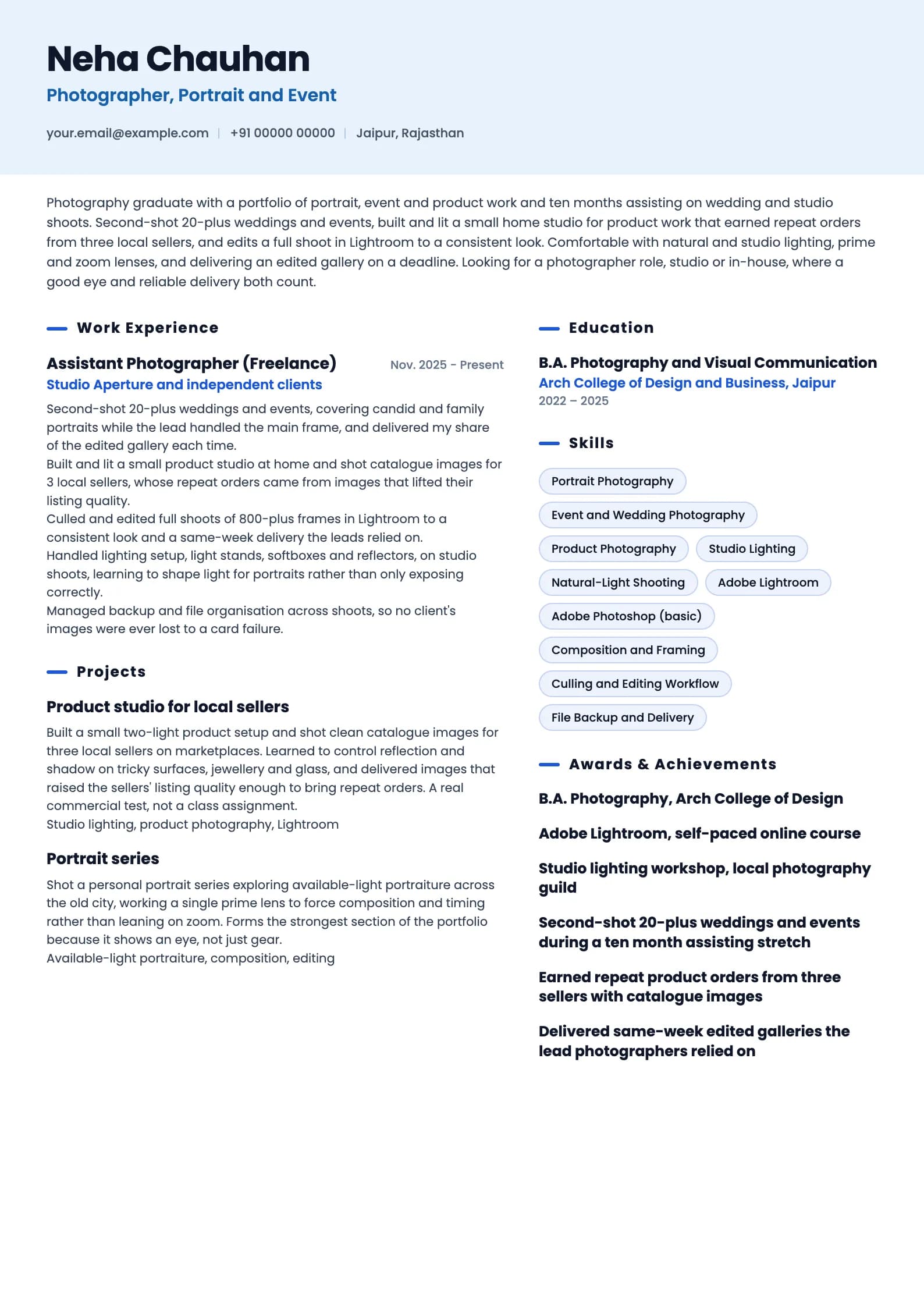
Build my resumePhotographer resume example, Fresher (0 years)
ai-era templateIs your resume good enough?
Upload the resume you have now and see what an applicant tracking system reads before a photographer recruiter ever does.
Free to run. Sign in with your mobile number to see your score.
Photographer resume example, Mid-level (5 years)
professional template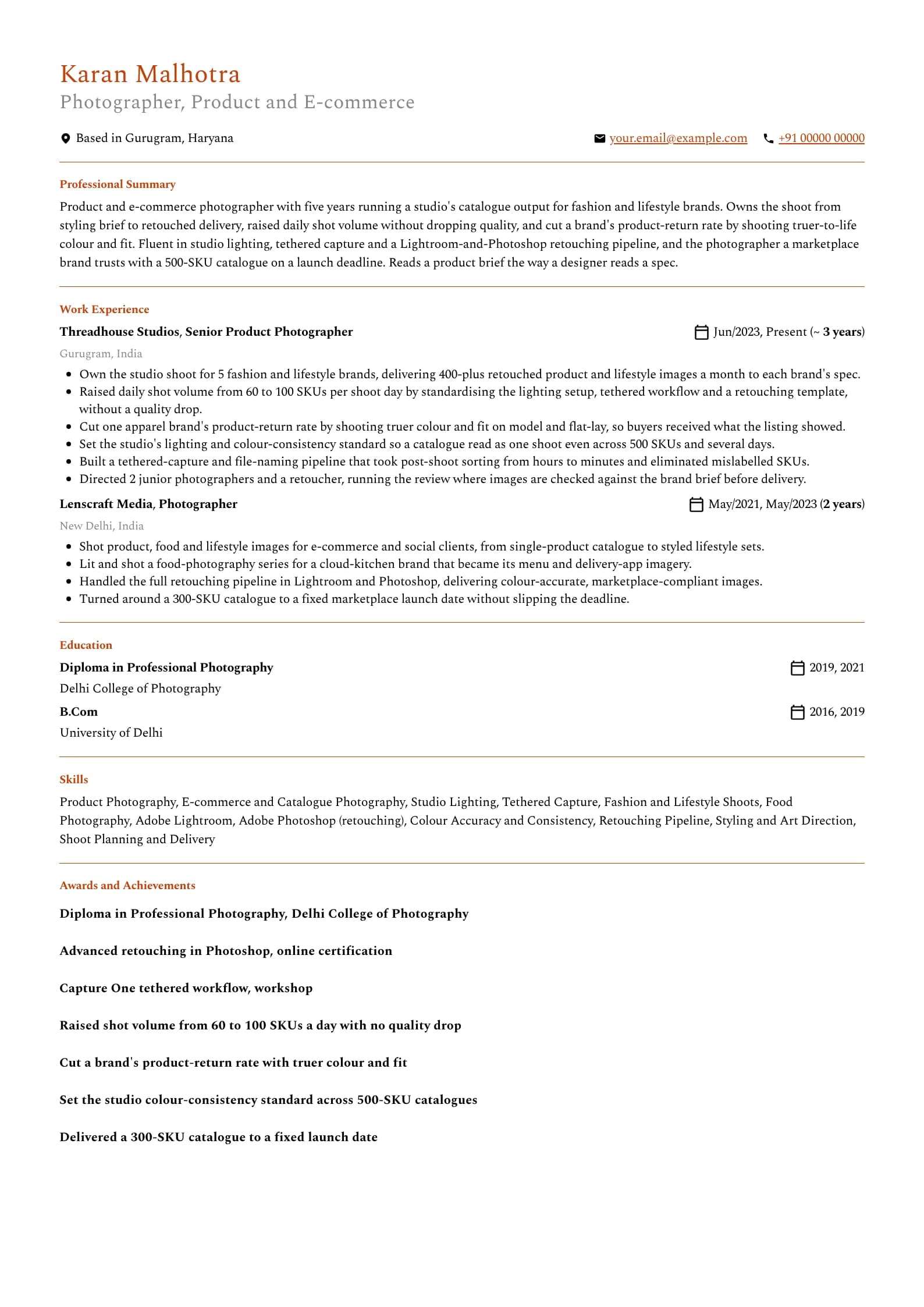
Want this structure with your own details? Build it in the resume builder.
Photographer resume example, Senior (10 years)
header-band template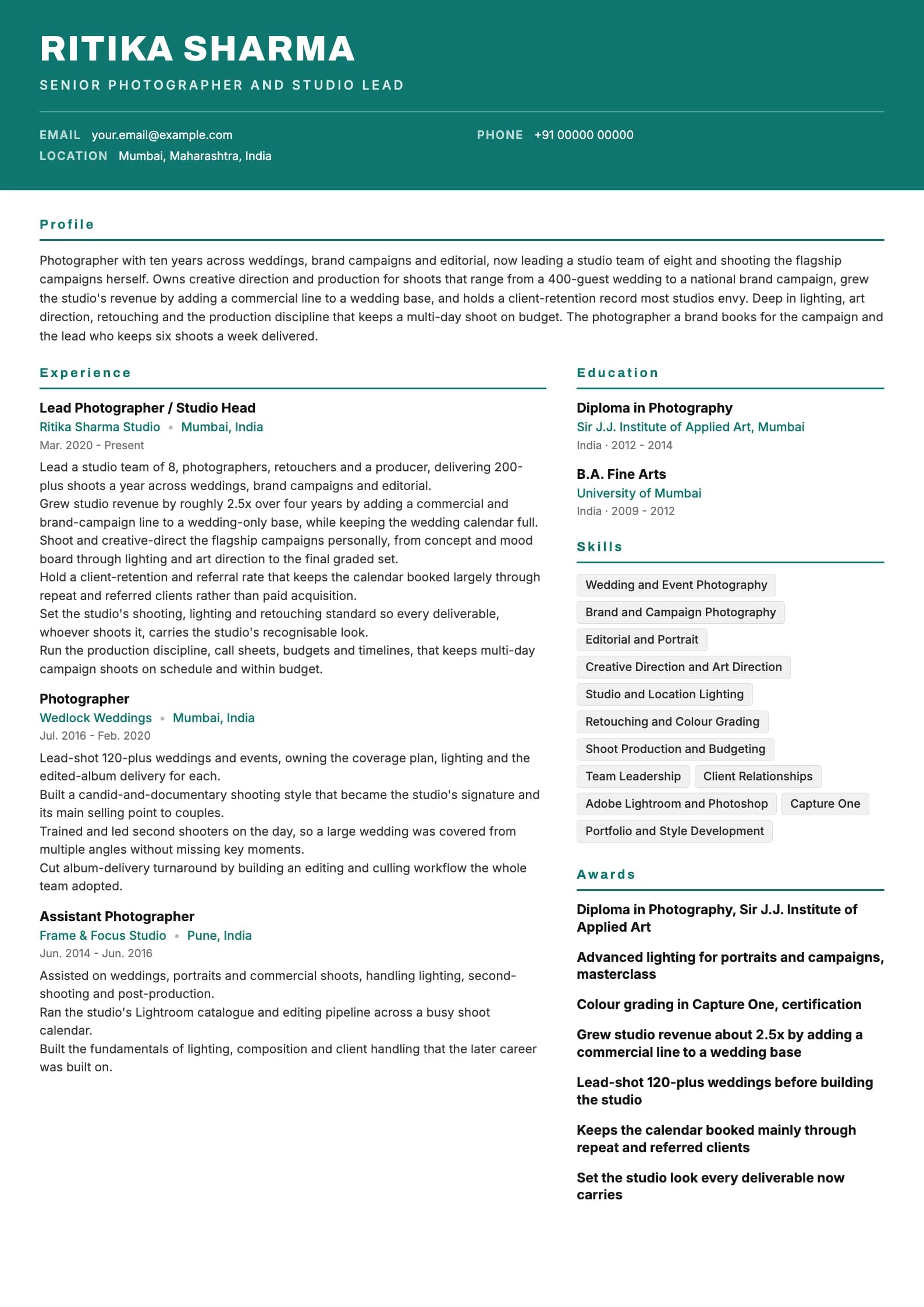
The format that works for photographer resumes in India
Reverse chronological is the layout to use. Put the most recent studio role or freelance stretch first, work backwards, and let the dates show. Functional resumes that group everything under Skills and drop the dates read as an attempt to hide a gap or a run of short gigs, and studios and art directors, who are used to spotting padding, treat them that way. For a photographer, the single most important thing on the page is a link to your portfolio. A resume without a portfolio link is a chef's resume with no mention of a dish. Put a clear, working link to a tight portfolio near the top, next to your name, because an art director decides more from twenty images than from any bullet. Curate hard: fifteen to thirty of your strongest, most recent, most relevant images beat a hundred that include everything you have ever shot. Length is decided by evidence. One page holds everything a fresher and most photographers up to roughly six years have to say, alongside the portfolio. A senior photographer or studio lead with team, campaign and business results earns a second page. A page two padded with a list of every lens is a one-page resume in disguise. Four things belong nowhere on the resume: a photograph of yourself as a headshot in the corner, date of birth, marital status and father's name. They survive from an older template, and the irony of a photographer padding with a selfie is not lost on a reviewer. Your images are your face; the portfolio does that job. Send a PDF unless the posting asks for DOCX, keep to a single column, and name the file with your own name and the role. The table below sets out the section order.
| Section | Where it goes | Why |
|---|---|---|
| Name and portfolio link | Top, above everything | The portfolio link is the most important item on a photographer's resume. Make it work and curate it hard. |
| Professional summary | Directly under the header | Three lines. Genre, years, and the single strongest result. |
| Work experience | Next, for anyone with a role or freelance record | Most recent first. Newest role gets the most bullets. |
| Selected work / clients | Above experience for freshers, below it after that | For a fresher this is the evidence beside the portfolio; for others it is highlights. |
| Skills | Below experience | Grouped: genres, lighting, post, workflow. Not a 20-lens wall. |
| Education | Bottom, unless a fresher | Photography qualification, institution, years. Self-taught is fine with a strong portfolio. |
| Gear (optional, brief) | After skills, one line | Camera system and key lights, one line, only if the role expects you to own kit. |
Naming your camera body is not the same as proving you can light
The most common photographer resume failure is a specifications line that reads Canon R5, Sony A7 IV, Nikon Z6, 24-70 f2.8, 50mm f1.4, Godox lights, Profoto, Lightroom, Photoshop, Capture One with no image or bullet that shows what the gear produced. A parser matches those terms, but an art director reads the gear list and shrugs, because owning a camera is not a skill, and jumps to the portfolio to see whether you can actually light and compose. The fix is to let the work prove the craft, and to lead with the portfolio. If you write studio lighting, a bullet should describe a shoot you lit and what was hard, reflective product, a large group, a tricky mixed-light venue. If you write retouching, a bullet should name the pipeline and the standard it delivered. The mid-level sample shows lighting and a retouching pipeline through SKU volume and a return-rate cut, not a gear list. The portfolio, the bullets and the skills all agree. Be specific about your genre, because a wedding photographer, a product photographer and an editorial photographer are different jobs. Naming your genre, and the sub-genre where it matters, jewellery product versus apparel, candid wedding versus traditional, tells a studio whether you fit their output. Pretending to shoot everything reads as shooting nothing well. Keep gear to a single optional line, and only if the role expects you to bring your own kit. A freelance wedding photographer listing a camera body and two lights makes sense; an in-house studio role that provides equipment does not need your Godox model numbers. Let the portfolio carry the proof and the gear line stay short.
For every genre and technique on your skills line, ask: is there an image in the portfolio and a bullet that proves it. If not, cut it. A gear list impresses nobody; the portfolio and a lit, composed frame do.
Writing a summary a studio or art director actually reads
The block under your name is the part that gets read before the portfolio, so it should carry three facts: what you shoot, how long you have been shooting it, and the strongest thing that happened because of your images. Three or four lines, no adjectives a portfolio or a reference cannot confirm. The old objective line, seeking a creative position to utilise my photography skills and passion in a reputed studio, tells an art director nothing new. Replace it with a summary. An objective describes what you want, a summary describes what you have already shot and delivered, and only one is evidence. Freshers often think they have nothing to summarise. Look at the fresher sample: it names the genres, the assisting length, and points at repeat product clients and same-week delivery. That is a genuine summary built from a portfolio and assisting work. What it avoids is "a passionate photographer with a keen eye for detail", a phrase so common on photography resumes it now carries no information. A keen eye is claimed by everyone; a client who reordered is proof. A practical test: read your summary and ask whether any other photographer with the same camera could paste it onto their resume unchanged. If they could, it describes the gear, not you. Add the specific genre, the specific number and the specific result until it stops being transferable.
Professional summary, mid-level photographer
Weak
A passionate and creative photographer with 5+ years of experience and a keen eye for detail, skilled in Lightroom, Photoshop and studio lighting, seeking a challenging role in a reputed studio.
Strong
Product and e-commerce photographer with five years owning a studio's catalogue output for fashion brands. Raised shot volume from 60 to 100 SKUs a day with no quality drop, and cut a brand's product-return rate by shooting truer colour and fit.
The rewrite trades a software list and self-description for a genre, an ownership scope and two verifiable, commercial results.
Experience bullets: verb, shoot, consequence
Every strong bullet in the samples follows the same shape. It opens with an action verb, names the specific shoot or output you owned, and closes with what measurably changed. The verb establishes that you did it. The shoot tells a reviewer what kind of work it is. The number, SKUs, shoots, volume, return rate, revenue, does the persuading. Start with the outcome and work backwards. Photographers usually write the task first, then leave it soft, which produces bullets like "clicked photos for various clients and edited them". Instead ask what happened because of your images: a client reordered, a return rate fell, volume rose, a catalogue launched on time, revenue grew. Then write the sentence that ends in that fact. Photography has honest numbers, especially in commercial work, so use them: shoots delivered, SKUs a day, images a month, delivery turnaround, return rate, repeat clients, revenue growth. Wedding and event work counts weddings shot, coverage delivered and referral rate. The samples vary these, which reads as range rather than one trick repeated. Where a number does not fit, give scope: how many brands, how many shoots a year, how large a catalogue, how big an event. "Delivered 400-plus retouched images a month to each brand's spec" carries weight without a revenue figure. Allocate bullets by recency. Current role gets five or six, the previous one four, anything older two or three.
| Level | What bullets and portfolio must prove | Typical metric |
|---|---|---|
| Fresher | You can light, compose and deliver a shoot | Shoots assisted, repeat clients, frames edited, delivery speed |
| 1 to 3 years | You own a shoot and its delivery unsupervised | Shoots a month, SKUs, turnaround, clients, on-spec delivery |
| 4 to 6 years | You own the output and raise its volume and quality | Volume per day, return rate, catalogues, launches hit |
| 7 years and up | You lead a studio and grow the business | Shoots a year, revenue growth, retention, team led |
Experience bullet, product photography
Weak
Clicked product photos for e-commerce clients and edited them in Lightroom and Photoshop.
Strong
Raised daily shot volume from 60 to 100 SKUs per shoot day by standardising lighting, tethered workflow and a retouching template, without a quality drop.
"Clicked photos" describes activity; the rewrite names the volume gain, how it was achieved, and that quality held.
Experience bullet, wedding photography
Weak
Photographed many weddings and events and delivered the albums to the clients.
Strong
Lead-shot 120-plus weddings, owning the coverage plan and lighting, and built a candid-and-documentary style that became the studio's signature and main selling point.
Names the volume, the ownership and the style that drew clients, so a reviewer sees a photographer who built demand, not just attended shoots.
If a bullet would read identically on any photographer's resume, it is describing the camera, not you. Rewrite it until it only fits the shoot and the result you delivered, and let the portfolio carry the eye.
The skills section: grouped, honest, and short enough to defend
A photographer's skills section has two audiences with opposite preferences. The parser wants literal terms it can match, product photography, studio lighting, Lightroom, retouching. A human wants a short, organised list that signals what kind of photographer you are. Grouping satisfies both. Group by function rather than one long line. Genres, lighting, post-production, and workflow is a grouping that works for almost every photographer. The exact headings matter less than the fact that structure exists. Write names the way the industry writes them: Lightroom not Light room, Photoshop not Photo Shop, Capture One not Capture 1. A parser matches on strings. Ten to sixteen skills is the working range. Below eight the section looks thin. Above twenty it stops being a signal, and photographer resumes are especially prone to turning into an equipment list, every camera body, every lens, every light, as though owning gear were a skill. Move gear to a single optional line and keep skills about what you can do. The list is a contract, and the portfolio is the proof of every item on it. Do not include a proficiency bar. Star ratings invite an argument you cannot win, and nobody agrees what four stars in lighting means. Let the portfolio prove the depth, and pitch the list to the target: a product role wants product, lighting and retouching, a wedding role wants event, candid and album delivery.
| Group | What goes in it | How many |
|---|---|---|
| Genres | Product, wedding, portrait, editorial, food (as relevant) | 2 to 4 |
| Lighting | Studio lighting, natural-light, location lighting | 1 to 3 |
| Post-production | Lightroom, Photoshop retouching, colour grading, Capture One | 2 to 4 |
| Workflow | Tethered capture, culling, backup, delivery, colour management | 2 to 3 |
| Direction (senior) | Art direction, styling, shoot production, team leadership | 1 to 3 |
Skills section
Weak
Skills: Canon R5, Sony A7 IV, Nikon Z6, 24-70 f2.8, 70-200 f2.8, 50mm f1.4, 85mm f1.8, Godox AD200, Godox AD600, Profoto B10, tripods, reflectors, Lightroom, Photoshop, photography, editing, creativity, hardworking
Strong
Genres: product, e-commerce, lifestyle, food. Lighting: studio and tethered. Post: Lightroom, Photoshop retouching, colour accuracy. Workflow: tethered capture, culling, delivery. Gear (one line): Sony full-frame system, Godox lighting.
Moves the equipment inventory to a single line and fills the skills with what you can actually do, grouped so a studio reads the level in one pass.
The portfolio and selected work: what to show and how to describe it
For a photographer the portfolio is the application. A resume gets your portfolio a view; the portfolio gets you the shoot. Curate it hard to fifteen to thirty images that are your strongest, most recent, and most relevant to the job, cut so the best frame comes first, and in the genre you are applying for. A wedding-heavy portfolio sent for a product role tells a studio you are not their photographer, however good the weddings are. Make the link work, and if it needs a login a busy reviewer will not create, host it somewhere open. Beside the portfolio, a short list of selected work or clients does what images alone cannot: it names who the client was, what the shoot was for, and what it achieved. The common failure is describing the gear or the edit instead of the result. "Shot a product catalogue in the studio" tells a reviewer nothing. Describe the client, the shoot and the outcome. The product-studio project in the fresher sample is a stronger entry than a prettier personal shoot, because it names repeat orders, a commercial result. Pick work that shows range within your genre rather than fifteen near-identical frames. For a product photographer, a clean catalogue set, a styled lifestyle set and a tricky-surface product show more than fifteen flat-lays. Two well-described projects beat five listed by name. If you assisted or second-shot, say so honestly. "Second shooter on" and "lead photographer for" are both credible; claiming lead credit on a shoot you assisted is exposed the moment a reviewer asks how you lit it.
Selected-work description, fresher portfolio
Weak
Product shoot: shot some products for a client in a home studio using two lights and edited in Lightroom.
Strong
Product studio for local sellers: built a two-light setup, controlled reflection and shadow on jewellery and glass, and delivered catalogue images that raised listing quality enough to bring repeat orders.
Swaps a gear-and-edit note for the hard part of the craft and a real commercial outcome the client rewarded with repeat business.
Where education, workshops and certifications belong
Education goes near the top for a fresher who has little else to lead with, and lower for anyone with a real body of work. A photography diploma or degree, institution and years is the whole entry for most people. And here, as in editing, being self-taught is genuinely fine: a strong portfolio from a self-taught photographer beats a weak one from a design-school graduate every time, because the images are the credential. If your route was assisting and paid shoots rather than a diploma, say so and let the portfolio carry the case. Marks matter little in photography, so do not lead with a percentage. A studio wants to see what you have shot, not your semester grades. Once you have a portfolio and clients, the degree recedes to a single line. Workshops and short courses sit below education. A lighting masterclass, an advanced-retouching course, or a Capture One workflow certification are worth naming with the year when they match the work you want, because they signal you keep sharpening a specific skill. But a certificate never outranks the portfolio: a photographer with no certifications and a striking body of work is more hireable than one with a wall of badges and dull images, so treat courses as supporting evidence, not the case.
Getting through the applicant tracking system
Studios, agencies, e-commerce companies and brands that recruit online run applications through an applicant tracking system before a human sees them. It reads your file, tries to break it into name, dates, employers, titles and skills, and stores the result so a recruiter can search. Almost every ATS problem is a parsing problem, and parsing problems come from layout, not wording, which matters for photographers because the instinct is to build a beautiful, image-heavy resume that a parser cannot read at all. The layout rules are short. One column. Standard section headings, so use Work Experience rather than My Photographic Journey, and Skills rather than My Craft. No text inside images, and do not build your resume as a designed graphic or a contact sheet, because a parser reads a picture of text as empty space and your name, skills and portfolio link vanish. Keep the sample images to your portfolio link, not baked into the resume as unreadable text. No critical information in the header or footer region, which some parsers drop. On wording, mirror the advertisement where it is honest. If the post says product photographer, use product photographer. If it names studio lighting, retouching or e-commerce and you do that work, write the term exactly. Spell out an acronym alongside itself at least once where one exists. For an e-commerce role, terms like catalogue, SKU, retouching and tethered capture are the ones the parser is set to match. Keyword stuffing does not work, and a hidden block of gear names is found quickly. Write real bullets that naturally contain the right terms. Save as PDF from a tool that embeds real text, then open the file and confirm you can select and copy a sentence, and that the portfolio link is clickable. If you cannot select the text, neither can the parser.
Resume built as a contact sheet or graphic
Weak
A designed, image-filled page exported as a picture, with the name, skills and portfolio link set as text inside the graphic.
Strong
A clean, text-based single-column PDF with a selectable portfolio link, standard headings and real text, with the images living behind the link.
A picture of a resume reads as one empty image to a parser; the text version keeps your name, skills and portfolio link searchable while the portfolio does the visual work.
Test your own file before you send it. Copy the text out of the PDF into a plain text editor. If your portfolio link and skills do not come out as text, a recruiter's search will never surface you, however strong the images behind the link are.
What gets photographer resumes rejected
Most rejections at the resume stage are not close calls. They come from a small set of recurring problems, and all of them are fixable in an afternoon. The list below covers what studios and art directors reviewing Indian photographer resumes see most often, in rough order of how much damage each one does.
- No portfolio link, or a broken one. For a photographer this is close to fatal, because the portfolio is the application.
- A resume built as a designed graphic or contact sheet, which parses as empty and buries the portfolio link where no search finds it.
- A gear list where the skills should be. Owning a camera is not a skill; move equipment to one optional line and fill skills with what you can do.
- A portfolio in the wrong genre for the job, or padded to a hundred images, so the reviewer never reaches your best work.
- Duties instead of results. "Clicked photos and edited them" says nothing; name the clients, volume, return rate or revenue.
- "Passionate photographer with a keen eye for detail" as the summary. Everyone claims the eye; the portfolio and a repeat client prove it.
- A headshot selfie, date of birth, marital status or father's name. Your images are your face; the personal details take a result's space.
- Claiming lead credit on shoots you assisted or second-shot, which a single question about the lighting exposes.
- Pretending to shoot every genre, which reads as shooting none of them well. Name your genre and show depth in it.
- Typos in the software you claim, such as writing Lightroom as "Lightoom" or Photoshop as "Photshop", which undoes an otherwise strong page.
Look at your own portfolio once as the busy art director opening it between shoots. If the first three images would not make you keep scrolling, recut the front of the portfolio before you send another resume.
Skills to put on a photographer resume
Technical
- Product and E-commerce Photography
- Portrait Photography
- Wedding and Event Photography
- Studio Lighting
- Natural and Location Lighting
- Retouching and Colour Grading
- Tethered Capture
- Food and Lifestyle Photography
- Colour Management and Accuracy
- Culling and Editing Workflow
- Art Direction and Styling
- Shoot Production
Tools and platforms
- Adobe Lightroom
- Adobe Photoshop
- Capture One
- DSLR and mirrorless systems
- Studio strobes and continuous lights
- Softboxes and modifiers
- Tethering software
- Colour calibration tools
Working skills
- Client handling and communication
- Direction on set
- Deadline reliability
- Attention to detail
- Composition and eye
- Calm on a busy shoot
- Collaboration with stylists and designers
- Self-organisation and backup discipline
- Building repeat clients
Certifications worth listing as a photographer
| Certification | Full name | Worth it for |
|---|---|---|
| Photography Diploma | Diploma or degree in professional photography | A structured route that helps freshers with fundamentals of lighting, composition and workflow. Genuinely optional in this field, since a strong portfolio from a self-taught photographer competes fully with a graduate; name it if you have it, but never lead with it over the portfolio. |
| Advanced Retouching | Advanced retouching in Photoshop certification | Worth it for product, beauty and editorial photographers, where high-end retouching is part of the deliverable. Signals you can finish an image to a commercial standard, not just shoot it; back it with retouched work in the portfolio. |
| Lighting Masterclass | Studio and location lighting masterclass | Valuable for photographers moving into commercial, product or campaign work, where controlled lighting separates a professional from an enthusiast. Most useful in the entry-to-mid range; the lit images in your portfolio are the real proof. |
| Capture One Workflow | Capture One tethered-capture and colour certification | A practical credential for studio and e-commerce photographers who shoot tethered at volume, where Capture One is the standard for catalogue work. Relevant when the role involves high-throughput studio shooting; skip it for a purely location or event practice. |
Keywords an ATS scans for in a photographer resume
These are the literal terms a parser matches against the job description. Use the ones that are true of you, in the sentences where you did the work, not as a list at the bottom.
- photographer
- photography
- product photography
- e-commerce photography
- studio lighting
- wedding photography
- portrait photography
- retouching
- lightroom
- photoshop
- capture one
- tethered capture
- colour grading
- catalogue
- SKU
- food photography
- art direction
- post-production
- editing
- portfolio
Photographer resume FAQ
What salary can a photographer expect in India?
A fresher or assistant photographer typically starts around 2.5 to 5 LPA in a studio, with freelancers earning per shoot and varying widely by genre and city. A mid-level product, e-commerce or event photographer with four to six years usually sits in the 5 to 10 LPA band as an employee, and often more as a busy freelancer. Senior photographers and studio leads commonly earn 10 to 20 LPA and above, with successful independent studio owners earning well beyond that. Commercial and product work tends to pay more predictably than wedding work, though top wedding photographers can earn the most of all.
How important is a portfolio on a photographer's resume?
It is the single most important thing. An art director decides more from twenty of your images than from your entire bullet list, so a working, well-curated portfolio link near the top of the resume is essential, and a missing or broken link is close to fatal. Curate to fifteen to thirty of your strongest, most recent images in the genre you are applying for, best frame first. The resume gets your portfolio a view; the portfolio gets you the shoot.
How does a fresher write a photographer resume with no full-time job?
Lead with your portfolio, then assisting and freelance work, then skills. Second-shooting weddings, assisting studio shoots, personal projects and small paid gigs all count, so treat each as evidence: what you shot, for whom, and what it achieved, such as repeat orders or a same-week delivery the lead relied on. Show that you can light and compose, not just own a camera, and put numbers on the work even when small. Being self-taught is fine in photography, so a strong portfolio beats a diploma with weak images.
Should I list all my camera equipment on my resume?
No, not as your skills. Owning a camera and lenses is not a skill, and a long gear list where the skills should be tells a studio nothing about whether you can light or compose. Move equipment to a single optional line, and include it only if the role expects you to bring your own kit, as freelance and wedding work often does. Fill the skills section with genres, lighting, post-production and workflow instead, and let the portfolio prove every one.
Do I need a photography degree to get hired?
No. Photography is one of the most portfolio-driven roles there is, and a strong body of work from a self-taught photographer competes fully with a design-school graduate. A diploma or degree helps with fundamentals and contacts, and is worth naming if you have it, but it never outranks the portfolio. If your route was assisting and paid shoots, say so plainly and let the images carry the case, because studios hire the eye, not the certificate.
How long should a photographer resume be?
One page up to about six years of experience, alongside the portfolio, and two pages after that only if the second page carries real studio, campaign or business results rather than a longer gear list. Nobody has been rejected for a resume that was easy to read. If you are struggling to fit one page, cut the oldest role to a line, move equipment to a single line, and remember the portfolio, not the resume length, is doing most of the persuading.
Will an ATS reject my designed photographer resume?
If you built it as a designed graphic or a contact sheet, effectively yes, because a parser reads a picture of text as empty space and your name, skills and portfolio link disappear. Keep the resume as a text-based, single-column PDF with real, selectable text and a clickable portfolio link, and let the images live behind that link rather than baked into the page. Test it by copying the text out of the PDF into a plain text editor; if your link and skills come out as text, it will parse.
What metrics can a photographer put on a resume?
More than you might think, especially in commercial work. Shoots delivered, SKUs or images per shoot day, images delivered a month, delivery turnaround, a client's product-return rate you improved, repeat and referral clients, catalogue launches hit on deadline, and for a studio lead, revenue growth and shoots a year. Wedding work counts weddings shot, coverage delivered and referral rate. Tie the craft to a business outcome where you can, because "cut the return rate" or "earned repeat orders" persuades more than any adjective.
Related resume examples and guides
Build your own in any of these formats
Start from a blank resume or upload the one you have. Goodspace renders it in 24 templates, keeps your portfolio link selectable, and flags the lighting, retouching and genre keywords an applicant tracking system will look for, and the gear-list padding it will not credit.
Build my resume