Mobile Repair Technician Resume Format, with 3 Full Samples
A mobile repair technician is hired on evidence of devices revived, dead boards traced and phones returned working the first time, yet most resumes list tools and forget the fault that was actually found. Below are three complete resumes, one for a fresher out of a mobile-repairing course, one for a service-centre technician with four years across board and software faults, and one for a senior chip-level engineer running a bench and a warranty desk. After the samples come the format rules, the difference between listing chip-level and proving you can rework a board, the terms a parser matches literally, and the mistakes that get a technician's resume set aside before a service manager reads it.
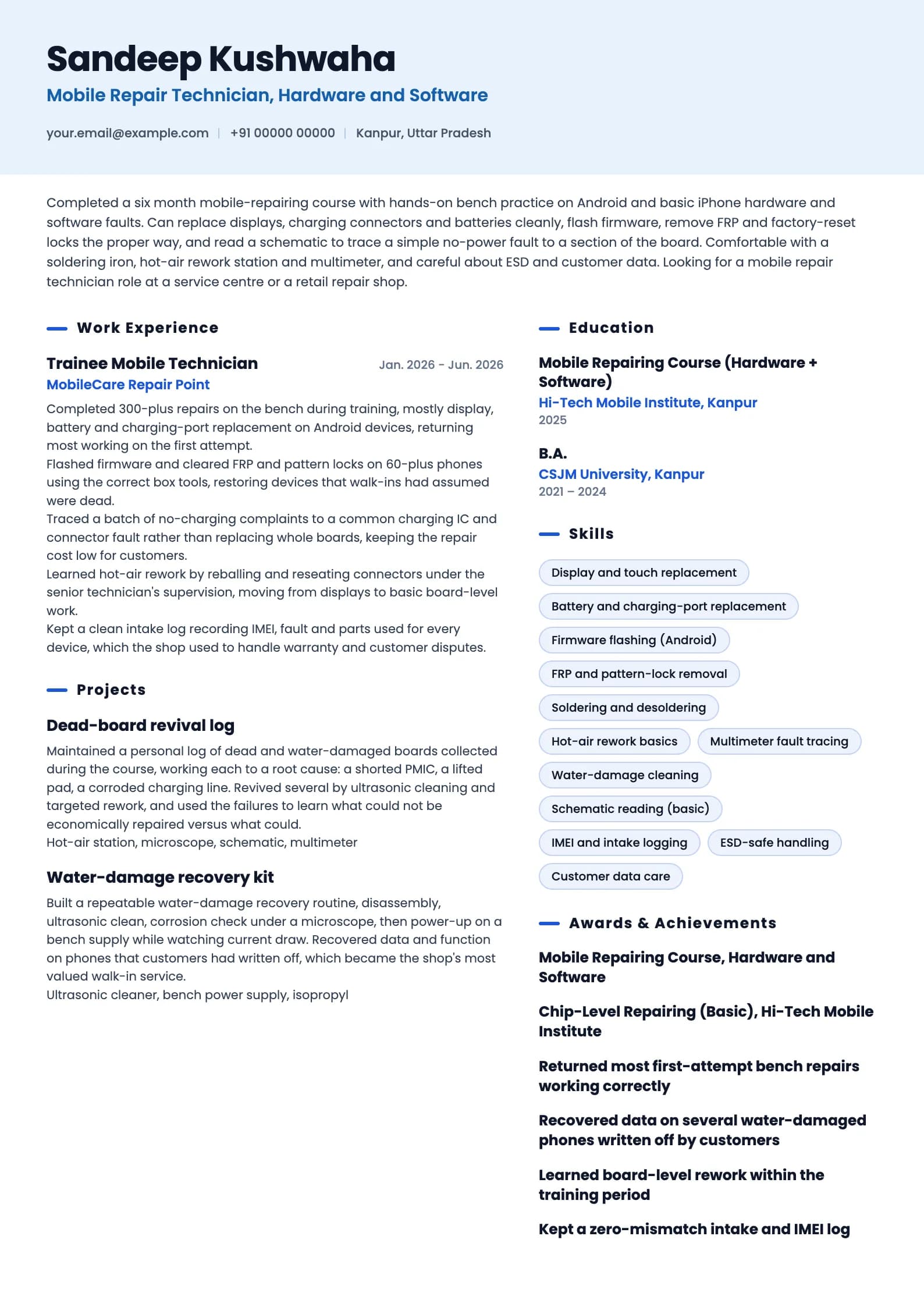
Build my resumeMobile Repair Technician resume example, Fresher (course + bench practice)
ai-era templateIs your resume good enough?
Upload the resume you have now and see what an applicant tracking system reads before a mobile repair technician recruiter ever does.
Free to run. Sign in with your mobile number to see your score.
Mobile Repair Technician resume example, Service-centre technician (4 years)
professional template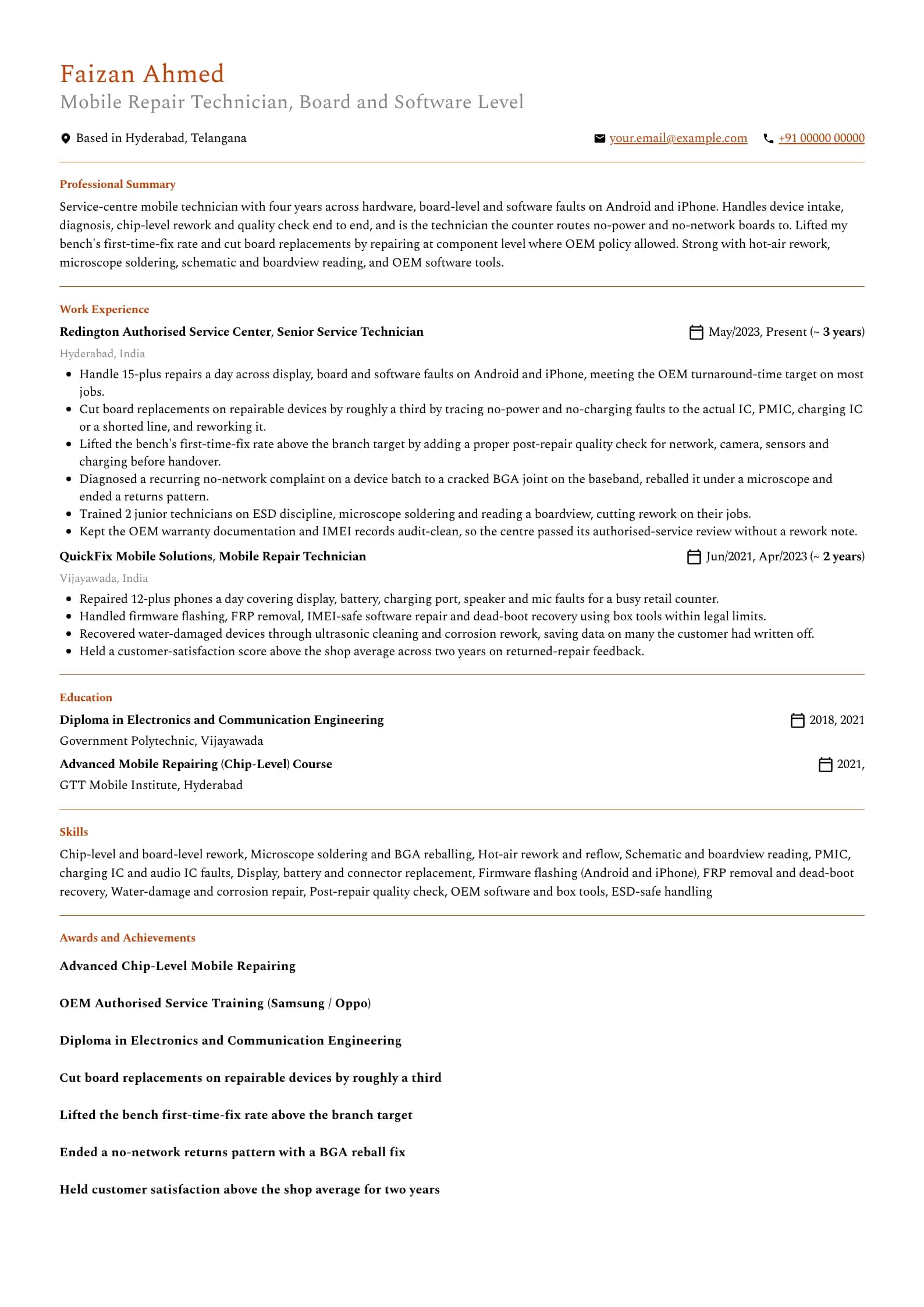
Want this structure with your own details? Build it in the resume builder.
Mobile Repair Technician resume example, Chip-level engineer (9 years)
header-band template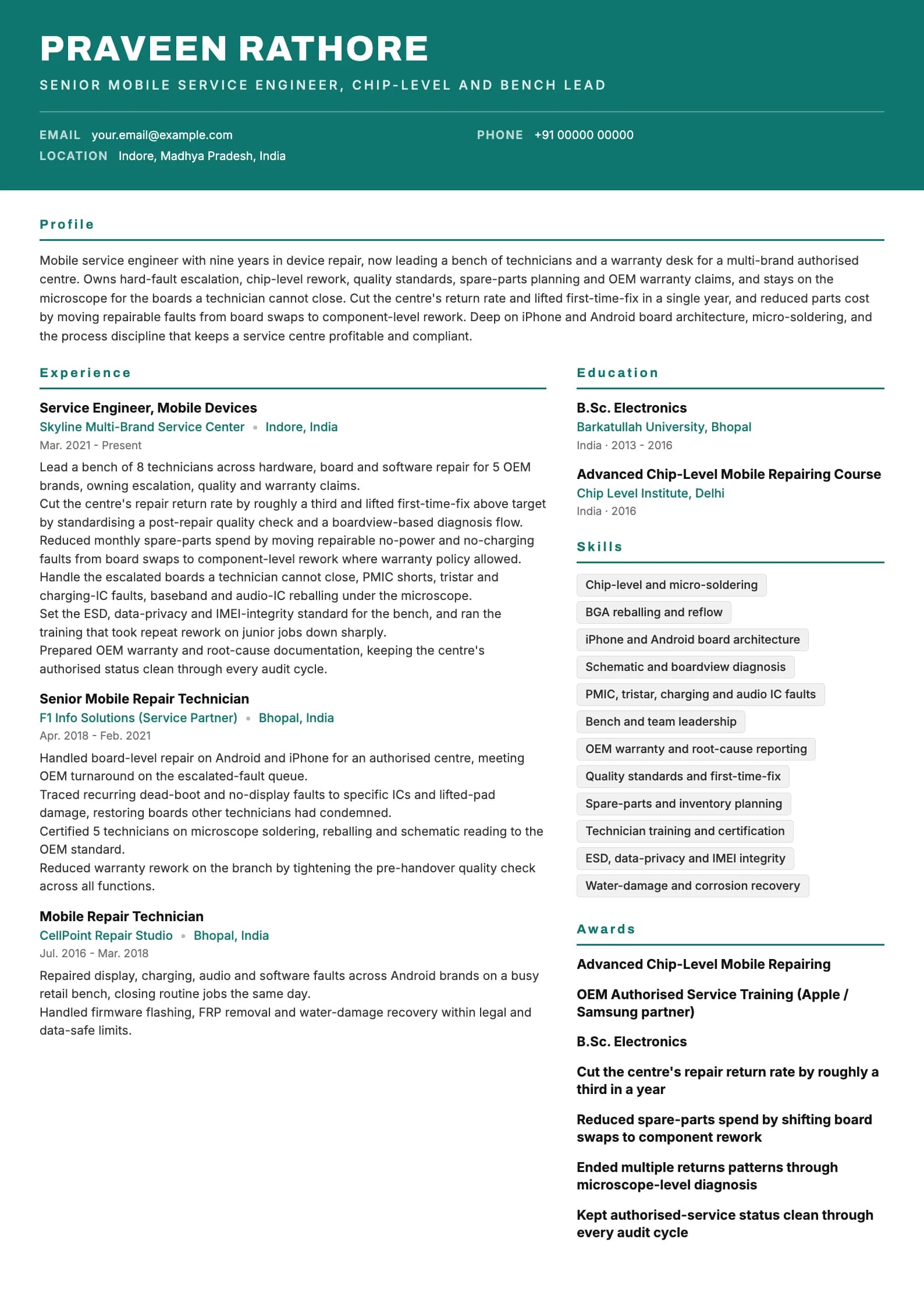
The format that works for mobile repair technician resumes in India
Reverse chronological is the layout to use. Put the most recent job first, work backwards, and keep the dates visible. A functional resume that lists only skills and box tools and drops the employers and dates reads as an attempt to hide a gap or short stints, and service managers treat it that way. If there is a gap, one honest line explains it better than a missing date. Keep it to one page. A mobile technician's resume, fresher or senior, holds everything worth saying on a single page: the fault types you handle, the benches you have owned and the results that came out of them. A second page on a trades resume is almost always padding, and a busy service manager will not read it. Lead with the fault range and the level you work at. Recruiters for service centres and OEM partners scan for hardware versus board-level versus chip-level, software and IMEI-safe work, and the brands you handle. Put that near the top where it is read, not buried under a long soft-skills list. Four things do not belong on a technician resume: a photograph, date of birth, marital status and father's name. They come from an old campus template and take space a real repair or result could use. Send a PDF unless the employer asks otherwise, name the file with your own name and the role, and use a single column so a parser and a busy manager both read it in order. The table below sets out the section order.
| Section | Where it goes | Why |
|---|---|---|
| Name and headline | Top, above everything | The headline is the role and level: mobile repair technician, board and software. Recruiters match on it. |
| Professional summary | Directly under the header | Three lines. Fault types you handle, years, and the strongest single result. |
| Work experience | Next, for anyone with a job | Most recent first. Newest role gets the most bullets. |
| Skills | Below experience, or above it for a fresher | Grouped: hardware, board-level, software, tools. Not a 40-item wall. |
| Certifications and courses | After skills | Chip-level course, OEM training, electronics diploma. These carry weight. |
| Education | Bottom for experienced, near top for a fresher | Course, diploma or degree, institution, years. |
Listing chip-level is not the same as proving you can rework a board
The most common mobile technician resume failure is a skills line that reads chip-level, board-level, micro-soldering, BGA reballing, PMIC, tristar, schematic, boardview with no bullet anywhere showing a board you actually revived or a fault you traced. A parser matches those words, but a service manager reads the list and assumes it is copied, then hands you a dead board in the trade test and watches whether you reach for the microscope or the parts drawer. The fix is to let the experience prove the level. If you write BGA reballing on the skills line, a bullet should describe a reball you did: a baseband, an audio IC, a CPU. The service-centre sample lists chip-level precisely because a bullet shows a BGA reball on the baseband that ended a returns pattern. The skills and the work agree, which is what makes both believable. Write what you diagnosed, not only what you replaced. Anyone can swap a display or a charging port. The technician a service centre wants is the one who traces a no-power or no-network fault to the actual IC or shorted line and reworks it, instead of condemning the whole board. A bullet that names the true fault behind a dead board is worth more than five that list parts changed. Be clear about the software line you do not cross. IMEI-safe firmware flashing, FRP removal and dead-boot recovery within legal limits are legitimate skills, and stating them that way signals you know where legal repair ends. Vague claims about unlocking anything read as a liability, and authorised centres screen for it hard.
For every level term on your skills line, ask: is there a bullet that shows a board I revived at that level. If not, either add the bullet or drop the term. A wall of unproven chip-level words helps the parser and fails the trade test.
Writing a summary a service manager actually reads
The block under your name is the part most likely to be read, so it should carry three facts: what fault types and level you handle, how long you have been doing it, and the strongest thing that happened because of your work. Three or four lines, no adjectives a manager cannot check. The old objective line, seeking a challenging position in a good company to grow my career in mobile repairing, tells the reader nothing they did not already assume. Replace it with a summary. An objective describes what you want, a summary describes what you have already fixed, and only one is evidence on a trades resume. Freshers often think they have nothing to summarise. Look at the fresher sample: it names the course, states the bench-practice volume, and points at real work, faults traced to a common IC and data recovered from water-damaged phones. That is a genuine summary built from a course and a training bench. What it avoids is hardworking and quick learner, phrases so common they carry no information. A practical test: read your summary and ask whether any classmate from the same course could paste it onto their resume unchanged. If they could, it describes the course, not you. Add the specific fault types, the specific result and the specific level until it stops being transferable.
Professional summary, service-centre technician
Weak
Hardworking and quick-learning mobile technician with 4 years of experience in mobile repairing seeking a challenging role in a reputed company to utilise my skills.
Strong
Service-centre technician with four years across hardware, board-level and software faults on Android and iPhone, owning intake to quality check. Cut board replacements by roughly a third through component-level rework and lifted the bench's first-time-fix rate above target.
The rewrite trades a generic wish for the fault range worked on, an ownership scope and two verifiable results.
Experience bullets: verb, fault, result
Every strong bullet in the samples follows the same shape. It opens with an action verb, names the specific fault or board you worked on, and closes with what measurably changed. The verb establishes that you did it. The fault tells a service manager whether the work is relevant. The number does the persuading. Start with the outcome and work backwards. Technicians usually write the task first, then struggle to attach a result, which produces bullets like did repairing of various mobile phones and software work. Instead ask what was different after your bench: a dead board came back to life, a returns pattern ended, a repair held on the first attempt, a board swap became a component fix, a parts cost dropped. Then write the sentence that ends in that fact. Vary the metric. A mobile repair resume can honestly reach for first-time-fix rate, return or repeat-repair rate, repairs per day, OEM turnaround time, board swaps avoided, parts cost and data recovered. Identical numbers read as one claim repeated; a mix reads as range. Where you lack a number, give scope: how many repairs a day, how many brands, how many technicians trained, how many boards on the escalation queue. Scope carries the same weight as a percentage on a service resume. Allocate bullets by recency. Current role gets five or six, the previous role three or four, anything older two.
| Level | What bullets must prove | Typical metric |
|---|---|---|
| Fresher | You can finish a repair and it holds | Repairs done, first-attempt fixes, boards revived, data recovered |
| 1 to 3 years | You run a retail bench without supervision | Repairs per day, return rate, software jobs, water-damage recovery |
| 4 to 6 years | You own board-level and escalation work | First-time-fix, board swaps avoided, returns ended, OEM turnaround |
| 7 years and up | You lead a bench and own the numbers and compliance | Return rate, parts cost, first-time-fix, audit-clean warranty, training |
Experience bullet, board-level work
Weak
Responsible for repairing of mobile phones, doing soldering work and software flashing of all types of phones.
Strong
Diagnosed a recurring no-network complaint on a device batch to a cracked BGA joint on the baseband, reballed it under a microscope and ended a returns pattern.
"Responsible for" describes a job card; the rewrite names the real fault found, the technique used and the returns pattern it ended.
Experience bullet, bench outcome
Weak
Worked on many phones and reduced the complaints and improved customer satisfaction at the shop.
Strong
Cut board replacements on repairable devices by roughly a third by tracing no-power and no-charging faults to the actual IC and reworking it.
Names the metric that moved and the method behind it, so a manager can ask a real follow-up instead of nodding at a vague claim.
If a bullet would read the same on any technician's resume, it is describing the trade, not you. Rewrite it until it only fits the board or the fault you actually worked.
The skills section: grouped, honest, and short enough to defend
A mobile technician's skills section serves two readers with opposite tastes. A parser wants literal terms it can match, BGA reballing and PMIC and firmware flashing. A service manager wants a short, organised list that shows what level of technician you are. Grouping satisfies both. Group by function rather than one long line. Hardware, board and chip level, software, and tools is a grouping that works for almost any mobile technician. The exact headings matter less than the fact that structure exists. Write names the way the trade writes them: BGA, PMIC, FRP, boardview, not vague versions a parser will miss. Ten to fourteen skills is the working range. Below eight the section looks thin. Above eighteen it stops being a signal, and a mobile resume is prone to padding by listing every IC name and every box tool as if each were a separate skill. The list is a contract: every item is a question you have agreed to answer in a trade test, so include the level you can actually work at, not the one you have only watched on video. Do not add a star rating or a percentage bar. Nobody agrees what four stars in micro-soldering means, and it invites an argument you cannot win. Let the experience prove the depth instead.
| Group | What goes in it | How many |
|---|---|---|
| Hardware | Display, battery, charging port, speaker, mic, camera replacement | 2 to 4 |
| Board and chip level | Micro-soldering, BGA reballing, PMIC, tristar, charging IC faults | 3 to 5 |
| Diagnosis | Schematic and boardview reading, multimeter, microscope | 2 to 3 |
| Software | Firmware flashing, FRP removal, dead-boot recovery (IMEI-safe) | 2 to 3 |
| Practices | Post-repair quality check, ESD, data privacy, water-damage recovery | 2 to 3 |
Skills section
Weak
Skills: mobile repairing, hardware, software, soldering, all types of ic, display, touch, battery, charging, unlocking, flashing, frp, all box tools, hardworking, honest, MS Word
Strong
Hardware: display, battery, charging port, connector. Board level: micro-soldering, BGA reballing, PMIC and charging IC faults. Diagnosis: schematic and boardview, microscope. Software: IMEI-safe flashing, FRP removal, dead-boot recovery.
Cuts the vague catch-alls, the unlock-anything liability and the filler traits, groups the rest, and keeps only what a trade test can verify.
Certifications, courses and where they belong
For a mobile repair role the course and certificate section is often the filter for a fresher and a differentiator for a senior. Service centres and OEM partners look for the level a course claims to have taught, so name it clearly and honestly. A mobile-repairing course covering hardware and software is the common entry credential and worth stating, including whether it covered chip-level or only card-level replacement, because the two are very different jobs. An advanced or chip-level course carries more weight for board-level roles. Name the institute. A diploma or degree in electronics or ECE sits alongside the trade course and helps for authorised-service and supervisory roles, where reading a schematic and understanding the electronics matters beyond swapping parts. Mention it. OEM authorised service training, from Samsung, Apple partners, Oppo, Vivo or Xiaomi, carries real weight because it signals you can be trusted with warranty devices, genuine parts and IMEI-integrity rules. Name the brand. If you have any data-privacy or e-waste handling training, list it, because customer data and safe disposal are compliance points authorised centres care about. List only what you hold and can demonstrate on a bench, since a trade test exposes an invented certificate immediately.
Getting through the applicant tracking system
Larger service networks, OEM partners and retail chains now put technician applications through an applicant tracking system before a human sees them. It is a parser and a search index, not a judge. It reads your file, tries to break it into name, dates, employers, titles and skills, and stores the result so a recruiter can search across candidates. Almost every problem is a parsing problem, and parsing problems come from layout, not wording. The layout rules are short. One column. Standard headings, so use Work Experience rather than My Repair Journey, and Skills rather than My Expertise. No text inside images, because a photo of tools or certificates reads as empty space. No critical information in the header or footer region, which some parsers drop. Avoid text boxes and nested tables in the body. On wording, mirror the job posting where it is honest. If it says chip-level or board-level, use the exact term rather than only repairing. If it says OEM or authorised service, use those words. Spell an acronym out once alongside the short form, for example FRP (factory reset protection), so both searches find you. Keyword stuffing does not work, and a hidden block of every IC name in white text is caught quickly, with a worse outcome than being filtered. Write real bullets that naturally contain the right terms, because a bullet describing a BGA reball contains the word BGA in a context that survives a human read too. Save as PDF from a tool that embeds real text, then open the file and confirm you can select and copy a sentence. If you cannot select the text, neither can the parser.
Section heading
Weak
My Journey in Mobile Repairing
Strong
Work Experience
Parsers look for standard headings; a creative one can push the whole block into an unclassified bucket the recruiter never searches.
What gets mobile repair technician resumes rejected
Most rejections at the resume stage for mobile technicians are not close calls. They come from a small set of recurring problems, and every one is fixable in an evening. The list below covers what service managers and OEM recruiters see most often, in rough order of how much damage each one does.
- A wall of chip-level and IC terms on the skills line with no bullet proving a board you actually revived at that level.
- Only card-level swapping, display, battery, charging port, dressed up as chip-level. The trade test exposes it immediately.
- Job duties copied off a shop board instead of what you fixed. "Responsible for repairing of mobile phones" is the tell.
- No numbers anywhere. First-time-fix, return rate, repairs per day, board swaps avoided. Pick whichever is honest.
- Vague claims about unlocking any phone, which read as a legal liability rather than a skill an authorised centre wants.
- A photo, date of birth, marital status or father's name from an old template, taking space a real repair could use.
- No mention of data care or IMEI integrity, when handling a customer's device and data is exactly what a service centre must trust you with.
- A generic objective line asking for a challenging position, instead of a summary that states fault types, years and one result.
- Inflated titles or job dates that will not survive an experience-letter check, since service networks do verify.
- Spelling the parts and ICs wrong, writing PMIC as PIMC or baseband as basband, which undoes an otherwise honest page.
Read your resume aloud once before sending it. Anything you could not demonstrate on a live board in a trade test is a line to cut or rewrite.
Skills to put on a mobile repair technician resume
Technical
- Display, touch and battery replacement
- Charging port and connector replacement
- Micro-soldering and chip-level rework
- BGA reballing and reflow
- PMIC, tristar and charging IC faults
- Schematic and boardview diagnosis
- Multimeter and short tracing
- Firmware flashing (Android and iPhone)
- FRP removal and dead-boot recovery
- Water-damage and corrosion recovery
- Post-repair quality check
- OEM software and box tools
Tools and platforms
- Hot-air rework station
- Soldering iron and micro-soldering pencil
- Stereo microscope
- DC bench power supply
- Multimeter
- Ultrasonic cleaner
- BGA reballing stencils
- Box tools (flashing and FRP)
- Thermal camera or short-detection tools
- ESD mat and wrist strap
Working skills
- Customer handling at the counter
- Data privacy and device trust
- Patience and steady hands
- Clear intake and IMEI logging
- Turnaround-time discipline
- Team and junior training
- Honest repair estimation
- Warranty and dispute handling
Certifications worth listing as a mobile repair technician
| Certification | Full name | Worth it for |
|---|---|---|
| Mobile Repairing Course | Mobile Repairing Course (Hardware and Software) | The common entry credential, essential for a fresher with no other paper. Worth stating whether it covered chip-level or only card-level replacement, since the two are very different jobs and service centres hire against the distinction. |
| Chip-Level Course | Advanced Chip-Level Mobile Repairing Course | Carries more weight for board-level and service-centre roles because it certifies micro-soldering and IC work, not just part swapping. Most valuable for technicians who can back it with real board-level bullets; without the bullets it reads as a claim a trade test will test. |
| OEM Service Training | Manufacturer Authorised Service Training (Samsung, Apple partner, Oppo, Vivo, Xiaomi) | Signals you can be trusted with warranty devices, genuine parts and IMEI-integrity rules. Name the brand. Most valuable for technicians at authorised-service and OEM-partner centres. |
| Electronics Diploma | Diploma or B.Sc. in Electronics / Electronics and Communication Engineering | A step above the trade course, worth naming for authorised-service and supervisory roles where reading a schematic and understanding the electronics matters beyond swapping parts. Less critical for a pure retail counter, where the repairing course and demonstrated skill lead. |
| Data and E-waste Handling | Data Privacy / E-waste and Safe Disposal Awareness | Increasingly relevant as service centres tighten customer-data and disposal compliance. Worth listing any formal training, since safe data handling and IMEI integrity are exactly what an authorised centre must trust a technician with. |
Keywords an ATS scans for in a mobile repair technician resume
These are the literal terms a parser matches against the job description. Use the ones that are true of you, in the sentences where you did the work, not as a list at the bottom.
- mobile repair technician
- chip-level repairing
- board-level repair
- micro-soldering
- bga reballing
- pmic
- charging ic
- display replacement
- firmware flashing
- frp removal
- dead-boot recovery
- schematic
- boardview
- hot-air rework
- water-damage recovery
- first-time-fix
- oem service
- imei
- quality check
- android and iphone
Mobile Repair Technician resume FAQ
What salary can a mobile repair technician expect in India?
A fresher out of a repairing course typically starts around 1.2 to 2.4 LPA at a retail counter or service centre, often with a small per-repair incentive. A service-centre technician with four to six years handling board-level and software faults usually earns 2.6 to 4.8 LPA as a salaried role. Senior chip-level engineers and bench leads with eight years and above, running a warranty desk at an authorised centre, commonly earn 4.5 to 8 LPA and higher. Proven chip-level and micro-soldering skill and OEM authorised training push the top of every band upward, and many experienced technicians also run their own shop.
How long should a mobile repair technician resume be?
One page, always. Fresher or senior, a mobile technician's fault range, benches and results fit on a single page, and a service manager scanning applications will not read a second. If you are struggling to fit, cut the oldest job to a single line, remove unrelated coursework, and drop any level of work you cannot demonstrate on a live board.
Is a mobile-repairing course or diploma needed to get hired?
A course helps, especially for a fresher, and stating whether it was chip-level or only card-level matters because the two are different jobs. But many technicians are hired on a demonstrated trade test rather than paper, so a fresher should lead with real bench work, repairs done and boards revived. A diploma or B.Sc. in electronics is a genuine plus for authorised-service and supervisory roles.
How does a fresher write a mobile repair resume with no job?
Lead with the repairing course and bench practice, then skills, then education. Treat the training bench like a job: how many repairs you completed, what faults you traced, which dead or water-damaged boards you revived. A fault log, a first-attempt success count and data recovered from written-off phones all count as evidence. Verifiable, demonstrable work beats words like hardworking and quick learner.
What is the difference between card-level and chip-level on a resume?
Card-level or module-level repair means swapping whole parts, display, battery, charging port. Chip-level or board-level means micro-soldering, tracing a fault to an IC and reworking it under a microscope. They are different jobs at different pay, and dressing up card-level work as chip-level is exposed in the first trade test. State honestly which level you work at, and back the higher claim with a bullet that names a board you revived.
Do OEM certifications like Samsung or Apple training help?
Yes. OEM authorised service training signals you can be trusted with warranty devices, genuine parts and IMEI-integrity rules, which is exactly what authorised centres and OEM partners screen for. Name the brand on the resume. It matters most for service-centre and senior roles and less for a first counter job, where the repairing course and demonstrated skill lead.
Should I mention software work like FRP and flashing on my resume?
Yes, but frame it as legitimate, IMEI-safe work within legal limits: firmware flashing, factory-reset-protection removal and dead-boot recovery. That framing signals you know where legal repair ends. Avoid vague claims about unlocking any phone, which read as a liability rather than a skill, and which authorised centres screen against hard.
Does a two-column resume get rejected by an ATS?
It is not rejected outright, but some parsers read multi-column layouts out of order and interleave your sidebar with your experience, producing nonsense in the recruiter's view. A single-column layout removes the risk, which is why all three samples use one. Test your own file by copying the text out of the PDF into a plain text editor; if it reads in order there, it will most likely parse correctly.
Related resume examples and guides
Build your own in any of these formats
Start from a blank resume or upload the one you have. Goodspace renders it in 24 templates and flags the chip-level, board-level and OEM keywords a service centre's applicant tracking system will look for, and the padding it will not credit.
Build my resume