MCA Fresher Resume Format, with 3 Full Samples
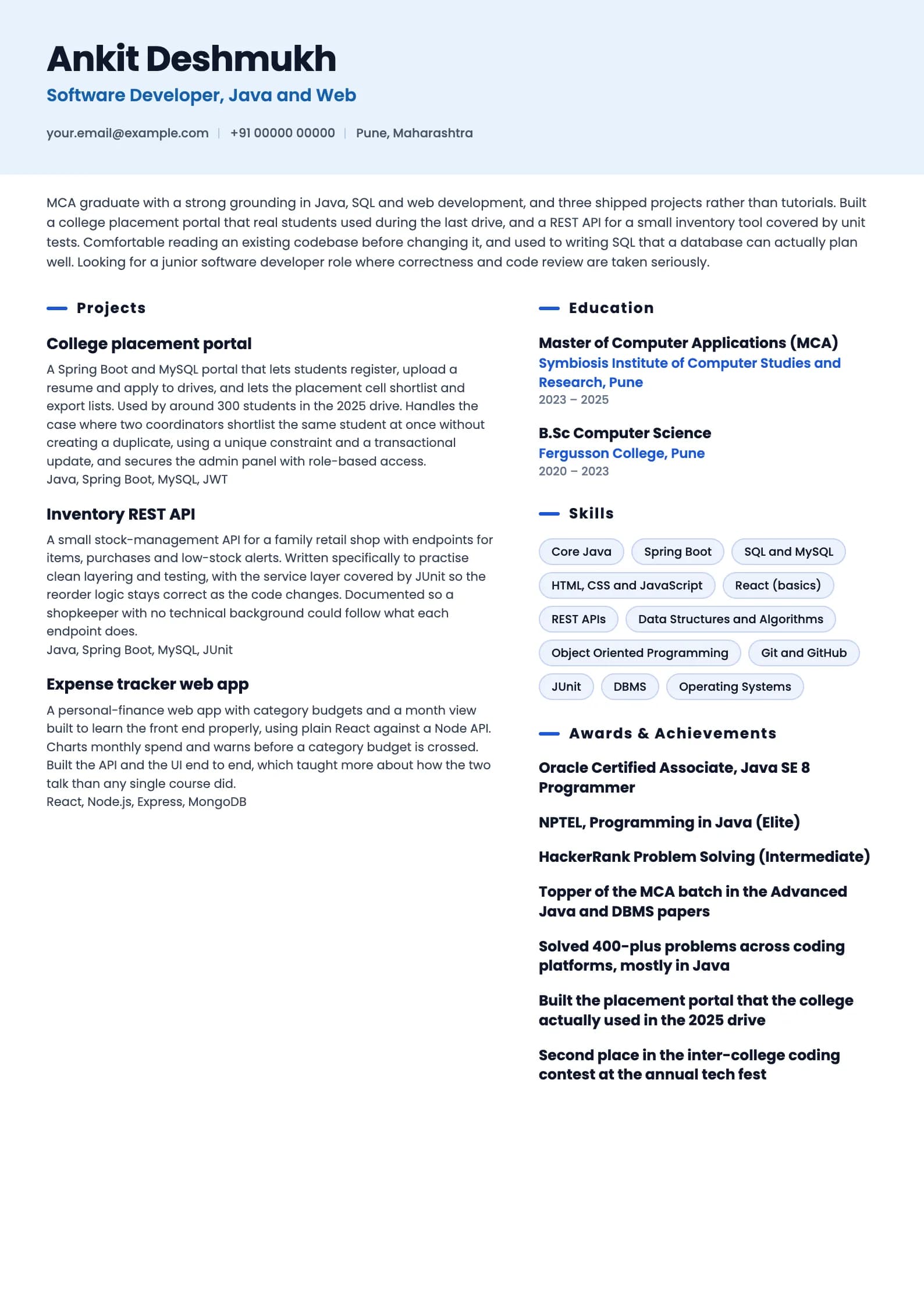
An MCA is a two-year jump straight at software work, so the resume has to prove you can build, not just that you sat through the degree. The trap is a page that lists Java, Python, DBMS and a mini project in one line and hopes a recruiter fills in the rest. Below are three complete MCA fresher resumes, one for a graduate with only academic projects targeting a developer role, one with a six month internship going for full-stack work, and one leaning into testing and QA. After the samples come the format rules, why projects sit above everything, the terms an applicant tracking system matches, and the mistakes that get a fresh MCA resume filtered before a person reads it.
Build my resumeMCA Fresher resume example, Fresher, developer track (0 years)
ai-era templateIs your resume good enough?
Upload the resume you have now and see what an applicant tracking system reads before a mca fresher recruiter ever does.
Free to run. Sign in with your mobile number to see your score.
MCA Fresher resume example, Fresher with internship (6 months)
professional template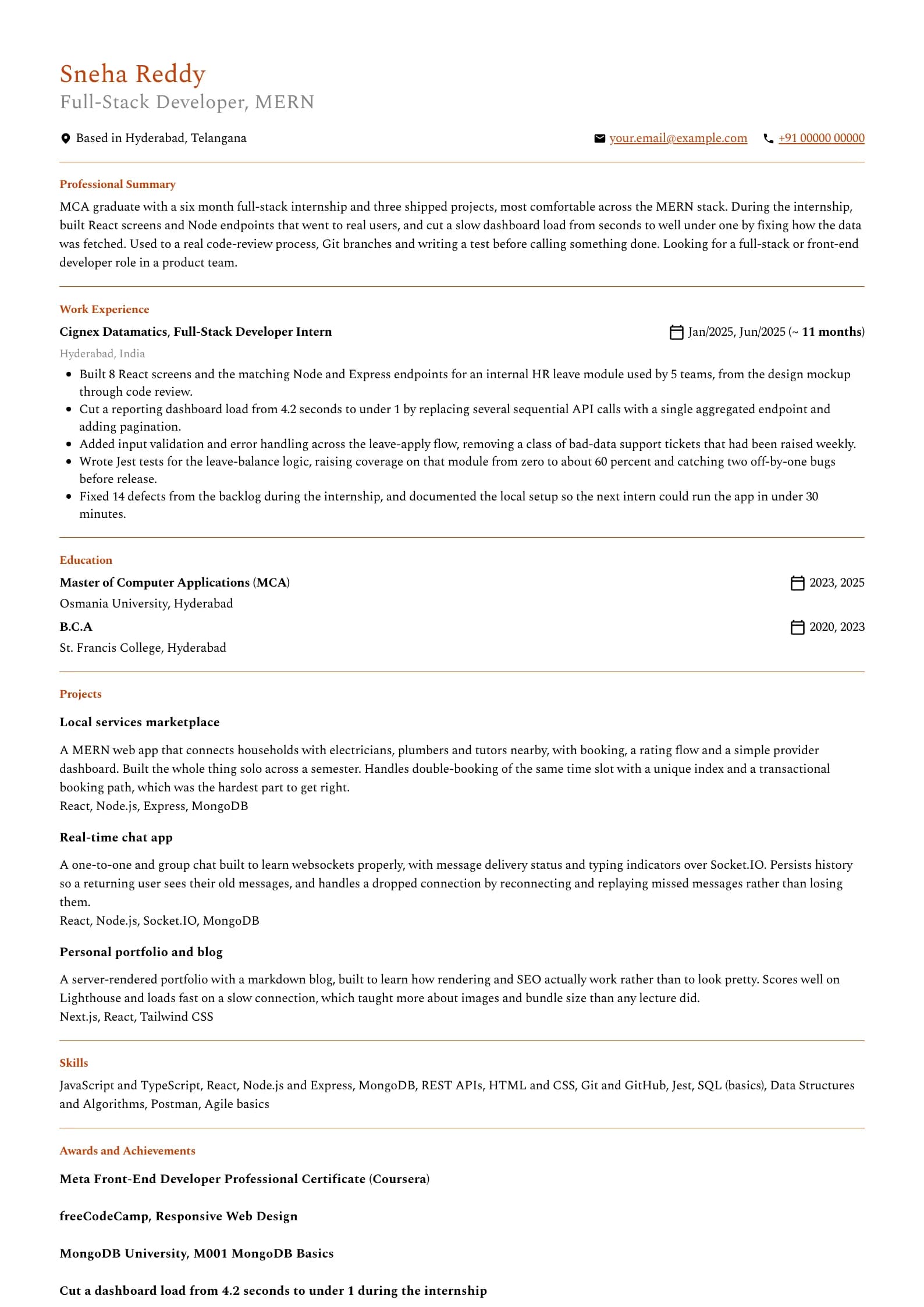
Want this structure with your own details? Build it in the resume builder.
MCA Fresher resume example, Fresher, QA and testing track (0 years)
modern template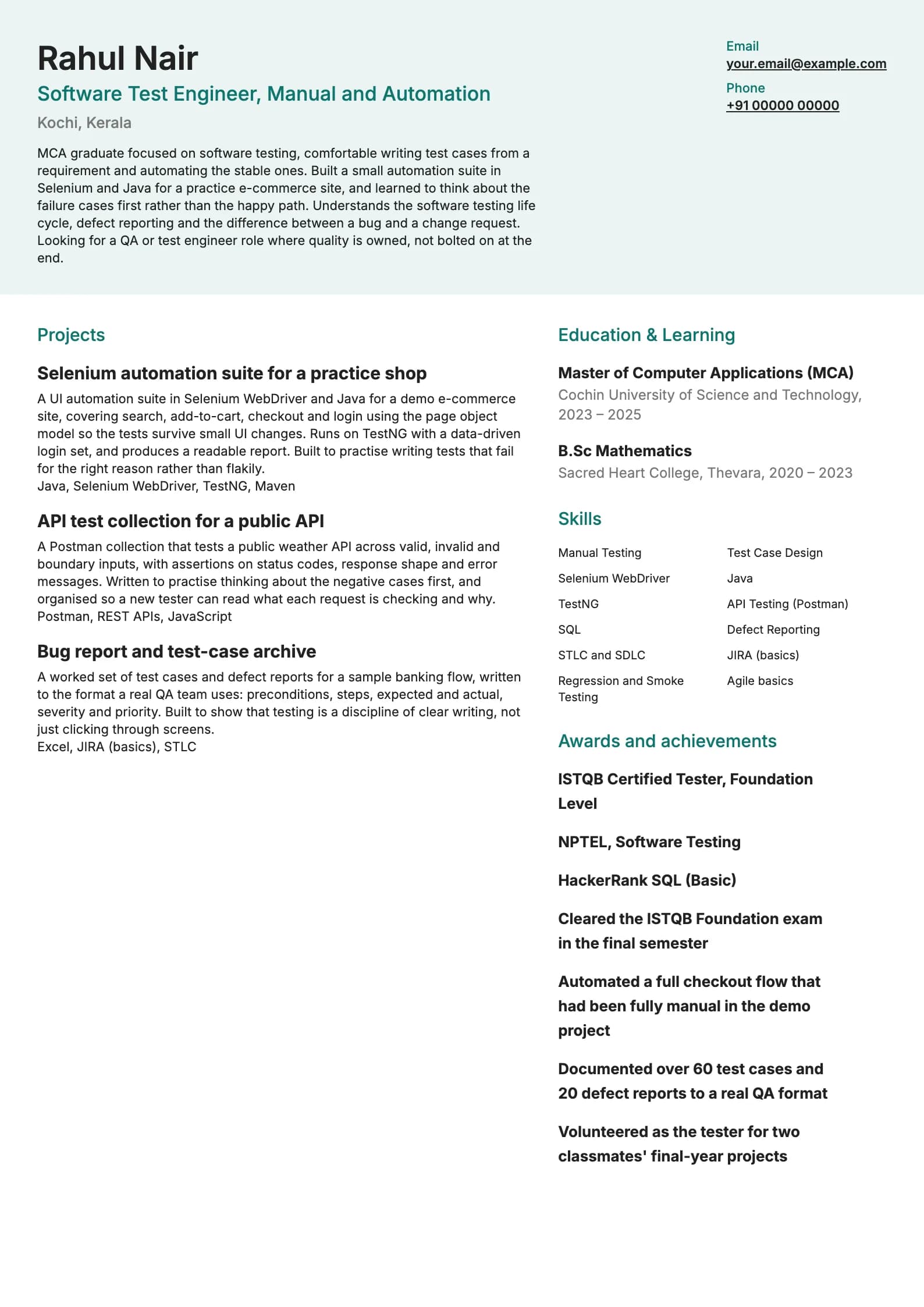
The format that works for an MCA fresher resume in India
Use a single-column, reverse-chronological layout. For a fresher that means the strongest evidence comes first: projects if you have no job, an internship if you have one. The old campus format that opens with a photograph, date of birth, father's name and a declaration wastes the top third of the page on facts no software recruiter is looking for. Every one of those lines is a line a project could have used. One page is the right length for almost every MCA fresher. You have two years of MCA, a bachelor's, some projects and maybe an internship, and all of it fits on one page if you cut the filler. A two-page fresher resume is nearly always a padded one-page resume with hobbies, a paragraph of soft skills and a declaration stretched to fill the gap. Order matters more for a fresher than for anyone else, because a reviewer decides in seconds whether there is any real building on the page. Lead with the summary, then projects or internship, then skills, then education, then certifications. If you have an internship, the internship goes above projects, because production work outranks academic work every time. Send a PDF unless the posting asks for DOCX, and name the file with your name and the target role, not resume_final2. Keep it one column all the way down, because two-column layouts confuse the parser that reads you first. The table below sets out the section order.
| Section | Where it goes | Why |
|---|---|---|
| Name and headline | Top, above everything | The headline is the role you want, developer, full-stack or QA. Recruiters match on it. |
| Professional summary | Directly under the header | Three lines. Your strongest stack, the fact that you build, and one concrete result. |
| Internship experience | Next, only if you have any | Even a six month internship outranks projects, because it is real work with real users. |
| Projects | Above skills for every fresher | This is the evidence you can build. Two well-described projects beat five named ones. |
| Skills | Below projects | Grouped: language, frameworks, data, tools. A defensible list, not a 30-item wall. |
| Education | Near the bottom, still visible | MCA first, then the bachelor's. Keep CGPA while it is fresh and good. |
| Certifications | After education, or beside skills if one or two | Name, issuing body, year. OCA, ISTQB and a stack certificate earn their place. |
Why projects carry an MCA fresher resume, and how to describe them
For an MCA fresher with no full-time job, projects are the resume. They are where a reviewer decides whether you can actually build software or only pass exams about it, so they sit high on the page and get the most space. This is the single highest-leverage part of an MCA fresher resume, and it is the part most candidates waste. The common failure is describing the stack instead of the software. "A web application built using Java, Spring Boot and MySQL with login and CRUD operations" appears on thousands of MCA resumes, which is exactly why it persuades no one. Describe what the thing does, who used it, and the one part that was genuinely hard. The placement portal in the first sample is stronger than a flashier project would be, because it names real users and one real problem: two coordinators must not shortlist the same student twice. Pick projects that show range rather than three versions of the same CRUD app. One with live users, one that demonstrates a real concept such as websockets, transactions or caching, and one with a tricky piece of logic is a far stronger set than three to-do lists. And whatever you claim, put the code where an interviewer can open it, because a repository with one commit called initial commit and a default README reads as a work sample of exactly nothing. A fresher's mini project and major project are fine to include, but rewrite them as software, not as academic deliverables. Drop the abstract, the guide's name and the phrase "this project aims to", and lead with what it does and who it is for.
Project description, MCA fresher
Weak
Final Year Project: an online college management system developed using Java, Spring Boot and MySQL with modules for students, faculty and admin performing CRUD operations.
Strong
College placement portal: registration and applications for 300 students in the 2025 drive, which stops two coordinators shortlisting the same student at once using a unique constraint and a transactional update, with role-based admin access.
Swaps a stack list and the word modules for real users and the one concurrency problem the project actually solves, which is what an interviewer can ask about.
For each project ask: what does it do, who used it, and what was hard. If your description does not answer all three, it is describing a tutorial, not your work. Rewrite until it only fits your project.
Writing an MCA fresher summary that is not the same as everyone else's
The block under your name is the part a reviewer is most likely to read, so it must carry three things: what you build, your strongest stack, and one concrete piece of evidence. Three or four lines, no adjectives that cannot be checked. Most MCA freshers write an objective instead of a summary, and the objective is nearly always the same sentence: seeking a challenging position in a reputed organisation to utilise my skills. It tells the reader nothing they did not already assume from the application. Replace it with a summary. An objective describes what you want; a summary describes what you have already done, and only one is evidence. The honest worry is that a fresher has nothing to summarise. Look at the samples. The developer summary names Java and SQL, points at a portal with real users, and names one hard problem. The full-stack summary names a real latency win from the internship. The QA summary states a specialisation and the concept behind it. All three are built from projects, one internship and a clear focus, and none of them uses "passionate about coding", a phrase so common on graduate resumes that it now carries no information at all. A practical test: read your summary and ask whether a classmate with the same MCA and the same certifications could paste it onto their resume unchanged. If they could, it describes the degree, not you. Add the specific project, the specific number and the specific focus until it stops being transferable.
Professional summary, MCA fresher
Weak
A hardworking and passionate MCA graduate seeking a challenging position in a reputed organisation to utilise my technical skills and grow with the company.
Strong
MCA graduate comfortable in Java, Spring Boot and SQL, with a placement portal used by 300 students in the last drive and an inventory API covered by unit tests. Looking for a junior developer role where code review is taken seriously.
Trades a stock objective and self-praise for a real stack, a project with users and a specific thing built, all of which a reviewer can probe.
The skills section: grouped, honest, and short enough to defend
An MCA fresher's skills section has two readers with opposite tastes. The parser wants literal terms it can match, Java and MySQL and React. A human wants a short, organised list that signals what kind of developer you are becoming. Grouping serves both. Group by function rather than one long line. Language, frameworks, databases, tools and concepts works for almost any MCA fresher. The exact headings matter less than the fact that structure exists. Write names the way the industry writes them: Spring Boot not Springboot, JavaScript not Java Script, MongoDB not Mongo DB. A parser matches on strings, and a misspelt technology quietly fails the search. Ten to fifteen skills is the working range for a fresher. Below eight the section looks thin. Above twenty it stops being a signal and starts looking padded, and MCA resumes are especially prone to listing an entire syllabus: C, C++, Java, Python, PHP, HTML, CSS, JavaScript, SQL, MongoDB, Android, Data Mining and Cloud Computing when the candidate can really defend three of them. The list is a contract, and every item is a question you have agreed to answer in the interview. Do not include a star rating or a percentage bar next to each skill. Nobody agrees on what four stars in Java means, and it invites an argument you cannot win. Let the projects prove the depth instead, and keep the section to what you would be comfortable being tested on.
| Group | What goes in it | How many |
|---|---|---|
| Language | The one or two you actually build in: Java, Python, JavaScript | 1 to 3 |
| Frameworks | Spring Boot, React, Node and Express, whatever your projects use | 2 to 4 |
| Databases | MySQL, PostgreSQL, MongoDB | 1 to 3 |
| Tools | Git, Postman, JUnit or Jest, an IDE, Maven | 3 to 5 |
| Concepts | DSA, OOP, DBMS, REST, operating systems | 3 to 5 |
Skills section, MCA fresher
Weak
Skills: C, C++, Java, Python, PHP, R, HTML, CSS, JavaScript, jQuery, Bootstrap, SQL, MySQL, Oracle, MongoDB, Android, Machine Learning, Cloud Computing, Data Mining, MS Office, Photoshop, Tally
Strong
Language: Java, JavaScript. Frameworks: Spring Boot, React. Databases: MySQL, MongoDB. Tools: Git, Postman, JUnit. Concepts: DSA, OOP, DBMS, REST APIs.
Cuts the syllabus dump and the unrelated tools, keeps only what the projects can back, and groups it so a human reads the whole thing in one pass.
Turning an internship into experience bullets that count
If you have an internship, even a short one, it is the most valuable section on the page, so treat it like real work rather than a line that says intern at a company for six months. Every bullet should follow the same shape as a senior engineer's: an action verb, the specific thing you built or changed, and what measurably moved. Start with the outcome and work backwards. Freshers tend to write the task first, which produces bullets like worked on the front end using React and helped the team. Ask instead what was different after you shipped: a screen exists that did not, a load time dropped, a class of bug stopped appearing, a test suite covers logic it did not before. Then write the sentence that ends in that fact. You will have fewer numbers than an experienced developer, and smaller ones, and that is fine. A dashboard from 4.2 seconds to under 1, coverage from zero to sixty percent, fourteen defects fixed: these are honest and specific. Where you truly have no number, give scope instead, such as how many screens, how many endpoints or how many teams used what you built. Be honest about what you did versus what the team did. An interviewer will ask, and there is no faster way to lose credibility than claiming a result the whole team delivered. Use I built and I fixed for your work, and describe the team's work as the context it was.
| What you did in the internship | Weak bullet | Strong bullet |
|---|---|---|
| Built some UI screens | Worked on front-end development using React | Built 8 React screens and their Node endpoints for an HR module used by 5 teams |
| Made something faster | Improved the performance of the dashboard | Cut a dashboard load from 4.2s to under 1 by collapsing several calls into one endpoint |
| Wrote some tests | Was involved in testing the application | Wrote Jest tests for the leave logic, taking coverage from 0 to about 60 percent |
| Fixed bugs | Fixed various bugs assigned to me | Fixed 14 backlog defects and documented local setup so the next intern started in 30 minutes |
Where education and CGPA belong on an MCA fresher resume
For an MCA fresher, education sits near the bottom but still clearly visible, because unlike an experienced hire you do not yet have shipped systems to lead with. List the MCA first, then the bachelor's: degree, institution, years. That is the whole entry for most people. Keep your MCA CGPA or percentage while you are a fresher and it is reasonable, roughly 7.5 out of 10 and above, because campus and early-career screening still filters on it, and some service companies set a hard cutoff. If your MCA score is strong, lead the education line with it. If a semester or two was weak but the overall number is fine, the aggregate is what to show. Once you have your first job, the number can go. If your bachelor's is also computer science, it is worth a full line for continuity. If it is unrelated, a B.Com or a B.Sc in another subject, keep it to a single line for context and let the MCA and the projects carry the technical weight. A career switch into software through an MCA is common and respected in India, so there is no need to hide or explain the earlier degree. Coursework lines are optional and only worth it when directly relevant to the target role: data structures, DBMS and operating systems for a developer role, software testing for a QA role. Skip generic mathematics and management papers. And skip school details entirely once you hold a degree.
Getting an MCA fresher resume through the applicant tracking system
An applicant tracking system is a parser and a search index, not a judge. It reads your file, tries to break it into name, dates, education, employers and skills, and stores the result so a recruiter can search across candidates. For a fresher applying to mass campus and off-campus drives, the ATS is often the first thing that ever touches your resume, so it has to parse cleanly. Almost every ATS problem is a layout problem, not a wording one. The layout rules are short. One column. Standard section headings, so use Work Experience or Internship, Projects and Skills rather than clever alternatives like My Journey or My Toolbox. No text inside images, because a logo strip or a skills graphic reads as blank space. Keep your name, degree and role in the body of the page, not only in a header or footer region that some parsers drop. On wording, mirror the language of the job description where it is honest. If the posting says Java Developer, make sure the words Java and developer appear in your summary and skills. If it says React, write React, not just JavaScript. Spell out an acronym alongside its short form at least once, for example DSA (data structures and algorithms), so both searches find you. Keyword stuffing does not work, and a hidden block of white-text keywords is caught quickly and is worse than being filtered. Write real project and internship bullets that naturally contain the right terms, because a bullet describing what you built in Spring Boot contains the word Spring Boot in a context that survives human review too. Then save as a PDF with real text and confirm you can select and copy a sentence from it. If you cannot select the text, neither can the parser.
Test your own file before you send it. Copy the text out of your PDF into a plain text editor. Whatever reads cleanly there is roughly what the parser sees, and anything scrambled or missing is a real risk in a drive that shortlists by keyword.
What gets an MCA fresher resume rejected
Most rejections at the resume stage are not close calls. They come from a small set of recurring problems, and every one of them is fixable in an afternoon. The list below covers what campus and off-campus recruiters see most often on MCA fresher resumes, in rough order of how much damage each one does.
- A syllabus dump for a skills section: every language and tool from two years of coursework listed as if all of it is defensible. List what your projects use.
- Projects described as academic deliverables, with an abstract, a guide's name and the phrase this project aims to, instead of what the software does and who used it.
- A generic objective line. Replace it with a summary that states your stack, that you build, and one concrete result.
- No live code anywhere for a developer role, or a GitHub link to a repository with one commit and a default README.
- A photo, date of birth, marital status, father's name and a declaration at the top, taking the space two projects should have.
- The same CRUD project described three times to fill the projects section, when two projects that show range would be stronger.
- An internship reduced to a single line that names the company and the dates but not one thing you built or fixed.
- Fake or borrowed numbers a fresher cannot defend, like improved performance by 90 percent, that collapse under one interview question.
- Spelling the technology wrong, writing MangoDB for MongoDB or Springboot for Spring Boot, which fails the parser search and undoes an otherwise strong page.
- Two pages of padding, with hobbies, a soft-skills paragraph and a references-available line stretched to fill a second page that says nothing.
Read your resume aloud once before sending it. Any line you would be embarrassed to defend to an interviewer's face is a line to cut or rewrite before it goes out.
Skills to put on a mca fresher resume
Technical
- Core Java
- Python
- JavaScript
- Spring Boot
- React
- Node.js and Express
- SQL and MySQL
- MongoDB
- REST APIs
- Data Structures and Algorithms
- Object Oriented Programming
- DBMS
- Operating Systems
- Manual and Automation Testing
Tools and platforms
- Git and GitHub
- Postman
- JUnit
- Jest
- Selenium WebDriver
- TestNG
- Maven
- VS Code
- IntelliJ IDEA
- JIRA
- MySQL Workbench
- Docker (basics)
Working skills
- Problem solving
- Code review readiness
- Clear written documentation
- Team collaboration
- Time management
- Willingness to learn
- Attention to detail
- Communication
Certifications worth listing as a mca fresher
| Certification | Full name | Worth it for |
|---|---|---|
| OCA Java | Oracle Certified Associate, Java SE Programmer | The entry-level Oracle Java certification, worth doing for an MCA fresher on a developer track who wants a clean, verifiable Java signal on a resume with no work history. Most useful in campus and service-company hiring. Drop it once you have shipped production Java or hold the professional-level OCP. |
| ISTQB Foundation | ISTQB Certified Tester, Foundation Level | The standard entry credential for anyone targeting QA or software testing, and the fastest way for an MCA fresher to signal a genuine testing focus rather than defaulting to it. Widely recognised by Indian service companies for junior test roles, and worth pairing with a small Selenium project. |
| Meta Front-End | Meta Front-End Developer Professional Certificate | A structured Coursera track that suits an MCA fresher aiming at front-end or full-stack roles, since it covers React and modern JavaScript in depth. It works best when your projects use the same stack, so the certificate and the code reinforce each other rather than standing alone. |
| AWS CCP | AWS Certified Cloud Practitioner | An entry cloud certification worth it for an MCA fresher who wants the AWS keyword on the page and is applying where deployment matters. It is broad rather than deep, so treat it as a foundation, and prefer a hands-on developer or associate track later once you have deployed something real. |
| NPTEL DSA | NPTEL, Data Structures and Algorithms (Elite or above) | A credible academic signal for an MCA fresher whose interviews will lean on data structures, which most developer interviews in India do. An Elite or higher grade is worth listing; a plain completion certificate is weaker, so pair it with a visible record of solved problems. |
Keywords an ATS scans for in a mca fresher resume
These are the literal terms a parser matches against the job description. Use the ones that are true of you, in the sentences where you did the work, not as a list at the bottom.
- mca fresher
- software developer
- junior developer
- full stack developer
- core java
- spring boot
- react
- node js
- javascript
- sql
- mysql
- mongodb
- REST API
- data structures
- object oriented programming
- dbms
- manual testing
- selenium
- git
- internship
MCA Fresher resume FAQ
What salary can an MCA fresher expect in India?
Most MCA freshers start between 3.5 and 6 LPA in service companies, with product firms and strong startups paying 7 to 12 LPA and above for a candidate who can clearly demonstrate building and solve a coding round. Mass recruiters running campus drives often anchor around 3.5 to 4.5 LPA. The single biggest lever on the offer is not the college but whether the resume and the interview show real projects and data-structures competence, which is what pushes a fresher into the higher band.
How long should an MCA fresher resume be?
One page. An MCA fresher has two years of MCA, a bachelor's, a few projects and maybe an internship, and all of it fits on a single page once the filler is cut. A two-page fresher resume is almost always a one-page resume padded with hobbies, a soft-skills paragraph and a declaration. If you are struggling to fit one page, tighten project descriptions to three lines each and drop generic coursework.
Should an MCA fresher put projects above education?
Yes, put projects above education and above skills, second only to an internship if you have one. With no full-time roles, projects are the strongest evidence that you can build software rather than only pass exams about it. Describe each as what it does, who used it and what was hard, and pick projects that show range: one with live users, one that demonstrates a concept, and one with tricky logic. Education still stays on the page, just lower.
Do I need work experience to get shortlisted as an MCA fresher?
No, but you do need evidence of building. Recruiters hiring MCA freshers expect no full-time experience, so they read your projects and any internship as the proxy for it. A candidate with two well-described projects and live code on GitHub is stronger than one with an internship line that names only a company and dates. If you can add even a short internship or an open-source contribution, it helps, but strong projects can carry the page alone.
Which certifications help an MCA fresher most?
The ones that match your target role and are backed by a project. For a developer track, OCA Java or a stack certificate like the Meta Front-End certificate; for QA, the ISTQB Foundation is close to standard; for cloud-facing roles, the AWS Cloud Practitioner. A certificate helps most when your projects use the same technology, so the two reinforce each other. Avoid a long list of unrelated course completions, which reads as collecting badges rather than depth.
How do I write an MCA fresher resume with no experience?
Lead with the summary, then projects, then skills, then education. Treat each project like a job: what it does, who used it, what you owned and what changed because it exists. Course projects count, a tool you built to automate something annoying counts, and a small open-source fix counts. Add anything checkable, such as an OCA or ISTQB certification, a coding-platform record or a public GitHub, because a verifiable fact carries far more weight than an adjective like passionate or hardworking.
Does an ATS reject two-column MCA fresher resumes?
It does not reject them outright, but some parsers read multi-column layouts out of order, which interleaves your sidebar with your projects and produces nonsense in the recruiter's search view. Since MCA freshers apply to high-volume drives that shortlist by keyword, a clean single-column layout is the safer choice, which is why all three samples above use one. Test your file by copying the text out of the PDF into a plain editor and checking it reads in order.
Is an MCA still worth it, and does the resume need to hide a non-CS bachelor?
An MCA remains a common and respected route into software in India, especially for graduates whose bachelor's was not computer science. There is nothing to hide. Keep a non-CS bachelor as a single line for context and let the MCA, the projects and any internship carry the technical story. A career switch into software is a normal thing to have done, and a strong projects section proves the switch worked better than any explanation would.
Should I mention my MCA CGPA on the resume?
Yes, while you are a fresher and it is reasonable, roughly 7.5 out of 10 and above, because campus and early-career screening still filters on it and some service companies set a hard cutoff. Show the aggregate rather than individual semester scores. If your MCA number is strong, put it on the education line prominently. Once you have your first full-time job, the CGPA can come off, because shipped work is a better signal than a number from your student years.
Related resume examples and guides
Build your MCA fresher resume in any of these formats
Start from a blank resume or upload the one you have. Goodspace renders it in 24 templates, keeps it to one clean page, and flags the developer, full-stack and QA keywords an applicant tracking system will look for, along with the padding it will not credit.
Build my resume