BCA Fresher Resume Format, with 3 Full Samples
A BCA fresher competes with B.Tech graduates for the same entry IT roles, so the resume has to prove the skill directly rather than lean on the degree. That means projects that work, one internship framed as a result, and a skill set an interviewer can probe. Below are three complete one-page resumes, one for a web developer, one for a software tester moving toward automation, and one for an IT support and systems role. After the samples come the format rules, how to describe a project so it survives an interview, the terms an applicant tracking system matches, and the mistakes that filter a BCA fresher before a human reads the page.
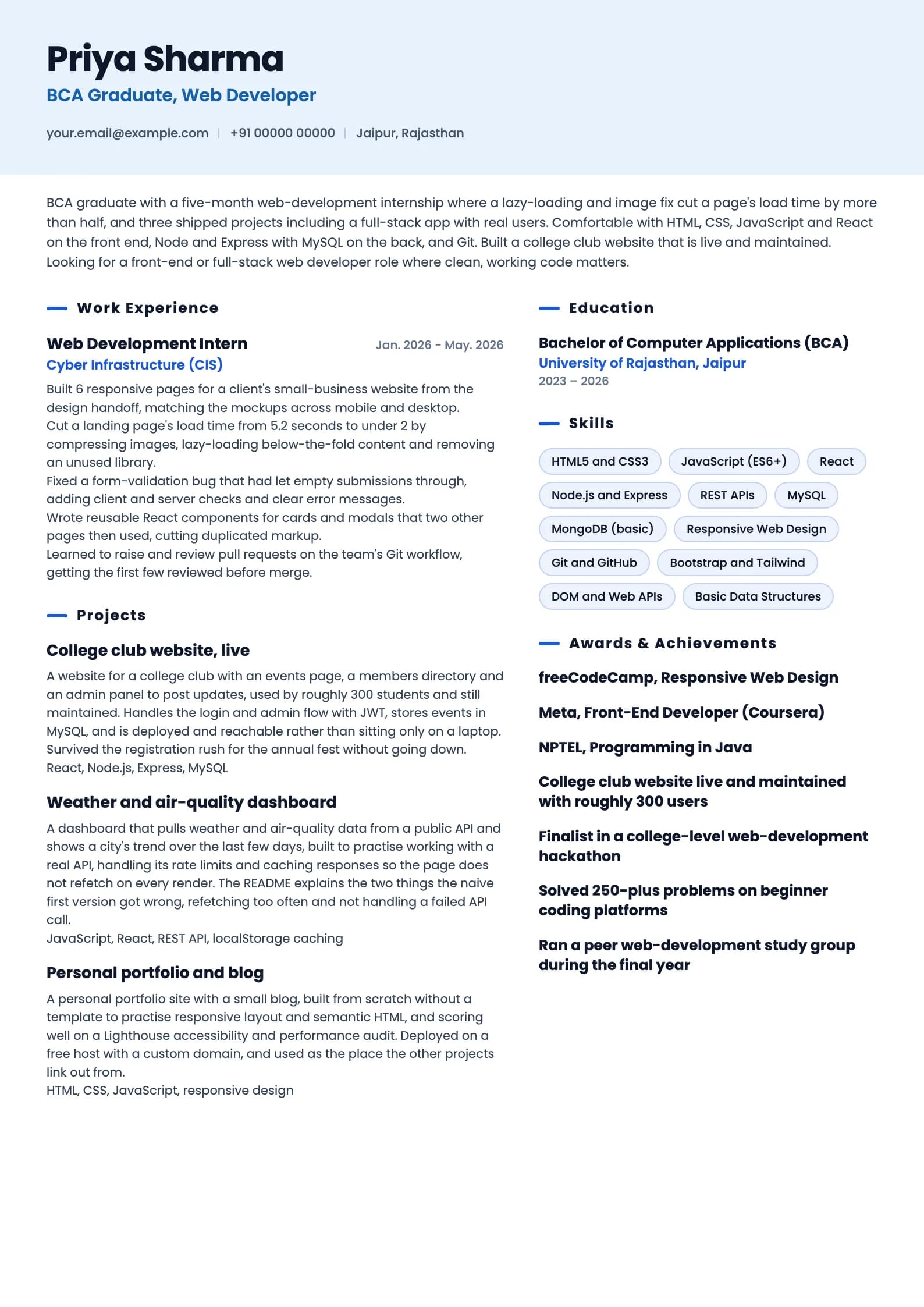
Build my resumeBCA Fresher resume example, Web development
ai-era templateIs your resume good enough?
Upload the resume you have now and see what an applicant tracking system reads before a bca fresher recruiter ever does.
Free to run. Sign in with your mobile number to see your score.
BCA Fresher resume example, Software testing
professional template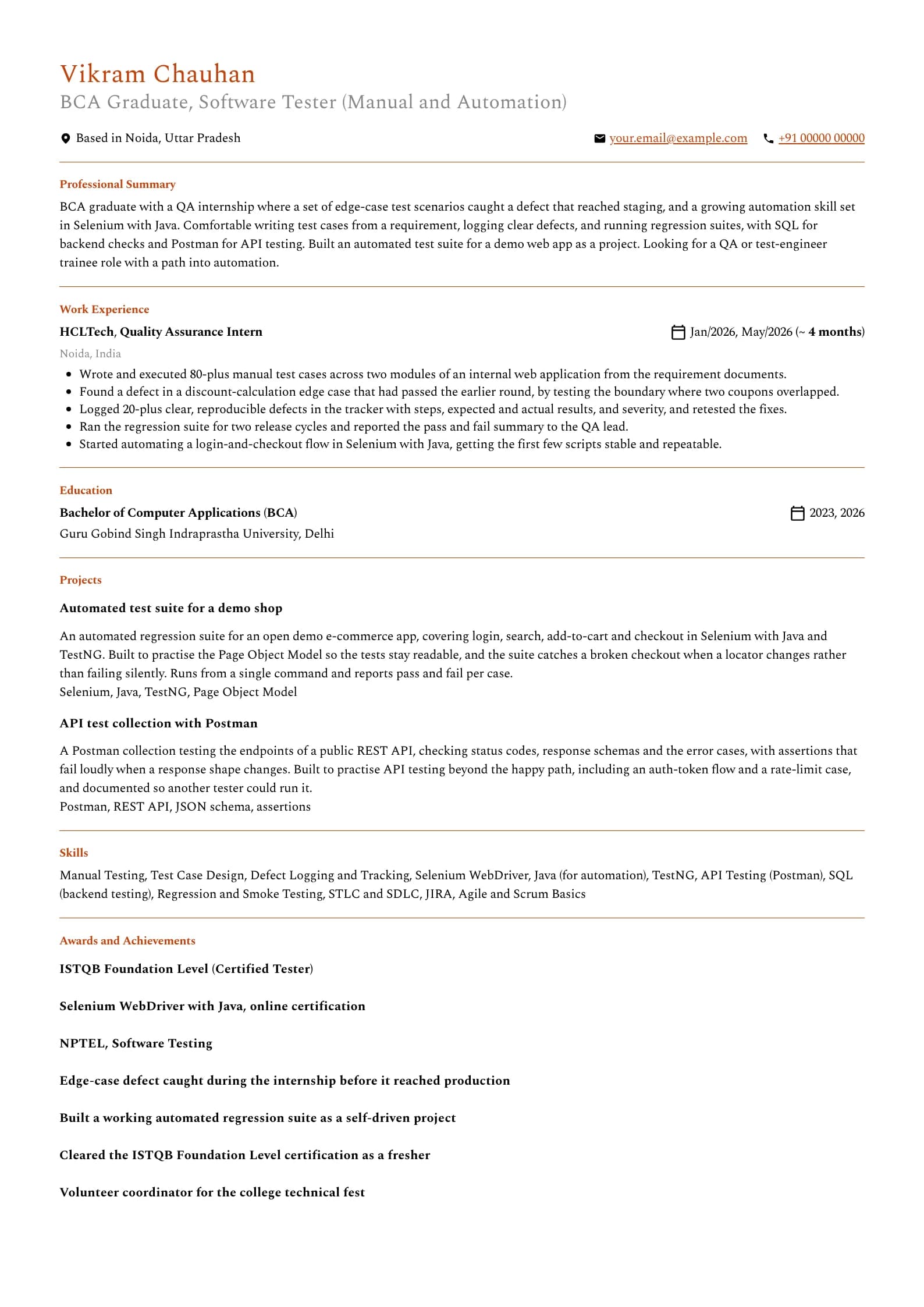
Want this structure with your own details? Build it in the resume builder.
BCA Fresher resume example, IT support and systems
minimalist template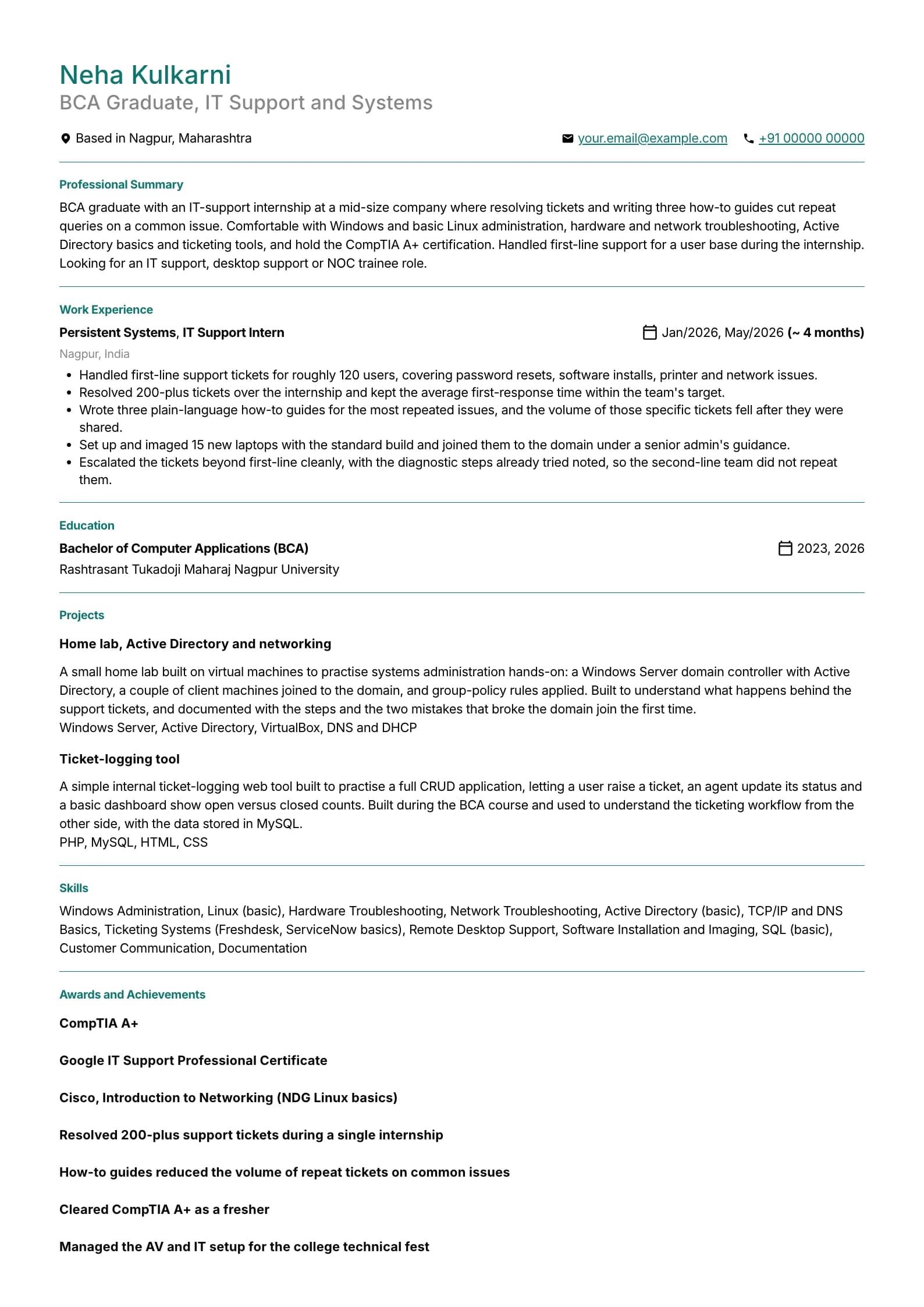
The format that works for a BCA fresher resume
A BCA fresher resume is one page, reverse chronological, and single column. A BCA competes for the same entry IT roles as B.Tech graduates, and the resume cannot lean on the degree to make up the difference, so it leads with the skill and the projects and keeps the education near the bottom, exactly as a B.Tech fresher's does. One page is the rule. You have projects, one internship, a degree and a few positions of responsibility, and all of it fits on a page once the objective and the hobbies come off. A second page on a fresher resume signals you cannot tell strong evidence from weak. Four things belong nowhere on the page: a photograph, date of birth, marital status and father's name. They survive from an old campus template and add nothing an IT recruiter wants. Every line they take is a line a project could have used. State the target role in the headline, not just the degree. "BCA Graduate, Web Developer" or "BCA Graduate, Software Tester" tells a recruiter which pile you belong in, where "BCA Fresher looking for opportunities" makes them guess. Send a PDF named with your own name and the role. The table below sets the section order.
| Section | Where it goes | Why |
|---|---|---|
| Name and headline | Top, above everything | Degree plus target role, so a recruiter places you in seconds. |
| Professional summary | Directly under the header | Three lines. Target role, the internship, and the one strongest project. |
| Projects | Near the top, above the internship | Your portfolio. A BCA proves the skill here, since the degree will not. |
| Internship | Below projects, as a work block | The one place you did real work. Frame it as a result, not tasks. |
| Technical skills | Below projects and internship | Grouped by function. Tools you can defend, not the syllabus. |
| Education | Near the bottom, with the BCA first | Degree, institution, years, CGPA while it is strong. |
| Certifications and achievements | Bottom | ISTQB, A+, coding counts, hackathons. Verifiable signals. |
Projects are how a BCA proves the skill
For a BCA fresher, projects carry more weight than they do for almost anyone, because you are competing against B.Tech graduates for the same roles and the projects are where you close that gap. They sit near the top, get the most space, and are where an interviewer decides whether you can actually build software or only pass exams about it. The common failure is describing the stack instead of the software. "A web application built using HTML, CSS, JavaScript and MySQL" is a line thousands of BCA resumes share. Describe what the thing does, who uses it, and the one part that was genuinely hard. The strongest entries in the samples name a real difficulty: a live site that survived a registration rush, an API dashboard that had to handle rate limits and failures, a test suite that catches a broken checkout when a locator changes. One live, deployed project is worth several that only run on your laptop. "Live and reachable" is the phrase a web recruiter reads as real, because it means you dealt with hosting, a domain and the things that break in production, not just the happy path in a dev server. If you can deploy one project, do, and say so in plain text. Pick projects that show range rather than three versions of the same tutorial. One deployed with real users, one that works with a real API or a real concept like caching or automation, and one that shows a different skill is a stronger set than five CRUD apps. Assume the interviewer will open your code, so fix a repository with one commit called "initial commit" before you link it.
| Target role | A project should prove | Name the hard part |
|---|---|---|
| Web developer | You ship working, deployed software | Real users, a real API, deployment, responsiveness |
| Software tester | You can find defects and automate | The edge case caught, the Page Object Model, the flaky test fixed |
| IT support / systems | You understand systems hands-on | The home lab, the domain join, the diagnosis path |
| App developer | You can build and run a mobile app | The offline case, the state bug, the store deployment |
Project description, web developer
Weak
College Website: a web application built using HTML, CSS, JavaScript and MySQL with login and admin functionality.
Strong
College club website, live and maintained for 300 students, with an events page, a members directory and a JWT-secured admin panel, deployed and reachable rather than only on a laptop, holding up through the fest registration rush.
Swaps a stack list and "admin functionality" for real users, a deployed and reachable site, and the load it survived.
Making one internship count
Most BCA freshers have one internship, and it is the only place on the page where you did real work for a real organisation, so it is worth framing carefully. The mistake is describing what you were assigned rather than what changed because of you. "Worked on the project under the senior developer" or "assisted the support team" is a task list, and every intern can write it. Frame the internship as a result. What problem were you pointed at, what did you build or find, and did it move a number. The samples follow this shape across roles: a load-time fix on a page, an edge-case defect caught before production, a set of how-to guides that cut repeat tickets. The verb, the change and the consequence are the bullet. A fresher's numbers are smaller, and that is honest. You are not claiming you transformed the company in five months. "Cut a page from 5.2 seconds to under 2" or "resolved 200-plus tickets and kept first-response time within target" are real intern-scale results, and they are more credible than a sweeping percentage an interviewer would doubt. Where you cannot claim a clean number, claim scope: six pages built, 80 test cases written, 15 laptops imaged. If your internship was mostly observation, say what you learned to do rather than inflating it. "Started automating a login-and-checkout flow in Selenium and got the first scripts stable" is a real, checkable skill gained, and it is stronger than claiming ownership of work you only watched.
Internship bullet, IT support
Weak
Assisted the IT support team with various tasks including tickets, installations and helping users with their problems.
Strong
Resolved 200-plus first-line tickets for roughly 120 users and wrote three how-to guides for the most repeated issues, after which the volume of those specific tickets fell.
Replaces "assisted" and "various tasks" with the ticket volume, the user base, and the guides that reduced repeat queries.
Ask of your internship bullet: what was different after I left. If the honest answer is a faster page, a defect caught, or a guide that cut tickets, name it. That beats "assisted the team" every time.
A summary, not an objective
The block under your name is the part a recruiter is most likely to read, so it should carry three facts: your target role, your internship in a clause, and the strongest project or result you have. Three or four lines, no adjectives a recruiter cannot check. The career objective, seeking a challenging position in a growth-oriented organisation to utilise my skills and knowledge, is the default on thousands of BCA resumes and tells a recruiter nothing new. Replace it with a summary. An objective describes what you want, a summary describes what you have already built, and only the second is evidence. Freshers often think they have nothing to summarise. The samples show otherwise: each names the target role, the internship in a phrase, and a concrete project or result, all built from coursework, one internship and projects. What each avoids is "passionate about technology and eager to learn", a phrase so common on fresher resumes that it now carries no information. The test is transferability. If a classmate with the same BCA could paste your summary onto their resume unchanged, it describes the degree, not you. Add the specific project, the specific number and the specific tool until it stops fitting anyone else.
Professional summary, software tester
Weak
A passionate and dedicated BCA graduate eager to learn and seeking a challenging position in a growth-oriented organisation to utilise my skills.
Strong
BCA graduate with a QA internship where an edge-case test scenario caught a defect before production, plus a Selenium automation suite built with the Page Object Model and the ISTQB Foundation certification.
Trades self-description and a wish for the target role, a concrete internship result, a named project and a real credential.
Technical skills: grouped, honest, and defendable
A BCA fresher skills section has two readers with opposite tastes. An applicant tracking system wants literal terms it can match, React and Selenium and Active Directory. A human interviewer wants a short, grouped list that signals what kind of candidate you are. Grouping by function serves both. Group rather than dumping one long line. For a web developer: front end, back end, data, tools. For a tester: testing types, automation, tools. For support: operating systems, networking, tools. The exact headings matter less than the fact that structure exists and a recruiter reads the section in one pass. Ten to fifteen skills is the working range for a fresher. Below eight it looks thin, above eighteen it stops being a signal and starts reading as the syllabus copied onto the page. Do not list every subject you studied, and do not pad with "MS Office", "internet browsing" and "typing", which read as filler on a technical resume and quietly undercut the real skills next to them. Every item is a question you have agreed to answer. Writing React means you can be asked how state works, writing Selenium means you can be asked about the Page Object Model, writing Active Directory means you can be asked what a group policy does. List what you can defend in a short conversation, be honest with the "basic" label where a skill is genuinely basic, and skip the star ratings, which only invite an argument.
Cut "MS Office", "typing" and "internet surfing" from a technical skills section. On a developer, tester or support resume they read as padding and make a recruiter doubt the real skills sitting beside them.
Where education and certifications belong
For a BCA fresher, education sits near the bottom of the page but stays substantial, because the degree and the CGPA are current screening signals that will fade once you have a couple of years of work. List the BCA first with the institution, the years and the CGPA. Keep the CGPA while it is strong, roughly 7.5 out of 10 and above, because many campus and mass recruiters apply an academic cut-off and a good number clears it for you. Add the twelfth marks as a compact line if they are strong, since some cut-offs look at the full record. Once you have a job, drop the school marks and eventually the CGPA, but as a fresher they still count. Because a BCA is competing with B.Tech graduates, certifications matter more here than they do for many freshers, and the right ones are role-specific and checkable. For web, a freeCodeCamp or Meta front-end certificate. For testing, the ISTQB Foundation Level, which is the recognised QA credential. For support, CompTIA A+ and the Google IT Support certificate. Name the certification, the body and the year. One certification that maps to your target role and that you can back with a project is worth more than five generic ones. A page of ten online course badges reads as collecting rather than building, and it crowds out the projects that actually carry you. Keep the list to two or three that point at the role in your headline, and be ready to answer for each.
Getting a BCA fresher resume through the ATS
The mass IT recruiters who hire BCA and B.Tech freshers in volume run every resume through an applicant tracking system before a human sees it. The system is a parser and a search index, not a judge: it breaks your file into name, education, employers, titles and skills, then lets a recruiter search across thousands. Almost every ATS problem is a parsing problem, and parsing problems come from layout, not wording. The layout rules are short. One column, because a two-column template with a sidebar is read out of order by some parsers and interleaves your skills with your projects. Standard headings, so Projects and Work Experience rather than My Work and My Journey. No text inside images, because a logo strip reads as blank space. Nothing critical in the header or footer region, which some parsers drop. On wording, mirror the job description where it is honest. If the posting says manual testing, write manual testing. If it says React, write React rather than only "front-end frameworks". Include an acronym with its expansion once, for example "AD (Active Directory)", so both searches find you. Keyword stuffing does not work and is easy to catch. A hidden white-text block of every technology is worse than being filtered, because a recruiter who finds it stops trusting the page. Write real project and internship bullets that naturally contain the right terms, then test the file: copy the text out of your PDF into a plain editor, and if it reads in order there, the parser sees roughly the same.
Before you upload, copy the text out of your PDF into a plain text editor. Whatever reads in order there is roughly what the ATS sees. If your skills and projects are scrambled together, your two-column template is the cause.
What gets BCA fresher resumes rejected
Most rejections at the resume stage are not close calls, and for BCA freshers they cluster around a small set of recurring problems, all fixable in an afternoon. The list below is what campus recruiters and mass IT screeners see most often, in rough order of how much damage each does.
- A generic career objective instead of a summary. "Seeking a challenging position in a growth-oriented organisation" is on thousands of resumes and says nothing.
- Projects described by stack, not by what they do. "A web app using HTML, CSS and MySQL" is a line thousands of BCA candidates share.
- No target role in the headline, just "BCA fresher", forcing a recruiter to guess whether you want web, testing or support.
- "MS Office", "typing" and "internet surfing" padding a technical skills section and undercutting the real skills beside them.
- The internship written as "assisted the team with various tasks" instead of the one result you produced.
- A photo, date of birth, marital status or father's name from an old campus template, taking space a project should occupy.
- Two columns and a decorative sidebar that parses out of order in an ATS, scrambling skills into projects.
- Only localhost projects, none deployed, when one live and reachable site would prove far more to a web recruiter.
- Spilling onto a second page. A fresher with one internship on two pages cannot tell strong evidence from weak.
- Typos in the technologies you claim, writing "Selenium" or "MongoDB" wrong, which undoes an otherwise careful resume.
Read your resume aloud once before sending it. If a line would embarrass you in front of an interviewer, a stack-list project or a "typing" skill, it is a line to cut or rewrite.
Skills to put on a bca fresher resume
Technical
- HTML, CSS and JavaScript
- React
- Node.js and Express
- SQL and MySQL
- Manual Testing
- Selenium and TestNG
- API Testing (Postman)
- Windows and Linux Basics
- Networking Fundamentals
- Active Directory (basic)
- Java (basic)
- PHP (basic)
Tools and platforms
- Git and GitHub
- VS Code
- JIRA
- Postman
- MySQL Workbench
- Chrome DevTools
- Ticketing Systems (Freshdesk, ServiceNow)
- VirtualBox
- Bootstrap and Tailwind
- Selenium WebDriver
Working skills
- Problem solving
- Clear written communication
- Customer and user communication
- Attention to detail
- Willingness to learn
- Team collaboration
- Documentation
- Time management
- Patience under pressure
Certifications worth listing as a bca fresher
| Certification | Full name | Worth it for |
|---|---|---|
| ISTQB Foundation | ISTQB Certified Tester, Foundation Level | The recognised entry credential for a BCA fresher targeting software testing, a checkable proof of QA fundamentals that campus and service recruiters read. Worth doing before placements if testing is your track. Back it with an automation project, because the certificate proves theory and the project proves you can actually test. |
| CompTIA A+ | CompTIA A+ Certification | The baseline hardware-and-support certification for a BCA fresher aiming at IT support, desktop support or NOC roles. Recognised across IT-services and infrastructure hiring. Pairs naturally with a support internship, and the Google IT Support certificate complements it without repeating it. |
| Meta Front-End | Meta Front-End Developer Professional Certificate (Coursera) | A structured front-end certification covering HTML, CSS, JavaScript and React, useful for a BCA fresher targeting web development who wants a recognised credential behind their projects. A supporting signal, not a substitute for a deployed project the recruiter can actually open. |
| freeCodeCamp | freeCodeCamp Responsive Web Design Certification | A free, project-based web certification covering responsive layout and semantic HTML and CSS, a low-cost credible signal for a web-focused BCA fresher. Its value is the projects you build to earn it, so make sure those projects are on your resume, not just the badge. |
| Google IT Support | Google IT Support Professional Certificate | A beginner-friendly support and systems certification covering troubleshooting, networking and system administration basics, worth it for a BCA fresher moving into IT support. Recognised and accessible. Complements CompTIA A+ rather than replacing it, and a home-lab project shows the same skills in practice. |
| AWS CCP | AWS Certified Cloud Practitioner | A foundational cloud certification that adds a recognised keyword for any BCA fresher, and a small edge for those eyeing cloud or DevOps-adjacent support roles. Quick to earn and ATS-friendly. Skip the associate-level certs as a fresher unless you have actually deployed something to the cloud. |
Keywords an ATS scans for in a bca fresher resume
These are the literal terms a parser matches against the job description. Use the ones that are true of you, in the sentences where you did the work, not as a list at the bottom.
- bca fresher
- web developer
- software tester
- it support
- html css javascript
- react
- node.js
- manual testing
- selenium
- api testing
- sql
- mysql
- active directory
- networking
- internship
- project
- git
- troubleshooting
- ISTQB
- problem solving
BCA Fresher resume FAQ
What salary can a BCA fresher expect in India?
For most BCA freshers the first role is at an IT-services or support company, commonly in the 2.5 to 4.5 LPA band, similar to the entry offers B.Tech graduates receive at the same firms. Web development and software-testing roles at good product companies or strong startups pay more, roughly 4 to 8 LPA for a fresher who clears a real skills bar, and a strong deployed-project portfolio pushes you toward the higher end. IT-support and NOC roles typically sit in the 2.5 to 4 LPA range early on, rising with certifications like CompTIA A+ and hands-on experience.
Is a BCA enough, or do recruiters prefer B.Tech?
For most entry IT roles a BCA is enough, and BCA and B.Tech graduates compete for the same jobs at service companies. The difference the resume has to make up is that a BCA cannot lean on the engineering-degree signal, so it must prove the skill directly through deployed projects, a well-framed internship and role-specific certifications. A BCA fresher with a live web app or a working automation suite will out-compete a B.Tech fresher with only coursework, because recruiters hire on demonstrated skill, not the letters after the degree.
How long should a BCA fresher resume be?
One page, without exception. You have projects, one internship, a degree and a couple of positions of responsibility, and all of it fits on a page once the objective and hobbies come off. A recruiter reading hundreds of fresher resumes treats a two-page one as an inability to prioritise. If you are struggling to fit one page, describe two projects well instead of five badly, cut the syllabus and "MS Office" out of skills, and remove the objective.
How do I describe a project so it survives the interview?
Name what it does, who uses it, and the one part that was genuinely hard, then be ready to defend that part, because the interviewer will open your code or ask you to walk through it. "A live club site that survived the fest registration rush" or "a test suite that catches a broken checkout when a locator changes" shows you did the work, because you can only write it if you understand it. A deployed project beats a localhost demo, so host at least one and say it is live in plain text.
Which certifications actually help a BCA fresher?
Role-specific, checkable ones. For web, a Meta Front-End or freeCodeCamp certificate behind real projects. For testing, the ISTQB Foundation Level, which is the recognised QA credential. For IT support, CompTIA A+ and the Google IT Support certificate. Name the certification, the body and the year, keep the list to two or three that map to your target role, and back each with a project or an internship line. A wall of ten generic badges reads as collecting rather than building.
I have only one internship. Is that enough?
Yes, one relevant internship framed as a result is plenty for a fresher. What matters is describing it as what you produced, not what you were assigned: a page you made faster, a defect you caught before production, a set of guides that cut repeat tickets. Claim intern-scale numbers honestly rather than a sweeping percentage. If the internship was mostly observation, say what concrete skill you learned to do, because an interviewer will test any claim of ownership.
Should I list MS Office and typing speed as skills?
No, not on a technical resume for a developer, tester or support role. "MS Office", "internet surfing" and "typing speed" read as filler and quietly make a recruiter doubt the real technical skills sitting beside them. Use the skills section for the tools and technologies the role actually needs, grouped by function, and let it be short enough that every item is something you can defend in a short conversation. If a role specifically asks for data-entry speed, that is the only time typing belongs.
Does an ATS reject two-column resume templates?
It does not reject them outright, but some parsers read a two-column layout out of order and interleave your sidebar with your main content, so your skills land in the middle of your projects in the recruiter's view. A single-column layout removes the risk, which is why all three samples use one. Test your own file by copying the text out of the PDF into a plain text editor: if it reads in order there, it will most likely parse correctly.
Do I need a photo on a BCA fresher resume in India?
No. IT recruiters do not expect one, and it takes space a project or an internship result should occupy. The same goes for date of birth, marital status, father's name, nationality and a declaration paragraph, all of which come from an older campus template and add nothing to a technical screen. The only exception is where a specific posting or the placement cell explicitly asks for a photograph.
Related resume examples and guides
Build your BCA fresher resume in any of these formats
Start from a blank resume or upload the draft you have. Goodspace renders it in 24 one-page templates and flags the role keywords a recruiter's applicant tracking system will look for, and the padding like "MS Office" and "typing" it will not credit.
Build my resume