Market Research Analyst Resume Format, with 3 Full Samples
A market research analyst is hired on evidence that their research changed a decision, yet most research resumes list the methods and tools and never say what the study concluded or what the business did about it. Below are three complete resumes, one for a fresher with an internship and a strong dissertation, one for an analyst with four years running primary and secondary studies, and one for a senior analyst leading research and turning insight into strategy. After the samples come the format rules, the difference between listing SPSS and proving an insight, the terms a parser matches literally, and the mistakes that get a research resume screened out.
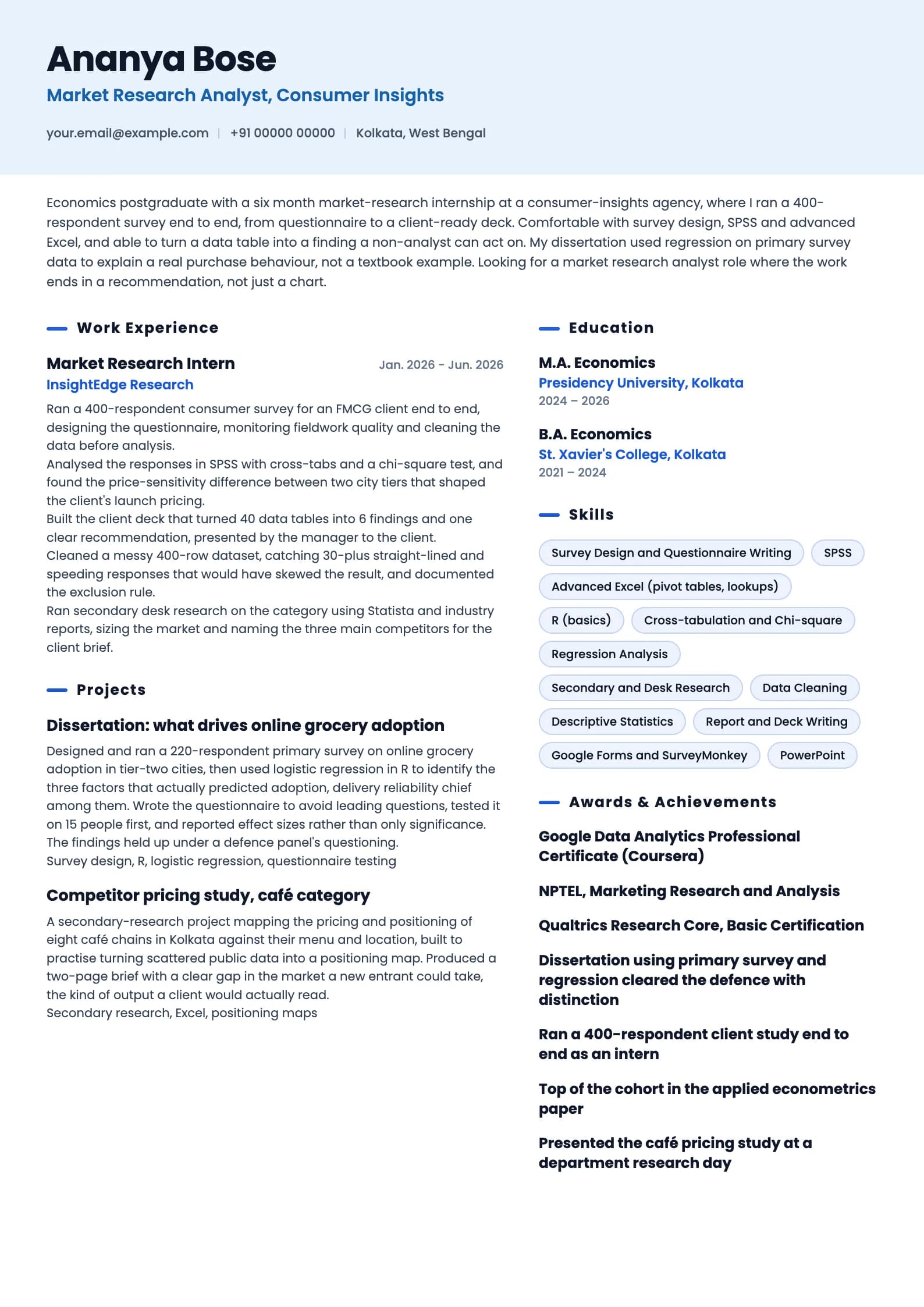
Build my resumeMarket Research Analyst resume example, Fresher (0 years)
ai-era templateIs your resume good enough?
Upload the resume you have now and see what an applicant tracking system reads before a market research analyst recruiter ever does.
Free to run. Sign in with your mobile number to see your score.
Market Research Analyst resume example, Mid-level (4 years)
professional template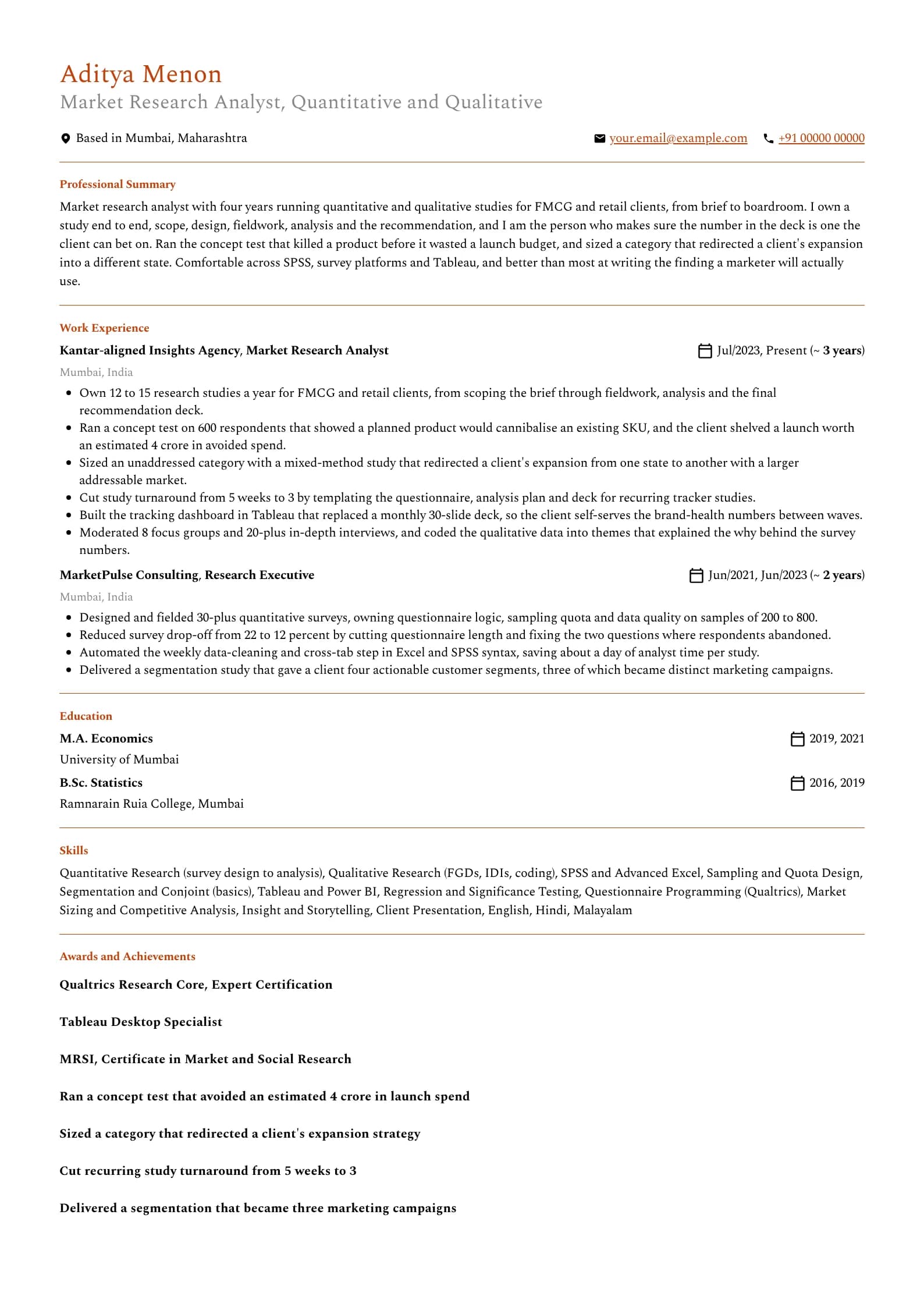
Want this structure with your own details? Build it in the resume builder.
Market Research Analyst resume example, Senior (9 years)
header-band template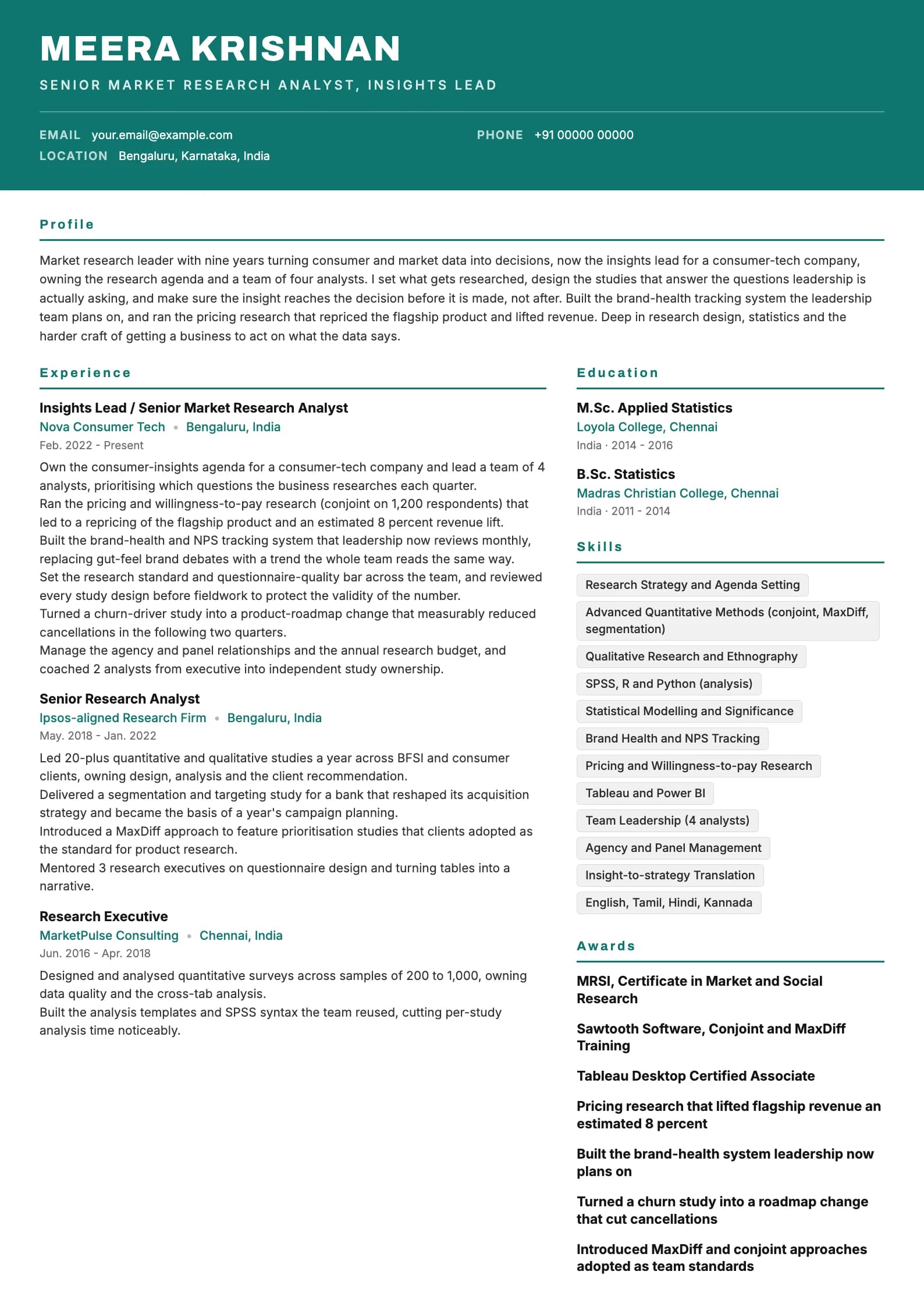
The format that works for market research analyst resumes in India
Reverse chronological is the layout to use. Most recent role first, work backwards, dates in plain view. A research hire is judged on a track record of studies that changed decisions, so a functional layout that groups everything under Skills and drops the dates reads as an attempt to hide a gap, and reviewers treat it that way. A gap is better explained in one honest line than buried. One page holds a fresher and most analysts up to roughly six years. Past that, a second page is fine when it carries real study work, named research that moved a decision, methods owned, a team led, rather than a longer tool list. A page two built from a competencies grid and a hobbies line is a padded one-page resume. Four things do not belong on this resume: a photograph, date of birth, marital status and father's name. They come from an older campus template and add nothing to a research screen, which is about the studies you ran and the decisions they shaped. Every line they take is a line an insight could have used. Send a PDF unless the posting asks otherwise, and name the file with your own name and market research analyst. Keep it a single column, because a two-column layout with a skills sidebar can parse out of order in an applicant tracking system. The table below sets the section order.
| Section | Where it goes | Why |
|---|---|---|
| Name and headline | Top, above everything | Headline names the role, market research or insights analyst. Recruiters match on it. |
| Professional summary | Directly under the header | Three lines. Years, research type, and one study that changed a decision. |
| Work experience | Next, for anyone with a job | Most recent first. Lead every bullet with a finding or a result, not a method. |
| Projects / dissertation | Above experience for freshers, below after that | For a fresher the dissertation is the evidence of a full research cycle. |
| Skills | Below experience | Grouped: methods, tools, analysis. Not a 30-item wall. |
| Education | Bottom, unless a fresher | Stats, economics or research background helps. Drop the percentage after your first job. |
| Certifications | After education | MRSI, Qualtrics, a stats or BI tool certificate. Name and year. |
Report the insight and the decision, not just the method
The single most common market research resume failure is a bullet that reads "conducted surveys and analysed data using SPSS" and stops there. It names the method and the tool and never says what the study found or what the business did about it. Research has no value until it changes a decision, and the resume has to carry that ending. Every strong research bullet has three parts: the study you ran, the finding it produced, and the decision it shaped. "Ran a concept test on 600 respondents that showed a planned product would cannibalise an existing SKU, and the client shelved a launch worth an estimated 4 crore" has all three. The method is there, but it is in service of a finding and a consequence, which is what a research manager is actually buying. Quantify the study and, where you honestly can, the decision. Sample size, response rate and turnaround describe the study's weight. The decision's value, a launch avoided, a price changed, a segment that became a campaign, a churn number reduced, is what proves the research mattered. You will not always have a rupee figure, and that is fine: "redirected a client's expansion into a state with a larger addressable market" is a real consequence stated without inventing a number. Name the methods precisely. Conjoint, MaxDiff, segmentation, concept testing, brand tracking and willingness-to-pay are specific techniques that tell a manager the level you work at. "Did quantitative and qualitative research" is generic. "Ran a conjoint study on 1,200 respondents" places you.
For every research bullet, ask: does this end in a finding and a decision, or does it stop at the method. If it stops at the method, add what the study concluded and what the business did, or the bullet is describing activity, not value.
A summary a research manager reads and trusts
A research hire is a trust hire, because leadership acts on the numbers you produce. The three lines under your name have to establish credibility fast: how long you have done research, what kind, and one study that changed a decision. No adjectives that cannot be checked. The old objective, seeking a challenging role in market research to apply my analytical and research skills, tells the reader nothing they did not assume from the application. Replace it with a summary. An objective is about what you want, a summary is about the research you have already done and the decisions it shaped, and only one of those wins an interview. Freshers think they have nothing to summarise. Look at the fresher sample: it names the internship, the 400-respondent study run end to end, the SPSS finding that shaped pricing, and a dissertation with real regression. That is a genuine summary built from one internship and a dissertation. What it avoids is "detail-oriented and analytical with a passion for consumer behaviour", a line so common on research resumes it now carries no information. A test: read your summary and ask whether a classmate with the same degree could paste it onto their resume unchanged. If they could, it describes the qualification, not you. Add the specific study, the specific method and the specific decision until it stops being transferable.
Professional summary, mid-level analyst
Weak
Detail-oriented and analytical market research analyst with 4+ years of experience in conducting surveys, data analysis and market studies, seeking a challenging role to apply my research skills.
Strong
Market research analyst with four years running quantitative and qualitative studies for FMCG and retail clients from brief to boardroom. Ran a concept test that shelved a launch worth an estimated 4 crore, and sized a category that redirected a client's expansion.
The rewrite trades self-description and a method list for the type of research, and two studies whose findings changed a real decision.
Experience bullets: study, finding, decision
Every strong bullet in the samples follows the same shape. It names the study you ran, states the finding, and closes with the decision it shaped or the number it moved. The study establishes the work. The finding shows you can read data. The decision proves it mattered. Start from the decision and work backwards. Analysts usually write the method first, "conducted a survey, analysed in SPSS, prepared a report", and never reach the consequence. Instead ask what the business did differently because of your study: a product shelved, a price changed, an expansion redirected, a segment turned into a campaign, a roadmap changed. Then write the sentence that ends in that fact. Vary the evidence so the resume does not read as one method repeated. Research honestly gives you sample size, response rate, study turnaround, method breadth, a decision's value, drop-off reduced, and process time saved. The mid-level sample uses several of these across its bullets, which reads as range rather than one survey described five ways. Where you cannot attach a decision's value, give the study's weight and the finding: "moderated 8 focus groups and 20-plus in-depth interviews, and coded the qualitative data into themes that explained the why behind the survey numbers" carries weight without inventing a rupee figure. Allocate bullets by recency. Current role gets five or six, the previous role three or four, anything older two.
| Level | What bullets must prove | Typical metric |
|---|---|---|
| Fresher | You can run a study cleanly and find something | Sample size, a finding, data cleaned, a dissertation result |
| 1 to 3 years | You own a study end to end | Studies delivered, sample sizes, drop-off cut, a decision shaped |
| 4 to 6 years | Your research changes business decisions | Decision value avoided or gained, method breadth, turnaround cut |
| 7 years and up | You set the research agenda and lead analysts | Revenue moved, tracking systems built, methods introduced, team led |
Experience bullet, research role
Weak
Responsible for conducting market surveys, collecting data and preparing analysis reports for various clients using SPSS and Excel.
Strong
Ran a concept test on 600 respondents that showed a planned product would cannibalise an existing SKU, and the client shelved a launch worth an estimated 4 crore in avoided spend.
"Responsible for conducting" restates a job description; the rewrite names the study, the finding and the business decision it drove.
Experience bullet, analysis work
Weak
Analysed survey data and identified key trends and insights to help clients understand their market better.
Strong
Sized an unaddressed category with a mixed-method study that redirected a client's expansion from one state to another with a larger addressable market.
Replaces vague "key trends and insights" with a specific study whose finding changed exactly what the client did next.
If a bullet would read identically on another analyst's resume, it is describing the method, not your work. Rewrite it around the specific study you ran, what it found and what the business decided.
The skills section: methods, tools, and analysis
A research skills section has two readers. An applicant tracking system wants literal terms it can match, SPSS, survey design, quantitative research, Tableau. A human research manager wants a short, organised list that signals what kind of analyst you are, quant or qual, junior or someone who runs conjoint. Grouping serves both. Group by function rather than one long line. Research methods, analysis and statistics, and tools is a grouping that fits almost every market research analyst. Under methods put survey design, qualitative research, segmentation, concept testing, the techniques you actually run. Under analysis put regression, significance testing, the statistical skills you have. Under tools put SPSS, R, Excel, Tableau, Qualtrics, the software by name. Twelve to sixteen skills is the working range. Below eight the section looks thin. Above twenty it stops signalling. The specific offender on research resumes is listing every statistical test and every Office app as separate skills, chi-square, t-test, ANOVA, correlation, Word, Excel, PowerPoint, to reach twenty, which pads the list without telling a manager anything they could not assume. Group the tests under one line and name the two or three methods you are strong in. Name your tools honestly and precisely. SPSS not "statistical software", Tableau not "data visualisation". A manager wants to know whether you can start on their stack. Distinguish the tools you analyse in daily (SPSS, Excel) from ones you have touched (R, Python), because overclaiming a tool gets exposed in a work sample. Do not add a proficiency bar; let the studies prove the depth.
| Group | What goes in it | How many |
|---|---|---|
| Research methods | Survey design, qualitative (FGD, IDI), segmentation, concept testing | 3 to 5 |
| Analysis and statistics | Regression, significance testing, conjoint, MaxDiff | 2 to 4 |
| Tools | SPSS, R, Excel, Qualtrics, SurveyMonkey | 3 to 5 |
| Visualisation | Tableau, Power BI, PowerPoint | 1 to 3 |
| Domain (optional) | The sector you research: FMCG, BFSI, consumer tech, retail | 1 to 2 |
Skills section
Weak
Skills: Market Research, Data Analysis, SPSS, Excel, MS Word, PowerPoint, Chi-square, T-test, ANOVA, Correlation, Regression, Survey, Communication, Teamwork, Analytical Skills, Time Management, MS Office, Internet
Strong
Methods: survey design, qualitative research (FGD, IDI), segmentation, concept testing. Analysis: regression, significance testing, conjoint. Tools: SPSS, R, advanced Excel, Qualtrics. Visualisation: Tableau, PowerPoint.
Collapses the wall of individual tests and Office apps into grouped, real capabilities, names the tools precisely, and drops the generic soft-skill filler.
The dissertation and projects: a fresher's proof of the full cycle
For a research fresher, the dissertation is the resume. It is the one place you can show you ran a complete research cycle, question, design, data, analysis, finding, without a manager holding your hand, so it sits above experience and gets real space. For an experienced analyst it moves below experience and shrinks, kept only if it shows a method the day job does not. The common failure is describing the topic instead of the research. "Dissertation on consumer buying behaviour" tells a reviewer nothing, because thousands of resumes carry that line. Describe what you actually did: the sample, the method, the finding, and one thing you got right that a careless researcher would not. The dissertation in the fresher sample is strong because it names a 220-respondent primary survey, logistic regression, a tested questionnaire and reported effect sizes, which together say you understand real research hygiene. Show the full cycle and the hygiene. What separates a research fresher from someone who only ran a canned dataset is evidence of primary data collection, a questionnaire you wrote and tested, data you cleaned, and a finding you can defend. Mentioning that you tested the questionnaire on 15 people first, or documented an exclusion rule, is a small line that signals a careful analyst. Pick projects that show range. A primary quantitative study, a secondary desk-research brief, and a piece of real analysis is a stronger set than three variations of the same survey. Two well-described projects beat five listed by title.
Dissertation description, fresher
Weak
Dissertation on the study of consumer buying behaviour towards online grocery shopping using primary and secondary data.
Strong
Ran a 220-respondent primary survey on online grocery adoption in tier-two cities, used logistic regression in R to identify the three factors that predicted adoption, and tested the questionnaire on 15 people first to avoid leading questions.
Swaps a topic label for the sample, the method, the finding and a hygiene step, which together show a real research cycle rather than a title.
Where education and certifications belong
Education goes at the bottom for anyone with a research job, and near the top for a fresher, who has nothing stronger to lead with. Degree, institution, years. A background in statistics, economics, psychology or an MBA is genuinely relevant to market research, so name the field clearly rather than just the degree, because it signals the quantitative or consumer grounding the role wants. Keep your CGPA or percentage while you are a fresher and it is good, roughly 7.5 out of 10 and above, because early-career research screening still filters on it, and a strong quantitative record supports the analytical claim. Once you have run studies that changed decisions, drop it. A number from years ago competes for space with research that is far more predictive. Certifications matter more in research than in many roles, because the discipline has recognised ones. The MRSI Certificate in Market and Social Research is India-specific and worth naming. A Qualtrics or survey-platform certification shows tool fluency. A stats or BI credential, Google Data Analytics for a fresher, Tableau or a Sawtooth conjoint course for a senior, signals a specific capability. For a fresher with a thin work history, a real completed certificate is a genuine differentiator. Write certifications with the full name, the issuing body and the year. A course you half-finished and cannot speak to is worse than none, because it invites a question you cannot answer. List what you can defend.
Getting through the applicant tracking system
Agencies and larger companies run research applications through an applicant tracking system before a human reads them. It is a parser and a search index, not a judge. It reads your file, tries to break it into name, dates, employers, titles and skills, and stores that so a recruiter can search across candidates. Almost every problem is a parsing problem, and parsing problems come from layout, not wording. The layout rules are short. One column, so a skills sidebar does not interleave with your experience. Standard headings, Work Experience not "My Research Journey", Skills not "Analytical Toolkit" in a graphic. No text inside images, because a tool-logo strip reads as blank space. Nothing critical in the header or footer region, which some parsers drop. Avoid embedding a chart of your skills as an image, which is a research-resume temptation and parses as nothing. On wording, mirror the job posting where it is honest. If the ad says market research analyst, put that exact phrase on the page even if your title was research executive. If it says quantitative research, SPSS, survey design, or a named method, and you have done it, use those exact words. Spell an acronym out once alongside its short form, for example "FGD (focus group discussion)", so both searches find you. Keyword stuffing does not work and is easy to spot: a hidden block of every statistical test in white text gets you filtered, not shortlisted. Write real bullets that naturally carry the right terms, because a bullet about the conjoint study you ran already contains the word conjoint in a context that survives human review too. Save as a PDF that contains real text, then open it and confirm you can select and copy a sentence. If you cannot select the text, neither can the parser.
Section heading
Weak
My Analytical Toolkit
Strong
Skills
Parsers look for standard headings; a creative one can push the whole section into an unclassified bucket the recruiter never searches on.
Test your own file before you send it. Copy the text out of the PDF into a plain notepad. Whatever reads cleanly there is roughly what the ATS sees, and anything scrambled, especially a skills chart embedded as an image, is a real risk to fix.
What gets market research analyst resumes rejected
Most research rejections at the resume stage are not close calls. They come from a small set of recurring problems, and every one is fixable in an afternoon. The list below covers what recruiters of Indian market research resumes see most often, in rough order of how much damage each does.
- Bullets that stop at the method, "conducted surveys and analysed data in SPSS", with no finding and no decision the research shaped.
- No numbers anywhere. Sample size, response rate, turnaround, a decision's value. Pick whichever is honest for the study.
- A wall of individual statistical tests and Office apps listed as separate skills to pad the section.
- "Responsible for" duties copied from the job description instead of the studies you actually ran.
- A generic dissertation line, "study of consumer behaviour", instead of the sample, method and finding.
- Overclaiming tools you have only touched, R or Python, that fall apart in a work-sample test.
- A skills chart embedded as an image, which looks tidy and parses as nothing in an ATS.
- A photo, date of birth, marital status or father's name, none of which belongs on a research screen.
- A generic objective about a "challenging analytical role" where a summary naming a study that changed a decision belongs.
- No sector named, so a manager cannot tell whether your FMCG or BFSI experience transfers to their category.
Read your resume as a research manager who has to defend a number to leadership. If a bullet does not end in a finding or a decision, it will not build that confidence, so give it one or cut it.
Skills to put on a market research analyst resume
Technical
- Quantitative Research
- Qualitative Research (FGD, IDI)
- Survey and Questionnaire Design
- Sampling and Quota Design
- Segmentation and Targeting
- Conjoint and MaxDiff
- Concept and Product Testing
- Regression and Significance Testing
- Market Sizing and Competitive Analysis
- Brand Health and NPS Tracking
- Data Cleaning and Validation
- Insight and Storytelling
Tools and platforms
- SPSS
- R
- Advanced Excel
- Qualtrics
- SurveyMonkey
- Google Forms
- Tableau
- Power BI
- Statista
- PowerPoint
Working skills
- Attention to detail
- Structured problem solving
- Client presentation
- Business writing
- Curiosity
- Stakeholder communication
- Project and timeline management
- Turning data into a narrative
Certifications worth listing as a market research analyst
| Certification | Full name | Worth it for |
|---|---|---|
| MRSI Certificate | Market Research Society of India, Certificate in Market and Social Research | The India-specific market-research credential, worth naming for anyone building a research career here, since it certifies the profession's methods and ethics. Useful across levels, and a genuine signal for a fresher or executive with a short work history. Its weight fades once you have studies that changed decisions. |
| Qualtrics Research Core | Qualtrics Research Core Certification (Basic / Expert) | Worth it for analysts who program and field surveys on Qualtrics, since it proves tool fluency on a platform many agencies and companies use. Take the expert level once you build complex survey logic. Less relevant if your shop runs on a different platform. |
| Google Data Analytics | Google Data Analytics Professional Certificate (Coursera) | A solid entry credential for a fresher or career-switcher into research who needs to show data-handling and cleaning skills on paper. Broad rather than research-specific, so pair it with a market-research or survey certificate. Redundant once you have real study experience. |
| Sawtooth (Conjoint) | Sawtooth Software, Conjoint and MaxDiff Training | A specialist credential for analysts running pricing, willingness-to-pay and feature-prioritisation studies, since Sawtooth is the standard tool for conjoint and MaxDiff. Worth it for mid-to-senior analysts who own advanced quantitative work. Overkill for a role that is mostly tracker surveys. |
| Tableau Specialist | Tableau Desktop Specialist / Certified Associate | Useful for research analysts who build the dashboards clients or leadership self-serve between waves, since visualisation is increasingly part of the job. Signals you can turn a tracker into a living dashboard, not just a deck. Skip it if your output is entirely PowerPoint reports. |
Keywords an ATS scans for in a market research analyst resume
These are the literal terms a parser matches against the job description. Use the ones that are true of you, in the sentences where you did the work, not as a list at the bottom.
- market research analyst
- market research
- consumer insights
- quantitative research
- qualitative research
- survey design
- questionnaire
- SPSS
- data analysis
- segmentation
- focus group
- market sizing
- competitive analysis
- regression
- Tableau
- Excel
- brand tracking
- sampling
- secondary research
- insights
Market Research Analyst resume FAQ
What salary can a market research analyst expect in India?
A fresher typically starts around 3.5 to 6 LPA at agencies and consumer companies, higher at strong product firms and consulting-linked research teams. An analyst with four to six years running studies end to end usually sits in the 8 to 16 LPA band. Senior analysts and insights leads with nine years and above commonly earn 18 to 32 LPA and more, especially those who own the research agenda and lead a team. Advanced quantitative skill, conjoint, segmentation, statistical modelling, plus the ability to turn insight into a decision, pushes the top of every band upward.
How long should a market research analyst resume be?
One page up to about six years of experience, two pages after that only if the second page carries real study work, named research that moved a decision, methods owned, a team led, rather than a longer tool list. Nobody has been rejected for a resume that was too easy to read. If you are struggling to fit one page, cut the oldest role to a line, remove coursework, and drop any tool you would not want to be tested on.
What is the most important thing a research bullet must show?
The decision the research changed. A bullet that stops at "conducted surveys and analysed data in SPSS" describes activity, not value, because research only matters when it shapes a choice. The strongest bullets name the study, state the finding, and close with what the business did, a launch shelved, a price changed, an expansion redirected, a segment turned into a campaign. Even without a rupee figure, naming the concrete decision is what turns a method into an achievement.
How does a fresher write a market research resume with no job?
Lead with the dissertation and projects, then education, then skills. Treat the dissertation as your proof of a full research cycle: name the sample, the method, the finding, and one hygiene step that shows care, a tested questionnaire, a documented exclusion rule. Add any internship with real study numbers, and a certificate you actually completed, MRSI, Qualtrics or Google Data Analytics. Verifiable research work beats a longer list of methods you have only read about.
Which tools should a market research analyst list?
The ones you actually work in, named precisely. SPSS and advanced Excel are the core for most Indian research roles, so lead with them. Add a survey platform (Qualtrics, SurveyMonkey), R or Python if you genuinely analyse in them, and a visualisation tool (Tableau, Power BI) if you build dashboards. Distinguish tools you use daily from ones you have touched, because overclaiming a tool gets exposed in a work-sample test. Group them rather than listing every one as a separate skill.
Do certifications like MRSI or Qualtrics help?
They help more in research than in many fields, because the discipline has recognised credentials. The MRSI Certificate in Market and Social Research is India-specific and worth naming. A Qualtrics certification shows survey-platform fluency, a Sawtooth course signals conjoint and MaxDiff capability, and Google Data Analytics is a solid entry credential for a fresher. They matter most when your work history is thin, and least once you have studies that changed decisions to point at. Keep the list to what you can defend.
Should I separate quantitative and qualitative research on my resume?
Yes, because they are different skills and managers hire for a specific mix. Name quantitative work with its methods and sample sizes, survey design, segmentation, conjoint, and name qualitative work separately, moderated focus groups, in-depth interviews, thematic coding. A resume that shows real numbers under both signals a full-spectrum analyst, while "conducted quantitative and qualitative research" in one vague phrase signals someone who has skimmed both. Show the depth under each.
Do I need a photo on a market research analyst resume in India?
No. A research screen is about the studies you ran and the decisions they shaped, neither of which a photo shows, and it only takes space a finding could occupy. The same goes for date of birth, marital status, father's name and a declaration paragraph, all of which come from an older campus template and add nothing to a research screen. The only exception is a posting that explicitly asks for a photograph.
Related resume examples and guides
Build your own in any of these formats
Start from a blank resume or upload the one you have. Goodspace renders it in 24 templates and flags the method, tool and insight keywords a research manager and an applicant tracking system look for, and the method-only padding neither of them credits.
Build my resume