Makeup Artist Resume Format, with 3 Full Samples
A makeup artist is hired on evidence of faces that photograph well, brides who booked on a referral, and a look that holds through a twelve-hour function. Yet most MUA resumes list every technique from HD to airbrush and forget the bridal count, the client referrals and the portfolio that a studio or a bride actually books on. Below are three complete resumes, one for an academy-trained fresher building a first portfolio, one for a bridal and salon makeup artist with five years and a steady wedding-season book, and one for a senior lead artist who runs a studio team and trains junior MUAs. After the samples come the format rules, the difference between listing airbrush and proving brides rebook and refer you, the terms a parser and a studio owner both scan for, and the mistakes that keep an artist out of the booking.
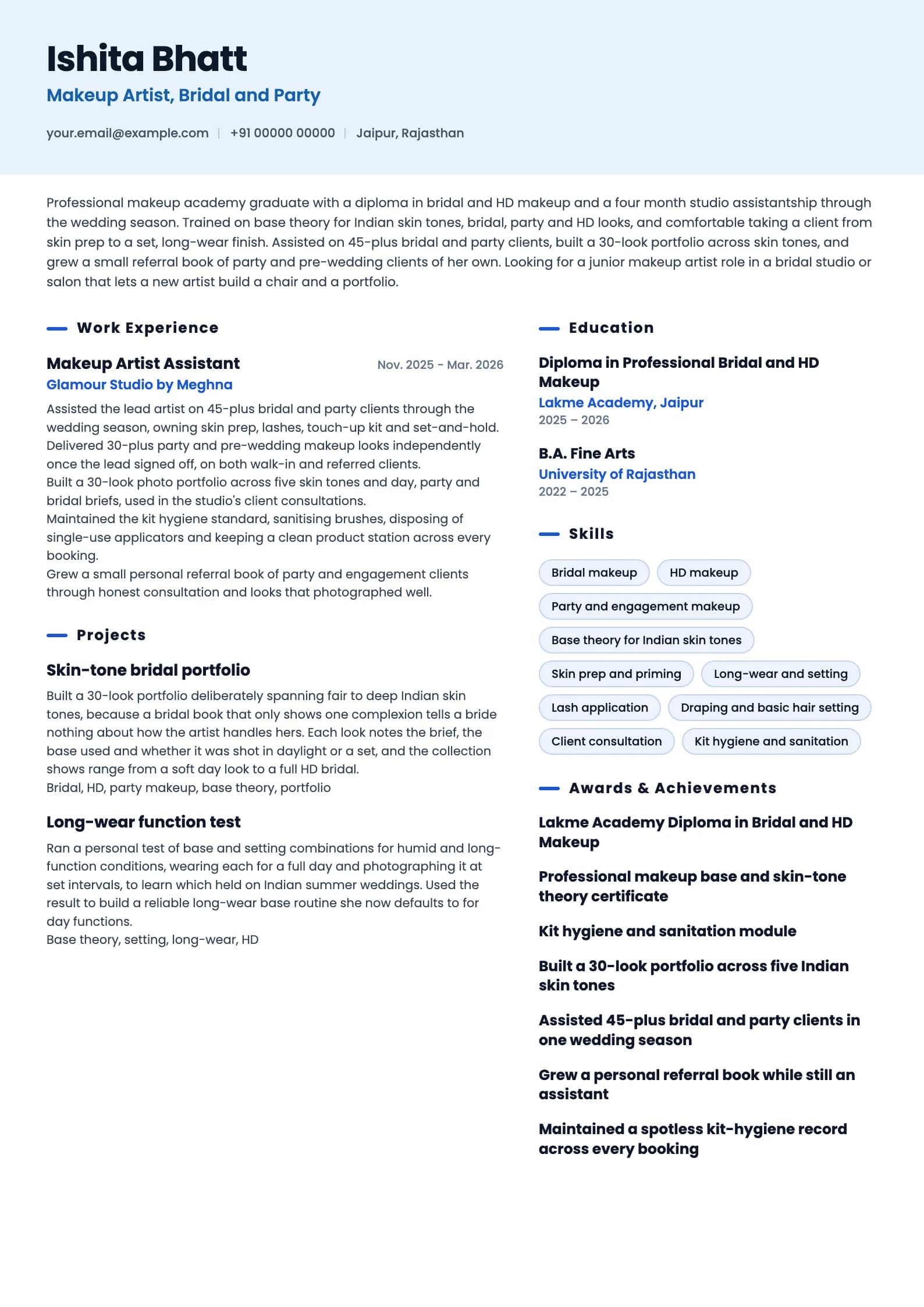
Build my resumeMakeup Artist resume example, Fresher (0 years)
ai-era templateIs your resume good enough?
Upload the resume you have now and see what an applicant tracking system reads before a makeup artist recruiter ever does.
Free to run. Sign in with your mobile number to see your score.
Makeup Artist resume example, Bridal MUA (5 years)
modern template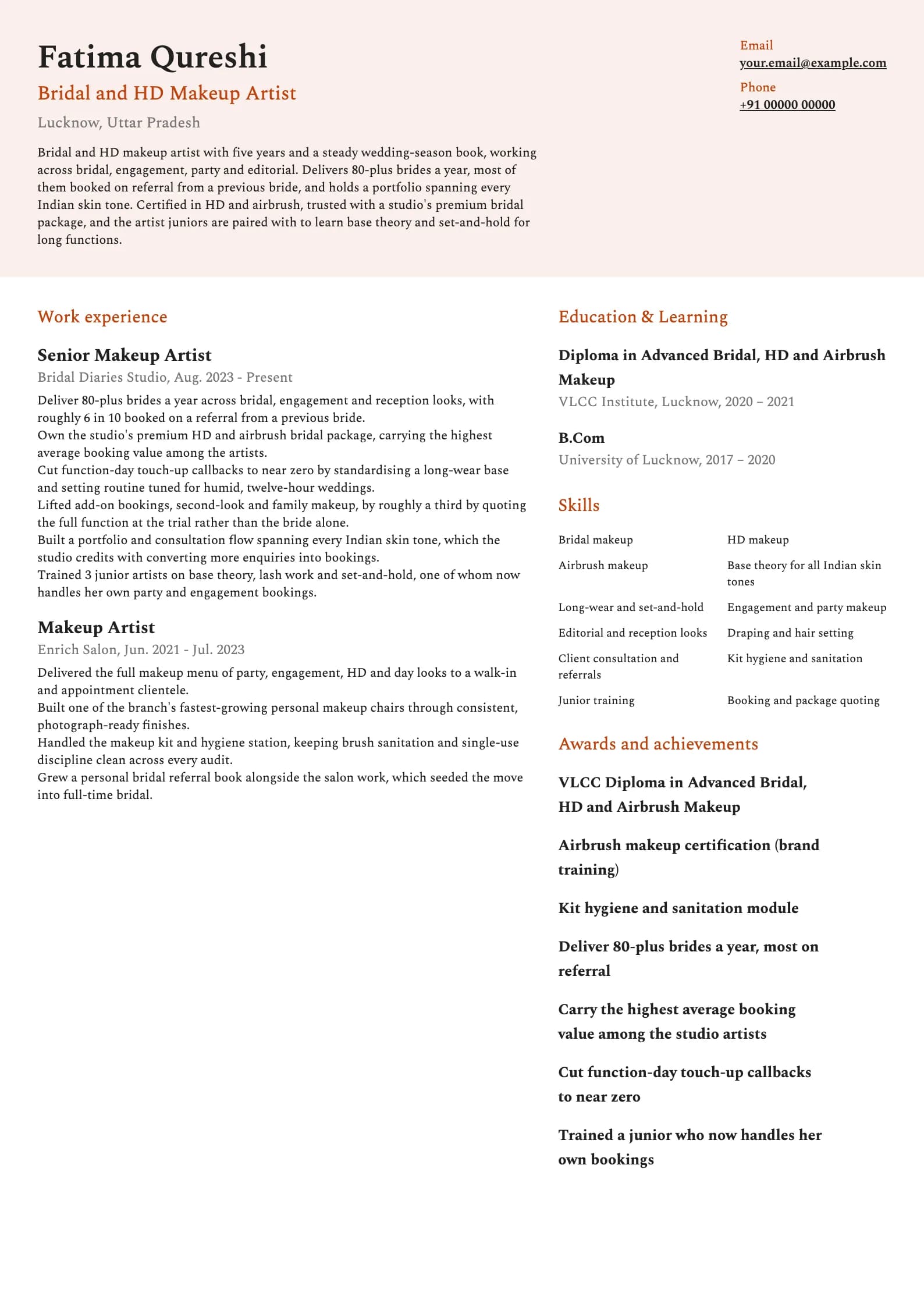
Want this structure with your own details? Build it in the resume builder.
Makeup Artist resume example, Lead Artist (9 years)
header-band template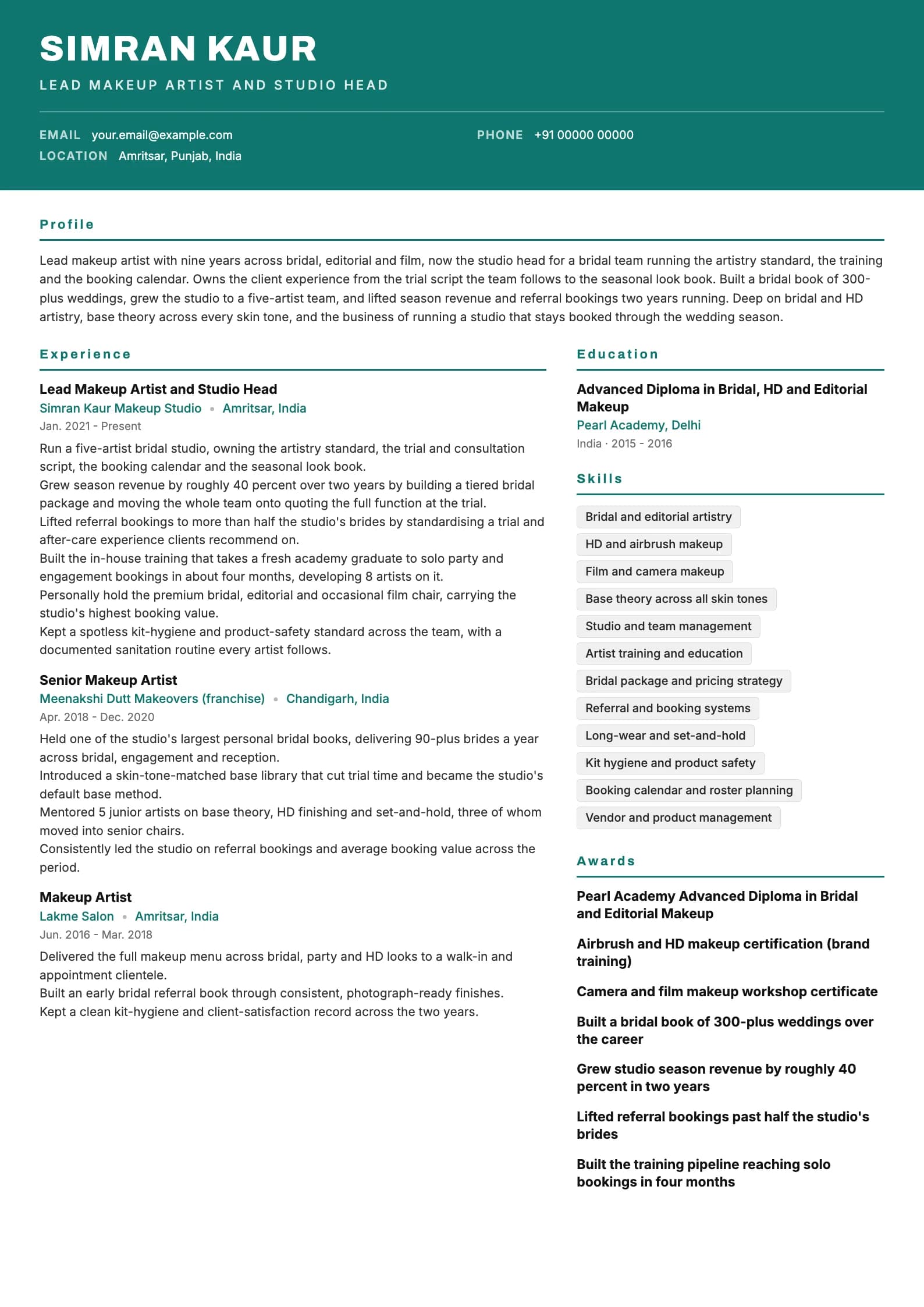
The format that works for makeup artist resumes in India
Reverse chronological is the layout to use. Put your current or most recent studio or salon first, work backwards, and keep the dates visible. A resume that hides dates and groups everything under a Skills heading reads as an attempt to cover a gap between bookings, and studio owners treat it that way. If you took a break or built freelance work between salon roles, one honest line explains it better than a scrambled layout, and freelance bridal work is real experience worth naming. Length is one page for almost every artist. A fresher, a five-year bridal MUA and most lead artists fit on a single page. A second page is only worth it for a studio head or educator with real team, revenue and referral results, and even then it should carry numbers, not a longer list of techniques you can name. Keep the top clean: your name, the role you want, makeup artist or bridal artist, and a three-line summary. The single most important addition for a makeup artist is a portfolio link, because a studio and a bride both book on the pictures. Do not open with a decorative photo strip, date of birth, marital status or father's name from an old placement template. Save and send a PDF unless asked otherwise, and name the file with your own name and makeup artist rather than resume_final. Use a single column top to bottom so it reads cleanly on the phone where most bookings and enquiries happen. The table below sets out the section order.
| Section | Where it goes | Why |
|---|---|---|
| Name and headline | Top, above everything | The headline is the role you want, makeup artist or bridal artist. It is the first thing a studio matches on. |
| Professional summary | Directly under the header | Three lines: years, your strongest looks, and one bridal-count or referral result. |
| Portfolio link | High on the page, near the header | A studio and a bride book on the pictures. The link is worth more than any adjective. |
| Work experience | Next, salon, studio or freelance | Most recent first. Freelance bridal work counts as experience. |
| Skills and specialities | Below experience | Grouped: bridal, HD and airbrush, base theory, kit business. Not a 30-item wall. |
| Certifications | After skills, or near the top for a fresher | Academy diploma and airbrush or HD training earn their place. |
| Education | Bottom, unless you are a fresher | Diploma and any degree, institution, years. |
Listing airbrush is not the same as proving brides refer you
The most common makeup artist resume failure is a services line that reads bridal, party, HD, airbrush, engagement, reception, editorial, saree draping, hair setting, nail art with nothing anywhere that shows a bride referred another bride. A studio owner already assumes a trained artist can create the looks. What they are booking is an artist brides recommend, whose work photographs well and holds through a long function, so the resume has to prove referrals, bridal volume and average booking value, not just recite techniques. The fix is to let the experience carry the techniques. If you write airbrush on the skills line, a bullet should say what it does to your booking value or your callbacks. If you write bridal, a bullet should mention the brides a year and the referral share. The mid-level sample lists HD, airbrush and referrals precisely because the bullets show 80-plus brides a year, 6 in 10 on referral and the highest average booking value. The skills and the experience agree, which makes both believable. Be specific about what a studio pays a premium for. HD and airbrush base, base theory across every Indian skin tone, long-wear set-and-hold for twelve-hour functions, and editorial or camera work separate a real bridal artist from someone who can do one party look. Naming skin-tone range matters more here than in almost any other beauty role, because a bride's first question is whether you can do her complexion. Do not pad with every adjacent service, nail art, mehndi, full hair styling, when the role is squarely a makeup chair. A padded menu reads as thin, and a trial makeup exposes it on one face.
For every technique on your skills line, ask: is there a bullet that shows a bride referred another, a booking value rose, or callbacks fell. If not, the studio reads it as a menu you can name, not an artist brides recommend.
Writing a summary a studio owner actually reads
The block under your name is the part you can count on being read, so it should carry three things: how long you have been booking clients, the looks you are strongest on, and the single best result, usually a bridal count or a referral share. Three or four lines, no adjectives a trial makeup cannot check. The old objective line, seeking a creative role in a reputed studio to showcase my makeup passion, tells an owner nothing new. Replace it with a summary. An objective says what you want; a summary says what you have already delivered on real faces, and only one gets you the booking. Freshers often think they have nothing to summarise. Look at the fresher sample: it names the diploma, the assistantship length, the bridal assists, the solo looks and a portfolio across skin tones. That is a real summary built from a course, a season of assisting and a curated book. What it avoids is "passionate about makeup and making brides feel beautiful", a line so common it now says nothing. A quick test: read your summary and ask whether a classmate from the same academy could paste it onto their resume unchanged. If they could, it describes the diploma, not you. Add your own bridal count, your own referral share, your own signature look until it stops being transferable.
Professional summary, bridal makeup artist
Weak
Creative and passionate makeup artist with 5+ years of experience in all types of makeup, seeking a challenging role in a reputed studio to showcase my artistry and grow.
Strong
Bridal and HD makeup artist with five years and a steady wedding-season book, delivering 80-plus brides a year with roughly 6 in 10 booked on referral. Owns the studio's premium HD and airbrush bridal package.
The rewrite trades a technique claim and self-description for a real bridal count, a referral share and a named premium speciality.
Experience bullets: verb, look, result
Every strong bullet in the samples has the same shape. It opens with an action verb, names the specific look, service or change, and closes with what measurably moved. The verb shows you did it. The look tells the studio whether it is the work they book. The number does the convincing. Start from the result and work backwards. Artists usually write the task first, then struggle to attach a number, which produces lines like "did bridal and party makeup for clients". Instead ask what was different because you did the face: a bride referred another, a booking value rose, a callback stopped, an add-on sold, a junior learned base theory. Then write the sentence that ends in that fact. Vary what you count. Ten lines that all say how many faces read as one trick. Across a real career you can honestly reach for brides a year, referral share, average booking value, callbacks cut, add-on bookings, portfolio conversion and juniors trained. The mid-level sample uses several, which reads as range. Where you lack a clean number, give scope: how many brides a season, how many looks in the portfolio, how many skin tones, how many artists on the team. "Deliver 80-plus brides a year across bridal, engagement and reception" carries weight without inventing a percentage. Allocate bullets by recency. Current role gets five or six, the previous one four or five, anything older two or three.
| Level | What bullets must prove | Typical result to cite |
|---|---|---|
| Fresher | You can create clean, photograph-ready looks safely | Bridal assists, solo looks, portfolio size, skin-tone range, hygiene |
| 1 to 3 years | Clients book you and refer their friends | Personal bookings, referrals, satisfaction, add-on sales |
| 4 to 6 years | You own bridal and a premium package | Brides a year, referral share, average booking value, callbacks cut |
| 7 years and up | You run a studio and set the artistry standard | Season revenue, referral share, team trained, book size |
Experience bullet, bridal work
Weak
Responsible for doing bridal, party and HD makeup for the clients who came to the studio for their functions.
Strong
Deliver 80-plus brides a year across bridal, engagement and reception looks, with roughly 6 in 10 booked on a referral from a previous bride.
"Responsible for" describes a job description; the rewrite names the bridal volume and the referral share that follows the artist to a new studio.
Experience bullet, long-wear work
Weak
Made sure the makeup of the bride stayed good for the whole function and did touch-ups when needed.
Strong
Cut function-day touch-up callbacks to near zero by standardising a long-wear base and setting routine tuned for humid, twelve-hour weddings.
Names the result and the method, so an owner can ask a real follow-up instead of nodding at a vague claim about touch-ups.
If a bullet would read identically on any artist's resume, it is describing the studio, not you. Rewrite it until it only fits the chair and the brides you actually did.
The skills and specialities section: grouped, honest, and short enough to prove on a trial
A makeup artist's skills section has two audiences. A parser wants literal terms it can match, HD makeup and airbrush and bridal. A studio owner wants a short, organised list that shows what kind of artist you are and where you are strongest. Grouping serves both. Group by function rather than one long line. Bridal and occasion, technique and finish, base and skin, and kit business is a grouping that works for almost every artist. The exact headings matter less than the fact that structure exists. Write technique names the way the industry writes them, and name skin-tone range explicitly, because it is the one thing a bride most wants to know. Twelve to sixteen items is the working range. Below eight it looks thin, and above twenty it stops being a signal and reads as a padded menu you cannot all deliver on a trial. Remember the trial makeup is real: a studio and often a bride will put you on a face, so every technique you list is one you may be asked to perform. Do not use star ratings or percentage bars. Nobody agrees what four stars in HD means, and a face at a trial settles it faster than any bar. Let the bridal count and the referral share in your experience prove the depth instead.
| Group | What goes in it | How many |
|---|---|---|
| Bridal and occasion | Bridal, engagement, reception, party, editorial | 3 to 5 |
| Technique and finish | HD, airbrush, long-wear, set-and-hold, camera | 3 to 4 |
| Base and skin | Base theory across skin tones, skin prep, priming | 2 to 3 |
| Add-ons | Lash application, draping, basic hair setting | 1 to 2 |
| Business | Consultation, referrals, kit hygiene, package quoting, training | 2 to 4 |
Skills and specialities section
Weak
Skills: Bridal Makeup, Party Makeup, HD Makeup, Airbrush, Engagement, Reception, Editorial, Saree Draping, Hair Setting, Nail Art, Mehndi, Threading, Facial, Cleanup, Hair Cut, Hair Colour, Waxing, Manicure, Pedicure, Spa
Strong
Bridal and occasion: bridal, engagement, reception, party, editorial. Technique: HD, airbrush, long-wear set-and-hold. Base and skin: base theory across all Indian skin tones, skin prep. Add-ons: lash application, draping. Business: referrals, kit hygiene, package quoting.
Cuts the adjacent salon services that dilute a makeup chair, names skin-tone range explicitly, and groups the rest so an owner reads it in one pass.
Certifications, training and where they belong
Makeup is a field where the right certification genuinely helps a resume, because a studio cannot judge your hands from a page and a recognised academy diploma is the next best proof before it sees your portfolio. For a fresher the diploma sits near the top, just under the summary and the portfolio link, since it is the strongest paper signal you can offer with no bridal book behind you. For an experienced artist it moves below the skills section, because by then your bridal count and referrals outrank any badge. Name the qualification the way the industry knows it, with the issuing body and the year. Academy diplomas from Lakme Academy, VLCC, Pearl Academy and similar are widely recognised across the studio and salon market. Airbrush and HD certifications are worth naming when the studio books those services. A camera or film makeup workshop is worth a line if you target editorial, film or television work, which is a distinct market from bridal. List only current and genuine training. A studio can check, and a weekend workshop is not a full diploma, so be honest about the level. In makeup the portfolio quickly settles what the certificate claims, so an inflated qualification costs more at the trial than it gains on the page. Do not bury a real academy diploma under a declaration paragraph at the very bottom. In makeup the diploma and specialised training are selling points, so give them a clear line, but always remember the portfolio outweighs them, so the link comes first.
Getting through the applicant tracking system and the studio inbox
Larger studio chains, salon groups and hotel and event companies run applications through an applicant tracking system, and even an independent studio owner reading a WhatsApp forward or an Instagram DM scans for the same words. The system reads your file, tries to break it into name, dates, studios, titles and specialities, and stores the result so a recruiter can search across artists. Almost every problem is a parsing problem, and parsing problems come from layout, not wording. The layout rules are short. One column. Standard headings, so use Work Experience rather than My Makeup Journey, and Skills or Specialities rather than My Signature Looks. No text baked into images, because a decorative graphic reads as empty space, and note that your portfolio pictures belong at a link, not pasted into the resume where a parser sees nothing. Keep your name out of the very top header or footer strip, which some parsers drop. Avoid text boxes and nested tables in the body. On wording, mirror the studio's own language where it is honest. If the posting says bridal artist, use bridal artist as well as makeup artist. If it says HD and airbrush, make sure both appear in a real bullet. Spell out a term in full at least once, for example HD written as high-definition alongside the short form, so both searches find you. Keyword stuffing does not work here either. A hidden block of every technique in tiny text is caught quickly, and the outcome is worse than being filtered. Write real bullets that naturally contain the right specialities, because a bullet about 80 brides a year contains the word bridal in a context that survives a human read too. Save as a PDF that holds real text, then open it and confirm you can select and copy a sentence, and check your portfolio link works. If you cannot select the text, neither can the parser, and a dead portfolio link loses you the booking a strong resume just won.
Section heading
Weak
My Signature Looks and Magic
Strong
Skills and Specialities
Parsers and busy owners look for standard headings; a decorative one can push the whole block into an unclassified bucket nobody searches.
Test your own file before you send it. Copy the text out of the PDF into a plain notes app, and click your portfolio link. Whatever you can read there is roughly what a parser and a hurried owner see, and a broken portfolio link is a booking lost.
What gets makeup artist resumes rejected
Most rejections at the resume stage are not close calls. They come from a small set of recurring problems, and every one is fixable in an evening. The list below covers what studio owners and beauty recruiters in India see most often, in rough order of how much damage each one does.
- No portfolio link, on a job where a studio and a bride both book on the pictures. A resume without a portfolio is half a resume.
- A long technique menu with no evidence a bride referred another. Referrals and bridal volume are what a studio actually books.
- No numbers anywhere. Brides a year, referral share, booking value, callbacks cut, portfolio conversion. Pick whichever is honest.
- A portfolio that shows only one skin tone, when a bride's first question is whether you can do her complexion.
- A stray line of salon services, waxing, threading, hair colour, on a squarely makeup chair, which dilutes the offer.
- Job duties copied from a template instead of what you did. "Responsible for bridal and party makeup" is the tell.
- A photo, date of birth, marital status or father's name from an old placement template. It takes space a portfolio link should use.
- A generic objective about a creative role in a reputed studio. Replace it with a summary that states years, speciality and one result.
- No mention of kit hygiene or product safety, on a job that works close to a client's eyes and skin all day.
- A broken or careless portfolio link, or one that leads to a reel that is not your own work, which a trial exposes fast.
Read your resume as if you were a bride deciding whether to trust this artist with her wedding face. Any line that does not build that trust, and any dead portfolio link, is a fix to make before you send it.
Skills to put on a makeup artist resume
Technical
- Bridal makeup
- HD (high-definition) makeup
- Airbrush makeup
- Base theory for all Indian skin tones
- Skin prep and priming
- Long-wear and set-and-hold
- Engagement and reception looks
- Editorial and party makeup
- Camera and film makeup
- Lash application
- Saree draping
- Basic hair setting
Tools and platforms
- Airbrush kit and compressor
- HD and camera-ready product lines
- Professional brush set
- Colour-matched base library
- Setting sprays and long-wear products
- Lash and false-lash kit
- Ring light and portfolio camera
- Booking and enquiry apps (Instagram, WhatsApp Business)
Working skills
- Client and bridal consultation
- Referral building
- Package quoting and upselling
- Kit hygiene discipline
- A calm hand on a wedding morning
- Junior training and mentoring
- Time management on a function day
- Managing an anxious bride and family
- Teamwork on a studio floor
Certifications worth listing as a makeup artist
| Certification | Full name | Worth it for |
|---|---|---|
| Academy Diploma | Diploma in Professional Bridal and HD Makeup (Lakme Academy, VLCC, Pearl Academy, etc.) | A recognised makeup academy diploma is the core paper credential for an artist, worth the most for a fresher entering the studio and salon market before there is a portfolio to point to. Studios know these syllabuses, so it is a clean entry signal. As you build a bridal book and referrals, the diploma matters less than your work, but it stays the foundation your portfolio sits on. |
| Airbrush Makeup | Airbrush makeup certification (brand or academy training) | A specific certification in airbrush application, worth it for artists in studios that book airbrush bridal, since it is a premium, higher-margin service. It signals you can operate the kit and deliver the flawless, long-wear finish clients pay extra for. Most valuable in the one-to-six-year range as you build a premium bridal package; name the level you hold. |
| HD Makeup | High-definition makeup certification | Training focused on camera-ready, high-definition finishing, worth it for artists doing bridal, editorial or any work that will be heavily photographed. It signals you understand base and product choices that hold up close and under a camera, which matters for weddings shot in HD video. A common and well-recognised specialisation to name alongside a base diploma. |
| Camera / Film Makeup | Camera, film and television makeup workshop or certification | Specialised training for makeup that reads correctly under film and studio lighting, worth it for artists targeting editorial, television, film or fashion work rather than only bridal. It marks a distinct market from wedding work, so name it only if you are actually pursuing that path. A strong differentiator for an artist moving beyond the bridal chair. |
| Advanced Bridal | Advanced bridal and creative makeup diploma or masterclass | A higher-level bridal or creative makeup qualification, worth it for an artist specialising deeply in bridal and wanting to command premium bridal pricing. It signals advanced artistry beyond a foundation diploma, useful for a senior artist or studio-head profile. Pair it with a strong bridal portfolio, since in makeup the work always outweighs the certificate. |
| Kit hygiene / safety | Makeup kit hygiene, sanitation and product-safety module | A short but genuinely useful credential for any artist, since you work close to a client's eyes and skin and share products across faces all day. Worth naming because it signals you sanitise brushes, use single-use applicators and store products safely, which a careful studio and an informed bride both value. Renew it if it lapses rather than listing an expired module. |
Keywords an ATS scans for in a makeup artist resume
These are the literal terms a parser matches against the job description. Use the ones that are true of you, in the sentences where you did the work, not as a list at the bottom.
- makeup artist
- bridal makeup
- MUA
- HD makeup
- airbrush makeup
- base theory
- skin tone
- engagement makeup
- party makeup
- editorial makeup
- long-wear
- client referral
- booking value
- consultation
- kit hygiene
- portfolio
- cosmetology
- studio
- wedding season
- lash application
Makeup Artist resume FAQ
What salary can a makeup artist expect in India?
A fresher or junior makeup artist in a salon or studio typically starts around 1.5 to 3 LPA on a base, usually with a per-booking commission on top. Bridal and freelance income works differently and often earns more: a skilled bridal MUA with four to six years and a steady wedding-season book can earn well through per-bride fees, with a single bridal booking ranging from a few thousand rupees to well into five figures depending on the market and reputation. Senior lead artists and studio owners with a strong bridal book and a team commonly clear far more across a season. The bridal count, the referral rate and the average booking value drive earnings far more than any fixed salary, which is why the resume should foreground them.
How long should a makeup artist resume be?
One page for almost everyone, plus a portfolio link. A fresher, a five-year bridal MUA and most lead artists fit comfortably on a single page. A second page is only worth it for a studio head or educator with real team, revenue and referral results, and even then it must carry numbers, not a longer list of techniques. Nobody was rejected for a resume that was easy to read. If you are struggling to fit one page, cut the oldest role to a line and remember the portfolio, not the resume, is where your range is shown.
How important is a portfolio for a makeup artist resume?
It is the single most important thing, more than the resume itself. A studio and a bride both book on the pictures, so a resume without a portfolio link is half a resume. Link it in plain text near the top, or name the social page where your work lives, and curate it to show range across Indian skin tones and across looks, from a soft day look to a full HD bridal. Make sure the link works and leads only to your own work, because an owner or a bride who opens it reads it as your work sample, and a trial makeup exposes anything borrowed.
How do I write a makeup artist resume as a fresher?
Lead with your academy diploma and a portfolio link, then your assistantship or freelance practice, then your specialities. Treat the assistantship like a job: how many bridal and party clients you assisted, how many looks you did solo, and how many skin tones your portfolio covers. A recognised academy diploma is a real signal before you have a book. Quantify faces even without years, because 45 bridal assists and a 30-look portfolio tell a studio you have a working, hygienic hand, which is what it is checking for.
Should I show my portfolio across different skin tones?
Yes, and it is one of the most important choices you can make. A bride's first and most anxious question is whether you can do her complexion, so a book that spans fair to deep Indian skin tones answers it directly, while a book that only shows one complexion leaves it open. Note the skin-tone range on your resume as the fresher sample does, and build the portfolio to prove it. This single point converts more bridal enquiries into bookings than almost anything else on the page.
Do certifications like an HD or airbrush course help?
Yes, especially early. A studio cannot judge your hands from a page before it sees your portfolio, so a recognised academy diploma plus specific HD or airbrush training is strong paper proof. Name the exact ones and the level you hold, because a studio that books airbrush bridal wants an artist already trained on it. As you build a bridal book and referrals, your work outranks any certificate, so keep the list short and put the portfolio link first. For editorial or film work, a camera-makeup workshop signals a different and valuable specialisation.
How should a freelance or bridal makeup artist write a resume?
Treat your freelance work as real experience, because it is your main experience. Give it a title such as Freelance Bridal Makeup Artist, name the city and years, and use bullets that show volume and referrals: how many brides a season, how many booked on a referral, your average booking value and any package you built. The portfolio matters even more for freelance work, so link it prominently and keep it current. If you also worked in a salon or studio, list both, and let the freelance bullets carry the bridal strengths a salaried chair might not show.
Do I need a photo of myself on a makeup artist resume in India?
A photo of your face is usually not needed, and it takes space a portfolio link should use. A studio and a bride judge you on your work and a trial, not a passport photo. What genuinely helps is a portfolio of your makeup, which is photos of the faces you have done, not of yourself. The same goes for date of birth, marital status, father's name and a declaration paragraph, which come from an old placement template. If a studio, event company or hotel posting explicitly asks for a photograph of you, keep it clean and professional.
Related resume examples and guides
Build your own in any of these formats
Start from a blank resume or upload the one you have. Goodspace renders it in 24 templates and flags the bridal, HD and referral keywords a studio recruiter will look for, and the padded technique menu they will not credit. Add your portfolio link and let the work do the booking.
Build my resume