Hair Stylist Resume Format, with 3 Full Samples
A hair stylist is hired on evidence of clients who come back for the same pair of scissors, colour work that holds, and a chair that fills itself. Yet most stylist resumes list every technique from layers to balayage and forget the rebooking rate, the colour retail and the client base that a salon manager actually pays for. Below are three complete resumes, one for an academy-trained fresher fresh off a cutting course, one for a salon stylist with five years across cut, colour and chemical services, and one for a senior creative stylist who leads a floor and trains the cutting team. After the samples come the format rules, the difference between listing balayage and proving clients rebook you for it, the terms a parser and a salon owner both scan for, and the mistakes that keep a stylist out of the interview chair.
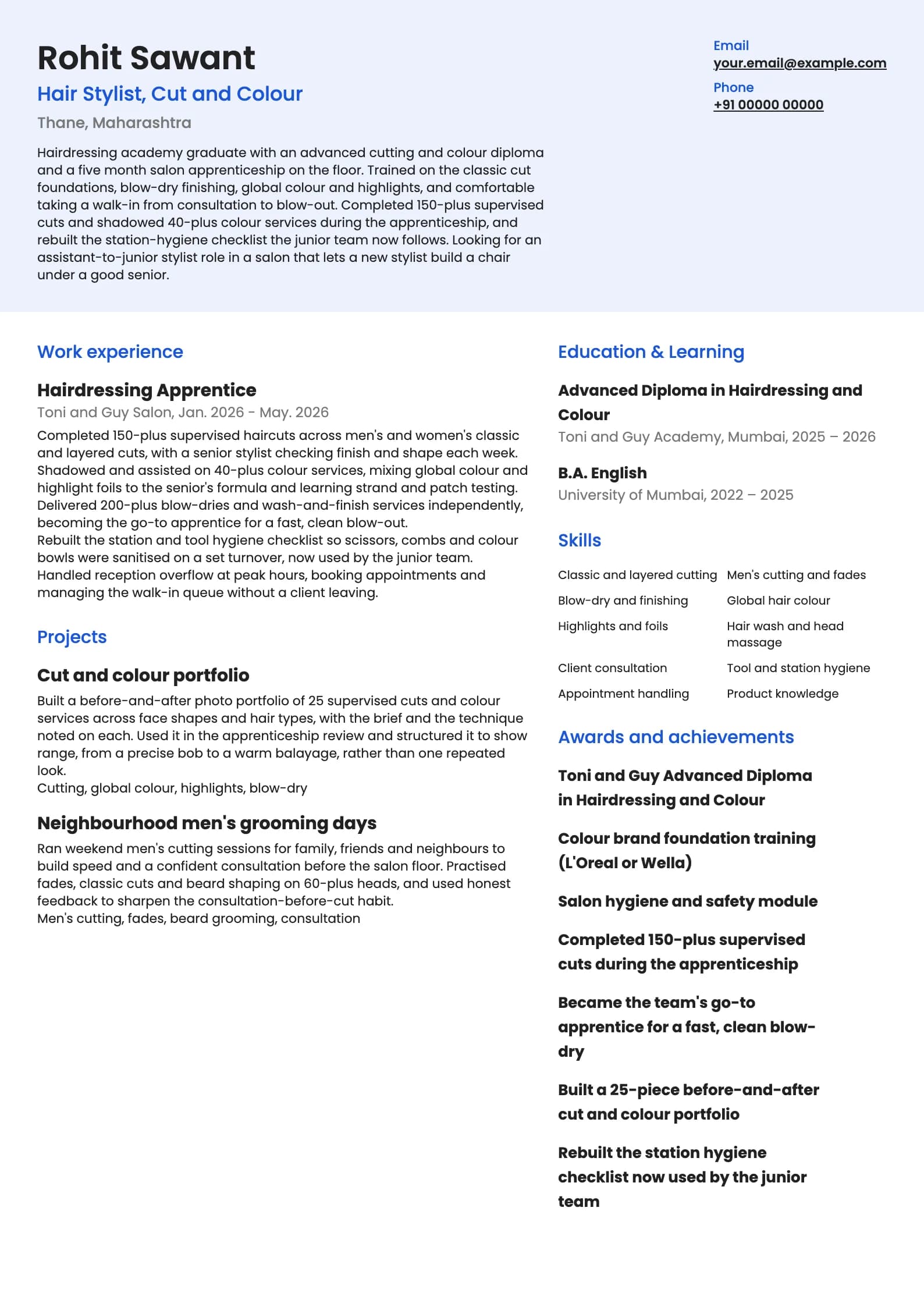
Build my resumeHair Stylist resume example, Fresher (0 years)
modern templateIs your resume good enough?
Upload the resume you have now and see what an applicant tracking system reads before a hair stylist recruiter ever does.
Free to run. Sign in with your mobile number to see your score.
Hair Stylist resume example, Salon Stylist (5 years)
professional template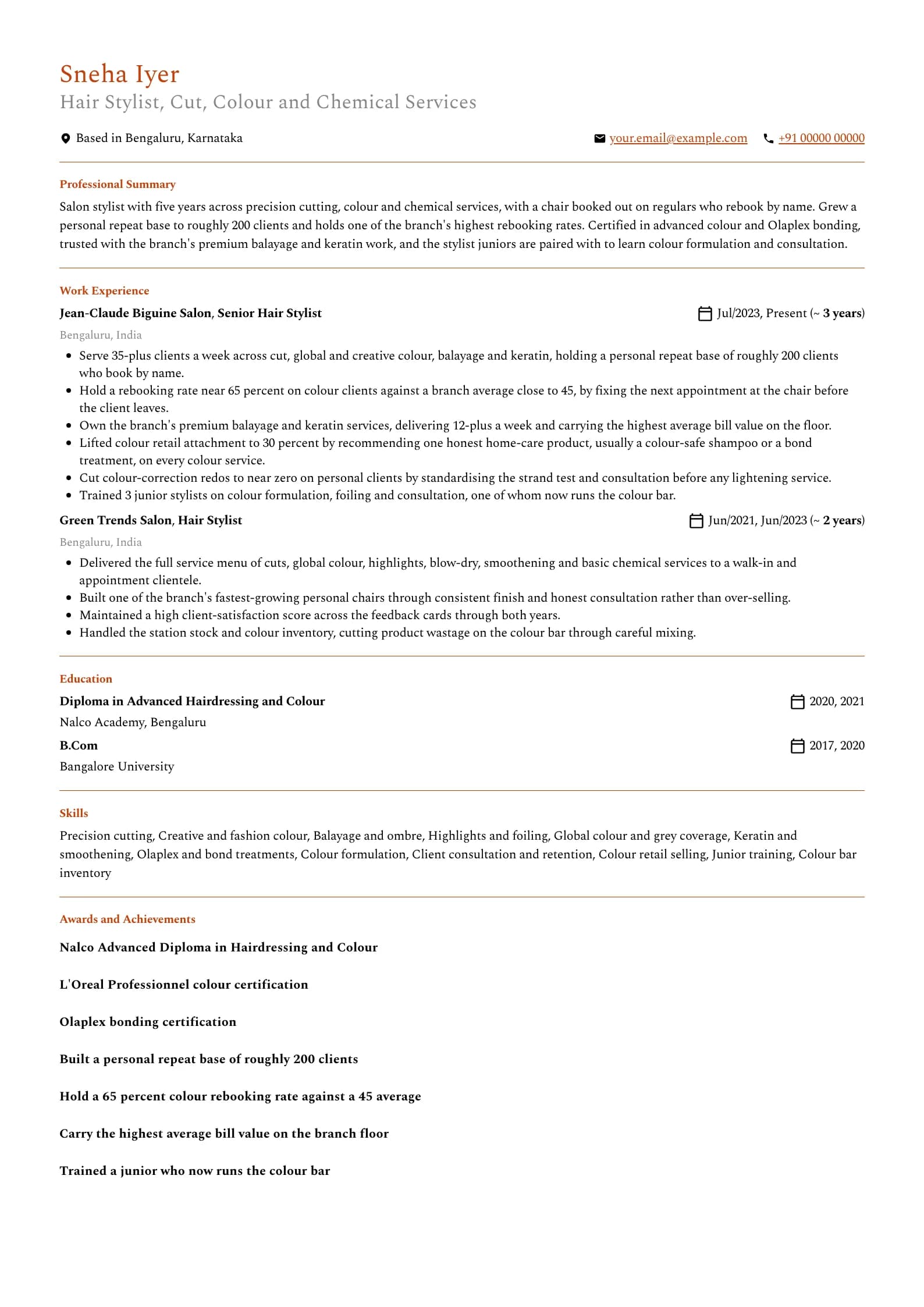
Want this structure with your own details? Build it in the resume builder.
Hair Stylist resume example, Creative Stylist / Floor Lead (10 years)
header-band template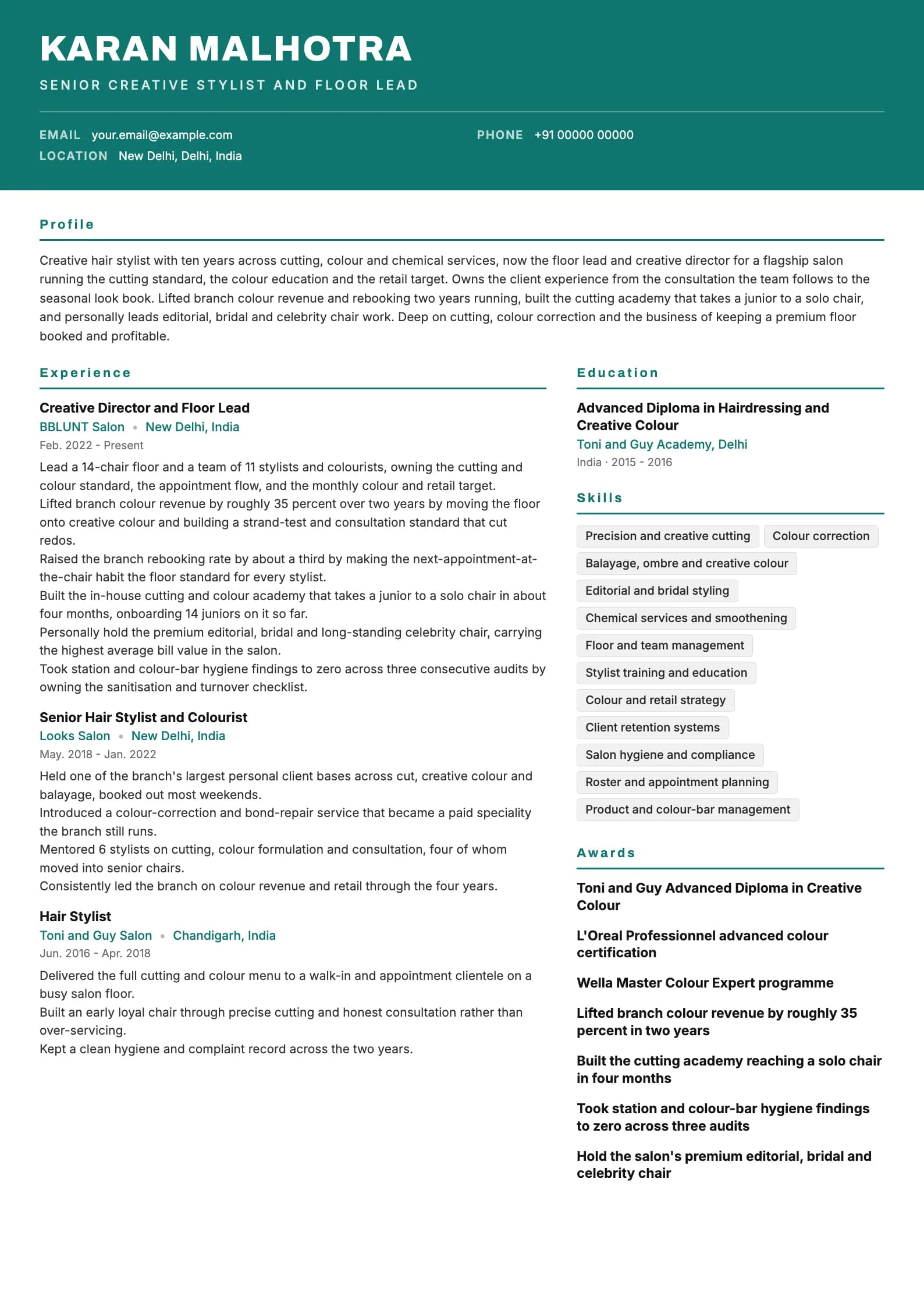
The format that works for hair stylist resumes in India
Reverse chronological is the layout to use. Put your current or most recent salon first, work backwards, and keep the dates in plain view. A resume that drops dates and hides everything under a Skills heading reads as an attempt to cover a gap between chairs, and salon managers treat it that way. If you took a break or moved cities, one honest line explains it better than a scrambled layout. Length is one page for almost every stylist. A fresher, a five-year salon stylist and most senior stylists fit on a single page. A second page is only worth it for a floor lead or educator with real team, colour-revenue and retention results, and even then it should carry numbers, not a longer list of techniques you can name. Keep the top clean: your name, the role you want, hair stylist or senior stylist, and a three-line summary. Do not open with a photo strip, date of birth, marital status or father's name. These come from an old placement-cell template and add nothing a salon needs. A stylist's real visual proof is a portfolio, not a passport photo, so link or mention a portfolio instead. Save and send a PDF unless the salon asks otherwise, and name the file with your own name and hair stylist rather than resume_final. Use a single column top to bottom so it reads cleanly on the phone where most managers will open it. The table below sets out the section order.
| Section | Where it goes | Why |
|---|---|---|
| Name and headline | Top, above everything | The headline is the role you want, hair stylist or colourist. It is the first thing a salon matches on. |
| Professional summary | Directly under the header | Three lines: years, your strongest cut or colour work, and one rebooking or revenue result. |
| Work experience | Next, for anyone who has worked a chair | Most recent salon first. The current role gets the most bullets. |
| Portfolio | A named line or link, high on the page | In hair, the finish is the proof. A portfolio link is worth more than any adjective. |
| Skills and services | Below experience | Grouped: cutting, colour, chemical, chair business. Not a 30-item wall. |
| Certifications | After skills, or near the top for a fresher | Academy diploma and colour-brand training earn their place. |
| Education | Bottom, unless you are a fresher | Diploma and any degree, institution, years. |
Listing balayage is not the same as proving clients rebook you for it
The most common stylist resume failure is a services line that reads haircut, layers, blow-dry, global colour, highlights, balayage, ombre, keratin, smoothening, rebonding, hair spa with nothing anywhere that shows a client came back for it. A salon owner already assumes a trained stylist can perform the menu. What they are hiring for is a chair that rebooks itself and brings colour revenue, so the resume has to prove rebooking, colour attachment and average bill, not just recite techniques. The fix is to let the experience carry the techniques. If you write balayage on the skills line, a bullet should say how many a week and what it does to your average bill. If you write colour, a bullet should mention the rebooking rate or the colour retail you attach. The mid-level sample lists balayage, keratin and colour retail precisely because the bullets show 12-plus premium services a week, a 65 percent rebooking rate and 30 percent retail. The skills and the experience agree, which makes both believable. Be specific about the high-value work. Colour correction, creative and fashion colour, balayage, keratin and bond treatments separate a real colourist from someone who only does trims and global colour. Name the colour brand you are certified on, L'Oreal, Wella or Schwarzkopf, because a salon that runs that line wants a stylist who already formulates in it. Do not pad with every chemical service when you rarely do them, or a stray line of beauty and makeup when the role is squarely a cutting and colour chair. A padded menu reads as thin, and the trial cut exposes it in one client.
For every technique on your skills line, ask: is there a bullet that shows a client rebooked, colour revenue rose, or the average bill went up. If not, the salon reads it as a menu you can name, not a chair you can fill.
Writing a summary a salon manager actually reads
The block under your name is the part you can count on being read, so it should carry three things: how long you have worked a chair, the cut or colour work you are strongest on, and the single best result, usually a rebooking or colour-revenue number. Three or four lines, no adjectives a trial cut cannot check. The old objective line, seeking a creative role in a reputed salon to grow as a stylist, tells a manager nothing new. Replace it with a summary. An objective says what you want; a summary says what you have already done at the chair, and only one gets you the trial. Freshers often think they have nothing to summarise. Look at the fresher sample: it names the diploma, the apprenticeship length, the supervised cut and colour volume, and a portfolio. That is a real summary built from a course, an apprenticeship and counted repetitions. What it avoids is "passionate about hair and making clients look their best", a line so common it now says nothing. A quick test: read your summary and ask whether a classmate from the same academy could paste it onto their resume unchanged. If they could, it describes the diploma, not you. Add your own rebooking rate, your own colour revenue, your own signature service until it stops being transferable.
Professional summary, salon stylist
Weak
Creative and passionate hair stylist with 5+ years of experience in all types of cutting and colouring, seeking a challenging role in a reputed salon to showcase my skills.
Strong
Salon stylist with five years across precision cutting, colour and chemical services, holding a personal repeat base of roughly 200 clients and a colour rebooking rate near 65 percent. Owns the branch's premium balayage and keratin work.
The rewrite trades a technique claim and self-description for a real repeat base, a rebooking figure and a named premium speciality.
Experience bullets: verb, service, result
Every strong bullet in the samples has the same shape. It opens with an action verb, names the specific cut, colour or change, and closes with what measurably moved. The verb shows you did it. The service tells the salon whether it is the work they need on their floor. The number does the convincing. Start from the result and work backwards. Stylists usually write the task first, then struggle to attach a number, which produces lines like "did cutting and colouring for daily clients". Instead ask what was different because you were on the chair: a client rebooked, colour revenue rose, an average bill went up, a redo stopped, a junior learned to formulate. Then write the sentence that ends in that fact. Vary what you count. Ten lines that all say how many clients a day read as one trick. Across a real salon career you can honestly reach for rebooking rate, colour revenue, retail attachment, average bill, redos cut, satisfaction scores and juniors trained. The mid-level sample uses several, which reads as range. Where you lack a clean number, give scope: how many services a week, how many chairs on the floor, how many juniors, how many premium colours. "Own the branch's premium balayage and keratin, delivering 12-plus a week" carries weight without inventing a percentage. Allocate bullets by recency. Current salon gets five or six, the previous one four or five, anything older two or three.
| Level | What bullets must prove | Typical result to cite |
|---|---|---|
| Fresher | You can cut and finish cleanly and safely | Supervised cuts, colour services shadowed, blow-dries, portfolio |
| 1 to 3 years | Clients ask for you and you sell colour and retail | Rebooking, personal chair growth, retail attachment, satisfaction |
| 4 to 6 years | You own a chair and a premium speciality | Repeat base, rebooking rate, colour revenue, average bill, redos cut |
| 7 years and up | You set the standard and run a floor or academy | Branch colour revenue, rebooking lift, hygiene audit, team trained |
Experience bullet, salon work
Weak
Responsible for cutting, colouring and styling the hair of the clients coming to the salon on a daily basis.
Strong
Serve 35-plus clients a week across cut, colour and balayage, holding a personal repeat base of roughly 200 who book by name.
"Responsible for" describes a job description; the rewrite names weekly volume and the repeat base that follows the stylist to a new salon.
Experience bullet, colour work
Weak
Did colouring services for clients and also suggested them hair products to buy.
Strong
Lifted colour retail attachment to 30 percent by recommending one honest home-care product, usually a colour-safe shampoo or bond treatment, on every colour service.
Names the figure and the method, so a manager can ask a real follow-up instead of nodding at a vague claim about products.
If a bullet would read identically on any stylist's resume, it is describing the salon, not you. Rewrite it until it only fits the chair you actually worked.
The skills and services section: grouped, honest, and short enough to prove on a trial
A stylist's skills section has two audiences. A parser wants literal terms it can match, balayage and keratin and colour correction. A salon manager wants a short, organised list that shows what kind of stylist you are and where you are strongest. Grouping serves both. Group by function rather than one long line. Cutting, colour, chemical services, and chair business is a grouping that works for almost every stylist. The exact headings matter less than the fact that structure exists. Write technique names the way the industry writes them, and match the salon's own menu language where you honestly can. Twelve to sixteen items is the working range. Below eight it looks thin, and above twenty it stops being a signal and reads as a padded menu you cannot all deliver on the trial. Remember the trial cut is real: a salon will put you on a client, so every technique you list is one you may be asked to perform that afternoon. Do not use star ratings or percentage bars. Nobody agrees what four stars in balayage means, and a client in the chair settles it faster than any bar. Let the rebooking rate and the colour revenue in your experience prove the depth instead.
| Group | What goes in it | How many |
|---|---|---|
| Cutting | Precision, layered and creative cutting, men's, fades | 2 to 4 |
| Colour | Global colour, highlights, balayage, ombre, correction | 3 to 5 |
| Chemical services | Keratin, smoothening, rebonding, perming, bond treatments | 2 to 3 |
| Finishing | Blow-dry, styling, editorial and bridal styling | 1 to 2 |
| Business | Client retention, rebooking, colour retail, training | 2 to 4 |
Skills and services section
Weak
Skills: Haircut, Layers, Feather Cut, Blow Dry, Iron, Curls, Global Colour, Highlights, Balayage, Ombre, Keratin, Smoothening, Rebonding, Perming, Hair Spa, Head Massage, Bridal Hair, Facial, Threading, Makeup
Strong
Cutting: precision and creative cutting, men's cutting. Colour: global colour, balayage, highlights, colour correction. Chemical: keratin, smoothening, bond treatments. Finishing: blow-dry, bridal styling. Business: rebooking, colour retail, junior training.
Cuts the techniques you would not want tested on a trial, drops the stray beauty and makeup items on a hair resume, and groups the rest so a manager reads it in one pass.
Certifications, brand training and where they belong
Hair is a field where the right certification genuinely moves a resume, because a salon cannot judge your scissors from a page and a recognised academy diploma is the next best proof. For a fresher the diploma and colour-brand training sit near the top, just under the summary, since they are the strongest signal you can offer with no chair years behind you. For an experienced stylist they move below the skills section, because by then your rebooking rate and colour revenue outrank any badge. Name the qualification the way the industry knows it, with the issuing body and the year. Academy diplomas from Toni and Guy, BBLUNT, Nalco and similar are widely recognised across the salon market. Colour-brand certifications carry real weight, so name the exact one: L'Oreal Professionnel, Wella Master Colour Expert or Schwarzkopf, because a salon that runs that colour line wants a stylist who already formulates in it. A bond-treatment certification such as Olaplex is worth a line when the salon offers it. List only current and genuine training. A salon can and does check, and a colour course you attended a session of is not a full certification. Be honest about the level, foundation versus advanced versus master, because the trial will settle it. Do not bury a real academy diploma at the very bottom under a declaration paragraph. In hair the diploma and the brand training are selling points, so give them a clear line where a manager will see them.
Getting through the applicant tracking system and the salon inbox
Larger salon chains, luxury groups and hotel salons run applications through an applicant tracking system, and even a single-salon owner reading a WhatsApp forward scans for the same words. The system reads your file, tries to break it into name, dates, salons, titles and services, and stores the result so a recruiter can search across candidates. Almost every problem is a parsing problem, and parsing problems come from layout, not wording. The layout rules are short. One column. Standard headings, so use Work Experience rather than My Styling Journey, and Skills or Services rather than My Signature Looks. No text baked into images, because a decorative graphic reads as empty space. Keep your name out of the very top header or footer strip, which some parsers drop. Avoid text boxes and nested tables in the body. On wording, mirror the salon's own language where it is honest. If the posting says colourist, use colourist as well as stylist. If it says balayage and keratin, make sure both appear in a real bullet. Name the colour brand the salon runs, because a chain that formulates in Wella searches for Wella. Keyword stuffing does not work here either. A hidden block of every technique in tiny text is caught quickly, and the outcome is worse than being filtered. Write real bullets that naturally contain the right techniques, because a bullet about 12 balayages a week contains the word balayage in a context that survives a human read too. Save as a PDF that holds real text, then open it and confirm you can select and copy a sentence. If you cannot select the text, neither can the parser, and neither can the manager who wants to copy your name into the roster.
Section heading
Weak
My Signature Looks and Talents
Strong
Skills and Services
Parsers and busy managers look for standard headings; a decorative one can push the whole block into an unclassified bucket nobody searches.
Test your own file before you send it. Copy the text out of the PDF into a plain notes app. Whatever you can read there is roughly what a parser and a hurried manager see, and anything scrambled is a real risk.
What gets hair stylist resumes rejected
Most rejections at the resume stage are not close calls. They come from a small set of recurring problems, and every one is fixable in an evening. The list below covers what salon owners and beauty recruiters in India see most often, in rough order of how much damage each one does.
- A long technique menu with no evidence a client rebooked. Rebooking and colour revenue are what a salon actually buys.
- No numbers anywhere. Rebooking rate, colour revenue, average bill, retail, redos cut. Pick whichever is honest for your chair.
- No portfolio or link, on a job where the finish is the whole proof. A picture of your work outweighs any adjective.
- Job duties copied from a template instead of what you did. "Responsible for cutting and colouring clients" is the tell.
- A stray line of makeup, threading and beauty services on a squarely cutting and colour chair, which reads as padding.
- A photo, date of birth, marital status or father's name from an old placement template. It takes space a result should use.
- A generic objective about a creative role in a reputed salon. Replace it with a summary that states years, speciality and one result.
- No colour brand named, so a salon on Wella or L'Oreal cannot tell whether you already formulate in their line.
- Spelling the techniques or brands you claim to know wrong, such as balayage or a colour line, which undoes an otherwise strong page.
- Inflated titles or dates that do not match your salon record. Reference checks are common and the trial cut settles the rest.
Read your resume as if you were the salon owner deciding whether to give you a trial cut on a paying client tomorrow. Any line that does not help that decision is a line to cut or rewrite.
Skills to put on a hair stylist resume
Technical
- Precision and layered cutting
- Men's cutting and fades
- Global colour and grey coverage
- Highlights and foiling
- Balayage and ombre
- Colour correction
- Keratin and smoothening
- Rebonding and perming
- Bond and Olaplex treatments
- Colour formulation
- Blow-dry and finishing
- Editorial and bridal styling
Tools and platforms
- Cutting scissors and razors
- Clippers and trimmers
- Colour bowls and brushes
- Foils and balayage boards
- Straighteners and curling tools
- Colour brand systems (L'Oreal, Wella, Schwarzkopf)
- Salon POS and booking software
- Sterilisation and UV cabinet
Working skills
- Client consultation
- Client retention and rebooking
- Colour and retail selling
- Hygiene discipline
- A steady hand under pressure
- Junior training and mentoring
- Time and appointment management
- Calm handling of colour complaints
- Teamwork on a busy floor
Certifications worth listing as a hair stylist
| Certification | Full name | Worth it for |
|---|---|---|
| Academy Diploma | Advanced Diploma in Hairdressing and Colour (Toni and Guy, BBLUNT, Nalco, etc.) | A recognised hairdressing academy diploma is the core credential for a stylist, worth the most for a fresher entering the salon market. Chains and premium salons know these syllabuses, so it is a clean entry signal. As you build a chair and a rebooking record, the diploma matters less than your numbers, but it stays the foundation everything else sits on. |
| L'Oreal Colour | L'Oreal Professionnel Colour certification | A colour-brand certification that carries real weight, worth it for any stylist doing serious colour work, especially in a salon that runs the L'Oreal line. It signals you can formulate and correct in a system the salon already uses. Most valuable in the one-to-six-year range as you build a colour speciality; name the exact level you hold. |
| Wella Master Colour | Wella Master Colour Expert programme | An advanced colour credential for stylists specialising as colourists, worth it for creative colour, balayage and correction work in Wella salons. It sits above a foundation colour course and signals real depth, so it is a strong differentiator for a senior stylist or colourist role. Skip it if you rarely do colour and focus on cutting. |
| Olaplex / Bond | Olaplex or equivalent bond-treatment certification | A short, specific certification on bond-repair treatments, worth it for stylists doing heavy lightening, balayage and chemical work where bond protection is part of the service. Useful when the salon offers the treatment and wants a stylist who can perform and sell it. Treat it as a top-up on a full diploma rather than a standalone qualification. |
| Chemical Services | Keratin, smoothening and rebonding brand certification | Brand training on chemical straightening and smoothening systems, worth it for stylists whose salon offers keratin and rebonding as premium services. It signals you can perform these higher-risk, higher-margin services safely, which a salon values. Name the specific system, because a salon that stocks that brand wants someone already trained on it. |
| Salon hygiene / first aid | Salon hygiene, sanitation and basic first-aid module | A short but genuinely useful credential for any stylist, since safe practice and clean tools are what a client and a licensing inspector check first. Worth naming because it signals you take sterilisation and chemical safety seriously, which matters given the colour and chemical products a stylist handles daily. Renew it if it lapses rather than listing an expired module. |
Keywords an ATS scans for in a hair stylist resume
These are the literal terms a parser matches against the job description. Use the ones that are true of you, in the sentences where you did the work, not as a list at the bottom.
- hair stylist
- hairdresser
- colourist
- haircut
- hair colour
- highlights
- balayage
- keratin
- smoothening
- colour correction
- blow-dry
- client retention
- rebooking
- colour retail
- consultation
- hygiene and sterilisation
- salon
- L'Oreal
- Wella
- bridal styling
Hair Stylist resume FAQ
What salary can a hair stylist expect in India?
A fresher or junior stylist typically starts around 1.5 to 3 LPA in a salon, usually with a commission on services and retail on top of the base. A skilled salon stylist with four to six years, a strong rebooking rate and good colour revenue usually sits in the 3 to 6 LPA band, and busy colourists and premium-salon stylists earn more, especially with a following. Senior creative stylists, colourists and floor leads in flagship salons, luxury groups and hotel salons commonly earn 6 to 12 LPA and more. Commission on colour and retail, and a client base that rebooks by name, push the top of every band upward, and celebrity or editorial work can go well beyond it.
How long should a hair stylist resume be?
One page for almost everyone. A fresher, a five-year salon stylist and most senior stylists fit comfortably on a single page. A second page is only worth it for a floor lead or educator with real team, colour-revenue and retention results, and even then it must carry numbers, not a longer list of techniques. Nobody was rejected for a resume that was easy to read. If you are struggling to fit one page, cut the oldest salon to a line and remove any technique you would not want tested on a trial cut.
Should a hair stylist include a portfolio on the resume?
Yes, and it is the single most valuable thing most stylist resumes leave out. In hair the finish is the proof, so a before-and-after portfolio of your cutting and colour work says more than any adjective. Link it in plain text near the top, or name a social page where your work lives, and curate it to show range, a precise cut, a clean colour correction, a warm balayage, rather than one repeated look. If you link a page, make sure it holds your own work and looks professional, because a manager who opens it reads it as a work sample.
How do I write a hair stylist resume as a fresher?
Lead with your academy diploma and colour-brand training, then your apprenticeship, then your skills and a portfolio. Treat the apprenticeship like a job: how many supervised cuts you completed, how many colour services you assisted, how many blow-dries you delivered solo. A recognised academy diploma is a real signal, so put it near the top. Quantify repetitions even without a client base, because 150 supervised cuts and a portfolio tell a salon you have a steady hand, which is what it is checking for.
Do colour-brand certifications like L'Oreal or Wella help?
Yes, more than most stylists realise. A salon cannot judge your colour work from a page, so a recognised brand certification is strong proof, especially in a salon that runs that line. Name the exact one, L'Oreal Professionnel, Wella Master Colour Expert or Schwarzkopf, and the level you hold, because a salon on that system wants a stylist who already formulates in it. Academy diplomas from Toni and Guy, BBLUNT or Nalco are the foundation; colour certifications are the differentiator as you build a colourist speciality.
Should I mention rebooking and colour revenue on my resume?
Absolutely, and it is what separates a strong stylist resume from a technique list. A salon earns from a chair that rebooks itself and from high-margin colour and chemical work, so a stylist who can show a rebooking rate, a repeat base and colour revenue is proving the numbers a manager cares about most. Even rough figures help, such as roughly 200 regulars, a 65 percent colour rebooking rate, or 30 percent colour retail. If you do not track these yet, start now, because they will lift your next resume more than any extra technique you can name.
Do I need a photo on a hair stylist resume in India?
A photo of yourself is usually not needed, and it takes space a result should use. A salon judges you on a trial cut and your portfolio, not a passport photo. What genuinely helps is a portfolio of your work, which is a photo of your cutting and colour, not of your face. The same goes for date of birth, marital status, father's name and a declaration paragraph, which come from an old placement template. If a premium salon or hotel posting explicitly asks for a photograph of you, keep it small and professional.
How should a freelance or bridal hair stylist write a resume?
Treat your freelance work as real experience. Give it a title such as Freelance Hair Stylist and Bridal Specialist, name the city and years, and use bullets that show volume and repeat business: how many bridal clients a season, how many regular clients, and any signature service you built. A portfolio matters even more for freelance work, so link it prominently. If you also worked in a salon, list both, and let the freelance bullets carry your bridal and editorial strengths that a salaried chair might not show.
Related resume examples and guides
Build your own in any of these formats
Start from a blank resume or upload the one you have. Goodspace renders it in 24 templates and flags the cutting, colour and rebooking keywords a salon recruiter will look for, and the padded technique menu they will not credit.
Build my resume