Journalist Resume Format, with 3 Full Samples
A journalist is hired on evidence of stories that stood up, sources that trusted them and bylines an editor can read, yet most resumes list beats and software and forget the reporting itself. Below are three complete resumes, one for a mass-communication fresher with internship bylines, one for a reporter with five years on a beat across print and digital, and one for a senior correspondent or assistant editor who runs a desk and breaks investigations. After the samples come the format rules, the difference between naming a beat and proving you owned a story, the terms a parser matches literally, and the mistakes that end a screening before an editor clicks a clip.
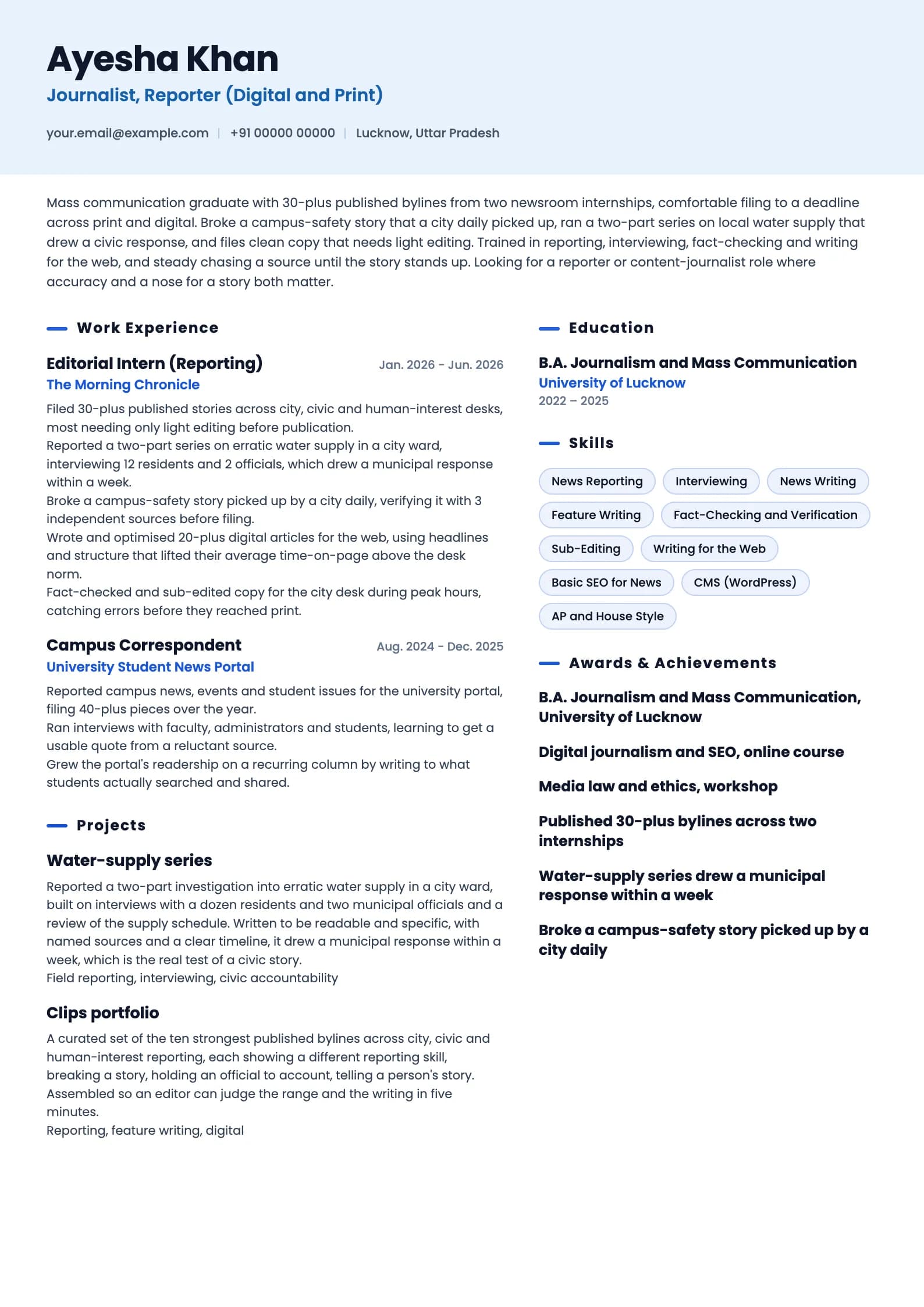
Build my resumeJournalist resume example, Fresher (0 years)
ai-era templateIs your resume good enough?
Upload the resume you have now and see what an applicant tracking system reads before a journalist recruiter ever does.
Free to run. Sign in with your mobile number to see your score.
Journalist resume example, Reporter (5 years)
professional template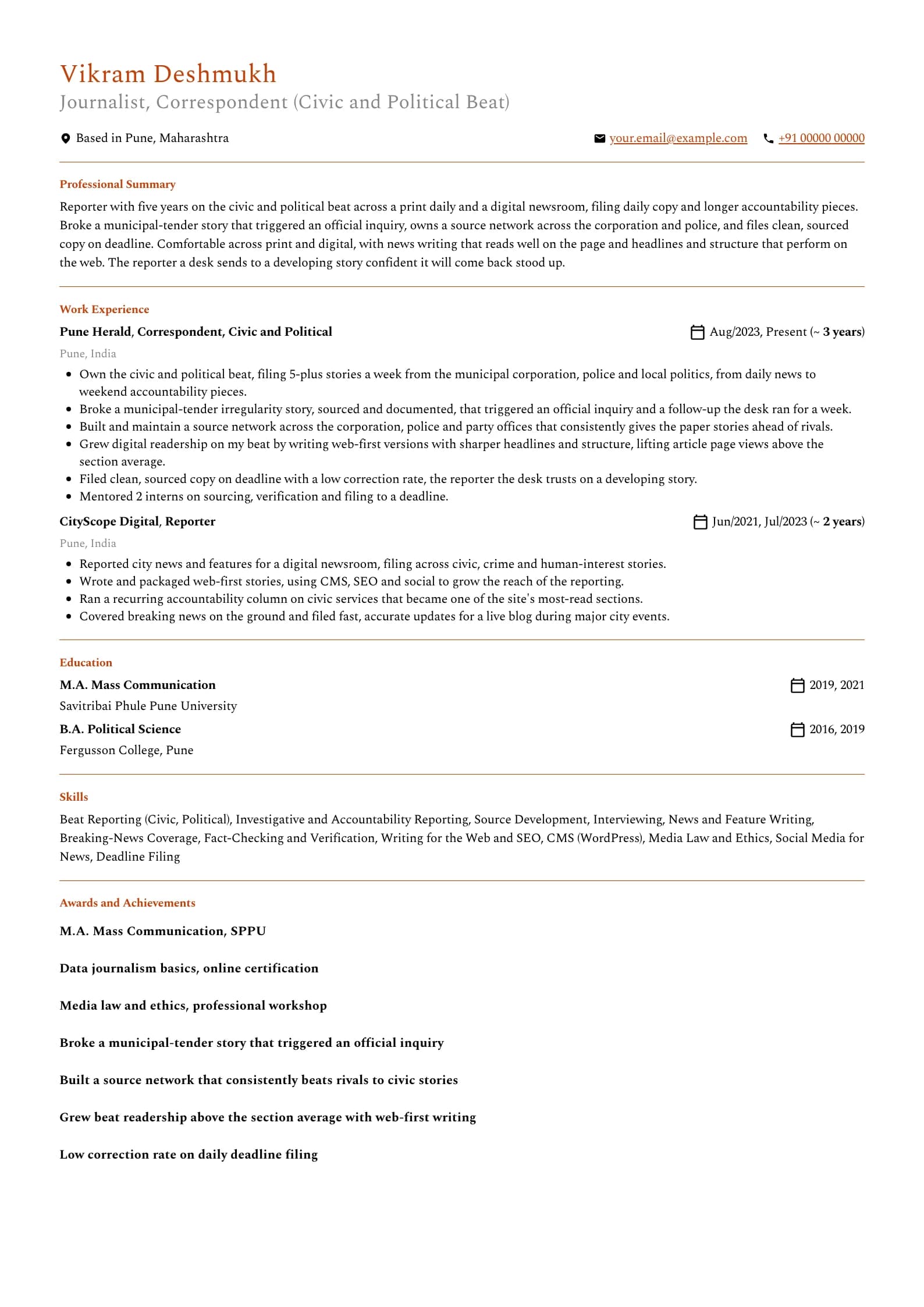
Want this structure with your own details? Build it in the resume builder.
Journalist resume example, Senior (10 years)
header-band template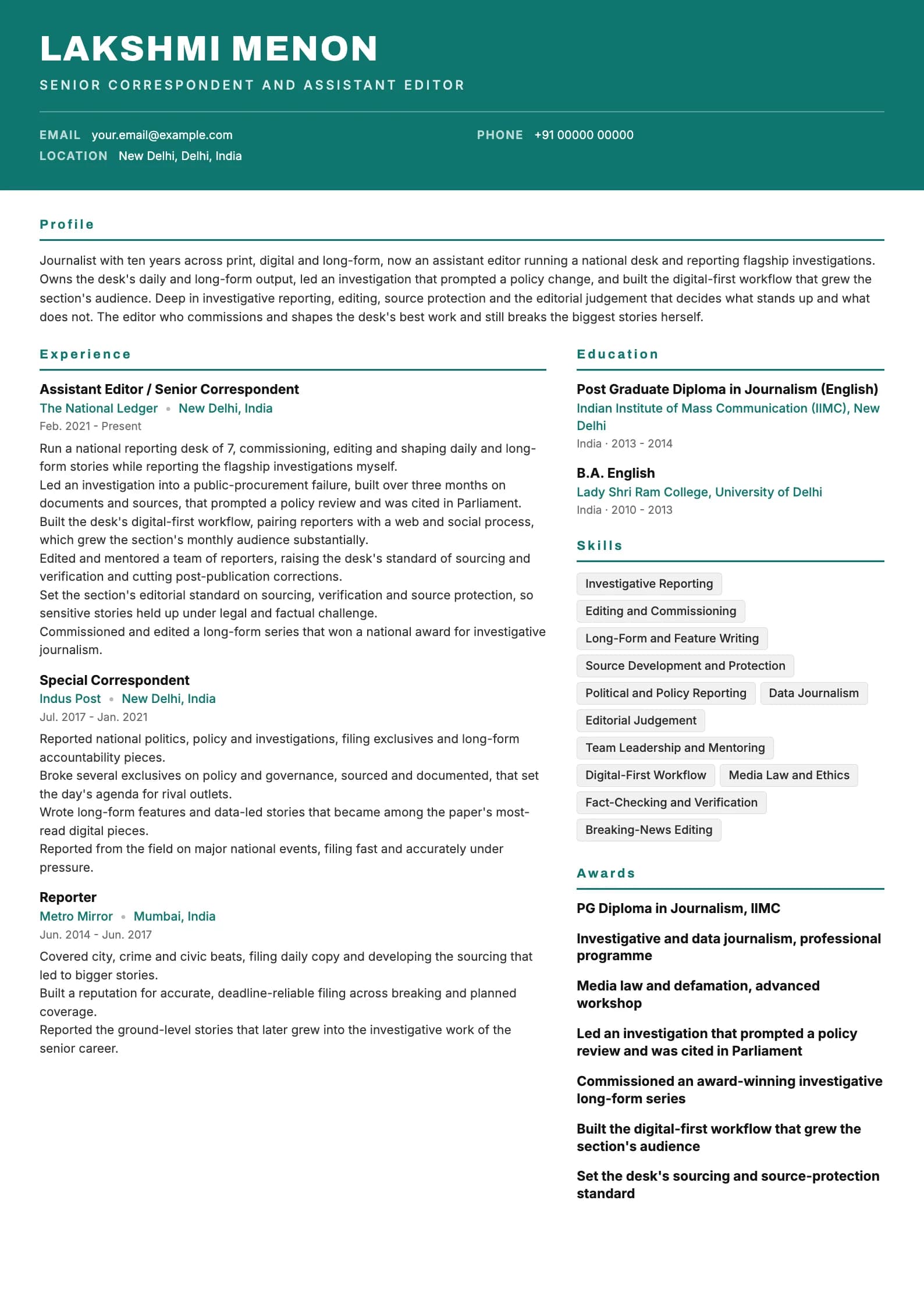
The format that works for journalist resumes in India
Reverse chronological is the layout to use. Put the most recent newsroom role first, work backwards, and let the dates show. Functional resumes that group everything under Skills and drop the dates read as an attempt to hide a gap or a run of short stints, and editors, who read for a living and are alert to spin, treat them that way. For a journalist, the second most important thing after the resume is a link to your clips, the published stories that prove you can report and write. Put a clear, working link to a curated clips portfolio near the top, because an editor decides more from three of your bylines than from any bullet. Curate to eight to twelve of your strongest, most recent, most relevant pieces, each showing a different reporting skill, and if a piece is behind a paywall, note that or host a readable version. Length is decided by evidence. One page holds everything a fresher and most reporters up to roughly six years have to say, alongside the clips. A senior correspondent or editor with investigations, leadership and awards earns a second page. A page two padded with a list of every event attended is a one-page resume in disguise. Four things belong nowhere on the resume: a photograph, date of birth, marital status and father's name. They survive from an older template. An editor is not screening for them, and every line they occupy is a line a story or a byline could have used. Send a PDF unless the posting asks for DOCX, keep to a single column, and name the file with your own name and the role. The table below sets out the section order.
| Section | Where it goes | Why |
|---|---|---|
| Name and clips link | Top, above everything | A link to your published clips is second only to the resume itself. Make it work and curate it. |
| Professional summary | Directly under the header | Three lines. Beat or track, years, and the single strongest story or impact. |
| Work experience | Next, for anyone with a newsroom role | Most recent first. Newest role gets the most bullets. |
| Selected stories / bylines | Above experience for freshers, below it after that | For a fresher this is the evidence beside the clips; for others it is highlights. |
| Skills | Below experience | Grouped: reporting, writing, digital, tools. Not a 20-item wall. |
| Education | Bottom, unless a fresher | Journalism or mass-comm qualification, institution, years. |
| Awards and languages | After education | Journalism awards and the languages you report in, which matter in Indian newsrooms. |
Naming a beat is not the same as proving you owned a story
The most common journalist resume failure is a line that reads reporting, writing, editing, interviewing, civic beat, political beat, crime beat, features, digital, SEO, CMS, social media with no clip or bullet that shows a story you actually broke or a piece that had impact. A parser matches those terms, but an editor reads the list and assumes it is a job description, then goes to the clips to see whether you can report. The fix is to let the work prove the reporting, and to lead with the clips. If you write investigative or accountability reporting, a bullet should name a story you broke, how you sourced it, and what it changed. If you write breaking news, a bullet should describe a developing story you filed under pressure. The mid-level sample shows the civic beat through a tender story that triggered an inquiry and a source network that beats rivals, not through the word beat. The clips, the bullets and the skills all agree. Be specific about your beat and medium, because a civic reporter, a business correspondent and a features writer are different jobs, and print, digital and broadcast reward different skills. Naming your beat and whether you report for print, digital or both tells an editor whether you fit the desk. A reporter who has only done rewrite-desk digital work is not the same as one with a source network on the ground, and an editor can tell. Do not claim a beat you covered once. If you filed two business stories as a city reporter, do not call yourself a business journalist, because an interview question about the sector will find the gap. List the beats you actually own, and let the clips prove them.
For every beat and skill on your line, ask: is there a clip and a bullet that shows a story I owned. If not, cut it. A list of beats impresses nobody; a story you broke and what it changed does.
Writing a summary an editor actually reads
The block under your name is the part that gets read before the clips, so it should carry three facts: your beat or track, how long you have reported it, and the strongest story or impact your work produced. Three or four lines, no adjectives a clip or a reference cannot confirm. The old objective line, seeking a challenging role in a reputed media house to utilise my writing and reporting skills, tells an editor nothing new. Replace it with a summary. An objective describes what you want, a summary describes what you have already reported, and only one is evidence. Freshers often think they have nothing to summarise. Look at the fresher sample: it names the medium, the internship bylines, and points at a series that drew a municipal response and a story picked up by a city daily. That is a genuine summary built from internships and clips. What it avoids is "a passionate journalist with excellent communication skills", a phrase so common on media resumes it now carries no information. Communication is assumed; a story that moved an official is proof. A practical test: read your summary and ask whether any other journalism graduate could paste it onto their resume unchanged. If they could, it describes the degree, not you. Add the specific beat, the specific story and the specific impact until it stops being transferable.
Professional summary, mid-level reporter
Weak
A passionate and hardworking journalist with 5+ years of experience in reporting and writing, with excellent communication skills, seeking a challenging role in a reputed media house.
Strong
Reporter with five years on the civic and political beat across print and digital, with a source network across the corporation and police. Broke a municipal-tender story that triggered an official inquiry and files clean, sourced copy on deadline.
The rewrite trades a skills list and self-description for a beat, a real asset (sources) and a verifiable story with impact.
Experience bullets: verb, story, consequence
Every strong bullet in the samples follows the same shape. It opens with an action verb, names the specific story, beat or reporting you owned, and closes with what it produced or changed. The verb establishes that you did it. The story tells an editor what kind of reporting it is. The impact, an inquiry, a pickup, a policy change, readership, does the persuading. Start with the outcome and work backwards. Journalists usually write the duty first, then leave it flat, which produces bullets like "reported various news stories for the newspaper". Instead ask what your reporting produced: a story broke, an inquiry opened, a piece was picked up, readership grew, a correction was avoided. Then write the sentence that ends in that fact. Journalism has honest measures beyond a story count, so use them: stories that triggered a response or inquiry, exclusives that set the agenda, bylines published, readership or page views grown, low correction rate, sources developed, awards. The samples vary these, which reads as range rather than one trick repeated. Where impact is hard to quantify, give scope and reliability: how many stories a week, how large a beat, how developed a source network, how consistently you file clean copy on deadline. "Own the civic and political beat, filing 5-plus stories a week" carries weight, and "low correction rate" is a real quality metric. Allocate bullets by recency. Current role gets five or six, the previous one four, anything older two or three.
| Level | What bullets and clips must prove | Typical metric |
|---|---|---|
| Fresher | You can report, verify and file publishable copy | Bylines published, a story's impact, pickups, light editing needed |
| 1 to 4 years | You own a beat and file reliably on deadline | Stories a week, exclusives, readership, correction rate |
| 5 to 8 years | You break stories and own a source network | Inquiries triggered, agenda-setting exclusives, sources, reach |
| 8 years and up | You lead a desk and set editorial standards | Investigations, policy impact, audience grown, team led, awards |
Experience bullet, beat reporting
Weak
Reported various civic and political news stories for the newspaper on a daily basis.
Strong
Broke a municipal-tender irregularity story, sourced and documented, that triggered an official inquiry and a follow-up the desk ran for a week.
"Various news stories" describes activity; the rewrite names the story, how it was built, and the inquiry it triggered.
Experience bullet, senior investigation
Weak
Worked on investigative stories about government and policy issues.
Strong
Led an investigation into a public-procurement failure, built over three months on documents and sources, that prompted a policy review and was cited in Parliament.
Names the subject, the method and timeframe, and the systemic impact, so an editor sees the reporting and the result, not a vague claim.
If a bullet would read identically on any reporter's resume, it is describing the job, not the story. Rewrite it until it names a piece you owned and what it changed, and let the clips carry the writing.
The skills section: grouped, honest, and short enough to defend
A journalist's skills section has two audiences with opposite preferences. The parser wants literal terms it can match, reporting, editing, SEO, CMS. A human wants a short, organised list that signals what kind of journalist you are. Grouping satisfies both. Group by function rather than one long line. Reporting, writing and editing, digital, and tools is a grouping that works for almost every journalist. The exact headings matter less than the fact that structure exists. Write names the way the field writes them: SEO not Seo, CMS not Cms, WordPress not Word Press. A parser matches on strings. Ten to sixteen skills is the working range. Below eight the section looks thin. Above twenty it stops being a signal, and journalist resumes are especially prone to listing every beat and every generic skill, communication, teamwork, writing, editing, as though breadth were depth. The list is a contract, and your clips are the proof of every reporting claim on it. Do not include a proficiency bar. Star ratings invite an argument you cannot win, and nobody agrees what four stars in reporting means. Let the clips prove the depth, and pitch the list to the target: a digital newsroom wants SEO, CMS and social alongside reporting; a legacy print desk wants beat reporting, sourcing and news writing.
| Group | What goes in it | How many |
|---|---|---|
| Reporting | Beat reporting, investigative, breaking news, interviewing, sourcing | 3 to 5 |
| Writing and editing | News writing, feature writing, sub-editing, editing, fact-checking | 2 to 4 |
| Digital | Writing for the web, SEO for news, social media, live blogging | 2 to 3 |
| Tools | CMS (WordPress), analytics, data-journalism tools | 1 to 2 |
| Foundations | Media law and ethics, verification, editorial judgement | 1 to 3 |
Skills section
Weak
Skills: reporting, writing, editing, interviewing, communication, teamwork, civic beat, political beat, crime beat, business, sports, entertainment, features, digital, SEO, CMS, social media, MS Office, hardworking, punctual
Strong
Reporting: civic and political beat, investigative, sourcing, interviewing. Writing: news and feature writing, sub-editing, fact-checking. Digital: web writing, SEO for news, social. Foundations: media law and ethics, verification.
Cuts the every-beat-and-soft-skill wall to the beats you own and the skills you can prove, grouped so an editor reads the level in one pass.
Clips and selected stories: what to show and how to describe it
For a journalist the clips are the argument. A resume gets your clips a click; the clips get you the interview. Curate to eight to twelve published stories that are your strongest, most recent, and most relevant to the desk, each chosen to show a different skill, breaking a story, holding power to account, telling a human story, writing long-form. A page of clips all from the same beat and the same week shows less than five that show range. Beside the clips, a short list of selected stories does what a link alone cannot: it names the story, where it ran, and what it achieved. The common failure is describing the topic instead of the reporting and the impact. "Wrote a story about water supply" tells an editor nothing. Describe what you reported, how you sourced it, and what it changed. The water-supply series in the fresher sample is a stronger entry than a longer feature, because it names the sourcing and a municipal response, real impact. Pick stories that show range within your track rather than five variations of the same daily. One that broke news, one accountability piece, and one feature or long-form show more than five spot reports. Two well-described stories beat five headlines listed without context. Be scrupulous about credit and confidentiality. "Reported" and "contributed to" are different, and an editor will ask what you did on a big story. And never name a confidential source or reveal how you protected one on a resume; describing that you protected sources is fine, naming them is a red flag to any newsroom.
Selected-story description, fresher clips
Weak
Water supply story: wrote a two-part article about water supply problems in the city for the newspaper.
Strong
Water-supply series: reported a two-part investigation into erratic supply in a city ward, built on interviews with 12 residents and 2 officials, which drew a municipal response within a week.
Swaps a topic summary for the reporting method, the sourcing, and the real-world response, which is how an editor judges a civic story.
Where education, awards and journalism training belong
Education goes near the top for a fresher who has little else to lead with, and lower for anyone with a real body of published work. A journalism or mass-communication qualification, institution and years is the whole entry for most people, and a name like IIMC, ACJ or the Symbiosis and Xavier's institutes carries weight in Indian newsrooms, so state it plainly. And as in other portfolio fields, strong clips can outweigh the degree: an editor hires the reporting, and a self-taught reporter with real bylines competes with a mass-comm graduate who has none. Marks matter little in journalism, so do not lead with a percentage. An editor wants to read your stories, not your semester grades. Once you have clips and a beat, the degree recedes to a single line. Awards belong on a journalist's resume when they are real, journalism awards, fellowships, a Ramnath Goenka or a state press award, named with the year and the work. They are a strong signal precisely because they are peer-judged. But list only genuine ones; an inflated or vague award line is easy for an editor to check and costs more than it gains. Languages deserve their own mention, because Indian journalism is multilingual and the languages you can report and write in directly widen or narrow the desks you fit. A reporter who can file in Hindi and English, or in a regional language and English, is more useful to many newsrooms, so state your working languages clearly rather than burying them.
Getting through the applicant tracking system
Large media houses and digital newsrooms that recruit online run applications through an applicant tracking system before a human sees them. It reads your file, tries to break it into name, dates, employers, titles and skills, and stores the result so a recruiter can search. Almost every ATS problem is a parsing problem, and parsing problems come from layout, not wording. The layout rules are short. One column. Standard section headings, so use Work Experience rather than My Reporting Journey, and Skills rather than My Strengths. No text inside images, because a screenshot of a byline reads as empty space; keep clips as a text link. No critical information in the header or footer region, which some parsers drop. Avoid text boxes and nested tables in the resume body. On wording, mirror the advertisement where it is honest. If the post says reporter or correspondent, use that title. If it names a beat, digital, SEO or investigative reporting and you do that work, write the term exactly. Spell out an acronym alongside itself at least once, for example "CMS (content management system)", so both searches find you. For a digital newsroom, terms like SEO, CMS, analytics and social media are ones the parser is set to match alongside reporting. Keyword stuffing does not work, and a hidden block of beats in white text is found quickly. Write real bullets that naturally contain the right terms. Save as PDF from a tool that embeds real text, then open the file and confirm you can select and copy a sentence, and that your clips link is clickable. If you cannot select the text, neither can the parser.
Section heading
Weak
My Life in the Newsroom
Strong
Work Experience
Parsers look for standard headings; a creative one can push the entire block into an unclassified bucket the recruiter never searches.
Test your own file before you send it. Copy the text out of the PDF into a plain text editor. If your clips link and beats do not come out as text, a recruiter's search will never surface you, however strong the stories behind the link are.
What gets journalist resumes rejected
Most rejections at the resume stage are not close calls. They come from a small set of recurring problems, and all of them are fixable in an afternoon. The list below covers what editors reviewing Indian journalist resumes see most often, in rough order of how much damage each one does.
- No clips link, or a broken one. An editor wants to read your reporting, and no way to do so ends the application.
- Beats and generic skills listed instead of stories. "Civic beat, political beat, features" says nothing; name a story you broke and what it changed.
- Duties instead of impact. "Reported various news stories" is the tell; state the inquiry, the pickup, the readership, the low correction rate.
- Clips that are all the same beat and week, or padded to fifty, so the editor never sees your range or your best work.
- Claiming a beat you covered once, which an interview question about the sector exposes.
- "Passionate journalist with excellent communication skills" as the summary. Communication is assumed; a story that moved something is proof.
- A photo, date of birth, marital status or father's name. None of it belongs on the resume and it takes a byline's space.
- Overstating your role on a big story, which an editor catches by asking exactly what you reported.
- Naming a confidential source or how you protected one, which reads as a serious ethics risk to any newsroom.
- Typos and factual slips in your own resume, which for a journalist, whose job is accuracy, are disqualifying in a way they are not elsewhere.
For a journalist, a typo in the resume is not a small thing: accuracy is the job. Proofread it as hard as you would a front-page story, and have someone else read it, before you send it.
Skills to put on a journalist resume
Technical
- News Reporting
- Investigative and Accountability Reporting
- Beat Reporting
- Interviewing
- Source Development
- News and Feature Writing
- Sub-Editing and Editing
- Fact-Checking and Verification
- Writing for the Web
- SEO for News
- Data Journalism
- Breaking-News Coverage
Tools and platforms
- WordPress and newsroom CMS
- Google Analytics
- Social media platforms
- Data and spreadsheet tools
- Transcription tools
- Newswire and research databases
- MS Office and Google Workspace
Working skills
- Editorial judgement
- Persistence in chasing a story
- Working under deadline pressure
- Ethics and integrity
- Source protection and trust
- Curiosity and news sense
- Clear communication
- Adaptability across mediums
- Handling pressure and criticism
Certifications worth listing as a journalist
| Certification | Full name | Worth it for |
|---|---|---|
| PG Diploma / MA Journalism | Postgraduate diploma or master's in journalism or mass communication | The most common qualifying credential, and a name like IIMC, ACJ or a leading mass-comm institute carries real weight in Indian newsrooms. Valuable for freshers to enter the field; once you have published clips, the reporting outweighs the degree, so let the work lead. |
| Digital Journalism / SEO | Digital journalism, SEO and analytics certification | Worth it for reporters moving into or working in digital newsrooms, where writing for the web, headlines that perform and analytics are part of the job. Signals you can grow a story's reach, not just report it; most useful in the entry-to-mid range. |
| Data Journalism | Data journalism and visualisation training | A genuine differentiator for reporters who work with datasets, records and documents, increasingly valued for investigative and accountability work. Pair it with a data-led story in your clips; less relevant for a pure spot-news or features beat. |
| Media Law and Ethics | Media law, defamation and ethics workshop | Valuable across the board, and especially for investigative and political reporters whose stories draw legal challenge. Signals you understand defamation, contempt and source protection, which editors need to trust on sensitive stories. Worth naming for accountability-heavy roles. |
Keywords an ATS scans for in a journalist resume
These are the literal terms a parser matches against the job description. Use the ones that are true of you, in the sentences where you did the work, not as a list at the bottom.
- journalist
- reporter
- correspondent
- news reporting
- investigative reporting
- feature writing
- news writing
- interviewing
- sub-editing
- editing
- fact-checking
- beat reporting
- digital journalism
- SEO
- CMS
- WordPress
- breaking news
- source development
- media law
- byline
Journalist resume FAQ
What salary can a journalist expect in India?
A trainee reporter or fresher typically starts around 2.5 to 4.5 LPA, higher in national digital newsrooms than in small regional papers. A reporter or correspondent with four to six years on a beat usually sits in the 6 to 12 LPA band. Senior correspondents, assistant editors and editors with investigations and leadership behind them commonly earn 12 to 25 LPA and above, with the top at national outlets and digital platforms. Broadcast and business journalism, and moving into editing or a specialised beat, tend to pay more than general print reporting.
How important are clips on a journalist's resume?
They are close to essential. An editor decides more from three of your published stories than from your entire bullet list, so a working link to a curated clips portfolio near the top of the resume is what turns an application into an interview. Curate to eight to twelve of your strongest, most recent, most relevant pieces, each showing a different reporting skill. If a piece is paywalled, note it or host a readable version, because a clip an editor cannot open does not count.
How does a fresher write a journalist resume with no full-time job?
Lead with your clips, then internships and campus reporting, then skills. Internship bylines, a campus-portal column, freelance pieces and student journalism all count, so treat each as evidence: what you reported, how you verified it, and what it achieved, a pickup, a response, growing readership. Show that you understand accuracy and verification, not just writing. Strong clips carry more weight than the degree, so build and curate a portfolio even if it is small.
Should I list every beat I have covered?
No. Listing civic, political, crime, business, sports, entertainment and features when you have really owned one or two beats reads as padding, and an interview question about a sector you barely touched will expose it. List the beats you actually own, and let a clip and a bullet prove each. Depth on a beat, a source network and a story you broke, persuades an editor far more than a wide list, so name your real track and show range within it.
Do I need a journalism degree to become a journalist?
It helps but it is not absolute. A journalism or mass-communication degree, especially from a respected institute, opens doors and teaches fundamentals, and is worth naming. But journalism is a portfolio field: an editor hires the reporting, and a self-taught reporter with real, published clips competes with a graduate who has none. If your route was freelancing and stringing rather than a degree, build a strong clips portfolio and let the bylines make the case.
How do I show impact when my stories cannot all be measured?
Use the impact you can point to, and reliability where you cannot. Stories that triggered an inquiry, a response or a policy change; exclusives that set the agenda for rivals; bylines published; readership or page views grown; a low correction rate; a source network that beats competitors; and journalism awards are all honest measures. Where a story's effect is hard to quantify, state scope and reliability, stories a week, size of beat, clean deadline filing, because an editor values a reporter who files accurately on time as much as one big splash.
Does an ATS reject two-column journalist resumes?
It does not reject them outright, but many media-house parsers read multi-column layouts out of order, which interleaves your sidebar with your experience and can scramble your clips link and beats. A single-column layout removes the risk, which is why all three samples above use one. Test your own file by copying the text out of the PDF into a plain text editor; if your clips link and beats come out as text and it reads in order, it will most likely parse.
Should I mention my sources or confidential stories on my resume?
Never name a confidential source or explain how you protected one on a resume; it reads as a serious ethics risk to any newsroom and can cost you the job. You can and should describe that you developed and protected sources, and that a story was built on documents and sources, without naming them. Similarly, be honest about your role on big stories, reported versus contributed to, because an editor will ask exactly what you did, and overstating it is easy to catch.
Related resume examples and guides
Build your own in any of these formats
Start from a blank resume or upload the one you have. Goodspace renders it in 24 templates, keeps your clips link selectable, and flags the reporting, beat and digital keywords an applicant tracking system will look for, and the list of beats it will not credit.
Build my resume