Growth Manager Resume Format, with 3 Full Samples
A growth manager is hired on evidence of a metric that moved, an experiment that shipped and a funnel that leaks less than it did before, yet most resumes list channels and tools and forget the number at the end. Below are three complete resumes, one for a growth associate two years into the craft, one for a growth manager owning activation and retention for a consumer app, and one for a head of growth running a team and a P&L line. After the samples come the format rules, the difference between listing a channel and proving a lift, the terms an applicant tracking system matches literally, and the mistakes that end a screening before a founder sees the page.
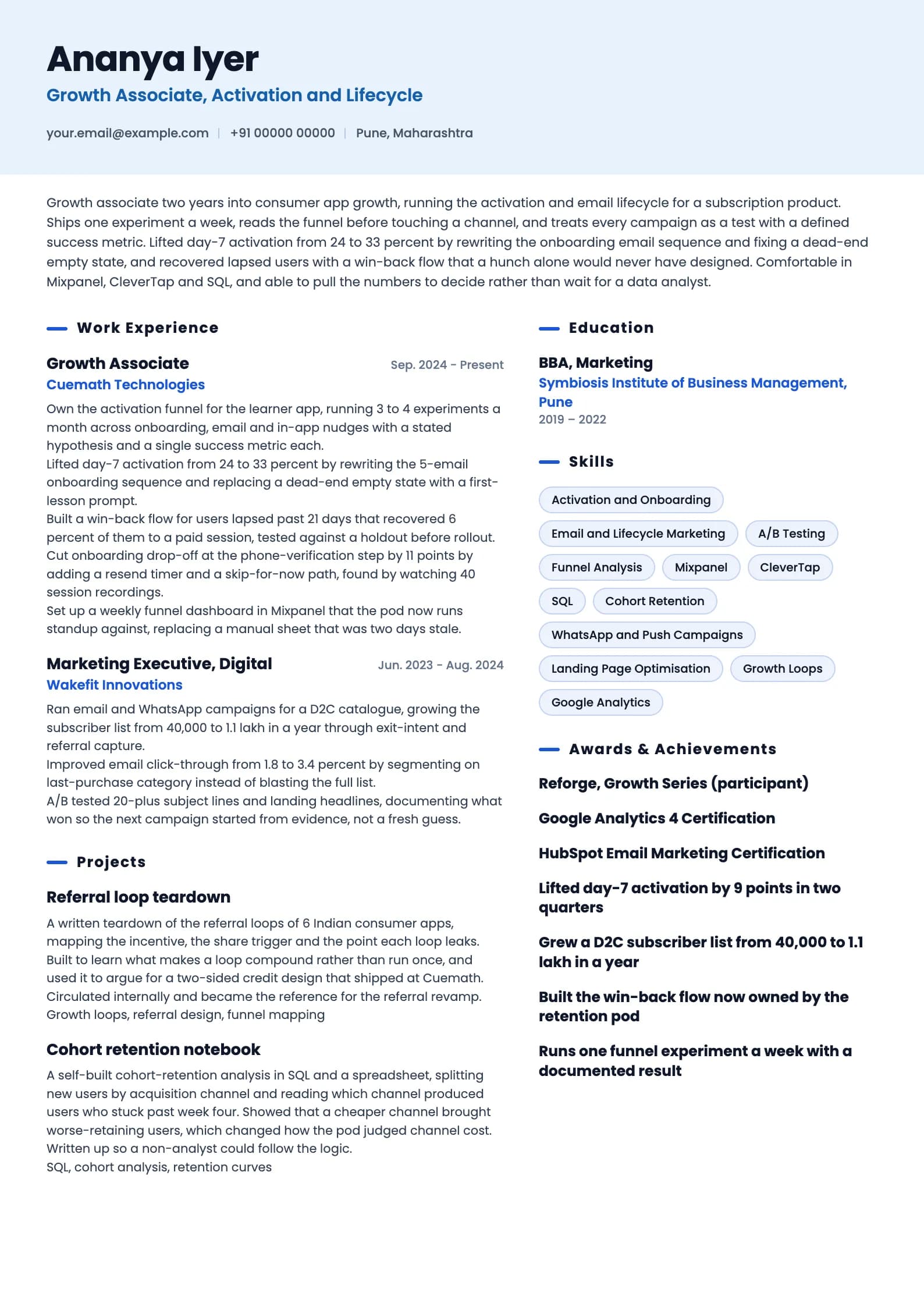
Build my resumeGrowth Manager resume example, Growth Associate (2 years)
ai-era templateIs your resume good enough?
Upload the resume you have now and see what an applicant tracking system reads before a growth manager recruiter ever does.
Free to run. Sign in with your mobile number to see your score.
Growth Manager resume example, Growth Manager (5 years)
professional template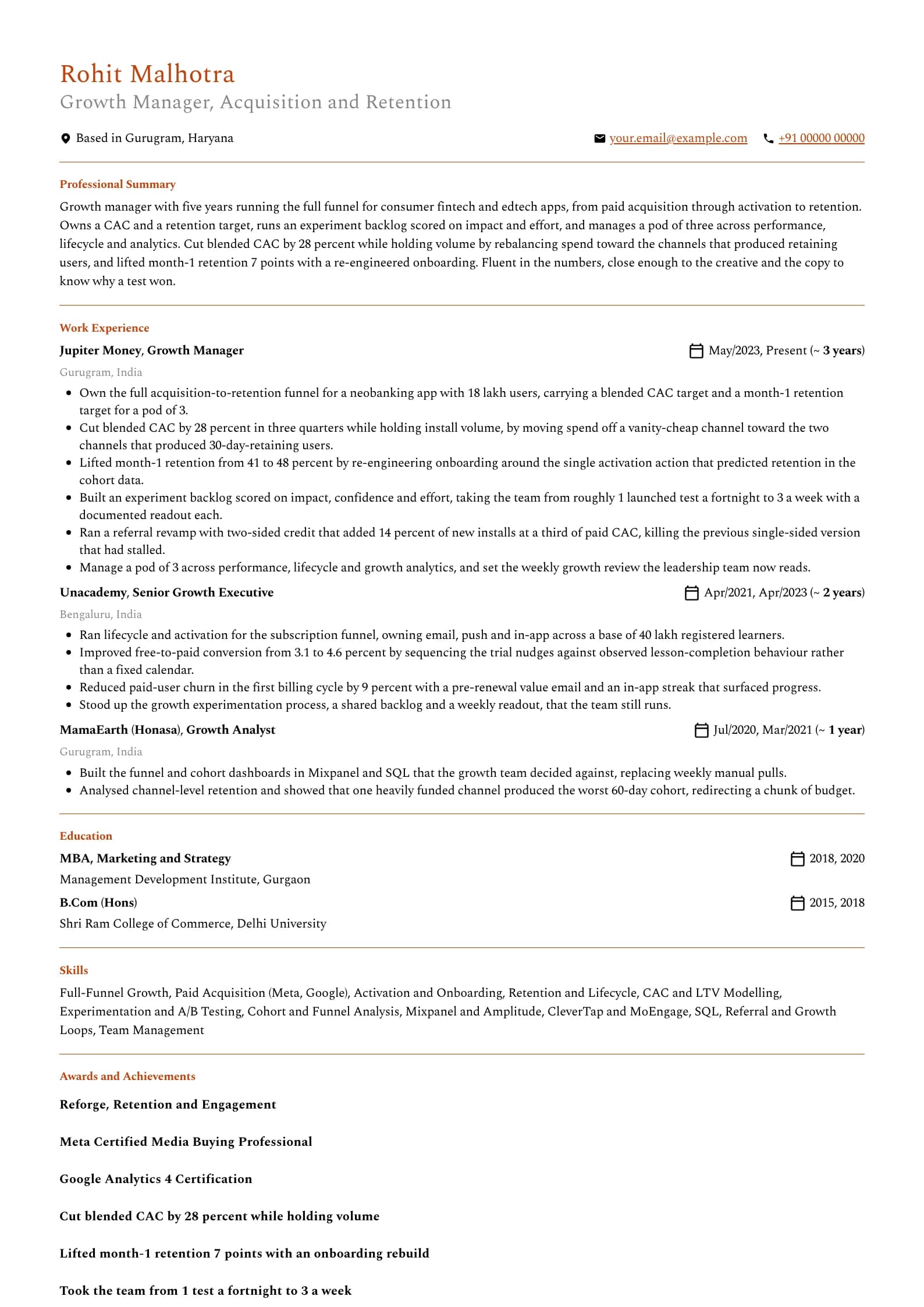
Want this structure with your own details? Build it in the resume builder.
Growth Manager resume example, Head of Growth (10 years)
header-band template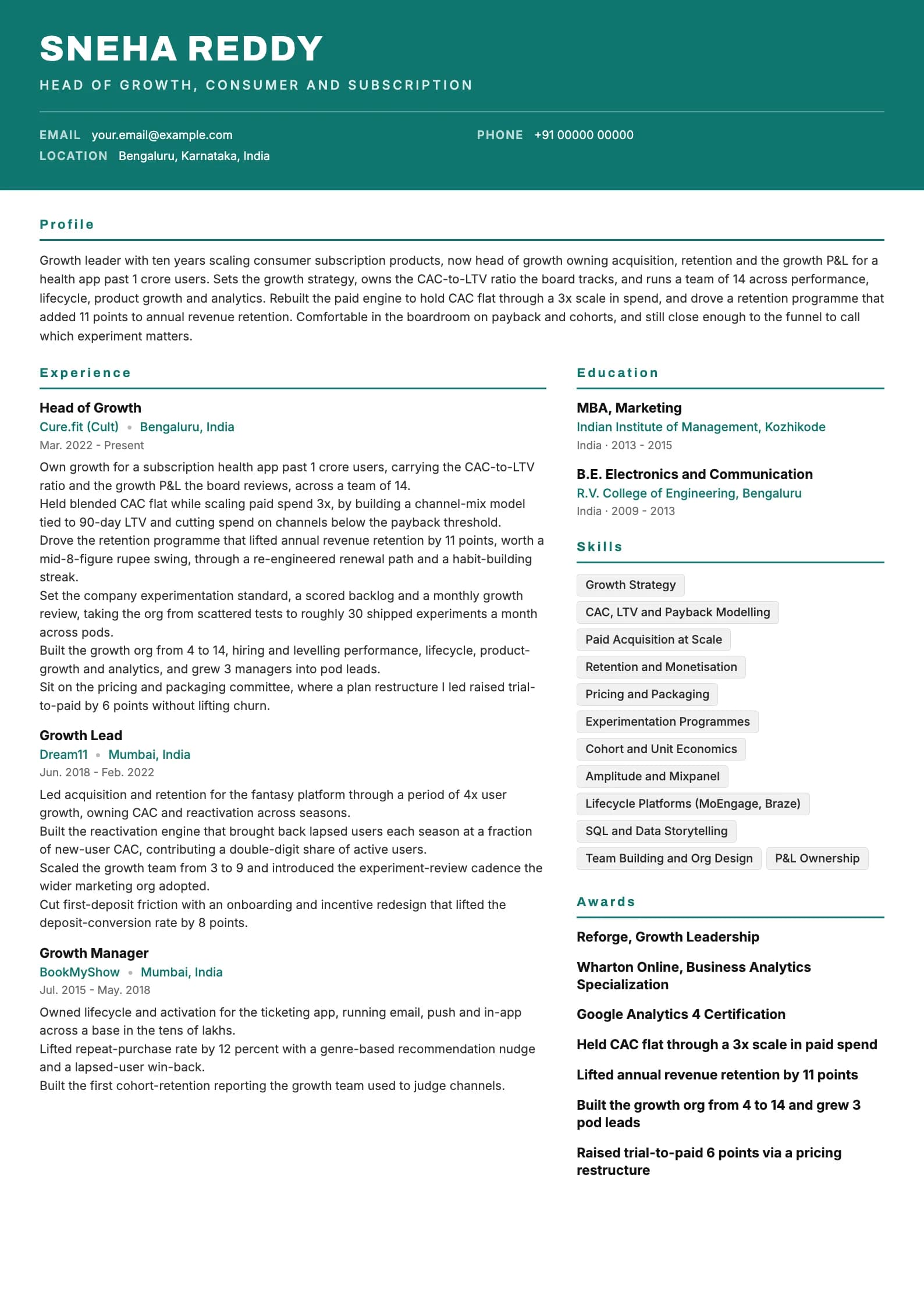
The format that works for growth manager resumes in India
Reverse chronological is the layout to use. Most recent role first, work backwards, dates in plain view. A functional resume that groups everything under Skills and Achievements and hides the dates reads as an attempt to mask a gap or a short stint, and startup reviewers, who see hundreds of these, treat it that way. A gap explained in one honest line costs you less than a layout that looks evasive. Length follows evidence. One page holds everything a growth associate and most managers up to roughly seven years have to say. A head of growth with a decade of scaling behind them can run to two, but only if the second page carries owned outcomes and team scope, not a longer list of tools. A page two built from a channels-I-have-used grid and a certifications wall is a padded one-pager. Four things belong nowhere on this resume: a photograph, date of birth, marital status and father's name. They survive from an older campus-placement template and add nothing to a growth screen, which is entirely about what you moved. Every line they take is a line an experiment or a metric could have used. Send a PDF unless the posting asks otherwise, and name the file with your own name and the target role rather than resume_final_v4. Keep a single column top to bottom, because a two-column layout with a channels sidebar parses unpredictably and can scramble a recruiter's search. The table below sets the section order.
| Section | Where it goes | Why |
|---|---|---|
| Name and headline | Top, above everything | The headline is the role you want, growth manager or head of growth. Recruiters match on it. |
| Professional summary | Directly under the header | Three lines: the funnel you own, years, and the single strongest metric you moved. |
| Work experience | Next, for anyone with a job | Most recent first. Newest role gets the most bullets and the biggest numbers. |
| Key metrics or highlights | Optional strip under the summary | A short band of your top 3 outcomes for scanners. Only if each is a real number. |
| Skills | Below experience | Grouped: growth areas, analytics, channels, tools. Not a 40-logo wall. |
| Education | Bottom, unless you are early-career | Degree, institution, years. An MBA is worth naming; drop the percentage after your first role. |
| Certifications | After education, or beside skills if only one or two | Reforge, GA4, a media certification. Name, body, year. |
Listing a channel is not the same as proving a lift
The single most common growth resume failure is a wall that reads Meta Ads, Google Ads, SEO, email, push, WhatsApp, referral, influencer, ASO, CRO, with no bullet anywhere that shows a number moving because of any of it. A parser matches the terms, but a founder reads the wall and assumes it is a list of things you have touched, not things you have moved, then goes looking for the one channel you can actually defend with a metric. The fix is to let the experience carry the outcome. Growth is the one function where a hiring manager genuinely expects a number on almost every line, because the job is literally to move numbers. If you write retention on the skills line, a bullet should state the retention figure before and after. If you write CAC, a bullet should show what it was and what you got it to. The manager sample lists retention, CAC and referral precisely because the bullets carry a retention lift, a CAC cut and a referral share, so the skills line and the experience agree. Be specific about the metric type, because growth has many and they are not interchangeable. Activation, retention, CAC, LTV, payback, conversion, churn and revenue each tell a different story, and a resume that only ever says grew and improved without naming which metric reads as someone who ran campaigns rather than owned an outcome. Name the metric, state the before and after, and attribute it to the change you made. Do not claim a company-level number as your personal result. Writing grew revenue 3x when you owned one lifecycle email is the fastest way to lose a sharp interviewer, who will ask exactly what you owned and watch the number shrink. Claim your slice honestly. A 7-point retention lift you drove is more credible, and more impressive, than a 3x you rode.
For every channel on your skills line, ask: is there a bullet with a number that proves I moved something with it. If not, either add the number or cut the channel. A wall of untouched channels helps the parser and sinks the interview.
Writing a summary a founder actually reads
The block under your name is the part you can be reasonably sure gets read, so it should carry three facts: what funnel or metric you own, how long you have owned it, and the single strongest thing that moved because of your work. Three or four lines, no adjectives a reviewer cannot check. The old objective line, a result-oriented growth professional seeking a challenging role in a fast-paced organisation, tells the reader nothing they did not already assume. Replace it with a summary. An objective describes what you want; a summary describes what you have already moved, and only one is evidence in a function that lives on evidence. Early-career candidates often believe they have nothing to summarise. Look at the associate sample: it names the funnel stage owned, the length of tenure, and points at an activation lift with a real before and after. That is a genuine summary built from two years and a handful of shipped experiments. What it avoids is data-driven and growth-obsessed, phrases so common on growth resumes they now carry no information at all. A practical test: read your summary and ask whether a peer with the same title could paste it onto their resume unchanged. If they could, it describes the job, not you. Add the specific funnel, the specific number and the specific ownership until it stops being transferable.
Professional summary, growth manager
Weak
Data-driven and growth-obsessed marketing professional with 5+ years of experience across acquisition, retention and performance marketing, seeking a challenging role in a fast-paced startup.
Strong
Growth manager with five years owning the full funnel for consumer fintech apps, carrying a CAC and a retention target for a pod of three. Cut blended CAC 28 percent while holding volume and lifted month-1 retention 7 points.
The rewrite trades a self-description and a keyword list for an ownership scope and two verifiable, attributable numbers.
Experience bullets: verb, lever, metric
Every strong bullet in the samples follows the same shape. It opens with an action verb, names the specific lever you pulled, and closes with the metric that moved. The verb establishes that you did it. The lever tells a growth reviewer whether the work is real or a guess. The number does the persuading, and in growth the number is not optional. Start with the outcome and work backwards. Growth people often write the activity first, then struggle to attach a result, which produces bullets like ran email and push campaigns to improve engagement. Instead ask what was measurably different after you shipped: activation rose, CAC fell, a cohort retained better, conversion moved, churn dropped. Then write the sentence that ends in that fact and names the change that caused it. Vary the metric. Five activation numbers in a row read as one lever pulled repeatedly. Across a real role you can honestly reach for activation, retention, CAC, LTV, conversion, churn, referral share and revenue. The manager sample moves across CAC, retention, test velocity and referral, which reads as range and full-funnel ownership rather than a single trick. Attribute honestly and state the method. Growth results are famously confounded, so a bullet that says tested against a holdout or found by watching session recordings is more credible than a bare percentage, because it shows you know a lift has to be earned, not assumed. Where you genuinely lack a clean number, give scope: how many experiments a week, how large the base, how many channels owned. Allocate bullets by recency. Current role gets five or six, the previous role three or four, anything older two.
| Level | What bullets must prove | Typical metric |
|---|---|---|
| Associate (0 to 2 yrs) | You can run an experiment end to end and read the result | Activation, click-through, drop-off, one funnel stage moved |
| Growth Manager (3 to 6 yrs) | You own a funnel and hit a target without hand-holding | CAC, retention, conversion, test velocity, referral share |
| Senior / Lead (6 to 9 yrs) | You own multiple levers and set the growth process | Blended CAC, LTV, payback, revenue retention, team output |
| Head of Growth (9+ yrs) | You own the growth economics and build the org | CAC-to-LTV, revenue retention, spend scaled, team grown |
Experience bullet, acquisition
Weak
Responsible for managing paid acquisition across Meta and Google to drive installs and improve overall marketing performance.
Strong
Cut blended CAC by 28 percent in three quarters while holding install volume, by moving spend off a vanity-cheap channel toward the two that produced 30-day-retaining users.
"Responsible for managing" describes a job description; the rewrite names the lever, the trade-off and the number, so a reviewer can ask a real follow-up.
Experience bullet, retention
Weak
Worked on retention and engagement initiatives which significantly improved user retention over time.
Strong
Lifted month-1 retention from 41 to 48 percent by re-engineering onboarding around the single activation action that predicted retention in the cohort data.
Names the before and after and the insight behind the change, which shows judgement rather than a vague claim of improvement.
If a bullet would read identically on a teammate's resume, it is describing the pod, not you. Rewrite it until it names the lever you pulled and the number you own, and only that.
The skills section: grouped, honest, and short enough to defend
A growth resume's skills section has two audiences with opposite tastes. The parser wants literal terms it can match, Mixpanel and CleverTap and SQL. A human wants a short, organised list that signals what kind of growth person you are, an acquisition specialist, a lifecycle person or a full-funnel owner. Grouping satisfies both. Group by function rather than one long line. Growth areas, analytics, channels and tools is a grouping that works for almost every growth manager. The exact headings matter less than the fact that structure exists. Write names the way the industry writes them: CleverTap not Clevertap, Amplitude not amplitude, GA4 not google analytics 4 alone. A parser matches on strings, and a recruiter reads the grouping in one pass. Twelve to sixteen skills is the working range. Below eight the section looks thin. Above twenty it stops being a signal, and growth resumes are especially prone to channel and tool padding, listing every ad platform, every CRM and every analytics tool anyone has ever opened. The list is a contract: every item is a question you have agreed to answer, and a tool you used once will not survive a five-minute probe. Do not include a proficiency bar. Star ratings invite an argument you cannot win, and nobody agrees on what four stars in retention means. Do not list soft skills as a headline group either, communication and leadership belong proven in the bullets, not asserted in a list. Let the experience carry the depth.
| Group | What goes in it | How many |
|---|---|---|
| Growth areas | Acquisition, activation, retention, monetisation, referral loops | 3 to 5 |
| Analytics | Funnel and cohort analysis, A/B testing, CAC/LTV modelling, SQL | 3 to 4 |
| Channels | Meta and Google Ads, email, push, WhatsApp, SEO, ASO | 3 to 5 |
| Tools | Mixpanel, Amplitude, CleverTap, MoEngage, GA4, Google Sheets | 3 to 5 |
| Leadership | Experimentation programmes, team management (senior only) | 1 to 2 |
Skills section
Weak
Skills: Digital Marketing, Growth Hacking, SEO, SEM, Meta Ads, Google Ads, Email Marketing, WhatsApp Marketing, Influencer Marketing, Affiliate, CRO, ASO, Mixpanel, Amplitude, CleverTap, MoEngage, Braze, WebEngage, GA, GA4, Excel, PowerPoint, SQL, Leadership, Communication, Teamwork
Strong
Growth areas: acquisition, activation, retention, referral loops. Analytics: funnel and cohort analysis, A/B testing, CAC/LTV modelling, SQL. Channels: Meta and Google Ads, email, push, WhatsApp. Tools: Mixpanel, CleverTap, GA4.
Cuts the buzzwords and the every-tool-I-opened list, drops asserted soft skills, and groups what remains so a human reads it in one pass and a parser still matches the real terms.
Case studies, side projects and what a growth portfolio proves
For an early-career growth candidate or a switcher, a small set of written case studies or side projects is the evidence a thin work history cannot yet provide. They sit above or beside experience and show a founder that you think in funnels and loops even where you have not owned a big budget. For a senior candidate they shrink to nothing, because the work history carries everything. The common failure is describing the tools instead of the thinking. A growth project built using Mixpanel and Google Sheets tells a reviewer nothing, because the tool is not the work. Describe the question you asked, what you found, and what changed because of it. The referral teardown in the associate sample is a stronger entry than a flashier project would be, because it shows the one thing a growth interview probes for: can you look at a loop and see where it leaks and why. Pick work that shows range rather than three versions of the same campaign. One teardown of how a product you admire grows, one piece of real analysis that changed a decision, and one shipped experiment with a documented result is a stronger set than three restated campaign briefs. Two well-described case studies beat five listed by name. If the analysis or write-up is public, say so in plain text. If it is a Notion doc or a blog post, make sure it reads as thinking rather than a screenshot dump, because an interviewer who opens it reads it as a work sample. A clear teardown of why a loop compounds is worth more than a certificate, because it shows the judgement the certificate only implies.
Project description, early-career growth
Weak
Growth project: analysed user data using Mixpanel and Google Sheets to find insights for improving the product funnel.
Strong
Referral loop teardown: mapped the incentive, share trigger and leak point of 6 Indian consumer apps, and used it to argue for the two-sided credit design that shipped and added 14 percent of installs.
Swaps a tool list and "find insights" for a specific piece of analysis, the mechanism it examined, and the shipped decision it drove.
Where education and certifications belong
Education goes at the bottom for anyone with a full-time job, and higher up for an early-career candidate who has nothing stronger to lead with. Degree, institution, years. That is the whole entry for most people, with one exception worth naming. An MBA is worth stating plainly, because growth hiring in India still reads a tier-one MBA as a signal, particularly for manager and above. Name the school and the specialisation. Beyond that, the rule is the same as any function: your degree stops competing with your work once you have shipped a couple of years of growth outcomes, so it moves to the bottom and the percentage comes off. CGPA or percentage is worth keeping while you are early-career and it is good, roughly 7.5 out of 10 and above, because campus and early-career screening still filters on it. Once you have your first full-time role and a metric you moved, drop it. A number from your degree competes for space with an activation lift that is far more predictive of how you will do the job. Certifications sit just below education, or beside skills if you hold only one or two. Write the full name, the issuing body and the year. For growth, Reforge programmes, a Meta or Google media certification and GA4 carry real signal, especially early on. They matter less once you have a track record of moved numbers to point at, so keep the list short and let the outcomes be the credential. An expired certification listed as current is a small dishonesty that is easy to catch, so renew it or remove it.
Getting through the applicant tracking system
An applicant tracking system is a parser and a search index, not a judge. It reads your file, tries to break it into name, dates, employers, titles and skills, and stores the result so a recruiter can search across candidates. Almost every ATS problem is a parsing problem, and parsing problems come from layout, not wording. The layout rules are short. One column. Standard section headings, so use Work Experience rather than My Growth Journey, and Skills rather than My Toolkit. No text inside images, because a strip of channel logos reads as empty space to a parser. No critical information in the header or footer region, which some parsers drop. Avoid text boxes and nested tables in the body of the resume. On wording, mirror the language of the job description where it is honest. If the posting says growth manager, use that title, not growth ninja or growth hacker. If it says retention and lifecycle, make sure those exact words appear in a real bullet. Include the expansion alongside an acronym at least once, for example CAC (customer acquisition cost) and LTV (lifetime value), so a search on either term finds you. Keyword stuffing does not work, and growth resumes are a common offender with a hidden block of every channel and tool in white text. Recruiters find it in seconds, and the outcome is worse than being filtered. Write real bullets that naturally contain the right terms, because a bullet describing a CAC cut contains the word CAC in a context that survives human review too. Save as PDF from a tool that embeds real text, then open the file and confirm you can select and copy a sentence. If you cannot select the text, neither can the parser, and your careful metrics never enter the search index.
Section heading and title
Weak
My Growth Hacking Adventures (Growth Ninja)
Strong
Work Experience (Growth Manager)
Parsers look for standard headings and match on real titles; a cute heading and a joke title can push the block into an unclassified bucket and miss the title search entirely.
Test your own file before you send it. Copy the text out of the PDF into a plain text editor. Whatever you can read there is roughly what the parser sees, and any scrambled metric is a real risk to a recruiter search.
What gets growth manager resumes rejected
Most rejections at the resume stage are not close calls. They come from a small set of recurring problems, and all of them are fixable in an afternoon. The list below covers what founders and growth leaders reviewing Indian growth manager resumes see most often, in rough order of how much damage each one does.
- A wall of channels and tools with no metric proving any of it. In growth, a line without a number reads as a line without an outcome.
- Claiming company-level results you did not own. "Grew revenue 3x" when you ran one email invites the exact question that shrinks the number.
- Only ever saying grew and improved, never naming which metric. Activation, retention, CAC and conversion are different jobs, and a reviewer notices when you cannot tell them apart.
- Buzzword titles like growth hacker or growth ninja, which read as unserious to a founder and miss the title search in an ATS.
- No mention of method. A bare percentage with no holdout, no cohort and no experiment reads as a number you hope is causal rather than one you earned.
- A photo, date of birth, marital status or father's name. None of it belongs on a growth resume, and it takes an experiment's space.
- Soft skills asserted as a headline group. Communication and leadership belong proven in a bullet, not claimed in a list.
- A generic objective line. Replace it with a summary that states the funnel you own, years and one moved number.
- Every ad platform and CRM listed as a skill to pad the section, which a five-minute probe sees straight through.
- Inflated titles or dates that do not match your offer letters. Background verification is standard and a mismatch ends the process.
Read your resume aloud once before sending it. For every number, ask whether you could defend it in an interview, name your slice, and explain how you know the change caused it. If you cannot, rewrite the line.
Skills to put on a growth manager resume
Technical
- Full-Funnel Growth
- Acquisition and Paid Media
- Activation and Onboarding
- Retention and Lifecycle
- Monetisation and Pricing
- Referral and Growth Loops
- A/B Testing and Experimentation
- Funnel and Cohort Analysis
- CAC, LTV and Payback Modelling
- SQL
- Conversion Rate Optimisation
- App Store Optimisation
- Attribution and Measurement
Tools and platforms
- Mixpanel
- Amplitude
- CleverTap
- MoEngage
- Braze
- Google Analytics 4
- Meta Ads Manager
- Google Ads
- Google Sheets and Excel
- Metabase
- Optimizely
- AppsFlyer
Working skills
- Experiment prioritisation
- Data storytelling
- Cross-functional collaboration
- Stakeholder management
- Team leadership
- Hypothesis-driven thinking
- Rapid iteration
- Commercial judgement
- Clear written communication
Certifications worth listing as a growth manager
| Certification | Full name | Worth it for |
|---|---|---|
| Reforge | Reforge Growth Programs (Growth Series, Retention, Monetisation) | The most respected growth credential among Indian startup hiring managers, worth it for growth managers who want to signal they think in loops and cohorts rather than campaigns. Most valuable in the two-to-seven-year range. Beyond that, a track record of moved metrics outranks any program, so treat it as a mid-career sharpener rather than a career-long badge. |
| GA4 | Google Analytics 4 Certification | A clean entry signal for early-career growth and marketing candidates that you can set up and read a funnel in the tool most Indian consumer companies use. Free and quick, so worth having on the page as a fresher or switcher. Redundant to name once you have owned analytics for a couple of years. |
| Meta Media Buying | Meta Certified Media Buying Professional | Useful for growth people whose remit includes paid social, since Meta is still a primary acquisition channel for Indian consumer apps. Signals you can run and read a paid account, not just brief an agency. Most valuable early on; senior growth roles care more about the CAC-to-LTV logic than the platform badge. |
| Google Ads | Google Ads Certification (Search, App) | Worth it for growth managers who own Google acquisition, especially app-install and search campaigns. Pairs with the Meta certification to cover the two channels most Indian growth budgets sit in. Like the Meta badge, it is an early-career signal that fades once you have a spend-and-payback track record. |
| SQL / Analytics | SQL for Data Analysis or a Business Analytics Specialization | Not role-specific, but genuinely differentiating, because a growth manager who can pull their own cohort in SQL moves faster than one who waits on an analyst. Worth it at any level if you cannot yet query your own data. Once you demonstrably run your own analysis, the outcome speaks louder than the certificate. |
Keywords an ATS scans for in a growth manager resume
These are the literal terms a parser matches against the job description. Use the ones that are true of you, in the sentences where you did the work, not as a list at the bottom.
- growth manager
- growth marketing
- user acquisition
- retention
- activation
- lifecycle marketing
- A/B testing
- experimentation
- funnel analysis
- cohort analysis
- CAC
- LTV
- conversion rate optimisation
- mixpanel
- amplitude
- clevertap
- SQL
- referral
- performance marketing
- GA4
Growth Manager resume FAQ
What salary can a growth manager expect in India?
A growth associate or executive with one to two years typically earns 6 to 12 LPA at a funded startup, more at a top-tier one. A growth manager with four to six years owning a funnel usually sits in the 18 to 35 LPA band, with variable and ESOPs on top at product companies. Heads of growth and growth leaders with nine years and above commonly earn 45 LPA to 1 crore and more, heavily weighted toward equity. A demonstrable track record of moving CAC, retention or revenue, plus the ability to own the growth economics, pushes the top of every band upward.
How long should a growth manager resume be?
One page up to about seven years of experience, two pages only for a head-of-growth profile whose second page carries owned outcomes and team scope rather than a longer tool list. Nobody has been rejected for a resume that was too easy to scan. If you are struggling to fit one page, cut the oldest role to a line, remove the channels grid, and delete any tool you would not want to be interviewed on.
Do I need numbers on every line of a growth resume?
Close to it, more than for almost any other role, because the job is literally to move numbers. Where a clean metric genuinely does not exist, give scope instead: how many experiments a week, how large the base, how many channels you owned. What you must avoid is a resume of activities with no outcomes, because a growth reviewer reads that as someone who ran campaigns rather than owned a result. Attribute honestly and, where you can, name the method that proves the lift was real.
How is a growth manager resume different from a digital marketing one?
A digital marketing resume tends to organise around channels and campaigns, reach, impressions, clicks and cost. A growth resume organises around the funnel and the business metric: activation, retention, CAC, LTV, conversion and revenue. If your resume reads as a list of channels run, it looks like a marketing executive; if it reads as a set of funnel metrics owned and moved through experiments, it looks like a growth manager. Reframe channel work as the lever that moved a funnel number.
Can I become a growth manager without an MBA?
Yes, and many strong growth people do. An MBA from a tier-one school is a helpful signal in Indian growth hiring, especially at manager and above, but it is not a gate. What replaces it is a demonstrable track record: funnel metrics you moved, experiments you shipped with documented results, and the ability to reason about CAC, LTV and payback. If you do not have the degree, over-invest in showing owned outcomes and, if you are early, a written case study or teardown that shows how you think.
Which tools should a growth manager list on a resume?
List the ones you genuinely use to make decisions, grouped rather than piled: a product-analytics tool such as Mixpanel or Amplitude, a lifecycle platform such as CleverTap or MoEngage, GA4, the ad managers for the channels you run, and SQL if you can query your own data. Twelve to sixteen skills across growth areas, analytics, channels and tools is the range. Do not list every platform you have opened, because each tool is a question an interviewer can ask, and one you used once will not survive the answer.
How does a fresher or switcher write a growth manager resume?
Lead with a funnel stage you can own and any evidence you think in growth. If you have run experiments even in a marketing or product role, frame them as growth: hypothesis, change, metric moved. If your work history is thin, add one or two written case studies, a teardown of how a product you admire grows, or a piece of real analysis that changed a decision, because judgement shown beats a certificate claimed. Keep it honest and specific; a small real number beats a big borrowed one.
Do certifications like Reforge or GA4 help a growth resume?
They help most when your work history is thin or you are switching into growth, and least once you have moved numbers a founder can probe. Reforge carries genuine signal with Indian startup hiring managers because it maps to how growth is actually practised, and a GA4 or media certification is a clean early-career tick. For senior roles, a track record of owned CAC, retention and revenue matters far more than any program, so keep the list short and let the outcomes carry it.
Does an ATS reject growth resumes with two columns?
It does not reject them outright, but some parsers read multi-column layouts out of order, which interleaves a channels sidebar with your experience and produces nonsense in the recruiter's search view. A single-column layout removes the risk, which is why all three samples above use one. Test your own file by copying the text out of the PDF into a plain text editor, and if it reads in order there it will most likely parse correctly and keep your metrics searchable.
Related resume examples and guides
Build your own in any of these formats
Start from a blank resume or upload the one you have. Goodspace renders it in 24 templates and flags the funnel and retention keywords an applicant tracking system will look for, and the channel padding it will not credit.
Build my resume