Field Sales Executive Resume Format, with 3 Full Samples
A field sales executive is hired on one question: can you walk a territory, open outlets and hit a number month after month. Yet most field-sales resumes read like a job description, listing duties such as visiting retailers and collecting orders with no target, no achievement and no growth figure anywhere. Below are three complete resumes, one for a fresher moving from a college internship into FMCG field sales, one for an executive with four years of beat-plan and distributor experience, and one for a senior field lead running a territory and a team. After the samples come the format rules, the difference between a duty and a result, the terms a parser matches literally, and the mistakes that get a field-sales resume filtered before a human calls you.
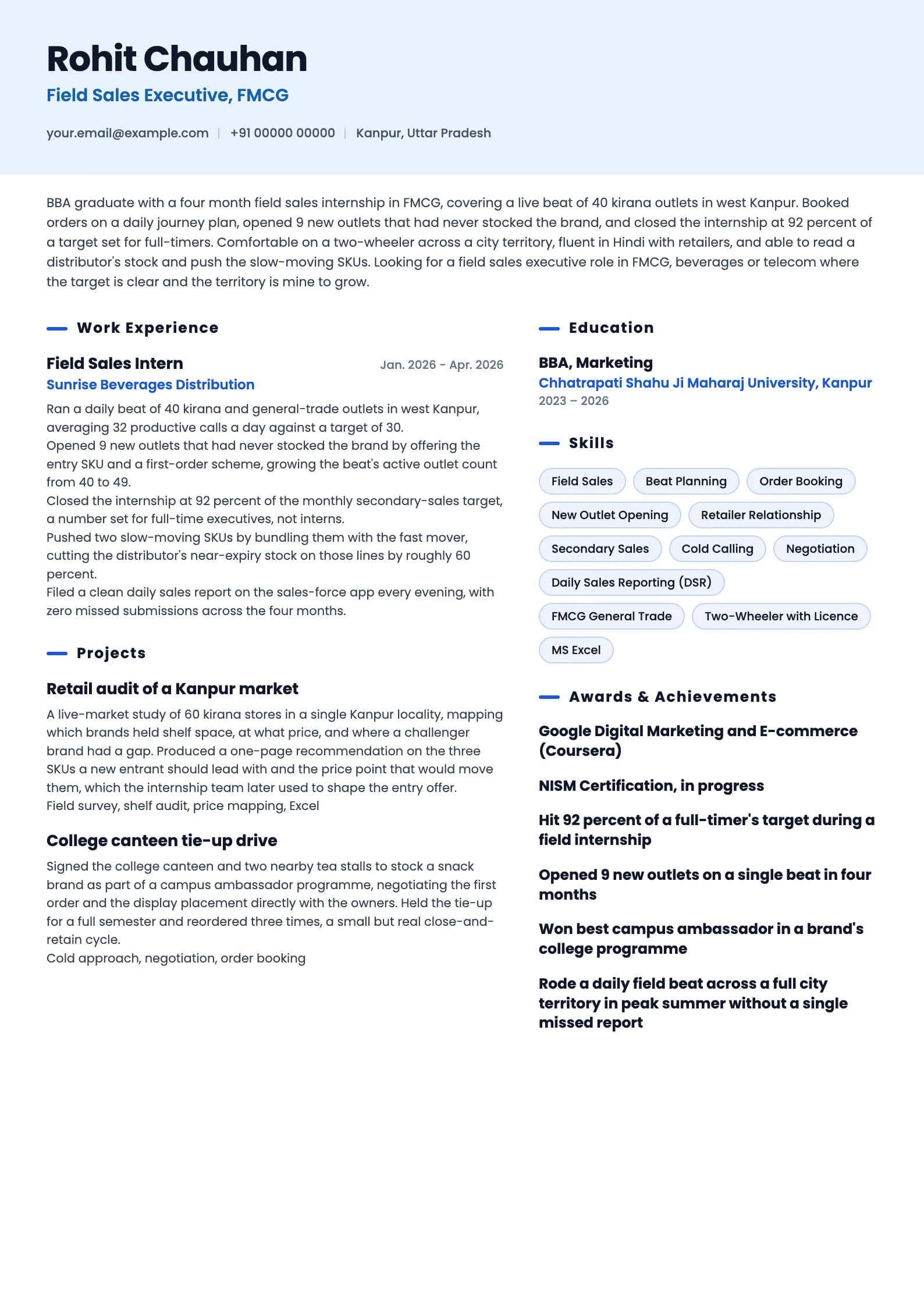
Build my resumeField Sales Executive resume example, Fresher (0 to 1 year)
ai-era templateIs your resume good enough?
Upload the resume you have now and see what an applicant tracking system reads before a field sales executive recruiter ever does.
Free to run. Sign in with your mobile number to see your score.
Field Sales Executive resume example, Mid-level (4 years)
professional template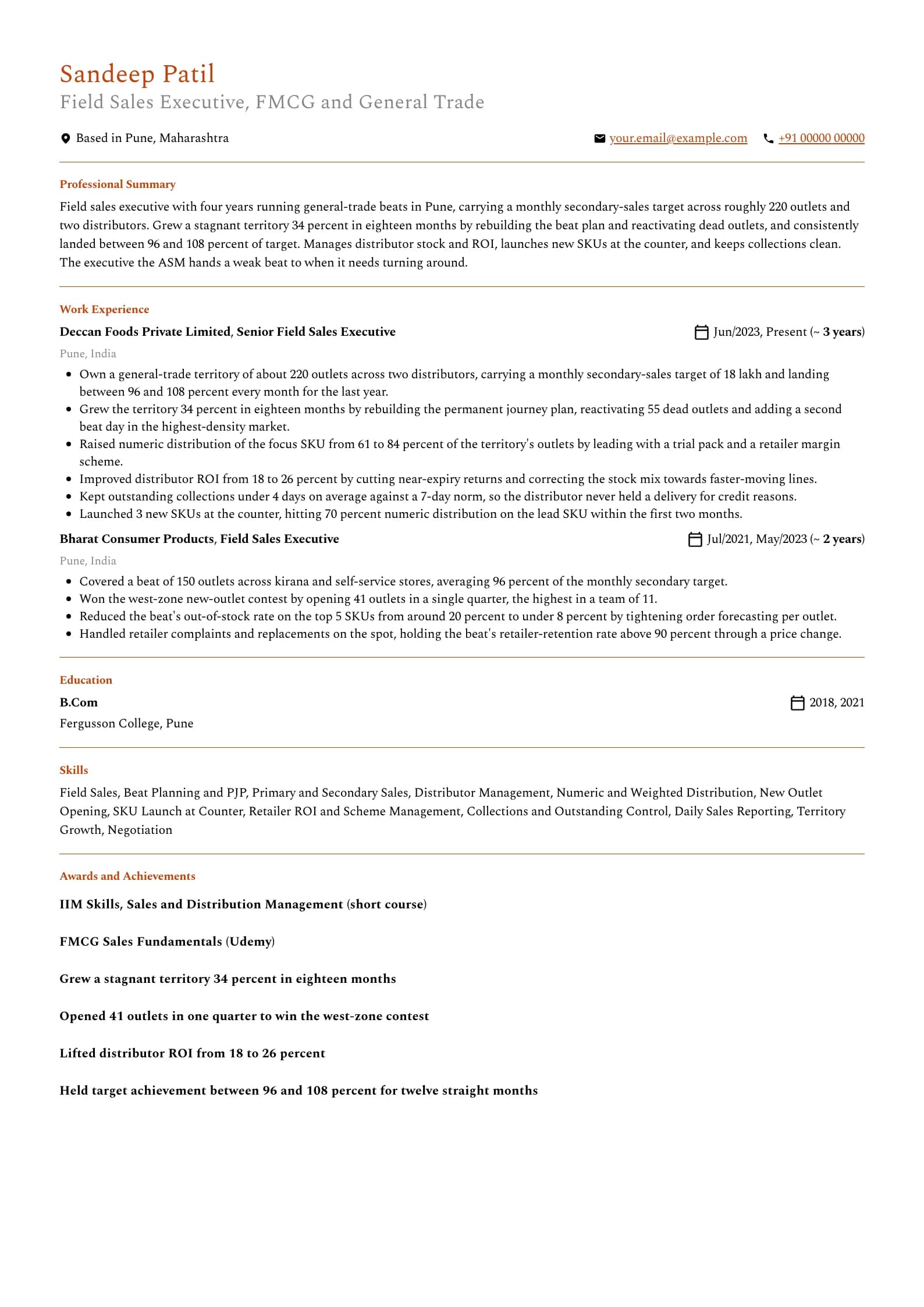
Want this structure with your own details? Build it in the resume builder.
Field Sales Executive resume example, Senior (8 years)
header-band template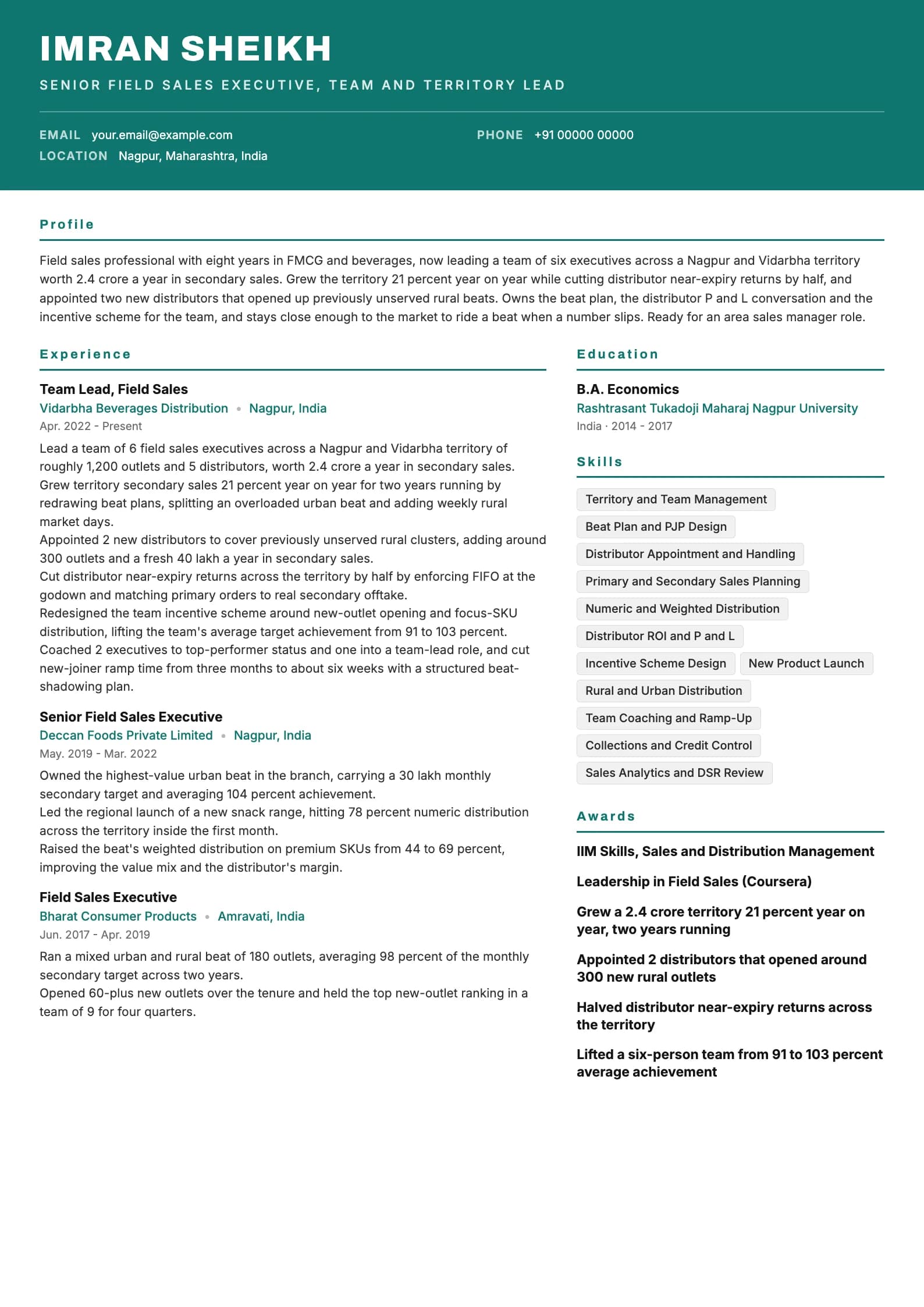
The format that works for field sales resumes in India
Reverse chronological is the layout to use. Put your current role first, work backwards, and let the dates and the company names sit in plain view, because a field-sales reviewer wants to see territory, tenure and stability at a glance. Functional resumes that group everything under Sales Skills and hide the dates read as an attempt to cover a job-hopping pattern, and field-sales hiring is already wary of it. Length is one page for a fresher and almost everyone up to six or seven years. A senior field lead with a team and multiple territories can justify a second page, but only if it carries real numbers rather than a longer list of the same duties. Nobody has been rejected for a resume that was quick to read on a field manager's phone between market visits. One block belongs at the very top and is skipped far too often: a two-line snapshot of your target achievement and territory. A field recruiter screening fifty resumes wants to know your consistent achievement percentage, your territory type and your outlet count before anything else. Two facts that many field resumes bury or omit are a two-wheeler with a valid licence and the local language, both of which are near mandatory for a field role and should be visible without hunting. Send a PDF unless the posting asks otherwise, name the file with your own name and the role, and keep a single column all the way down so the resume parses cleanly. The table below sets out the section order.
| Section | Where it goes | Why |
|---|---|---|
| Name and headline | Top, above everything | Headline is the role you want, field sales executive plus the sector. Recruiters match on it. |
| Professional summary | Directly under the header | Three lines. Territory type, years, and your consistent target achievement. |
| Work experience | Next, for anyone with a job | Most recent first. Lead every bullet with a number, target or growth figure. |
| Key achievements | Beside or below the summary | Contest wins, best-performer awards, biggest territory growth. Field sales rewards these openly. |
| Skills | Below experience | Beat planning, distributor handling, collections. Not a wall of soft-skill adjectives. |
| Education | Bottom, unless you are a fresher | Degree, institution, years. A graduate degree is enough for most field roles. |
| Licence and language | In a details line or the skills block | Two-wheeler with licence and the local language are screening filters for field work. |
A duty is not an achievement: put the number first
The single most common field-sales resume failure is a page of duties. "Responsible for visiting retailers, booking orders and collecting payments" describes the job every field executive already does. It tells a reviewer nothing about whether you are good at it, because a person who missed target every month could write the exact same line. The fix is to lead with the result. Field sales is one of the most measurable jobs there is, so almost every bullet can carry a number: your target achievement percentage, territory growth, new outlets opened, numeric distribution, collections days, distributor ROI, or a contest rank. "Landed between 96 and 108 percent of a monthly 18 lakh secondary target across 220 outlets" says in one line what a paragraph of duties cannot. If you genuinely cannot attach a percentage, give scope and count instead. How many outlets on your beat, how many distributors, how many new outlets opened, how large a territory in value. "Opened 41 outlets in a single quarter" carries weight without inventing a figure. Scope is a real number even when growth is hard to isolate. Vary what you measure. Ten target-achievement percentages in a row read as one fact repeated. Across a real role you can honestly reach for achievement, growth, distribution, ROI, collections, retention and contest rank. Mixing the metric types is what makes a field-sales resume read as range rather than a single trick.
Experience bullet, field sales
Weak
Responsible for visiting retail outlets, taking orders and achieving monthly sales targets in the assigned territory.
Strong
Landed between 96 and 108 percent of an 18 lakh monthly secondary target across 220 outlets for twelve straight months, growing the territory 34 percent in eighteen months.
The rewrite trades a duty every field executive shares for a specific target, a consistency record and a growth figure only this person produced.
Experience bullet, new outlets
Weak
Worked on increasing the number of outlets and expanding the market in the given area.
Strong
Opened 41 outlets in a single quarter to win the west-zone new-outlet contest, the highest in a team of 11.
Names the count, the timeframe and the rank, so a reviewer can picture the run rate instead of nodding at a vague claim.
For every bullet, ask: does this describe a duty every field executive shares, or a result only I produced. If it is a shared duty, add the number that makes it yours, or cut it.
Writing a summary a sales manager actually reads
The block under your name is the part a busy field manager will actually read before deciding whether to call, so it must carry three facts: what kind of territory you sell into, how long you have been doing it, and your consistent target achievement. Three or four lines, no adjectives that cannot be checked. The old objective line, seeking a challenging position in a reputed organisation to utilise my sales skills, tells the reader nothing they did not assume from the application. Replace it with a summary. An objective describes what you want, a summary describes what you have already delivered, and only one of those is evidence for a field role. Freshers often think they have nothing to summarise. Look at the fresher sample: it names the sector, states the internship length, gives the outlet count, and quotes a real achievement percentage against a full-timer's target. That is a genuine field summary built from one internship and a college drive. What it avoids is "hardworking and target-oriented", a phrase so common it now carries no information at all. A practical test: read your summary and ask whether a classmate who did the same internship could paste it onto their resume unchanged. If they could, it describes the internship, not you. Add your specific territory, your specific number and your specific win until it stops being transferable.
Professional summary, mid-level executive
Weak
Hardworking and target-oriented field sales executive with 4+ years of experience looking for a challenging and growth-oriented role in a reputed FMCG organisation.
Strong
Field sales executive with four years running general-trade beats across 220 outlets and two distributors, landing between 96 and 108 percent of target every month. Grew a stagnant territory 34 percent in eighteen months.
The rewrite swaps self-description for a territory size, a consistency record and a growth figure a manager can verify in a reference call.
Speak the distribution language: primary, secondary, ROI and PJP
Field sales in India has a precise vocabulary, and using it correctly is a quiet signal that you have really done the job. A resume that says only "achieved sales targets" reads as generic. One that separates primary sales (what you sold into the distributor) from secondary sales (what actually sold through to retailers) reads as someone who understands where the real work is. Name the levers you actually pulled. Numeric distribution is the share of outlets that stock a SKU, weighted distribution accounts for outlet size, and the two tell very different stories. Distributor ROI is the return the distributor earns on the money they park in your stock, and an executive who improved it by cutting near-expiry returns and fixing the stock mix has done something a manager cares about deeply. PJP or the permanent journey plan is your beat schedule, and rebuilding one to add coverage is real territory work. Be accurate, because a field manager interviews on exactly these terms. If you write that you improved distributor ROI, you will be asked how, and "cut near-expiry returns and corrected the stock mix" is the answer that lands. If you cannot explain a term you used, drop it, because a wrong claim about ROI or distribution costs you more in the interview than a vague resume would have. Do not overload the page with jargon either. Two or three correctly used distribution terms tied to a real result beat a paragraph stuffed with every acronym you have heard. The point is to show understanding, not to prove you own a glossary.
| Term | What it means | How to use it on the resume |
|---|---|---|
| Secondary sales | Sales that sold through from distributor to retailer | Your real target. Quote achievement against it, not just primary. |
| Numeric distribution | Share of outlets in the territory that stock the SKU | "Raised numeric distribution of the focus SKU from 61 to 84 percent." |
| Distributor ROI | Return the distributor earns on stock they hold | "Improved distributor ROI from 18 to 26 percent by cutting returns." |
| PJP or beat plan | Your permanent journey plan, the daily route of outlets | "Rebuilt the PJP and reactivated 55 dead outlets." |
| Collections | Recovering outstanding payment within credit terms | "Kept outstanding collections under 4 days against a 7-day norm." |
Experience bullets: action, territory, result
Every strong bullet in the samples follows the same shape. It opens with an action verb, names the specific territory, beat, distributor or SKU, and closes with what measurably moved. The verb establishes that you did it. The territory tells a reviewer the scale and type of selling. The number does the persuading. Start with the outcome and work backwards. Field executives usually write the task first, then struggle to attach a number, which produces bullets like "handled sales in the assigned area and met targets". Instead ask what was different after your month or your quarter: target hit, territory grew, outlets opened, distribution rose, returns fell, collections tightened, a launch landed. Then write the sentence that ends in that fact. Allocate bullets by recency. Your current role gets five or six bullets, the previous role four or five, anything older two or three. The newest, largest territory is what a hiring manager is buying, so it earns the most space. Where you lack a clean percentage, give the count. Outlets on the beat, distributors handled, new outlets opened, the value of the territory. A count is honest and specific, and it beats a vague adjective every time. Include at least one line that is not a raw sales number: a contest win, a launch you led, a retention figure, a coaching result. It shows you are more than a single-metric performer, which is exactly what gets you the team-lead or ASM conversation.
| Level | What bullets must prove | Typical metric |
|---|---|---|
| Fresher | You can walk a beat and book orders that stick | Calls a day, outlets opened, percent of an intern target |
| 1 to 3 years | You own a beat and hit target without supervision | Target achievement, outlets opened, out-of-stock rate |
| 4 to 6 years | You grow a territory and manage the distributor | Territory growth, numeric distribution, ROI, collections |
| 7 years and up | You run a team and appoint distributors | Territory value, team achievement, distributors appointed |
Experience bullet, distributor work
Weak
Managed distributor relationship and ensured proper stock availability in the market.
Strong
Improved distributor ROI from 18 to 26 percent by cutting near-expiry returns and correcting the stock mix towards faster-moving lines.
Names the ROI numbers and the two levers used, so an interviewer can ask a real follow-up instead of accepting a generic claim about managing a relationship.
If a bullet would read identically on a teammate's resume, it is describing the beat, not you. Rewrite it until it only fits the territory and number you actually owned.
The skills section: real field skills, not a wall of adjectives
A field-sales resume's skills section has two audiences. The parser wants literal terms it can match, beat planning and distributor management and secondary sales. A human wants a short, organised list that signals what kind of seller you are. A grouped, honest list satisfies both. The common failure is a wall of soft adjectives: hardworking, dedicated, target-oriented, good communication, team player, self-motivated. None of these can be checked, they appear on nearly every field resume, and a full section of them signals that you have nothing concrete to list. One or two soft skills tied to the work are fine, but the bulk of the section should be capabilities a manager can test. Group by function. Core field skills such as beat planning, order booking and new outlet opening. Commercial skills such as distributor ROI, collections and scheme management. Sector and tools such as FMCG general trade, the sales-force app you use and Excel. And the practical filters, a two-wheeler with a valid licence and the languages you sell in. The exact headings matter less than the fact that structure exists. Twelve to sixteen skills is the working range. Write them the way the industry does, secondary sales not just sales, numeric distribution not just distribution. A parser matches on strings, and a field manager reads the specific terms as proof you have lived the job.
Skills section
Weak
Skills: Hardworking, Dedicated, Target-oriented, Good communication skills, Team player, Self-motivated, Ability to work under pressure, Quick learner, Positive attitude, Sales
Strong
Field: beat planning and PJP, order booking, new outlet opening, secondary sales. Commercial: distributor ROI, collections, scheme management. Sector and tools: FMCG general trade, sales-force app, Excel. Also: two-wheeler with valid licence; Hindi, Marathi, English.
Cuts the uncheckable adjectives, replaces them with capabilities a manager can test, and surfaces the licence and language filters a field recruiter screens on first.
Where education, licence and certifications belong
Education goes at the bottom for anyone with field experience, and near the top for a fresher who has nothing stronger to lead with. Degree, institution, years. Most field-sales roles ask for a graduate degree in any stream, and a BBA or B.Com in marketing is a small plus but rarely the deciding factor. Keep the entry to one line for each qualification. A percentage or CGPA is worth keeping while you are a fresher and it is respectable, because early-career screening still filters on it. Once you have a couple of years of target achievement to show, drop it. A number from college competes for space with growth figures that predict field performance far better. Two details matter more than most certifications for a field role, and both are easy to miss: a two-wheeler with a valid driving licence, and the local languages you speak. A field executive who cannot ride a beat or talk to a retailer in their language cannot do the job, so these belong somewhere visible, in a details line or the skills block. Certifications carry less weight in field sales than in technical roles, but a sales and distribution management short course from a recognised institute, a digital-marketing certificate, or an NISM certification for a fintech field role are all worth naming with the issuing body and year. Do not pad the section, and never list a certification you did not complete as if it were done.
Getting through the applicant tracking system
Larger FMCG, telecom and fintech employers run field-sales applications through an applicant tracking system, which is a parser and a search index, not a judge. It reads your file, tries to break it into name, dates, employers, titles and skills, and stores the result so a recruiter can search across candidates. Almost every ATS problem is a parsing problem, and parsing problems come from layout, not wording. The layout rules are short. One column. Standard section headings, so use Work Experience rather than My Sales Journey, and Skills rather than My Strengths. No text inside images, because a company-logo strip reads as empty space. No critical information in the header or footer region, which some parsers drop. Avoid text boxes and nested tables in the body of the resume. On wording, mirror the language of the job description where it is honest. If the posting says secondary sales, write secondary sales. If it says distributor management or general trade, use those exact terms rather than a paraphrase. Include the expansion alongside an acronym at least once, for example "PJP (permanent journey plan)" and "DSR (daily sales report)", so both the acronym search and the full-term search find you. Keyword stuffing does not work. A hidden block of sales terms in white text is caught quickly and the outcome is worse than being filtered. Write real bullets that naturally contain the right terms, because a bullet describing how you grew a territory contains growth, distribution and target in a context that survives human review too. Save as PDF from a tool that embeds real text, then open the file and confirm you can select and copy a sentence. If you cannot select the text, neither can the parser.
Mirror the posting's exact words where they are true of you. If the job says general trade and secondary sales, those phrases should appear in your bullets, not a paraphrase the search will miss.
What gets field sales resumes rejected
Most rejections at the resume stage are not close calls. They come from a small set of recurring problems, and all of them are fixable in an afternoon. The list below covers what recruiters of Indian field-sales resumes see most often, in rough order of how much damage each one does.
- A page of duties with no numbers. Target achievement, territory growth, outlets opened, ROI, collections. Field sales is measurable, so measure it.
- A wall of soft-skill adjectives as the entire skills section. Hardworking and dedicated appear on every field resume and prove nothing.
- No two-wheeler, licence or local language mentioned, which are near-mandatory filters a recruiter needs to see before calling.
- A generic objective line instead of a summary that states territory, years and consistent achievement.
- Confusing primary and secondary sales, or claiming an ROI or distribution improvement you cannot explain in an interview.
- Unexplained short stints back to back with no achievement in any of them, which reads as a person who does not hit target.
- Vague territory claims like "handled a large area" with no outlet count, distributor count or value.
- A photo, date of birth, marital status or father's name, none of which belongs on the page and all of which takes an achievement's space.
- Inflated titles or target percentages that will not survive a reference call, since field-sales references are quick and specific.
- Typos in the brands, SKUs or distributor terms you claim to know, which undoes an otherwise strong page.
Read your resume as if you were the sales manager who has to defend the hire to their own boss. Every line should give them a number they could repeat in that conversation.
Skills to put on a field sales executive resume
Technical
- Beat Planning and PJP
- Primary and Secondary Sales
- Distributor Management
- Numeric and Weighted Distribution
- New Outlet Opening
- Target Achievement
- Territory Growth
- SKU Launch at Counter
- Distributor ROI Management
- Collections and Credit Control
- Scheme and Trade Marketing
- Sales Forecasting
Tools and platforms
- Sales-Force Automation App (Bizom, FieldAssist)
- MS Excel
- Distributor Management System (DMS)
- Google Sheets
- CRM (Salesforce, Zoho)
- WhatsApp Business
- Daily Sales Report (DSR) Tools
- Two-Wheeler with Valid Licence
Working skills
- Negotiation
- Retailer Relationship Building
- Persuasion
- Resilience under target pressure
- Local-language communication
- Territory ownership
- Team coaching
- Time and route management
Certifications worth listing as a field sales executive
| Certification | Full name | Worth it for |
|---|---|---|
| Sales and Distribution Management | Sales and Distribution Management short course (IIM Skills or similar) | Useful for a field executive with one to four years who wants to move towards a team-lead or ASM role, since it formalises the distributor and channel side that on-the-job learning covers unevenly. Less necessary once you have run a territory and a distributor P and L yourself. |
| NISM | NISM Series certifications (National Institute of Securities Markets) | Relevant only for field roles in fintech, insurance or financial-product distribution, where a NISM certification is often a regulatory requirement to sell. Skip it for FMCG, telecom or consumer-durable field roles where it adds nothing. |
| Google Digital Marketing | Google Digital Marketing and E-commerce Certificate | A small plus for a fresher or a field executive moving into modern-trade or e-commerce-linked selling, where understanding online demand helps. It is a general credential, not a field-sales one, so treat it as supporting rather than central. |
| Sales Fundamentals | Sales Fundamentals or Field Sales course (Udemy, Coursera) | Worth listing for a fresher or career switcher who needs to show some structured sales grounding on paper before they have a track record. Once you have real target-achievement numbers, the numbers outrank any online course, so let them lead. |
Keywords an ATS scans for in a field sales executive resume
These are the literal terms a parser matches against the job description. Use the ones that are true of you, in the sentences where you did the work, not as a list at the bottom.
- field sales executive
- field sales
- secondary sales
- primary sales
- beat planning
- PJP
- distributor management
- numeric distribution
- new outlet opening
- FMCG sales
- general trade
- target achievement
- collections
- distributor ROI
- SKU
- daily sales report
- DSR
- territory management
- sales executive
- retailer relationship
Field Sales Executive resume FAQ
What salary can a field sales executive expect in India?
A fresher typically starts around 2.4 to 4 LPA fixed, plus a monthly incentive tied to target that can add meaningfully in a good month. A field executive with four to six years and a strong achievement record usually sits in the 4.5 to 8 LPA fixed band, again with incentives on top. Senior field leads and those moving into area sales manager roles commonly earn 9 to 18 LPA. Sector matters: fintech, pharma and premium consumer-durable field roles tend to pay above FMCG general trade, and a consistent above-100-percent achievement record is the strongest lever on where you land in every band.
How long should a field sales resume be?
One page for a fresher and almost everyone up to six or seven years. A senior field lead running a team and multiple territories can use a second page, but only if it carries real numbers rather than a longer list of the same duties. Field managers often screen on a phone between market visits, so a resume that gives target achievement, territory type and outlet count in the first few lines beats one they have to scroll to understand.
What are the most important things to put on a field sales resume?
Your consistent target achievement percentage, the size and type of your territory in outlets and value, your new-outlet record, and a distribution or ROI figure that shows you understand the distributor economics. On top of that, make a two-wheeler with a valid licence and the local languages you sell in clearly visible, because both are near-mandatory filters a recruiter checks before calling. Lead with numbers, not duties.
How do I write a field sales resume as a fresher?
Lead with any field internship, a college sales or ambassador drive, and projects such as a retail or shelf audit, treating each as evidence you can actually sell and cover a beat. Quote real numbers even from a short run: outlets covered, calls a day, new outlets opened, percentage of a target. Add your two-wheeler, licence and languages up top, and keep education near the top since it is your strongest formal credential. Verifiable field facts beat adjectives like hardworking every time.
Should I mention primary and secondary sales separately?
Yes, if you have really worked with both, because separating them signals that you understand where the real selling happens. Primary sales is what you sold into the distributor; secondary sales is what actually sold through to retailers, and it is the number a manager cares about most. Quote your achievement against the secondary target. Be ready to explain any distribution or ROI term you use, because field interviews probe exactly these words and a claim you cannot defend costs you.
Do certifications help a field sales executive?
Less than in technical roles, but they can help at the margins. A sales and distribution management short course is a reasonable signal if you are aiming for a team-lead or ASM step. A NISM certification is effectively required for field roles selling financial products. A digital-marketing certificate helps for modern-trade or e-commerce-linked selling. Beyond those, your target-achievement record and territory growth outrank any certificate, so keep the list short and let the numbers carry the page.
Does a field sales resume go through an ATS?
At larger FMCG, telecom and fintech employers, yes. Keep it to a single column with standard headings like Work Experience and Skills, avoid text inside images and multi-column layouts, and mirror the posting's exact terms where they are true of you, such as secondary sales, general trade and distributor management. Spell out acronyms once, for example PJP and DSR, so both searches find you. Then copy the text out of your PDF into a plain editor to confirm it reads in order, which is roughly what the parser sees.
Is a two-wheeler and driving licence really needed on the resume?
For most field-sales roles, yes, and stating it plainly saves you a screening rejection. A field executive covers a beat of outlets across a city or rural territory every day, so a recruiter treats a two-wheeler with a valid licence as a basic requirement and often filters for it before reading further. Put it in a details line or the skills block. The same visibility helps for the local languages you speak, since you will be negotiating with retailers in them.
How do I show job stability if I have changed companies often?
Field sales sees more movement than most functions, so a couple of well-timed switches are not fatal, but back-to-back short stints with no achievement in any of them read as someone who did not hit target. Attach a concrete result to every role, however short, so each stint reads as a completed chapter rather than an exit. If a move was for a clear reason such as a territory closure or a promotion, a single honest line explaining it is better than leaving the reviewer to guess the worst.
Related resume examples and guides
Build your own in any of these formats
Start from a blank resume or upload the one you have. Goodspace renders it in 24 templates and flags the field-sales keywords an applicant tracking system will look for, from secondary sales to distributor management, and the duty-only lines it will not credit.
Build my resume