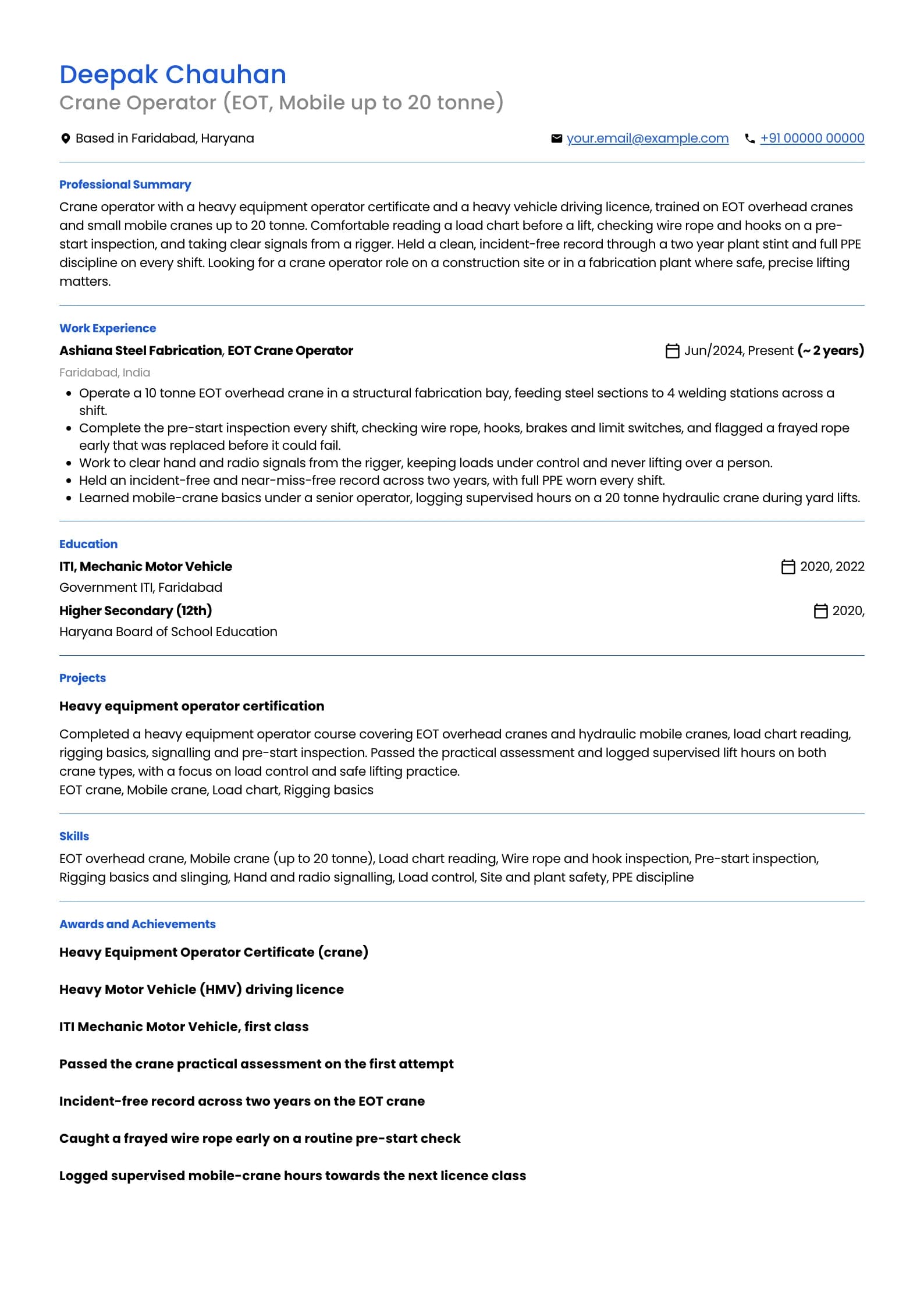
Crane Operator Resume Format, with 3 Full Samples
A crane operator is hired on the cranes they are licensed to run, the tonnage they have lifted and how many lakh hours they have worked without an incident, yet most resumes say crane operation and forget the crane type, the capacity and the safety record that actually decide the job. Below are three complete resumes, one for an EOT and small mobile crane operator early in the trade, one for a mobile and tower crane operator with seven years on construction sites, and one for a senior heavy-lift operator who plans the difficult lifts and runs a crane crew. After the samples come the format rules, the difference between naming a crane and proving a clean lift record, the terms a construction and plant hirer scans for, and the mistakes that get a resume set aside before the practical test.
Build my resumeCrane Operator resume example, EOT and Entry Operator (0 to 2 years)
minimalist templateIs your resume good enough?
Upload the resume you have now and see what an applicant tracking system reads before a crane operator recruiter ever does.
Free to run. Sign in with your mobile number to see your score.
Crane Operator resume example, Mobile and Tower Crane Operator (7 years)
professional template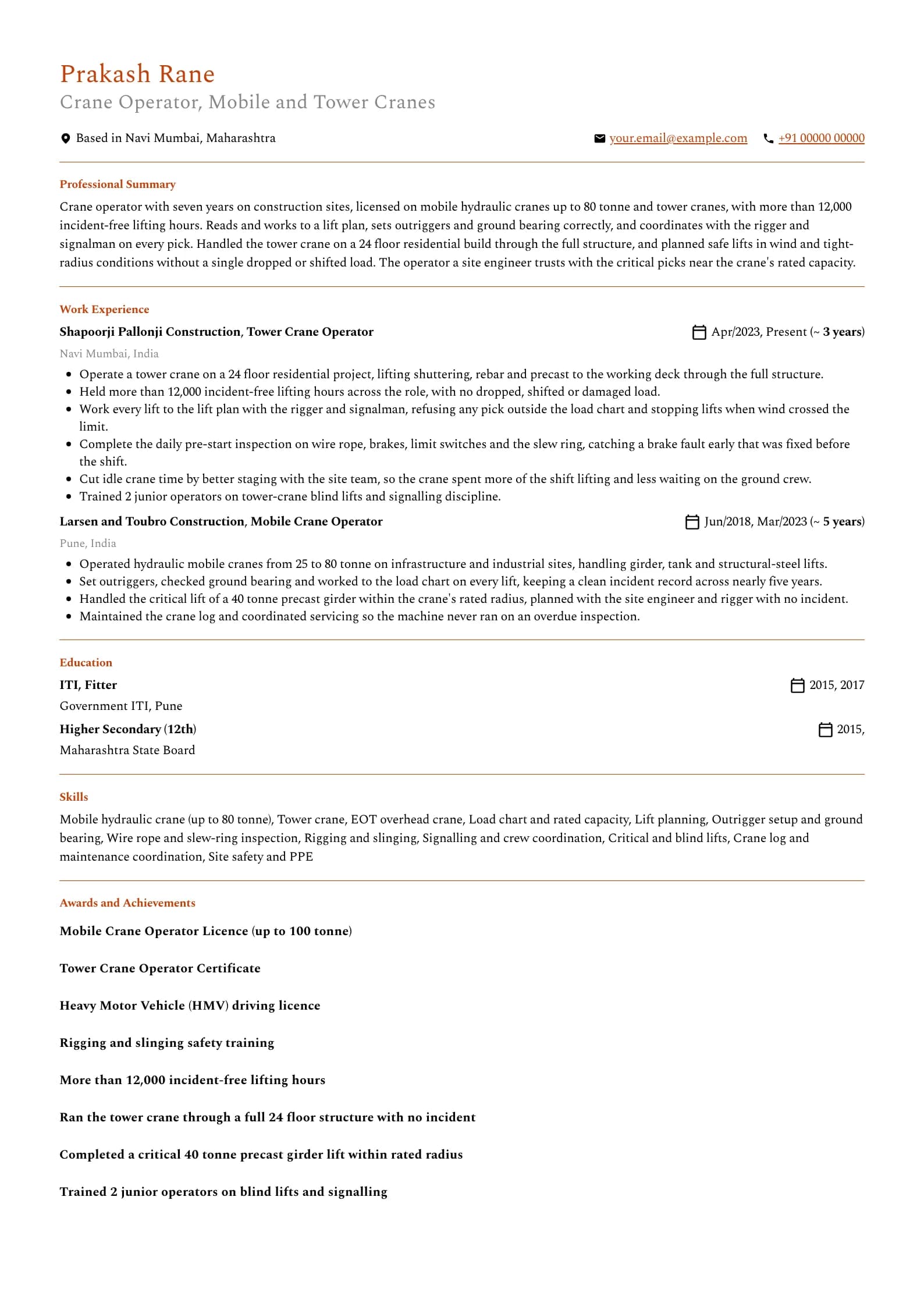
Want this structure with your own details? Build it in the resume builder.
Crane Operator resume example, Heavy-Lift Operator and Lead (15 years)
header-band template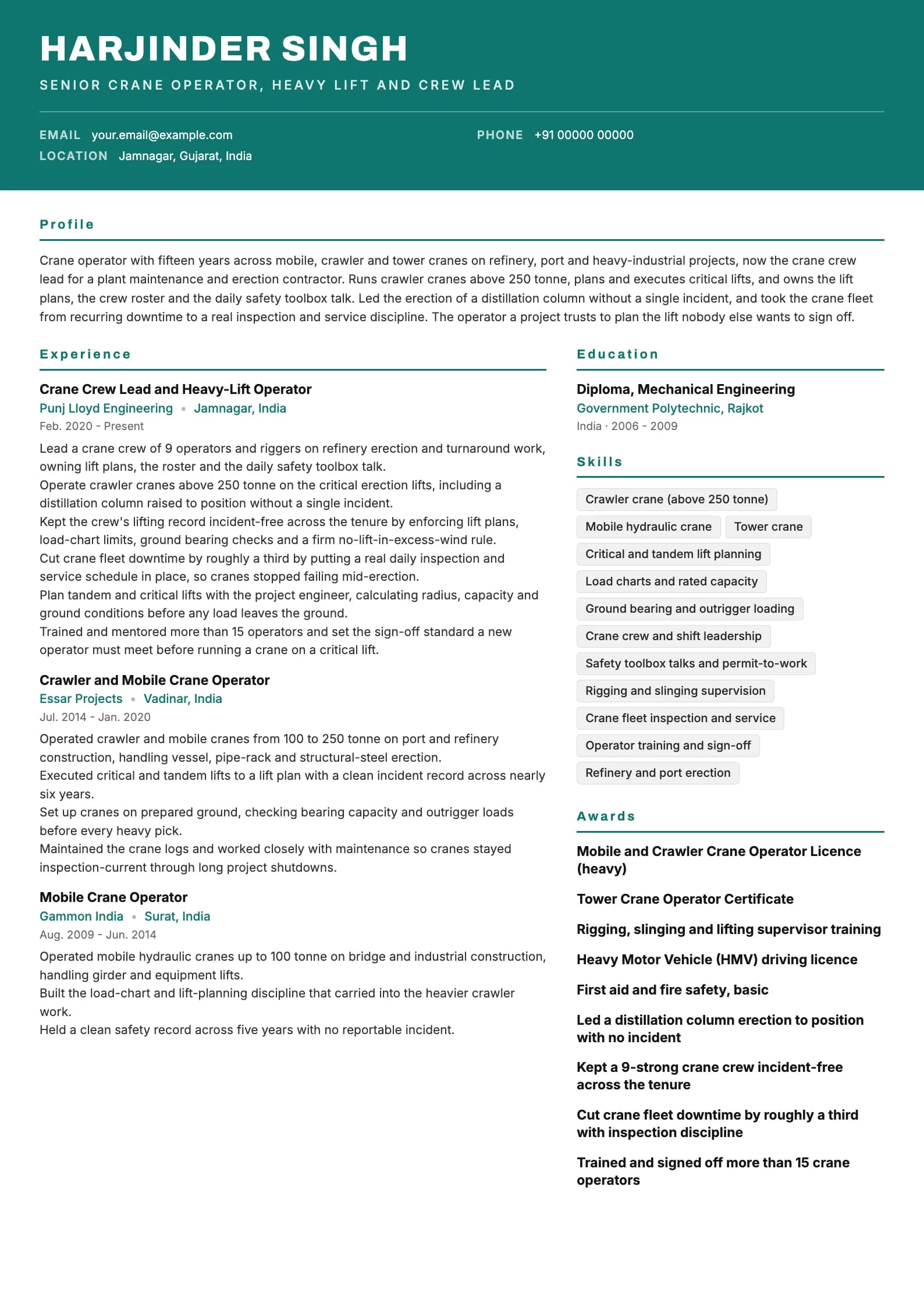
The format that works for crane operator resumes in India
Reverse chronological is the layout to use. Put the most recent site or plant role first, work backwards, and keep the dates in plain view. A functional resume that hides the dates under a skills heading reads as an attempt to cover a gap, and a hirer treats it that way. One honest line about a gap beats a layout built to bury it. Keep it to one page for most operators, and two only for a senior heavy-lift lead with a long project list worth naming. What a construction or plant hirer wants sits on the first page: the crane types you are licensed to run, the tonnage you have lifted, your incident-free record and your certifications. A second page padded with a declaration and hobbies dilutes the first. Put the crane types and tonnage where they are seen first, in the headline and summary. This is the most important fact on the page, because a site cannot use an operator not licensed for their crane. Naming EOT, mobile up to a tonnage, tower or crawler up front answers the first question a hirer has. Four things do not belong on the page: a photograph, date of birth, marital status and father's name. They come from an older template and take space a lift record or a tonnage could use. Send a PDF unless the posting asks otherwise, name the file with your own name and the word crane, and use a single column so a parser reads it cleanly. The table below sets out the section order.
| Section | Where it goes | Why |
|---|---|---|
| Name and headline | Top, above everything | The headline names the role, crane types and tonnage. A hirer matches on it. |
| Summary | Directly under the header | Three lines: crane types, years, incident-free record and the strongest lift. |
| Licence and certifications | High, near the summary | Crane operator licence and the classes on it. This is the gate a hirer checks first. |
| Work experience | Next, for anyone with a job | Most recent first. Newest role and the biggest lifts get the most bullets. |
| Skills | Below experience | Crane types, load charts, rigging, safety. Grouped, not one long line. |
| Education and ITI | Below skills | ITI or diploma, institution, years. A Fitter or MMV trade helps. |
| Languages | Bottom | The site language plus any others. Useful for signalling on a mixed crew. |
The crane type, tonnage and licence decide whether you are read
A crane operator resume lives on one fact above all: which cranes you are licensed and trained to run, and to what capacity. A refinery erection contractor running crawler cranes above 250 tonne cannot use an operator certified only on a 20 tonne mobile, and a site running a tower crane cannot use a mobile-only operator. So this belongs at the top, not buried in a skills list halfway down. Name every crane class specifically. EOT overhead, mobile hydraulic, tower, crawler and telescopic are different machines with different licences, and a hirer needs to see the exact one. Write the ones you have real hours on, and always state the tonnage, because a 40 tonne mobile and a 250 tonne crawler are different jobs. The mid-level sample lists mobile up to 80 tonne, tower and EOT precisely because the bullets show hours on each. State the biggest and the most critical lifts you have done. A hirer with heavy or critical erection work needs to know you have taken a load near the crane's rated capacity, planned it, and set it down safely. A 40 tonne precast girder within rated radius or a distillation column erection tells them far more than a tonnage on a skills line. Do not claim a crane you have only watched. A practical test at the site will find it fast, and an operator who overstates the licence is the last one a safety-conscious project wants near a critical lift. List what you can run, and note the classes you are logging supervised hours towards separately and honestly.
Before anything else, a site asks: is this operator licensed for our crane and this tonnage. Put the crane classes and the capacity in the headline and summary, so the answer is visible in the first three seconds and your resume clears the first gate.
The lift record is the number that wins the job
On a construction site or in a plant, the operator who lifts the fastest is not the one who gets hired. The one with the cleanest lift record is. A crane failure or a dropped load is among the most serious incidents a site can have, so a hirer is buying safe judgement first and speed second. Your resume has to lead with the record, not treat it as a footnote. Quantify it honestly. Incident-free lifting hours, years without a reportable incident, or a clean record of no dropped, shifted or damaged load are the numbers that matter, and they are numbers you can stand behind because they either happened or they did not. The mid-level sample leads on 12,000 incident-free lifting hours for exactly this reason. Show the judgement behind the record. Working to a lift plan, refusing a pick outside the load chart, stopping a lift when wind crossed the limit, checking ground bearing and outriggers, catching a brake or rope fault on inspection. Refusing an unsafe lift is a strength on a crane resume, not a black mark, because it is precisely the discipline a site engineer needs from the person in the cab. Do not inflate this. A safety claim is checkable through references and a site's incident records, and an operator caught overstating a clean record loses the one thing the job is about. If the record has a mark on it, leave the number off and lead on your lift-planning and inspection discipline instead.
Summary line, mobile crane operator
Weak
Experienced and reliable crane operator with good knowledge of crane operation looking for a challenging position in a reputed company.
Strong
Crane operator with seven years on mobile cranes up to 80 tonne and tower cranes, with more than 12,000 incident-free lifting hours and a clean critical-lift record.
The rewrite trades self-description for the crane types, the tonnage and the incident-free hours a construction site actually screens for.
Writing a summary a site hirer actually reads
The block under your name is the part you can be sure a busy site engineer reads, so it must carry four facts: which cranes you run and to what tonnage, how long you have run them, your incident record and the strongest lift you have delivered. Three or four lines, plain and checkable. The old objective line, seeking a challenging position to utilise my crane operating skills in a reputed organisation, tells the reader nothing they did not assume. Replace it with a summary. An objective says what you want; a summary says what you have already lifted safely, and only one is evidence. Entry operators often think they have nothing to summarise. Look at the fresher sample: it names the licence and both crane types, states the tonnage, and points at a clean record and a frayed rope caught on inspection. That is a real summary built from a course, a certificate and a plant stint. What it avoids is a vague hardworking and sincere, which every resume carries and none is helped by. A practical test: read your summary and ask whether another operator with the same licence could paste it onto their resume unchanged. If they could, it describes the licence, not you. Add the specific crane classes, the specific tonnage, the specific incident-free number and the hardest lift until it stops fitting anyone else.
Summary, senior heavy-lift operator
Weak
Senior crane operator with more than 15 years of experience in operating various types of cranes seeking a good position in a reputed company.
Strong
Crane crew lead with fifteen years across mobile, crawler and tower cranes, running crawler cranes above 250 tonne and planning the critical lifts, including a distillation column erection with no incident.
The rewrite names the crane range, the capacity, the leadership scope and the hardest lift, so a project sees the level of operator in one line instead of a generic claim.
Experience bullets: action, crane and load, safe result
Every strong bullet in the samples follows the same shape. It opens with an action, names the crane and the load, and closes with what measurably happened, safely. The action says you did it. The crane and load tell a site whether the work is relevant to their erection. The number or the named lift does the persuading. Start with the result and work backwards. Operators tend to write the task first, which produces lines like operated crane and lifted materials. Instead ask what was delivered: a girder set, a column raised, a floor of shuttering lifted, an incident-free record held, a downtime cut. Then write the sentence that ends in that fact. Vary what you prove. Lifting hours, tonnage, named critical lifts, downtime, operators trained, idle-time cut. A page that only ever says lifted materials reads as one line repeated; a mix reads as an operator who understands the whole erection. Where you lack a clean number, name the lift and its conditions. Handled the critical lift of a 40 tonne precast girder within the crane's rated radius carries more weight than any invented percentage, because a site engineer can picture the exact pick. Allocate bullets by recency. Current role gets five or six, the previous role three or four, anything older two or three.
| Level | What bullets must prove | Typical metric |
|---|---|---|
| Entry | You hold a licence and run a crane safely | Crane type, clean record, inspection catches |
| 2 to 6 years | You run several crane types to a lift plan | Incident-free hours, tonnage, named lifts, crew coordination |
| 7 to 12 years | You handle the critical and heavy lifts | Rated-capacity lifts, downtime, operators trained, project scale |
| 13 years and up | You plan lifts and lead a crane crew | Critical erections, crew size, fleet uptime, sign-off standard |
Experience bullet, mobile crane operator
Weak
Responsible for operating mobile crane and lifting of materials at construction site as per site requirement.
Strong
Handled the critical lift of a 40 tonne precast girder within the crane's rated radius, planned with the site engineer and rigger with no incident.
Responsible for describes a job card; the rewrite names the load, the radius, the planning and the clean result a site engineer can verify.
Experience bullet, safety judgement
Weak
Always worked safely and followed all the safety rules on the site during crane operation.
Strong
Worked every lift to the lift plan with the rigger and signalman, refusing any pick outside the load chart and stopping lifts when wind crossed the limit.
Trades a claim of being safe for the specific decisions that make a lift safe, which is exactly the judgement a site wants in the cab.
If a bullet would read identically on any operator's resume, it is describing the trade, not you. Rewrite it until it only fits the crane you ran and the load you set down.
The skills section: cranes, load charts and safety, grouped
A crane operator's skills section has two readers. A site or plant hirer wants the crane types, the tonnage and the safety practices fast. An applicant tracking system, used by large EPC and construction firms, wants literal terms it can match, mobile crane, tower crane, load chart, rigging. Grouping the list satisfies both. Group by function rather than one long line. Cranes, lifting and safety, and site practices is a grouping that works for almost every operator. The exact headings matter less than the fact that structure exists. Write the industry terms as they appear on postings: EOT not E.O.T, crawler crane not crawler, load chart not load-chart, and always with the tonnage where it matters. Ten to fourteen skills is the working range. Below eight it looks thin; above eighteen it stops being a signal. Do not pad it with generic lines like hardworking or sincere, which belong in no skills section. Every crane you list is a machine a practical test can ask you to run, so list only the classes you can. Do not add a star rating next to a crane type. Nobody agrees what four stars on a crawler crane means, and a site decides that on the practical test, not on your self-rating. Let the hours and the named lifts in your experience prove the depth.
| Group | What goes in it | How many |
|---|---|---|
| Cranes | EOT, mobile, tower, crawler, and the tonnage handled | 3 to 5 |
| Lifting | Load charts, rigging and slinging, lift planning, ground bearing | 3 to 4 |
| Safety | Pre-start inspection, signalling, PPE, permit-to-work | 2 to 3 |
| Site practices | Critical lifts, crane log, maintenance coordination, crew work | 2 to 3 |
Skills section
Weak
Skills: Crane operating, hardworking, sincere, punctual, lifting, loading, team player, honest, quick learner, site work, hard working
Strong
Cranes: mobile hydraulic (up to 80 tonne), tower crane, EOT. Lifting: load charts, rigging and slinging, lift planning, ground bearing. Safety: pre-start inspection, signalling, PPE.
Cuts the character adjectives that no skills section should carry, names the actual cranes and tonnage, and groups them so a hirer and a parser both read it in one pass.
Where the ITI, licence and certifications belong
For a crane operator, the operator licence and lifting certifications matter far more than the school record, so they sit high on the page, near the summary. The crane operator licence and the classes and tonnage on it are the gate a hirer checks first, so do not let them fall to the bottom. An ITI trade is a genuine asset and worth naming. A Fitter or Mechanic Motor Vehicle ITI shows mechanical sense and an understanding of the machine, which a site values in an operator who has to spot a fault on a pre-start check. Name the trade, the ITI and the year, and keep first class if you earned it early in your career. A heavy vehicle driving licence is worth listing, because mobile-crane work often means driving the crane between and around sites, and it signals you are used to handling a heavy machine. Rigging and slinging training and, for senior operators, a lifting supervisor certificate carry real weight, because a critical lift is planned as much as it is executed. Keep the school record short. Your 10th and 12th are worth one line each, no percentage needed once you have real crane hours. What a site wants under education is the ITI or diploma, the crane operator licence, the rigging training and any lifting-supervisor or first-aid certificate, in that order of usefulness. An expired licence or certificate listed as current is easy to catch and costs you trust, so renew it or leave it off.
Getting through the screening at a large construction or EPC firm
A small contractor screens by hand, but a large construction, EPC or plant company increasingly runs an applicant tracking system first. It reads your file, tries to break it into name, dates, employers and skills, and stores the result so a recruiter can search. Almost every screening problem is a layout problem, not a wording one. The layout rules are short. One column. Standard headings, so Work Experience not My Journey and Skills not My Strengths. No text inside an image, because a company-logo strip reads as blank space. Keep the licence and key details out of the header and footer region, which some parsers drop. Avoid text boxes and nested tables in the body. On wording, mirror the posting where it is honest. If it says mobile crane operator, write mobile crane. If it says tower crane or crawler crane, use the exact term. Spell an acronym out once, for example EOT (electric overhead travelling) crane, so both searches find you. If the posting names a crane class or a tonnage you have run, make sure that exact term appears in a bullet. Do not stuff hidden keywords. Some operators paste a white-text block of every crane and tonnage; recruiters find it fast and the result is worse than being filtered. Write real bullets that naturally contain mobile crane, tower crane and load chart, because a bullet that describes an actual lift survives a human read too. Save as a PDF that holds real text, then open it and try to select and copy a sentence. If you cannot select the text, neither can the parser, and your resume lands in a pile a recruiter never searches.
Section heading
Weak
My Journey On Site
Strong
Work Experience
A parser searches for standard headings; a creative one can push the whole block into an unclassified bucket the recruiter never sees.
Test your own file before you send it. Copy the text out of the PDF into a plain notes app. Whatever reads cleanly there is roughly what the parser sees, and anything scrambled is a real risk to fix.
What gets crane operator resumes set aside
Most rejections at the resume stage are not close calls. They come from a small set of recurring problems, and all of them are fixable in an evening. The list below covers what construction and plant hirers see most often on Indian crane operator resumes, in rough order of how much damage each does.
- No crane type or tonnage stated up front. A site cannot tell whether you can run their crane, so it moves on.
- No lift record anywhere. Incident-free hours or years without a reportable incident is the number the job is about; leaving it off is a missed open goal.
- Crane types not named specifically. Just crane operator hides whether you can run a tower or crawler crane or only a small mobile.
- No tonnage. A 20 tonne mobile and a 250 tonne crawler are different jobs, and a hirer needs to know which you have handled.
- Duties copied from a job card instead of lifts delivered. Responsible for operating crane is the tell.
- No named critical lift for a senior operator. The hardest pick you planned and delivered is the strongest line you have.
- A photo, date of birth, marital status or father's name. None of it belongs on the page and it takes a lift record's space.
- Character adjectives in the skills section. Hardworking and sincere are not skills; the record and the practical test prove those.
- An expired operator or driving licence listed as current. Easy to catch on verification and it costs you the job.
- Claiming a crane class you have only watched. A practical test finds it fast and a safety-conscious site drops you.
Read your resume as if you were the site safety engineer. If a line would not survive a practical test or a reference check, cut it or make it true before you send the page.
Skills to put on a crane operator resume
Technical
- EOT overhead crane
- Mobile hydraulic crane
- Tower crane
- Crawler crane
- Load chart and rated capacity
- Lift planning
- Critical and tandem lifts
- Outrigger setup and ground bearing
- Rigging and slinging
- Wire rope, hook and slew-ring inspection
- Pre-start inspection
- Load control and precise placement
Tools and platforms
- Load chart and lift plan
- Load moment indicator (LMI)
- Anemometer and wind gauge
- Slings, shackles and spreader beams
- Crane log and inspection checklist
- Two-way radio for signalling
- Level and ground-bearing pads
Working skills
- Safety discipline
- Sound lifting judgement
- Refusing an unsafe lift
- Crew and rigger coordination
- Clear signalling communication
- Attention to detail
- Calm under load
- Operator training
- Permit-to-work compliance
Certifications worth listing as a crane operator
| Certification | Full name | Worth it for |
|---|---|---|
| Crane Operator Licence | Mobile, tower or crawler crane operator licence | The single most important credential for the role, and worth doing for every operator. Get it endorsed for each crane class and tonnage you run, because a site can only put you on the crane your licence covers. It is the gate a hirer checks before reading the rest of the page, so keep it current and specific. |
| Rigging and Slinging | Rigging, slinging and lifting safety training | A strong companion credential for a crane operator, because a lift is only as safe as its rigging, and it broadens the work you can take on and supervise. Worth doing from the mid-career point on, and close to expected for anyone planning tandem or critical lifts. It signals you understand the load side, not only the cab. |
| Lifting Supervisor | Lifting supervisor or lift-plan competency certificate | Worth doing for a senior operator moving towards crew lead or heavy-lift planning, since it certifies you can plan a critical lift, calculate capacity and ground conditions, and sign off a method statement. Most valuable once you are already running heavy cranes and want to own the lift plan, not just execute it. |
| HMV Licence | Heavy Motor Vehicle driving licence | Worth holding for a crane operator, especially for mobile-crane work where you drive the crane between and around sites. It widens the roles you can take and signals you are used to operating a heavy machine responsibly. Less essential for a fixed EOT or tower-only operator, but still a useful add-on. |
| ITI Fitter or MMV | ITI trade certificate, Fitter or Mechanic Motor Vehicle | A useful backing credential, because it shows mechanical sense and an understanding of the machine, which helps when you have to spot a fault on a pre-start check. A Fitter or Mechanic Motor Vehicle trade is the most relevant. Most valuable early in a career, before you have a long lift record to point at. |
Keywords an ATS scans for in a crane operator resume
These are the literal terms a parser matches against the job description. Use the ones that are true of you, in the sentences where you did the work, not as a list at the bottom.
- crane operator
- mobile crane
- tower crane
- crawler crane
- EOT crane
- overhead crane
- load chart
- rigging
- slinging
- lift planning
- outriggers
- ground bearing
- rated capacity
- critical lift
- pre-start inspection
- crane operator licence
- signalling
- PPE
- incident-free
- HMV licence
Crane Operator resume FAQ
What salary can a crane operator expect in India?
An entry crane operator on EOT or small mobile cranes typically starts around 2.4 to 4 LPA, roughly 20,000 to 33,000 a month. A mobile or tower crane operator with five to eight years usually sits in the 4 to 7.5 LPA band, more on large infrastructure and EPC projects. A senior heavy-lift operator or crane crew lead with twelve years and above commonly earns 7.5 to 14 LPA, and offshore, port and refinery work pays higher still. Licences for heavier crane classes, a clean incident record and rigging or lifting-supervisor training push the top of every band upward.
How long should a crane operator resume be?
One page for most operators, and two only for a senior heavy-lift lead whose project list and critical lifts are worth naming. Everything a construction or plant hirer wants, the crane types, the tonnage, the incident-free record and the certifications, fits on the first page. If space is tight, cut the oldest role to a single line and remove any declaration or hobbies section. Nobody was rejected for a resume that was too easy to read.
What should an entry-level crane operator put on a resume?
Lead with the operator licence and the crane types you trained on, with the tonnage, then your training, then a clean safety record and full PPE discipline. Look at the entry sample above: a heavy equipment operator certificate, EOT and mobile up to 20 tonne, a frayed rope caught on inspection and an incident-free record make a real summary out of limited experience. Logged supervised hours towards the next licence class, an ITI trade and passing the practical on the first attempt are all checkable facts worth more than adjectives.
Do I need a licence to work as a crane operator?
Yes, for almost every site and plant role. A crane operator licence, endorsed for the crane class and tonnage you run, is the credential a hirer checks first, because a site can only put you on the crane your licence covers. Get it endorsed for each class you can run, whether EOT, mobile, tower or crawler. Some employers train and certify you, but arriving already licensed for the crane on the job puts you well ahead.
Which crane types and tonnage should I list?
List every crane class you have real hours on, named specifically: EOT overhead, mobile hydraulic, tower and crawler are different machines with different licences. Always state the tonnage, because a 40 tonne mobile and a 250 tonne crawler are different jobs and a hirer needs to know which you have run. Name your biggest and most critical lifts too, since a load taken near the crane's rated capacity tells a site engineer more than any tonnage on a skills line. Do not list a crane you have only watched.
How do I show my safety record on a crane resume?
Quantify it. Incident-free lifting hours, years without a reportable incident, or a clean record of no dropped, shifted or damaged load are the strongest numbers on a crane resume, because a dropped load is among the most serious incidents a site can have. Back the outcome with the judgement behind it: working to a lift plan, refusing a pick outside the load chart, stopping a lift when wind crossed the limit, and checking ground bearing and outriggers. Refusing an unsafe lift is a strength, because it is exactly the discipline a site wants in the cab.
Does an applicant tracking system reject crane operator resumes?
Large construction, EPC and plant companies often run one, and it can misread a resume that uses two columns, creative headings or text inside images. It does not reject a good operator on purpose, but a scrambled parse can bury you in a pile the recruiter never searches. Use a single column, standard headings, and mirror the posting's terms like mobile crane, tower crane and load chart. Test your file by copying the text out of the PDF into a plain notes app to see what the parser sees.
Do certifications like rigging or lifting supervisor help?
Yes, and they grow in value as you go up. Rigging and slinging training is a strong companion to the operator licence, because a lift is only as safe as its rigging, and it broadens what you can take on. A lifting-supervisor or lift-plan certificate matters most for a senior operator moving towards planning critical lifts and running a crew. Early on, the operator licence and a clean record carry the page; the planning certificates earn their place once you are on heavy cranes.
Related resume examples and guides
Build your own in any of these formats
Start from a blank resume or upload the one you have. Goodspace renders it in 24 templates and flags the licence, crane types, tonnage and safety terms a construction or plant hirer will look for, and the padding they will not credit.
Build my resume