Welder Resume Format, with 3 Full Samples
A welder is hired on the processes they can run, the positions they can weld and how many welds pass radiography, yet most resumes list every process and forget the pass rate that actually decides the job. Below are three complete resumes, one for an ITI welder passout, one for a MIG and TIG fabrication welder with six years on structural and stainless work, and one for a 6G-qualified pipe welder who also runs a welding crew. After the samples come the format rules, the difference between naming TIG and proving your welds pass a test, the terms a fabrication contractor scans for, and the mistakes that get a resume set aside before the trade test.
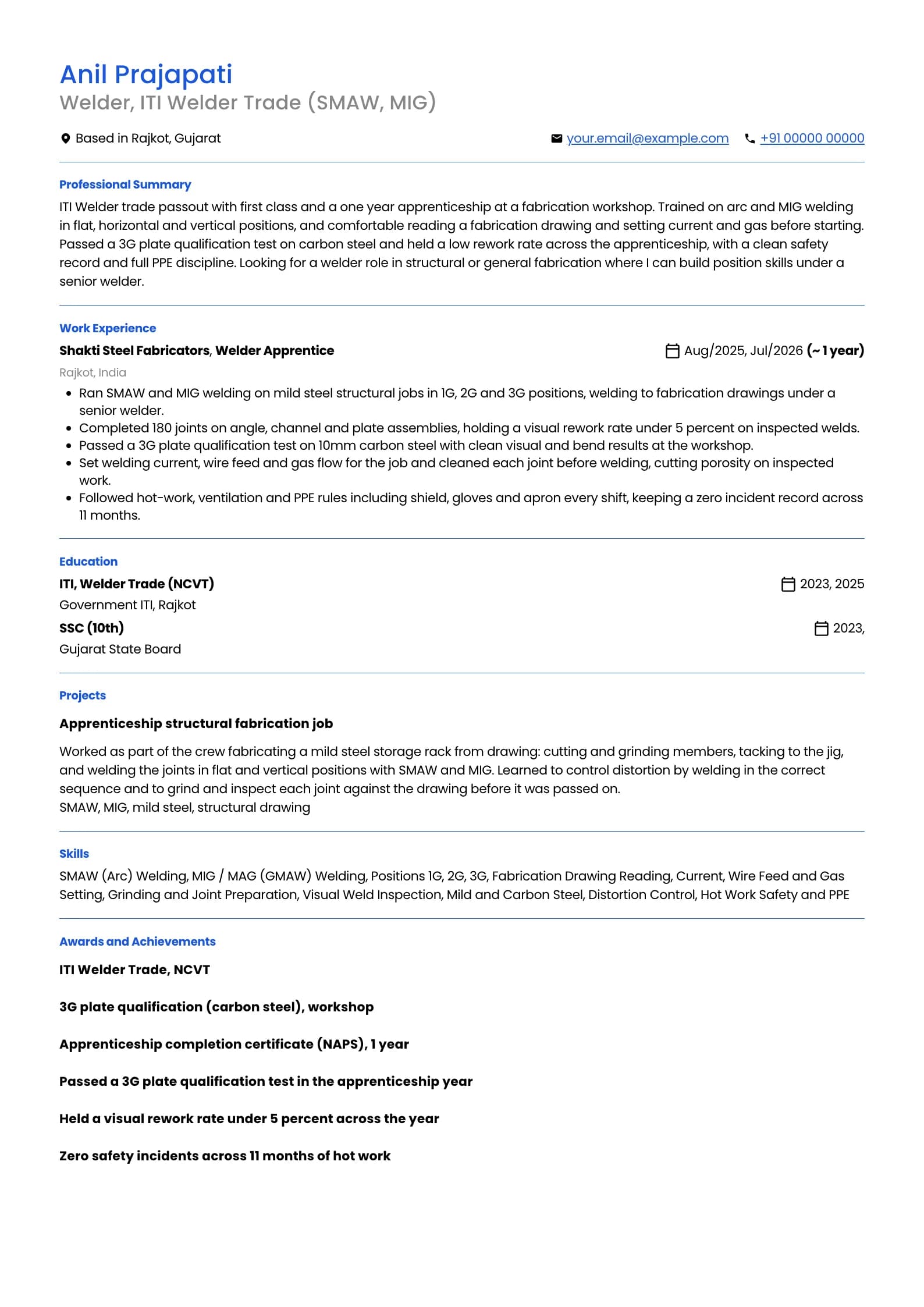
Build my resumeWelder resume example, ITI Passout (0 to 1 year)
minimalist templateIs your resume good enough?
Upload the resume you have now and see what an applicant tracking system reads before a welder recruiter ever does.
Free to run. Sign in with your mobile number to see your score.
Welder resume example, Fabrication Welder (6 years)
modern template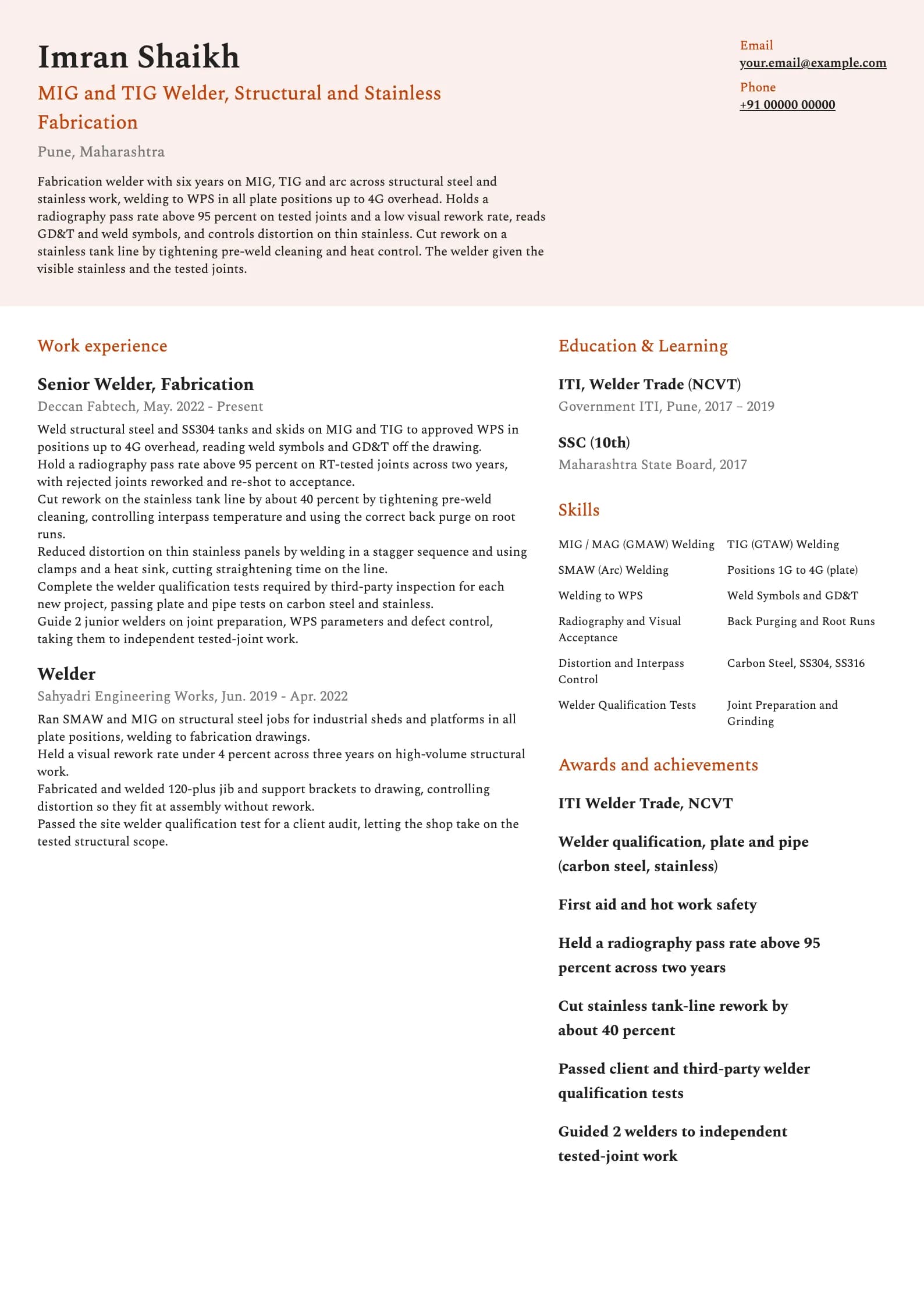
Want this structure with your own details? Build it in the resume builder.
Welder resume example, 6G Pipe Welder / Supervisor (12 years)
professional template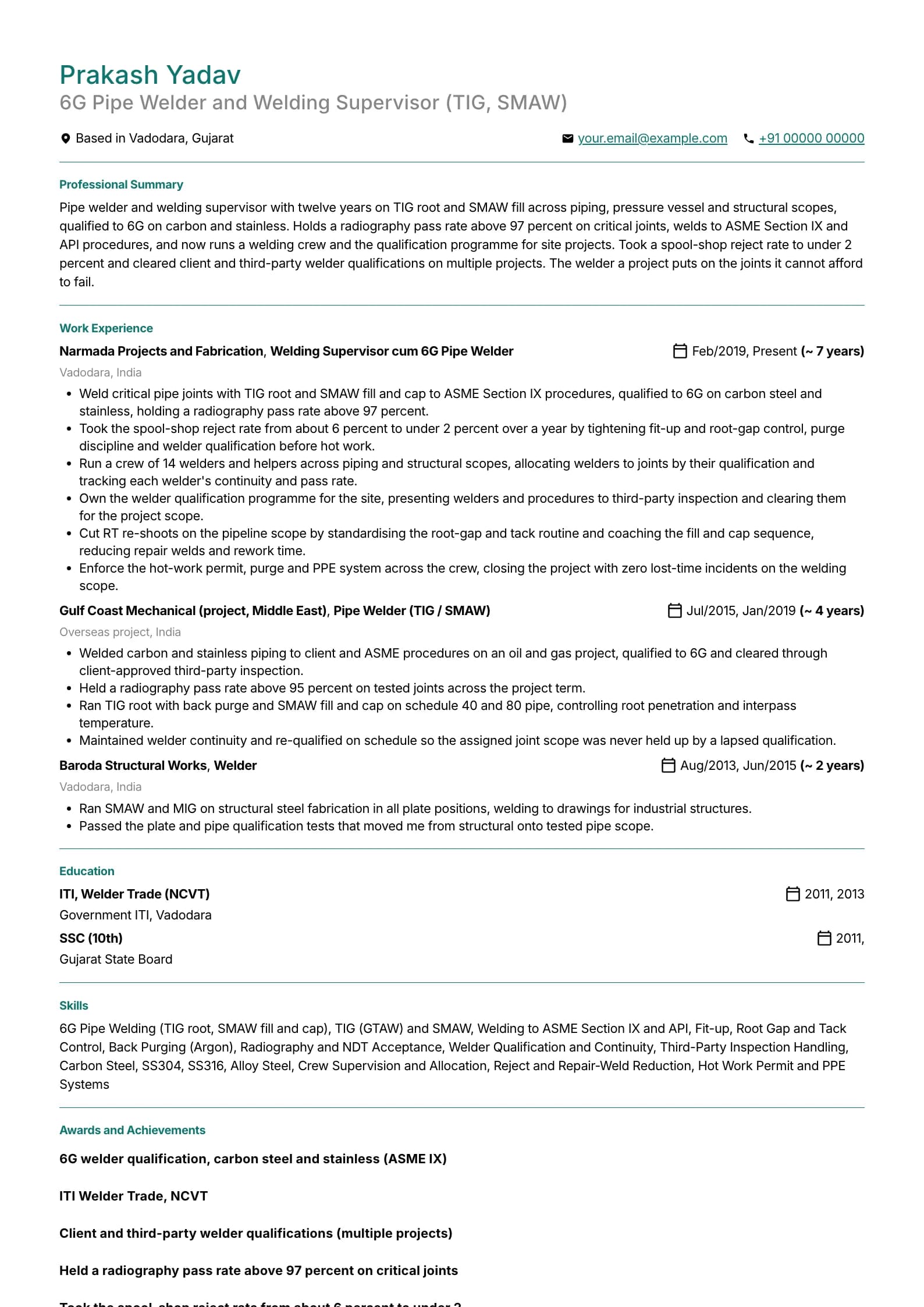
The format that works for welder resumes in India
Keep it to one page and reverse chronological, most recent job first. A fabrication contractor or site HR reads a welder resume in under a minute and is looking for four things fast: the processes you run, the positions you weld, whether you are qualified to a code, and your pass rate. A functional layout that buries the dates reads as a cover for a gap, and a site treats it that way before the trade test. The header carries the trade. Put your name, then a headline that names the processes and the level, for example MIG and TIG Welder, or 6G Pipe Welder. A supervisor sorting a stack matches on process and position first, so a headline that just says Experienced Professional wastes the most valuable line on the page. Section order for a welder is header, a two or three line summary, work experience, then skills split into processes, positions, codes and materials, then education with the ITI Welder trade named, then certifications and qualification tests. A fresher with an apprenticeship leads with that apprenticeship as experience, because a site trusts hours under an arc over classroom hours. Leave off the photograph, date of birth, marital status and father's name. Send a PDF unless the posting asks otherwise, name the file with your own name and Welder, and keep it a single column so a phone screen and a parser both read it cleanly. If you hold a passport and are open to overseas or Gulf work, one plain line saying so is worth adding, because it is a real filter for contractors. The table below sets out the order.
| Section | Where it goes | Why |
|---|---|---|
| Name and process headline | Top, above everything | Names the processes and level, for example 6G Pipe Welder, TIG and SMAW. Contractors filter on it. |
| Summary | Directly under the header | Two or three lines: processes, positions, code, and the pass rate. |
| Work experience | Next, apprenticeship counts as experience | Most recent first. Name the process, position, material and pass rate, not just the employer. |
| Skills | Below experience | Grouped: processes, positions, codes, materials. Not one long line. |
| Education | Below skills, near top for a fresher | ITI Welder trade and NCVT or NSQF. Name the trade clearly. |
| Certifications and tests | After education | ITI, welder qualification tests, 6G, code exposure, with the year. |
Naming TIG is not the same as proving your welds pass a test
The most common welder resume failure is a skills line that reads SMAW, GMAW, GTAW, FCAW, SAW, MIG, TIG, arc, gas, spot with no bullet showing tested work in any of them. A screener matches the words, but the trade test and the welder qualification test decide the job, and a padded process list means nothing if the welds do not pass. The number that matters is the pass rate, and it belongs on the page. The fix is to let the work prove the process. If you write TIG on the skills line, a bullet should describe a joint or a material you ran with TIG and how it was tested. If you write 6G, the resume should show pipe work qualified to 6G, not a plate job in disguise. The mid-level sample names MIG and TIG because the bullets show structural MIG and stainless TIG with a radiography pass rate attached. The skills and the experience agree, which is what a fabrication contractor trusts. Be specific about position and code. There is a real difference between a welder qualified to 3G plate and one qualified to 6G pipe, and between welding to a fabrication drawing and welding to an approved WPS under ASME Section IX or API. Say which you are, because the qualification test at the site will confirm it, and a resume that claims 6G but tests at 3G ends the process on the spot. Name the pass rate honestly. Radiography pass rate on tested joints, or visual rework rate where the work is not radiographed, is the single most persuasive number a welder can carry. A pass rate above 95 percent, stated plainly, does more than any list of processes, because it is the outcome the whole job is measured on.
For every process and position on your skills line, ask whether a bullet shows tested work in it. If not, cut it. A wide process list with no pass rate helps the screener for a minute and fails you at the qualification test.
Writing a summary a fabrication contractor actually reads
The block under your name is the part most likely to be read in full, so it should carry the facts a hiring contractor needs: the processes you run, the positions and code you weld to, how many years, and your pass rate. Two or three lines, no adjectives that cannot be checked at the trade test. The old objective line, seeking a challenging position in a reputed organisation to utilise my welding skills, tells a contractor nothing they did not assume. Replace it with a summary of what you have already welded and how it tested. An objective says what you want, a summary says what you have run and how many welds passed, and only one survives a qualification test. Freshers often think they have nothing to summarise. Look at the fresher sample: it names the processes, the positions, the plate qualification test passed and the rework rate held. That is a real summary from an ITI course and one apprenticeship. What it avoids is "hardworking welder with good knowledge", a phrase that carries no information a site can act on. A practical test: read your summary and ask whether another ITI welder from your batch could paste it onto their resume unchanged. If they could, it describes the trade, not you. Add the specific process, the specific position, the code and the pass rate until it stops being transferable.
Summary, fabrication welder
Weak
Hardworking and experienced welder with 6 years of experience in welding, having good knowledge of all types of welding, seeking a good position in a reputed company.
Strong
Fabrication welder with six years on MIG and TIG across structural and stainless, welding to WPS up to 4G overhead. Holds a radiography pass rate above 95 percent and cut stainless tank rework by about 40 percent.
The rewrite trades "all types of welding" for the exact processes, positions, code and the pass rate a contractor can verify.
Experience bullets: process, joint, and how it tested
Every strong bullet in the samples follows the same shape. It names the process and position, the joint or material welded, and how it was tested or what measurably changed. The process tells a contractor the work is relevant. The material and position tell them the scope. The pass rate, the reject rate or the rework figure does the persuading. Start from the result and work backwards. Welders usually write the task first, which produces a bullet like "did welding work as per drawing given by supervisor". Instead ask how the welds tested and what changed on the line: a pass rate held, a reject rate cut, distortion reduced, re-shoots avoided, a qualification cleared. Then write the sentence that ends in that fact. Vary the number. A pass rate stated five times reads as one trick repeated. Across a real job you can honestly reach for radiography pass rate, visual rework rate, reject or repair-weld rate, distortion or straightening time saved, joints completed, and welders guided. The mid and senior samples move across several of these, which reads as range. Where you lack a clean number, give scope: which processes, which positions, which code, which materials, how many joints. "Welded critical pipe joints with TIG root and SMAW fill to ASME Section IX, qualified to 6G" carries weight without inventing a percentage. Allocate bullets by recency: current job five or six, previous job three or four, the oldest one or two.
| Level | What bullets must prove | Typical number |
|---|---|---|
| ITI passout or fresher | You can run a bead to drawing and pass a plate test | Plate qualification passed, visual rework rate, joints completed |
| 1 to 4 years | You weld to WPS in multiple positions and hold quality | Rework rate, positions welded, distortion controlled |
| 5 to 8 years | Your tested joints pass and you fix why welds fail | Radiography pass rate, reject cut, rework reduced |
| 6G / supervisor, 8 years and up | You weld critical joints to code and run a qualified crew | Pass rate, spool reject rate, re-shoots cut, crew handled |
Experience bullet, pipe welder
Weak
Responsible for doing welding work on pipes as per the drawing and instructions given by the site engineer.
Strong
Took the spool-shop reject rate from about 6 percent to under 2 percent by tightening fit-up and root-gap control, purge discipline and welder qualification before hot work.
"Responsible for" describes the job posting; the rewrite names the reject number and the three causes the welder actually controlled.
If a bullet would read the same on every welder's resume on your site, it describes the crew, not you. Rewrite it until it names the process, the joint and the pass rate you held.
The skills section: processes, positions, codes and materials
A welder resume's skills section has two readers with opposite needs. The screener wants literal terms to match, TIG and 6G and ASME. A supervisor wants a short, organised list that tells them at a glance what class of welder you are. Grouping serves both. Group by function rather than one long line. Processes, positions, codes and materials is a grouping that fits almost every welder. Write both the trade name and the code name for a process at least once, for example MIG / MAG (GMAW) and TIG (GTAW), because a posting may search on either. The exact headings matter less than the fact that structure exists, and a misspelt process, GTAW written as "GTWA", stands out to a supervisor. Ten to sixteen skills is the working range. Below eight it looks thin. Above twenty it stops being a signal, and welder resumes are prone to process padding: listing SMAW, GMAW, GTAW, FCAW, SAW, PAW and spot when you have really run three. The list is a contract, and every process and position on it is something the qualification test can check. Do not use star ratings or percentage bars for welding skill. The qualification test is the rating, and it is pass or fail, so let the pass rate and the tests you have cleared carry the depth instead. Keep positions explicit, 3G, 4G, 6G, because a position is a hard, checkable fact that a contractor matches directly to the scope.
| Group | What goes in it | How many |
|---|---|---|
| Processes | SMAW (arc), MIG / MAG (GMAW), TIG (GTAW), FCAW, SAW | 2 to 4 |
| Positions | 1G, 2G, 3G, 4G, 5G, 6G, the ones you are qualified in | 2 to 4 |
| Codes and procedures | Welding to WPS, ASME Section IX, API, AWS D1.1 | 1 to 3 |
| Materials | Carbon steel, SS304, SS316, alloy steel, aluminium | 2 to 4 |
| Practices | Fit-up, root gap, back purge, distortion control, NDT acceptance | 2 to 4 |
Skills section
Weak
Skills: welding, SMAW, GMAW, GTAW, FCAW, SAW, PAW, spot, arc, gas, MIG, TIG, all positions, all materials, hardworking, sincere, MS Office
Strong
Processes: SMAW, MIG (GMAW), TIG (GTAW). Positions: 3G, 4G, 6G. Codes: welding to WPS, ASME Section IX. Materials: carbon steel, SS304, SS316. Practices: fit-up, root gap, back purge, NDT acceptance.
Cuts the processes and "all positions" you cannot back at a test, and groups the rest so a supervisor reads your real scope in one pass.
Welder qualification, codes and NDT: the language of a real welding hire
The single fact that separates a general welder from a tested one is qualification. Passing a welder qualification test to a written procedure, and welding to that procedure, is what lets a site put you on a joint that will be radiographed. A resume that never mentions qualification, a code or an NDT result reads as a welder who has only ever run to a drawing, and that limits the scope you will be offered. Name the qualifications you hold and the position they cover. A 3G plate qualification, a 6G pipe qualification on carbon or stainless, or a client and third-party approved qualification on a named project are all checkable facts. State the process and material each covers, because a 6G stainless TIG qualification and a 3G carbon MIG qualification are very different tickets. Use the code language where it is honest. Welding to WPS, to ASME Section IX for pressure work, to API for pipelines, or to AWS D1.1 for structural steel tells a contractor you have worked inside a real qualification system with a WPS, a PQR and a welder performance qualification behind it. Do not claim a code you have not welded to, because the qualification test at the site will expose it. Name the NDT and acceptance you have worked with. Radiography (RT), dye penetrant (PT), magnetic particle (MT) and ultrasonic (UT), and knowing common defects, porosity, undercut, lack of fusion, cracks, tells a site you understand how your welds are judged. This is where a radiography pass rate belongs, and stating it here, with the code you welded to, is the strongest section a tested welder can write.
A welder resume that names processes but never a qualification, a code or an NDT result reads as untested. Name the qualification, the position it covers, the code you welded to and the pass rate it earned.
Where the ITI trade, apprenticeship and qualifications belong
For a welder the ITI Welder trade is a real credential, so name it clearly with the certifying body, for example ITI Welder Trade, NCVT, or under NSQF. For a fresher this sits near the top, just below the summary, because it is the strongest thing you can lead with. For an experienced welder it moves below skills, but the trade line stays because sites and staffing agencies filter on it. An apprenticeship is experience, not education, and belongs in the work section. A NAPS apprenticeship at a fabrication shop tells a contractor you have logged real hours under an arc, which is worth more than classroom hours. State the length, the processes and the positions you ran, the same way you would a job. Welder qualification tests are not ordinary certificates, and they deserve their own line. A 3G plate pass, a 6G pipe qualification, or a client and third-party approval on a project each names the process, position and material it covers, plus the year. These are the credentials a welding hire is actually built on, so keep them explicit rather than folding them into a general skills line. Keep the school percentage only while it helps a fresher. Once you have years under an arc and a pass rate to point at, the qualifications you hold and the joints you have welded predict far more than a mark from years ago, so let those lead and keep the education line short.
Getting past the screening, human or software
Larger EPC contractors and staffing agencies run welder applications through an applicant tracking system before a human reads them, and even where a person screens first, the same rules make the resume fast to read. Almost every failure here is a formatting problem, not a wording one. The layout rules are short. One column, because a two-column sidebar can be read out of order and scramble your experience. Standard headings, so use Work Experience and Skills rather than My Journey and My Toolbox. No text trapped inside an image or a certificate scan, because a parser reads it as blank space. Keep the processes, positions and qualifications in the body text, not only in a header some parsers drop. On wording, mirror the posting where it is honest. If it asks for a TIG welder, write TIG. If it asks for a 6G pipe welder, write 6G, not just pipe welder. Spell out an abbreviation once alongside its short form, for example "GTAW (TIG)" and "RT (radiography)", so both searches find you. Keep the ITI trade name, Welder, in plain text, because agencies often search on the exact trade. Save as a PDF that holds real text, then open it and try to select and copy a line. If you cannot select the text, a parser cannot read it either, and neither can a recruiter searching for a 6G welder later. A clean, single-column PDF beats a decorated one every time.
Section heading
Weak
My Welding Career
Strong
Work Experience
A parser looks for standard headings; a creative one can drop the whole block into an unclassified bucket the recruiter never searches.
What gets welder resumes set aside
Most rejections at the resume stage on a fabrication or site hire are not close calls. They come from a small set of recurring problems, and every one is fixable in an evening. The list below covers what fabrication contractors and site HR see most often on Indian welder resumes, in rough order of how much damage each one does.
- A wide process list with no pass rate. The qualification test decides the job, and a padded process line means nothing without a tested result.
- No radiography or visual pass rate anywhere, so a contractor cannot tell whether your welds actually hold.
- Claiming 6G or a code you have not welded to, which the qualification test at the site exposes immediately.
- Being vague about position and code, blurring a 3G plate ticket with 6G pipe work.
- No mention of the material, when carbon steel, stainless and aluminium are very different welds.
- A generic objective line instead of a summary naming processes, positions, code and pass rate.
- No safety or PPE discipline shown, which matters on hot work where a careless welder is a site liability.
- A photo, date of birth, marital status or father's name from an old campus template, taking space a qualification could use.
- Inflated experience or dates that will not match ESI, PF or project letters, which background checks catch.
- Misspelt processes or codes, writing GTAW as "GTWA" or ASME as "ASMI", which undoes an otherwise solid page.
Read your resume as if you were the welding supervisor about to test you. Any process, position or code you would not want to prove at the qualification test is a line to fix or cut.
Skills to put on a welder resume
Technical
- SMAW (Arc) Welding
- MIG / MAG (GMAW) Welding
- TIG (GTAW) Welding
- 6G and 3G Position Welding
- Welding to WPS
- ASME Section IX and API Procedures
- Fit-up, Root Gap and Tack Control
- Back Purging and Root Runs
- Distortion and Interpass Control
- Weld Defect Identification
- Radiography and NDT Acceptance
- Fabrication Drawing and Weld Symbols
Tools and platforms
- Arc / SMAW machine
- MIG / GMAW machine
- TIG / GTAW machine
- Angle grinder and gouging
- Argon back purge setup
- Welding gauges and fillet gauge
- Preheat and interpass thermometer
- PPE (shield, gloves, apron)
Working skills
- Hot work safety discipline
- PPE compliance
- Reading and following WPS
- Crew coordination
- Attention to defect and finish
- Reliability and continuity
- Working to inspection
- Guiding junior welders
Certifications worth listing as a welder
| Certification | Full name | Worth it for |
|---|---|---|
| ITI Welder | ITI Welder Trade (NCVT / NSQF) | The core credential for a welder, worth naming clearly for any fabrication shop or site. A first class ITI Welder is a clean entry signal for a fresher, and the trade stays on the resume even at senior level because contractors and agencies filter on it. |
| 6G Qualification | 6G Welder Performance Qualification (pipe, all positions) | The qualification that opens tested pipe and pressure scope, since 6G covers all positions on pipe. Worth it for any welder moving from structural into piping, and often the single fact a project checks first. State the process and material it covers, carbon or stainless. |
| ASME IX | Welder qualification to ASME Section IX | Proof you have welded to the pressure-work code with a WPS and PQR behind it, essential for pressure vessel and piping scope. Worth listing for anyone on tested joints; do not claim it if you have only welded to a fabrication drawing. |
| AWS Certified | AWS Certified Welder (D1.1 structural) | A recognised structural welding qualification, useful for structural steel and infrastructure scope and for contractors that work to AWS D1.1. Worth it where the project or client specifies AWS rather than ASME procedures. |
| NAPS Apprenticeship | National Apprenticeship Promotion Scheme completion certificate | Proof of real hours under an arc on a registered apprenticeship, worth more than a classroom course to a fabrication shop. List it as experience, not just a certificate, and state the processes and positions you ran during it. |
Keywords an ATS scans for in a welder resume
These are the literal terms a parser matches against the job description. Use the ones that are true of you, in the sentences where you did the work, not as a list at the bottom.
- welder
- tig welder
- mig welder
- arc welder
- pipe welder
- 6g welder
- smaw
- gmaw
- gtaw
- welding wps
- asme section ix
- radiography
- ndt
- iti welder
- welder qualification
- structural welding
- stainless steel welding
- fit up
- root gap
- fabrication
Welder resume FAQ
What salary can a welder expect in India?
An ITI fresher or apprentice welder typically starts around 1.8 to 3 LPA, often with overtime and site allowances on top. A MIG and TIG fabrication welder with five to seven years usually sits in the 3 to 6 LPA band, higher on tested stainless and pressure work. A 6G pipe welder or welding supervisor with eight years and above commonly earns 6 to 10 LPA in India, and considerably more on Gulf and overseas projects. A strong radiography pass rate and a 6G or ASME qualification push the top of every band upward.
How long should a welder resume be?
One page is right for almost every welder. A contractor scans it in under a minute, so everything that decides the hire, the processes, the positions, the code, the materials and the pass rate, should fit on a single clean page. If you are struggling to fit it, cut the oldest job to one line and remove any generic certificate that does not move a welding hire.
Should I list every welding process I have touched?
No. List the processes you can weld to a test, usually two or three, and let a bullet show tested work in each. A line reading SMAW, GMAW, GTAW, FCAW, SAW, PAW and spot is padding, because the qualification test, not the resume, decides the job. Two processes you can back with a pass rate beat seven you name once.
What is the most important thing to put on a welder resume?
Your pass rate and your qualifications. A radiography pass rate on tested joints, or a visual rework rate where the work is not radiographed, is the single most persuasive number a welder can carry, because it is the outcome the whole job is measured on. Alongside it, name the positions you are qualified in, 3G, 4G, 6G, and the code you weld to. Those facts decide the scope you will be offered.
How does a fresher write a welder resume with no job?
Lead with your apprenticeship as experience, then your ITI Welder trade, then skills. Treat the apprenticeship like a job: the processes and positions you ran, the materials, and any plate qualification test you passed. An ITI trade, a NAPS apprenticeship, a passed 3G test and a clean safety record are checkable facts that carry more weight than "hardworking welder with good knowledge". Name the visual rework rate you held, since it stands in for a pass rate.
Does a 6G qualification really matter?
Yes, for tested pipe and pressure work it is often the single fact a project checks first, because 6G covers all positions on pipe. It moves you from general fabrication onto joints that will be radiographed, and it usually carries a real pay difference. State the process and material it covers, TIG or SMAW, carbon or stainless, and be honest, because the site qualification test will confirm it.
Should I mention codes like ASME or AWS?
Only where you have actually welded to them. Welding to a WPS under ASME Section IX for pressure work, or to AWS D1.1 for structural, tells a contractor you have worked inside a real qualification system. It is a strong signal for tested scope. Do not claim a code you have only heard of, because the qualification test at the site will expose it and end the process.
Do I need a photo on a welder resume in India?
No. A welding hire is decided on processes, positions, qualifications and a trade test, not a photograph, and the space is better used for a pass rate or a qualification. The same goes for date of birth, marital status, father's name and a declaration paragraph, all of which come from an older campus template. If you are open to overseas or Gulf work, a single line saying you hold a passport is worth far more than a photo.
Related resume examples and guides
Build your own welder resume in any of these formats
Start from a blank resume or upload the one you have. Goodspace renders it in 24 templates and flags the process, position and qualification keywords a fabrication contractor will scan for, and the padding a welding supervisor will not credit.
Build my resume