Machinist Resume Format, with 3 Full Samples
A machinist is hired on the parts they can make to a drawing, the tolerances they can hold and how little they scrap, yet most resumes list every machine and forget the precision work that sets a machinist apart from an operator. Below are three complete resumes, one for an ITI machinist passout, one for a toolroom machinist who works both conventional and CNC to tight tolerances, and one for a lead machinist who owns a toolroom and its output. After the samples come the format rules, the difference between running a machine and making a part to 5 microns, the terms a toolroom hirer scans for, and the mistakes that get a resume set aside before the trade test.
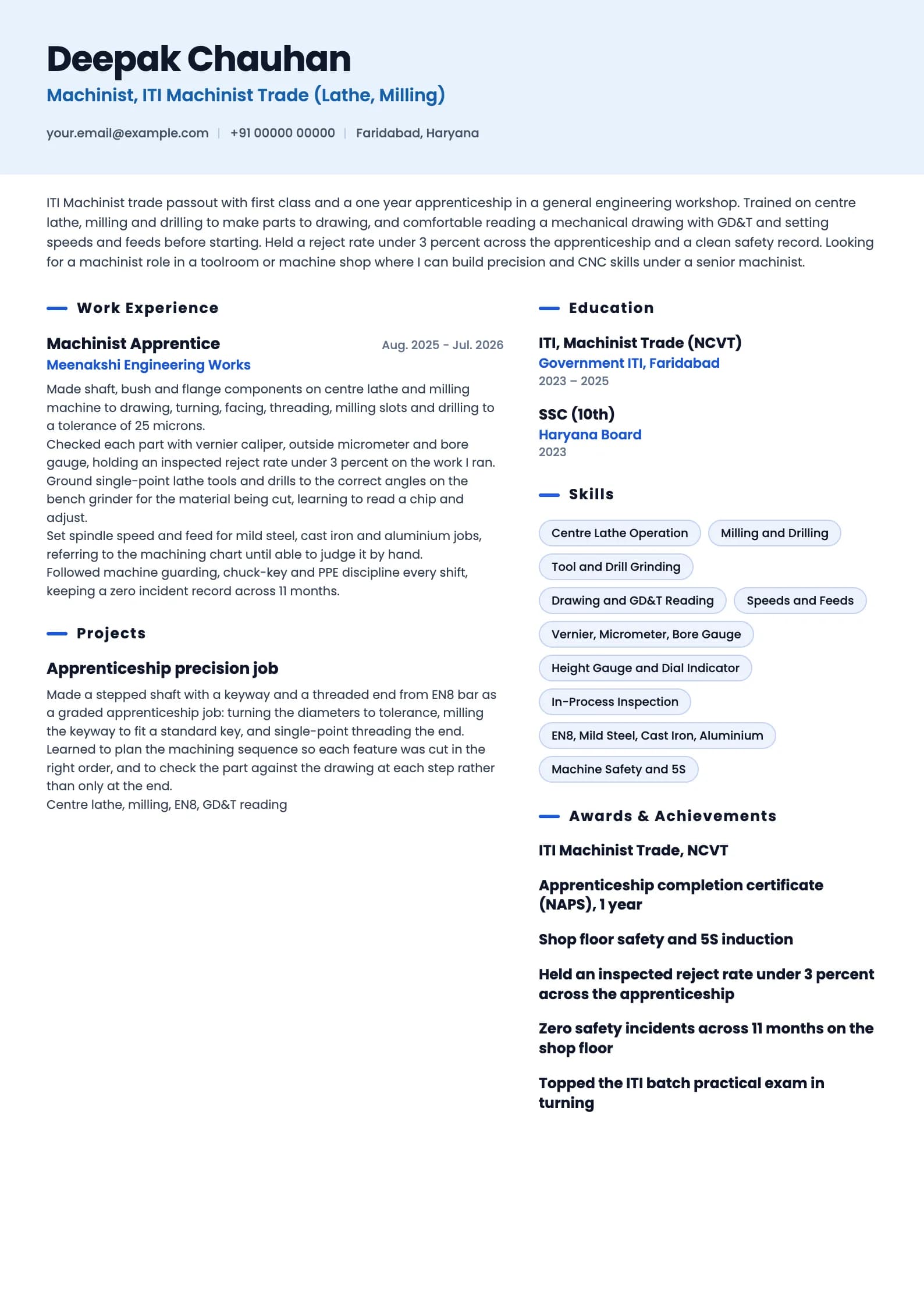
Build my resumeMachinist resume example, ITI Passout (0 to 1 year)
ai-era templateIs your resume good enough?
Upload the resume you have now and see what an applicant tracking system reads before a machinist recruiter ever does.
Free to run. Sign in with your mobile number to see your score.
Machinist resume example, Toolroom Machinist (6 years)
modern template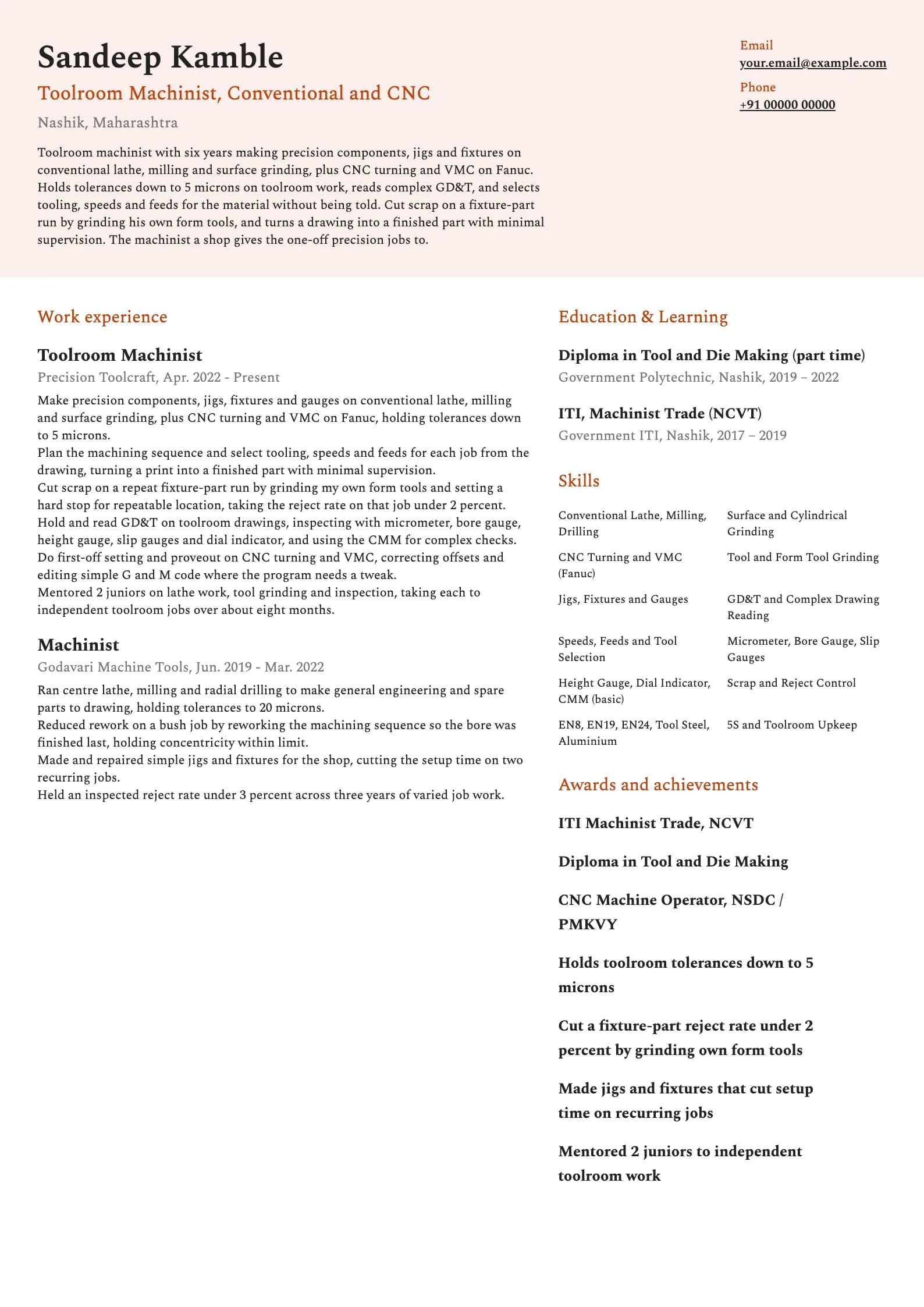
Want this structure with your own details? Build it in the resume builder.
Machinist resume example, Lead Machinist / Toolroom In-charge (13 years)
header-band template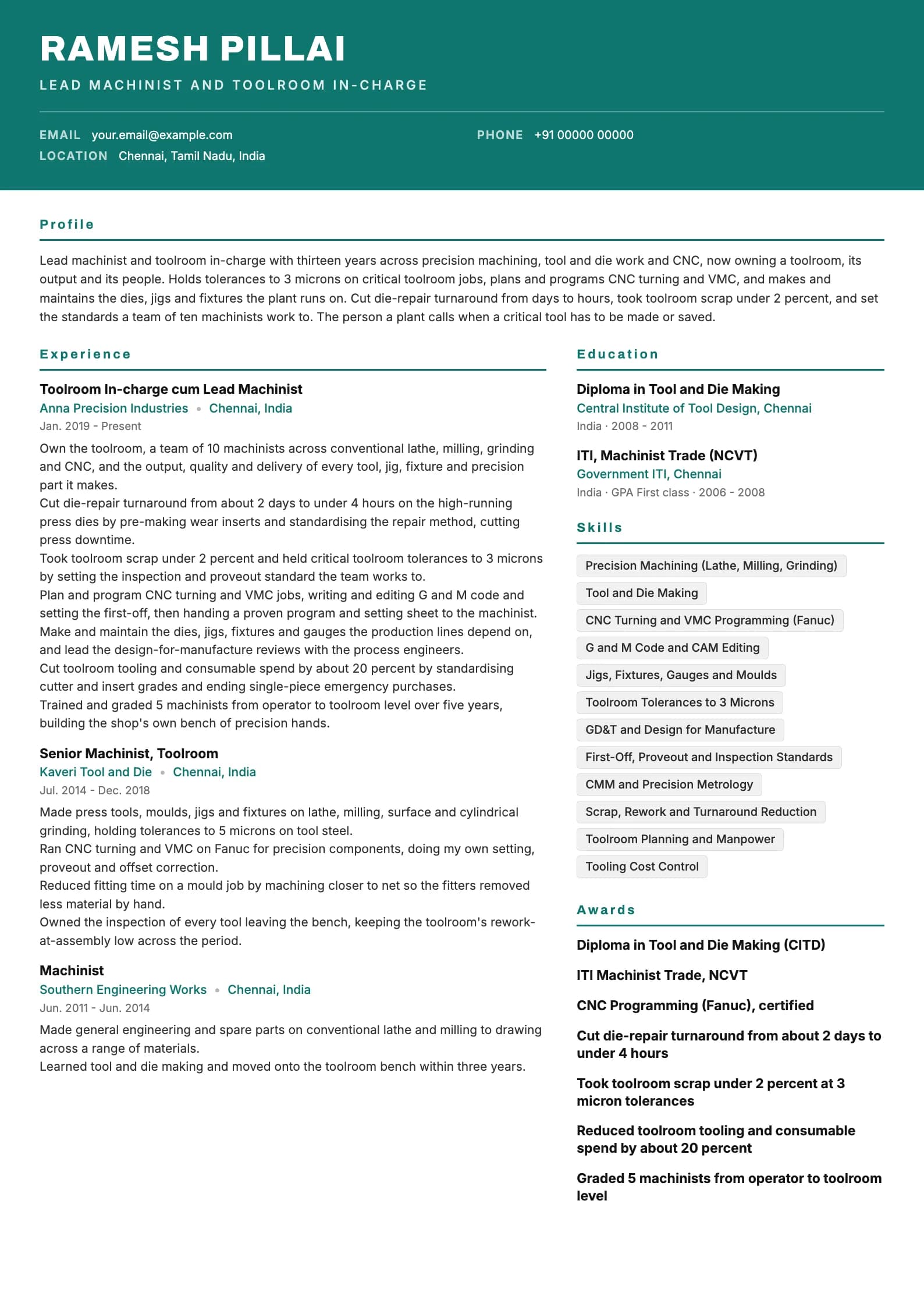
The format that works for machinist resumes in India
Keep it to one page and reverse chronological, most recent job first. A toolroom lead or a machine shop owner reads a machinist resume fast, and is looking for the trade, the machines both conventional and CNC, the tolerance you hold, and how much you scrap. A functional layout that hides the dates under a Skills heading reads as a cover for a gap, and a shop treats it that way before the trade test. The header carries the trade and the range. Put your name, then a headline that names the trade and the machine range, for example Toolroom Machinist, Conventional and CNC. A machinist who works both worlds is worth more than an operator on one, so the headline should make that range visible. A line that just says Skilled Professional wastes the most valuable space on the page. Section order for a machinist is header, a two or three line summary, work experience, then skills split into machines, precision work, measuring instruments and materials, then education with the ITI Machinist trade and any tool-and-die diploma named, then certifications. A fresher with an apprenticeship leads with that apprenticeship as experience, because a shop trusts hours at the machine over classroom hours. Leave off the photograph, date of birth, marital status and father's name. Send a PDF unless the posting asks otherwise, name the file with your own name and Machinist, and keep it a single column so a phone screen and a parser both read it cleanly. The table below sets out the order.
| Section | Where it goes | Why |
|---|---|---|
| Name and trade headline | Top, above everything | Names the trade and machine range, for example Toolroom Machinist, Conventional and CNC. Shops filter on it. |
| Summary | Directly under the header | Two or three lines: machines, years, tolerance held and the one strongest number. |
| Work experience | Next, apprenticeship counts as experience | Most recent first. Name the machine, the part, the tolerance and what you made, not just the employer. |
| Skills | Below experience | Grouped: machines, precision work, measuring instruments, materials. Not one long line. |
| Education | Below skills, near top for a fresher | ITI Machinist trade and NCVT, plus any tool-and-die diploma. Name the trade clearly. |
| Certifications | After education | ITI, tool-and-die diploma, NSDC and any CNC programming certificate, with the year. |
Running a machine is not the same as making a part to 5 microns
The most common machinist resume failure is a page that reads like an operator's: a list of machines and a line about doing production to target, with nothing that shows the precision work a machinist is actually paid for. The difference between a machinist and an operator is that a machinist turns a drawing into a finished part, plans the sequence, selects the tooling, grinds a form tool if needed, and holds a tolerance a production line never sees. The resume has to show that, or a toolroom reads you as an operator and pays you like one. The fix is to let the work prove the precision. State the tolerance you hold, in microns, because holding 5 microns on a toolroom job is a different skill from a 50 micron production part. Name the precision work: jigs, fixtures, gauges, dies, moulds, one-off components, prototypes. Say that you plan the machining sequence and select speeds, feeds and tooling yourself, because deciding how to make the part is the machinist's job, not just running it. Name the skills an operator often does not have. Grinding your own single-point and form tools, doing surface and cylindrical grinding, reading complex GD&T, checking with slip gauges and a CMM, and making a fixture that locates a part repeatably. Each of these is a line an operator resume cannot honestly write, so each one separates you. Show both the conventional and the CNC side if you have them. A machinist who can do manual lathe, milling and grinding and also set, prove out and program a CNC is more useful to a toolroom than someone on one or the other, because the toolroom needs both. Say which CNC work you actually do, running, setting or programming, because there is a pay difference across the three and the trade test will confirm it.
For every machine on your skills line, ask whether a bullet shows you making a part to tolerance on it, not just running production. If not, add the tolerance and the part. A machine list with no precision work reads as an operator resume.
Writing a summary a toolroom lead actually reads
The block under your name is the part most likely to be read in full, so it should carry the facts a hiring toolroom needs: the machines you work both conventional and CNC, how many years, the tolerance you hold, and the single strongest thing you have made or improved. Two or three lines, no adjectives that cannot be checked at the trade test. The old objective line, seeking a challenging position in a reputed organisation to utilise my machining skills, tells a lead nothing they did not assume. Replace it with a summary of what you have already made and how tight. An objective says what you want, a summary says what you have machined and the tolerance you held, and only one survives a trade test. Freshers often think they have nothing to summarise. Look at the fresher sample: it names the machines, the trade, the apprenticeship length, the tolerance and the reject rate, and it mentions tool grinding. That is a real summary from an ITI course and one apprenticeship. What it avoids is "hardworking and skilled machinist", a phrase that carries no information a shop can act on. A practical test: read your summary and ask whether another ITI machinist from your batch could paste it onto their resume unchanged. If they could, it describes the trade, not you. Add the specific machine, the specific tolerance and the specific part until it stops being transferable.
Summary, toolroom machinist
Weak
Skilled and experienced machinist with 6 years of experience in lathe, milling and CNC machines, seeking a good position in a reputed manufacturing company to utilise my skills.
Strong
Toolroom machinist with six years on conventional lathe, milling and grinding plus CNC turning and VMC on Fanuc, holding tolerances down to 5 microns. Makes jigs, fixtures and gauges from print, and cut a fixture-part reject rate under 2 percent by grinding his own form tools.
The rewrite trades a machine list and self-description for the tolerance held, the precision work made, and one verifiable result.
Experience bullets: machine, part, tolerance, and what moved
Every strong bullet in the samples follows the same shape. It names the machine, the part or tool you made, the tolerance you held, and what measurably changed. The machine tells a toolroom the work is relevant. The part and tolerance tell them the class of precision. The number, reject rate, scrap, turnaround, setup time, does the persuading. Start from the result and work backwards. Machinists usually write the task first, which produces a bullet like "worked on lathe and milling and made parts as per drawing". Instead ask what you made and how it turned out: a part held to tolerance, scrap cut, a fixture that removed setup time, a die repaired faster, rework at assembly reduced. Then write the sentence that ends in that fact. Vary the number. Reject rate stated five times reads as one trick repeated. Across a real job you can honestly reach for reject or scrap rate, tolerance held, turnaround or repair time, setup time saved, rework at assembly, and machinists trained. The mid and senior samples move across several of these, which reads as range. Where you lack a clean number, give scope: which machines, what precision, which materials, what you made. "Make jigs, fixtures and gauges to 5 microns and select the tooling myself" carries weight without inventing a percentage. Allocate bullets by recency: current job five or six, previous job three or four, the oldest one or two.
| Level | What bullets must prove | Typical number |
|---|---|---|
| ITI passout or fresher | You can make a part to drawing and grind your own tools | Reject rate, tolerance held, parts made, safety record |
| 1 to 4 years | You plan the job and hold tolerance across varied work | Scrap rate, tolerance, rework cut, setup saved |
| 5 to 8 years, toolroom | You turn a print into precision tools and parts alone | Toolroom tolerance, scrap, fixtures made, turnaround |
| Lead, 8 years and up | You own the toolroom, its standards and its output | Turnaround, scrap, tooling cost, machinists graded |
Experience bullet, toolroom machinist
Weak
Responsible for operating lathe, milling and grinding machines and making parts as per drawing given by supervisor.
Strong
Cut die-repair turnaround from about 2 days to under 4 hours on the high-running press dies by pre-making wear inserts and standardising the repair method.
"Responsible for" describes the job posting; the rewrite names the tool, the turnaround and the method that moved it.
If a bullet would read the same on every machinist's resume in your shop, it describes the trade, not you. Rewrite it until it names the part you made, the tolerance you held and the number you moved.
The skills section: machines, precision work, instruments and materials
A machinist resume's skills section has two readers with opposite needs. The screener wants literal terms to match, lathe and VMC and micrometer. A toolroom lead wants a short, organised list that tells them at a glance what class of machinist you are. Grouping serves both. Group by function rather than one long line. Machines, precision work, measuring instruments and materials is a grouping that fits almost every machinist. The exact headings matter less than the fact that structure exists. Write names the way the trade writes them: VMC not V.M.C, micrometer not micro meter, EN24 not en 24. A parser matches on strings, and a toolroom lead notices a misspelt instrument. Ten to sixteen skills is the working range. Below eight it looks thin. Above twenty it stops being a signal, and machinist resumes are prone to machine padding: listing every machine in the shop when you have really worked four. The list is a contract, and every machine and every precision skill on it is something the trade test can check. Do not use star ratings or percentage bars. Nobody agrees on what four stars in surface grinding means, and it invites an argument you cannot win. Let the tolerance you hold and the parts you have made carry the depth. Keep the measuring instruments explicit, slip gauges, bore gauge, height gauge, dial indicator, CMM, because precise inspection is half of a machinist's value.
| Group | What goes in it | How many |
|---|---|---|
| Machines | Centre lathe, milling, surface and cylindrical grinding, CNC turning, VMC | 3 to 5 |
| Precision work | Jigs, fixtures, gauges, dies, tool grinding, GD&T, proveout | 2 to 4 |
| Measuring instruments | Micrometer, bore gauge, height gauge, slip gauges, dial indicator, CMM | 3 to 5 |
| Materials | EN8, EN19, EN24, tool steel, cast iron, aluminium | 2 to 4 |
| Controls and practices | Fanuc, G and M code, speeds and feeds, 5S | 2 to 4 |
Skills section
Weak
Skills: lathe, milling, drilling, grinding, shaper, planer, slotting, CNC, VMC, HMC, Fanuc, Siemens, Mazak, measuring, drawing, hardworking, sincere, team player, MS Office
Strong
Machines: centre lathe, milling, surface grinding, CNC turning, VMC. Precision: jigs, fixtures, gauges, tool grinding, GD&T. Instruments: micrometer, bore gauge, slip gauges, CMM. Materials: EN8, EN24, tool steel. Controls: Fanuc, G and M code.
Cuts the machines and controls you cannot back at a test and the soft-skill filler, and groups the rest so a toolroom lead reads your real range in one pass.
Toolroom, tool and die work: the machinist's premium skills
The best-paid machinist work is toolroom work: making and maintaining the jigs, fixtures, gauges, dies and moulds a plant runs on, and the one-off precision parts a production line cannot make. A machinist who can do toolroom work is more valuable than one who only runs production, so if you have those skills, the resume should name them clearly rather than leaving them inside a general machining line. Name what you make. Jigs and fixtures that locate a part repeatably, gauges that check it, press tools and dies, moulds, and precision spare parts. Each of these tells a hirer you can produce the tooling other people machine against, which is a different and higher skill than making parts to someone else's fixture. Name the precision skills. Surface and cylindrical grinding to a fine finish and tight tolerance, tool and form-tool grinding, lapping and honing where you do it, and machining tool steel and hardened material. These are the skills a toolroom bench needs and a production cell rarely does, so listing them signals the class of work you belong in. Tie the toolroom work to an outcome where you can. A die repaired faster and press downtime cut, a fixture that removed setup time, a gauge that caught a problem, machining closer to net so fitters removed less by hand. This is where turnaround and rework numbers belong, and stating them next to the tools you made is the strongest case a toolroom machinist can put on a page.
If you do toolroom work, do not bury it in a general machining line. Name the jigs, fixtures, dies and gauges you make, the grinding and tool steel you handle, and the turnaround or setup you saved.
Where the ITI trade, diploma and certifications belong
For a machinist the ITI Machinist trade is a real credential, so name it clearly with the certifying body, for example ITI Machinist Trade, NCVT, or under NSQF. For a fresher this sits near the top, just below the summary, because it is the strongest thing you can lead with. For an experienced machinist it moves below skills, but the trade line stays because shops filter on it. A tool-and-die making diploma carries real weight for toolroom work, so if you hold one, from a government polytechnic or an institute like CITD, name it plainly. It tells a toolroom you have formal grounding in tools, dies and precision, not only production machining, and it often makes the difference for a bench role. An apprenticeship is experience, not education, and belongs in the work section. A NAPS apprenticeship at a machine shop or toolroom tells a hirer you have logged real hours at the machine, worth more than classroom hours. State the length, the machines and the work you did, the same way you would a job. Certifications sit below education. The ones that matter for a machinist are the ITI trade, the tool-and-die diploma, an NSDC or PMKVY CNC course, and a CNC programming certificate for anyone on the programming track. Write the full name, the issuing body and the year. Keep the school percentage only while it helps a fresher, because once you have years at the bench and tolerances to point at, the work predicts more than a mark from years ago.
Getting past the screening, human or software
Larger manufacturers and staffing agencies run machinist applications through an applicant tracking system before a human reads them, and even where a person screens first, the same rules make the resume fast to read. Almost every failure here is a formatting problem, not a wording one. The layout rules are short. One column, because a two-column sidebar can be read out of order and scramble your experience. Standard headings, so use Work Experience and Skills rather than My Journey and My Toolbox. No text trapped inside an image or a machine-logo strip, because a parser reads it as blank space. Keep the trade, machines and precision work in the body text, not only in a header some parsers drop. On wording, mirror the posting where it is honest. If it asks for a toolroom machinist, write toolroom machinist. If it asks for VMC or surface grinding, write those exact terms. Spell out an abbreviation once alongside its short form, for example "VMC (vertical machining centre)" and "GD&T (geometric dimensioning and tolerancing)", so both searches find you. Keep the ITI trade name, Machinist, in plain text, because agencies often search on the exact trade. Save as a PDF that holds real text, then open it and try to select and copy a line. If you cannot select the text, a parser cannot read it either, and neither can a recruiter searching for a toolroom machinist later. A clean, single-column PDF beats a decorated one every time.
Section heading
Weak
My Machining Journey
Strong
Work Experience
A parser looks for standard headings; a creative one can drop the whole block into an unclassified bucket the recruiter never searches.
What gets machinist resumes set aside
Most rejections at the resume stage in a machine shop or toolroom are not close calls. They come from a small set of recurring problems, and every one is fixable in an evening. The list below covers what shop owners and toolroom leads see most often on Indian machinist resumes, in rough order of how much damage each one does.
- A page that reads like an operator's: machines listed, production to target mentioned, no precision work or tolerance shown.
- No tolerance stated anywhere, so a toolroom cannot tell whether you hold 5 microns or run loose production parts.
- No numbers on the work. Reject rate, scrap, turnaround, setup time, rework. Pick whichever is honest for your job.
- Toolroom skills buried in a general machining line, hiding jigs, fixtures, dies, grinding and tool grinding.
- Being vague about the CNC side, blurring running a program with setting, proveout and programming.
- A generic objective line instead of a summary naming machines, tolerance and one result.
- No mention of measuring instruments, which reads as a machinist who does not inspect his own work.
- A photo, date of birth, marital status or father's name from an old campus template, taking space precision work could use.
- Inflated experience or dates that will not match ESI, PF or offer letters, which background checks catch.
- Misspelt machines or materials, writing EN24 as "en 24" or micrometer as "micro meter", which undoes an otherwise solid page.
Read your resume as if you were the toolroom lead about to test you. Any machine, tolerance or precision skill you would not want to prove at the trade test is a line to fix or cut.
Skills to put on a machinist resume
Technical
- Centre Lathe and Turning
- Milling and Drilling
- Surface and Cylindrical Grinding
- CNC Turning and VMC Operation
- CNC Setting and Proveout
- Tool and Die Making
- Jigs, Fixtures and Gauges
- Tool and Form Tool Grinding
- GD&T and Drawing Interpretation
- Speeds, Feeds and Tool Selection
- Precision Inspection and Metrology
- Scrap and Rework Reduction
Tools and platforms
- Fanuc Control
- Vernier Caliper
- Outside and Bore Micrometer
- Bore Gauge and Height Gauge
- Slip Gauges
- Dial Indicator
- CMM (basic)
- Bench and Tool Grinder
Working skills
- Machining sequence planning
- Attention to tolerance
- Shop floor safety discipline
- Toolroom teamwork
- Mentoring juniors
- Reliability and attendance
- Reading and following drawings
- Record keeping and inspection
Certifications worth listing as a machinist
| Certification | Full name | Worth it for |
|---|---|---|
| ITI Machinist | ITI Machinist Trade (NCVT / NSQF) | The core credential for a machinist, worth naming clearly for any machine shop or toolroom. A first class ITI Machinist is a clean entry signal for a fresher, and the trade stays on the resume even at senior level because shops filter on it. |
| ITI Turner | ITI Turner Trade (NCVT / NSQF) | The turning-focused trade, worth naming alongside or instead of the Machinist trade for anyone whose core work is lathe and turning. Many machinists hold one of the two; name whichever you actually completed. |
| Tool and Die Diploma | Diploma in Tool and Die Making (Polytechnic / CITD / NTTF) | Carries real weight for toolroom, tool and die and mould work, since it certifies formal grounding in tools, dies and precision rather than only production machining. Often the fact that decides a toolroom bench role. |
| NSDC CNC | CNC Machine Operator, NSDC / PMKVY | A short skilling certificate useful for a career switcher or a non-ITI candidate who needs a recognised CNC credential on paper. Worth listing early, though a real apprenticeship and bench hours outweigh it once you have them. |
| CNC Programming | CNC Programming Certificate (Fanuc / Siemens) | A control-specific certificate that matters for the machinist moving onto the CNC programming track, since it certifies writing and editing part programs rather than only running them. Worth it when you start proving out and programming jobs, not just operating. |
Keywords an ATS scans for in a machinist resume
These are the literal terms a parser matches against the job description. Use the ones that are true of you, in the sentences where you did the work, not as a list at the bottom.
- machinist
- toolroom machinist
- cnc machinist
- lathe operator
- milling
- surface grinding
- vmc
- tool and die
- jigs and fixtures
- gd&t
- micrometer
- slip gauges
- cmm
- iti machinist
- tolerance
- tool grinding
- scrap reduction
- fanuc
- 5s
- precision machining
Machinist resume FAQ
What salary can a machinist expect in India?
An ITI fresher or apprentice machinist typically starts around 1.8 to 3 LPA, often with shift and overtime allowances. A toolroom or CNC machinist with five to seven years usually sits in the 3.5 to 6 LPA band, higher for tight-tolerance tool and die work. A lead machinist or toolroom in-charge with eight years and above commonly earns 6 to 11 LPA, and more in strong tool rooms and product companies. Tool-and-die skill, CNC programming and a fine tolerance record push the top of every band upward.
What is the difference between a machinist and a CNC operator?
A CNC operator runs production to an existing program and checks the parts. A machinist turns a drawing into a finished part: planning the machining sequence, selecting the tooling and speeds, working both conventional and CNC machines, holding tighter tolerances, and often making the jigs, fixtures and tools the operators run against. The machinist decides how to make the part, not just how to run it, and the resume should show that thinking to earn machinist pay.
How long should a machinist resume be?
One page is right for almost every machinist, including toolroom leads. A shop scans it in under a minute, so the trade, the machines, the tolerance and the numbers should fit on a single clean page. If you are struggling to fit it, cut the oldest job to one line and remove any generic certificate that does not move a machining hire.
Should I list every machine in the shop?
No. List the machines you have actually worked, usually four or five, and let a bullet show real work on the important ones. A line naming every machine in the shop is padding, because the trade test, not the resume, decides the job. Machines you can back with a part you made and a tolerance you held beat a longer list you name once.
How does a fresher write a machinist resume with no job?
Lead with your apprenticeship as experience, then your ITI Machinist or Turner trade, then skills. Treat the apprenticeship like a job: the machines you ran, the parts you made, the tolerance and the reject rate you held, and skills like tool grinding that an operator often lacks. An ITI trade, a NAPS apprenticeship and a clean safety record are checkable facts that carry more weight than "hardworking and skilled".
How do I show toolroom and tool-and-die skills?
Name them plainly rather than hiding them in a general machining line. State the jigs, fixtures, gauges, dies and moulds you make, the surface and cylindrical grinding and tool steel you handle, and the tolerance you hold on toolroom work. Tie them to an outcome where you can, a die repaired faster, a fixture that cut setup time, machining closer to net. A tool-and-die diploma is worth naming clearly too, since it often decides a bench role.
Do certifications like ITI or a tool-and-die diploma help?
Yes. The ITI Machinist or Turner trade is the core credential and shops filter on it, so name it clearly. A tool-and-die making diploma carries real weight for toolroom, die and mould work. An NSDC CNC course helps a career switcher, and a CNC programming certificate helps anyone moving onto the programming track. Once you have years at the bench and tolerances to point at, the work outweighs the certificates, so keep the list short.
Do I need a photo on a machinist resume in India?
No. A machining hire is decided on trade, machines, tolerance and a trade test, not a photograph, and the space is better used for a part you made or a tolerance you held. The same goes for date of birth, marital status, father's name and a declaration paragraph, all of which come from an older campus template and add nothing to a shop floor screen. Only include a photo if the specific posting asks for one.
Related resume examples and guides
Build your own machinist resume in any of these formats
Start from a blank resume or upload the one you have. Goodspace renders it in 24 templates and flags the machine, tolerance and toolroom keywords a shop will scan for, and the padding a toolroom lead will not credit.
Build my resume