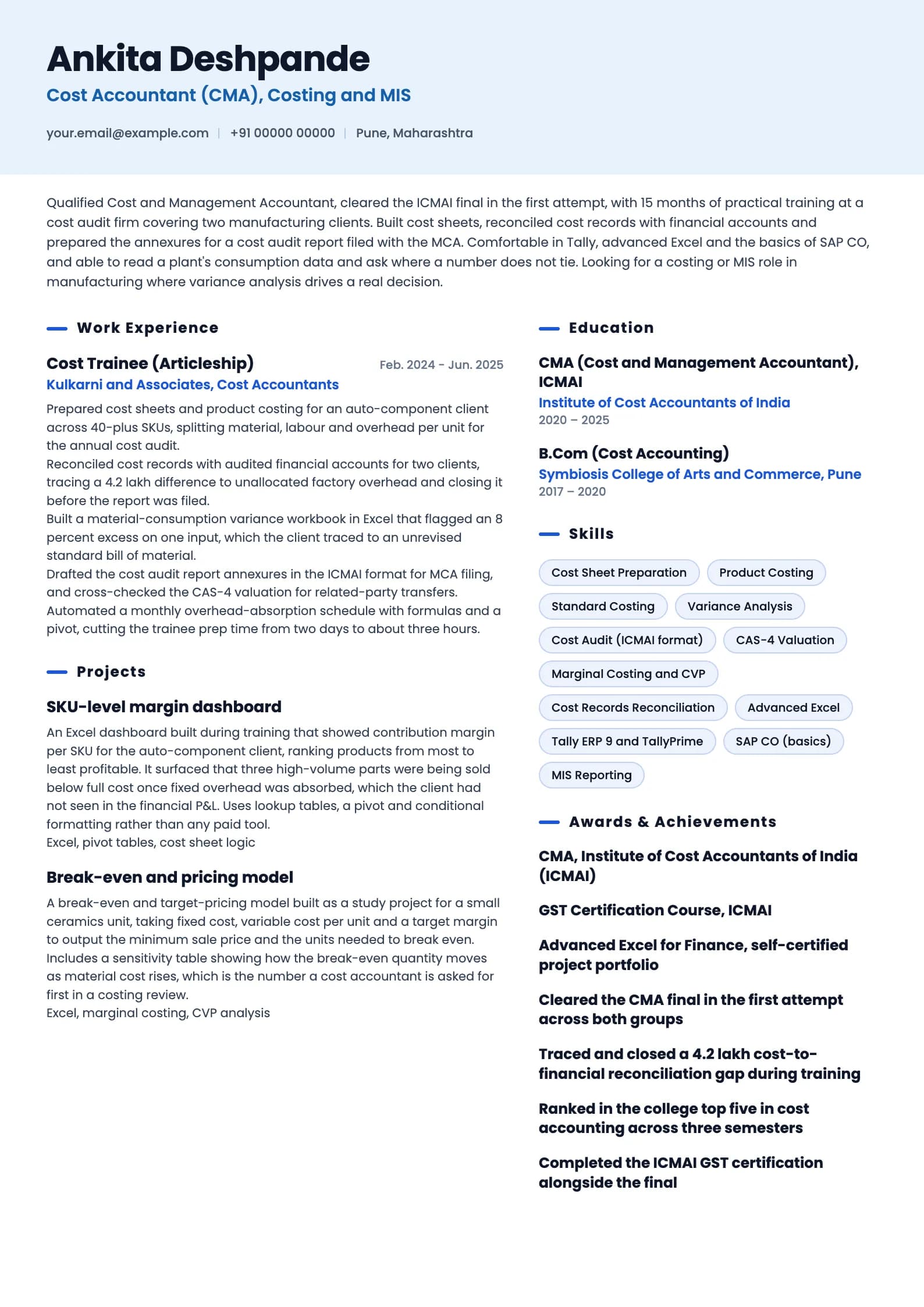
Cost Accountant Resume Format, with 3 Full Samples
A cost accountant is hired on evidence of money found, wastage cut and a costing system a plant can actually run on, yet most resumes list Tally, SAP and standard costing and forget the savings those tools produced. Below are three complete resumes, one for a fresh CMA who cleared the ICMAI final, one for a costing manager with five years in manufacturing, and one for a senior cost controller who owns product costing and margin for a factory. After the samples come the format rules, the difference between listing variance analysis and proving it, the terms a parser matches literally, and the mistakes that end a screening before a human reads the page.
Build my resumeCost Accountant resume example, Fresher CMA (0 years)
ai-era templateIs your resume good enough?
Upload the resume you have now and see what an applicant tracking system reads before a cost accountant recruiter ever does.
Free to run. Sign in with your mobile number to see your score.
Cost Accountant resume example, Costing Manager (5 years)
professional template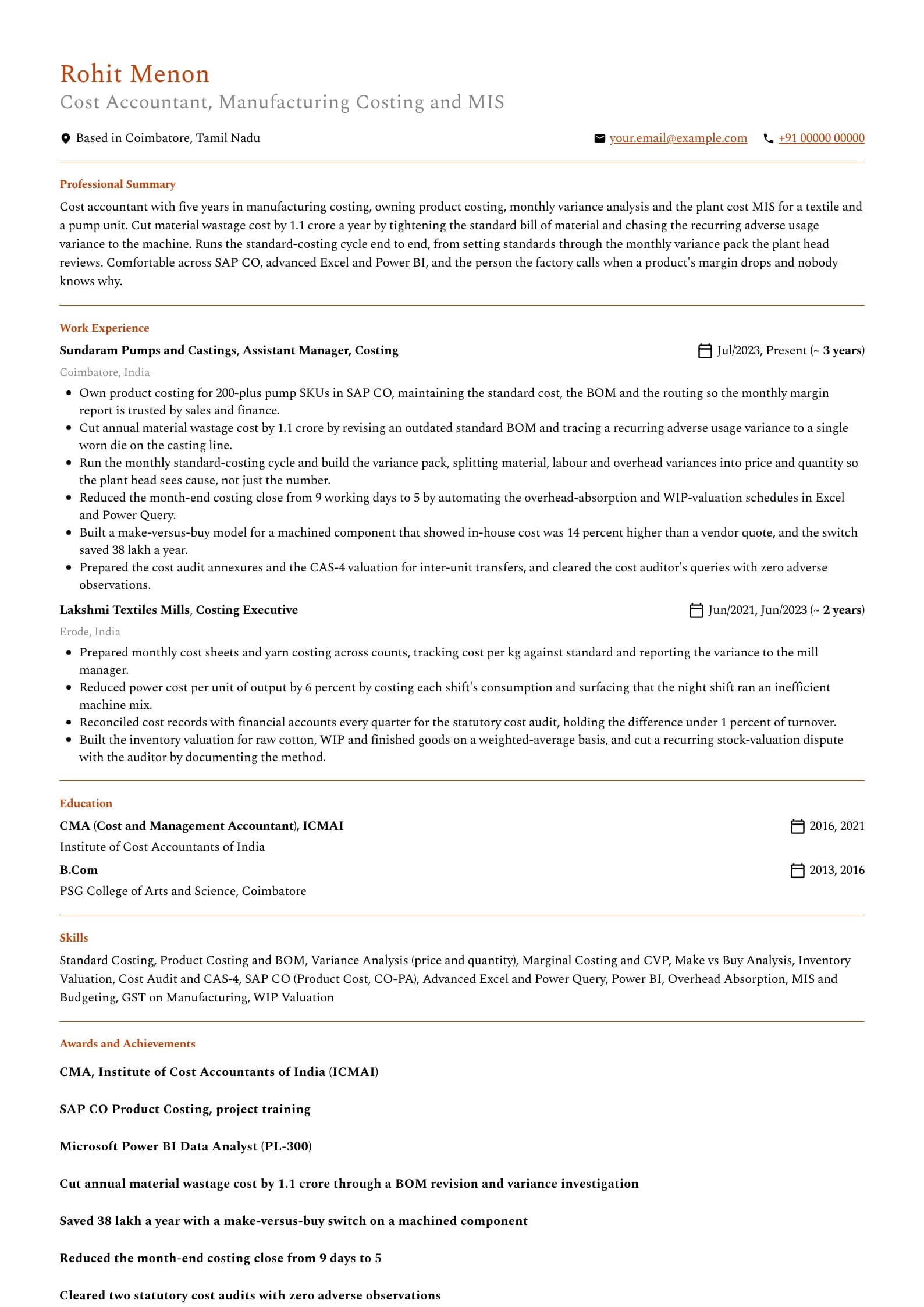
Want this structure with your own details? Build it in the resume builder.
Cost Accountant resume example, Senior Cost Controller (12 years)
header-band template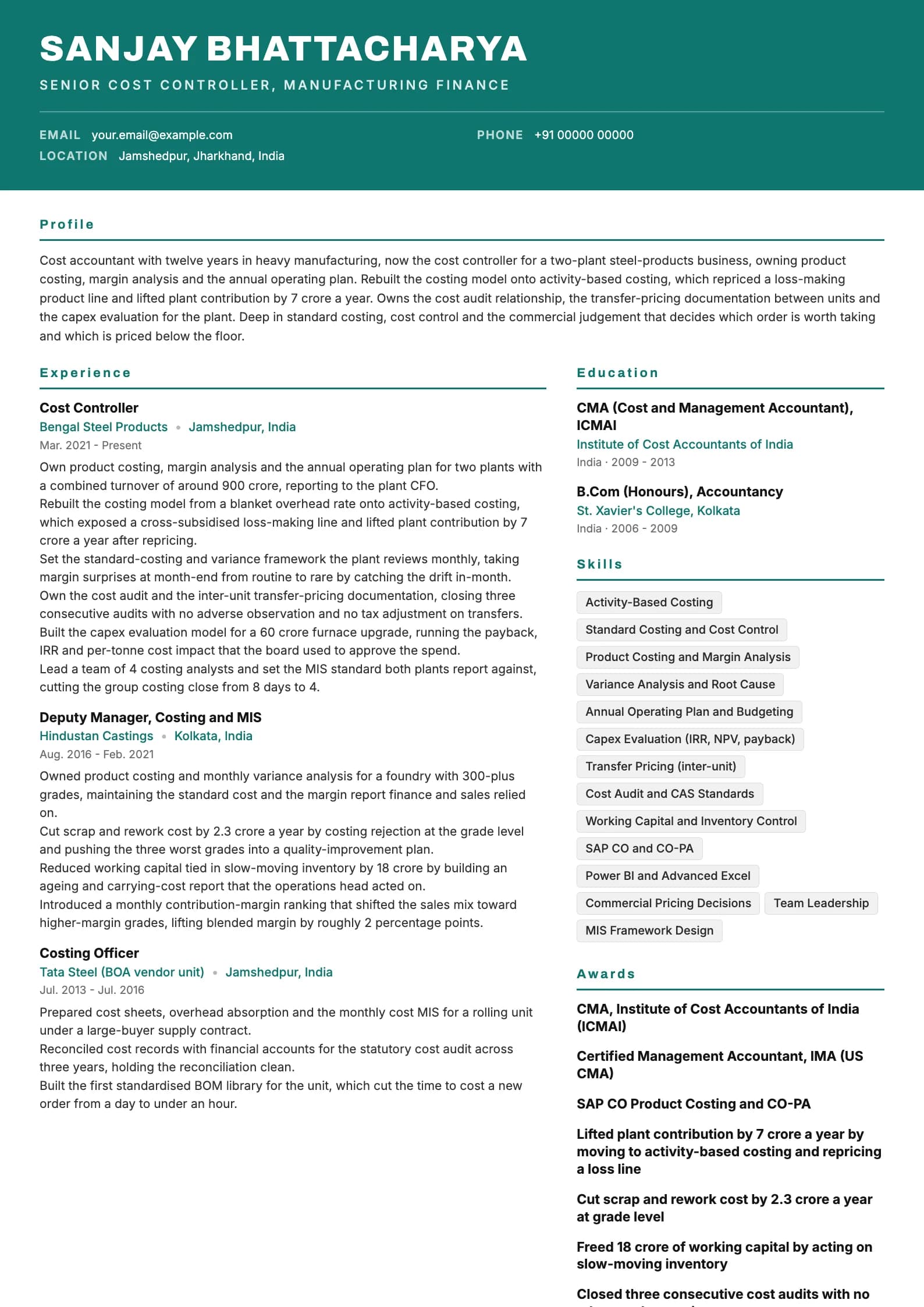
The format that works for cost accountant resumes in India
Reverse chronological is the layout to use. Put the most recent role first, work backwards, and leave the dates in plain view. Functional resumes that group everything under a Skills heading and quietly drop the dates read as an attempt to hide a gap, and reviewers treat them that way. A cost accountant's whole job is that a number ties, so a resume that will not let its own dates tie starts on the back foot. Length follows evidence. One page holds everything a fresh CMA and most cost accountants up to roughly six years have to say. Past that, a second page is fine when it carries real costing systems and savings rather than a longer software list. A second page built from a declaration paragraph and a hobbies line is a padded one-page resume. Four things belong nowhere on a finance resume here: a photograph, date of birth, marital status and father's name. They survive from an older campus-placement template. Nobody screening a costing role is looking for them, and every line they occupy is a line a saving or a costing project could have used. Lead with the qualification. For a cost accountant the CMA membership from ICMAI is the credential the whole page hangs on, so a fresher puts it near the top and everyone states it in the header line. Send a PDF unless the posting asks for DOCX, name the file with your own name and the target role, and use a single column all the way down, because two-column layouts parse unpredictably. The table below sets out the section order.
| Section | Where it goes | Why |
|---|---|---|
| Name and headline | Top, above everything | Headline names the role and the CMA, for example Cost Accountant (CMA). Recruiters match on it. |
| Professional summary | Directly under the header | Three lines. Costing area, years, and the single strongest saving. |
| Work experience | Next, for anyone with a job | Most recent first. Newest role gets the most bullets. |
| Projects or key assignments | Above experience for freshers, below it after that | For a fresh CMA this is the evidence: a costing model, a margin study. |
| Skills | Below experience | Grouped: costing, systems, analysis, compliance. Not a 30-item wall. |
| Education and qualification | Near the top for a fresher, lower once employed | CMA, then degree. First-attempt pass is worth stating. |
| Certifications | After education, or beside skills if only one or two | SAP CO, US CMA, Power BI. Name, body, year. |
Listing standard costing is not the same as proving it
The most common cost accountant resume failure is a skills line that reads standard costing, marginal costing, variance analysis, cost audit, budgeting, SAP, Tally, Excel with no bullet anywhere that shows any of it producing a decision or a rupee. A parser matches those terms, but a hiring manager reads the wall and assumes it is coursework restated, then looks for the one costing method you can actually defend in an interview. The fix is to let the experience prove the technique. If you write variance analysis, at least one bullet should trace a variance to its cause and say what it cost or saved. If you write activity-based costing, a bullet should show what it repriced. The costing manager sample lists standard costing, make-versus-buy and CAS-4 precisely because the bullets show a BOM revision that saved 1.1 crore, a make-versus-buy switch that saved 38 lakh and a clean CAS-4 valuation. The skills line and the experience agree, which is what makes both believable. Be specific about the system you actually work in. SAP CO is a different claim from Tally, and SAP CO Product Costing with CO-PA is a different claim again from SAP FI. Writing the exact module tells a reviewer whether you can walk into their environment, because a plant on SAP CO does not want someone whose costing experience stopped at Tally cost centres. Do not pad with every accounting standard and every compliance acronym unless you have worked with them. On a costing resume a long list of standards you cannot discuss reads as exam recall, not experience, and an interviewer opens with the one you know least.
For every costing method on your skills line, ask: is there a bullet that shows it changing a number or a decision. If not, either add the bullet or cut the method. A wall of unproven techniques helps the parser and hurts the interview.
Writing a summary a hiring manager actually reads
The block under your name is the part you can be reasonably sure gets read, so it should carry three facts: what you cost or control, how long you have done it, and the single strongest thing that changed because of your work, usually a saving or a margin. Three or four lines, no adjectives a reviewer cannot check. The old objective line, seeking a challenging position in a reputed organisation to utilise your costing skills, tells the reader nothing they did not already assume. Replace it with a summary. An objective describes what you want, a summary describes what you have already done, and only one of them is evidence a factory would pay for. Freshers often believe they have nothing to summarise. Look at the fresher sample: it names the qualification, the first-attempt pass, the length of training and a real reconciliation gap that was closed. That is a genuine summary built from articleship and two clients. What it avoids is "detail-oriented and hardworking", a phrase so common on finance resumes that it now carries no information at all. A practical test: read your summary and ask whether another CMA from your batch could paste it onto their resume unchanged. If they could, it describes the qualification, not you. Add the specific plant, the specific saving and the specific ownership until it stops being transferable.
Professional summary, costing manager
Weak
Detail-oriented and hardworking cost accountant with 5+ years of experience in costing, MIS, variance analysis and SAP seeking a challenging role in a reputed manufacturing organisation.
Strong
Cost accountant with five years in manufacturing costing, owning product costing and the monthly variance pack for two plants. Cut material wastage cost by 1.1 crore by tightening the standard BOM and tracing a recurring usage variance to a worn die.
The rewrite trades a keyword list and self-description for a costing domain, an ownership scope and a verifiable saving with a cause.
Experience bullets: verb, cost lever, consequence
Every strong bullet in the samples follows the same shape. It opens with an action verb, names the specific cost lever you pulled, and closes with what measurably moved in rupees, percentage or days. The verb establishes that you did it. The lever tells a costing reviewer whether the work is relevant. The number does the persuading. Start with the outcome and work backwards. Cost accountants usually write the task first, then struggle to attach a number, which produces bullets like "handled costing and MIS activities using SAP". Instead ask what was different after you were done: wastage dropped, a product was repriced, the close got faster, working capital came down, an audit closed clean. Then write the sentence that ends in that fact. Vary the metric. Five savings figures in a row read as one trick. Across a real role you can honestly reach for rupees saved, percentage of cost cut, close days, working capital freed, margin points, variance percentage and audit observations. The senior sample uses several types across its bullets, which reads as range. Where you lack a rupee number, give scope: how many SKUs you cost, how many plants report against your MIS, how many grades you value. "Own product costing for 200-plus SKUs in SAP CO" carries weight without inventing a saving. And whenever a variance appears, chase it to its cause in the bullet, because a variance traced to a worn die or a wrong BOM is what tells a reviewer you understand the shop floor, not just the spreadsheet. Allocate bullets by recency. Current role gets five or six, the previous role four or five, anything older two or three.
| Level | What bullets must prove | Typical metric |
|---|---|---|
| Fresher CMA | You can build a cost sheet and it ties | Reconciliation gap closed, variance flagged, SKUs costed, close time cut |
| 1 to 3 years | You run a costing cycle without hand-holding | Wastage cut, close days, SKUs owned, audit queries cleared |
| 4 to 6 years | You own costing for a plant and change decisions | Rupees saved, make-vs-buy, margin points, close days, clean audit |
| 7 years and up | You set the costing model and inform capital calls | Plant contribution, working capital freed, capex payback, MIS standard set |
Experience bullet, costing role
Weak
Responsible for preparation of cost sheets, variance analysis and MIS reports on a monthly basis using SAP and Excel.
Strong
Cut annual material wastage cost by 1.1 crore by revising an outdated standard BOM and tracing a recurring adverse usage variance to a single worn die on the casting line.
"Responsible for" describes a job description; the rewrite names the lever pulled, the cause found and the money it saved.
Experience bullet, margin work
Weak
Worked on product costing which helped in improving the profitability of the products.
Strong
Rebuilt the costing model onto activity-based costing, which exposed a cross-subsidised loss-making line and lifted plant contribution by 7 crore a year after repricing.
Names the method, the thing it exposed and the annual number, so a reviewer can ask a real follow-up instead of nodding at a vague claim.
If a bullet would read identically on another CMA's resume, it is describing the qualification, not you. Rewrite it until it only fits the plant and the saving you actually owned.
The skills section: grouped, honest, and short enough to defend
A cost accountant's skills section has two audiences with opposite preferences. The parser wants literal terms it can match, standard costing and variance analysis and SAP CO. A human wants a short, organised list that signals what kind of costing professional you are. Grouping satisfies both. Group by function rather than one long line. Costing methods, systems and tools, analysis, and compliance is a grouping that works for almost every cost accountant. The exact headings matter less than the fact that structure exists. Write names the way the profession writes them: CAS-4 not CAS4, SAP CO not SAP-CO, activity-based costing spelled out at least once. A parser matches on strings. Twelve to sixteen skills is the working range. Below eight the section looks thin. Above twenty it stops being a signal, and a costing resume is especially prone to listing every accounting standard and every Excel feature as separate items to pad. The list is a contract: every item is a question you have agreed to answer, so a standard you cannot discuss costs you more in the interview than it gains you in the search. Do not include a proficiency bar. Star ratings invite an argument you cannot win, and nobody agrees on what four stars in SAP CO means. Let the experience prove the depth instead.
| Group | What goes in it | How many |
|---|---|---|
| Costing methods | Standard, marginal, activity-based, product costing, CVP | 3 to 5 |
| Systems and tools | SAP CO, Tally, Advanced Excel, Power BI, Power Query | 3 to 5 |
| Analysis | Variance analysis, make vs buy, margin analysis, capex evaluation | 2 to 4 |
| Compliance | Cost audit, CAS standards, transfer pricing, GST | 2 to 4 |
| Planning | Budgeting, annual operating plan, inventory and working capital | 2 to 3 |
Skills section
Weak
Skills: Costing, Cost Accounting, Cost Sheet, Standard Costing, Marginal Costing, Absorption Costing, Variance, Budgeting, MIS, Tally, SAP, Excel, Word, PowerPoint, GST, TDS, Accounting, Finance, Communication, Teamwork, Leadership
Strong
Costing methods: standard, marginal and activity-based costing, product costing. Systems: SAP CO, TallyPrime, advanced Excel, Power BI. Analysis: variance analysis, make vs buy, margin analysis. Compliance: cost audit, CAS-4, GST.
Cuts the office-software and soft-skill filler, collapses the overlapping costing terms to real methods, and groups the rest so a human reads it in one pass.
Key assignments and models: what to include and how to describe it
For a fresh CMA, key assignments and models are the resume. They sit above experience, they get the most space, and they are where a reviewer decides whether you can actually build a costing system or only pass exams about one. For an experienced cost accountant they move below experience and shrink to one or two entries, kept only if they show something the day job does not. The common failure is describing the topic instead of the work. "A project on marginal costing and break-even analysis" tells a reviewer nothing, because thousands of resumes carry that exact line. Describe what the model does, whose decision it informs, and what it revealed. The SKU-margin dashboard in the fresher sample is a stronger entry than a fancier-sounding project, because it names a real finding: three high-volume parts sold below full cost. Pick assignments that show range rather than three variations of the same cost sheet. One that reveals a hidden loss, one that supports a pricing or make-versus-buy decision, and one that ties cost records to financials is a stronger set than three restatements of a textbook problem. Two well-described models beat five listed by name. If the work was during articleship, say what you owned and what you did not, because a reviewer reads an honest scope more favourably than an inflated one. A trainee who reconciled two clients and closed a 4.2 lakh gap is more credible than one who claims to have led an audit.
Assignment description, fresher CMA
Weak
Project on cost analysis: prepared cost sheets and did variance analysis for a manufacturing company as part of training.
Strong
SKU-level margin dashboard for an auto-component client that ranked contribution per part and surfaced three high-volume SKUs being sold below full cost once fixed overhead was absorbed, a loss the financial P&L had not shown.
Swaps a topic label and "variance analysis" for a concrete finding and the decision it informed.
Where the CMA, education and certifications belong
The CMA qualification is the spine of a cost accountant resume, so it is stated in the header line and given its own education entry. For a fresher it sits near the top, because it is the strongest thing on the page. Name the institute as ICMAI, the Institute of Cost Accountants of India, and if you cleared the final in the first attempt, say so, because it is a genuine differentiator in a field where many clear it over several attempts. The degree, usually a B.Com, sits below the CMA. Degree, institution, years. Keep the percentage while you are a fresher and it is decent, roughly 65 percent and above, because early-career screening still filters on it. Once you have your first full-time costing role, drop it and let the shipped savings compete for the space instead. Certifications sit just below education, or beside skills if you hold only one or two. Write the full name, the issuing body and the year. For a cost accountant, SAP CO Product Costing carries real weight because so many plants run on it, the US CMA from IMA signals a wider management-accounting toolkit, and a Power BI certification is worth it once MIS and dashboards are part of the job. An expired or half-finished course listed as complete is a small dishonesty that is easy to catch, so state "in progress" honestly or leave it off.
Getting through the applicant tracking system
An applicant tracking system is a parser and a search index, not a judge. It reads your file, tries to break it into name, dates, employers, titles and skills, and stores the result so a recruiter can search across candidates. Almost every ATS problem is a parsing problem, and parsing problems come from layout, not wording. The layout rules are short. One column. Standard section headings, so use Work Experience rather than My Journey, and Skills rather than My Toolkit. No text inside images, because a company-logo strip reads as empty space. No critical information in the header or footer region, which some parsers drop. Avoid text boxes and nested tables in the resume body. On wording, mirror the language of the job description where it is honest. If the posting says variance analysis, write variance analysis. If it says SAP CO, write SAP CO rather than just SAP. Include the expansion alongside an acronym at least once, for example "CMA (Cost and Management Accountant)" and "ABC (activity-based costing)", so both searches find you. Keyword stuffing does not work. A hidden block of every costing term in white text is found quickly, and the outcome is worse than being filtered. Write real bullets that naturally contain the right terms, because a bullet describing a make-versus-buy decision contains the words make and buy in a context that survives human review too. Save as PDF from a tool that embeds real text, then open the file and confirm you can select and copy a sentence. If you cannot select the text, neither can the parser.
Section heading
Weak
My Costing Journey So Far
Strong
Work Experience
Parsers look for standard headings; a creative one can push the whole block into an unclassified bucket the recruiter never searches.
Test your own file before you send it. Copy the text out of the PDF into a plain text editor. Whatever you can read there is roughly what the parser sees, and anything scrambled is a real risk.
What gets cost accountant resumes rejected
Most rejections at the resume stage are not close calls. They come from a small set of recurring problems, and all of them are fixable in an afternoon. The list below covers what reviewers of Indian cost accountant resumes see most often, in rough order of how much damage each one does.
- A wall of costing terms and accounting standards with no bullet proving any of them produced a saving or a decision.
- Job duties copied from the appointment letter instead of what you saved or changed. "Responsible for costing and MIS" is the tell.
- No numbers anywhere. Rupees saved, percentage cut, close days, working capital freed, margin points. Pick whichever is honest.
- A variance mentioned but never traced to a cause, which reads as a report generated rather than a problem solved.
- A photo, date of birth, marital status or father's name. None of it belongs on a finance resume, and it takes a saving's space.
- Confusing the qualification: listing yourself as a cost accountant without stating CMA from ICMAI clearly in the header.
- A generic objective line. Replace it with a summary that states costing area, years and one saving.
- Naming SAP without the module, so a plant on SAP CO cannot tell whether you have used it or only SAP FI.
- Inflated titles or dates that will not match your Form 16 and offer letters. Background verification is standard and a mismatch ends the process.
- Typos in the standards and tools you claim, such as writing CAS-4 as CAS4 inconsistently, or TallyPrime as Tally Prime, which undoes an otherwise clean page.
Read your resume aloud once before sending it. Any line you would be embarrassed to defend in a costing review is a line to cut or rewrite.
Skills to put on a cost accountant resume
Technical
- Standard Costing
- Marginal and Absorption Costing
- Activity-Based Costing
- Product Costing and BOM
- Variance Analysis (price and quantity)
- Cost Audit and CAS Standards
- CAS-4 Valuation
- Make vs Buy Analysis
- Margin and Contribution Analysis
- Inventory and WIP Valuation
- Budgeting and Annual Operating Plan
- Capex Evaluation (IRR, NPV, payback)
- Overhead Absorption
- Transfer Pricing (inter-unit)
Tools and platforms
- SAP CO (Product Costing, CO-PA)
- Tally ERP 9 and TallyPrime
- Advanced Excel
- Power Query
- Power BI
- SAP FI (basics)
- Oracle ERP costing
- MS Access
Working skills
- Cost control mindset
- Root-cause investigation
- Cross-functional collaboration with plant and sales
- MIS and management reporting
- Commercial judgement
- Stakeholder communication
- Team leadership
- Working under close deadlines
Certifications worth listing as a cost accountant
| Certification | Full name | Worth it for |
|---|---|---|
| CMA (ICMAI) | Cost and Management Accountant, Institute of Cost Accountants of India | The core qualification for the role in India and the credential the whole resume hangs on. Essential for any costing, cost audit or plant-controlling position, and the one thing a fresher must state clearly in the header. A first-attempt pass is worth naming because it is a genuine differentiator. |
| US CMA (IMA) | Certified Management Accountant, Institute of Management Accountants (US) | Worth it for a cost accountant moving toward FP&A, business finance or an MNC controlling role, since it signals a wider management-accounting toolkit than costing alone. Most valuable when you want roles beyond the plant, and often paired with the Indian CMA rather than replacing it. |
| SAP CO | SAP Controlling, Product Costing and CO-PA | A practical, high-value credential because so many Indian manufacturers run costing on SAP CO. Worth it for anyone whose day job is or will be in an SAP plant, since it turns SAP CO on the skills line from a claim into a proven skill. Skip it if your environment is Tally or Oracle. |
| PL-300 | Microsoft Power BI Data Analyst Associate | Worth it for cost accountants who own the MIS and are moving reporting off static Excel onto dashboards. Pairs naturally with costing because so much of the job is turning consumption and margin data into a picture a plant head reads in one look. Optional early on, valuable once MIS is your responsibility. |
| CIMA | Chartered Institute of Management Accountants (UK) | A globally recognised management-accounting qualification, worth considering for cost accountants targeting MNC or overseas roles. Heavier and longer than the certifications above, so pursue it only if your career direction is international finance rather than an Indian plant floor. |
Keywords an ATS scans for in a cost accountant resume
These are the literal terms a parser matches against the job description. Use the ones that are true of you, in the sentences where you did the work, not as a list at the bottom.
- cost accountant
- CMA
- ICMAI
- cost accounting
- standard costing
- variance analysis
- product costing
- activity-based costing
- cost audit
- CAS-4
- marginal costing
- SAP CO
- MIS
- budgeting
- inventory valuation
- margin analysis
- make vs buy
- overhead absorption
- Tally
- advanced Excel
Cost Accountant resume FAQ
What salary can a cost accountant expect in India?
A fresh CMA typically starts around 5 to 9 LPA in manufacturing and higher in large corporates or consulting, with cost audit firms usually at the lower end. A cost accountant with four to six years in plant costing and MIS commonly sits in the 10 to 20 LPA band. Senior cost controllers and heads of costing with ten years and above often earn 24 to 45 LPA, more in large manufacturing groups. Deep activity-based costing and commercial-pricing experience, plus SAP CO and a US CMA, pushes the top of every band upward.
How long should a cost accountant resume be?
One page up to about six years of experience, two pages after that only if the second page carries real costing systems and savings rather than a longer software list. Nobody has been rejected for a resume that was too easy to read. If you are struggling to fit one page, cut the oldest role to a single line, remove coursework, and delete any technique you would not want to be interviewed on.
Do I need the CMA to apply for cost accountant roles?
For a role titled cost accountant, cost auditor or costing manager, the CMA from ICMAI is usually expected, and it is the credential the resume hangs on. Costing-adjacent roles such as MIS analyst, plant finance executive or FP&A can be reached without it, especially with strong Excel and SAP CO skills. If you are a CMA, state it in the header line; if you are still qualifying, say which group you have cleared honestly rather than implying the full qualification.
Should a fresh CMA put projects above work experience?
Yes. With no full-time roles, your articleship and your costing models are the strongest evidence, so key assignments sit directly under the summary. State what each model does, whose decision it informs and what it revealed, not just the topic. Pick work that shows range: one that surfaces a hidden loss, one that supports a pricing or make-versus-buy call, and one that ties cost records to financials. Articleship still goes in a separate experience section with an honest scope.
Which costing keywords should I put on the resume for an ATS?
Mirror the posting where it is honest. Common literal terms recruiters search for include cost accountant, CMA, standard costing, variance analysis, product costing, activity-based costing, cost audit, CAS-4, SAP CO, MIS and budgeting. Write them inside real bullets rather than in a hidden block, because a bullet describing a make-versus-buy decision or a BOM revision carries the term in a context that survives human review too. Expand each acronym once, for example CMA and ABC.
How do I show impact if I only prepared reports?
Trace the report to the decision it drove. A monthly variance pack on its own is a task, but a variance you traced to a worn die that saved a lakh is impact. Ask what changed after your number reached the plant head: a product was repriced, wastage dropped, an audit closed clean, the close got faster. Even scope helps: how many SKUs you cost, how many plants report against your MIS. The point is to end the bullet at a consequence, not at the report.
Does an ATS reject resumes with two columns?
It does not reject them outright, but some parsers read multi-column layouts out of order, which interleaves a sidebar with your experience and produces nonsense in the recruiter's view. A single-column layout removes the risk, which is why all three samples above use one. Test your own file by copying the text out of the PDF into a plain text editor, and if it reads in order there it will most likely parse correctly.
Do I need a photo on a cost accountant resume in India?
No. Finance recruiters do not expect one, and it takes space a saving or a costing project should occupy. The same goes for date of birth, marital status, father's name, nationality and a declaration paragraph. These come from an older campus-placement template and add nothing to a costing screen. Let the CMA, the savings and the systems you have run carry the page instead.
Should I list Tally and SAP both if I have used them?
Yes, but name the SAP module. Writing SAP alone leaves a reviewer unsure whether you mean SAP CO, which is costing, or SAP FI, which is financial accounting. If you work in product costing, write SAP CO (Product Costing, CO-PA). List Tally alongside it if you genuinely use it, since many smaller units still run on TallyPrime, and let a bullet show the system doing real work rather than just appearing on the skills line.
Related resume examples and guides
Build your own in any of these formats
Start from a blank resume or upload the one you have. Goodspace renders it in 24 templates and flags the costing and variance-analysis keywords an applicant tracking system will look for, and the filler it will not credit.
Build my resume