Chartered Accountant Resume Format, with 3 Full Samples
A chartered accountant is hired on evidence of numbers made reliable: audits that held, tax positions that stood, closes that shrank and controls that caught what they were built to catch. Yet most CA resumes list the sections of the syllabus and the standards, and forget what the work actually saved or protected. Below are three complete resumes, one for a fresh CA who just cleared finals and is leaning on articleship, one for a finance and audit manager with five years, and one for a finance controller running the books of a mid-sized company. After the samples come the format rules, how to frame articleship, the terms an ATS reads literally, and the mistakes that cost a CA an interview.
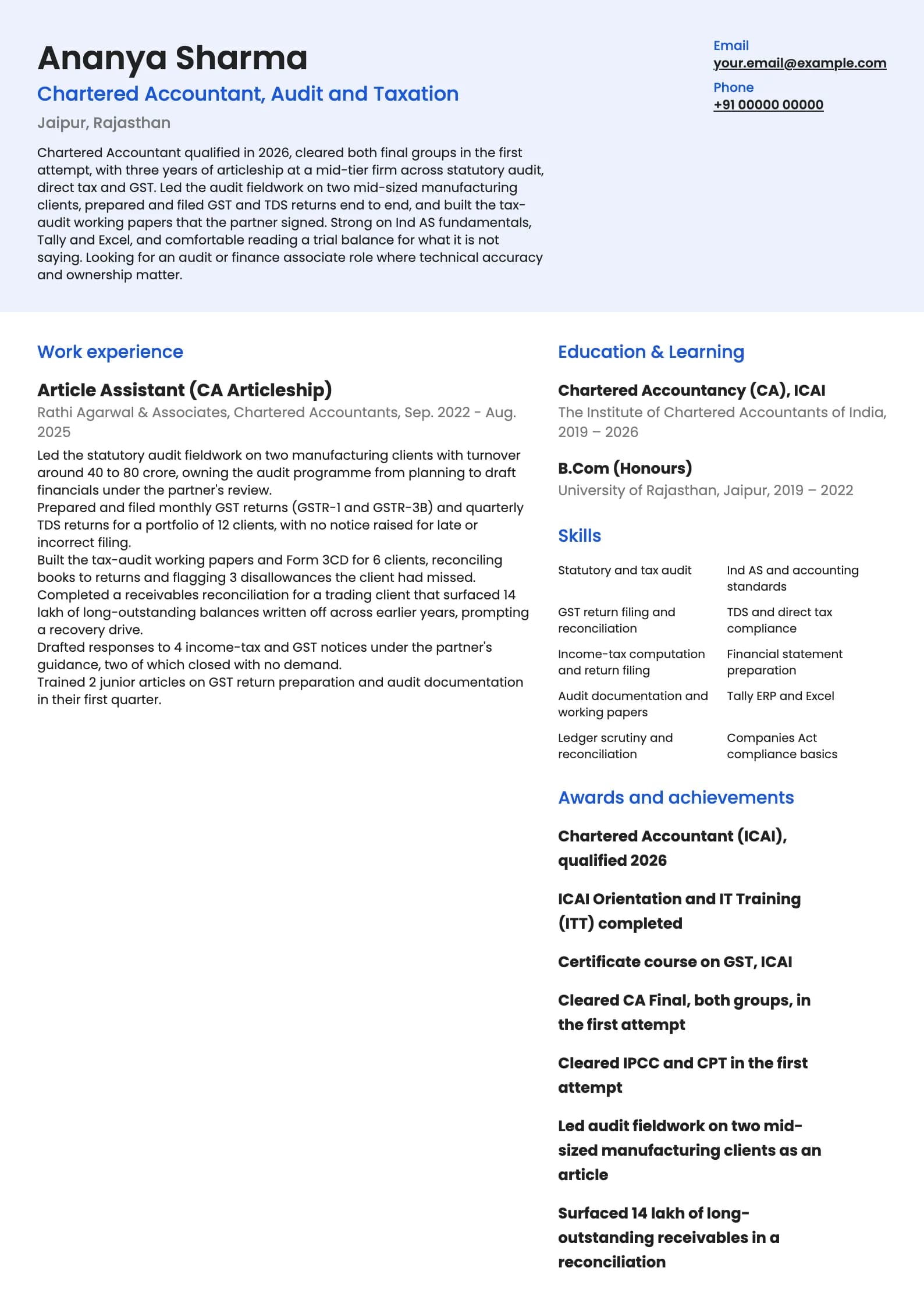
Build my resumeChartered Accountant resume example, Fresh CA (0 years post-qualification)
modern templateIs your resume good enough?
Upload the resume you have now and see what an applicant tracking system reads before a chartered accountant recruiter ever does.
Free to run. Sign in with your mobile number to see your score.
Chartered Accountant resume example, Manager (5 years)
professional template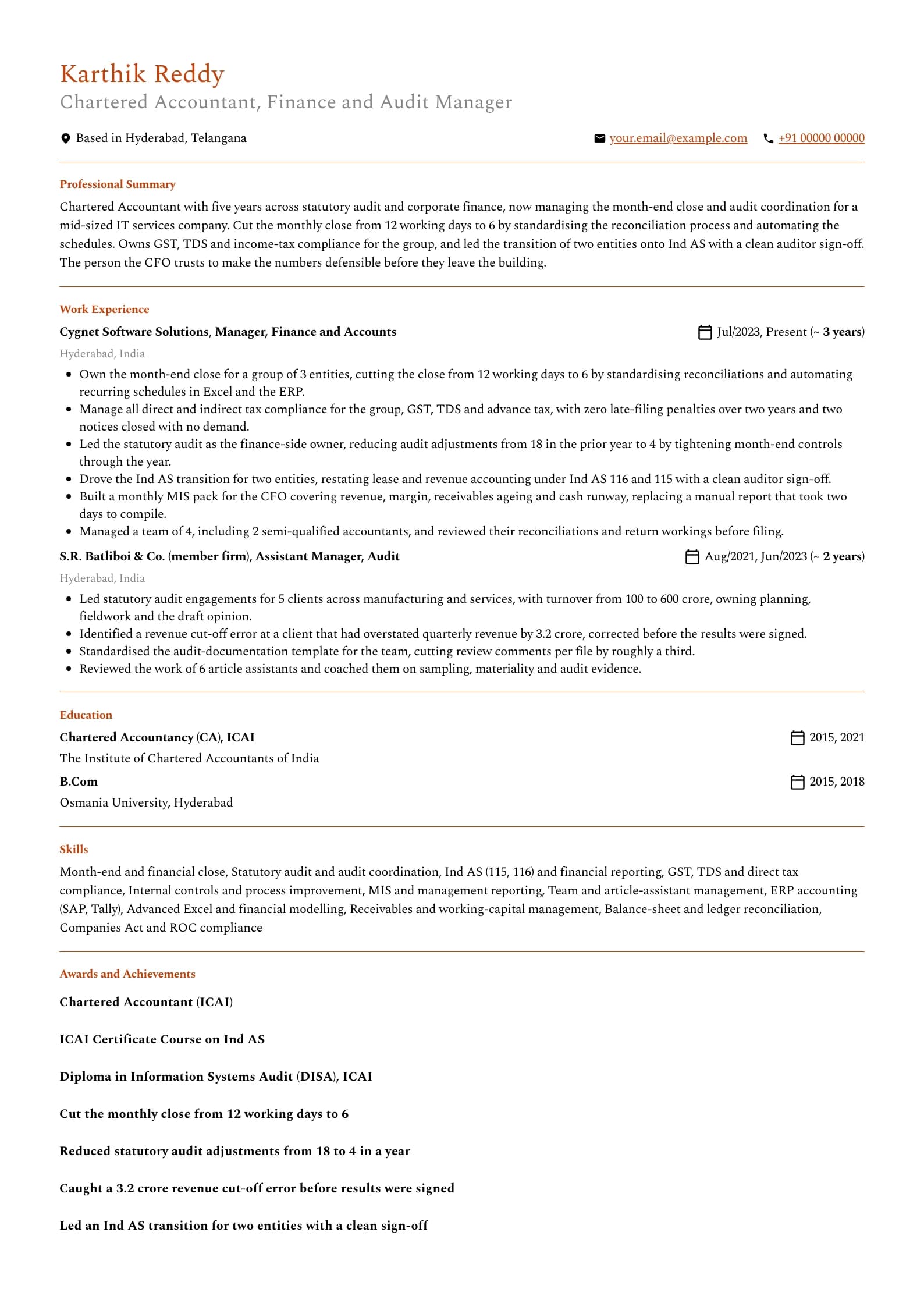
Want this structure with your own details? Build it in the resume builder.
Chartered Accountant resume example, Finance Controller (10 years)
header-band template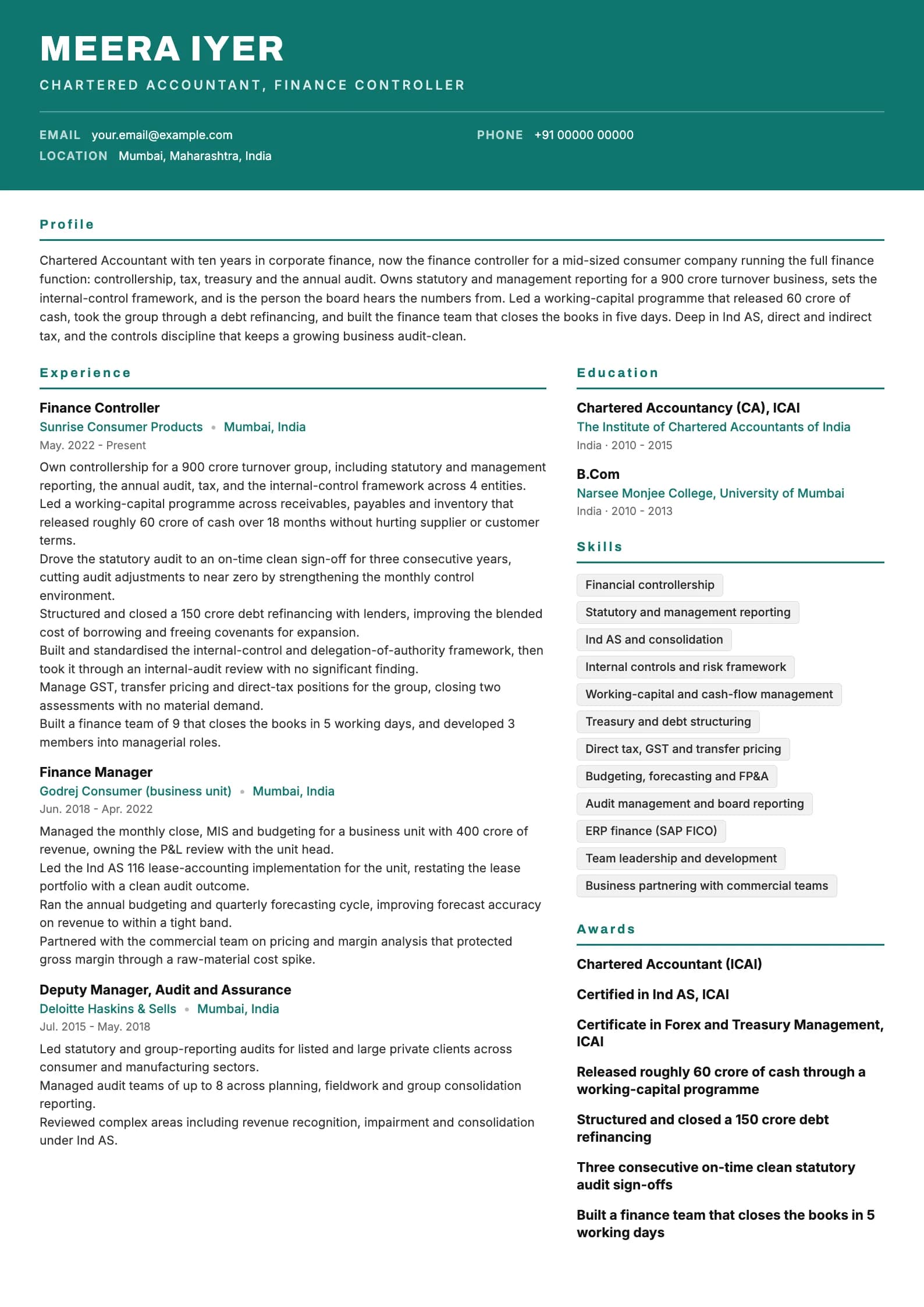
The format that works for a CA resume in India
Reverse chronological is the only layout worth using. Most recent role first, work backwards, and keep the dates in plain view. Finance is a field where background verification and reference checks are standard, so the timeline has to be honest and the dates have to match your Form 16s and relieving letters. A functional layout that groups everything under competencies and drops the dates reads as an attempt to hide a gap, and reviewers treat it that way. Length follows evidence. One page holds a fresh CA and most professionals up to roughly six years. Beyond that, a second page is fine when it carries real controllership, audit leadership or transaction work, not a longer list of accounting standards. A page two padded with a hobbies line and a declaration is a one-page resume stretched. For a fresh CA, articleship is the experience, so it comes right after the summary and is written like a job. For an experienced CA, articleship shrinks to a line or disappears, replaced by real post-qualification roles. Education, including the CA qualification and attempt history, sits near the top for a fresher and moves down once you have shipped a few years of work. Send a PDF unless the posting asks for DOCX, and name the file with your own name and CA. Use a single column, because two-column layouts with a sidebar parse unpredictably. Skip the photo, date of birth, marital status and father's name. The table below sets the section order.
| Section | Where it goes | Why |
|---|---|---|
| Name and headline | Top of the page | Headline names the track: Audit, Finance, Taxation or Controllership. |
| Professional summary | Under the header | Three lines: CA status, years, track and the single strongest result. |
| Articleship | Right after summary for a fresh CA | Written like a job. This is a fresh CA's real experience. |
| Work experience | Next, for a qualified CA with roles | Most recent first, most bullets. Outcomes, not duties. |
| Education and CA | Top for a fresher, lower once experienced | CA with attempt history, then degree. Attempt matters early. |
| Skills | Below experience | Grouped: reporting, tax, audit, systems. Not a standards list. |
| Certifications | After education or beside skills | DISA, Ind AS, treasury certificates that add to the CA. |
How to frame articleship on a fresh CA resume
The single biggest mistake a fresh CA makes is treating three years of articleship as a training footnote. It is not. It is three years of real audit, tax and accounting work, often with genuine ownership, and it is the only professional experience a fresh CA has to offer. Written well, it is what gets the interview. Write articleship like a job, not a syllabus. Name the firm, the period, and then the actual deliverables you owned: the audits you did fieldwork on, the returns you filed, the reconciliations you completed, the notices you drafted responses to. The fresher sample leads with "led the statutory audit fieldwork on two manufacturing clients" and "filed GST and TDS returns for 12 clients with no notice raised", which are real, owned outcomes, not "assisted in various audit and taxation assignments". Quantify wherever it is honest. Even as an article you have numbers: the size of clients you audited, the number of returns filed on time, disallowances you flagged, a reconciliation that surfaced money. "Surfaced 14 lakh of long-outstanding receivables" is a fact from real work, and it reads far stronger than "gained exposure to reconciliations". State your firm's tier and exposure plainly, because it tells a recruiter what you have seen. Articleship at a Big Four or a strong mid-tier firm with listed clients is a different training from a small local practice, and both are worth describing accurately. Do not inflate it, but do not undersell the real work either.
Articleship description, fresh CA
Weak
Worked as an article assistant and gained exposure to various assignments in the field of statutory audit, taxation and accounting under the guidance of seniors.
Strong
Led statutory audit fieldwork on two manufacturing clients with 40 to 80 crore turnover from planning to draft financials, and filed monthly GST and quarterly TDS returns for 12 clients with no notice raised.
Swaps a vague exposure statement for owned deliverables, real client sizes and a checkable compliance record.
Writing a CA summary a hiring manager reads
The block under your name is the part that reliably gets read, so it should carry three things: your CA status and how long since you qualified, the track you work in, audit, tax, controllership or FP&A, and the single strongest result you have produced. Three or four lines, no adjectives that cannot be checked. The old objective, "seeking a challenging position in a reputed organisation to utilise my accounting and auditing skills", tells the reader nothing they did not assume the moment they saw CA on the page. Replace it with a summary. An objective describes what you want, a summary describes what you have already done, and only one is evidence in a finance function that lives on evidence. A fresh CA can still write a real summary. The fresher sample states the qualification year, the first-attempt clearance, the articleship firm and track, and points at owned work. That is a genuine summary built from articleship and results, and it avoids "detail-oriented and hardworking professional", a phrase so common on finance resumes that it now carries no signal at all. A practical test: read your summary and ask whether another CA from your batch could paste it onto their resume unchanged. If they could, it describes the qualification, not you. Add the specific track, the specific number and the specific ownership until it stops being transferable.
Professional summary, CA with five years
Weak
Detail-oriented and hardworking Chartered Accountant with 5+ years of experience in accounting, auditing and taxation seeking a challenging role in a reputed organisation.
Strong
Chartered Accountant with five years across statutory audit and corporate finance, now owning the month-end close for a group of three entities. Cut the close from 12 working days to 6 and reduced audit adjustments from 18 to 4 in a year.
The rewrite trades a self-description and a topic list for an ownership scope and two verifiable outcomes.
Experience: what you owned, what you changed, what it saved
Every strong CA bullet names what you owned, the action you took, and the number that moved because of it. "Handled accounting and finalisation of accounts" describes a job title. "Cut the month-end close from 12 working days to 6 by standardising reconciliations and automating recurring schedules" names the ownership, the method and the outcome. The specifics are what turn a resume from a duty list into evidence. Start from the outcome and work back. Accountants tend to write the task first, then struggle to attach a number, producing bullets like "responsible for GST compliance and returns". Instead ask what was different because you did the work: the close is faster, penalties dropped to zero, audit adjustments fell, a cut-off error was caught, cash was released, a notice closed with no demand. Then write the sentence that ends in that fact. Vary the metric, because finance offers many. Days to close, audit adjustments, penalty and notice record, working capital released, forecast accuracy, cost of borrowing, receivables ageing, team size. A range of these reads as breadth, while five compliance lines in a row read as one narrow role. Where you lack a clean number, give scope: the turnover of the entities you handle, the number of entities in the close, the size of clients you audit, the number of returns filed. "Own the month-end close for a group of three entities" carries weight without inventing a percentage. Give your current role the most bullets and let older roles compress.
| Level | What the bullets must prove | Typical metric |
|---|---|---|
| Fresh CA / article | You owned real audit and tax deliverables | Client size, returns filed on time, disallowances, reconciliations |
| 1 to 3 years | You run compliance and close without supervision | Close time, penalty record, audit adjustments, entities handled |
| 4 to 6 years | You improve the process and manage a team | Days-to-close cut, MIS built, adjustments reduced, team size |
| 7 years and up | You own controllership and business impact | Working capital released, refinancing, clean sign-offs, team built |
Experience bullet, compliance work
Weak
Responsible for handling GST, TDS and income-tax compliance and filing of returns on a timely basis.
Strong
Managed all direct and indirect tax compliance for a group of three entities with zero late-filing penalties over two years and two notices closed with no demand.
"Responsible for" describes the job; the rewrite names the scope, the penalty record and the notice outcomes.
If a bullet would read identically on another CA's resume, it is describing the role, not you. Add the entity, the number and the outcome until it only fits the work you actually owned.
The skills section: grouped by function, not a standards list
A CA resume's skills section has two audiences. An ATS wants literal terms it can match, GST, Ind AS, statutory audit, SAP. A human wants a short, organised list that signals what kind of finance professional you are. Grouping satisfies both. Group by function rather than one long line. Reporting and close, taxation, audit and assurance, controls and compliance, and systems is a grouping that works for almost every CA. The exact headings matter less than the fact that structure exists, so a reviewer reads your profile in one pass instead of hunting through a wall. Do not turn the skills section into a list of accounting standards. Writing Ind AS 1, 2, 7, 12, 16, 36, 37, 109, 115, 116 as separate line items is padding, the same mistake a Java developer makes listing every Spring module. Name the standards that are genuinely central to your work, revenue and leases if you have implemented them, and let a bullet prove it. The standards you list are questions you have agreed to answer. Name your systems, because finance roles filter on them. Tally, SAP FICO, Oracle, QuickBooks, Zoho Books and advanced Excel each tell a recruiter something concrete, and an SAP shop searches for SAP. Keep the list to what you can defend, twelve to sixteen items, and skip proficiency bars, because nobody agrees what four stars in Ind AS means and it only invites an argument.
| Group | What goes in it | How many |
|---|---|---|
| Reporting and close | Financial reporting, month-end close, consolidation, MIS | 3 to 5 |
| Taxation | GST, TDS, income tax, transfer pricing | 2 to 4 |
| Audit and assurance | Statutory audit, internal audit, audit coordination | 2 to 3 |
| Controls and compliance | Internal controls, Companies Act, ROC, Ind AS | 2 to 4 |
| Systems | SAP FICO, Tally, Oracle, advanced Excel | 2 to 4 |
Where the CA, attempts, rank and degree belong
For a CA, the qualification itself is the headline credential, so how you present it matters. State that you are a Chartered Accountant and the year you qualified. For a fresh CA and up to a couple of years out, the number of attempts is a genuine signal in the market, so if you cleared groups in the first attempt, say so plainly in the education block. If you did not, simply state the qualification year without dwelling on attempts, and let the work carry you. An All India Rank is worth stating prominently while it is fresh, because a rank in the CA final or intermediate is a strong, verifiable signal that campus and early-career recruiters weigh. Put it beside the CA line. Like attempts, its value fades once you have several years of real work, at which point the roles you have held predict more than an exam rank from years ago. Education sits near the top for a fresh CA, who has nothing stronger to lead with after articleship, and moves toward the bottom once you have post-qualification experience. Name the CA, then the graduation, B.Com or equivalent, with the university and years. Class or percentage on the degree is worth keeping only while you are a fresher and it is strong. Certifications sit below education or beside skills. For a CA, the ones that add real weight are the ICAI post-qualification courses, DISA for systems audit, the Ind AS certificate, and treasury or forensic certificates where they match your track. Name the issuing body and keep the list to what supports the role you are applying for.
Getting a CA resume through the ATS
Corporates and consulting firms run finance resumes through an applicant tracking system that parses your file into name, dates, employers, titles and skills, then lets a recruiter search across candidates. Almost every ATS problem is a parsing problem, and parsing problems come from layout, not wording. Keep the layout simple. One column, standard section headings, so Work Experience rather than My Professional Journey and Skills rather than Core Competencies written as art. No text inside images, because a logo strip or a skills infographic reads as empty space to the parser. Keep critical information out of the header and footer region, which some parsers drop, and avoid text boxes and nested tables in the body. Mirror the language of the posting where it is honest. If it says Ind AS, write Ind AS; if it says statutory audit, write statutory audit rather than only "auditing". Spell out an acronym alongside its expansion at least once, for example "DISA (Diploma in Information Systems Audit)", so both searches find you. Use the terms a finance recruiter searches: GST, TDS, month-end close, reconciliation, Ind AS, SAP, statutory audit, MIS. Do not stuff the page with a hidden block of standards and keywords. Finance recruiters read carefully and check credentials, and a claim that does not hold up in the interview costs more than a missing keyword. Let real bullets carry the terms, because a bullet about leading an Ind AS 116 transition already contains the words that matter. Save as a text-based PDF and confirm you can select and copy a sentence. If you cannot select the text, neither can the parser, and a finance resume the system cannot read is one no recruiter ever sees.
Test your own file before you send it. Copy the text out of the PDF into a plain text editor. What you can read there is roughly what the parser sees, and anything scrambled, especially your employers and dates, is a real risk.
What gets a CA resume rejected
Most CA resumes are set aside for a small set of recurring problems, and all of them are fixable in an afternoon. Here are the ones finance recruiters see most often on Indian CA resumes, in rough order of how much damage each does.
- Articleship written as a training footnote instead of a job. Three years of real audit and tax work is a fresh CA's only experience, so it must show owned deliverables.
- A duty list copied from a job description. "Responsible for finalisation of accounts" is the tell; name what you changed and what it saved.
- No numbers anywhere. Days to close, penalty record, audit adjustments, cash released, notices closed. Pick whichever is honest for the work.
- A skills section that is really a list of accounting standards. Name the standards central to your work and let a bullet prove them.
- A generic objective line. Replace it with a summary of CA status, track and one result.
- Overstating firm tier or client exposure. Finance verification is thorough, and a mismatch on the CV ends the process.
- A photo, date of birth, marital status and father's name from an old template. None of it belongs and it takes real space.
- Hiding a gap with a functional layout. One honest line explains a break better than a timeline the reviewer cannot follow.
- Listing every ICAI course and webinar as a certification. Keep the ones that support the role, DISA, Ind AS, treasury.
- Typos in the technical terms, writing Ind AS as "Indus" or reconciliation as "reconcilation". On a finance resume, accuracy is the whole point.
Read your CA resume once as the CFO or partner who will sign off on your hire. If it does not show what you owned, what you changed and that the numbers held, it is not finished.
Skills to put on a chartered accountant resume
Technical
- Financial reporting and month-end close
- Ind AS and accounting standards
- Statutory and internal audit
- GST compliance and reconciliation
- TDS and direct tax
- Income-tax computation and assessments
- Internal controls and risk
- Consolidation and group reporting
- Budgeting, forecasting and FP&A
- Working-capital and treasury management
Tools and platforms
- SAP FICO
- Tally ERP
- Oracle Financials
- Zoho Books and QuickBooks
- Advanced Excel and financial modelling
- GST and TDS return utilities
- Power BI (reporting)
- Computax / income-tax software
Working skills
- Analytical and problem-solving
- Attention to detail and accuracy
- Business partnering
- Team leadership and review
- Stakeholder and board communication
- Working to statutory deadlines
- Integrity and professional scepticism
- Mentoring article and semi-qualified staff
Certifications worth listing as a chartered accountant
| Certification | Full name | Worth it for |
|---|---|---|
| CA (ICAI) | Chartered Accountant, Institute of Chartered Accountants of India | The core qualification, and the reason the resume exists. State the year you qualified and, while it is fresh, your attempt history and any All India Rank, because early-career finance hiring weighs them. Beyond a couple of years, the roles you have held predict more than the exam, so let the work lead and keep the credential as the anchor. |
| DISA | Diploma in Information Systems Audit, ICAI | A post-qualification ICAI course valued for CAs moving into IT and systems audit, internal audit and risk advisory, or roles in banks and IT companies. Worth it if your track touches controls over IT systems. Less relevant for a pure tax or treasury role, so add it where the job actually uses systems-audit competence. |
| Ind AS Cert | ICAI Certificate Course on Ind AS | A focused credential for CAs doing financial reporting, consolidation and statutory audit under Ind AS, which is most corporate finance and assurance work. Useful in the early-to-mid years to signal reporting depth. Once you have led an Ind AS implementation, the experience outweighs the certificate, so let a bullet carry it. |
| CPA / ACCA | US CPA or ACCA (UK) | An international qualification worth pursuing for CAs targeting multinationals, US-GAAP reporting, Big Four global roles or overseas mobility. It complements the Indian CA rather than replacing it, and signals reporting under US GAAP or IFRS. Skip it if your career is squarely in Indian statutory and tax work, where the CA alone carries the weight. |
| CFA | Chartered Financial Analyst, CFA Institute | Worth it for CAs moving toward FP&A, investment analysis, corporate development or treasury, where valuation and markets matter more than statutory reporting. It signals a shift in track rather than deeper accounting. Not necessary for a controllership or audit path, so pursue it only if you are steering toward finance analysis and investments. |
| Forex & Treasury | Certificate Course on Forex and Treasury Management, ICAI | A specialist credential for CAs in treasury, cash management and debt roles, especially in larger companies with borrowing and hedging. Worth it if your work touches banking relationships, refinancing and foreign-exchange exposure. Add it where the role is treasury-oriented rather than pure controllership or audit. |
Keywords an ATS scans for in a chartered accountant resume
These are the literal terms a parser matches against the job description. Use the ones that are true of you, in the sentences where you did the work, not as a list at the bottom.
- chartered accountant
- CA
- statutory audit
- Ind AS
- GST
- TDS
- income tax
- month-end close
- financial reporting
- reconciliation
- internal controls
- MIS
- SAP FICO
- Tally
- consolidation
- transfer pricing
- budgeting
- forecasting
- audit coordination
- ROC compliance
Chartered Accountant resume FAQ
What salary can a chartered accountant expect in India?
A fresh CA typically starts around 8 to 12 LPA, higher for rank holders and Big Four or strong industry roles, and lower in small practices. A CA with four to six years in a manager-level finance or audit role usually sits in the 15 to 30 LPA band. A finance controller or senior finance leader with ten years and above commonly earns 35 to 70 LPA and more at large companies, with the top driven by controllership scope, industry and location. A first-attempt clearance, a strong articleship firm, and skills in Ind AS, SAP and FP&A push you toward the top of each band.
How long should a CA resume be?
One page for a fresh CA and up to about six years of experience, and two pages after that only if the second page carries real controllership, audit leadership or transaction work rather than a longer list of accounting standards. Recruiters and partners read fast, and a clean one-page resume that leads with the strongest outcomes beats a padded two-pager. If you are struggling to fit one page, cut the oldest role to a line and remove any standard you would not want to be interviewed on.
How should a fresh CA present articleship on a resume?
As a job, not a training footnote. Three years of articleship is a fresh CA's only professional experience, so name the firm, the period and the real deliverables you owned: the audits you did fieldwork on, the returns you filed, the reconciliations you completed, the notices you responded to. Quantify wherever honest, such as client turnover, returns filed on time or a reconciliation that surfaced money. State your firm's tier and exposure accurately, because it tells a recruiter what kind of work you have seen. Well-written articleship is what gets a fresh CA the interview.
Should I mention my CA attempts or rank on my resume?
While you are a fresh CA and for the first couple of years, yes. A first-attempt clearance is a genuine positive signal in the market, so state it plainly in the education block, and an All India Rank in the CA final or intermediate is worth putting prominently because it is strong and verifiable. If you cleared over multiple attempts, simply state the qualification year without dwelling on it and let your work carry you. Beyond a few years of experience, the roles you have held predict far more than an exam result, so attempts and rank quietly drop off the page.
Which skills should a CA put on a resume?
Group them by function rather than listing accounting standards. Reporting and close, month-end close, consolidation, MIS; taxation, GST, TDS, income tax, transfer pricing; audit and assurance, statutory and internal audit; controls and compliance, internal controls, Companies Act, Ind AS; and systems, SAP FICO, Tally, Oracle and advanced Excel. Name the standards and systems central to your actual work and let a bullet prove them. Keep the list to twelve to sixteen items you can defend in an interview, because each one is a question you have agreed to answer.
Do certifications like DISA or CPA help a CA resume?
They help when they match your track. DISA is valued for systems audit, internal audit and risk roles; the ICAI Ind AS certificate suits financial reporting and audit; a treasury certificate suits treasury and debt roles. US CPA or ACCA helps for multinationals and overseas mobility, and CFA suits a move toward FP&A and investment analysis. Add the ones that support the specific role you are applying for and skip the rest, because a long list of unrelated ICAI webinars dilutes the signal rather than strengthening it.
How do I write a CA resume for an industry role after audit?
Reframe your audit experience in the language of the finance function you are targeting. Instead of describing engagements client by client, lead with the transferable skills: financial reporting under Ind AS, month-end close understanding, internal controls, and the specific sectors you audited. Highlight any work that looks like industry finance, controls testing, consolidation, MIS review, and use the summary to state clearly that you are moving into a controllership or FP&A track. A recruiter for an industry role wants to see that you understand the close and the controls from the inside, not just how to test them from outside.
Do I need a photo on a CA resume in India?
No. Finance recruiters do not expect one, and it takes space your experience and results should fill. The same goes for date of birth, marital status, father's name, nationality and a declaration paragraph, which come from an older template that spread through college placement cells and add nothing to a finance screen. Keep the page single-column and let your CA qualification, the roles you have held and the numbers you have moved do the talking.
How do I show finance impact without breaking confidentiality?
Describe the outcome and the metric without naming confidential figures you are not free to share. "Released roughly 60 crore of working capital over 18 months" or "cut the month-end close from 12 days to 6" describes your impact without disclosing anything a company would treat as sensitive, because it is about the improvement you drove, not proprietary detail. Use ranges and rounded figures where exact numbers would be confidential, and never put a current employer's unpublished financials on a resume. Aggregate, rounded outcomes are both safe and more readable.
Related resume examples and guides
Build your CA resume in any of these formats
Start from a blank page or upload the resume you have. Goodspace renders it in 24 clean templates and highlights the Ind AS, GST, audit and close keywords a finance recruiter and an applicant tracking system look for, and the padding they will not credit.
Build my resume