Cook Resume Format, with 3 Full Samples
A cook is hired on the cuisines they can run, the covers they can hold at consistency and how clean the kitchen stays under a food-safety audit, yet most resumes list dishes and forget the covers, the consistency and the hygiene that actually decide the job. Below are three complete resumes, one for a trainee and commis cook, one for a cook running a section with six years across North Indian and Chinese, and one for a head cook and kitchen in-charge who owns a menu, a team and the FSSAI compliance. After the samples come the format rules, the difference between naming a dish and proving you plate it the same at cover 200, the terms a restaurant and a hotel scan for, and the mistakes that get a resume set aside before the trade test in the kitchen.
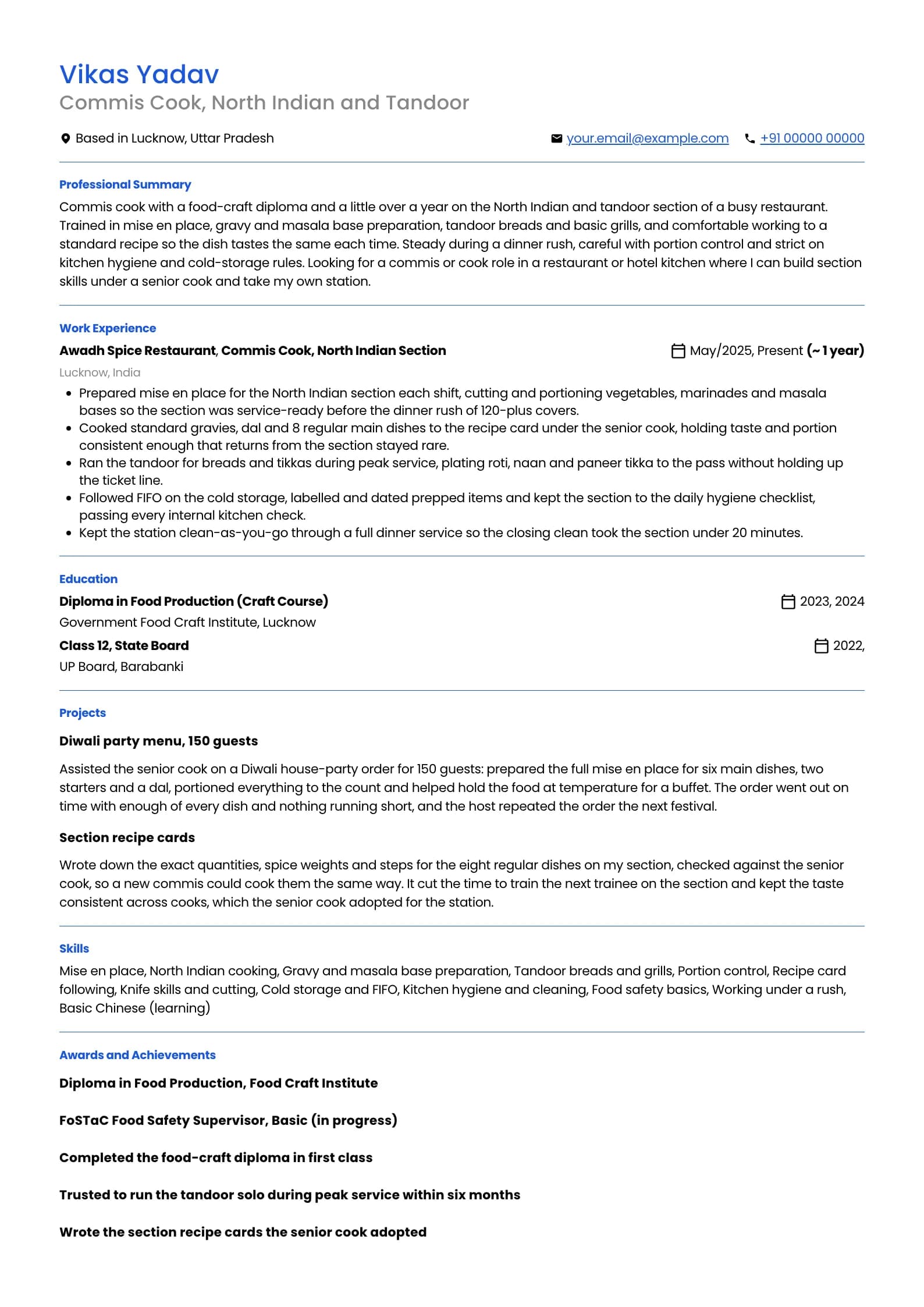
Build my resumeCook resume example, Trainee and Commis Cook (0 to 1 year)
minimalist templateIs your resume good enough?
Upload the resume you have now and see what an applicant tracking system reads before a cook recruiter ever does.
Free to run. Sign in with your mobile number to see your score.
Cook resume example, Cook, Section In-Charge (6 years)
professional template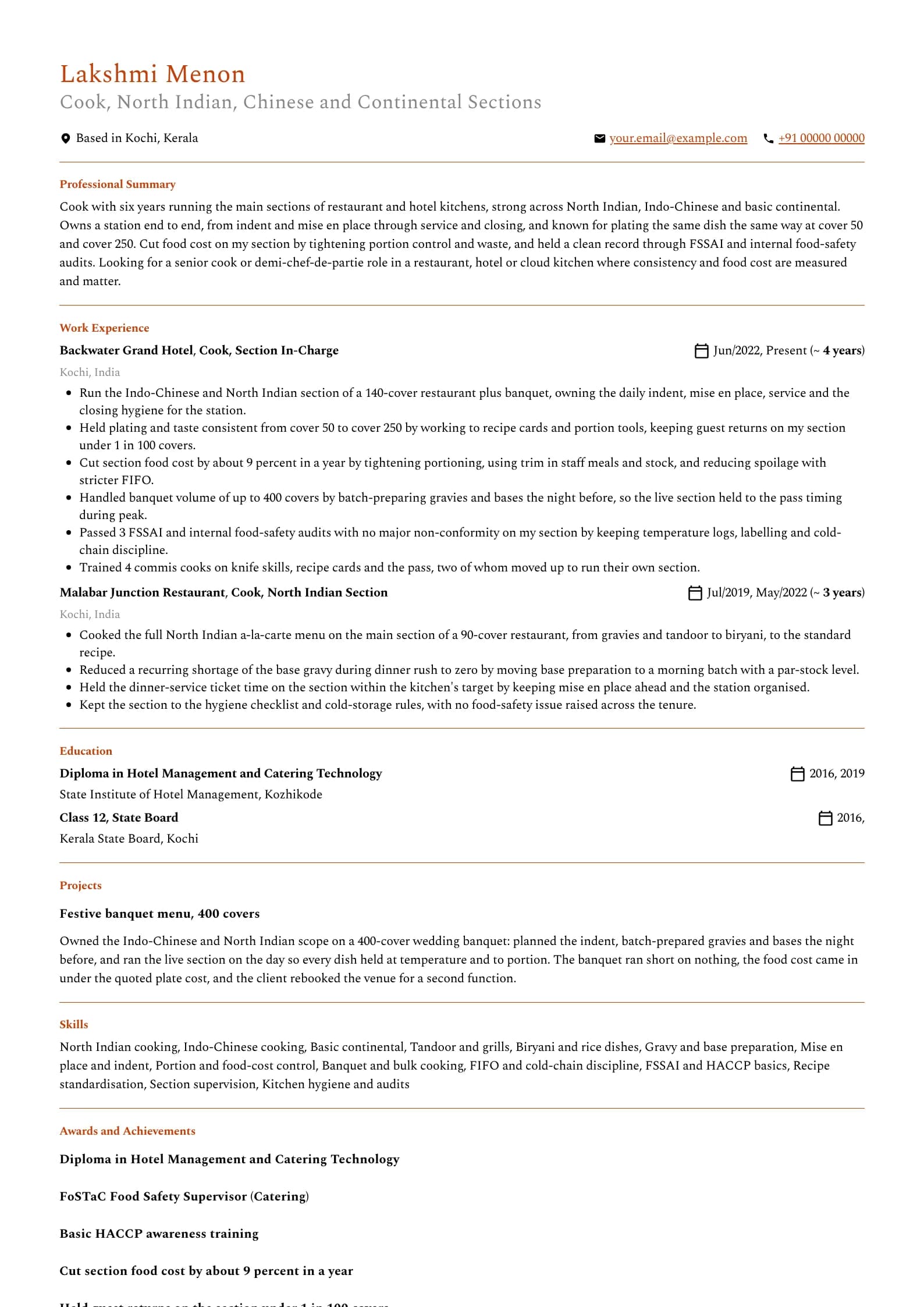
Want this structure with your own details? Build it in the resume builder.
Cook resume example, Head Cook and Kitchen In-Charge (13 years)
header-band template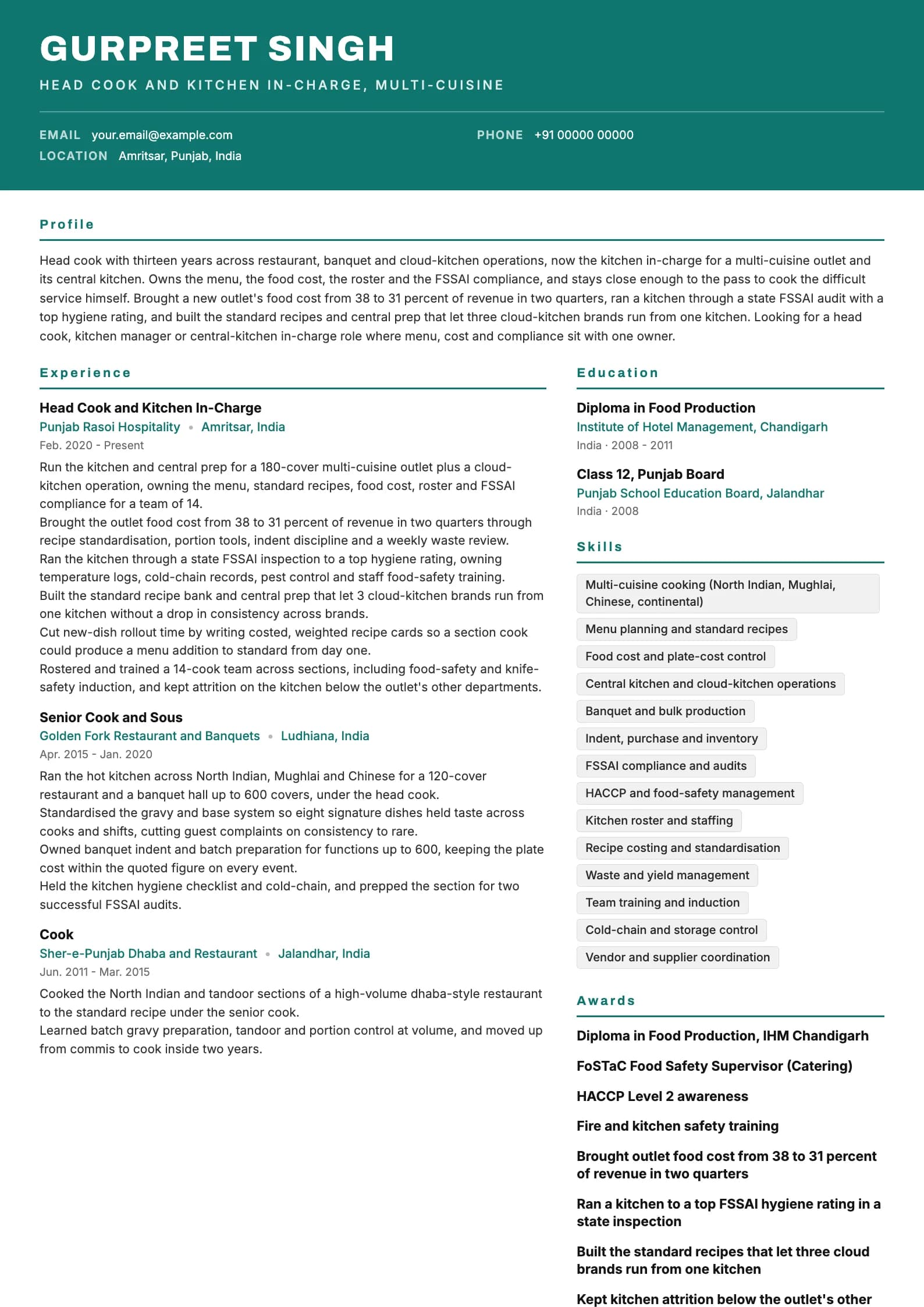
The format that works for cook resumes in India
Reverse chronological is the layout to use. Put your most recent kitchen first, work backwards, and keep the periods in plain view. A cook's resume that hides dates behind a wall of cuisines and dishes reads as an attempt to cover a gap or job-hopping, and a chef or manager treats it that way. If there was a gap, one honest line explains it better than a scrambled layout does. Keep it to one page. A commis, a section cook and most head cooks up to a long career fit on a single page, because the trade is proven by covers held and consistency, not by length. A second page padded with a hobbies line and a long dish inventory is a one-page resume stretched thin. Four things do not belong on a cook's resume: a photograph, date of birth, marital status and father's name. They come from an old template and take space a section, a cuisine result or a food-cost number could use. What a kitchen wants instead is the cuisines you run, the covers you hold, the consistency you keep and how clean the station stays under an audit. Send a PDF unless the restaurant asks for something else, and name the file with your own name and the word cook rather than resume_final. Use a single column all the way down, because a two-column sidebar can confuse an applicant tracking system when a hotel group runs one. The table below sets out the section order.
| Section | Where it goes | Why |
|---|---|---|
| Name and headline | Top, above everything | The headline names the role and cuisines: commis cook, cook or head cook, North Indian and Chinese. That is what a kitchen matches on. |
| Summary | Directly under the header | Three lines. Years, cuisines and sections, and the strongest consistency or cost result. |
| Work experience | Next, for anyone with a job | Most recent first. Newest kitchen gets the most bullets. |
| Skills | Below experience | Grouped: cuisines, sections, food safety, kitchen skills. Not a 40-dish wall. |
| Key events or projects | Above experience for a fresher, below it after that | For a commis this is the evidence. For a cook it names a standout banquet or menu. |
| Education and training | Bottom, unless you are a fresher | Food-craft or hotel-management diploma, institution, years. A fresher can lead with it. |
| Certifications and safety | After education, or beside skills | Diploma, FoSTaC food-safety, HACCP awareness, fire and kitchen safety. |
Listing a dish is not the same as proving you hold it at cover 200
The most common cook resume failure is a skills line that reads butter chicken, dal makhani, biryani, hakka noodles, manchurian, pasta, pizza, tandoori, kebabs, momos with no bullet anywhere that shows a section run, a consistency held or a cost protected. A chef reads that menu and assumes it is copied, then goes to the pass and asks you to make one dish so they can see whether it matches what a resume promised. The fix is to let the work prove the cuisine. If you write banquet on the skills line, a bullet should name the cover count and how you held the plate at temperature. If you write food cost, a bullet should name the section and the percentage you moved it. The section-cook sample lists Indo-Chinese, banquet and portion control precisely because the bullets show a 250-cover section, a 400-cover banquet and a 9 percent food-cost cut. The skills line and the experience agree, which is what makes both believable. Be specific about the section and the volume, not just the cuisine. Running the tandoor at a 120-cover dhaba and plating continental on a 40-cover fine-dining pass are different jobs, and a chef wants to know which you have done. Naming mise en place, indent, service and closing as the full station cycle tells a reviewer you own a section, not just cook a few dishes on it. A long dish list is not a strength on a cook's resume, it is a red flag. A cook who claims fifty dishes across five cuisines usually holds none of them to standard under volume. Claim the cuisines and sections you can actually run at speed, and let a couple of signature dishes carry the detail.
For every cuisine on your skills line, ask: is there a bullet that names the section I ran it on and the covers I held it at. If not, either add the bullet or cut the cuisine. A menu of unproven dishes helps nobody and invites a trade-test dish you cannot deliver.
Writing a summary a chef actually reads
The lines under your name are the part a chef or manager is most likely to read, so they should carry three facts: how long you have cooked, the cuisines and sections you run, and the strongest consistency, cost or hygiene result you can point to. Three or four lines, no adjectives that cannot be checked at the pass. The old objective line, seeking a challenging position in a reputed hotel to utilise my cooking skills, tells a chef nothing they did not already assume. Replace it with a summary. An objective says what you want, a summary says what you have already delivered, and only one of those helps a chef decide whether to trade-test you. A commis often feels there is nothing to summarise. Look at the commis sample: it names the section, the mise en place and tandoor work, the covers held and the hygiene discipline, built from one food-craft diploma and a year on a station. That is a real summary. What it avoids is "passionate about cooking with a love for food", a phrase so common it now carries no information. A practical test: read your summary and ask whether any cook with the same diploma could paste it onto their resume unchanged. If they could, it describes the trade, not you. Add the specific section, the specific cover count and the specific result until it stops being transferable.
Summary, section cook
Weak
Passionate cook with 6+ years of experience in different cuisines and a love for food, seeking a good position in a reputed hotel for career growth.
Strong
Cook with six years running restaurant and hotel sections across North Indian, Indo-Chinese and continental. Held plating consistent from cover 50 to 250 and cut section food cost by about 9 percent in a year.
The rewrite trades self-description and "different cuisines" for the sections run, a consistency scope and a cost result a chef can check.
Experience bullets: verb, section, result
Every strong bullet in the samples follows the same shape. It opens with an action verb, names the section or the cuisine and the volume, and closes with what measurably came out of it. The verb says you did the work. The section and volume tell a chef whether the work is the kind their kitchen runs. The number does the persuading. Start with the result and work backwards. Cooks usually write the task first, then cannot attach a number, which produces bullets like "did cooking of North Indian and Chinese dishes as per requirement". Instead ask what was true at service: the returns were rare, the food cost dropped, the banquet ran short on nothing, the audit had no non-conformity, the ticket time held. Then write the sentence that ends in that fact. Vary the metric. Every bullet ending in "maintained good quality" reads as one claim repeated. Across a real career you can honestly reach for covers held, guest returns, food-cost percentage, banquet count, waste reduction, audit result, ticket time and cooks trained. The section-cook sample moves across covers, returns, food cost, banquet volume and audits, which reads as range. Where you lack a number, give scope: how many covers, how many banquet guests, how many cooks trained, how many sections. "Handled banquet volume of up to 400 covers by batch-preparing gravies the night before" carries weight without inventing a percentage. Allocate bullets by recency. Current kitchen gets five or six, the previous kitchen four, anything older two.
| Level | What bullets must prove | Typical metric |
|---|---|---|
| Commis and trainee | You prep a section right and cook to a recipe | Covers supported, dishes to recipe, closing time, returns rare |
| Cook (2 to 5 yrs) | You run a section on your own at volume | Covers held, guest returns, waste cut, ticket time, banquet count |
| Section in-charge (5 to 8 yrs) | You own a section including cost and hygiene | Food cost, returns per covers, audit result, commis trained |
| Head cook and in-charge (8 yrs +) | You own the menu, food cost and compliance | Outlet food cost, FSSAI rating, menu and recipe systems, retention |
Experience bullet, section work
Weak
Responsible for cooking North Indian and Chinese food and maintaining quality and hygiene in the kitchen as per hotel standards.
Strong
Held plating and taste consistent from cover 50 to 250 by working to recipe cards and portion tools, keeping guest returns on my section under 1 in 100 covers.
"Responsible for" describes a job title; the rewrite names the consistency scope and the return rate that proves it.
Experience bullet, cost work
Weak
Helped reduce wastage in the kitchen and controlled food cost to save money for the restaurant.
Strong
Cut section food cost by about 9 percent in a year by tightening portioning, using trim in staff meals and stock, and reducing spoilage with stricter FIFO.
Names the percentage and the three practices behind it, so a chef can ask a real follow-up instead of nodding at "helped reduce wastage".
If a bullet would read identically on any cook's resume, it is describing the trade, not you. Rewrite it until it only fits the section you ran and the cover count you held it at.
The skills section: grouped, honest, and short enough to cook on demand
A cook's skills section has two readers with opposite tastes. An applicant tracking system, where a hotel group runs one, wants literal terms it can match, tandoor and FSSAI and HACCP. A chef or manager wants a short, organised list that signals what kind of cook you are. Grouping satisfies both. Group by function rather than one long dish list. Cuisines, sections, food safety, and kitchen skills is a grouping that works for almost every cook. The exact headings matter less than the fact that structure exists. Write terms the way the trade writes them: mise en place not mice on plas, FSSAI written out once as the Food Safety and Standards Authority of India, HACCP spelled correctly. A parser matches on strings and a chef reads a misspelled cooking term as a cook who has not actually trained. Twelve to sixteen skills is the working range. Below eight the section looks thin. Above twenty it stops being a signal, and a cook resume is especially prone to listing forty individual dishes. The list is a contract: every cuisine and section on it is a dish you have agreed to cook at the trade test. Do not add star ratings or a proficiency bar. Nobody agrees what four stars in continental means, and it invites an argument you cannot win at the pass. Let the experience prove the depth instead.
| Group | What goes in it | How many |
|---|---|---|
| Cuisines | North Indian, Mughlai, Chinese, continental, South Indian, tandoor | 3 to 5 |
| Sections and production | Hot kitchen, tandoor, banquet, bulk, central kitchen, garde manger | 2 to 4 |
| Food safety | FSSAI, HACCP, FIFO, cold chain, temperature control, hygiene | 3 to 4 |
| Kitchen skills | Mise en place, portion control, knife skills, indent, recipe cards | 3 to 5 |
| Management (senior) | Food cost, menu planning, roster, team training, inventory | 2 to 4 |
Skills section
Weak
Skills: Butter Chicken, Dal Makhani, Paneer, Biryani, Fried Rice, Noodles, Manchurian, Chilli Paneer, Momos, Pasta, Pizza, Sandwich, Tandoori Chicken, Naan, Roti, Kebab, Soup, Salad, Hard Working, Team Player
Strong
Cuisines: North Indian, Mughlai, Indo-Chinese, continental. Sections: hot kitchen, tandoor, banquet. Food safety: FSSAI, HACCP, FIFO, cold chain. Kitchen: mise en place, portion control, recipe cards, indent.
Cuts the forty-dish inventory and the soft-skill filler, and groups cuisines, sections and food safety so a chef reads it in one pass.
Key events and menus: what to include and how to describe it
For a commis, a couple of key events are the resume. They sit above experience, get real space, and are where a chef decides whether you can actually hold a section under volume or only cook a dish at home. For a section cook they move below experience and shrink to one standout banquet or menu, kept only if it shows something the regular bullets do not. The common failure is naming the event instead of the work. "Worked on a wedding function of 400 people" tells a chef nothing, because thousands of cooks can write it. Describe what section you owned, what you prepared, what you did to hold it at volume and what came out right. The Diwali order in the commis sample is a stronger entry than a bigger event named without detail, because it says what the commis actually prepared and that nothing ran short. Pick events that show range rather than three of the same. One high-cover banquet, one menu or recipe you standardised, and one service where you solved a real problem, a shortage or a timing, is a stronger set than three wedding functions named in a row. Two well-described events beat five listed by size. Be honest about your role. If you were the commis, say commis and say what you owned, the mise en place or your section. A chef who trade-tests you will find out at the pass, and an honest scope you can cook beats an inflated one you cannot.
Key event description, commis resume
Weak
Wedding Function: worked on a big wedding of 400 people and did cooking of different dishes with the team.
Strong
Diwali party, 150 guests: prepared the full mise en place for six mains, two starters and a dal, portioned everything to the count and held the food at temperature for the buffet, so the order went out on time with nothing running short and the host repeated it.
Swaps a headcount and "with the team" for the exact scope owned, what was prepared and the result the host actually saw.
Where the diploma and food-safety training belong
The food-craft or hotel-management diploma and schooling go at the bottom for a cook with kitchens behind them, and near the top for a commis or fresh passout, who has nothing stronger to lead with. Course, institution, years. That is the whole entry for most people. The diploma grade is worth keeping while you are a fresher and it is good, because a hotel's early screening still looks at it. Once you have a few years and real sections to point at, the diploma line stays but the grade can go. A section held at 250 covers predicts more than a mark from years ago. Many strong cooks in India learned on the line without a diploma. If that is you, do not hide it. Lead the resume with your kitchens, sections and results, and a chef will trade-test the skill regardless. A FoSTaC food-safety certificate is cheap and quick, and it is often the one paper a company kitchen or a cloud kitchen actually needs on file, so it is worth adding even without a diploma. Food-safety training carries real weight in this trade and belongs on the page: FoSTaC Food Safety Supervisor, HACCP awareness, and fire and kitchen safety. A company kitchen, a hotel or a cloud kitchen needs a certified food-safety supervisor on record, so name the certificate and the year. A food-safety card listed as current when it has lapsed is easy to catch in an audit, so renew it or remove it.
Getting through an applicant tracking system
A hotel group, a cloud-kitchen company or a large catering firm may run an applicant tracking system, which is a parser and a search index, not a judge. It reads your file, tries to break it into name, dates, employers, titles and skills, and stores the result so a chef or HR can search across applicants. Almost every problem it causes is a parsing problem, and parsing problems come from layout, not wording. The layout rules are short. One column. Standard headings, so use Work Experience rather than My Culinary Journey, and Skills rather than My Kitchen. No text inside images, because a plated-food photo reads as empty space to a parser. No critical information in the header or footer strip, which some parsers drop. Avoid text boxes and nested tables in the body. On wording, mirror the language of the job advert where it is honest. If the advert says commis or CDP, put the matching title in your headline. If it says FSSAI, HACCP or Indo-Chinese, and you have done it, use those exact words. Write an acronym out once, for example "FSSAI (Food Safety and Standards Authority of India)", so both searches find you. Keyword stuffing does not work. A hidden block of a hundred dish names in tiny text is caught quickly and the outcome is worse than being filtered. Write real bullets that naturally carry the right terms, because a bullet describing the banquet you ran contains the word banquet in a context that survives a human read too. Save as a PDF that holds real text, then open it and check you can select and copy a line. If you cannot select the text, neither can the parser, and a photographed or scanned resume is invisible to it.
Section heading
Weak
My Delicious Journey
Strong
Work Experience
A parser looks for standard headings; a creative one can push the whole block into an unclassified bucket a chef never searches.
Test your own file before you send it. Copy the text out of the PDF into a plain notes app. Whatever you can read there is roughly what the parser sees, and anything scrambled is a real risk.
What gets cook resumes set aside
Most rejections at the resume stage are not close calls. They come from a small set of recurring problems, and all of them are fixable in an afternoon. The list below covers what chefs and kitchen managers reviewing cook resumes in India see most often, in rough order of how much damage each one does.
- A forty-dish inventory on the skills line with no bullet proving a section run or a cover count held. A cook who claims everything usually holds nothing to standard at volume.
- Job duties copied from a description instead of what you delivered. "Responsible for cooking as per hotel standards" is the tell.
- No numbers anywhere. Covers, guest returns, food-cost percentage, banquet count, waste cut, audit result. Pick whichever is honest for the work.
- No mention of food safety, when FSSAI compliance and a certified food-safety supervisor are what a company kitchen legally needs on file.
- A photo, date of birth, marital status or father's name. None of it belongs on a cook's resume, and it takes a section's space.
- Claiming five cuisines at a senior level with no depth, when a chef will trade-test the one you are weakest on.
- A generic objective line. Replace it with a summary that states years, cuisines and one consistency or cost result.
- Frequent short stints with no reason, which in a high-attrition trade reads as a flight risk unless one honest line explains it.
- Inflated role, a commis written as a head cook, which the pass exposes in the first service.
- Misspelled cooking and food-safety terms, mise en place or HACCP written wrong, which reads as a cook who has not actually trained.
Read your resume aloud once before sending it. Any dish or cuisine you would be uneasy cooking in front of a chef at a trade test is a line to cut or soften.
Skills to put on a cook resume
Technical
- North Indian cooking
- Mughlai cooking
- Indo-Chinese cooking
- Continental cooking
- South Indian cooking
- Tandoor and grills
- Biryani and rice dishes
- Gravy and base preparation
- Mise en place
- Portion and food-cost control
- Banquet and bulk production
- Menu planning and recipe standardisation
- FSSAI and HACCP compliance
- Cold chain and FIFO
Tools and platforms
- Tandoor and clay oven
- Commercial burners and range
- Chinese wok and range
- Bulk cooking cauldrons
- Knives and cutting tools
- Weighing scale and portion tools
- Blast chiller and cold storage
- Temperature probe and logs
- Steamer and salamander
- Deep fryer
- Food processor and grinder
- Indent and inventory sheets
Working skills
- Consistency under volume
- Working under a rush
- Kitchen hygiene discipline
- Team coordination on the pass
- Section supervision
- Time and prep planning
- Waste awareness
- Reliability and stamina
- Training commis cooks
Certifications worth listing as a cook
| Certification | Full name | Worth it for |
|---|---|---|
| Food Production Diploma | Diploma in Food Production / Food Craft (IHM or FCI) | The core culinary credential in India, worth naming for a commis, a fresh passout or a career switcher who needs to prove kitchen fundamentals on paper. It anchors a hotel or company-kitchen screening and stays on the resume as the training line even after the grade comes off. Not required by every dhaba or small restaurant, which hire on a trade test. |
| FoSTaC Food Safety | FoSTaC Food Safety Supervisor (Catering), FSSAI | The food-safety certificate a company kitchen, hotel or cloud kitchen actually needs on file under FSSAI rules. Cheap, quick and close to essential for a company job, so worth doing even if you learned to cook on the line without a diploma. A section cook and above should hold at least the basic level. |
| HACCP Awareness | HACCP (Hazard Analysis and Critical Control Points) Awareness | A food-safety management credential worth it for section cooks and head cooks in hotels, central kitchens and export or corporate catering, where a HACCP-based system is expected. It signals you understand critical control points and temperature discipline, not just general cleanliness, which a kitchen in-charge is judged on. |
| Hotel Management | Diploma or Degree in Hotel Management and Catering Technology | The broader hospitality qualification, worth naming for cooks aiming at hotel kitchens or a management track toward sous and head cook. It carries more weight than a short craft course for a company or hotel role, though on the line a chef still judges you at the pass regardless of the paper. |
| Fire and Kitchen Safety | Fire Safety and Kitchen Safety Training | A practical safety credential for any cook working a commercial kitchen with gas, oil and heat at volume. Often part of a hotel or company induction and worth listing, since a kitchen in-charge who owns fire and knife-safety training is easier for an employer to put in charge of a team. |
Keywords an ATS scans for in a cook resume
These are the literal terms a parser matches against the job description. Use the ones that are true of you, in the sentences where you did the work, not as a list at the bottom.
- cook
- commis cook
- head cook
- kitchen in-charge
- north indian
- indo-chinese
- continental
- tandoor
- mise en place
- portion control
- food cost
- banquet
- FSSAI
- HACCP
- food safety
- cold chain
- menu planning
- recipe standardisation
- kitchen hygiene
- food production
Cook resume FAQ
What salary can a cook expect in India?
A commis or trainee cook typically starts around 12,000 to 20,000 a month depending on the city and whether the kitchen is a restaurant, hotel or cloud kitchen. A cook running a section with a few years usually earns 20,000 to 40,000 a month. A senior cook, sous or head cook with a long record commonly earns 40,000 to 90,000 and more, with a hotel or a busy multi-cuisine outlet at the top of the band. Cruise, Gulf and corporate-catering roles pay well above these figures for qualified cooks with food-safety certification.
How long should a cook resume be?
One page. A commis, a section cook and most head cooks all fit on a single page, because the trade is proven by covers held and consistency rather than by a long dish list. If you are struggling to fit one page, cut the oldest kitchen to a single line, drop the schooling detail, and remove any cuisine you would not want to be trade-tested on. Nobody was ever rejected for a resume that was too easy to read.
Do I need a hotel-management or food-craft diploma to get a cook job?
Not for a dhaba, a small restaurant or many cloud kitchens, which hire on a trade test at the pass. A diploma helps and is often expected for a hotel, a company kitchen or a management track toward sous and head cook. Many strong cooks in India learned on the line without one, and if that is you, lead the resume with your kitchens, sections and results. A quick FoSTaC food-safety certificate is usually the one paper a company kitchen actually needs, so add it even without a diploma.
How do I write a cook resume with no experience?
Lead with your food-craft or hotel-management training, then a couple of key events or your first kitchen, then grouped skills. Treat each event as evidence: what section you prepped, what you cooked to a recipe, what you owned and what came out right. A festival order counts, a canteen or mess job counts, and an internship counts if you describe the real work. Add anything checkable, the diploma, a FoSTaC certificate, a clean hygiene record, because verifiable facts carry more weight than "passionate about food".
Should I list all the dishes I can cook on my resume?
No. A forty-dish inventory is a red flag, not a strength, because a cook who claims everything usually holds none of it to standard at volume. List the cuisines and sections you can actually run at speed, name a couple of signature dishes, and prove them in your bullets with a section and a cover count. A chef reads a short, honest cuisine list and a section held at 250 covers as far stronger than a long menu with no evidence behind it.
Does food-safety certification matter on a cook resume?
Yes, more than most cooks expect. Under FSSAI rules a company kitchen, hotel or cloud kitchen needs a certified food-safety supervisor on record, and a FoSTaC certificate is cheap and quick to get. Naming it, with the year, is often what lets a company hire you over an equally skilled cook who has no paper on file. For hotel and central-kitchen roles, HACCP awareness on top signals you understand critical control points, which a kitchen in-charge is judged on.
How do I show consistency on a cook resume?
In covers and returns, not adjectives. "Maintains good quality" is unprovable, but "held plating consistent from cover 50 to 250 with guest returns under 1 in 100 covers" is checkable and is exactly what a chef is hiring for. Work to recipe cards and portion tools, then state the volume you held the standard at. Consistency under a rush is the single hardest thing in a kitchen, so a number that proves it does more for your resume than any dish name.
Is a head cook resume different from a cook resume?
Yes. A cook's resume proves the section: cuisines, covers, consistency and a clean station. A head cook or kitchen in-charge resume adds the P&L and the compliance: the outlet food cost you own and moved, the FSSAI audit rating, the menu and standard recipes you built, the roster and the team you run and retain. If you are applying for a head-cook role, lead the bullets with food cost, audits, menu systems and the team, not just your own cooking on the line.
Related resume examples and guides
Build your own cook resume in any of these formats
Start from a blank resume or upload the one you have. Goodspace renders it in 24 templates and flags the cuisine, section and food-safety keywords a chef and an applicant tracking system look for, and the forty-dish padding they will not credit.
Build my resume