Actuary Resume Format, with 3 Full Samples
An actuary is hired on evidence of exams passed, models built and reserves or pricing signed off, yet most early-career actuarial resumes list Excel and R and forget to state exactly how many actuarial papers are cleared, which is the first thing a screener looks for. Below are three complete resumes, one for an actuarial analyst two exams in, one for a nearly-qualified actuary owning reserving and pricing work, and one for a qualified Fellow moving toward an appointed-actuary role. After the samples come the format rules, why exam progress must be explicit, the terms a parser matches literally, and the mistakes that end a screening before a human sees the page.
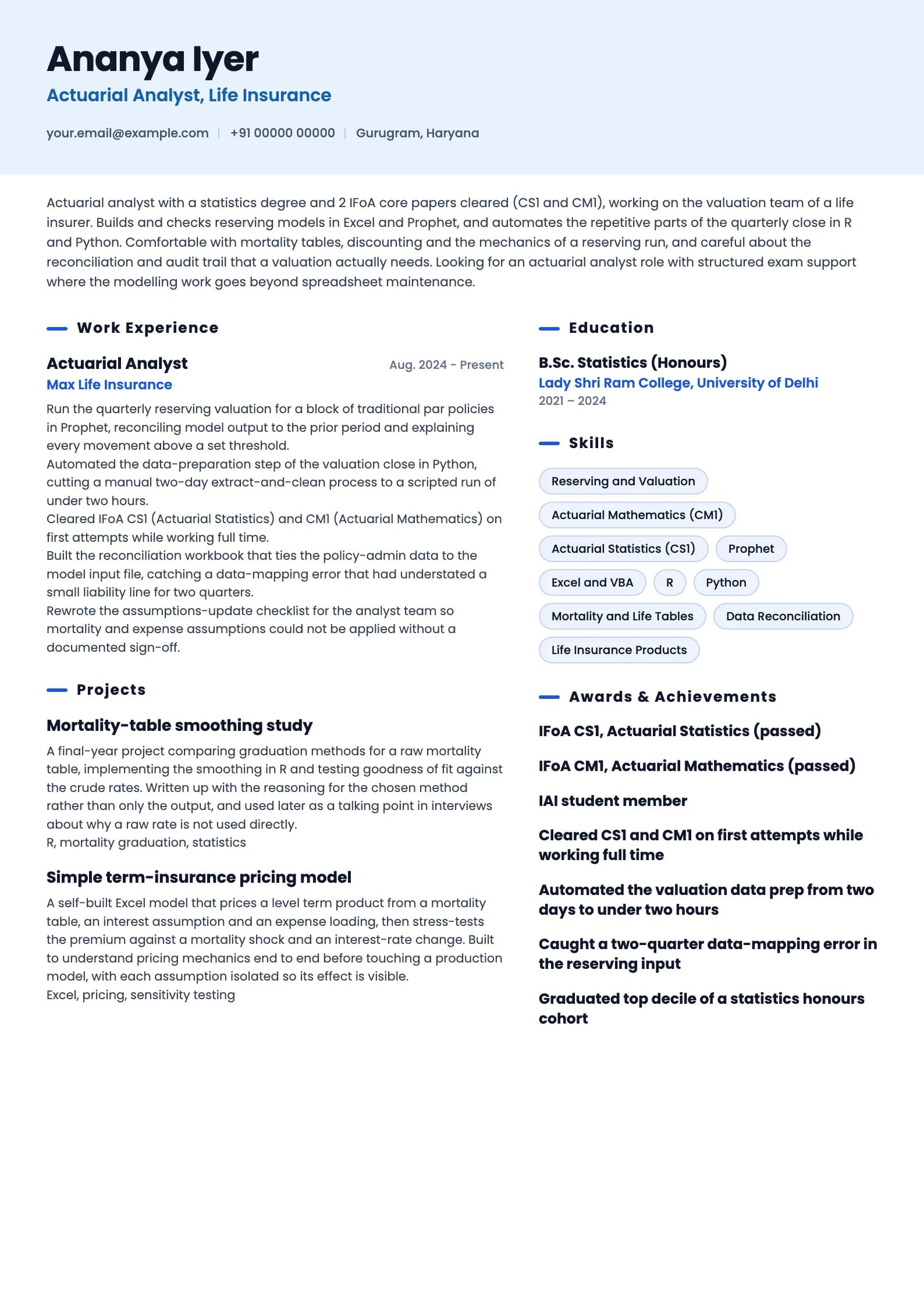
Build my resumeActuary resume example, Actuarial Analyst (2 exams)
ai-era templateIs your resume good enough?
Upload the resume you have now and see what an applicant tracking system reads before a actuary recruiter ever does.
Free to run. Sign in with your mobile number to see your score.
Actuary resume example, Nearly Qualified (6 years, 11 exams)
professional template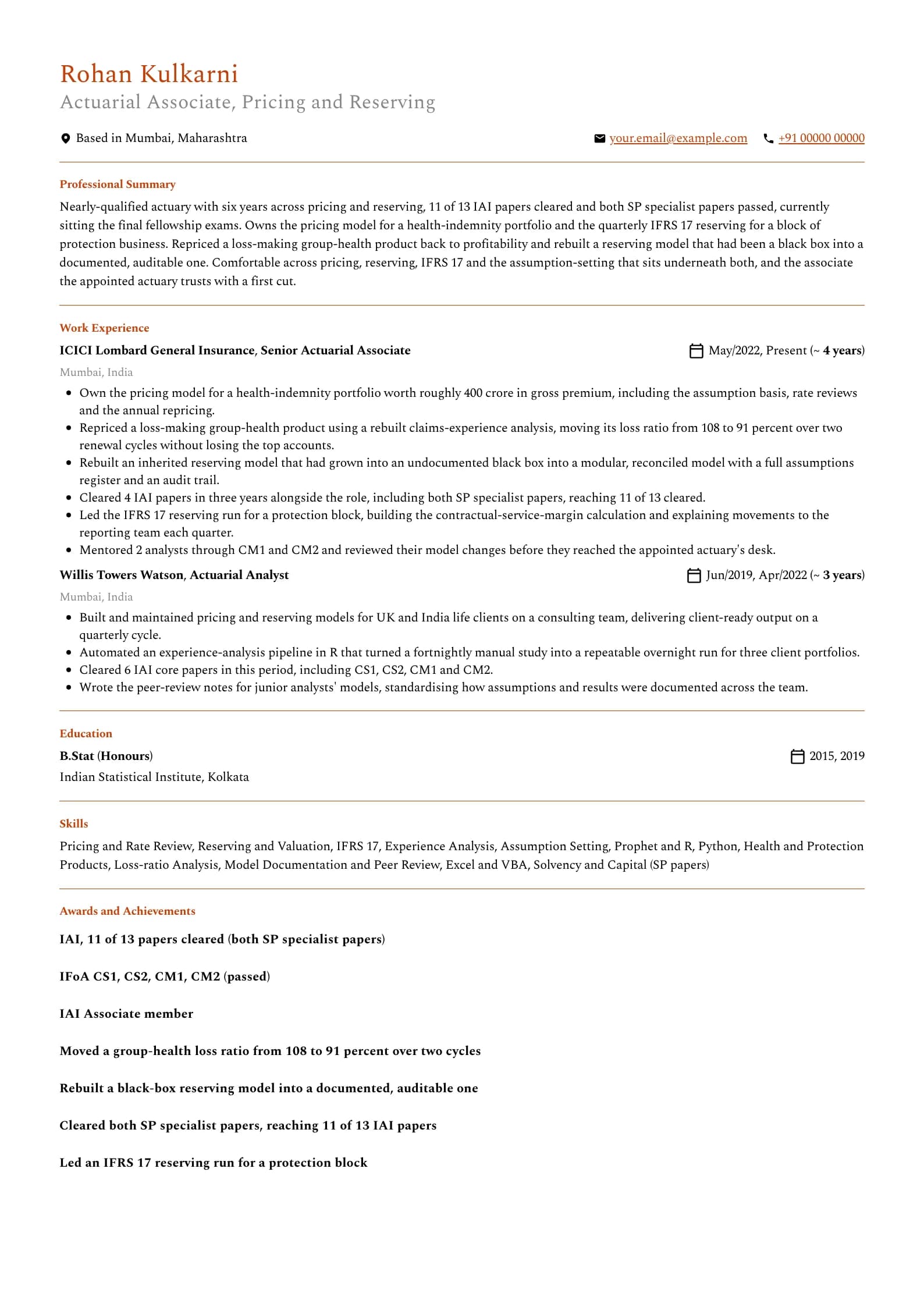
Want this structure with your own details? Build it in the resume builder.
Actuary resume example, Qualified Actuary (12 years, FIAI)
header-band template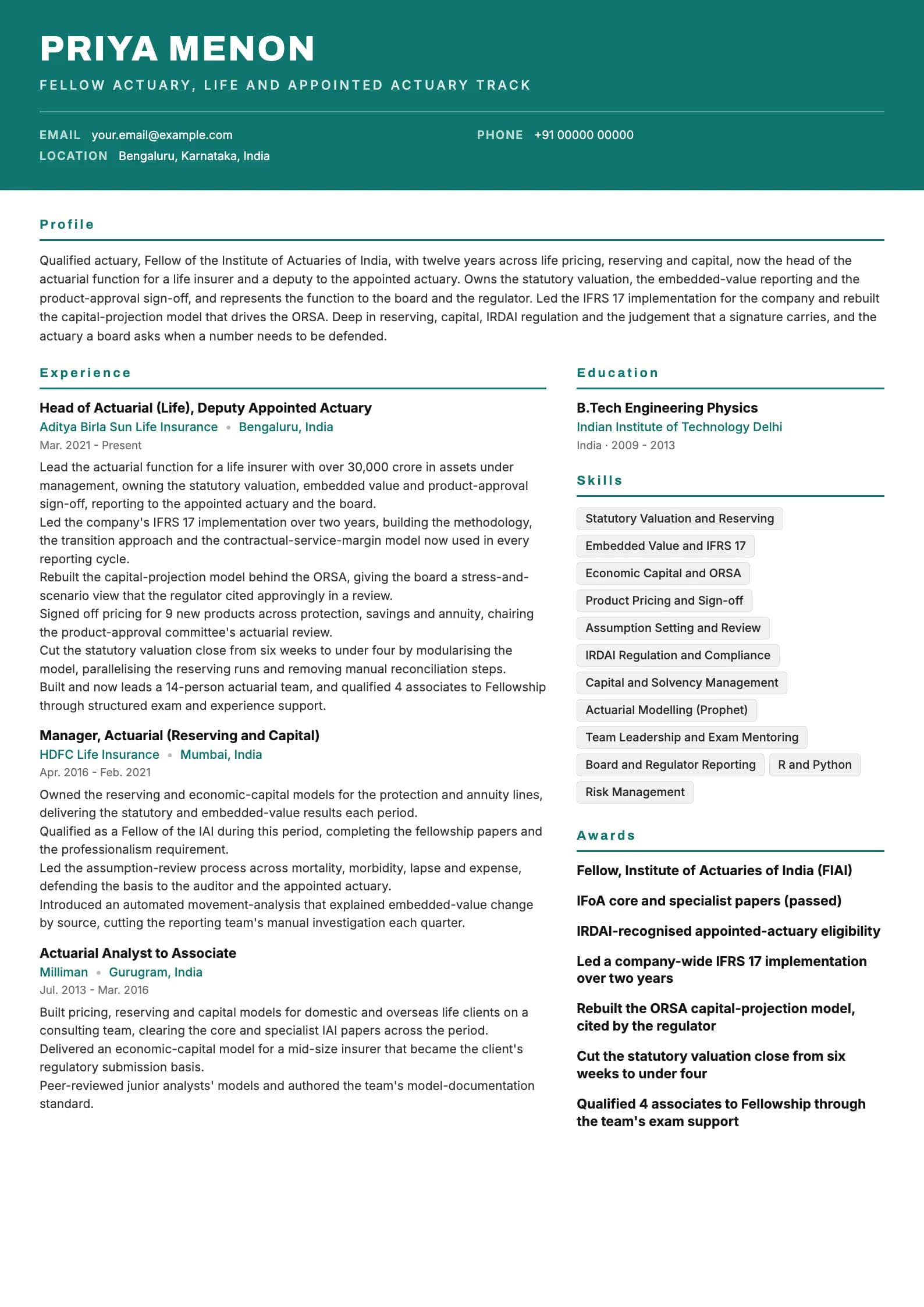
The format that works for actuary resumes in India
Reverse chronological is the layout to use. Put your most recent role first, work backwards, and let the dates sit in plain view. Actuarial careers are long and structured, so a clean timeline that shows steady progression and steady exam clearance is itself a positive signal. A functional layout that hides the dates works against you here, because the correlation between experience and exams is exactly what a screener wants to read. Exam progress is the one thing this resume cannot leave to inference. State it explicitly and near the top: how many IAI or IFoA papers you have cleared, out of how many, and which specialist papers if any. An early-career actuary is filtered almost entirely on exam count, and a hiring manager should not have to hunt for it. Put it in the summary and again in a clearly labelled section. Length follows seniority. One page for an analyst and most associates up to five or six years. A qualified actuary with a decade of reserving, capital and sign-off work can use two pages, provided the second carries owned models, regulatory work and team leadership rather than a longer software list. Four things belong nowhere on this resume: a photograph, date of birth, marital status and father's name. Send a PDF unless the posting asks for DOCX, use a single column so the file parses cleanly, and name it with your name and the role. The table below sets out the section order.
| Section | Where it goes | Why |
|---|---|---|
| Name and headline | Top, above everything | Headline names the role and level: actuarial analyst, associate, Fellow actuary. |
| Summary with exam status | Directly under the header | Three lines plus the exam count, e.g. 11 of 13 IAI papers cleared. This sets your band. |
| Exams and qualifications | High, its own section | Papers cleared, body (IAI, IFoA), specialist papers, membership grade. Never buried. |
| Work experience | Next, for anyone with a role | Most recent first. Lead with owned models and business outcomes, not tasks. |
| Technical skills | Below experience | Grouped: actuarial domain, modelling software, programming. Not a wall of tools. |
| Education | Bottom, unless you are a fresher | Degree, institution, years. A strong quant degree stays worth naming longer than most. |
Exam progress must be explicit, not implied
The single most common actuarial resume failure is leaving the exam count vague. A line like pursuing actuarial exams or actuarial student tells a screener almost nothing, because the gap between two papers and eleven papers is the gap between an analyst hire and an associate hire, and they are recruited for entirely different roles. State the number. Write it as a fraction and name the body. Cleared 11 of 13 IAI papers, or passed 6 IFoA papers including CS1, CS2, CM1 and CM2, is unambiguous. If you have cleared any specialist papers, the SP or SA series, name them, because they signal you are into the harder, judgement-heavy part of the qualification rather than still on the core mathematics. If you have qualified, write Fellow of the Institute of Actuaries of India or FIAI, because that single word changes what you can be hired to sign. Name the specific papers where they matter. A pricing role cares that you have CM1 and the relevant SP. A reserving role cares about CM2 and the life or general SP. Listing the papers, not just the count, lets a hiring manager match you to the seat. Be scrupulously honest. Exam records are verifiable through the institute, and every actuary interviewing you has sat the same papers, so an inflated count or a claimed pass that was actually a fail collapses instantly and permanently. A modest, accurate count always beats an inflated one.
Exam status line
Weak
Actuarial student currently pursuing actuarial science examinations with good progress.
Strong
Cleared 11 of 13 IAI papers, including both SP specialist papers, currently sitting the final fellowship exams.
Good progress could mean two papers or twelve; the rewrite states the exact count and which papers, which is what sets the hiring band.
State exams as a named fraction near the top: cleared X of Y IAI or IFoA papers, listing specialist papers. This one line sets the band you are read at, and leaving it vague gets a strong candidate filtered as a weak one.
Writing a summary a chief actuary actually reads
The block under your name is the part you can be reasonably sure gets read, so it should carry four facts: what actuarial work you do, how long you have done it, your exam status, and the strongest thing your models actually changed. Three or four lines, no adjectives that cannot be checked. The old objective line, seeking a challenging position to utilise my actuarial and analytical skills in a reputed organisation, tells the reader nothing. Replace it with a summary. An objective describes what you want, a summary describes the exams you have passed and the models you have owned, and only one is evidence. Analysts often think they have nothing to summarise. Look at the analyst sample: it names the exams cleared, the modelling software, the valuation work and a real error caught. That is a genuine summary built from one role and two papers. What it avoids is passionate about numbers, a phrase that carries no information on a quantitative resume. A practical test: read your summary and ask whether another analyst with the same two exams could paste it onto their resume unchanged. If they could, it describes the qualification, not you. Add the specific portfolio, the specific model you owned and the specific outcome until it stops being transferable.
Professional summary, nearly-qualified actuary
Weak
Detail-oriented and analytical actuarial professional with strong knowledge of Excel and modelling seeking a challenging pricing or reserving role.
Strong
Nearly-qualified actuary, 11 of 13 IAI papers, owning the pricing model for a 400 crore health portfolio. Repriced a loss-making group product from a 108 to a 91 percent loss ratio over two cycles.
The rewrite swaps self-description for exam status, an owned portfolio and the loss-ratio outcome the model actually delivered.
Experience bullets: model, action, business outcome
Every strong bullet in the samples follows the same shape. It names the model or the actuarial work, states what you did to it, and closes with what measurably changed in the business. Actuarial work is easy to describe as a series of tasks, ran the valuation, updated assumptions, and that undersells it. Tie the work to an outcome wherever the truth allows. Start with what changed. Analysts and associates tend to write the process first, ran the quarterly reserving, then stop, which reads as maintenance. Instead ask what was different because of your work: a loss ratio moved, a close ran faster, a black-box model became auditable, a data error was caught, a product was priced and approved. Then write the sentence that ends in that fact. Vary the evidence. Not everything is a percentage. Across a real role you can reach for loss ratio, close timeline, model runtime, exams cleared, products priced, portfolio size and, for a senior actuary, regulatory outcomes and associates qualified. The nearly-qualified sample moves across several, which reads as range rather than one trick. Where you cannot give a number, give scope and judgement: which portfolio, how large, what assumption basis you owned, what you signed or reviewed. Owning the assumption basis for a 400 crore portfolio carries weight without a percentage. Allocate bullets by recency. Current role gets five or six, the previous role four, anything older two or three.
| Level | What bullets must prove | Typical evidence |
|---|---|---|
| Analyst (0 to 3 exams) | You can build and check a model correctly | Automation built, reconciliation, errors caught, exams cleared |
| Associate (partly qualified) | You own a model and its assumptions | Portfolio owned, loss ratio, repricing outcome, IFRS 17 work |
| Nearly qualified | You own results others rely on | Valuation led, capital work, close timeline, papers cleared |
| Fellow / signing actuary | You own judgement, sign-off and the function | Products signed, regulatory outcomes, EV, team qualified |
Experience bullet, reserving work
Weak
Responsible for the quarterly reserving process and updating actuarial assumptions as required.
Strong
Rebuilt an inherited black-box reserving model into a modular, reconciled one with a full assumptions register and audit trail.
Responsible for the process describes the seat; the rewrite names the model change and the auditability it delivered, which is the actual value.
If a bullet would read identically on any actuarial analyst's resume, it is describing the process, not you. Rewrite it until it only fits the model you owned or the result you delivered.
The skills section: actuarial domain, software and programming
An actuarial resume's skills section has two audiences with opposite preferences. The parser wants literal terms it can match, reserving and IFRS 17 and Prophet. A human wants a short, organised list that signals what kind of actuary you are. Grouping satisfies both. Group by function rather than one long line. Actuarial domain, modelling software and programming is a grouping that works for almost everyone. Under domain put reserving, pricing, IFRS 17, embedded value, capital, whatever you have actually done. Under software put the specialist tools, Prophet, GGY AXIS, RAFM, Moses. Under programming put R, Python, SQL and VBA. Write names the way the profession writes them: IFRS 17 not IFRS17, Prophet capitalised, IAI and IFoA correctly. Be honest about the domains you have worked in versus studied. Listing IFRS 17 when you have only read about it, not implemented it, is a trap, because an actuarial interviewer will ask you to walk through the contractual service margin and the gap shows. The list is a contract: every domain is a technical conversation you have agreed to have. Do not include a proficiency bar. Nobody agrees what four stars in reserving means, and it invites an argument. Let the exams and the experience prove the depth instead. Twelve to sixteen grouped skills is the working range.
| Group | What goes in it | How many |
|---|---|---|
| Actuarial domain | Reserving, pricing, IFRS 17, embedded value, capital, ORSA | 4 to 6 |
| Modelling software | Prophet, GGY AXIS, RAFM, Moses, the tool you use | 1 to 3 |
| Programming and data | R, Python, SQL, Excel and VBA | 3 to 4 |
| Products | Life, health, protection, annuity, general, the lines you know | 2 to 3 |
| For seniors | IRDAI regulation, team leadership, board reporting | 2 to 3 |
Where exams, education and the qualification belong
For an actuary, the professional exams outrank the degree, so the exams-and-qualifications section sits high, usually just under the summary, and the university degree sits at the bottom for anyone past the fresher stage. This is the reverse of most resumes, and it is correct here, because the profession qualifies you through the institute, not the university. That said, a strong quantitative degree, from an ISI, an IIT, a top statistics or mathematics programme, stays worth naming longer than most degrees do, because the profession recruits heavily from those pools and a recruiter reads it as evidence of the raw ability the exams demand. Keep it, but keep it to degree, institution and years once you are working. Name your membership grade and body precisely. Student member, Associate or Fellow of the Institute of Actuaries of India, and separately any IFoA membership or exemptions. Many Indian actuaries sit both IAI and IFoA papers, and exemptions carried between them are worth stating because they explain your exam count. Do not list a paper you have failed as cleared, or round eleven up to nearly qualified in a way that implies twelve. Institute records are verifiable and the profession is small. An accurate, modest count builds the trust that a signing profession runs on.
Getting through the applicant tracking system
Insurers, consultancies and the large actuarial employers run resumes through an applicant tracking system before a human sees them. It is a parser and a search index, not a judge. It reads your file, tries to break it into name, dates, employers, titles and skills, and stores the result so a recruiter can search across candidates. Almost every ATS problem is a parsing problem, and parsing problems come from layout, not wording. The layout rules are short. One column. Standard section headings, so use Work Experience and Skills and Qualifications rather than invented ones. No text inside images. No critical information in the header or footer region, which some parsers drop. Avoid text boxes and nested tables in the body, which is a common trap on graphically designed actuarial resumes. On wording, mirror the posting where it is honest. If it says reserving, write reserving. If it says IFRS 17, write IFRS 17. Actuarial recruiters search on exact terms, Prophet, IFRS 17, pricing, reserving, IAI, so those should appear as words in your bullets, not just as software logos. Spell out an acronym once alongside its short form, for example ORSA (own risk and solvency assessment). Crucially, make your exam count machine-readable text, not an image or a graphic progress bar, because a recruiter often searches on it. Save as a PDF that embeds real text and confirm you can select and copy your exam line. If you cannot select it, neither can the parser, and the one fact you most need found is invisible.
Section heading
Weak
My Actuarial Journey
Strong
Exams and Qualifications
Parsers and recruiters look for a standard, searchable heading; a creative one can hide the exam count in a bucket the recruiter never queries.
What gets actuary resumes rejected
Most rejections at the resume stage are not close calls. They come from a small set of recurring problems, and all of them are fixable in an afternoon. The list below covers what actuarial recruiters in India see most often, in rough order of how much damage each one does.
- A vague exam status like pursuing actuarial exams. State the count, out of how many, and which papers, or you are filtered as the weakest possible reading of it.
- Listing tasks with no business outcome. Ran the valuation is maintenance; moved a loss ratio from 108 to 91 percent is impact.
- Claiming a domain you have only studied, such as IFRS 17, that collapses under a single technical follow-up in the interview.
- Burying the exams in a graphic or an image so a recruiter's search cannot find the one number that sets your band.
- A generic objective line about a challenging role. Replace it with a summary that leads on exams and an owned model.
- A wall of software logos, Prophet, R, Python, SQL, VBA, SAS, with no bullet showing what you built with any of them.
- A photo, date of birth, marital status or father's name, none of which belongs on a technical actuarial resume.
- An inflated exam count or a claimed pass that was a fail. Institute records are verifiable and the profession is small enough that it surfaces.
- No named specialist papers, so a hiring manager cannot tell whether you are on core mathematics or into the judgement-heavy SP and SA papers.
- A two-column, heavily designed layout that parses out of order and scrambles exactly the exam and skills lines you need read correctly.
Read your resume once as the recruiter will search it. If they typed your target exam count, IFRS 17 and Prophet into a box, would your file come back. If the answer is no, the content is there but hidden.
Skills to put on a actuary resume
Technical
- Reserving and Valuation
- Pricing and Rate Review
- IFRS 17
- Embedded Value
- Economic Capital and ORSA
- Experience Analysis
- Assumption Setting
- Mortality and Morbidity Analysis
- Solvency and Capital Management
- Statutory Reporting
- Actuarial Mathematics
- Risk Management
Tools and platforms
- Prophet
- GGY AXIS
- Moses / RAFM
- R
- Python
- SQL
- Excel and VBA
- SAS
- Power BI
Working skills
- Analytical rigour
- Attention to detail
- Model documentation
- Peer review
- Communicating results to non-actuaries
- Regulatory and audit liaison
- Exam and self-study discipline
- Judgement under uncertainty
- Team mentoring
Certifications worth listing as a actuary
| Certification | Full name | Worth it for |
|---|---|---|
| IAI (student to Fellow) | Institute of Actuaries of India professional examinations | The core Indian actuarial qualification. Every actuary states their exam progress from this on the resume, as a count out of thirteen with specialist papers named. Membership grade, student, Associate or Fellow (FIAI), sets what you can be hired to do. |
| IFoA | Institute and Faculty of Actuaries (UK) examinations | Widely sat by Indian actuaries alongside or instead of the IAI, with exemptions carried between the two. Worth naming the exact papers passed, CS, CM, CB, SP and SA series, because they map directly to the roles you can fill. |
| CS papers | Actuarial Statistics core papers (CS1, CS2) | The statistics core, foundational for any data-heavy actuarial or analytics role. Worth highlighting for pricing, experience-analysis and increasingly for data-science-adjacent actuarial work. |
| CM papers | Actuarial Mathematics core papers (CM1, CM2) | The mathematics core covering contingencies and financial engineering. Essential for pricing and reserving roles, and usually the first papers a life-insurance employer looks for on an analyst resume. |
| SP / SA specialist papers | Specialist Principles and Specialist Advanced papers | The judgement-heavy specialist stage, in life, health, general, pensions or investment. Naming the specific SP or SA papers signals you are past the core mathematics and into the reasoning that qualified actuarial work actually requires. |
Keywords an ATS scans for in a actuary resume
These are the literal terms a parser matches against the job description. Use the ones that are true of you, in the sentences where you did the work, not as a list at the bottom.
- actuary
- actuarial analyst
- reserving
- pricing
- valuation
- IFRS 17
- embedded value
- economic capital
- ORSA
- Prophet
- experience analysis
- assumption setting
- IAI
- IFoA
- life insurance
- solvency
- R
- Python
- SQL
- actuarial modelling
Actuary resume FAQ
What salary can an actuary expect in India?
Pay tracks exams closely. An actuarial analyst with two or three papers typically starts around 6 to 10 LPA, rising through the associate stage. A nearly-qualified actuary with ten or more papers commonly sits in the 18 to 35 LPA band. A newly qualified Fellow often earns 25 to 45 LPA, and senior actuaries, chief and appointed actuaries, earn well above that, frequently 60 LPA to a crore or more. Each cleared paper tends to move the band, which is why exam progress is the single most important thing on the resume.
How long should an actuary resume be?
One page for an analyst and most associates up to five or six years. A qualified actuary with a decade of reserving, capital and sign-off work can use two pages, provided the second carries owned models, regulatory work and team leadership rather than a longer software list. Reviewers value clarity over volume, so if you are struggling to fit one page, cut the oldest role to a line and remove any tool you would not want to be tested on.
How should I show my exam progress on the resume?
Explicitly, near the top, and as machine-readable text rather than a graphic. Write it as a named fraction with the body, for example cleared 11 of 13 IAI papers including both SP specialist papers, or passed six IFoA papers including CS1, CS2, CM1 and CM2. Name specialist papers where you have them, and if you are qualified, write Fellow of the Institute of Actuaries of India or FIAI. Exam count is the first thing an actuarial recruiter filters on, so leaving it vague gets a strong candidate read as a weak one.
Do I list programming languages like R and Python?
Yes, but prove them. R, Python and SQL are increasingly expected on actuarial teams for automation and experience analysis, so list the ones you use, grouped separately from the actuarial software like Prophet. Back at least one with a bullet, for example automating a valuation data step from two days to under two hours, because a wall of language logos with nothing built behind them reads as padding an interviewer will probe.
How does an actuarial fresher write this resume with no experience?
Lead with your exam count and your quantitative degree, then use projects and internships as evidence of how you think. A mortality-graduation study or a self-built pricing model shows you understand the mechanics, and stating the method you chose and why matters more than the tool. Add any internship, the exams cleared and a strong CGPA. For an actuarial fresher, two cleared papers plus a genuine modelling project is a stronger page than a long, unproven skills list.
Should I claim experience in IFRS 17 or capital if I have only studied it?
No. Actuarial interviews are technical and conducted by people who have done the work, so a domain you have studied but not implemented, IFRS 17 and economic capital are the usual traps, collapses the moment you are asked to walk through the contractual service margin or a capital stress. List the domains you have genuinely worked in, and if you have only exam-level knowledge of another, keep it to the exams section rather than claiming it as experience.
Does an ATS reject heavily designed actuarial resumes?
It does not reject them outright, but two-column and graphic-heavy layouts often parse out of order, which is especially damaging here because it can scramble the exam and skills lines a recruiter searches on. A single-column layout with standard headings removes the risk, which is why all three samples above use one. Test your file by copying the text out of the PDF into a plain text editor, and make sure your exam count reads correctly there, since that is the fact you most need found.
Is the IAI or the IFoA qualification better for a resume in India?
Both are recognised, and many Indian actuaries sit papers from both, carrying exemptions between them. For working in India the IAI is the domestic body and appointed-actuary roles are tied to it, so a Fellowship of the IAI carries specific regulatory weight. The IFoA is widely respected and common on consulting teams. What matters most on the resume is naming the exact papers passed from whichever body, since recruiters map those papers to the roles you can fill.
Related resume examples and guides
Build your own in any of these formats
Start from a blank resume or upload the one you have. Goodspace renders it in 24 templates and makes sure your exam count, the reserving and IFRS 17 keywords, and the models you owned are the machine-readable text an insurer's applicant tracking system will search for.
Build my resume