Warehouse Manager Resume Format, with 3 Full Samples
A warehouse manager is hired on evidence of stock kept accurate, orders shipped on time and a floor that runs safely, yet most resumes list duties and forget the numbers that prove them. Below are three complete resumes, one for a supervisor stepping up from the floor, one for a warehouse manager running a single distribution centre, and one for a senior operations manager across multiple sites. After the samples come the format rules, the difference between listing WMS and proving it, the terms a parser matches literally, and the mistakes that end a screening before a human reads the page.
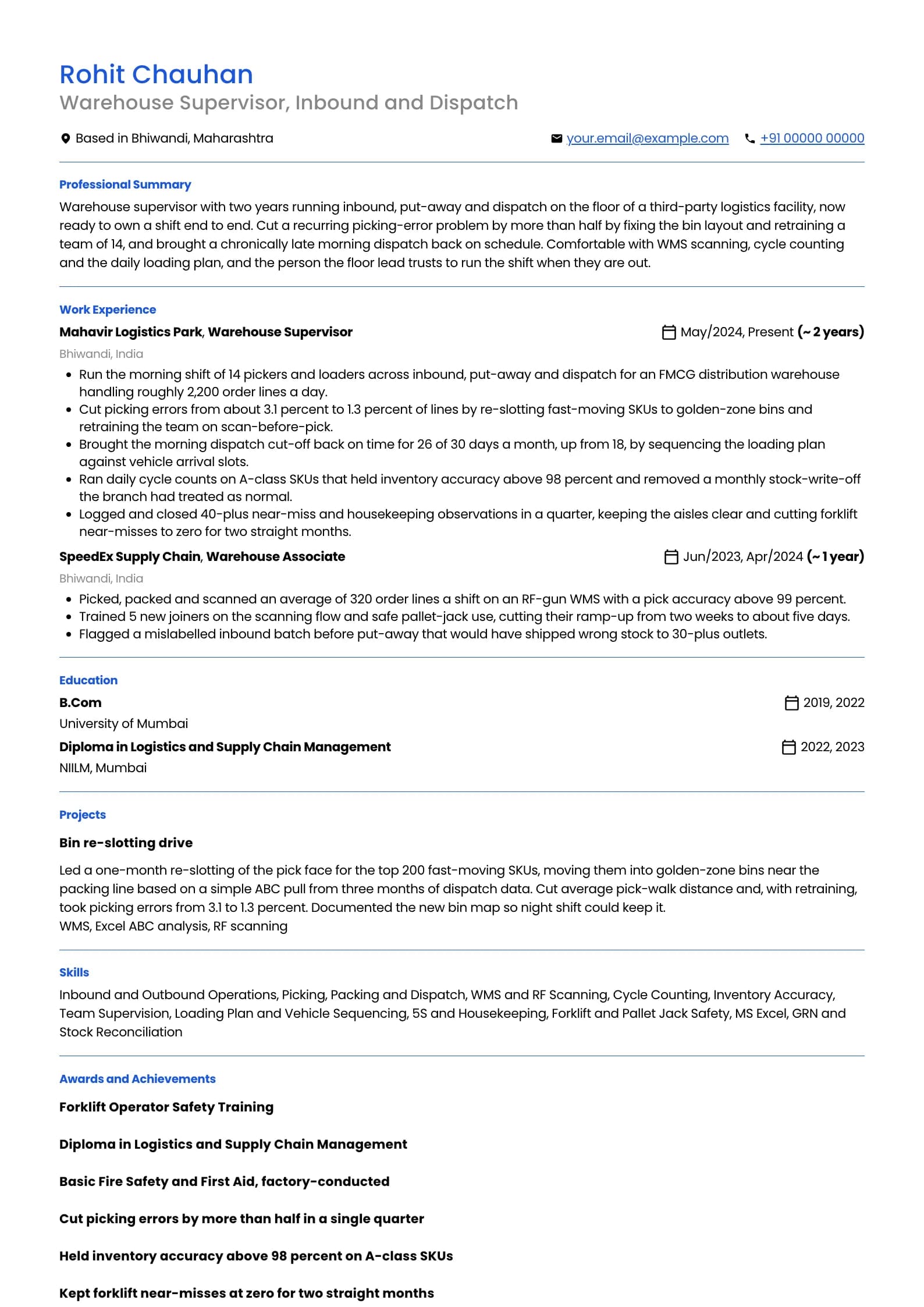
Build my resumeWarehouse Manager resume example, Supervisor stepping up (2 years)
professional templateIs your resume good enough?
Upload the resume you have now and see what an applicant tracking system reads before a warehouse manager recruiter ever does.
Free to run. Sign in with your mobile number to see your score.
Warehouse Manager resume example, Warehouse Manager (6 years)
header-band template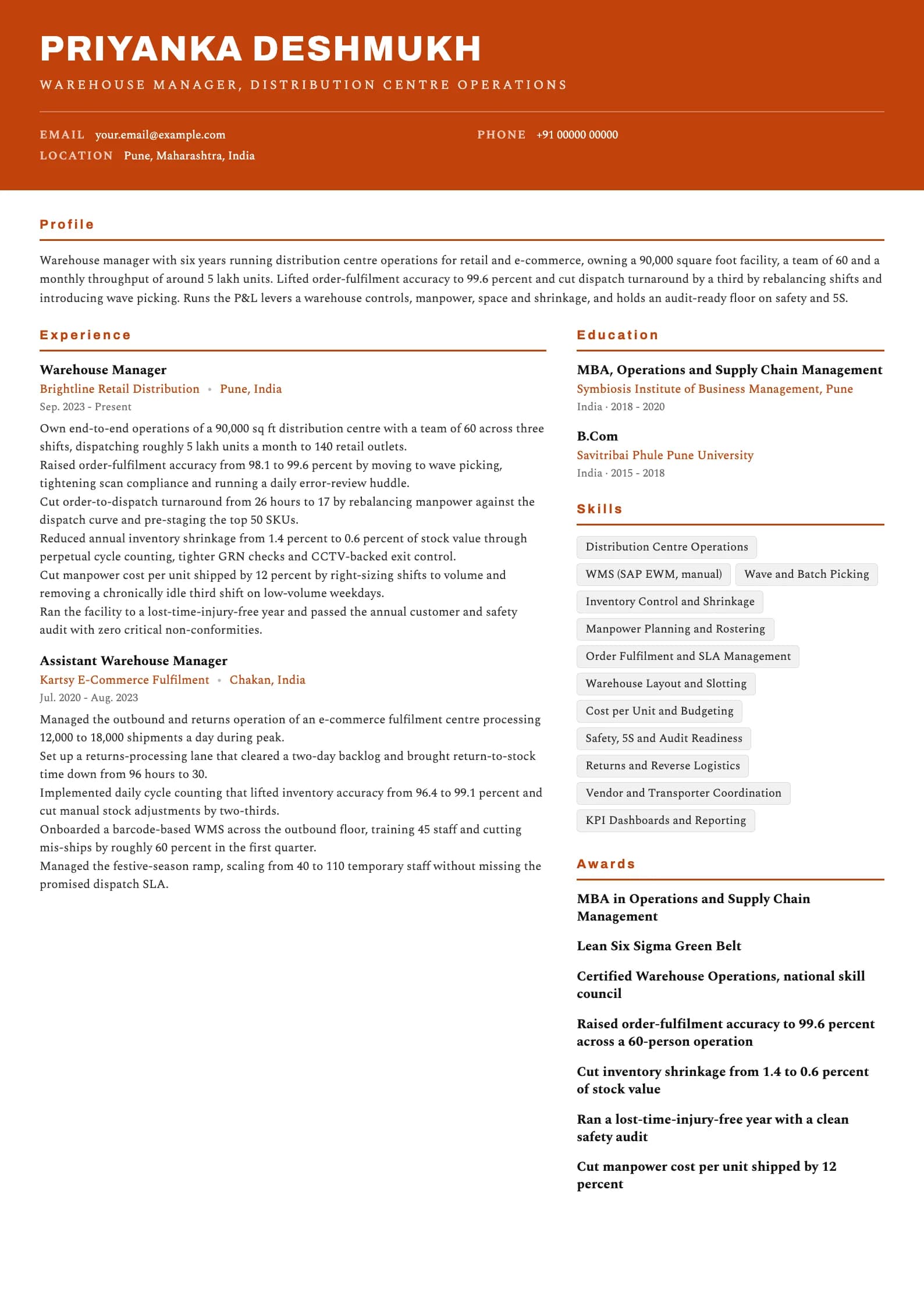
Want this structure with your own details? Build it in the resume builder.
Warehouse Manager resume example, Senior Operations (12 years)
modern template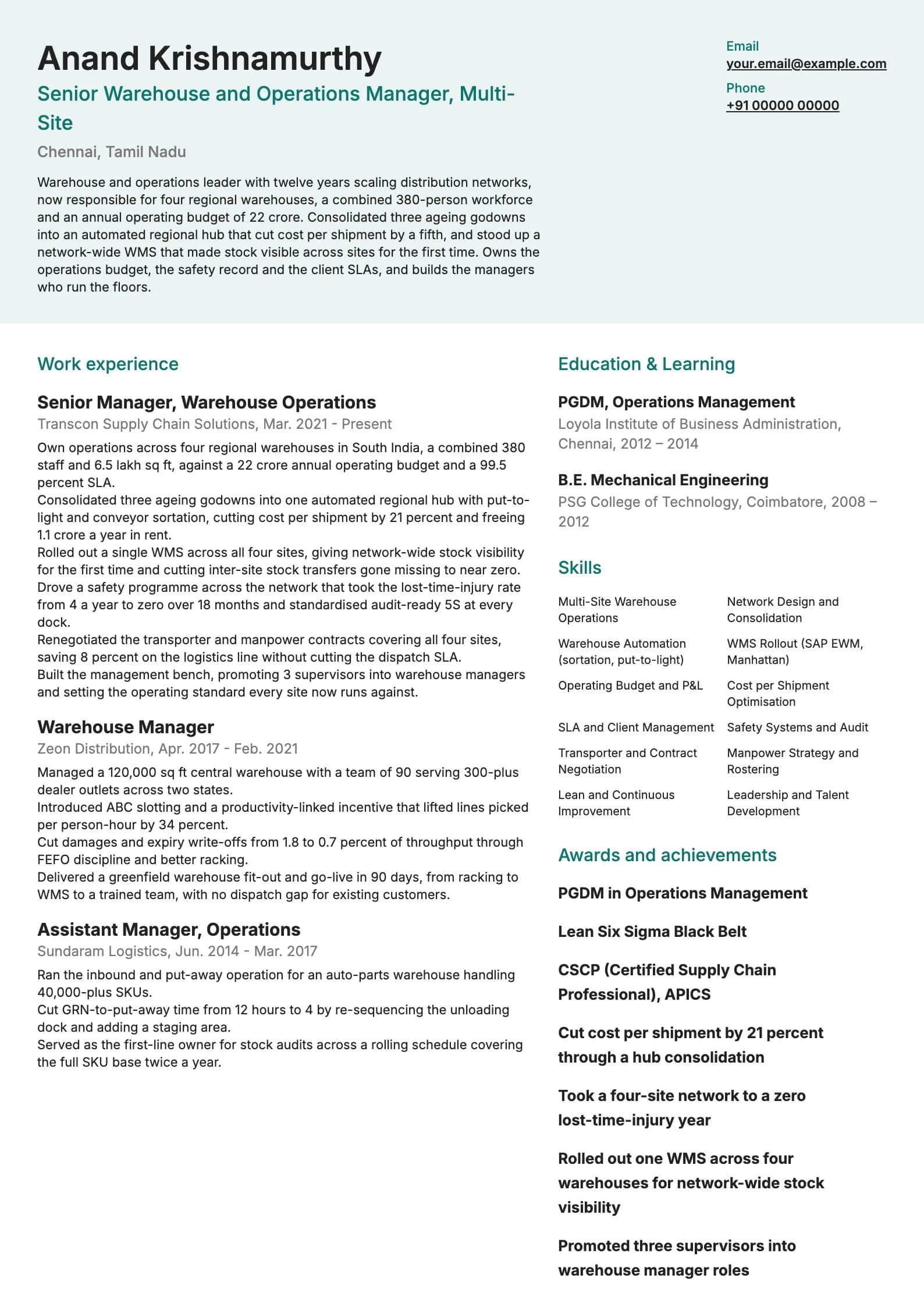
The format that works for warehouse manager resumes in India
Reverse chronological is the only layout worth using. Put the most recent role first, work backwards, and let the dates sit in plain view. Functional resumes that group everything under a Skills heading and drop the dates read as an attempt to hide a gap or a short stint, and hiring managers in logistics treat them that way. If you have a gap, one honest line explains it better than a hidden one raises suspicion. Length is decided by evidence. One page holds everything a supervisor and most warehouse managers up to roughly eight years have to say. A senior operations manager across multiple sites can run to a second page when it carries real scope, budgets, headcount and network decisions, rather than a longer list of daily duties. Four things belong nowhere on this resume: a photograph, date of birth, marital status and father's name. They survive from an older template that circulated through placement offices. Nobody hiring a warehouse manager is looking for them, and every line they occupy is a line an accuracy number or a safety record could have used. Send a PDF unless the posting asks for DOCX, and name the file with your own name and the target role rather than resume_final_v4. Use a single column all the way down, because two-column layouts parse unpredictably when a sidebar sits beside the experience. The table below sets out the section order.
| Section | Where it goes | Why |
|---|---|---|
| Name and headline | Top, above everything | The headline is the role you want, warehouse manager or operations manager. Recruiters match on it. |
| Professional summary | Directly under the header | Three lines. Scope run, years, and the single strongest result. |
| Work experience | Next, for anyone with a job | Most recent first. Newest role gets the most bullets. |
| Key skills | Below the summary or beside experience | Operations, WMS, inventory, safety. Grouped, not a 30-item wall. |
| Achievements or metrics | Optional band near the top for managers | Accuracy, throughput, cost, safety. The numbers a screener wants first. |
| Education | Below experience | Degree, MBA or diploma, institution, years. |
| Certifications | After education, or beside skills if only one or two | Six Sigma, forklift, supply-chain certs. Name, body, year. |
Listing duties is not the same as proving results
The single most common warehouse manager resume failure is a page of responsibilities that could belong to anyone with the same title: managing warehouse operations, handling inventory, supervising staff, ensuring timely dispatch, maintaining safety. A parser sees the keywords, but a hiring manager reads the wall and cannot tell a strong operator from a weak one, because both wrote the same sentences. The fix is to attach a number to the thing you managed. Warehouse work is one of the most measurable jobs there is, and the numbers are already tracked on the floor. Inventory accuracy, order-fulfilment accuracy, dispatch turnaround, cost per unit or per shipment, shrinkage as a percentage of stock value, lines picked per person-hour, and safety, whether measured in lost-time injuries or near-misses closed. Every bullet in the samples ends in one of these. Speak the language of scope. "Managed a warehouse" tells a reviewer nothing. "Own a 90,000 sq ft distribution centre with a team of 60 dispatching 5 lakh units a month" tells them the size of the job in one line, before a single result. Square footage, headcount, SKU count, daily order lines and monthly units are the vocabulary a logistics hiring manager reads scope in. Do not pad with software you touched once. If you list SAP EWM, a bullet should show what you did with it. The manager sample lists WMS precisely because a bullet describes rolling it out and training staff on it. The skills line and the experience agree, which is what makes both believable.
For every duty on your resume, ask: what number moved because I did this. Accuracy, cost, turnaround, shrinkage or safety. If nothing moved, the line is a job description, not an achievement.
Writing a summary a hiring manager actually reads
The block under your name is the part you can be reasonably sure gets read, so it should carry three facts: the scale of what you run, how long you have run operations, and the strongest thing that happened because of your work. Three or four lines, no adjectives that cannot be checked. The old objective line, seeking a challenging position in a reputed organisation to utilise your warehouse and inventory management skills, tells the reader nothing they did not assume from the application. Replace it with a summary. An objective describes what you want, a summary describes what you have already run, and only one is evidence. Supervisors stepping up often believe they have nothing to summarise. Look at the supervisor sample: it names the team size, the facility type, and points at a real result, picking errors cut by more than half. That is a genuine summary built from two years on the floor. What it avoids is "hardworking and dedicated team player", a phrase so common it now carries no information. A practical test: read your summary and ask whether the supervisor at the next warehouse could paste it onto their resume unchanged. If they could, it describes the job title, not you. Add the specific facility size, the specific accuracy number and the specific team until it stops being transferable.
Professional summary, warehouse manager
Weak
Hardworking and result-oriented warehouse manager with 6+ years of experience in warehouse operations, inventory management and team handling seeking a challenging role in a reputed organisation.
Strong
Warehouse manager with six years running a 90,000 sq ft distribution centre and a team of 60, dispatching 5 lakh units a month. Lifted order-fulfilment accuracy to 99.6 percent and cut inventory shrinkage from 1.4 to 0.6 percent.
The rewrite trades a keyword list and self-praise for a stated scope and two verifiable results a screener can act on.
Experience bullets: verb, operation, consequence
Every strong bullet in the samples follows the same shape. It opens with an action verb, names the specific operation or change you ran, and closes with what measurably moved. The verb establishes that you did it. The operation tells a reviewer whether the work is relevant to their floor. The number does the persuading. Start with the outcome and work backwards. Managers usually write the duty first, then struggle to attach a number, which produces bullets like "handled dispatch operations and ensured timely delivery". Instead ask what was different on the floor after you changed something: accuracy rose, turnaround dropped, shrinkage fell, cost per unit came down, a picking rate improved, an injury count went to zero. Then write the sentence that ends in that fact. Vary the metric. Five accuracy numbers in a row read as one trick repeated. Across a real warehouse role you can honestly reach for accuracy, throughput, turnaround, cost per unit, shrinkage, productivity per person-hour, SLA adherence and safety. The manager sample uses several of these, which reads as range and as a manager who watches the whole board, not one dial. Where you lack a number, give scope: how many staff, how large the facility, how many SKUs, how many outlets served, how long a go-live took. "Delivered a greenfield warehouse go-live in 90 days with no dispatch gap for existing customers" carries weight without inventing a percentage. Allocate bullets by recency. Current role gets five or six, the previous role four or five, anything older two or three.
| Level | What bullets must prove | Typical metric |
|---|---|---|
| Supervisor | You can run a shift and improve it | Picking accuracy, on-time dispatch, near-misses, cycle-count accuracy |
| Warehouse manager | You own a facility end to end | Fulfilment accuracy, turnaround, shrinkage, cost per unit, SLA |
| Senior operations | You own budget, safety and the network | Cost per shipment, operating budget, LTI rate, sites consolidated |
| Any level | The floor is safe under you | Lost-time injuries, near-misses closed, audit non-conformities |
Experience bullet, dispatch operations
Weak
Responsible for managing dispatch operations and ensuring orders are delivered to customers on time.
Strong
Cut order-to-dispatch turnaround from 26 hours to 17 by rebalancing manpower against the dispatch curve and pre-staging the top 50 SKUs.
"Responsible for" describes a job description; the rewrite names the change made, the before and after, and how it was done.
Experience bullet, inventory
Weak
Handled inventory management and maintained stock accuracy in the warehouse.
Strong
Reduced annual inventory shrinkage from 1.4 to 0.6 percent of stock value through perpetual cycle counting, tighter GRN checks and CCTV-backed exit control.
Names the metric, the before and after and the three controls, so a reviewer can ask a real follow-up instead of nodding at a vague claim.
If a bullet would read identically on the resume of the supervisor at the next warehouse, it is describing the title, not you. Rewrite it until it only fits the operation you actually ran.
The skills section: grouped, honest, and short enough to defend
A warehouse manager resume's skills section has two audiences with opposite preferences. The parser wants literal terms it can match, WMS and inventory control and dispatch. A hiring manager wants a short, organised list that signals what kind of operator you are. Grouping satisfies both. Group by function rather than one long line. Operations, inventory and systems, people, and safety and compliance is a grouping that works for almost every warehouse manager. The exact headings matter less than the fact that structure exists. Write names the way the industry writes them: SAP EWM not SAP, FEFO and FIFO spelled correctly, 5S not five S. A parser matches on strings. Twelve to sixteen skills is the working range. Below eight the section looks thin. Above twenty it stops being a signal. A warehouse resume is especially prone to listing every synonym for the same thing, inventory management and stock control and inventory control as three items, when they are one. The list is a contract: every item is a question you have agreed to answer in the interview. Do not include a proficiency bar. Star ratings invite an argument you cannot win, and nobody agrees what four stars in inventory control means. Let the experience prove the depth instead.
| Group | What goes in it | How many |
|---|---|---|
| Operations | Inbound, dispatch, picking, wave picking, layout, slotting | 3 to 5 |
| Inventory and systems | WMS (SAP EWM), cycle counting, shrinkage control, FEFO | 3 to 5 |
| People and cost | Manpower planning, rostering, cost per unit, budgeting | 2 to 4 |
| Safety and compliance | 5S, safety systems, audit readiness, forklift safety | 2 to 3 |
| Tools | MS Excel, ERP, KPI dashboards | 1 to 3 |
Skills section
Weak
Skills: Warehouse management, Inventory management, Stock control, Inventory control, Operations, Dispatch, Team handling, Team management, Man management, Leadership, Hard working, Time management, MS Office, MS Excel, Communication
Strong
Operations: inbound and dispatch, wave picking, slotting. Inventory: WMS (SAP EWM), cycle counting, shrinkage control, FEFO. People and cost: manpower planning, cost per unit. Safety: 5S, audit readiness, forklift safety. Tools: Excel, KPI dashboards.
Cuts the duplicated synonyms and vague traits, keeps the terms a warehouse recruiter actually searches, and groups the rest so a human reads it in one pass.
Improvements and projects: what to include and how to describe it
A warehouse manager rarely has a projects section in the software sense, but the equivalent is powerful: the specific improvement drive you led. A re-slotting exercise, a WMS go-live, a returns-lane redesign, a safety programme, a greenfield fit-out. These are the entries that show you do not just run the operation you inherited, you make it better. The common failure is describing the activity instead of the outcome. "Worked on a project to improve warehouse efficiency" tells a reviewer nothing, because thousands of resumes carry that exact line. Describe what you changed, what data you used to decide, and what measurably moved. The re-slotting drive in the supervisor sample is a stronger entry than a grander-sounding one would be, because it names the data pulled, the change made and the errors cut. For a supervisor or a manager stepping up, one well-described improvement is worth more than a longer duty list, because it is the clearest evidence of the initiative that earns a promotion. For a senior operations leader, the network decisions, a consolidation or a network-wide WMS, belong in the experience bullets themselves, as the highest-scope work you have done. If you led a go-live or a fit-out, say what could have gone wrong and did not: no dispatch gap, no missed SLA during the ramp, no stock lost in the cutover. An operations reviewer reads risk avoided as competence, because they know exactly how badly these can go.
Improvement description
Weak
Led a project to improve warehouse efficiency and productivity using various process improvement techniques.
Strong
Led a re-slotting of the pick face for the top 200 SKUs using three months of dispatch data, cutting pick-walk distance and taking picking errors from 3.1 to 1.3 percent.
Swaps vague process language for the data used, the change made and the specific error rate the work moved.
Where education and certifications belong
Education goes below experience for anyone with a full-time job. Degree, institution, years. An MBA or PGDM in operations or supply chain is worth naming clearly, because it is a genuine differentiator for a manager role, but it still sits under the work that proves you can run a floor. Percentage or CGPA is worth keeping only while you are early in your career and it is strong. Once you have run a warehouse, an accuracy number and a shrinkage number are far more predictive than a college mark, so drop the percentage and let the operation speak. For this field, a diploma in logistics or supply chain management is a real asset for a supervisor or someone entering warehouse management without an operations degree, and it belongs on the page. So does a forklift operator certification early on, because it signals you have worked the floor and understand the equipment, not just the spreadsheet. Certifications sit just below education, or beside skills if you hold only one or two. Write the full name, the issuing body and the year. A Lean Six Sigma belt carries real weight in Indian warehouse and operations hiring, because process improvement is the core of the job. A supply-chain certification such as CSCP or CPIM helps as you move towards senior and network roles. An expired safety certification listed as current is a small dishonesty that is easy to catch on an audit-conscious floor, so renew it or remove it.
Getting through the applicant tracking system
An applicant tracking system is a parser and a search index, not a judge. It reads your file, tries to break it into name, dates, employers, titles and skills, and stores the result so a recruiter can search across candidates. Almost every ATS problem is a parsing problem, and parsing problems come from layout, not wording. The layout rules are short. One column. Standard section headings, so use Work Experience rather than My Journey, and Key Skills rather than My Toolbox. No text inside images, because a warehouse-photo banner reads as empty space. No critical information in the header or footer region, which some parsers drop. Avoid text boxes and nested tables in the resume body. On wording, mirror the language of the job description where it is honest. If the posting says WMS, write WMS. If it says inventory management, write inventory management rather than only stock control. Include the expansion alongside an acronym at least once, for example "WMS (warehouse management system)" and "GRN (goods receipt note)", so both searches find you. Keyword stuffing does not work, and warehouse resumes are a common offender with a hidden block of every logistics term in white text. Recruiters find it quickly, and the outcome is worse than being filtered. Write real bullets that naturally contain the right terms, because a bullet describing a shrinkage number contains the word inventory in a context that survives human review too. Save as PDF from a tool that embeds real text, then open the file and confirm you can select and copy a sentence. If you cannot select the text, neither can the parser.
Section heading
Weak
My Warehouse Journey
Strong
Work Experience
Parsers look for standard headings; a creative one can push the entire block into an unclassified bucket the recruiter never searches.
Test your own file before you send it. Copy the text out of the PDF into a plain text editor. Whatever you can read there is roughly what the parser sees, and anything scrambled is a real risk.
What gets warehouse manager resumes rejected
Most rejections at the resume stage are not close calls. They come from a small set of recurring problems, and all of them are fixable in an afternoon. The list below covers what reviewers of Indian warehouse manager resumes see most often, in rough order of how much damage each one does.
- A page of duties with no numbers. Accuracy, turnaround, shrinkage, cost per unit and safety are all tracked on your floor already. Use them.
- No stated scope. Facility size, headcount, SKU count, daily order lines and monthly units are the vocabulary scope is read in. Without them, a reviewer cannot size the job you ran.
- Safety left off entirely. For a warehouse role, a lost-time-injury record or near-misses closed is not optional, it is a core screening signal.
- Duplicated synonyms padding the skills line, inventory management and stock control and inventory control as three items when they are one.
- Software listed but never proven. If SAP EWM is on the skills line, a bullet must show what you did with it.
- A photo, date of birth, marital status or father's name. None of it belongs on this resume, and it takes a metric's space.
- A generic objective line. Replace it with a summary that states scope, years and one result.
- Job-hopping across warehouses with no reason and no result at each stint, which reads as a pattern rather than progression.
- Inflated titles or dates that do not match your payslips and offer letters. Background verification is standard and a mismatch ends the process.
- Typos in the operational terms you claim to know. Writing FEFO as FIFO where it matters, or misspelling a WMS you list, undoes an otherwise strong page.
Read your resume aloud once before sending it. Any line you would be embarrassed to defend to an operations head across the table is a line to cut or rewrite.
Skills to put on a warehouse manager resume
Technical
- Warehouse Operations Management
- Inventory Control and Cycle Counting
- Order Fulfilment and Dispatch
- WMS (SAP EWM, Manhattan)
- Wave and Batch Picking
- Layout Design and Slotting
- Shrinkage and Damage Control
- FEFO and FIFO Discipline
- Cost per Unit and Budgeting
- SLA and KPI Management
- Reverse Logistics and Returns
- Warehouse Automation
Tools and platforms
- SAP EWM
- Manhattan WMS
- MS Excel
- RF Scanning / Barcode
- ERP (SAP, Oracle)
- KPI Dashboards
- Google Sheets
- Tally (stock module)
Working skills
- Team leadership and supervision
- Manpower planning
- Cross-functional coordination
- Vendor and transporter management
- Problem solving under pressure
- Safety-first mindset
- Training and development
- Stakeholder communication
Certifications worth listing as a warehouse manager
| Certification | Full name | Worth it for |
|---|---|---|
| Lean Six Sigma Green Belt | Lean Six Sigma Green Belt Certification | Carries real weight in Indian warehouse and operations hiring, because process improvement is the core of a warehouse manager's job. Most valuable for supervisors stepping up and managers with a few years, where it signals you can run a structured improvement, not just react to fires. Pair it with an actual improvement result on the page. |
| Lean Six Sigma Black Belt | Lean Six Sigma Black Belt Certification | Worth it for senior warehouse and operations leaders driving cost, quality and network-level projects. It signals you can lead improvement across sites and mentor green belts, which matches a multi-site or regional role. Overkill for a first-time supervisor, where the green belt is the right level. |
| CSCP | Certified Supply Chain Professional, APICS | A strong, globally recognised credential for warehouse managers moving towards broader supply-chain and operations leadership. Most useful once you own more than the four walls of a warehouse and touch planning, procurement or the wider network. Less relevant for a floor supervisor focused purely on execution. |
| CPIM | Certified in Planning and Inventory Management, APICS | Focused on inventory, planning and production control, so it helps warehouse managers whose role leans heavily on stock accuracy and inventory strategy. Worth it if you own the inventory number as a headline responsibility. If your job is more dispatch and manpower than planning, the Six Sigma track gives you more. |
| Forklift Certification | Certified Forklift and MHE Operator Safety Training | An entry and floor-level credential, most useful for supervisors and warehouse associates moving up. It signals you have worked the equipment and understand material-handling safety first-hand, which reassures a manager hiring someone to run a floor. Managers with years of leadership rarely need to keep it on the page. |
| Diploma in Logistics | Diploma in Logistics and Supply Chain Management | A genuine asset for someone entering warehouse management without an operations degree, and a common route for supervisors and associates who worked their way up. It gives a screener a formal signal alongside floor experience. Once you hold an MBA or PGDM in operations, it becomes redundant on the page. |
Keywords an ATS scans for in a warehouse manager resume
These are the literal terms a parser matches against the job description. Use the ones that are true of you, in the sentences where you did the work, not as a list at the bottom.
- warehouse manager
- warehouse operations
- inventory management
- WMS
- SAP EWM
- order fulfilment
- dispatch
- cycle counting
- inventory accuracy
- shrinkage control
- picking and packing
- supply chain
- distribution centre
- manpower planning
- 5S
- warehouse safety
- GRN
- cost per unit
- FEFO
- logistics
Warehouse Manager resume FAQ
What salary can a warehouse manager expect in India?
A supervisor or team lead stepping up typically earns around 3 to 5.5 LPA. A warehouse manager running a single distribution centre with a mid-sized team usually sits in the 6 to 14 LPA band, higher in e-commerce and 3PL firms in metro logistics hubs like Bhiwandi, Bhiwadi, Chakan and Hosur. Senior and regional operations managers across multiple sites commonly earn 18 to 40 LPA and more. A Lean Six Sigma belt, WMS depth and a strong shrinkage or cost record push the top of every band upward.
How long should a warehouse manager resume be?
One page up to about eight years of experience, two pages after that only when the second page carries real scope, budgets, headcount and network decisions, rather than a longer list of daily duties. Nobody has been rejected for a resume that was too easy to read. If you are struggling to fit one page, cut the oldest role to a single line, remove college percentages, and delete any duty that has no number attached.
What are the most important metrics to put on a warehouse resume?
Inventory accuracy and order-fulfilment accuracy, dispatch or order-to-dispatch turnaround, shrinkage as a percentage of stock value, cost per unit or per shipment, lines picked per person-hour, and a safety number such as lost-time injuries or near-misses closed. These are already tracked on your floor. Leading your bullets with them is the single biggest upgrade you can make, because they are exactly what an operations head screens on.
How does a warehouse supervisor show they are ready to be a manager?
Show initiative and a measurable improvement, not just that you ran the shift you were handed. A re-slotting drive that cut errors, a returns lane that cleared a backlog, or holding inventory accuracy above target are the entries that prove you make an operation better. Add scope, team size and facility type, and one line showing you were trusted to run the full shift or site in your manager's absence.
Do certifications like Six Sigma or CSCP help a warehouse manager?
Yes, more than in many fields, because process improvement and inventory control are the core of the job. A Lean Six Sigma Green Belt helps supervisors and mid-level managers, and a Black Belt or CSCP helps as you move to senior and network roles. That said, a certificate never outranks a real result. A green belt next to an actual shrinkage or accuracy improvement is far stronger than the belt alone.
Should I mention WMS software on my warehouse resume?
Yes, and name the specific one you have used, SAP EWM, Manhattan, or a manual or in-house WMS, rather than just writing WMS. Then prove it in a bullet: a rollout you led, a training you ran, or an accuracy gain you drove through it. Include the expansion once, warehouse management system, so an ATS matches both. Software you list but never back with a bullet costs you in the interview.
Does safety really need to be on a warehouse manager resume?
Yes. A warehouse is a safety-critical environment, and an operations head reads your safety record as a measure of how well you run a floor. Put a real number on it: a lost-time-injury-free period, near-misses logged and closed, a clean safety audit, or zero critical non-conformities. Leaving safety off entirely reads as a manager who does not track it, which is a red flag on a floor with forklifts and racking.
How do I write a warehouse resume with limited experience?
Lead with what you did on the floor, then education and certifications. Treat each responsibility as evidence: how many order lines you handled a shift, your pick accuracy, the new joiners you trained, a mislabelled batch you caught before it shipped. A forklift certification and a logistics diploma count. Add one improvement you drove, even a small one, because a candidate who improved their aisle stands out from one who only worked it.
Do I need a photo on a warehouse manager resume in India?
No. Operations recruiters do not expect one, and it takes space an accuracy or safety number should occupy. The same goes for date of birth, marital status, father's name, nationality and a declaration paragraph. These come from an older template that spread through placement offices and add nothing to an operations screen. The only exception is a role that explicitly asks for a photograph in the posting.
Related resume examples and guides
Build your own in any of these formats
Start from a blank resume or upload the one you have. Goodspace renders it in 24 templates and flags the WMS, inventory and safety keywords an applicant tracking system will look for, and the padding it will not credit.
Build my resume