Inventory Manager Resume Format, with 3 Full Samples
An inventory manager is hired on proof that the stock on the system matches the stock on the shelf, that nothing runs out and nothing rots, and that working capital is not sitting dead in a corner of the warehouse. Yet most inventory resumes describe daily tasks and never name a single accuracy or turns number. Below are three complete resumes, one for a junior inventory executive with two years on cycle counts, one for an inventory manager running a full warehouse on a WMS, and one for a senior inventory or materials head owning multi-site stock and working capital. After the samples come the format rules, the metrics that prove you controlled stock, the terms a parser matches literally, and the mistakes that end a screening before a human reads the page.
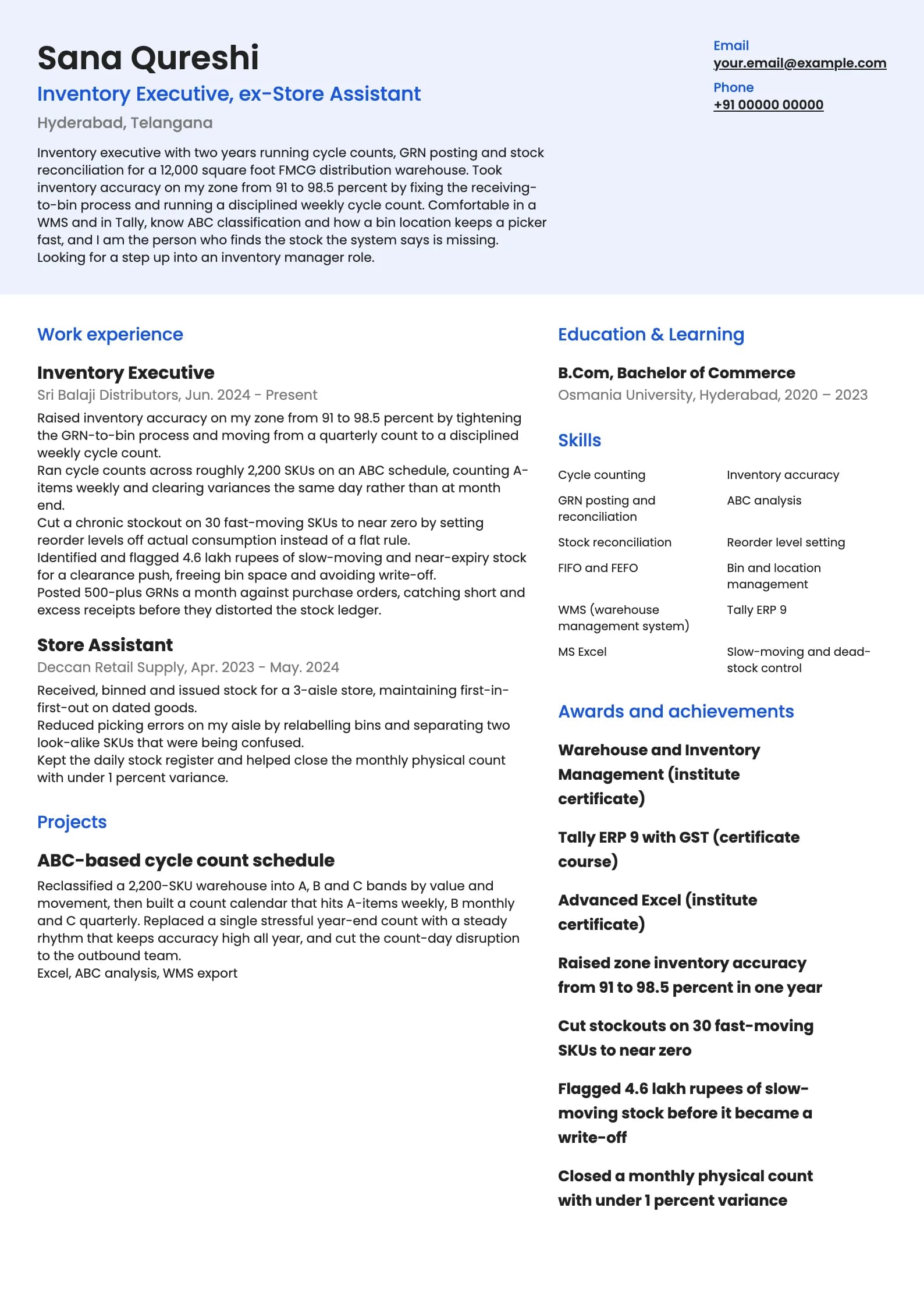
Build my resumeInventory Manager resume example, Junior inventory executive (2 years)
modern templateIs your resume good enough?
Upload the resume you have now and see what an applicant tracking system reads before a inventory manager recruiter ever does.
Free to run. Sign in with your mobile number to see your score.
Inventory Manager resume example, Inventory manager (5 years)
professional template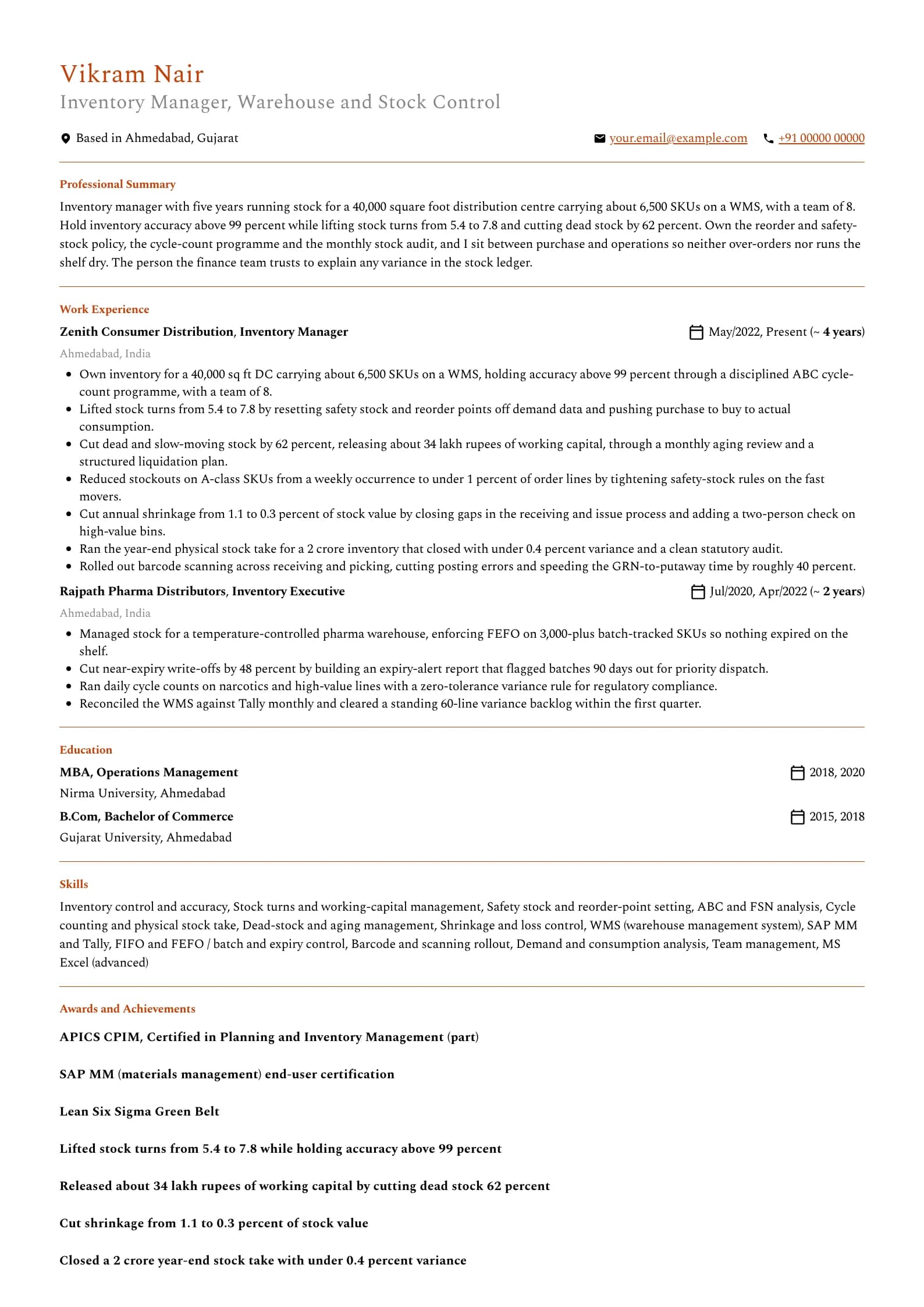
Want this structure with your own details? Build it in the resume builder.
Inventory Manager resume example, Senior inventory head (12 years)
header-band template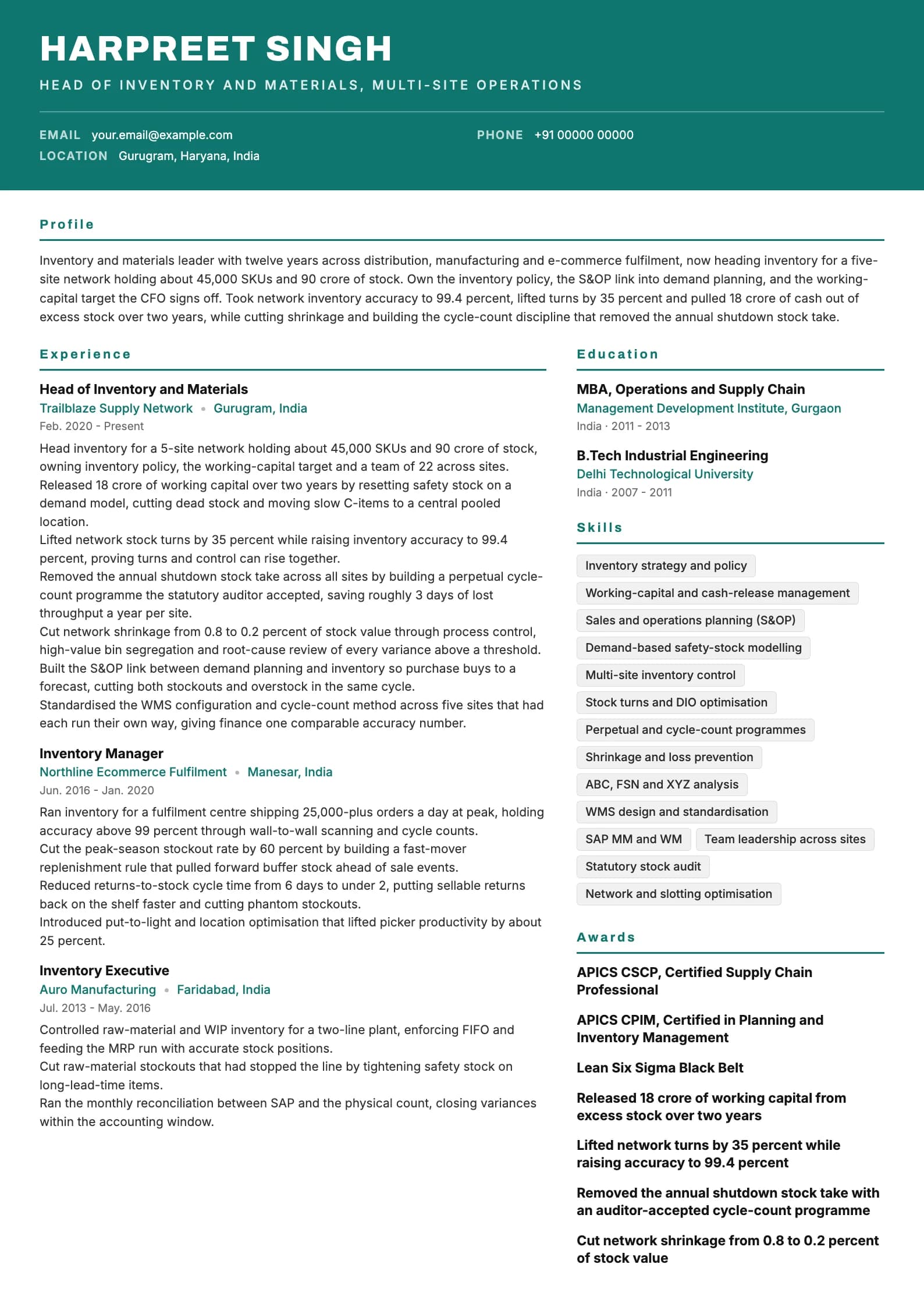
The format that works for inventory manager resumes in India
Reverse chronological is the layout to use. Most recent role first, work backwards, dates in plain view. Functional resumes that bury dates under a Skills block read as an attempt to hide a gap, and inventory reviewers, whose whole job is reconciling what should be there against what is, spot it at once. One honest line about a gap beats a layout designed to obscure it. Length follows evidence. One page holds everything a junior executive and most inventory managers up to roughly six years have to say. Beyond that, a second page is fine when it carries real multi-site or working-capital work, not a longer software list. A page two padded with a declaration paragraph and hobbies is just a stretched one-page resume. Four things do not belong on an inventory resume: a photograph, date of birth, marital status and father's name. They survive from an older template that circulated through campus and coaching classes. Nobody hiring an inventory manager is looking for them, and every line they take is a line an accuracy or turns number could have used. Send a PDF unless the posting asks for DOCX, and name the file with your own name and the target role, not inventory_resume_final. Use a single column top to bottom, because two-column layouts parse unpredictably when a sidebar sits beside the experience. The table below sets the section order.
| Section | Where it goes | Why |
|---|---|---|
| Name and headline | Top, above everything | The headline is the role you want, inventory manager or inventory executive. Filters and recruiters match on it. |
| Professional summary | Directly under the header | Three lines. Stock and SKUs owned, years, and the strongest accuracy or turns result. |
| Work experience | Next, for anyone with a job | Most recent first. Newest role gets the most bullets and the biggest numbers. |
| Key achievements | Optional band under the summary | 3 to 4 headline metrics, accuracy, turns, dead stock cut, shrinkage, pulled out where they are seen first. |
| Skills | Below experience | Grouped: inventory control, systems, analysis. Not a 30-item wall. |
| Education | Bottom, unless you are a junior candidate | Degree, institution, years. Drop the percentage after your first job. |
| Certifications | After education, or beside skills if only one or two | Name, body, year. CPIM, CSCP and SAP MM earn their place. |
The numbers that prove you controlled stock
The single most common inventory resume failure is a page of duties, maintained stock records, handled GRN, coordinated with the warehouse team, with not one accuracy, turns or shrinkage number anywhere. A parser matches the words, but an operations head reading them cannot tell whether your warehouse ran at 99 percent accuracy or 85, and those are entirely different candidates. Inventory is one of the most measurable jobs there is, so the fix is to lead with the measures. Inventory accuracy is the headline: the percentage of SKUs where system quantity matches physical quantity. Stock turns, or DIO, days inventory outstanding, shows whether stock moves or sits. Shrinkage measures loss. Dead-stock reduction and working capital released show you freed cash. Stockout rate and fill rate show the shelf stayed supplied. Name several of these with before-and-after numbers and the resume becomes unarguable. Guard against the single-metric trap. Turns alone can be raised by starving the shelf into stockouts, and accuracy alone can be held by a warehouse that never moves. The strongest lines show two in tension resolved together: accuracy above 99 percent while turns rose from 5.4 to 7.8 says you controlled stock without choking supply. That pairing is the mark of a real inventory manager. Where you lack a clean percentage, give scale: how many SKUs, how large the stock value, how many sites, how big the team. Own inventory for a 40,000 sq ft DC carrying about 6,500 SKUs carries weight without inventing a number.
| Metric | What it proves | Good direction |
|---|---|---|
| Inventory accuracy | System stock matches physical stock | Toward 99 percent and above |
| Stock turns / DIO | Stock moves rather than sits as dead cash | Turns up, days inventory down |
| Shrinkage | Loss from theft, damage and error is controlled | Toward zero, stated as percent of value |
| Dead / slow-moving stock | Working capital is not trapped in unsold stock | Down, with cash released named |
| Stockout / fill rate | The shelf stayed supplied for fast movers | Stockouts down, fill rate up |
| Physical-count variance | The stock take reconciles cleanly for audit | Toward zero at year-end count |
Lead with inventory accuracy, then pair it with turns. Accuracy without turns describes a warehouse that never moves; turns without accuracy describes a guess. The pair proves control.
Writing a summary an operations head actually reads
The block under your name is the part you can be reasonably sure gets read, so it should carry three facts: the stock and SKU count you own, how long you have owned it, and the strongest result your control produced. Three or four lines, no adjectives an audit could not confirm. The old objective line, seeking a challenging position in a reputed organisation to utilise my inventory management skills, tells the reader nothing they did not assume from the application. Replace it with a summary. An objective describes what you want; a summary describes what your control already delivered, and only one of those is evidence. Junior candidates often think they have nothing to summarise. Look at the fresher sample: it names the warehouse size, the accuracy it moved, and the cycle-count discipline behind the number. That is a real summary built from two years and one project. What it avoids is sincere and quick learner, phrases so common they carry no information. A practical test: read your summary and ask whether a colleague from the same warehouse could paste it onto their resume unchanged. If they could, it describes the warehouse, not you. Add the specific accuracy figure, the specific turns and the specific cash released until it stops being transferable.
Professional summary, inventory manager
Weak
Sincere and hardworking inventory manager with 5+ years of experience in inventory management, stock control and warehouse operations looking for a challenging opportunity in a reputed organisation.
Strong
Inventory manager with five years running a 40,000 sq ft DC of about 6,500 SKUs on a WMS, holding accuracy above 99 percent while lifting stock turns from 5.4 to 7.8 and cutting dead stock 62 percent to release 34 lakh of working capital.
The rewrite trades a keyword list and self-description for the scope owned and four verifiable results in the language operations and finance both read.
Experience bullets: verb, stock scope, measured result
Every strong bullet in the samples follows the same shape. It opens with an action verb, names the specific stock, SKUs or process you controlled, and closes with what measurably moved. The verb establishes you did it, the scope tells the reviewer the scale, and the number does the persuading. Start with the outcome and work backwards. Inventory people usually write the task first, then cannot attach a number, which produces responsible for maintaining stock accuracy in the warehouse. Instead ask what was different after you did the work: accuracy rose, turns rose, dead stock fell, shrinkage dropped, a stockout ended, a variance backlog cleared. Then write the sentence that ends in that fact. Vary the metric. A column of accuracy percentages reads as one number repeated. Across a real role you can honestly reach for accuracy, turns, shrinkage, dead stock, stockout rate, count variance, cycle time and working capital. Naming different outcomes reads as command of the whole function. Where you lack a clean percentage, give scope: SKU count, stock value, sites, team size, orders shipped. Ran inventory for a fulfilment centre shipping 25,000-plus orders a day carries weight without a percentage attached. Allocate bullets by recency. Current role gets five to seven, the previous role three or four, anything older two or three.
Experience bullet, stock accuracy
Weak
Responsible for maintaining stock accuracy and ensuring proper record keeping in the warehouse.
Strong
Raised inventory accuracy from 91 to 98.5 percent by tightening the GRN-to-bin process and moving from a quarterly count to a disciplined weekly cycle count.
"Responsible for" describes a job description; the rewrite names the before and after and the two process changes that produced it.
Experience bullet, working capital
Weak
Worked on reducing excess and old stock in the warehouse to save cost for the company.
Strong
Cut dead and slow-moving stock by 62 percent, releasing about 34 lakh rupees of working capital, through a monthly aging review and a structured liquidation plan.
Names the reduction, the cash freed and the method, turning a vague cost claim into a result finance can verify.
If a bullet would read identically on any warehouse colleague's resume, it is describing the site, not your work. Rewrite it until it only fits the stock and the numbers you actually owned.
The skills section: grouped, honest, short enough to defend
An inventory resume's skills section has two audiences with opposite tastes. The parser wants literal terms it can match, WMS and cycle counting and ABC analysis. A human wants a short, organised list that signals what kind of inventory person you are. Grouping satisfies both. Group by function rather than one long line. Inventory control, systems, and analysis is a grouping that works for almost every inventory manager. The exact headings matter less than the fact that structure exists. Write names the way the industry writes them: WMS spelled out once as warehouse management system, FIFO and FEFO, SAP MM not SAP-mm. Twelve to sixteen skills is the working range. Below eight the section looks thin. Above twenty it stops being a signal. A common padding move is listing inventory management, inventory control, stock management and stock control as four items; they are the same skill, so pick one and let an accuracy bullet prove it. The list is a contract: every item is a question you have agreed to answer. Name the system you have actually used. WMS, SAP MM or WM, Oracle and Tally are searched literally, and an e-commerce fulfilment role running a specific WMS does not want a resume that only says software. Claiming SAP you have never opened is caught in the first practical question.
| Group | What goes in it | How many |
|---|---|---|
| Inventory control | Cycle counting, accuracy, safety stock, reorder points, FIFO/FEFO | 5 to 7 |
| Systems | WMS, SAP MM or WM, Oracle, Tally, barcode and scanning | 1 to 3 |
| Analysis | ABC, FSN, XYZ analysis, stock turns, dead-stock aging | 3 to 5 |
| Operations | GRN, putaway, picking, physical stock take, shrinkage control | 2 to 4 |
| Tools | Advanced Excel, reporting dashboards, reconciliation | 1 to 2 |
Skills section
Weak
Skills: Inventory Management, Inventory Control, Stock Management, Stock Control, Warehouse Management, Store Management, Stock Keeping, GRN, MS Office, Communication, Team Player, Hard Working, Time Management
Strong
Inventory control: cycle counting, inventory accuracy, safety-stock and reorder-point setting, FEFO. Systems: WMS, SAP MM, barcode scanning. Analysis: ABC and FSN analysis, stock turns, dead-stock aging. Operations: GRN, physical stock take, shrinkage control.
Collapses the four ways of writing the same skill, drops the soft filler, adds the system a filter searches, and groups the rest so a human reads it in one pass.
WMS, ERP and the systems worth naming
For an inventory manager, the system you run the stock in is a hard filter. A distribution centre on a specific WMS will screen for it, a manufacturer on SAP MM or WM will screen for SAP, and a small distributor on Tally will screen for Tally. Name the ones you have actually operated, and be specific about depth: running cycle counts and GRN in a WMS is different from configuring bin logic or a replenishment rule, and both are worth stating for what they are. Do not stop at the system. The methods of the job carry keywords too: ABC classification, FSN and XYZ analysis, safety stock, reorder point, EOQ, FIFO and FEFO, kanban and vendor-managed inventory. A resume that names the analysis it ran reads as someone who controls stock by policy, not by reacting to whatever is short this week. Barcode and scanning deserve a mention if you have rolled them out, because moving a warehouse from manual posting to scanning is a real accuracy and speed win, and it is a concrete project rather than a soft claim. The senior sample names put-to-light and slotting for the same reason: these are the levers a mature inventory function pulls. Be honest about depth. There is a difference between an end user posting transactions and someone who set the WMS configuration across sites. Claim the level you held, because the gap shows in the first practical question, and inventory interviews almost always include one about how you would fix a persistent variance.
Name the WMS or ERP, not just software. A specific WMS, SAP MM, SAP WM, Oracle and Tally are searched literally by both the filter and the hiring manager, and a generic line hides you from the exact system the role runs on.
Getting through the applicant tracking system
An applicant tracking system is a parser and a search index, not a judge. It reads your file, tries to split it into name, dates, employers, titles and skills, and stores the result so a recruiter can search across candidates. Almost every ATS problem is a parsing problem, and parsing problems come from layout, not wording. The layout rules are short. One column. Standard section headings, so use Work Experience rather than My Journey, and Skills rather than My Toolbox. No text inside images, because a logo strip reads as empty space. No critical information in the header or footer region, which some parsers drop. Avoid text boxes and nested tables in the body. On wording, mirror the language of the job description where it is honest. If the posting says cycle counting, write cycle counting. If it says WMS, write WMS rather than just software, and name the specific system too. Include the expansion alongside an acronym at least once, for example WMS (warehouse management system) and FEFO (first expiry first out), so both searches find you. Keyword stuffing does not work. A hidden block of every inventory term in white text is found quickly, and the outcome is worse than being filtered. Write real bullets that naturally carry the terms, because a bullet describing a cycle-count programme contains cycle count and inventory accuracy in a context that survives human review too. Save as PDF from a tool that embeds real text, then open the file and confirm you can select and copy a sentence. If you cannot select the text, neither can the parser.
Section heading
Weak
My Warehouse Story
Strong
Work Experience
Parsers look for standard headings; a creative one can push the whole block into an unclassified bucket the recruiter never searches.
Test your own file before you send it. Copy the text out of the PDF into a plain text editor. Whatever you can read there is roughly what the parser sees, and anything scrambled is a real risk.
What gets inventory manager resumes rejected
Most rejections at the resume stage are not close calls. They come from a small set of recurring problems, and all of them are fixable in an afternoon. The list below covers what reviewers of Indian inventory manager resumes see most often, in rough order of how much damage each one does.
- No accuracy, turns or shrinkage number anywhere. Inventory is measurable; a resume with no metric reads as a stock clerk, not a manager.
- Turns claimed with no mention of accuracy or stockouts, which reads as a warehouse starved to hit a number rather than controlled.
- Job duties copied from the job description instead of what you moved. "Responsible for maintaining stock records" is the tell.
- Only the word software or ERP, never the actual WMS or SAP module, so the filter for a specific system drops you.
- Four ways of writing the same skill, inventory management, inventory control, stock management, stock control, to pad the list.
- A photo, date of birth, marital status or father's name. None of it belongs on an inventory resume and it takes a metric's space.
- A generic objective line. Replace it with a summary stating stock owned, years and one accuracy or turns result.
- Inflated stock value or accuracy that will not survive a reference check or a practical question about how you got there.
- No mention of the count method. An inventory manager who never names cycle counting or ABC reads as someone who reacts rather than controls.
- Typos in the systems or methods you claim, writing FEFO as FEOF or SAP MM as SAP NM, which undoes an otherwise clean page.
Read your resume aloud once before sending it. Any accuracy or turns number you would be uncomfortable defending to an operations head's face is a line to soften or cut.
Skills to put on a inventory manager resume
Technical
- Inventory control and accuracy
- Cycle counting and physical stock take
- Safety stock and reorder-point setting
- Stock turns and DIO optimisation
- ABC, FSN and XYZ analysis
- Dead-stock and aging management
- Shrinkage and loss prevention
- FIFO and FEFO / batch and expiry control
- Demand and consumption analysis
- Working-capital management
- GRN, putaway and picking
- EOQ and replenishment policy
- Multi-site inventory control
- Statutory stock audit
Tools and platforms
- WMS (warehouse management system)
- SAP MM and WM
- Oracle Inventory
- Tally ERP 9
- Barcode and scanning systems
- Advanced MS Excel
- Inventory dashboards and reporting
- RFID (where used)
- Put-to-light and pick-to-light
- Reconciliation tools
Working skills
- Attention to detail
- Team management
- Cross-functional coordination
- Problem solving under variance
- Process discipline
- Vendor and purchase coordination
- Reporting and communication
- Ownership and accountability
- Training and coaching
Certifications worth listing as a inventory manager
| Certification | Full name | Worth it for |
|---|---|---|
| CPIM | APICS Certified in Planning and Inventory Management | The most directly relevant certification for an inventory manager, since it certifies the planning and inventory knowledge the role is built on. Well recognised in manufacturing and supply-chain hiring in India. Worth it once you have a couple of years of hands-on inventory work to anchor it, and it is the badge most likely to move an inventory resume. |
| CSCP | APICS Certified Supply Chain Professional | A broader supply-chain credential for inventory professionals moving towards a materials or supply-chain leadership role that spans planning, sourcing and distribution. Most valuable at senior level. For a junior inventory executive, CPIM is the better first step because it is closer to the daily job. |
| SAP MM / WM | SAP Materials Management or Warehouse Management certification | The most practical systems certification for an Indian inventory manager, because so many manufacturers and distributors run SAP and screen for it by name. The end-user level proves you can operate the module day to day; the consultant level suits a move towards implementation. Worth it whenever your target employers run SAP. |
| Lean Six Sigma | Lean Six Sigma Green or Black Belt | A process-improvement credential that helps an inventory manager who leads accuracy, shrinkage and cycle-time projects. Green Belt suits a hands-on manager; Black Belt suits someone driving improvement across sites. It signals a structured method rather than inventory knowledge itself, so pair it with real results on the page. |
| Warehouse Management | Warehouse and Inventory Management certificate (foundation) | An entry-level certificate worth it for a fresher or a store assistant stepping into inventory who needs to prove the fundamentals on paper. It carries weight with small and mid distributors for a junior role. Once you have shipped real accuracy and turns numbers, the experience outranks the certificate. |
Keywords an ATS scans for in a inventory manager resume
These are the literal terms a parser matches against the job description. Use the ones that are true of you, in the sentences where you did the work, not as a list at the bottom.
- inventory manager
- inventory control
- inventory accuracy
- cycle counting
- stock turns
- WMS
- SAP MM
- ABC analysis
- safety stock
- reorder point
- shrinkage
- dead stock
- FIFO
- FEFO
- GRN
- stock reconciliation
- physical stock take
- warehouse management
- working capital
- demand planning
Inventory Manager resume FAQ
What salary can an inventory manager expect in India?
A junior inventory executive typically starts around 2.4 to 3.5 LPA. An inventory manager with five to seven years running a full warehouse usually sits in the 6 to 12 LPA band. Senior inventory or materials heads with ten years and above, especially across multiple sites, commonly earn 15 to 28 LPA and more in large distribution or e-commerce networks. Strong stock-turns and working-capital results, plus a CPIM or CSCP certification, push the top of every band upward.
How long should an inventory manager resume be?
One page up to about six years of experience, two pages after that only if the second page carries real multi-site or working-capital work rather than a longer software list. Nobody has been rejected for a resume that was easy to read. If you are struggling to fit one page, cut the oldest role to a single line, remove coursework, and delete any skill you would not want to be questioned on.
What metrics should an inventory manager put on a resume?
Inventory accuracy first, because it is the number the role is measured on daily. Then stock turns or DIO, shrinkage, dead-stock reduction with the working capital released, stockout or fill rate, and physical-count variance at year-end. The strongest resumes pair accuracy with turns to show you controlled stock without starving the shelf. A resume with no metric reads as a stock clerk, so lead with at least one hard number.
Should I name the WMS or ERP on my inventory resume?
Yes, and name the specific one. A distribution centre on a particular WMS, a manufacturer on SAP MM or WM, and a distributor on Tally each screen for their system by name, so writing only software or ERP hides you from the exact employer you fit. Be honest about depth: posting transactions is end-user level, configuring bin logic or replenishment rules is deeper. Claiming a system you have never operated is caught in the first practical question.
Do certifications like CPIM or CSCP help?
They help, especially in manufacturing and supply-chain hiring and for a step up into a materials or supply-chain leadership role. CPIM is the most directly relevant to inventory work and the best first certification; CSCP is broader and suits senior candidates. Small and mid distributors weigh delivered accuracy and turns above any badge, so build the numbers first and let the certificate support them rather than carry the resume.
How does a fresher write an inventory resume?
Lead with any store or inventory role, internship or project, then education, then skills. Treat it as measurable work: what accuracy you moved, how many SKUs you counted, what stockout you fixed, what dead stock you flagged. An ABC-based cycle-count schedule or a variance you cleared both count. Name WMS, Tally and Excel, and add anything checkable such as a warehouse-management certificate, because verifiable facts carry more weight than adjectives.
What is the difference between an inventory executive and manager on a resume?
Scope and ownership. An inventory executive runs the daily transactions, cycle counts, GRN posting and variance clearing on a zone. An inventory manager owns the policy, safety stock and reorder rules, the count programme, and often a team and the working-capital target. Write to the level you held: if you set the reorder policy and released cash, say so; if you executed counts on a zone, say that clearly, because claiming manager scope you did not hold is caught in the interview.
Does an ATS reject two-column inventory resumes?
It does not reject them outright, but some parsers read multi-column layouts out of order, which interleaves your sidebar with your experience and produces nonsense in the recruiter's view. A single-column layout removes the risk, which is why all three samples above use one. Test your own file by copying the text out of the PDF into a plain text editor, and if it reads in order there it will most likely parse correctly.
Related resume examples and guides
Build your own in any of these formats
Start from a blank resume or upload the one you have. Goodspace renders it in 24 templates and flags the inventory accuracy, WMS and stock-turns keywords an applicant tracking system will look for, and the padding it will not credit.
Build my resume