Technical Support Engineer Resume Format, with 3 Full Samples
A technical support engineer is hired on evidence of tickets resolved, escalations prevented and customers kept, yet most resumes list Zendesk and a product name and stop there. Below are three complete resumes, one for a fresher moving from a support internship into L1, one for an L2 engineer who owns a product queue and writes root-cause notes, and one for a senior engineer who runs escalations and cuts recurring tickets at the source. After the samples come the format rules, the difference between naming a ticketing tool and proving you resolved with it, the terms a parser matches literally, and the mistakes that end a screening before a human reads the page.
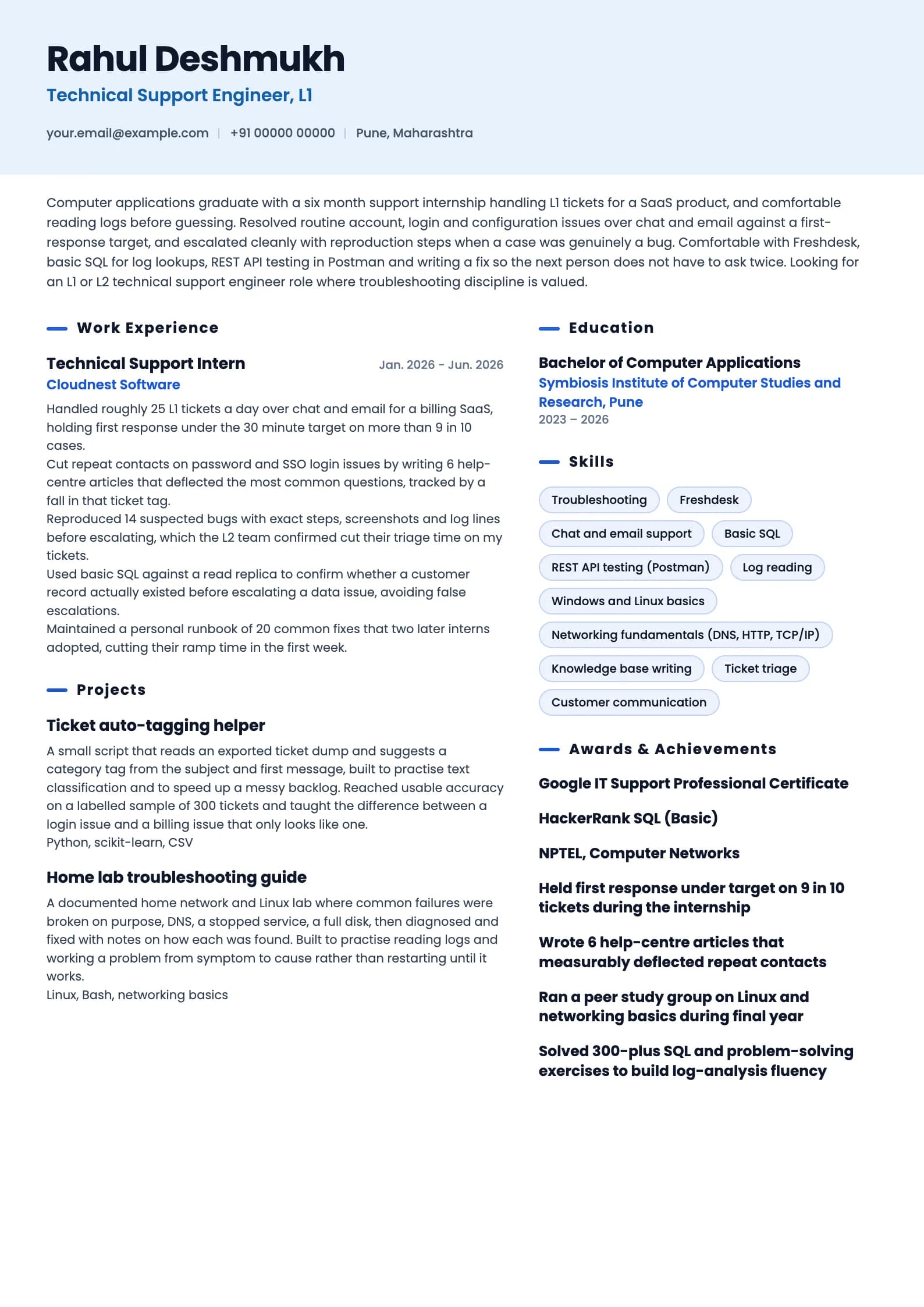
Build my resumeTechnical Support Engineer resume example, Fresher (0 to 1 year)
ai-era templateIs your resume good enough?
Upload the resume you have now and see what an applicant tracking system reads before a technical support engineer recruiter ever does.
Free to run. Sign in with your mobile number to see your score.
Technical Support Engineer resume example, L2 Engineer (4 years)
professional template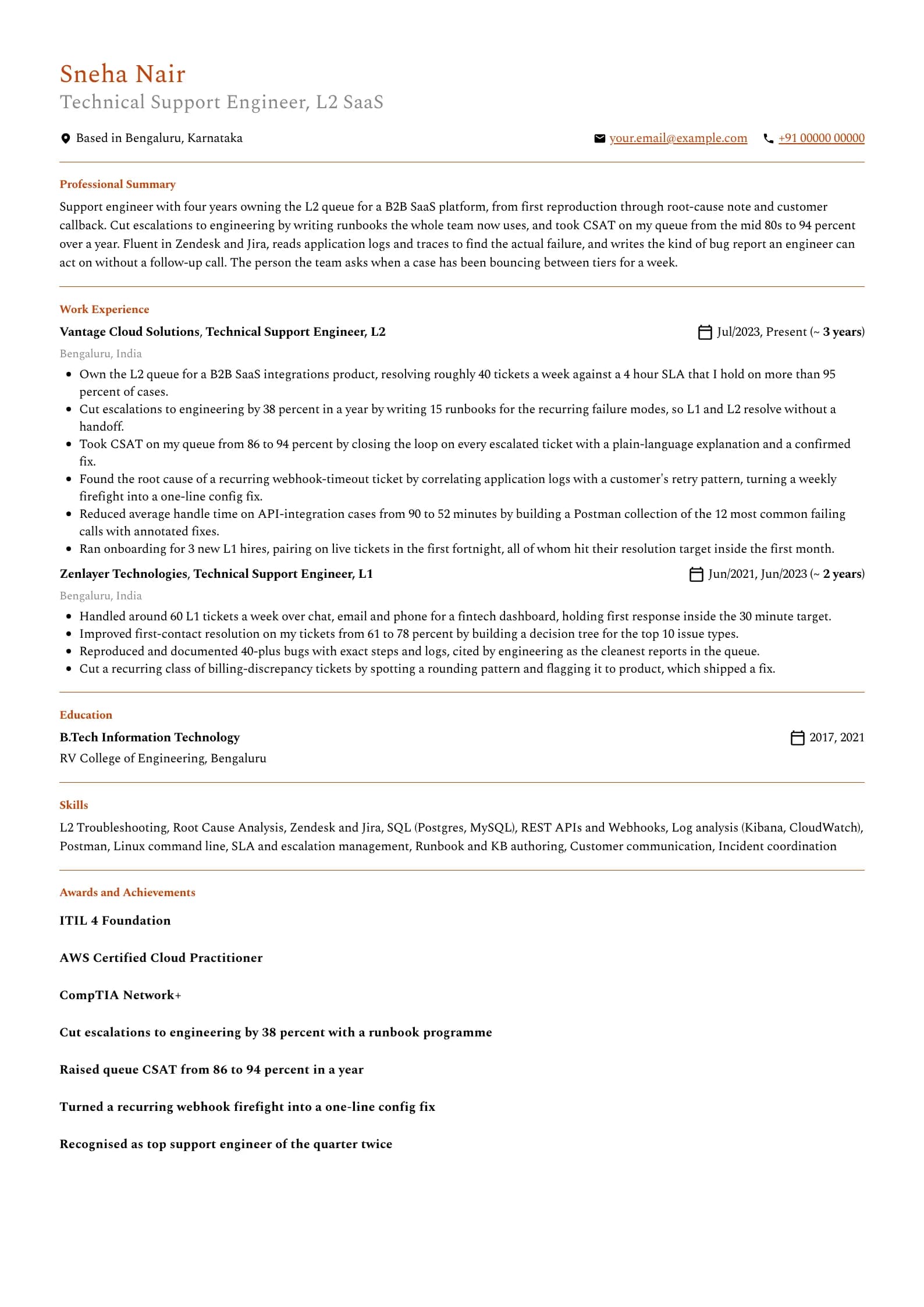
Want this structure with your own details? Build it in the resume builder.
Technical Support Engineer resume example, Senior Engineer (8 years)
header-band template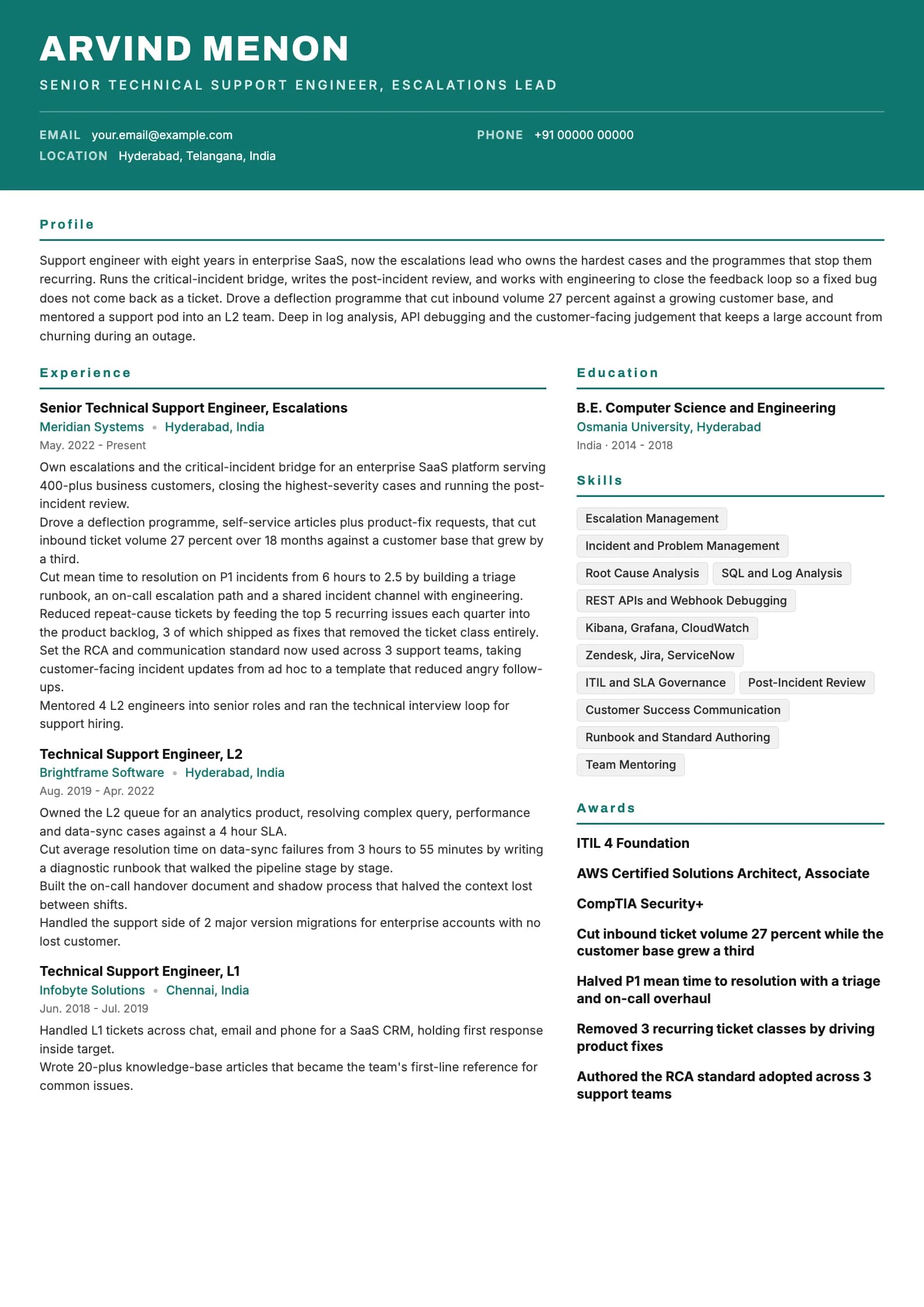
The format that works for technical support engineer resumes in India
Reverse chronological is the layout to use. Put the current support role first, work backwards, and keep the dates in plain view. Functional resumes that bury the timeline under a Skills heading read as an attempt to hide a gap or a short stint, and support hiring, where job-hopping is common, is exactly where reviewers look for that. Length follows evidence. One page covers a fresher and most engineers up to roughly six years. A senior engineer running escalations and incident programmes can justify a second page, but only if it carries real problem-management work rather than a longer list of products touched. A second page built from a hobbies line and a declaration is a padded one-page resume. Four things do not belong on a support resume here: a photograph, date of birth, marital status and father's name. They come from an older campus template and add nothing to a technical screen. Every line they take is a line an SLA number or a root-cause story could have used. Send a PDF unless the posting asks for DOCX, name the file with your own name and the target role, and keep it a single column top to bottom. Two-column layouts, common on support resumes because people cram a tools sidebar in, parse unpredictably when a parser hits the sidebar. The table below sets the section order.
| Section | Where it goes | Why |
|---|---|---|
| Name and headline | Top, above everything | The headline names the tier and product type, L2 SaaS support. Recruiters match on it. |
| Professional summary | Directly under the header | Three lines. Tier, years, and the single strongest support result. |
| Work experience | Next, for anyone with a support job | Most recent first. Current role gets the most bullets and the SLA numbers. |
| Skills | Below experience, grouped | Troubleshooting, tools, platforms, communication. Not a 30-tool wall. |
| Projects or KB work | For freshers, above experience | For a fresher, a home lab or a documented troubleshooting habit is the evidence. |
| Certifications | After skills or beside education | ITIL, CompTIA, a cloud practitioner cert. Name, body, year. |
| Education | Bottom, unless you are a fresher | Degree, institution, years. Drop the percentage after your first job. |
Naming Zendesk is not the same as proving you resolved with it
The most common support resume failure is a skills line reading Zendesk, Freshdesk, ServiceNow, Jira, Salesforce Service Cloud, Intercom with no bullet anywhere showing a ticket resolved, an SLA held or an escalation prevented. A parser matches those names, but a hiring manager reads the list and assumes you logged into each once, then goes hunting for the one you can actually talk through. The fix is to let the experience carry the support numbers. Support is one of the most measurable jobs there is, so a resume with no numbers is leaving its strongest evidence on the table. First response time, resolution time, SLA hit rate, CSAT, first-contact resolution, escalation rate, ticket deflection: each is a fact a reviewer can weigh. The L2 sample lists Zendesk and Jira precisely because its bullets show a queue held to a 4 hour SLA and escalations cut 38 percent, so the tool and the outcome agree. Be specific about the tier and the product type. L1, L2 and L3 mean different things, and a resume that says only support engineer forces the reviewer to guess. B2B SaaS support, enterprise infrastructure support and consumer app support are different jobs, so name yours. A shop hiring for API-integration support does not want a resume that could equally be for a hardware helpdesk. Do not pad with every adjacent tool you have seen a colleague use. A support resume gains far more from one bullet showing you found a root cause in the logs than from five monitoring tools listed and none proven.
For every tool on your skills line, ask: is there a bullet that shows me resolving something with it. If not, add the bullet or cut the tool. Support is measurable, so a resume with no SLA, CSAT or resolution numbers is hiding its best evidence.
Writing a support summary a hiring manager actually reads
The block under your name is the part you can count on being read, so it should carry three facts: what you support and at which tier, how long you have done it, and the strongest thing that happened because of your work. Three or four lines, no adjectives a reference could not confirm. The old objective, seeking a challenging position in a reputed organisation to utilise my technical and communication skills, tells the reader nothing the application did not already say. Replace it with a summary. An objective describes what you want; a summary describes what you have already done, and only one is evidence a screener can act on. Freshers often think they have nothing to summarise. The fresher sample names the ticket volume from an internship, the first-response performance and a genuine troubleshooting habit built in a home lab. That is a real summary drawn from one internship and some self-directed practice. What it avoids is "passionate about helping customers", a phrase so common on support resumes it now carries zero information. A practical test: read your summary and ask whether a colleague from the same queue could paste it onto their resume unchanged. If they could, it describes the queue, not you. Add the specific SLA, the specific CSAT number and the specific ownership until it stops being transferable.
Professional summary, L2 engineer
Weak
Hardworking and customer-focused technical support engineer with 4+ years of experience in Zendesk, Jira and troubleshooting, seeking a challenging role in a growth-oriented company.
Strong
Support engineer with four years owning the L2 queue for a B2B SaaS platform, from reproduction to root-cause note. Cut escalations to engineering 38 percent and raised queue CSAT from 86 to 94 percent.
The rewrite trades a tool list and self-description for a tier, an ownership scope and two verifiable support results.
Experience bullets: verb, issue, resolution and its effect
Every strong bullet in the samples has the same shape. It opens with an action verb, names the kind of issue or the specific change you made, and closes with what measurably moved. The verb says you did it. The issue tells a reviewer whether the work is relevant to their product. The number does the persuading. Start with the outcome and work backwards. Support engineers tend to write the activity first, which produces bullets like "handled customer tickets and resolved technical issues on time". Instead ask what was different after you owned the queue: an SLA hit rate rose, escalations fell, CSAT climbed, a recurring ticket disappeared, handle time dropped. Then write the sentence that ends in that fact. Vary the metric. Five CSAT numbers in a row read as one trick. Across a real support role you can honestly reach for SLA compliance, first-response time, resolution time, first-contact resolution, escalation rate, deflection and incident count. The L2 sample moves across several, which reads as genuine ownership rather than one memorised figure. Where you lack a clean number, give scope: how many tickets a week, how many products, how many runbooks written, how many customers on the platform. "Own the L2 queue for a B2B integrations product, roughly 40 tickets a week" carries weight without inventing a percentage. Allocate bullets by recency. Current role gets five or six, the previous role four or five, anything older two or three.
| Level | What bullets must prove | Typical metric |
|---|---|---|
| Fresher / L1 | You resolve routine issues and escalate cleanly | Tickets a day, first response, first-contact resolution, articles written |
| L2 (2 to 5 years) | You own a queue and find root causes | SLA hit rate, CSAT, escalation rate reduced, handle time, runbooks |
| Senior / L3 (5 to 8 years) | You own escalations and stop tickets recurring | P1 MTTR, ticket deflection, recurring classes removed, incidents |
| Lead (8 years and up) | You set standards and change how teams support | Volume deflected, churn prevented, standards set, team grown |
Experience bullet, L2 support
Weak
Responsible for handling customer tickets and resolving technical issues within the given SLA and escalating when required.
Strong
Found the root cause of a recurring webhook-timeout ticket by correlating logs with a customer's retry pattern, turning a weekly firefight into a one-line config fix.
"Responsible for" describes the job posting; the rewrite names the specific issue, how it was diagnosed and the recurring pain it removed.
Experience bullet, deflection work
Weak
Created knowledge base articles and documentation which helped in reducing the number of tickets.
Strong
Cut escalations to engineering 38 percent in a year by writing 15 runbooks for the recurring failure modes, so L1 and L2 resolve without a handoff.
Puts a number and a mechanism on quiet documentation work, so a reviewer can see the size of the effect instead of taking it on faith.
If a bullet would read identically on a teammate's resume, it is describing the queue, not you. Rewrite it until it only fits the tickets and the fix you actually owned.
The skills section: grouped by what you actually do
A support resume's skills section serves two readers with opposite tastes. The parser wants literal terms it can match, Zendesk and SQL and REST API. A hiring manager wants a short, organised list that signals what kind of support engineer you are. Grouping serves both. Group by function rather than one long line. Troubleshooting, ticketing tools, platforms and systems, and communication is a grouping that fits almost every support engineer. The exact headings matter less than the fact that structure exists. Write names the way the industry writes them: ServiceNow not Service-Now, PostgreSQL not Postgres, Kibana not kibana. A parser matches on strings. Twelve to sixteen skills is the working range. Below eight it looks thin. Above twenty it stops being a signal, and support resumes are especially prone to listing every monitoring dashboard and chat tool the company happened to use. The list is a contract: every item is a question you have agreed to answer, so a tool you cannot debug in front of an interviewer costs you more than it gains. Put the transferable technical skills forward, because they outlast any one product. SQL, log analysis, API debugging and networking fundamentals move with you to the next SaaS. A specific ticketing tool is learned in a week; the ability to read a stack trace is why they hire you.
| Group | What goes in it | How many |
|---|---|---|
| Troubleshooting | Root cause analysis, log reading, debugging, incident triage | 3 to 5 |
| Ticketing and ITSM | Zendesk, Freshdesk, Jira, ServiceNow, Salesforce Service Cloud | 2 to 3 |
| Technical | SQL, REST APIs, Postman, Linux, networking, cloud basics | 3 to 5 |
| Observability | Kibana, Grafana, CloudWatch, Splunk | 1 to 3 |
| Communication | Customer communication, KB authoring, escalation, SLA management | 2 to 4 |
Skills section
Weak
Skills: Zendesk, Freshdesk, Jira, ServiceNow, Intercom, Salesforce, Slack, MS Office, Windows, Linux, Mac, Networking, SQL, HTML, CSS, Communication, Teamwork, Hardworking, Customer Service, Fast Learner
Strong
Troubleshooting: root cause analysis, log reading, API debugging. Ticketing: Zendesk, Jira, ServiceNow. Technical: SQL, REST APIs, Postman, Linux. Observability: Kibana, CloudWatch. Communication: KB authoring, SLA and escalation management.
Cuts the office software and personality adjectives, groups the rest so a human reads it in one pass, and leads with the transferable technical skills that outlast any one tool.
Showing you troubleshoot, not just close tickets
The difference between an L1 who follows a script and an engineer worth hiring at L2 is method, and the resume is where you prove you have one. A reviewer is looking for evidence that you move from symptom to cause instead of restarting things until the customer goes quiet. That evidence is a bullet that names how you found the actual problem. The common failure is describing the volume instead of the thinking. "Resolved 40 tickets a week" tells a reviewer you were busy, not that you were good. Pair the volume with one bullet that shows depth: a log correlation that found a root cause, a reproduction that unblocked engineering, a pattern spotted across tickets that turned into a product fix. The webhook-timeout story in the L2 sample does more for the candidate than the ticket count above it. Name the tools of diagnosis, not just the tools of ticketing. SQL against a replica, a trace in Kibana, a call inspected in Postman, a packet capture, a stack trace read: these are what separate a support engineer from a call-centre agent, and they are the terms a technical interviewer will drill into. If you used them, say so in a bullet, not just on the skills line. At senior level, the strongest evidence is closing the loop back to the product. An engineer who feeds recurring issues into the backlog and removes a ticket class entirely is worth more than one who resolves the same ticket faster every week. Support that ends the work at its source is the ceiling of the role, so lead with it if you have it.
One bullet showing how you found a root cause outweighs three showing how many tickets you closed. Volume proves you were busy; a log correlation proves you can do the job they are hiring for.
Getting through the applicant tracking system
An applicant tracking system is a parser and a search index, not a judge. It reads your file, tries to split it into name, dates, employers, titles and skills, and stores the result so a recruiter can search across candidates. Almost every ATS problem is a parsing problem, and parsing problems come from layout, not wording. The layout rules are short. One column. Standard section headings, so use Work Experience rather than My Support Journey, and Skills rather than My Toolkit. No text inside images, because a strip of tool logos reads as empty space. No critical information in the header or footer region, which some parsers drop. Avoid text boxes and nested tables in the body. On wording, mirror the language of the job description where it is honest. If the posting says technical support engineer, use that title rather than support executive. If it says SLA, ITIL or root cause analysis, and you have done it, write those exact terms. Spell out an acronym alongside its short form at least once, for example "RCA (root cause analysis)", so both searches find you. Keyword stuffing does not work. A hidden block of every ticketing tool in white text is found quickly, and the outcome is worse than being filtered. Write real bullets that naturally contain the right terms, because a bullet describing an SLA you held contains the word SLA in a context that also survives human review. Save as PDF from a tool that embeds real text, then open the file and confirm you can select and copy a sentence. If you cannot select the text, neither can the parser.
Section heading
Weak
My Support Adventures
Strong
Work Experience
Parsers look for standard headings; a creative one can push the whole block into an unclassified bucket the recruiter never searches.
What gets technical support engineer resumes rejected
Most rejections at the resume stage are not close calls. They come from a small set of recurring problems, and every one is fixable in an afternoon. The list below covers what reviewers of Indian support resumes see most often, in rough order of how much damage each one does.
- A wall of ticketing and monitoring tools with no bullet showing a ticket resolved, an SLA held or a root cause found. Every tool is a question you have agreed to answer.
- No support numbers anywhere. SLA, CSAT, resolution time, escalation rate, deflection. Support is measurable, so this is the worst omission on the page.
- No tier stated. L1, L2 and L3 are different jobs, and support engineer alone forces the reviewer to guess your level.
- Volume without method. "Resolved 40 tickets a week" proves you were busy; it does not prove you can find a root cause.
- Job duties copied from the posting instead of what you did. "Responsible for resolving issues within SLA" is the tell.
- A photo, date of birth, marital status or father's name. None of it belongs on a technical resume, and it takes a result's space.
- A generic objective line. Replace it with a summary that states tier, years and one result.
- Only the day's ticketing tool listed, with none of the transferable skills, SQL, logs, APIs, that actually move with you to the next SaaS.
- Inflated titles or dates that do not match your offer letters. Background verification is standard and a mismatch ends the process.
- Typos in the tools you claim to know, ServiceNow written as Servicenow or Kibana as Kibaba, which undoes an otherwise strong page.
Read your resume aloud once before sending it. Any bullet you would be embarrassed to defend to an interviewer is a line to cut or rewrite.
Skills to put on a technical support engineer resume
Technical
- Troubleshooting and Root Cause Analysis
- SQL (Postgres, MySQL)
- REST APIs and Webhooks
- Log Analysis
- Linux Command Line
- Networking Fundamentals (DNS, HTTP, TCP/IP)
- Cloud Basics (AWS, Azure)
- Incident Triage
- Scripting (Python, Bash)
- API Testing
- Windows and Active Directory basics
- Debugging
Tools and platforms
- Zendesk
- Freshdesk
- Jira
- ServiceNow
- Salesforce Service Cloud
- Postman
- Kibana
- Grafana
- CloudWatch
- Splunk
- Slack
- Confluence
Working skills
- Customer communication
- Escalation management
- SLA discipline
- Knowledge base authoring
- Patience under pressure
- Cross-team collaboration
- Incident coordination
- Mentoring
- Clear written explanation
Certifications worth listing as a technical support engineer
| Certification | Full name | Worth it for |
|---|---|---|
| ITIL 4 Foundation | ITIL 4 Foundation | The most-asked-for support credential in Indian job postings, worth it for anyone working incidents, problems and SLAs. It gives you the shared vocabulary, incident, problem, change, that enterprise support teams run on, and it reads well from L1 upward. Beyond foundation level the intermediate modules matter mainly for support-management roles. |
| CompTIA Network+ | CompTIA Network+ | A solid signal for support engineers whose product touches networking, DNS, HTTP, firewalls, connectivity issues. Worth it in the first few years to prove fundamentals on paper, especially for infrastructure or platform support. Less necessary once you have years of production troubleshooting to point at. |
| AWS CCP | AWS Certified Cloud Practitioner | Worth it for support engineers on cloud-hosted SaaS who want the cloud keyword and a shared vocabulary with engineering. Entry level and quick, it pairs naturally with SaaS support. Move to the associate-level developer or SysOps track if your work goes deeper into the platform. |
| Google IT Support | Google IT Support Professional Certificate | A practical starter credential for freshers and career switchers with no formal IT background. It covers helpdesk fundamentals, troubleshooting method and basic systems, and reads well on a first support resume. Redundant once you hold ITIL or have a year of real support experience. |
| CompTIA A+ | CompTIA A+ | The classic entry hardware and OS credential, most useful for support roles that still touch endpoints and devices. Strong on a fresher or helpdesk-adjacent resume, less relevant for pure SaaS or API support where the issues live in software, not machines. |
Keywords an ATS scans for in a technical support engineer resume
These are the literal terms a parser matches against the job description. Use the ones that are true of you, in the sentences where you did the work, not as a list at the bottom.
- technical support engineer
- l2 support
- troubleshooting
- root cause analysis
- ticketing
- zendesk
- jira
- servicenow
- SLA
- ITIL
- escalation management
- SQL
- REST API
- log analysis
- incident management
- CSAT
- customer support
- knowledge base
- linux
- SaaS support
Technical Support Engineer resume FAQ
What salary can a technical support engineer expect in India?
A fresher or L1 typically starts around 3 to 5.5 LPA, higher in product SaaS companies than in large outsourced support. An L2 engineer with four to six years owning a queue usually sits in the 7 to 14 LPA band. Senior and escalation engineers with seven years and above commonly earn 16 to 30 LPA, and support-team leads more. Strong troubleshooting depth, SQL and API debugging, plus a product-SaaS background rather than call-centre support, pushes the top of every band upward.
How long should a technical support engineer resume be?
One page up to about six years, two pages after that only if the second page carries real escalation or problem-management work rather than a longer product list. Nobody is rejected for a resume that is easy to read. If you are struggling to fit one page, cut the oldest role to a single line, remove coursework, and delete any tool you would not want to be interviewed on.
Should I list L1, L2 or L3 on my resume?
Yes, always name your tier in the headline and summary. L1, L2 and L3 are genuinely different jobs, front-line triage versus root-cause ownership versus deep engineering escalation, and a resume that says only support engineer forces the reviewer to guess your level. Naming the tier also lets you apply to the right band instead of being screened for the wrong one.
What metrics should a support engineer put on a resume?
Support is one of the most measurable jobs there is, so use its numbers. First response time, resolution time, SLA hit rate, CSAT, first-contact resolution, escalation rate and ticket deflection are all facts a reviewer can weigh. Vary them across your bullets rather than repeating CSAT five times, and pair a volume figure with at least one bullet that shows how you found a root cause, so the resume proves method and not just busyness.
Do certifications like ITIL help for support roles?
ITIL 4 Foundation is the single most-requested support credential in Indian postings and is worth holding from L1 upward, because it gives you the incident, problem and change vocabulary that enterprise teams run on. CompTIA Network+ and a cloud practitioner cert help when your product touches networking or cloud. As with any role, once you have years of real troubleshooting to point at, the certificate matters less than the work.
How do I write a support resume as a fresher?
Lead with any support internship, then projects, then skills and education. Treat a home lab, a documented troubleshooting habit or a small automation as evidence: name what you diagnosed and how you found it, not just the tools. Add anything checkable, an ITIL or Google IT Support certificate, a SQL score, articles you wrote, since verifiable facts carry more weight than "passionate about helping customers". Escalating cleanly with reproduction steps is a real, nameable skill even at L1.
Should I focus on tools or troubleshooting on my resume?
Troubleshooting, every time. A specific ticketing tool is learned in a week, but the ability to read a log, correlate it with a customer's behaviour and find the actual cause is why they hire you. List the tools you have used, but spend your bullets on how you diagnosed and resolved things. The transferable technical skills, SQL, API debugging, log analysis, networking, are what move with you to the next product and the next salary band.
Does an ATS reject support resumes with two columns?
It does not reject them outright, but some parsers read multi-column layouts out of order, which interleaves your tools sidebar with your experience and produces nonsense in the recruiter's view. Support resumes are prone to this because people cram a tools column in. A single-column layout removes the risk, which is why all three samples above use one. Copy the text out of your PDF into a plain editor; if it reads in order there, it will most likely parse correctly.
Do I need a photo on a support engineer resume in India?
No. Tech recruiters do not expect one, and it takes space a support result should occupy. The same goes for date of birth, marital status, father's name, nationality and a declaration paragraph. These come from an older template that spread through campus placement cells and add nothing to a technical screen. The only exception is a customer-facing role that explicitly asks for a photograph in the posting.
Related resume examples and guides
Build your own in any of these formats
Start from a blank resume or upload the one you have. Goodspace renders it in 24 templates and flags the SLA, ITIL and troubleshooting keywords an applicant tracking system will look for, and the tool-list padding it will not credit.
Build my resume