Solution Architect Resume Format, with 3 Full Samples
A solution architect is hired on evidence of decisions that held up, systems that scaled without a rewrite and delivery teams that shipped because the design was right. Yet most architect resumes read like a technology inventory, every cloud service and framework listed and not one trade-off explained. Below are three complete resumes, one for an application architect stepping up from senior engineering, one for a solution architect owning cloud migrations at enterprise scale, and one for a principal architect setting direction across a portfolio. After the samples come the format rules, the difference between naming AWS and proving you chose it correctly, the terms a parser matches literally, and the mistakes that end a screening before an interview panel ever forms.
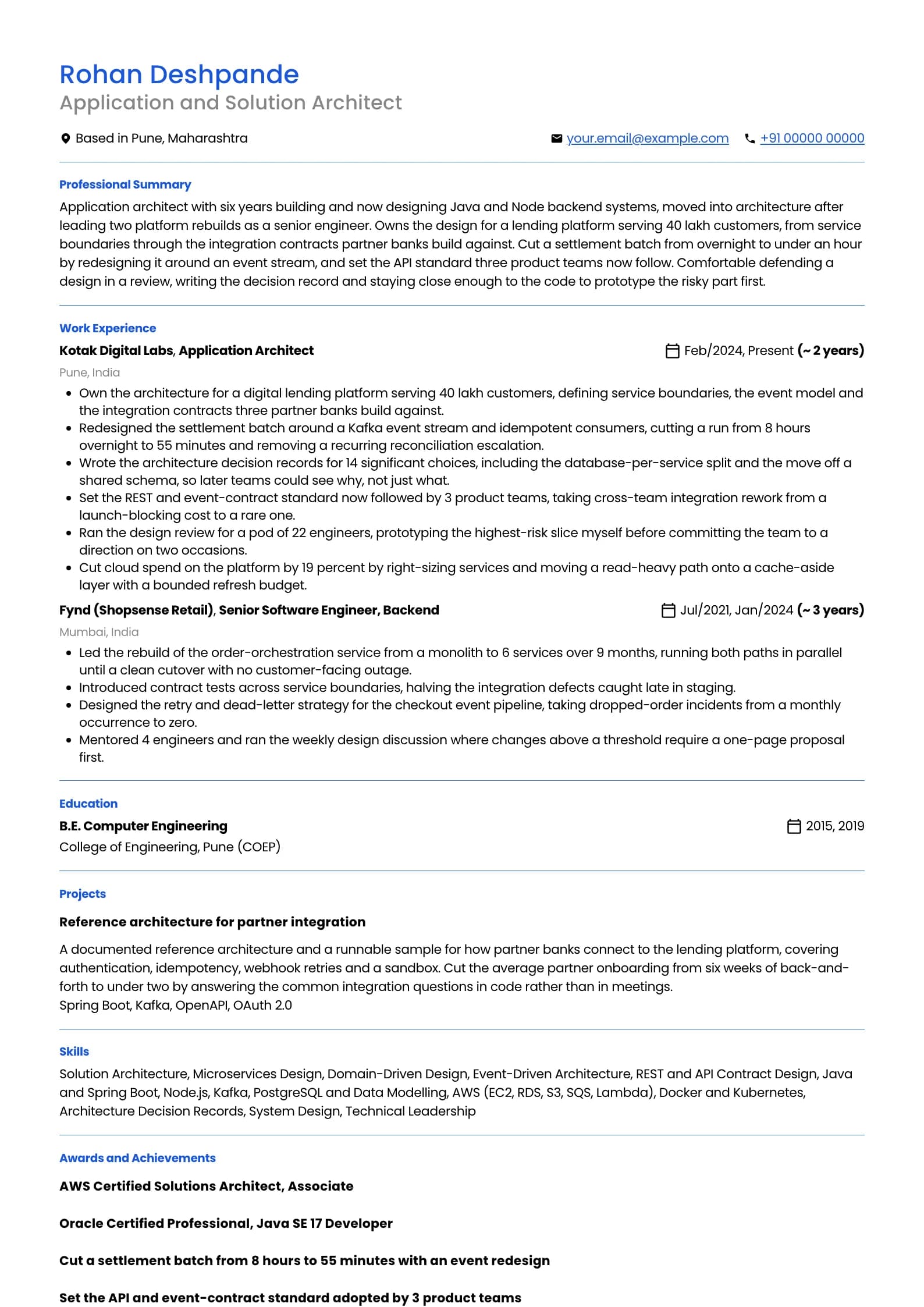
Build my resumeSolution Architect resume example, Application Architect (6 years)
professional templateIs your resume good enough?
Upload the resume you have now and see what an applicant tracking system reads before a solution architect recruiter ever does.
Free to run. Sign in with your mobile number to see your score.
Solution Architect resume example, Solution Architect (10 years)
header-band template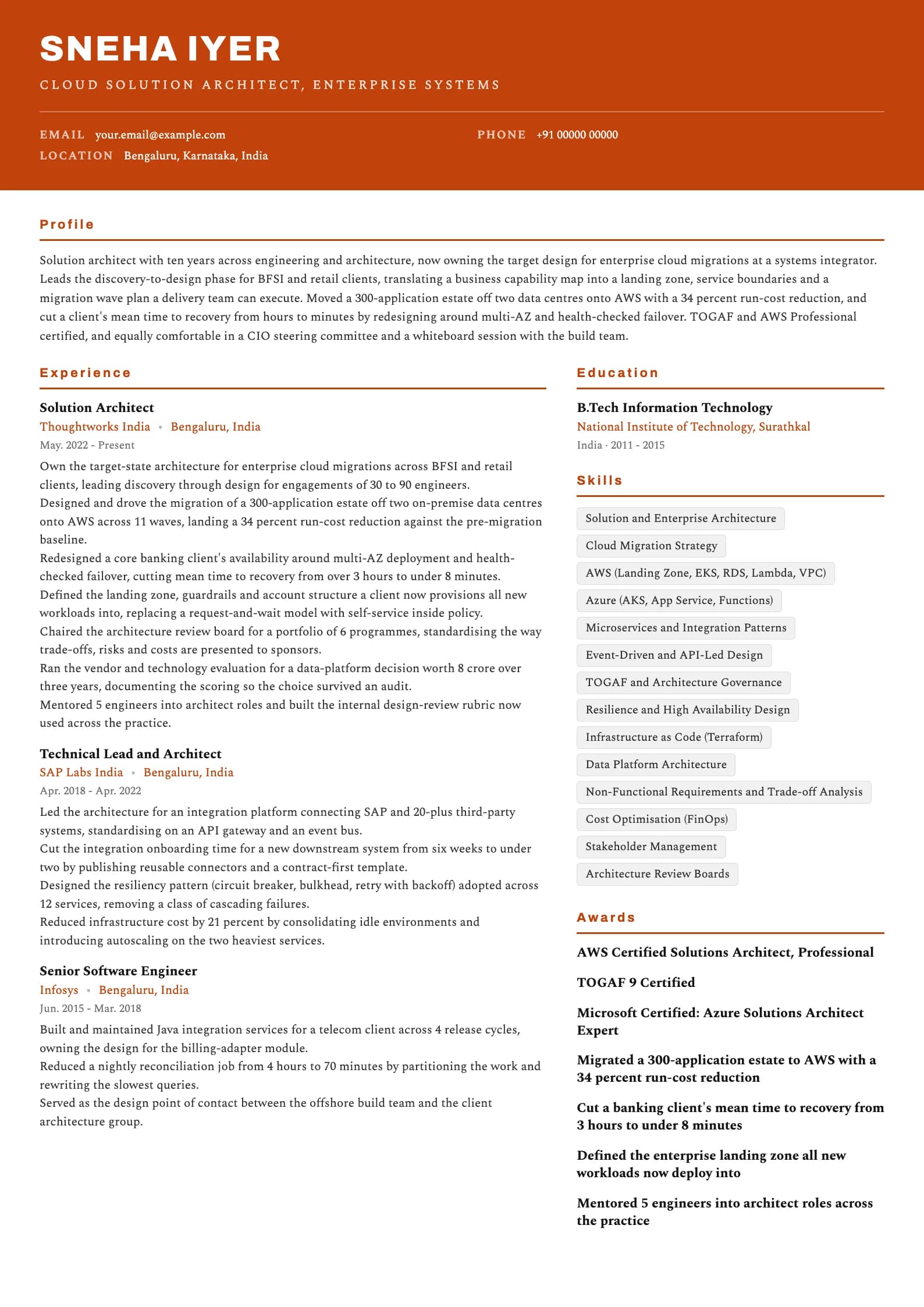
Want this structure with your own details? Build it in the resume builder.
Solution Architect resume example, Principal Architect (15 years)
modern template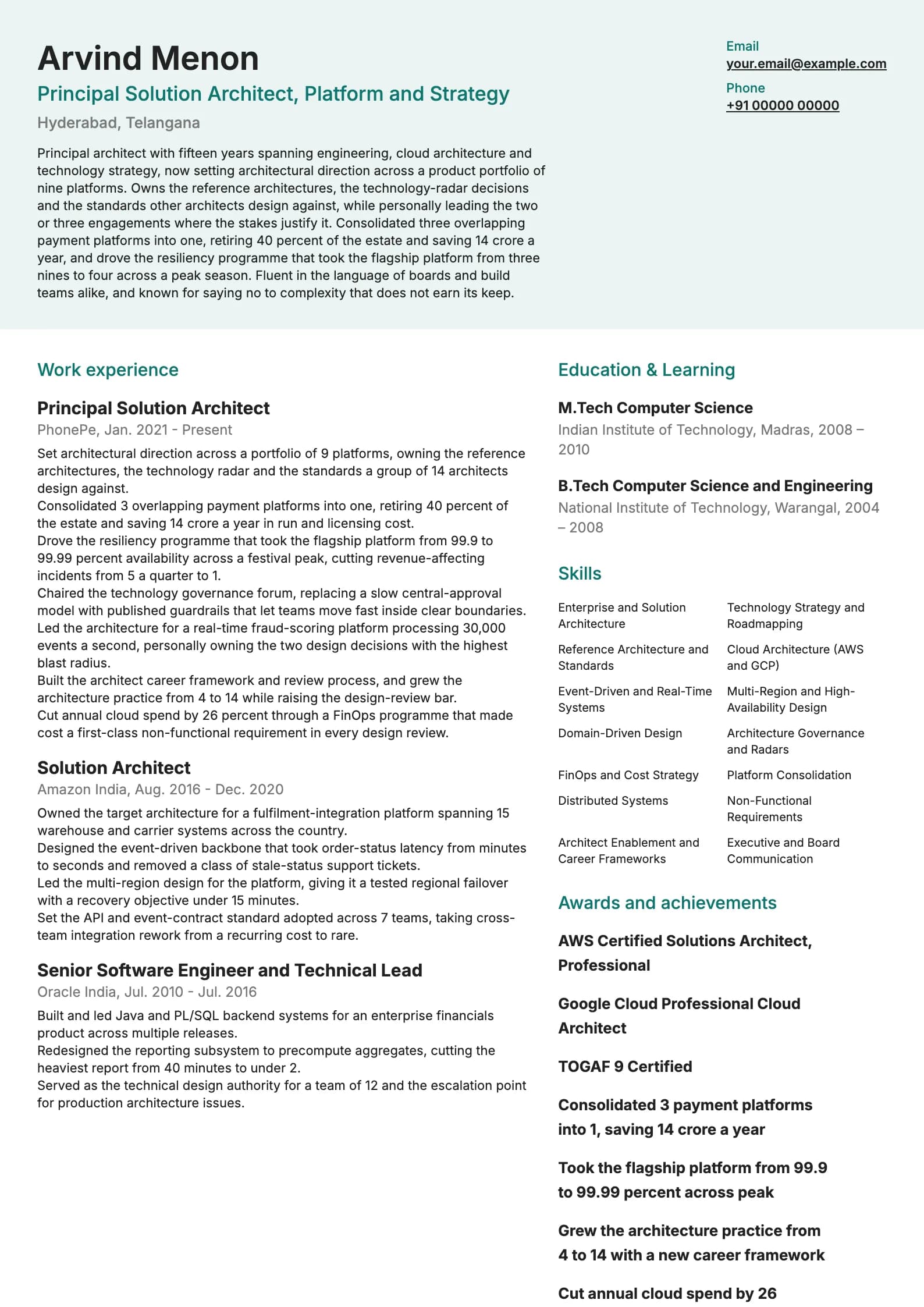
The format that works for solution architect resumes in India
Reverse chronological is the only layout worth using. Put the most recent role first, work backwards, and keep the dates in plain view. Functional resumes that group everything under Skills and drop the timeline read as an attempt to hide something, and for a role built on accountability that is the worst first impression you can make. Length is different for architects than for engineers. Two pages is normal and expected past about eight years, because the job is a portfolio of decisions and outcomes that genuinely need the space. What a second page must not be is a longer technology list. The reviewer is looking for scope, trade-offs and results, so a page two that carries three real engagements is right and a page two that carries a certifications wall and a hobbies line is padding. Lead with a summary that states what you architect, at what scale, and the strongest outcome you drove. An architect who buries the scope, enterprise or startup, greenfield or migration, ten engineers or a hundred, forces the reviewer to guess, and a busy reviewer guesses low. Four things belong nowhere on this resume: a photograph, date of birth, marital status and father's name. They survive from an older campus template and take space a decision record or a migration outcome should occupy. Send a PDF unless the posting asks for DOCX, use a single column all the way down because two-column layouts parse unpredictably, and name the file with your own name and the target role. The table below sets out the section order.
| Section | Where it goes | Why |
|---|---|---|
| Name and headline | Top, above everything | The headline is the role and specialism, solution or cloud architect. Recruiters match on it. |
| Professional summary | Directly under the header | Three or four lines. What you architect, at what scale, the single strongest outcome. |
| Core competencies | Optional band under the summary | A short grouped strip of architecture domains, useful for the parser and a fast human scan. |
| Work experience | Next, the heart of the resume | Most recent first. Decisions owned, scope, and what measurably changed. |
| Skills and platforms | Below experience | Grouped: architecture, cloud, integration, data, governance. Not a 50-item wall. |
| Certifications | After skills or beside it | TOGAF, AWS or Azure Professional, GCP Architect. Name, body, year. |
| Education | Bottom | Degree, institution, years. Drop the percentage after your first job. |
Naming AWS is not the same as proving you chose it
The single most common solution architect resume failure is a page that lists every cloud service and framework the candidate has been near, EC2, Lambda, EKS, Kafka, RabbitMQ, Terraform, Kubernetes, Istio, Kong, and never once shows a decision. A parser matches those terms, but an interview panel reads the inventory and asks the only question that matters: what did you choose, what did you choose it over, and why. If the resume cannot answer that, the technology list actively works against you. The job of an architect is trade-offs, so the resume has to show them. Instead of "used Kafka and microservices", write what the design achieved and the constraint it respected: an event stream that took a batch from overnight to under an hour, a database-per-service split with the decision record that explains why the shared schema was retired. The samples above name service boundaries, failover designs, landing zones and consolidation decisions, because those are architect artefacts. A service name on its own is an engineer artefact. Be specific about scale and context, because an architecture is only right relative to its constraints. A design for 40 lakh customers, a 300-application migration, a 30,000-events-a-second pipeline: the number tells the reviewer whether your judgement was formed at the scale their role needs. "Designed a scalable microservices architecture" without a number is the phrase every architect writes and none can defend. Do not list a technology you cannot defend in a design discussion. An architect interview is a trade-off conversation, and a service on your resume you have only read about is a trap you set for yourself. If Istio is on the page, be ready to explain why a service mesh, and what you would lose by not having one.
For every technology on your page, ask: can I name what I chose it over and why. If not, it is decoration. An architect resume is a record of decisions, and a decision has an alternative you rejected.
Writing a summary a hiring panel actually reads
The block under your name is the part you can be reasonably sure gets read, so it should carry four facts: what you architect, at what scale, the domains you work in, and the single strongest outcome your designs produced. Three or four lines, no adjectives a reviewer cannot check. The old objective line, seeking a challenging architect role in a reputed organisation to utilise your technical skills, tells the panel nothing they did not assume from the application. Replace it with a summary. An objective describes what you want, a summary describes the systems you have already shaped, and only one is evidence for a role that is entirely about judgement. An engineer moving into architecture often writes a summary that still reads like a senior developer: frameworks, languages, years. The step up is to lead with design ownership. Look at the application-architect sample: it names the platform, the scale, the decisions owned and one hard outcome. That is a summary built from real architecture work, not a longer skills line. A practical test: read your summary and ask whether a senior engineer with the same certifications could paste it onto their resume unchanged. If they could, it describes a skill set, not an architect. Add the specific system, the specific scale and the specific decision until it could only be yours.
Professional summary, solution architect
Weak
Results-oriented solution architect with 10+ years of experience in AWS, Azure, microservices and Kubernetes seeking a challenging architecture role in a reputed organisation.
Strong
Solution architect with ten years owning the target design for enterprise cloud migrations across BFSI and retail. Moved a 300-application estate onto AWS with a 34 percent run-cost cut and took a banking client's recovery time from 3 hours to under 8 minutes.
The rewrite trades a platform list and self-description for a domain, a migration scale and two outcomes a sponsor would recognise.
Experience bullets: decision, scope, consequence
Every strong bullet in the samples follows the same shape. It names the decision or design you owned, states the scope it applied at, and closes with what measurably moved. The decision establishes it was architecture, not coding. The scope tells a reviewer whether it is relevant to their scale. The number does the persuading. Start with the outcome and work backwards. Architects often write the responsibility first, then struggle to attach a result, which produces bullets like "responsible for the overall architecture of the platform". Instead ask what was different because of a design you drove: a cost dropped, an estate shrank, availability rose, a recovery time fell, an integration went from weeks to days, a class of incident disappeared. Then write the sentence that ends in that fact. Vary the metric. An architect can honestly reach for run cost, availability in nines, recovery time, migration scale, throughput, integration lead time, incident count and estate size. A page of nothing but cost percentages reads as one trick; a page that moves across several outcome types reads as range and judgement. Where you lack a clean number, give scope: how many applications migrated, how many systems integrated, how many teams adopted a standard, how many engineers a design served. "Set the event-contract standard adopted across 7 teams" carries weight without inventing a percentage. Show governance and enablement, not only designs. Chairing a review board, writing the standards, growing an architecture practice: these are architect-specific bullets that a senior engineer cannot claim, and they are exactly what distinguishes the levels. The table below maps what each level must prove.
| Level | What bullets must prove | Typical metric |
|---|---|---|
| Application architect | You own the design of a system and defend the trade-offs | Service boundaries, latency, integration lead time, decision records |
| Solution architect | You own the target design and drive it through delivery | Migration scale, run cost, availability, recovery time |
| Senior or lead architect | You govern designs across programmes and set standards | Estate consolidated, standards adopted, review-board scope |
| Principal architect | You set direction across a portfolio and grow the practice | Portfolio cost, nines at peak, architects mentored, radar decisions |
Experience bullet, cloud migration
Weak
Responsible for migrating multiple applications to the cloud using AWS services and best practices.
Strong
Designed and drove the migration of a 300-application estate off two data centres onto AWS across 11 waves, landing a 34 percent run-cost reduction against the baseline.
"Responsible for" and "best practices" describe a job posting; the rewrite names the estate size, the approach and the cost outcome a reviewer can probe.
Experience bullet, availability work
Weak
Improved the availability and reliability of the platform by implementing high availability architecture.
Strong
Redesigned a core banking client's availability around multi-AZ deployment and health-checked failover, cutting mean time to recovery from over 3 hours to under 8 minutes.
Names the specific pattern and the before and after, so the panel can ask a real design question instead of nodding at a generic claim.
If a bullet would read identically on a senior engineer's resume, it is not architecture. Rewrite it around the decision you owned, the alternative you rejected, and the outcome across the scope it applied to.
The skills section: grouped, defensible, and honest about depth
A solution architect's skills section has two audiences with opposite preferences. The parser wants literal platform terms, AWS and Kubernetes and Kafka. A hiring panel wants a short, organised map of the architecture domains you actually own. Grouping satisfies both. Group by domain rather than one long line. Architecture and design, cloud platforms, integration, data, governance and cost is a grouping that works for almost every solution architect. The exact headings matter less than the fact that structure exists, so a reviewer can see at a glance that you think in domains, which is the job. Write names the way the industry writes them: Kubernetes not K8s on the first mention, PostgreSQL not Postgres, Terraform not terraform. Sixteen to twenty grouped skills is the working range for an architect, wider than an engineer's list because the role legitimately spans more. What kills it is the multi-cloud, every-service inventory: listing all of AWS, Azure and GCP with a dozen services each signals breadth without depth, which is the exact opposite of what an architect is hired for. List the platforms you have actually designed on, and let the experience carry the depth. Do not include a proficiency bar. Star ratings invite an argument you cannot win, and no panel agrees on what four stars in Kubernetes means for an architect. The experience section is where depth is proven, so let it do that job. Every domain on the skills line is a design conversation you have agreed to have.
| Group | What goes in it | How many |
|---|---|---|
| Architecture and design | Solution, microservices, event-driven, domain-driven, DDD | 3 to 5 |
| Cloud platforms | AWS, Azure or GCP, and the services you have designed on | 3 to 5 |
| Integration | API gateway, event bus, Kafka, REST and contract design | 2 to 4 |
| Data | PostgreSQL, data modelling, caching, data-platform patterns | 2 to 4 |
| Governance and NFRs | TOGAF, review boards, resilience, security, FinOps | 3 to 5 |
Skills section
Weak
Skills: AWS, EC2, S3, Lambda, ECS, EKS, RDS, DynamoDB, SQS, SNS, Azure, AKS, GCP, GKE, Kubernetes, Docker, Terraform, Ansible, Jenkins, Kafka, RabbitMQ, Istio, Kong, Java, Spring, Node, Python, Go, MongoDB, Oracle, MS Office
Strong
Architecture: solution design, event-driven, DDD. Cloud: AWS (EKS, RDS, Lambda, VPC), Azure (AKS). Integration: API gateway, Kafka, contract-first REST. Data: PostgreSQL, caching, data modelling. Governance: TOGAF, review boards, resilience, FinOps.
Cuts the every-service inventory to the platforms you have designed on, groups by domain so a panel reads it in one pass, and drops the padding that signals breadth without depth.
Diagrams, decision records and the evidence an architect leaves behind
An architect's work is largely invisible on a resume unless you name the artefacts. Engineers point at code; architects point at the things a good architect produces: decision records, reference architectures, standards, review-board rubrics, migration plans and the diagrams teams actually build from. Naming these is how you make design work concrete for a reviewer who cannot see the systems. Decision records are the single most powerful artefact to cite, because they prove you reason in writing and leave a trail. "Wrote the architecture decision records for 14 significant choices" tells a reviewer you do not just decide, you document why, which is exactly the discipline that separates an architect a team can follow from one whose reasoning dies in a meeting. If you use a standard format such as ADRs or the arc42 template, say so. Reference architectures and standards are the multiplier artefacts. A design you drew once serves one project; a reference architecture or an API standard serves every team that adopts it, so a bullet that names how many teams adopted a standard shows leverage. The samples cite standards adopted across three and seven teams for exactly this reason. Be careful with diagrams. Do not paste a boxes-and-arrows diagram into the resume itself, because it will not survive parsing and it eats space. Instead, name the modelling you did, C4 model, sequence diagrams for the risky flows, a capability map, and keep any actual diagrams for a portfolio you can share on request. The resume states that the design work happened and at what scale; the interview is where the diagram comes out. If you have public writing, an architecture blog, a conference talk, an open reference implementation, name it in plain text. For an architect, evidence of thinking in public is a strong differentiator, because so much of the job is explaining a design to people who did not draw it.
Design work description, architect resume
Weak
Created architecture diagrams and design documents for various projects and presented them to stakeholders.
Strong
Wrote the architecture decision records for 14 significant choices, including the database-per-service split, and modelled the risky flows with C4 and sequence diagrams the build team worked from.
Swaps a vague "diagrams and documents" line for named artefacts, a specific decision and the modelling notation, all of which a reviewer can ask about.
Which certifications carry weight, and when they stop mattering
For a solution architect in India, certifications matter more than for most engineering roles, because enterprise clients and systems integrators genuinely filter on them, and a client contract sometimes requires a certified architect on the account. The three that carry real weight are the cloud professional-level architect certifications (AWS Solutions Architect Professional, Azure Solutions Architect Expert, Google Professional Cloud Architect) and TOGAF for enterprise-architecture governance. Match the certification to the work. If you design on AWS, the AWS Solutions Architect Professional is the credential a reviewer expects to see, and the associate is the entry point on the way there. If your world is enterprise architecture, capability maps and governance, TOGAF signals you speak that language. Holding all three cloud architect certifications at once can read as certification collecting rather than depth, so prioritise the platform you actually design on. Certifications carry the most weight in the associate-to-senior range and in consulting or systems-integrator hiring, where they are sometimes a contractual requirement. At principal level, a portfolio of consolidations, migrations and platform outcomes outranks any badge, so keep the list short and let the engagements be the credential. An expired certification listed as current is a small dishonesty that is easy to catch in a role built on trust, so renew it or remove it. Place certifications just below the skills section, or beside it if you hold only two, with the full name, the issuing body and the year. For an architect, one well-chosen professional certification and TOGAF says more than a stack of associate badges across three clouds.
Getting through the applicant tracking system
An applicant tracking system is a parser and a search index, not a judge. It reads your file, tries to break it into name, dates, employers, titles and skills, and stores the result so a recruiter can search across candidates. For architect roles the searches are specific, solution architect, cloud architect, AWS, TOGAF, microservices, and almost every failure is a parsing problem, not a wording one. The layout rules are short. One column, because a two-column architect resume with a skills sidebar is exactly the layout that parses out of order. Standard section headings, so Work Experience rather than My Journey, and Skills rather than My Toolbox. No text inside images, because a cloud-logo strip reads as empty space. No critical information in the header or footer region, which some parsers drop. Avoid text boxes and nested tables in the resume body. On wording, mirror the job description where it is honest. If the posting says solution architect, the title on your page should match rather than reading only application architect or technical lead. If it says AWS, write AWS. Include the expansion alongside an acronym at least once, for example "TOGAF (the open group architecture framework)", so both searches find you. Keyword stuffing does not work, and architect resumes are prone to a specific version of it, a hidden block of every cloud service in tiny text. Recruiters find it quickly and the outcome is worse than being filtered. Write real bullets that naturally contain the right terms, because a bullet describing a landing zone you designed contains the words landing zone in a context that survives the human read too. Save as PDF from a tool that embeds real text, then open the file and confirm you can select and copy a sentence. If you cannot select the text, neither can the parser.
Section heading
Weak
My Architecture Odyssey
Strong
Work Experience
Parsers look for standard headings; a creative one can push the entire block into an unclassified bucket the recruiter never searches.
Test your own file before you send it. Copy the text out of the PDF into a plain text editor. Whatever you can read there is roughly what the parser sees, and anything scrambled is a real risk for a role where recruiters search on exact platform terms.
What gets solution architect resumes rejected
Most rejections at the resume stage are not close calls. They come from a small set of recurring problems, and all of them are fixable in an afternoon. The list below covers what reviewers of Indian solution architect resumes see most often, in rough order of how much damage each one does.
- A technology inventory with no decisions. Every cloud service and framework listed, not one trade-off explained. An architect is judged on choices, not exposure.
- No scale or context anywhere. "Designed a scalable microservices architecture" with no number tells the reviewer nothing about the judgement behind it.
- Reads like a senior engineer, not an architect. Frameworks and languages front and centre, no design ownership, no governance, no artefacts.
- Responsibilities copied from a job description. "Responsible for the overall architecture" is the tell; it describes a role, not a result you produced.
- Certification collecting. Every associate badge across three clouds, signalling breadth without the depth an architect is actually hired for.
- A wall of unproven platforms you cannot defend in a design discussion. An architect interview is a trade-off conversation, so each item is a trap you set.
- No business impact. Availability, run cost, migration scale, recovery time. A design with no outcome a sponsor cares about reads as an exercise.
- A photo, date of birth, marital status or father's name. None of it belongs on this resume, and it takes space a decision or a migration should use.
- A one-page resume forced past ten years, cramming a portfolio of engagements into a summary so dense none of it lands.
- Inflated titles or dates that do not match your payslips and offer letters. Background verification is standard and a mismatch ends a senior process fast.
For every bullet, ask whether it names a decision, a scope and an outcome. An architect resume that only lists technologies and responsibilities is describing a very senior engineer, and the panel will hire one for less.
Skills to put on a solution architect resume
Technical
- Solution Architecture
- Enterprise Architecture (TOGAF)
- Microservices and Event-Driven Design
- Domain-Driven Design
- Cloud Architecture (AWS, Azure, GCP)
- Cloud Migration Strategy
- API and Integration Design
- High Availability and Resilience Design
- Multi-Region Architecture
- Data and Platform Architecture
- Non-Functional Requirements
- Infrastructure as Code
- Security Architecture
- Cost Optimisation and FinOps
Tools and platforms
- AWS (EKS, RDS, Lambda, VPC, SQS)
- Azure (AKS, App Service, Functions)
- Kubernetes and Docker
- Kafka
- Terraform
- API Gateway (Kong, APIM)
- PostgreSQL
- C4 Model and Diagramming
- Confluence and ADR Tooling
- Jenkins and CI/CD
- Grafana and Observability
- Draw.io and Lucidchart
Working skills
- Architecture governance
- Stakeholder and executive communication
- Trade-off analysis
- Design review facilitation
- Technical leadership
- Mentoring and architect enablement
- Vendor and technology evaluation
- Written decision-making
- Cross-functional collaboration
Certifications worth listing as a solution architect
| Certification | Full name | Worth it for |
|---|---|---|
| AWS SA Pro | AWS Certified Solutions Architect, Professional | The credential enterprise clients and systems integrators most expect from an architect who designs on AWS, and sometimes a contractual requirement on an account. Most valuable from mid-senior level upward once you have real AWS design behind you. The associate is the entry point on the way to it. |
| TOGAF | The Open Group TOGAF 9 Certified | The standard signal for enterprise-architecture governance, capability mapping and working with an architecture review board. Worth it for architects moving into enterprise architecture or consulting, where the vocabulary is expected. Less relevant for a hands-on application architect who mostly designs single systems. |
| Azure SA Expert | Microsoft Certified: Azure Solutions Architect Expert | The equivalent professional-level credential for architects who design on Azure, common in BFSI and enterprise shops standardised on Microsoft. Prioritise it over the AWS or GCP tracks only if Azure is the platform you actually design on, since holding all three reads as collecting rather than depth. |
| GCP PCA | Google Cloud Professional Cloud Architect | The professional cloud-architect certification for teams building on Google Cloud, strongest in data-heavy and analytics-led organisations. Worth it when GCP is your primary platform. Like the other cloud architect certifications, its value fades at principal level where a portfolio of platform outcomes outranks any badge. |
| CKA | Certified Kubernetes Administrator | A hands-on credential worth it for architects whose designs lean heavily on Kubernetes and who want to prove they understand the platform they are asking teams to run on, not just draw it. Skip it if your architecture work stays above the container-orchestration layer. |
Keywords an ATS scans for in a solution architect resume
These are the literal terms a parser matches against the job description. Use the ones that are true of you, in the sentences where you did the work, not as a list at the bottom.
- solution architect
- cloud architect
- enterprise architecture
- TOGAF
- AWS
- azure
- microservices
- event-driven architecture
- domain-driven design
- cloud migration
- high availability
- API design
- kubernetes
- kafka
- architecture decision records
- non-functional requirements
- system design
- terraform
- FinOps
- stakeholder management
Solution Architect resume FAQ
What salary can a solution architect expect in India?
An application architect stepping up from senior engineering with around six years usually sits in the 20 to 32 LPA band. A solution architect with ten years owning enterprise migrations commonly earns 30 to 55 LPA, higher at strong product companies and top consultancies. Principal and enterprise architects with fifteen years and above frequently earn 55 LPA to 1 crore and more at leading firms. A professional-level cloud architect certification, TOGAF and a track record of migrations or consolidations push the top of every band upward, and BFSI and product companies pay above services rates for the same experience.
How long should a solution architect resume be?
One page is fine only if you are just moving into architecture with under about six years. Past that, two pages is normal and expected, because the job is a portfolio of decisions and outcomes that need the space. What a second page must not be is a longer technology list. Fill it with real engagements, the scope you owned and what changed, and cut the oldest roles to a line or two so the recent, senior work gets the room.
How is an architect resume different from a senior engineer's?
A senior engineer's resume proves they build systems; an architect's proves they decide how systems get built and defend the trade-offs. The shift is from frameworks and features to decisions, scope and governance. Lead with design ownership, name the artefacts you leave behind such as decision records and standards, and state scale in the client's units, cost, availability, migration size. If your resume still reads as a very senior developer, a panel will hire one for less.
Do certifications like TOGAF and AWS Professional actually matter?
For architects in India, yes, more than for most engineering roles. Enterprise clients and systems integrators genuinely filter on them, and a client account sometimes requires a certified architect. The professional-level cloud architect certifications and TOGAF carry the most weight. Match the certification to your work rather than collecting all of them, because holding every associate badge across three clouds signals breadth without the depth an architect is hired for. At principal level, a portfolio of outcomes outranks any badge.
How do I show architecture work that has no code to point at?
Name the artefacts an architect actually produces: decision records, reference architectures, standards adopted across teams, migration wave plans, resilience patterns and the modelling notation you used such as C4 or sequence diagrams. State how many teams adopted a standard or how large an estate a migration covered, because those numbers make invisible design work concrete. Keep actual diagrams for a portfolio you share on request rather than pasting them into a resume where they will not survive parsing.
Should I list every cloud service I have used?
No. Listing all of AWS, Azure and GCP with a dozen services each signals breadth without depth, which is the opposite of what an architect is hired for. List the platforms you have actually designed on, grouped by domain, and let the experience carry the depth. Every technology on your page is a design conversation you have agreed to have, so include only what you can defend, since an architect interview is a trade-off discussion, not a recall test.
Does an ATS reject architect resumes with two columns?
It does not reject them outright, but some parsers read multi-column layouts out of order, and an architect resume with a skills sidebar is exactly the layout that interleaves your competencies with your experience and produces nonsense in the recruiter's view. A single-column layout removes the risk, which is why all three samples above use one. Test your file by copying the text out of the PDF into a plain text editor, and if it reads in order there it will most likely parse correctly.
Can I move into a solution architect role without the title on my resume?
Yes, if your recent work already shows architecture ownership even under a senior engineer or technical lead title. Rewrite those roles around the design decisions you owned, the boundaries you drew, the standards you set and the trade-offs you defended, rather than the features you shipped. Then make sure the title language on the page mirrors the postings you are targeting where it is honest, for example naming an application-architect responsibility explicitly, so both a recruiter search and a human reviewer see the transition.
Do I need a photo on a solution architect resume in India?
No. Enterprise and product recruiters do not expect one, and it takes space a decision record or a migration outcome should occupy. The same goes for date of birth, marital status, father's name, nationality and a declaration paragraph. These come from an older campus template and add nothing to a senior technical screen. The only exception is a client-facing consulting role that explicitly asks for a photograph in the posting.
Related resume examples and guides
Build your own in any of these formats
Start from a blank resume or upload the one you have. Goodspace renders it in 24 templates and flags the cloud, integration and architecture keywords an applicant tracking system will look for, and the technology padding it will not credit.
Build my resume