Cloud Architect Resume Format, with 3 Full Samples
A cloud architect is hired on evidence of systems designed to hold under load, a cloud bill that went down while traffic went up, and migrations that moved a business onto the cloud without breaking it. Yet most cloud architect resumes list every AWS service and forget the trade-off each design actually made. Below are three complete resumes, one for an emerging architect stepping up from a senior cloud engineer role, one for a cloud architect owning platform and migration for a product org, and one for a principal architect setting cloud strategy across an enterprise. After the samples come the format rules, the difference between listing a service and proving a design decision, the terms a parser matches literally, and the mistakes that end a screening before a human reads the page.
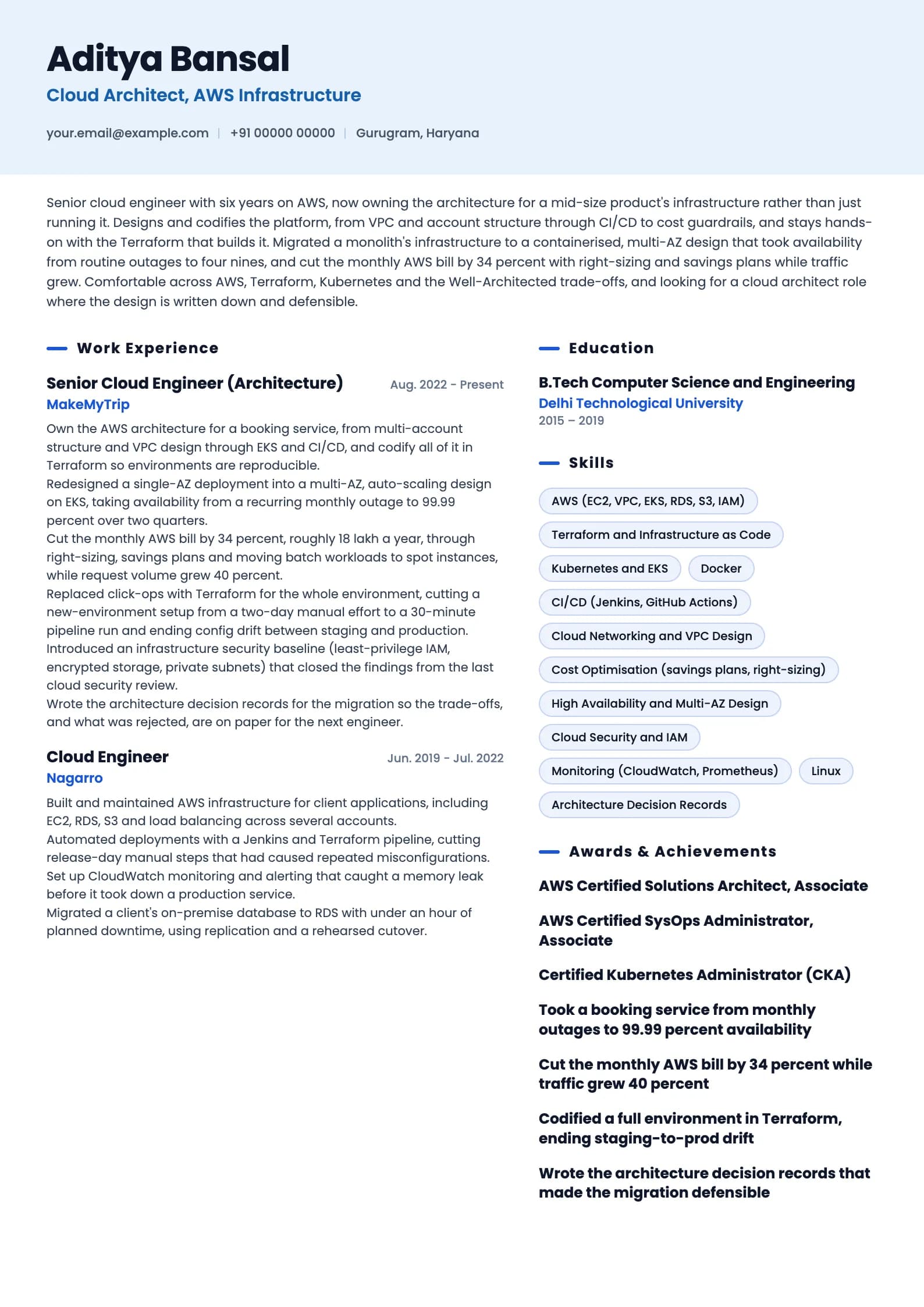
Build my resumeCloud Architect resume example, Emerging Architect (6 years)
ai-era templateIs your resume good enough?
Upload the resume you have now and see what an applicant tracking system reads before a cloud architect recruiter ever does.
Free to run. Sign in with your mobile number to see your score.
Cloud Architect resume example, Cloud Architect (9 years)
professional template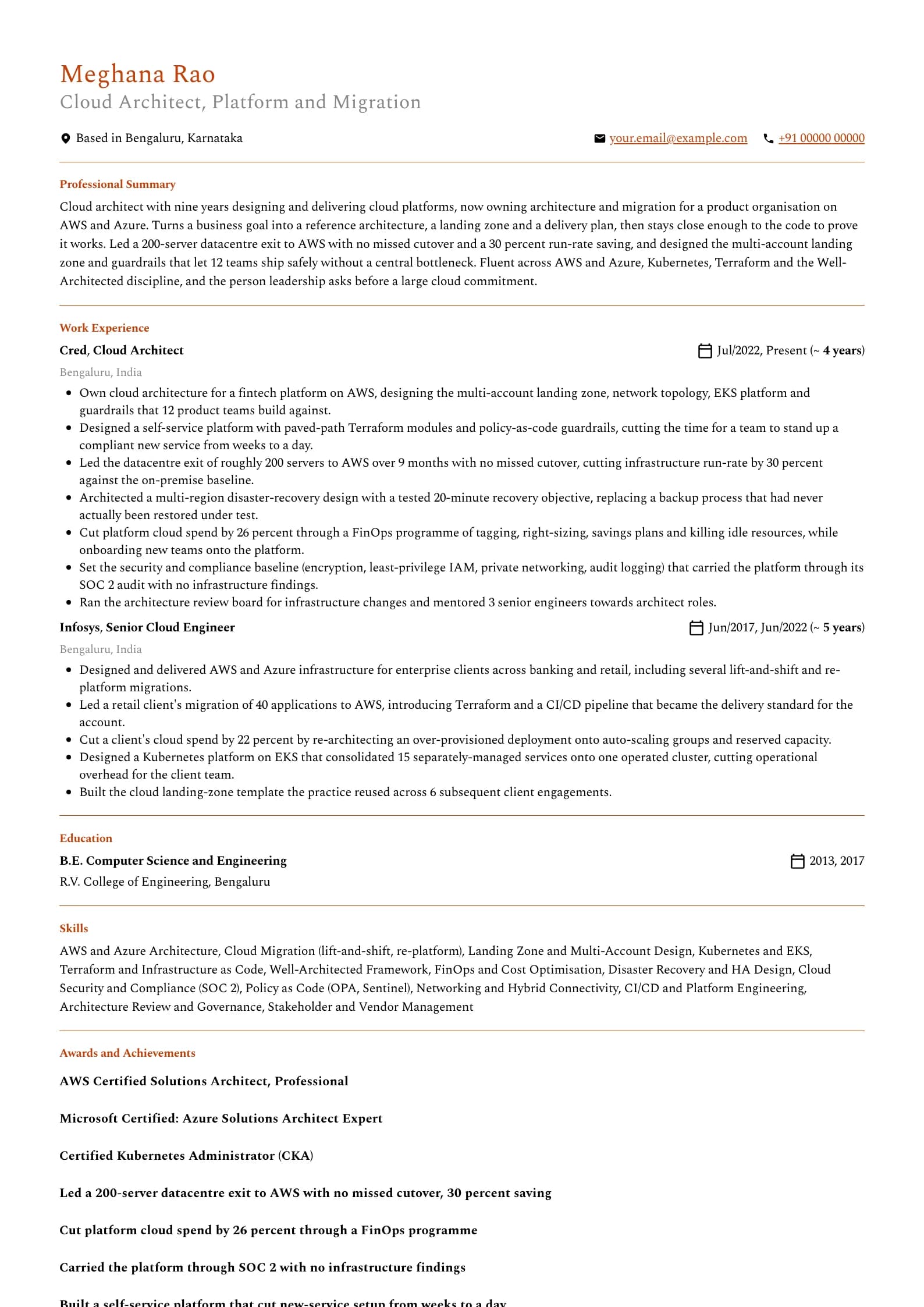
Want this structure with your own details? Build it in the resume builder.
Cloud Architect resume example, Principal (15 years)
header-band template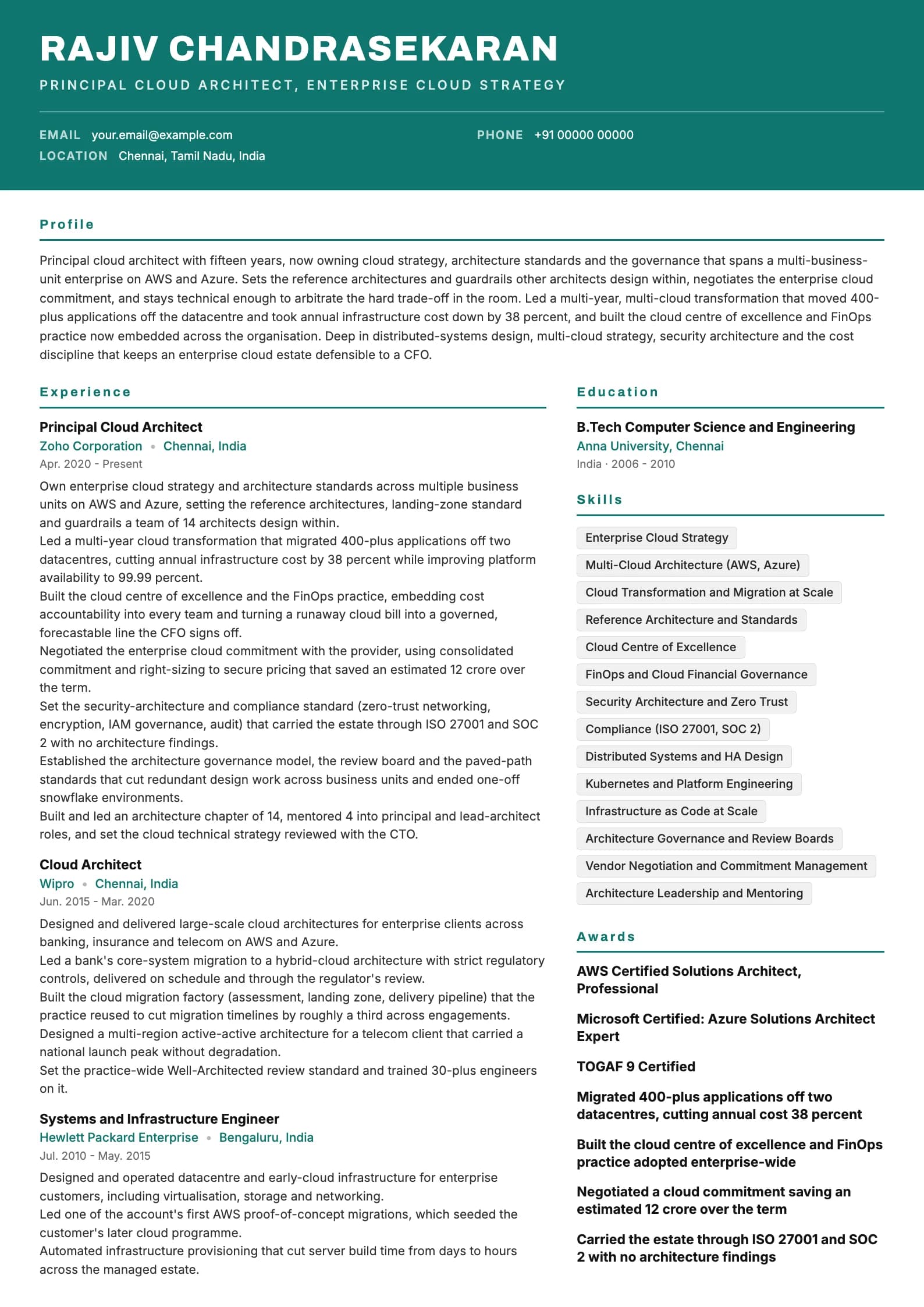
The format that works for cloud architect resumes in India
Reverse chronological is the layout to use. Most recent role first, work backwards, dates in plain view. Cloud architect resumes are often long careers with several migrations, and a functional layout that hides the timeline reads as evasion. Show the progression from engineer to architect plainly, because that arc is itself part of the story a hiring manager wants to see. Length follows evidence. Cloud architect is a senior role, so two pages is normal and expected past roughly eight years, provided the second page carries real architecture, migrations, cost programmes and governance rather than a longer service list. What does not earn a second page is a certifications wall or a paragraph listing every AWS service you have touched. One page still works for an emerging architect with five or six years. Four things belong nowhere on this resume: a photograph, date of birth, marital status and father's name. They survive from an older campus template and add nothing to a role screened on design decisions, cost outcomes and availability. Every line they take is a line an architecture result could have used. Send a PDF unless the posting asks for DOCX, name the file with your own name and the target role, and keep it a single column so a two-column sidebar does not scramble the parse. The table below sets out the section order.
| Section | Where it goes | Why |
|---|---|---|
| Name and headline | Top, above everything | The headline names the role and primary cloud: cloud architect, AWS or Azure. Recruiters match on it. |
| Professional summary | Directly under the header | Three or four lines. Years, primary clouds, and the strongest cost or migration outcome. |
| Work experience | Next, most recent first | Newest role gets the most bullets and the architecture and cost numbers. |
| Skills | Below experience, or a compact block up top for senior | Grouped: clouds, IaC and containers, architecture, security, FinOps. Not a service dump. |
| Certifications | After skills, or beside it, given how much they matter here | SA Professional, Azure Architect Expert, CKA and TOGAF earn their place. |
| Key projects or migrations | Optional block for standout transformations | One or two named migrations with scale and outcome, if a role bullet cannot hold them. |
| Education | Bottom | Degree, institution, years. No percentage at this level. |
Listing every AWS service is not the same as designing with it
The single most common cloud architect resume failure is a page that reads EC2, S3, VPC, Lambda, ECS, EKS, RDS, DynamoDB, CloudFront, Route 53, SQS, SNS, Kinesis, Glue, Athena, Redshift, CloudFormation with no line showing a single design decision. A parser matches the services, but a hiring manager reads the wall and knows the difference between someone who has used a service and someone who chose it over the alternative for a reason. Architecture is the reasoning, not the service list. The fix is to write the decision, not the inventory. Not "used EKS and auto-scaling", but "redesigned a single-AZ deployment into a multi-AZ auto-scaling design on EKS, taking availability from a monthly outage to four nines". The service is present, but it sits inside a trade-off, a before and after, and an outcome. A strong architect bullet answers three questions: what did you design, what did it replace, and what got better and by how much. Cloud architects are judged on two numbers above all others: cost and availability. A cloud bill cut while traffic grew, an availability figure stated in nines, a recovery objective actually tested. Every senior sample here leads with cost and reliability, because those are the terms a business commits cloud budget in. FinOps, right-sizing, savings plans and a governed spend forecast are architect work, not an afterthought. Do not lead with the provider you happen to know. A shop moving to Azure does not care that your last estate was on AWS, it cares that you can reason about landing zones, networking, security and cost in the abstract and apply it. Name the cloud inside the bullet as where you did the work, then let the design decision and its outcome carry the line.
For every service on your skills line, ask: is there a bullet where I chose this over an alternative and something got cheaper, safer or more available. If not, it is inventory, not architecture. Cut it or turn it into a decision.
Writing a summary a hiring manager actually reads
The block under your name is the part you can be reasonably sure gets read, so it must carry three or four facts: how long you have architected, which clouds, the scope you design for, and the strongest cost or migration outcome you have delivered. No adjectives that cannot be checked. The old objective line, seeking a challenging cloud architect position in a reputed organisation to utilise my cloud skills, tells the reader nothing they did not assume. Replace it with a summary. An objective describes what you want, a summary describes the migration you delivered and the bill you cut, and only one is evidence. An engineer stepping into architecture often struggles to summarise the shift. Look at the emerging sample: it names the design ownership, the availability it took to four nines, and the bill it cut while traffic grew. That is a genuine architect summary built from senior cloud-engineering work reframed as design. What it avoids is "passionate about cloud and DevOps", a phrase so common it now carries no information. A practical test: read your summary and ask whether a cloud engineer with the same certifications could paste it onto their resume unchanged. If they could, it describes the badge, not you. Add the specific migration, the specific cost number and the specific scope of teams or applications until it stops being transferable.
Professional summary, cloud architect
Weak
Passionate cloud architect with 9+ years of experience in AWS, Azure, Kubernetes, Terraform and DevOps seeking a challenging role in a reputed organisation to design scalable cloud solutions.
Strong
Cloud architect with nine years designing cloud platforms on AWS and Azure. Led a 200-server datacentre exit to AWS with no missed cutover and a 30 percent run-rate saving, and designed the landing zone and guardrails that let 12 teams ship safely without a central bottleneck.
The rewrite trades a service list and self-description for a migration at scale, a cost outcome and an organisational-design result.
Experience bullets: design, decision, outcome
Every strong bullet in the samples follows the same shape. It names what you designed, the decision or trade-off behind it, and what measurably changed. The design establishes scope. The decision shows you reasoned rather than defaulted. The number, usually cost or availability, does the persuading. Start with the outcome and work backwards. Architects often write the design first, then forget the result, which produces bullets like "designed and implemented a scalable microservices architecture on AWS". Instead ask what the business got: a cheaper bill, a higher availability figure, a faster migration, a tested recovery objective, a compliance audit passed. Then write the sentence that ends in that fact. Vary the metric. Four availability numbers in a row read as one trick. Across a real career you can honestly reach for cloud cost cut, availability in nines, applications migrated, recovery objective, provisioning time, teams enabled, audit outcomes and commitment savings. The mid-level sample moves several of these, which reads as range. Where you lack a clean number, give scope: how many applications migrated, how many servers exited, how many teams build on your platform, how many accounts governed. "Led a 200-server datacentre exit over 9 months with no missed cutover" carries weight without a percentage attached. Allocate bullets by recency and seniority. Current architect role gets six or seven, the previous role four or five, older engineering roles two or three, compressed to the architecture-relevant work.
| Level | What bullets must prove | Typical metric |
|---|---|---|
| Emerging / 5 to 7 years | You own a design, not just run infrastructure | Availability, cloud cost cut, IaC coverage, drift removed |
| Cloud architect / 8 to 11 years | You design platforms and lead migrations for an org | Apps migrated, run-rate saving, teams enabled, DR objective, audit passed |
| Senior / lead architect | You set standards and guardrails others design within | Landing zone adopted, FinOps saving, compliance, cost forecastable |
| Principal / 13 years and up | You own cloud strategy and governance across an enterprise | Enterprise cost cut, commitment negotiated, CoE built, standards set |
Experience bullet, architecture work
Weak
Designed and implemented a scalable and highly available microservices architecture on AWS using various services as per best practices.
Strong
Redesigned a single-AZ deployment into a multi-AZ, auto-scaling design on EKS, taking availability from a recurring monthly outage to 99.99 percent over two quarters.
"As per best practices" describes an aspiration; the rewrite names what it replaced, the design chosen and the availability it produced.
Experience bullet, cost work
Weak
Worked on cloud cost optimisation initiatives that resulted in significant savings for the organisation.
Strong
Cut the monthly AWS bill by 34 percent, roughly 18 lakh a year, through right-sizing, savings plans and moving batch workloads to spot instances, while request volume grew 40 percent.
Names the size of the cut, the three levers and the fact that traffic grew, so the saving reads as real engineering rather than a slowdown.
If a bullet would read identically on a teammate's resume, it is describing the team, not you. Rewrite it until it only fits the architecture you actually owned and the decision you actually made.
The skills section: grouped, honest, and short enough to defend
A cloud architect's skills section has two audiences with opposite preferences. The parser wants literal terms it can match, AWS and Terraform and Kubernetes. A human wants a short, organised list that signals what kind of architect you are. Grouping satisfies both, and for a role this senior the grouping itself signals that you think in domains. Group by domain rather than one long line. Clouds, infrastructure as code and containers, architecture and design, security and compliance, cost and governance is a grouping that works for almost every cloud architect. The exact headings matter less than the fact that structure exists. Write names the way the industry writes them: Kubernetes not k8s at least once, Terraform not terraform, Well-Architected not well architected, because a parser matches on strings. Twelve to sixteen skills is the working range. Below eight the section looks thin for an architect. Above twenty it stops being a signal and becomes the AWS service catalogue, which is the classic cloud-resume tell. Do not list twenty individual AWS services as skills; list the domains and let the experience name the services in context. The list is a contract: every item is a question you have agreed to answer, and an architect gets asked design questions, not trivia. Do not include a proficiency bar. Star ratings invite an argument nobody wins, and no two people agree on what four stars in security architecture means. Let the migrations and the cost numbers prove the depth instead.
| Group | What goes in it | How many |
|---|---|---|
| Clouds | AWS, Azure, GCP, the ones you have genuinely designed on | 1 to 3 |
| IaC and containers | Terraform, Kubernetes, Docker, CloudFormation, Helm | 3 to 4 |
| Architecture and design | Landing zones, HA and DR, Well-Architected, distributed systems | 3 to 5 |
| Security and compliance | IAM, zero trust, encryption, SOC 2, ISO 27001 | 2 to 4 |
| Cost and governance | FinOps, cost optimisation, architecture review, standards | 2 to 4 |
Skills section
Weak
Skills: AWS, EC2, S3, VPC, Lambda, ECS, EKS, RDS, DynamoDB, CloudFront, Route 53, SQS, SNS, Kinesis, Glue, Athena, Redshift, CloudFormation, IAM, CloudWatch, Azure, GCP, Terraform, Kubernetes, Docker, Jenkins, Linux, Python
Strong
Clouds: AWS, Azure. IaC and containers: Terraform, Kubernetes, Docker. Architecture: landing zones, HA and DR, Well-Architected. Security: IAM, zero trust, SOC 2. Cost and governance: FinOps, cost optimisation, architecture review.
Replaces the AWS service catalogue with the design domains an architect is actually hired for, grouped so a human reads it in one pass.
Migrations and transformations: the architect's headline work
For a cloud architect, a migration or transformation is often the single strongest thing on the resume, because it is where design, delivery, cost and risk all meet. Yet these are frequently reduced to one flat line, "migrated applications to AWS", that throws away everything a hiring manager wants to know. Give the flagship migrations the space they deserve. Name the scale and the shape. How many applications or servers, over what timeline, off what and onto what, and what kind of migration it was, lift-and-shift, re-platform or re-architect. "Led a 200-server datacentre exit to AWS over nine months with no missed cutover" tells a reviewer the scope, the difficulty and the discipline in one line. The kind of migration matters, because a re-architecture is a different skill from a lift-and-shift, and conflating them costs you credibility in the interview. Attach the outcome, and make it the business kind. Run-rate saving against the on-premise baseline, availability improvement, a tested recovery objective, a compliance audit the new estate passed. A migration with no stated outcome reads as motion without result, and cloud migrations are expensive enough that leadership always asks what it bought. Be honest about your role. On a large transformation, say whether you owned the architecture, led the delivery, or contributed to a stream. Architects who claim to have single-handedly migrated a bank get found out in the first competency question. "Led the architecture and cutover for the payments stream of a wider programme" is both more credible and more useful than an inflated claim.
For each migration, a reviewer wants four things in one line: how much moved, off what and onto what, what kind of migration, and what it saved or improved. If your bullet is missing one of those, it is throwing away the most valuable evidence you have.
Where education and certifications belong
Education goes at the bottom for a cloud architect, always. By the time you hold this title the degree is context, not evidence, and it takes a single line: degree, institution, years. No percentage, no coursework, no school. Certifications, on the other hand, carry unusual weight in cloud, because the providers run rigorous, recognised, role-specific exams and Indian employers screen on them heavily. Place them just below skills, or in a compact block near the top for a senior architect, and write the full name, the issuing body and the year. The AWS Solutions Architect Professional and the Azure Solutions Architect Expert are the two that most directly signal architect-level depth. A Kubernetes certification (CKA or CKS) and TOGAF for enterprise-architecture roles round out a strong set. Match the certification to the cloud in the job description. An all-AWS certification set for an Azure-first shop is a weaker signal than a candidate who shows genuine multi-cloud credentials, so if you work across clouds, hold at least one architect certification per cloud you claim. The associate-level certifications are fine to keep while you are an emerging architect, but drop them once you hold the professional-level equivalent, since listing both just dilutes the page. Do not list an expired certification as current. Cloud certifications lapse on a schedule, three years for AWS, and an expired one presented as active is a small dishonesty that is easy to verify and check. Renew what you claim or remove it.
Getting through the applicant tracking system
An applicant tracking system is a parser and a search index, not a judge. It reads your file, tries to break it into name, dates, employers, titles and skills, and stores the result so a recruiter can search across candidates. Almost every ATS problem is a parsing problem, and parsing problems come from layout, not wording. The layout rules are short. One column. Standard section headings, so use Work Experience rather than My Cloud Journey, and Skills rather than My Tech Stack. No text inside images, because an architecture-diagram thumbnail or a cloud-logo strip reads as empty space. No critical information in the header or footer region, which some parsers drop. Avoid text boxes and nested tables in the resume body, and resist the temptation to render your resume as a fancy diagram, because a parser sees nothing. On wording, mirror the language of the job description where it is honest. If the posting says AWS, write AWS, not just cloud. If it says Well-Architected, write Well-Architected. If it says landing zone or FinOps, use those exact terms. Include the expansion alongside an acronym at least once, for example "IaC (infrastructure as code)", so both searches find you. Keyword stuffing does not work, and cloud resumes are a common offender with a hidden block of every AWS service in white text. Recruiters and modern parsers catch it, and the outcome is worse than being filtered. Write real bullets that naturally contain the right terms, because a bullet describing a landing zone you built in Terraform contains both terms in a context that survives human review too. Save as PDF from a tool that embeds real text, then open the file and confirm you can select and copy a sentence. If you cannot select the text, neither can the parser.
Section heading
Weak
My Cloud Transformation Journey
Strong
Work Experience
Parsers look for standard headings; a creative one can push the entire block into an unclassified bucket the recruiter never searches.
Test your own file before you send it. Copy the text out of the PDF into a plain text editor. Whatever you can read there is roughly what the parser sees, and anything scrambled is a real risk.
What gets cloud architect resumes rejected
Most rejections at the resume stage are not close calls. They come from a small set of recurring problems, and all of them are fixable in an afternoon. The list below covers what reviewers of Indian cloud architect resumes see most often, in rough order of how much damage each one does.
- The AWS service catalogue as a skills section, with no design decision anywhere. Architecture is reasoning, not an inventory of services touched.
- No cost or availability numbers. A cloud architect is judged on the bill and the nines; a resume without either reads as an engineer with a new title.
- Migrations reduced to "migrated applications to AWS" with no scale, no kind and no outcome, throwing away the strongest evidence on the page.
- "Designed a scalable, highly available, secure architecture using best practices" with no specifics. Every architect claims this; only the numbers separate them.
- An all-AWS certification set applied to an Azure-first role, or associate certs listed alongside the professional ones that supersede them.
- Reads like a DevOps or cloud-engineer resume, all pipelines and no design ownership, when the target is an architect role.
- A photo, date of birth, marital status or father's name. None of it belongs on this resume, and it takes an architecture result's space.
- Inflated ownership of a large transformation, claiming a whole bank migration as solo work, which collapses in the first competency question.
- No mention of security, compliance or governance for an enterprise role where those are half the job.
- Titles or dates that do not match your offer letters. Background verification is standard at this level and a mismatch ends the process.
Read your resume aloud once before sending it. Anything you would be embarrassed to defend when a panel asks "why that design and not the alternative" is a line to cut or rewrite.
Skills to put on a cloud architect resume
Technical
- AWS Architecture
- Azure Architecture
- Cloud Migration and Transformation
- Landing Zone and Multi-Account Design
- Kubernetes and Container Platforms
- Terraform and Infrastructure as Code
- Well-Architected Framework
- High Availability and Disaster Recovery
- Cloud Networking and Hybrid Connectivity
- Security Architecture and Zero Trust
- FinOps and Cost Optimisation
- Distributed Systems Design
- Serverless and Event-Driven Architecture
- CI/CD and Platform Engineering
Tools and platforms
- Terraform
- Kubernetes
- Docker
- CloudFormation
- Helm
- Jenkins
- GitHub Actions
- Prometheus and Grafana
- CloudWatch
- Open Policy Agent
- Ansible
- Linux
Working skills
- Architecture decision-making
- Trade-off communication
- Stakeholder and executive alignment
- Architecture review and governance
- Vendor negotiation
- Mentoring architects and engineers
- Cost accountability
- Cross-team collaboration
- Technical writing and decision records
Certifications worth listing as a cloud architect
| Certification | Full name | Worth it for |
|---|---|---|
| AWS SA Pro | AWS Certified Solutions Architect, Professional | The single strongest cloud-architect credential for the Indian market, given how much enterprise and product cloud here runs on AWS. Worth it for any architect on AWS, and near-expected for senior roles. It certifies design-level depth, not just service familiarity, so it carries where the associate no longer does. |
| Azure Architect Expert | Microsoft Certified: Azure Solutions Architect Expert | The Azure equivalent of the AWS professional, worth it for architects working in Microsoft-stack enterprises, which are common in Indian banking and large corporates. If you claim multi-cloud, hold this alongside the AWS credential rather than presenting an all-AWS set for an Azure-first role. |
| AWS SA Associate | AWS Certified Solutions Architect, Associate | The entry architect certification, worth it for an emerging architect or a cloud engineer moving into design who needs the credential on paper. A clean signal early on. Drop it once you hold the professional-level SA Pro, since listing both just dilutes the page. |
| CKA | Certified Kubernetes Administrator | A hands-on credential worth it for cloud architects designing container platforms on Kubernetes, which is now the default for new workloads. It proves you can operate the platform you design, not just draw it. Pair it with CKS if security of the cluster is part of your remit. |
| TOGAF | TOGAF 9 Certified | An enterprise-architecture framework certification worth it for senior and principal architects whose role spans strategy, standards and governance across business units, not just cloud infrastructure. It signals you can work at the enterprise-architecture level. Skip it if your work is purely hands-on cloud design. |
| AWS Security Specialty | AWS Certified Security, Specialty | A deep credential worth it for architects who own security architecture on AWS in regulated domains like fintech and healthcare. It proves you can design and defend the security controls an audit will probe. Most valuable once security and compliance are an explicit part of your architect remit. |
Keywords an ATS scans for in a cloud architect resume
These are the literal terms a parser matches against the job description. Use the ones that are true of you, in the sentences where you did the work, not as a list at the bottom.
- cloud architect
- AWS
- azure
- solutions architect
- cloud migration
- landing zone
- kubernetes
- terraform
- infrastructure as code
- well-architected
- high availability
- disaster recovery
- finops
- cost optimisation
- cloud security
- zero trust
- SOC 2
- multi-cloud
- serverless
- architecture governance
Cloud Architect resume FAQ
What salary can a cloud architect expect in India?
An emerging cloud architect with five to seven years typically sits around 18 to 32 LPA. A cloud architect with eight to eleven years owning platforms and migrations usually earns 30 to 55 LPA, higher in product and fintech firms. Principal and lead cloud architects with thirteen years and above commonly reach 55 LPA to 1 crore and beyond at large product companies and consultancies. Professional-level certifications, proven multi-cloud depth and a record of large migrations with real cost savings push the top of every band upward.
How long should a cloud architect resume be?
Two pages is normal and expected past roughly eight years, because a cloud architect has real migrations, cost programmes and governance work that earn the space. One page still works for an emerging architect with five or six years. The test for a second page is whether it carries architecture and outcomes rather than a longer service list. Cut the AWS service catalogue, compress older engineering roles to their architecture-relevant lines, and the length takes care of itself.
Is cloud architect a role a fresher can apply for?
Not directly. Cloud architect is a senior title that assumes years of hands-on cloud engineering behind it, because architecture is judgement built from having operated systems. The realistic path is cloud engineer or DevOps engineer first, then reframing that work as design ownership as you take on architecture. The emerging-architect sample on this page shows exactly that transition. A fresher aiming here should target a cloud engineer resume and build towards this over several years.
Which metrics matter most on a cloud architect resume?
Cost and availability, above everything. A cloud bill cut while traffic grew, availability stated in nines, a tested recovery objective. Beyond those, applications or servers migrated, teams enabled by a platform, compliance audits passed, and commitment savings negotiated are all strong. Cloud architects commit real budget, so leadership screens for whether your designs saved money and stayed up. Vary the metric across bullets so the resume reads as range rather than one number repeated.
How important are certifications for a cloud architect?
More than in almost any other engineering role, because the cloud providers run rigorous, recognised exams and Indian employers screen on them heavily. The AWS Solutions Architect Professional and Azure Solutions Architect Expert are the two that signal genuine architect depth. That said, certifications get you past the filter; the migrations and cost outcomes get you the offer. Hold the professional-level cert for each cloud you claim, keep it current, and let the shipped architecture do the rest.
Should I claim AWS and Azure if I am strong in one?
Only if it is honest, and back each with evidence. Multi-cloud is valuable, but a resume that lists AWS and Azure with all its depth in AWS gets exposed the moment an interviewer asks an Azure networking question. If you are genuinely strong in one and familiar with the other, say so plainly, hold the architect certification for your primary cloud, and describe the second at the level you can defend. Honest single-cloud depth beats a hollow multi-cloud claim.
How do I show migration experience without inflating my role?
Name the scale, the shape and your actual part in it. "Led the architecture and cutover for the payments stream of a wider datacentre-exit programme" is credible and specific; "single-handedly migrated the bank to AWS" is not, and it collapses in the first competency question. Say how many applications or servers moved, off what and onto what, what kind of migration it was, and whether you owned the architecture, led delivery or contributed a stream. Panels probe migration claims hard, so accuracy protects you.
Does an ATS reject resumes with two columns or diagrams?
Diagrams and multi-column layouts are a real risk. Some parsers read multi-column layouts out of order, and any text rendered inside an image or an architecture diagram is invisible to the parser entirely. Cloud architects are especially tempted to make a visually impressive, diagram-heavy resume, and it can parse to almost nothing. Use a single-column, text-based layout, and test it by copying the text out of the PDF into a plain editor. If it reads in order there, it will most likely parse correctly.
Do I need a photo on a cloud architect resume in India?
No. Recruiters for architecture roles do not expect one, and it takes space a migration or a cost outcome should occupy. The same goes for date of birth, marital status, father's name, nationality and a declaration paragraph. These come from an older template that spread through campus placement cells and add nothing to a screen based on design decisions, cost and availability. The only exception is a posting that explicitly asks for a photograph.
Related resume examples and guides
Build your own in any of these formats
Start from a blank resume or upload the one you have. Goodspace renders it in 24 templates and flags the AWS, Azure, Kubernetes, IaC and FinOps keywords an applicant tracking system will look for, and the service-catalogue padding it will not credit.
Build my resume