Scrum Master Resume Format, with 3 Full Samples
A scrum master is hired on evidence of teams that ship more predictably, impediments cleared before they became delays, and delivery that improved on a number someone cared about, yet most resumes list the ceremonies and the certifications and forget the outcome. Below are three complete resumes, one for a developer or QA professional newly moved into the role, one for a scrum master running two mature teams, and one for a senior scrum master and release train engineer coaching at scale. After the samples come the format rules, the difference between listing ceremonies and proving delivery improved, the terms a parser matches literally, and the mistakes that end a screening before a human reads the page.
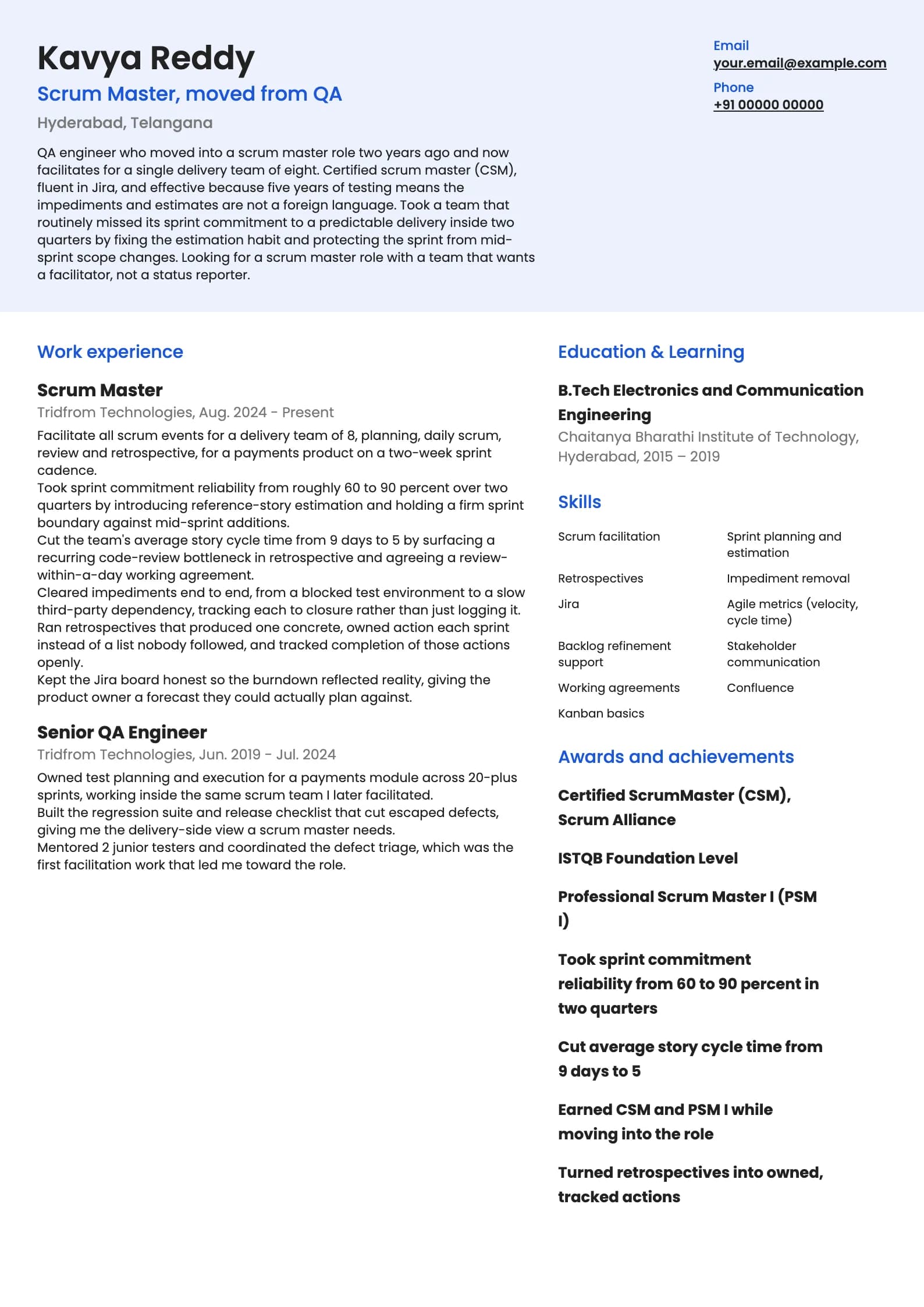
Build my resumeScrum Master resume example, New Scrum Master (2 years)
modern templateIs your resume good enough?
Upload the resume you have now and see what an applicant tracking system reads before a scrum master recruiter ever does.
Free to run. Sign in with your mobile number to see your score.
Scrum Master resume example, Scrum Master (5 years)
professional template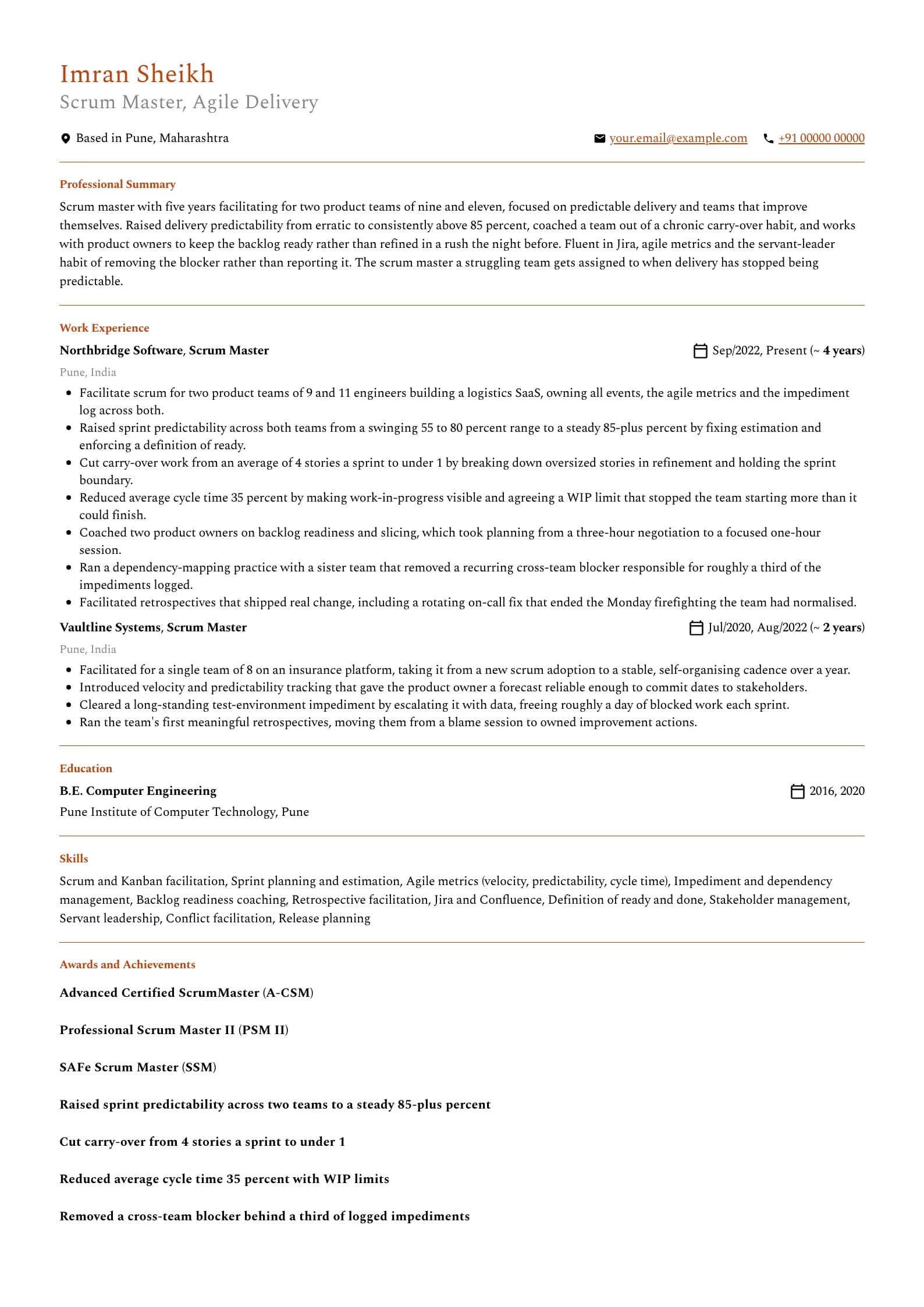
Want this structure with your own details? Build it in the resume builder.
Scrum Master resume example, Senior / RTE (10 years)
header-band template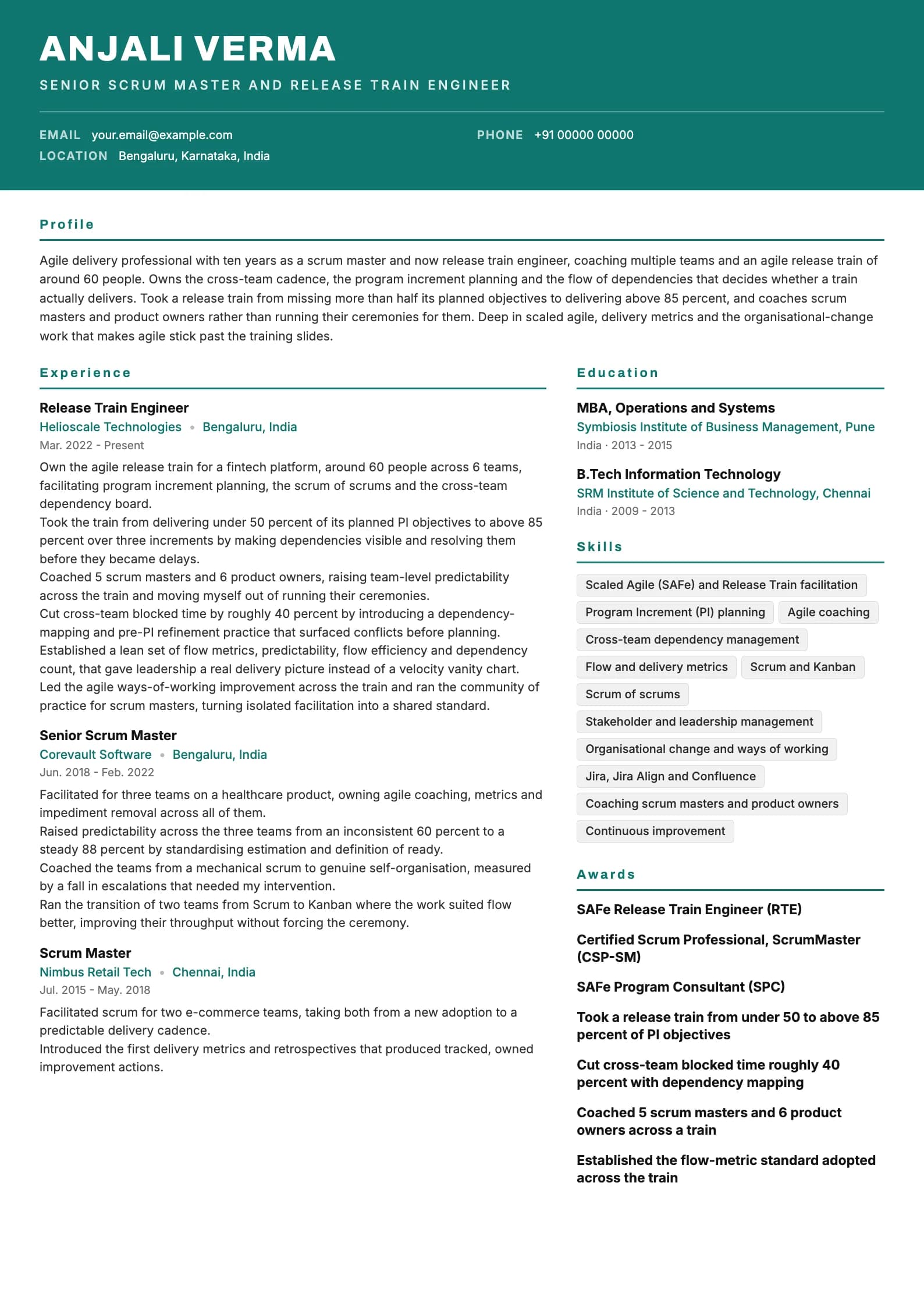
The format that works for scrum master resumes in India
Reverse chronological is the layout to use. Put the current role first, work backwards, and keep the dates visible. Scrum master resumes are especially prone to a functional layout that groups everything under Agile Expertise and hides the timeline, which reviewers read as an attempt to cover a gap or a thin run of actual facilitation. A clear timeline is more convincing than a wall of framework buzzwords. Length follows evidence. One page covers most scrum masters up to roughly six years. A senior scrum master, agile coach or release train engineer can justify a second page, but only if it carries real cross-team and coaching work rather than a longer certification list. A second page built from a values statement and a hobbies line is a padded one-page resume. Four things do not belong on a scrum master resume here: a photograph, date of birth, marital status and father's name. They come from an older campus template and add nothing to a professional screen. Every line they take is a line a delivery result could have used. Send a PDF unless the posting asks for DOCX, name the file with your own name and the target role, and keep it a single column top to bottom. Two-column layouts, common because people put a certifications and tools sidebar in, parse unpredictably when the parser hits the sidebar. The table below sets the section order.
| Section | Where it goes | Why |
|---|---|---|
| Name and headline | Top, above everything | The headline names the role and level, scrum master or RTE. Recruiters match on it. |
| Professional summary | Directly under the header | Three lines. Teams facilitated, years, and the single strongest delivery result. |
| Work experience | Next, the core of the resume | Most recent first. Current role gets the most bullets and the delivery metrics. |
| Certifications | High, near the top | CSM, PSM, SAFe carry real weight here. Name, body, level. |
| Skills | Below experience, grouped | Facilitation, metrics, tools, coaching. Not a buzzword wall. |
| Education | Bottom | Degree, institution, years. An MBA is worth keeping visible. |
| Prior role (for new scrum masters) | Below the scrum master role | A dev, QA or BA background explains the transition and adds credibility. |
Listing the ceremonies is not the same as proving delivery improved
The single most common scrum master resume failure is a page that lists the mechanics, facilitated daily stand-ups, sprint planning, sprint review, retrospective and backlog grooming, with no line anywhere showing that anything got better because of it. Every scrum master facilitates those events; the phrase describes the job, not the person. A hiring manager reads a resume of ceremonies and assumes a meeting scheduler, then goes looking for a candidate who moved a number. The fix is to lead with delivery outcomes. A scrum master is ultimately hired to help a team deliver more predictably and improve itself, so the resume should prove that happened. Predictability, the share of sprint commitments met, is the strongest metric because it is what a stakeholder actually feels. Cycle time, carry-over, escaped defects, dependency count, PI objective completion and the disappearance of a recurring firefight all work too. The mid-level sample lists Jira and estimation precisely because its bullets show predictability raised and carry-over cut, so the tool and the outcome agree. Be careful with velocity. Velocity is an internal planning number, not an achievement, and "increased team velocity by 40 percent" is a red flag to an experienced interviewer because velocity is trivially inflated by re-pointing stories. Predictability and flow are the honest metrics. If you must mention velocity, frame it as stabilised and predictable, not increased. Be specific about scope and framework. Facilitating one team is a different job from running a release train of 60. Scrum, Kanban and SAFe are different contexts. Name your teams, their size and the framework, because a shop scaling with SAFe does not want a resume that could equally be a single-team Scrum role.
For every ceremony on your resume, ask: what got better because I facilitated it. If nothing, you have described the job, not your impact. Predictability, cycle time and cleared impediments are outcomes; a list of stand-ups and retros is a job description.
Writing a scrum master summary a hiring manager actually reads
The block under your name is the part you can count on being read, so it should carry three facts: how many teams you facilitate and in what context, how long you have done it, and the strongest delivery outcome you have driven. Three or four lines, no servant-leader poetry that a reference could not confirm. The old objective, seeking a challenging scrum master position in a reputed organisation to apply my agile knowledge, tells the reader nothing the application did not already say. Replace it with a summary. An objective describes what you want; a summary describes what you have already done, and only one is evidence a screener can act on. New scrum masters often think they have nothing to summarise. The associate sample names the single team, the certification, the prior QA track that gives the transition credibility, and one real delivery result. That is a genuine summary drawn from two years in the role and a relevant background. What it avoids is "passionate servant leader dedicated to agile transformation", a phrase so common on scrum master resumes it now carries no information at all. A practical test: read your summary and ask whether any certified scrum master could paste it onto their resume unchanged. If they could, it describes the certificate, not you. Add the specific team, the specific predictability number and the specific coaching you did until it stops being transferable.
Professional summary, mid-level scrum master
Weak
Passionate and dedicated servant leader and certified scrum master with 5+ years of experience in facilitating agile ceremonies, seeking a challenging role to drive agile transformation in a reputed organisation.
Strong
Scrum master with five years facilitating two product teams of nine and eleven, focused on predictable delivery. Raised predictability to a steady 85-plus percent, cut carry-over from four stories a sprint to under one, and coaches product owners on backlog readiness.
The rewrite trades servant-leader language and a ceremony list for team scope, an ownership context and two verifiable delivery results.
Experience bullets: what you facilitated, what changed, by how much
Every strong bullet in the samples has the same shape. It names what you facilitated or coached, states what measurably changed for the team, and closes with the number. The facilitation shows you did the job. The change tells a reviewer you affect delivery. The number does the persuading, and it is the part scrum master resumes most often lack. Start with the outcome and work backwards. Scrum masters tend to write the activity, which produces bullets like "facilitated all scrum ceremonies and ensured the team followed the agile process". Instead ask what was different after you worked with the team: predictability rose, cycle time fell, carry-over dropped, a chronic impediment disappeared, a product owner learned to slice a backlog. Then write the sentence that ends in that fact. Vary the metric, and prefer the ones stakeholders feel. Predictability, cycle time, carry-over, escaped defects, dependency count and PI objective completion are honest and meaningful. Avoid a wall of velocity numbers, which read as internal and gameable. The mid-level sample moves across predictability, carry-over and cycle time, which reads as a real grasp of delivery rather than one memorised figure. Where you lack a clean number, give scope and a concrete impediment: how many teams, what size, what specific blocker you cleared and what it freed. "Removed a cross-team blocker responsible for roughly a third of the impediments logged" carries weight without inventing a percentage improvement. Allocate bullets by recency. Current role gets five or six, the previous role four or five, anything older two or three.
| Level | What bullets must prove | Typical metric |
|---|---|---|
| New scrum master (1 to 3 years) | You facilitate a team and improved its delivery | Predictability, cycle time, retro actions completed, impediments cleared |
| Scrum master (3 to 6 years) | You make teams predictable and self-organising | Predictability, carry-over, dependency count, PO coaching |
| Senior (6 to 9 years) | You coach multiple teams and other scrum masters | Cross-team predictability, escalations reduced, coaching outcomes |
| RTE / coach (9 years and up) | You run a train and make agile stick org-wide | PI objective completion, cross-team blocked time, flow, ways of working |
Experience bullet, scrum master
Weak
Facilitated all scrum ceremonies including daily stand-up, sprint planning, review and retrospective, and ensured the team followed the agile process.
Strong
Took sprint predictability from a swinging 55 to 80 percent range to a steady 85-plus percent by fixing estimation and enforcing a definition of ready.
The first line lists the job every scrum master does; the rewrite names the delivery outcome and the two practices that produced it.
Experience bullet, metrics
Weak
Increased the team's velocity by 40 percent by motivating the team and improving the agile process.
Strong
Cut carry-over work from an average of 4 stories a sprint to under 1 by breaking down oversized stories in refinement and holding the sprint boundary.
Velocity is internal and trivially inflated; the rewrite uses carry-over, a metric a stakeholder feels, and names the practice behind it.
If a bullet would read identically on any certified scrum master's resume, it is describing the framework, not you. Rewrite it until it only fits the team you actually facilitated and the number you actually moved.
The skills section: grouped, honest, and free of buzzwords
A scrum master resume's skills section serves two readers with opposite tastes. The parser wants literal terms it can match, Scrum, Kanban, Jira, SAFe. A hiring manager wants a short, organised list that signals what kind of scrum master you are. Grouping serves both. Group by function rather than one long line. Facilitation, delivery metrics, tools and coaching is a grouping that fits almost every scrum master. The exact headings matter less than the fact that structure exists. Write names the way the industry writes them: SAFe not Safe, Kanban not Kaban, Jira not JIRA in current usage. A parser matches on strings. Ten to fifteen skills is the working range. Below eight it looks thin. Above twenty it stops being a signal, and scrum master resumes are especially prone to a buzzword wall: agile, agility, agile mindset, agile transformation, agile coaching, servant leadership, servant leader, empowerment, self-organisation listed as nine separate skills. That is one idea repeated. The list is a contract: every item is a question you have agreed to answer. Lead with the concrete, checkable skills. Estimation, agile metrics, dependency management, backlog readiness and specific tools are things an interviewer can probe and you can defend. Vague values like passion, positivity and enthusiasm are not skills; they are self-description, and they belong nowhere on the page.
| Group | What goes in it | How many |
|---|---|---|
| Facilitation | Scrum events, sprint planning, retrospectives, working agreements | 3 to 5 |
| Delivery metrics | Predictability, velocity, cycle time, flow, dependency management | 2 to 4 |
| Frameworks | Scrum, Kanban, SAFe, scaled agile | 2 to 4 |
| Tools | Jira, Confluence, Jira Align, Azure DevOps, Miro | 2 to 4 |
| Coaching | Servant leadership, stakeholder management, conflict facilitation, PO coaching | 2 to 4 |
Skills section
Weak
Skills: Agile, Agile Methodology, Agile Mindset, Agile Coaching, Agile Transformation, Scrum, Servant Leadership, Servant Leader, Team Player, Communication, Passion, Positivity, Leadership, Motivation, Collaboration, Jira, Empowerment, Self-Organisation, Facilitation, Enthusiasm
Strong
Facilitation: scrum events, estimation, retrospectives, working agreements. Metrics: predictability, cycle time, dependency management. Frameworks: Scrum, Kanban, SAFe. Tools: Jira, Confluence, Jira Align. Coaching: servant leadership, stakeholder management, PO coaching.
Collapses nine ways of saying agile and four personality words into concrete, defensible skills, and groups them so a human reads the list in one pass.
Where certifications belong, and which ones carry weight
Scrum master hiring leans on certifications more than most technical roles, so unlike a developer resume, yours belongs high on the page, near the summary rather than buried at the bottom. A recruiter screening scrum master applications often filters on CSM, PSM or SAFe in the first pass, so make them easy to find. Write the full name, the issuing body and the level. Understand what each signals. The Scrum Alliance CSM and the Scrum.org PSM I are the baseline entry credentials, and both are worth holding. The PSM I is respected because it is a real assessment with no mandatory course, so it reads as knowledge rather than attendance. Advanced levels, A-CSM, PSM II, CSP-SM, signal a mid-to-senior practitioner. For any organisation scaling agile, the SAFe certifications, SAFe Scrum Master and Release Train Engineer, are often what the posting actually asks for. Do not let the certifications carry the whole resume. A page that is three certification logos and a ceremony list, with no delivery outcome anywhere, reads as someone who took the courses but has not yet made a team better. The certificate gets you past the filter; the delivery results get you the offer. Balance the two. An expired or lapsed certification listed as current is a small dishonesty that is easy to check, since both Scrum Alliance and Scrum.org maintain public registries. Keep the renewal current, or state the year and let it be read as historical.
Getting through the applicant tracking system
An applicant tracking system is a parser and a search index, not a judge. It reads your file, tries to split it into name, dates, employers, titles and skills, and stores the result so a recruiter can search across candidates. Almost every ATS problem is a parsing problem, and parsing problems come from layout, not wording. The layout rules are short. One column. Standard section headings, so use Work Experience rather than My Agile Journey, and Skills rather than My Superpowers. No text inside images, because a certification-badge strip reads as empty space to a parser, which is a real risk for scrum masters who love a badge row. Put the certification names in text as well. No critical information in the header or footer region, which some parsers drop. On wording, mirror the language of the job description where it is honest. If the posting says scrum master, use that exact title rather than agile facilitator. If it says SAFe, PI planning, CSM or predictability, and you have done it, write those exact terms. Spell out an acronym alongside its short form at least once, for example "RTE (release train engineer)", so both searches find you. Keyword stuffing does not work. A hidden block of every agile term in white text is found quickly, and the outcome is worse than being filtered. Write real bullets that naturally contain the right terms, because a bullet describing a PI planning event contains the term in a context that also survives human review. Save as PDF from a tool that embeds real text, then open the file and confirm you can select and copy a sentence, including your certification names. If you cannot select the text, neither can the parser.
Certifications shown as badge images only
Weak
A row of CSM, PSM and SAFe logo images with no text
Strong
Certifications: Certified ScrumMaster (CSM), Scrum Alliance; Professional Scrum Master II (PSM II); SAFe Scrum Master (SSM)
Recruiters filter on certification names as text; a logo image parses as empty space, so the exact credential the screener searches for never matches.
What gets scrum master resumes rejected
Most rejections at the resume stage are not close calls. They come from a small set of recurring problems, and every one is fixable in an afternoon. The list below covers what reviewers of Indian scrum master resumes see most often, in rough order of how much damage each one does.
- A list of ceremonies facilitated with no delivery outcome anywhere. Every scrum master runs the events; the resume has to show what got better.
- Velocity increases as the headline metric. "Raised velocity 40 percent" reads as gameable to an experienced interviewer. Use predictability, cycle time or carry-over instead.
- A buzzword wall: agile, agility, agile mindset, agile transformation, servant leadership listed as separate skills. One idea repeated is not a skills section.
- Servant-leader poetry in the summary with no team scope, no numbers and no framework. It describes an aspiration, not a track record.
- Certifications carrying the whole resume, with the badges present but not a single team made more predictable.
- No team scope. Facilitating one team and running a 60-person train are different jobs; a resume that omits the scale forces a guess.
- Certifications shown only as logo images, which parse as empty space, so the ATS never matches the credential the recruiter searches for.
- A generic objective line. Replace it with a summary that states teams, years and one delivery result.
- Inflated titles or team sizes that do not survive a reference check. Agile hiring loops probe scope hard, and a mismatch ends the process.
- Typos in the frameworks you claim, SAFe written as Safe or Kanban as Kanaban, which undoes an otherwise strong page.
Read your resume aloud once before sending it. If every line describes the framework rather than a team you changed, the reviewer will hear a course attendee, not a scrum master.
Skills to put on a scrum master resume
Technical
- Scrum framework
- Kanban
- Scaled Agile (SAFe)
- Sprint planning and estimation
- Program Increment (PI) planning
- Agile metrics (predictability, cycle time, flow)
- Dependency management
- Definition of ready and done
- Release planning
- Backlog readiness coaching
- Retrospective facilitation
- Continuous improvement
Tools and platforms
- Jira
- Confluence
- Jira Align
- Azure DevOps
- Trello
- Miro
- Mural
- Rally
- Slack
- Microsoft Teams
Working skills
- Servant leadership
- Facilitation
- Stakeholder management
- Conflict resolution
- Coaching and mentoring
- Active listening
- Influence without authority
- Communication
- Team building
Certifications worth listing as a scrum master
| Certification | Full name | Worth it for |
|---|---|---|
| CSM | Certified ScrumMaster, Scrum Alliance | The most widely recognised entry credential for scrum masters in India, and often the literal filter a recruiter runs in the first pass. Worth it for anyone entering or early in the role. It requires a course, so it signals training rather than assessed depth, which is why many pair it with the PSM. |
| PSM I | Professional Scrum Master I, Scrum.org | Respected because it is a real assessment with no mandatory course, so it reads as knowledge rather than attendance. Excellent value for a new or self-taught scrum master who wants to prove they actually understand the framework. Holds weight throughout a career and pairs well with the CSM. |
| A-CSM / PSM II | Advanced Certified ScrumMaster / Professional Scrum Master II | The advanced-practitioner level, worth it for scrum masters with a few years who want to signal they are past the mechanics and into coaching and team dynamics. A sensible next step once you have real delivery outcomes to talk through in the assessment. |
| SAFe SSM | SAFe Scrum Master | The credential many large Indian enterprises and their vendors actually ask for by name, because they scale delivery with SAFe. Worth it if you work, or want to work, in a scaled-agile environment with release trains and PI planning. Less relevant for a pure single-team Scrum shop. |
| SAFe RTE | SAFe Release Train Engineer | The senior scaled-agile credential for those facilitating an agile release train across multiple teams. Worth it for experienced scrum masters moving into RTE or program-level facilitation. Signals you can run PI planning and cross-team dependency flow, not just a single board. |
| CSP-SM / PSM III | Certified Scrum Professional ScrumMaster / Professional Scrum Master III | The most advanced scrum-master credentials, worth it for senior practitioners and coaches who want to demonstrate deep, assessed expertise. Rarely a hiring filter, but a genuine differentiator for agile coach and senior scrum master roles where depth is the point. |
Keywords an ATS scans for in a scrum master resume
These are the literal terms a parser matches against the job description. Use the ones that are true of you, in the sentences where you did the work, not as a list at the bottom.
- scrum master
- agile
- scrum
- kanban
- sprint planning
- retrospective
- jira
- SAFe
- PI planning
- release train engineer
- servant leadership
- agile coaching
- velocity
- predictability
- impediment removal
- backlog refinement
- stakeholder management
- CSM
- PSM
- agile delivery
Scrum Master resume FAQ
What salary can a scrum master expect in India?
A scrum master with two to three years typically sits around 8 to 15 LPA, higher in product companies than in services firms. A scrum master with five to seven years running multiple teams usually falls in the 16 to 28 LPA band. Senior scrum masters, agile coaches and release train engineers with nine years and above commonly earn 28 to 50 LPA and more. SAFe experience at scale, real delivery-predictability outcomes and coaching credentials push the top of every band upward.
How long should a scrum master resume be?
One page up to about six years, two pages after that only if the second page carries real cross-team, coaching or release-train work rather than a longer certification list. Nobody is rejected for a resume that is easy to read. If you are struggling to fit one page, cut the oldest role to a single line, remove the values statement, and keep only the delivery outcomes that a stakeholder would recognise.
Can I become a scrum master with no experience?
There is no true fresher scrum master role; the job assumes you have worked inside a delivery team. The common paths are from development, QA, business analysis or project coordination, and your prior role is an asset, not something to hide. Keep it on the resume below the scrum master role, because a scrum master who has shipped understands impediments and estimates far better than one who has only facilitated. Pair a CSM or PSM I with a genuine facilitation story from your current team to make the transition credible.
What metrics should a scrum master put on a resume?
Lead with predictability, the share of sprint commitments the team met, because it is what a stakeholder actually feels. Cycle time, carry-over, escaped defects, dependency count and PI objective completion all work well too. Be careful with velocity: it is an internal planning number that is trivially inflated by re-pointing stories, so "increased velocity 40 percent" reads as a red flag to an experienced interviewer. If you mention velocity at all, frame it as stabilised and predictable, not increased.
Which scrum master certification is most valued in India?
The CSM from Scrum Alliance is the most widely recognised and is often the literal filter recruiters run first, so it is the safe baseline. The PSM I from Scrum.org is respected because it is an assessment with no mandatory course, so it reads as real knowledge. For large enterprises and their vendors, SAFe certifications, SAFe Scrum Master and Release Train Engineer, are frequently asked for by name because those organisations scale with SAFe. Hold the baseline, then add what your target employers actually list.
How do I avoid a resume that is just a list of ceremonies?
For every ceremony you would list, ask what got better because you facilitated it, and write that instead. Every scrum master runs stand-ups, planning, reviews and retrospectives, so naming them describes the job, not your impact. Replace "facilitated all scrum ceremonies" with the outcome: predictability raised, carry-over cut, a chronic impediment cleared, a product owner coached on backlog readiness. The mechanics belong in your working memory; the resume belongs to what changed for the team.
Should certifications go at the top of a scrum master resume?
Higher than on most technical resumes, yes. Scrum master hiring leans on certifications, and recruiters often filter on CSM, PSM or SAFe in the first pass, so place them near the summary where they are easy to find, written as text rather than badge images that a parser reads as empty space. But do not let them carry the whole page: the certificate gets you past the filter, and the delivery outcomes get you the offer, so balance the two.
Does an ATS reject scrum master resumes with two columns?
It does not reject them outright, but some parsers read multi-column layouts out of order, which interleaves your certifications and tools sidebar with your experience and produces nonsense in the recruiter's view. Scrum master resumes are prone to this because people love a certifications sidebar and a badge row. A single-column layout removes the risk, which is why all three samples above use one. Copy the text out of your PDF into a plain editor; if it reads in order there, it will most likely parse correctly.
Do I need a photo on a scrum master resume in India?
No. Recruiters do not expect one, and it takes space a delivery result should occupy. The same goes for date of birth, marital status, father's name, nationality and a declaration paragraph. These come from an older template that spread through campus placement cells and add nothing to a professional screen. The only exception is a role that explicitly asks for a photograph in the posting.
Related resume examples and guides
Build your own in any of these formats
Start from a blank resume or upload the one you have. Goodspace renders it in 24 templates and flags the agile, SAFe and delivery-metric keywords an applicant tracking system will look for, and the ceremony-list padding it will not credit.
Build my resume