QA Manager Resume Format, with 3 Full Samples
A QA manager is hired on evidence of release quality raised, defect leakage cut and a test organisation that ships confidently at speed, yet most QA management resumes list tools and process frameworks and forget the outcomes they produced. Below are three complete resumes, one for a QA lead stepping into first-line management, one for a QA manager owning quality for a product line, and one for a senior quality engineering leader running a department. After the samples come the format rules, the difference between listing a test strategy and proving it moved a metric, the terms a parser matches literally, and the mistakes that end a QA manager's screening before a human reads the page.
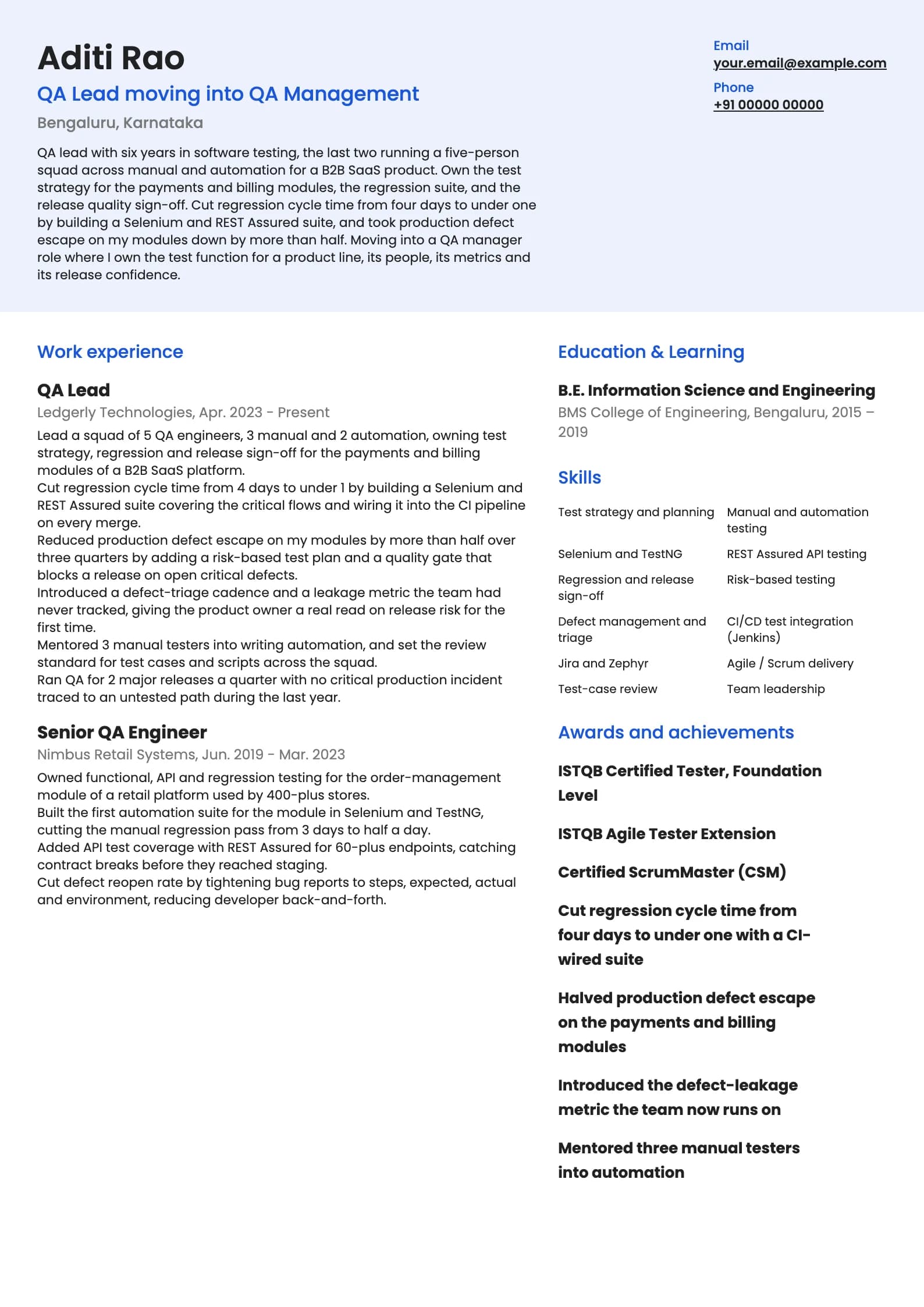
Build my resumeQA Manager resume example, QA Lead stepping up (6 years)
modern templateIs your resume good enough?
Upload the resume you have now and see what an applicant tracking system reads before a qa manager recruiter ever does.
Free to run. Sign in with your mobile number to see your score.
QA Manager resume example, QA Manager (10 years)
header-band template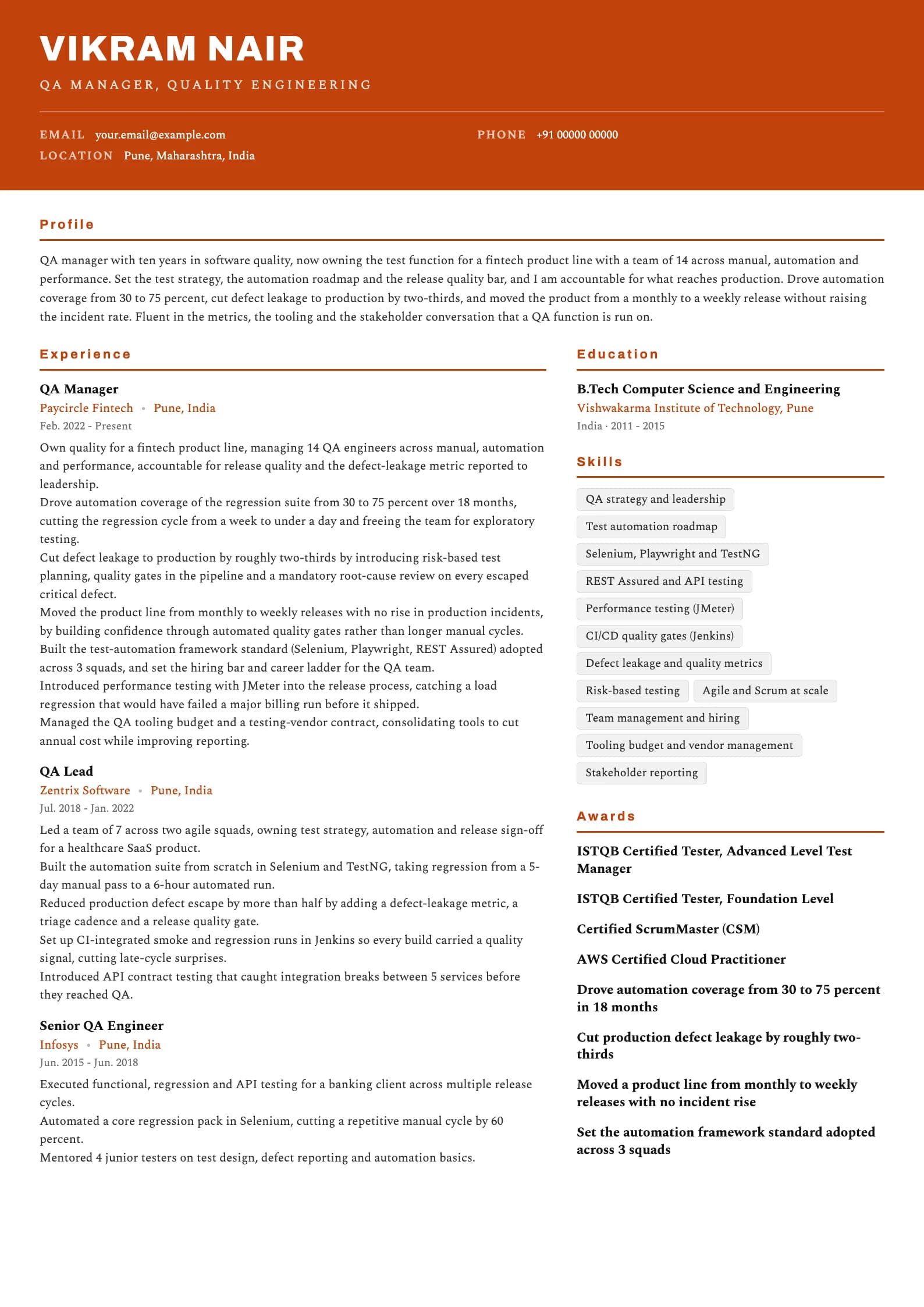
Want this structure with your own details? Build it in the resume builder.
QA Manager resume example, Senior QA / Quality Engineering Leader (16 years)
professional template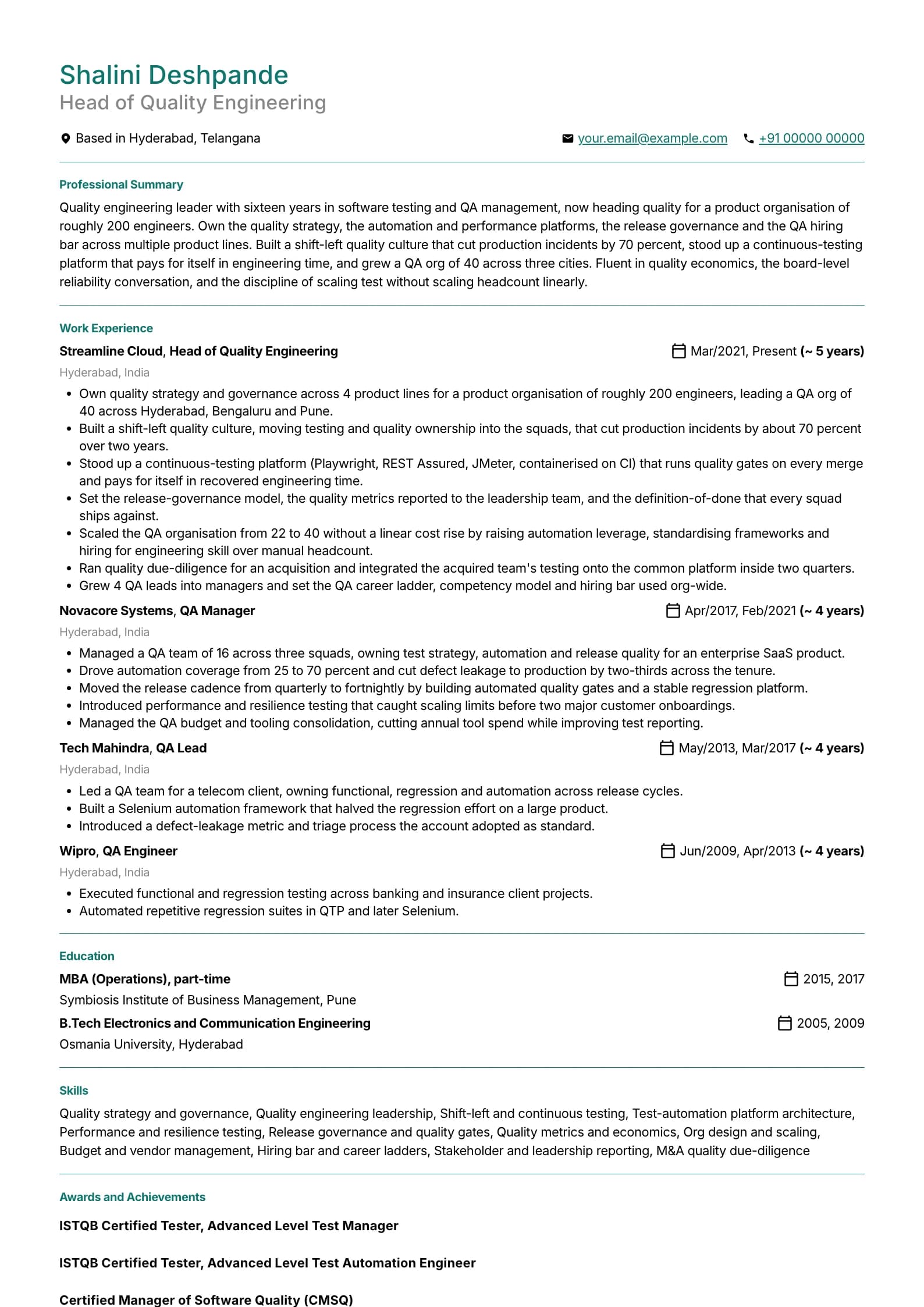
The format that works for QA manager resumes in India
Reverse chronological is the only layout worth using. Put your current role first, work backwards, and keep the dates in plain view. A QA management resume that hides dates under a skills or a summary heading reads as an attempt to obscure a gap, and reviewers treat it that way. A gap is better handled in one honest line. Length is set by seniority and evidence. A QA lead stepping into management fits on one page. A QA manager with ten years usually needs a tight one or a full two, and a quality leader with a department and fifteen years of history earns two pages, but only if the second carries real leadership and outcomes rather than a longer tool list. A page built from a tools inventory and a hobbies line is a padded resume at any level. Lead with accountability, not activity. The whole point of a management resume is to show what you own and what happened because of it: release quality, defect leakage, automation coverage, team size, budget. A reviewer scanning for a QA manager wants to see the scope of ownership in the first few lines, which is why every sample summary states the team size, the product scope and the headline metric. Drop the photograph, date of birth, marital status and father's name, which add nothing to a management screen and take space that scope and results should hold. Send a PDF, name it with your name and the word QA or quality, and keep a single-column layout, because two-column resumes parse unpredictably. The table below sets the section order.
| Section | Where it goes | Why |
|---|---|---|
| Name and headline | Top, above everything | Headline names the level: QA Manager, Head of Quality Engineering. Recruiters match on the title band. |
| Executive summary | Directly under the header | Three to four lines: scope owned, team size, and the two strongest quality outcomes. |
| Work experience | Next, always | Most recent first. Lead each role with ownership, then the metrics it moved. |
| Skills | Below experience | Grouped: strategy, automation and tooling, leadership. Not a 40-item tool wall. |
| Certifications | After skills, or beside it | ISTQB Test Manager, CSM, Six Sigma. Name, body, year. |
| Education | Bottom | Degree, institution, years. An MBA is worth naming; drop the percentage. |
| Key achievements | Optional band near the top for seniors | Three or four outcome lines a busy reviewer reads first. Metrics only. |
The metrics a QA manager is actually judged on
A QA manager resume lives or dies on quality metrics, because a hiring manager is trying to predict whether releases will get safer and faster under you. The problem is that most QA management resumes describe process, implemented a test strategy, established QA best practices, without ever naming a number that moved. Process is the how. The metric is the result, and the result is what persuades. Learn the handful of numbers that a QA function runs on and use them. Defect leakage or escape rate to production is the single most important, because it is the direct measure of quality reaching the customer. Automation coverage of the regression suite, regression cycle time, release cadence, production incident count, and defect removal efficiency are the others a reviewer expects to see. The manager sample links three of them, coverage up, leakage down, cadence from monthly to weekly, which tells a complete story: the product got both faster and safer. Connect the metric to the mechanism. A number with no method behind it reads as a claim, while a number with a mechanism reads as a case study. "Cut defect leakage by two-thirds by introducing risk-based test planning, quality gates and a root-cause review on every escaped critical defect" is convincing because a reviewer can ask a real follow-up. The bare version, improved product quality significantly, invites nothing. At the senior level, translate quality into money and leverage. Scaling a QA org without a linear cost rise, a platform that pays for itself in engineering time, incidents cut that protected revenue: this is the language a quality leader is judged in above the manager level, and the senior sample leads with it.
Summary line, QA manager
Weak
Result-oriented QA manager with strong experience in implementing test strategies, QA best practices and process improvements to ensure high quality software delivery.
Strong
QA manager owning quality for a fintech product line with a team of 14. Drove automation coverage from 30 to 75 percent, cut defect leakage to production by two-thirds, and moved the product from monthly to weekly releases with no rise in incidents.
Trades a list of process nouns for a scope of ownership and three linked metrics a hiring manager can verify and probe.
For every process you claim to have implemented, name the metric it moved. Best practices, strategy and framework are the how. Leakage, coverage, cadence and incidents are the result, and only the result persuades.
Showing management, not just senior testing
The most common failure in a QA manager resume is that it reads like a senior QA engineer's resume with a bigger tool list. The bullets describe scripts written, suites built and bugs found, which is individual-contributor work, and never establish that the person led people, set direction, or was accountable for a function. A hiring manager reading it cannot tell whether they are looking at a manager or a strong engineer who wants the title. Show the three things management is actually about. First, people: how many you led, who you grew, the hiring bar and career ladder you set. Second, direction: the strategy, the automation roadmap, the standard adopted across teams. Third, accountability: the release quality you owned, the metric you reported to leadership, the budget you managed. Every sample states team size, a person you developed, and a metric you were accountable for, because those are the three legs a management resume stands on. Be careful with we and I. A manager's resume that says we improved everything gives no read on what you personally drove, while one that says I did everything reads as someone who did not delegate. The honest middle is to own the direction and the outcome, built the framework standard adopted across three squads, drove coverage from 30 to 75, and credit the team's execution where it belongs. Do not drop the technical depth entirely. A QA manager who cannot talk about a test framework, a CI pipeline or a performance test loses credibility with the engineers they would lead. The balance is a resume that leads with ownership and outcomes and still shows you know the craft, which is how all three samples are built.
Experience bullet, QA manager
Weak
Worked on test automation using Selenium and wrote automation scripts for regression testing of the application.
Strong
Built the test-automation framework standard (Selenium, Playwright, REST Assured) adopted across 3 squads, and set the hiring bar and career ladder for the QA team.
Moves from writing scripts, which is engineer work, to setting a standard other teams adopt and owning the team's hiring and growth, which is management.
Read each bullet and ask: could a senior QA engineer write this. If yes, it is not a management bullet. Rewrite it around people led, direction set or a function owned until only a manager could claim it.
Experience bullets: ownership, mechanism, outcome
Every strong bullet in the samples follows the same shape. It opens with ownership or an action verb, names the specific change or programme you drove, and closes with the outcome that moved. The ownership establishes it was yours. The mechanism tells a technical reviewer it was real. The number does the persuading. Start from the outcome and work backwards. Managers often write the initiative first, then cannot attach a result, which produces bullets like established a QA process and improved quality. Instead ask what was measurably different: leakage fell, coverage rose, a cycle shortened, a cadence increased, incidents dropped, a cost was cut. Then write the sentence that ends in that fact and names how you got there. Vary the metric. Coverage on every bullet reads as one trick. Across a real role you can honestly reach for defect leakage, automation coverage, regression cycle time, release cadence, incident count, defect removal efficiency, tool cost and team growth. The senior sample moves across incidents, org size, cost and platform leverage, which reads as range. Where a number is not available, give scope: team size, product lines owned, squads served, releases governed. "Own quality strategy and governance across 4 product lines for an organisation of roughly 200 engineers" carries weight without a percentage. Allocate bullets by recency and seniority: the current role gets the most and the strongest, older roles compress to two or three.
| Level | What bullets must prove | Typical metric |
|---|---|---|
| QA Lead to first-line manager | You own a module's quality and lead a small team | Regression cycle time, defect escape, coverage, testers mentored |
| QA Manager | You own a product line's quality and a full team | Defect leakage, automation coverage, release cadence, team size, budget |
| Senior QA Manager | You own quality across multiple teams and set standards | Production incidents, coverage at scale, cost, leads developed |
| Head of Quality | You own quality strategy, org and economics for a product org | Incident reduction, org scaling vs cost, platform leverage, governance |
Experience bullet, release quality
Weak
Responsible for improving the release process and ensuring quality of releases delivered to production.
Strong
Moved the product line from monthly to weekly releases with no rise in production incidents, by building confidence through automated quality gates rather than longer manual cycles.
"Responsible for" describes the job title; the rewrite names the cadence change, the incident outcome and the mechanism that made faster also safer.
If a bullet would read identically on any QA manager's resume, it is describing the role, not you. Add the metric, the mechanism and the scope until it only fits the function you actually ran.
The skills section: grouped, current, and short enough to defend
A QA manager's skills section has two audiences. A parser and a recruiter want literal terms they can match, Selenium, ISTQB, CI/CD, test strategy. A hiring manager wants a short, organised list that signals what kind of QA leader you are: hands-on, strategic, or both. Grouping satisfies both. Group by function rather than one long line. Strategy and process, automation and tooling, and leadership is a grouping that works for almost every QA manager. Keep the tools current: a manager whose skills line is heavy on QTP, WinRunner and manual testing with no modern automation reads as someone whose craft stopped a decade ago. Name modern tools you actually use, Selenium, Playwright, Cypress, REST Assured, JMeter, and write them the way the industry does. Twelve to sixteen skills is the working range. Below eight the section looks thin for a manager. Above twenty it stops being a signal, and a QA resume is especially prone to listing every tool ever touched. The list is a contract: every item is a question you have agreed to answer, and a hiring manager will ask you to justify a strategy or a metrics skill just as readily as a tool. Balance the two halves of the job. A QA manager's skills should show both the engineering side, automation frameworks, CI/CD, API and performance testing, and the management side, test strategy, quality metrics, team leadership, stakeholder reporting, budget. A resume that lists only tools reads as an engineer, and one that lists only management reads as someone who has drifted from the craft. Do not use star ratings or proficiency bars, which invite an argument no one wins. Let the experience prove the depth.
| Group | What goes in it | How many |
|---|---|---|
| Strategy and process | Test strategy, risk-based testing, quality metrics, release governance | 3 to 5 |
| Automation and tooling | Selenium, Playwright, REST Assured, JMeter, CI/CD, Jira, TestRail | 4 to 6 |
| Testing types | Functional, API, performance, regression, exploratory | 2 to 4 |
| Leadership | Team management, hiring, mentoring, stakeholder reporting, budget | 3 to 5 |
| Delivery | Agile, Scrum, SAFe, shift-left, continuous testing | 2 to 3 |
Writing an executive summary a hiring manager reads
The block under your name is the part you can be sure gets read, so for a QA manager it should carry the scope you own, the size of the team, and the two strongest outcomes you have produced. Three or four lines, no adjectives that cannot be checked. This is the paragraph that decides whether the reviewer keeps reading, so it is the highest-value real estate on the page. The old objective, seeking a challenging QA leadership position in a reputed organisation to utilise my testing skills, tells the reader nothing they did not assume from the application. Replace it with a summary that states what you are accountable for and what happened because of it. An objective describes what you want, a summary describes what you have already delivered, and only one is evidence a hiring manager can act on. Be specific about scope. Owning quality for a product line with a team of fourteen is a different job from leading a two-person squad, and the summary should make the level unmistakable in the first line. The three samples each open by naming the team size and the product scope precisely, so a reviewer places the candidate in the right band before reading a single bullet. A practical test: read your summary and ask whether another QA manager with the same tools could paste it onto their resume unchanged. If they could, it describes the role, not you. Add the specific team size, the specific metric and the specific accountability until it stops being transferable.
Your summary should name the team you led and the metric you moved in the first two lines. If a reviewer cannot tell your level and your best result from those lines alone, rewrite them.
Getting through the applicant tracking system
QA management roles at product companies, GCCs and larger service firms almost always come through an applicant tracking system, which is a parser and a search index, not a judge. It reads your file, breaks it into name, dates, employers, titles and skills, and stores the result so a recruiter can search across candidates. Nearly every ATS problem is a parsing problem, and parsing problems come from layout, not wording. The layout rules are short. One column. Standard section headings, so use Work Experience rather than My Journey, and Skills rather than My Toolbox. No text inside images, because a tool-logo strip reads as empty space. Nothing critical in the header or footer region, which some parsers drop. Avoid text boxes and nested tables in the body. On wording, mirror the job description where it is honest. If the posting says test automation, write test automation. If it says defect leakage or quality metrics, use those exact terms, because a recruiter often searches on them. Include the expansion alongside an acronym at least once, for example ISTQB (International Software Testing Qualifications Board) and DRE (defect removal efficiency), so both searches find you. Titles matter for QA search: if your role was effectively QA management under a different internal label, make the standard title clear so a recruiter filtering on QA Manager or Test Manager reaches you. Keyword stuffing does not work. A hidden block of every testing tool in white text is found quickly and the outcome is worse than being filtered. Write real bullets that naturally contain the right terms, because a bullet describing an automation programme contains automation, coverage and CI in a context that survives human review too. Save as a PDF that embeds real text, then open it and confirm you can select and copy a sentence, since whatever you cannot select, the parser cannot read.
Test your own file before sending it. Copy the text out of the PDF into a plain text editor. Whatever reads cleanly there is roughly what the parser sees, and anything scrambled is a real risk, especially your title and your metrics.
What gets QA manager resumes rejected
Most QA manager resumes are rejected at the screening stage for a small set of recurring reasons, and all of them are fixable in an afternoon. The list below covers what hiring managers and recruiters see most often on Indian QA management resumes, in rough order of how much damage each one does.
- Reads like a senior QA engineer's resume with more tools. No people led, no direction set, no function owned. The bullets describe scripts, not management.
- Process nouns without a single metric. Implemented test strategy, established best practices, with no leakage, coverage, cadence or incident number attached.
- An outdated tool list. QTP and WinRunner front and centre with no modern automation, reading as a craft that stopped a decade ago.
- A generic objective line instead of a summary that states scope owned, team size and the two strongest outcomes.
- No team size or scope anywhere, so a reviewer cannot tell whether you led two people or forty.
- Only we, never I, so it is impossible to read what you personally drove, or only I, so it reads as someone who did not delegate.
- Vague quality claims, ensured high quality delivery, that name no mechanism and invite no follow-up.
- A photo, date of birth, marital status or father's name, none of which belong on a management resume and all of which take a result's space.
- Inflated titles or dates that do not match payslips and offer letters, since background verification is standard and a mismatch ends the process.
- Losing the technical depth entirely, so the resume cannot show you could earn the respect of the engineers you would lead.
Read your resume as the hiring manager who will report to their own leadership on release quality. If it does not convince you that this person would make releases safer and faster, it needs the ownership and the metrics put back in.
Skills to put on a qa manager resume
Technical
- Test strategy and planning
- Test automation architecture
- Selenium and Playwright
- REST Assured and API testing
- Performance testing (JMeter)
- CI/CD quality gates
- Risk-based testing
- Defect leakage and quality metrics
- Shift-left and continuous testing
- Release governance
- Exploratory and regression testing
- Test data and environment management
Tools and platforms
- Jira and Zephyr
- TestRail and qTest
- Jenkins and GitHub Actions
- Selenium and TestNG
- Playwright and Cypress
- REST Assured and Postman
- JMeter and Gatling
- Git and Docker
Working skills
- Team leadership
- Hiring and mentoring
- Stakeholder management
- Cross-functional collaboration
- Budget and vendor management
- Roadmap and prioritisation
- Escalation and risk communication
- Coaching and career development
Certifications worth listing as a qa manager
| Certification | Full name | Worth it for |
|---|---|---|
| ISTQB Test Manager | ISTQB Certified Tester, Advanced Level Test Manager (CTAL-TM) | The core certification for a QA manager, since it certifies test planning, estimation, risk management, metrics and team leadership rather than tool use. The most directly relevant credential for anyone moving into or working in QA management, and worth naming prominently. |
| ISTQB Foundation | ISTQB Certified Tester, Foundation Level (CTFL) | The entry-level testing certification and a common baseline expectation. Useful early in a career and worth keeping listed, though a QA manager should pair it with the Advanced Test Manager level, which carries more weight at the management stage. |
| CTAL-TAE | ISTQB Certified Tester, Advanced Level Test Automation Engineer | A strong signal for a QA manager who owns an automation strategy and framework, since it certifies automation architecture rather than script writing. Most valuable for leaders whose mandate is raising automation coverage and building a continuous-testing platform. |
| CSM | Certified ScrumMaster (Scrum Alliance) | Useful for a QA manager working in agile teams, since so much of the role is quality within a sprint cadence and release process. A fair add-on that signals comfort with agile delivery, though it matters less than the ISTQB management track for a QA-specific role. |
| CMSQ | Certified Manager of Software Quality (QAI) | A management-focused quality certification worth considering for senior QA managers and quality leaders who own process, metrics and organisational quality. Recognised in enterprise and service-company contexts, and a reasonable complement to the ISTQB management level. |
| Six Sigma Green Belt | Lean Six Sigma Green Belt | Worth it for QA leaders who drive measurable process improvement and quality economics, since it certifies a structured approach to reducing defects and variation. Most relevant at the senior manager and head-of-quality level, where the job is as much about process and cost as about testing. |
Keywords an ATS scans for in a qa manager resume
These are the literal terms a parser matches against the job description. Use the ones that are true of you, in the sentences where you did the work, not as a list at the bottom.
- qa manager
- quality assurance manager
- test manager
- quality engineering
- test strategy
- test automation
- selenium
- playwright
- api testing
- performance testing
- defect leakage
- quality metrics
- CI/CD
- release management
- risk-based testing
- agile
- scrum
- ISTQB
- team management
- shift-left testing
QA Manager resume FAQ
What salary can a QA manager expect in India?
A QA lead stepping into first-line management typically sits around 14 to 22 LPA. A QA manager owning a product line with a team of ten to fifteen usually earns 18 to 35 LPA, with product companies and GCCs at the higher end. A senior QA manager or head of quality engineering running a department commonly earns 35 to 60 LPA and more at strong product organisations. Depth in test automation strategy, quality metrics and a track record of cutting defect leakage while raising release cadence pushes the top of every band upward, and cloud or performance-engineering breadth adds to it.
How long should a QA manager resume be?
A QA lead stepping up fits on one page. A QA manager with ten years usually needs a tight one page or a full two, and a quality leader with a department and fifteen-plus years earns two pages, but only if the second carries real leadership and outcomes rather than a longer tool list. Lead with ownership and metrics so a reviewer sees your level in the first few lines regardless of length, and cut older roles to two or three bullets to keep the page focused on what you own now.
How do I show management experience rather than just senior testing?
Build the bullets around the three things management is about: people led and grown, direction set, and a function owned. State team size, name a tester or lead you developed, and lead with the release quality and defect-leakage metrics you were accountable for. Rewrite any bullet a senior QA engineer could also claim, wrote automation scripts, until it becomes something only a manager could, set the automation framework standard adopted across three squads and owned the team's hiring bar. Keep some technical depth so you can still earn the respect of the engineers you would lead.
Which metrics should a QA manager put on a resume?
Defect leakage or escape rate to production is the most important, because it directly measures quality reaching the customer. Add automation coverage of the regression suite, regression cycle time, release cadence, production incident count and defect removal efficiency. Connect each metric to the mechanism that moved it, since a number with a method behind it reads as a case study while a bare number reads as a claim. At the senior level, translate quality into money and leverage, such as scaling a QA org without a linear cost rise or a platform that pays for itself in engineering time.
Do certifications like ISTQB Test Manager help a QA manager?
Yes, the ISTQB Advanced Level Test Manager is the most directly relevant credential, because it certifies test planning, risk, metrics and team leadership rather than tool use. The Foundation level is a common baseline, the Test Automation Engineer level helps if you own an automation strategy, and a Six Sigma or CMSQ certification adds weight at the senior and head-of-quality level. That said, certifications support the resume rather than carry it: a track record of cutting leakage and raising cadence matters far more than any badge for a management role.
Should a QA manager resume still show hands-on technical skills?
Yes. A QA manager who cannot talk about a test framework, a CI pipeline, API or performance testing loses credibility with the engineers they would lead, so the resume should keep current technical skills visible even as it leads with ownership and outcomes. The balance is a page that shows both halves of the job: the management side of strategy, metrics, team and budget, and the engineering side of modern automation and continuous testing. A resume that is all tools reads as an engineer, and one that is all management reads as someone who has drifted from the craft.
How does a QA lead write a resume to move into QA management?
Reframe your experience around ownership and people rather than execution. Show that you already own a module's test strategy, its regression suite and its release sign-off, that you lead and mentor a small team, and that you speak in the metrics a manager is judged on, regression cycle time, defect escape, coverage. Introduce a metric the team did not track before, such as defect leakage, since starting to manage the numbers is itself a management signal. The fresher-of-management sample is built exactly this way: a lead demonstrating manager-level ownership before holding the title.
Do I need a photo on a QA manager resume in India?
No. A photograph, date of birth, marital status and father's name come from an older template and add nothing to a management screen, while they take space that scope and results should hold. Leave them off. The only exception is a specific posting that explicitly asks for a photograph, which is rare for a QA management role at a product or technology company.
Related resume examples and guides
Build your own QA manager resume in any of these formats
Start from a blank resume or upload the one you have. Goodspace renders it in 24 templates and flags the ownership, quality-metric and automation keywords a hiring manager and an applicant tracking system look for, and the tool-list padding they will not credit.
Build my resume