Procurement Manager Resume Format, with 3 Full Samples
A procurement manager is hired on evidence of cost taken out, suppliers managed and supply kept flowing, yet most resumes list the sourcing process and forget the rupees it saved. Below are three complete resumes, one for a procurement executive stepping up, one for a category-owning procurement manager, and one for a senior procurement leader running sourcing across a business. After the samples come the format rules, the difference between listing negotiation and proving a saving, the terms a parser matches literally, and the mistakes that end a screening before a human reads the page.
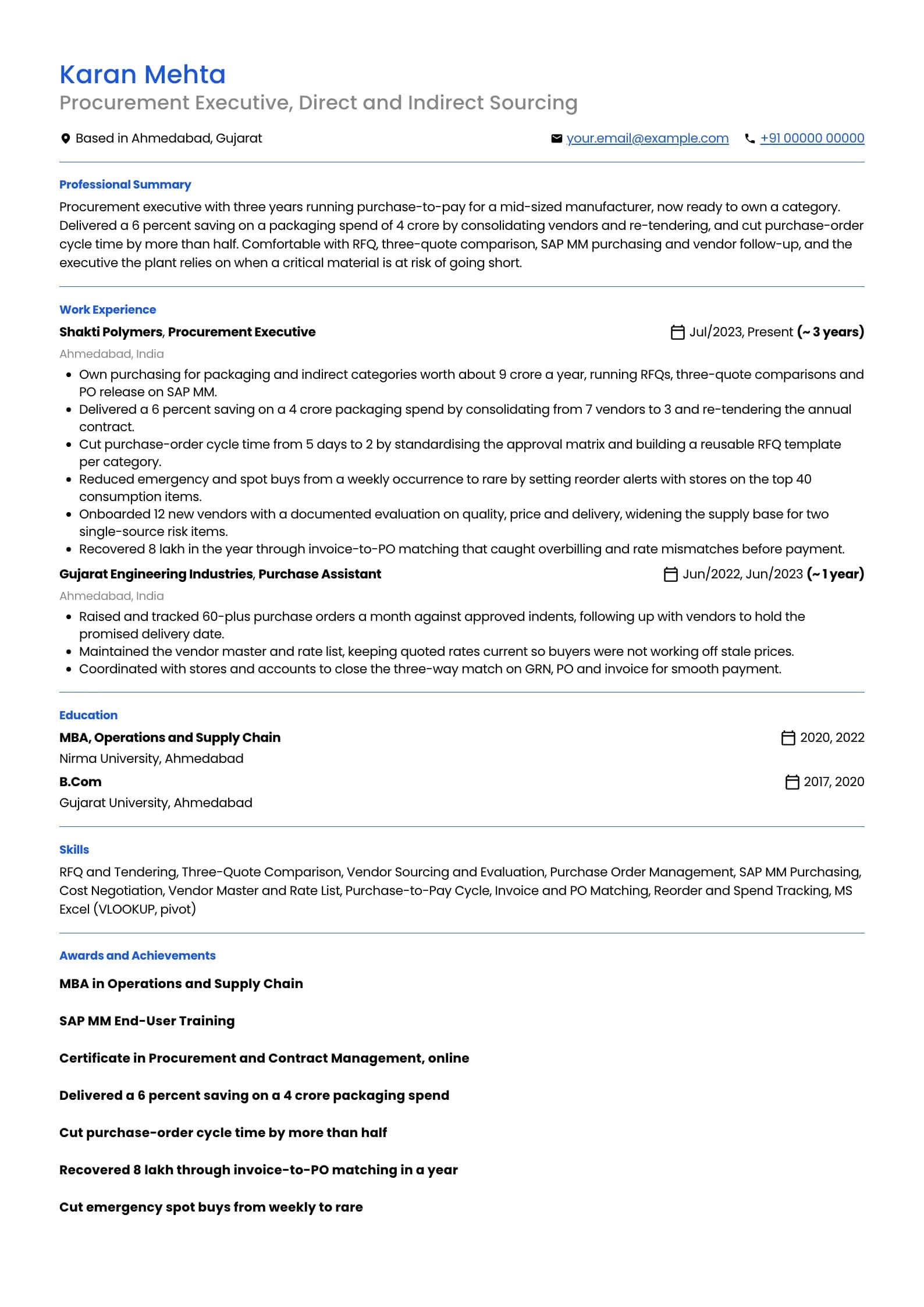
Build my resumeProcurement Manager resume example, Procurement Executive stepping up (3 years)
professional templateIs your resume good enough?
Upload the resume you have now and see what an applicant tracking system reads before a procurement manager recruiter ever does.
Free to run. Sign in with your mobile number to see your score.
Procurement Manager resume example, Procurement Manager (8 years)
header-band template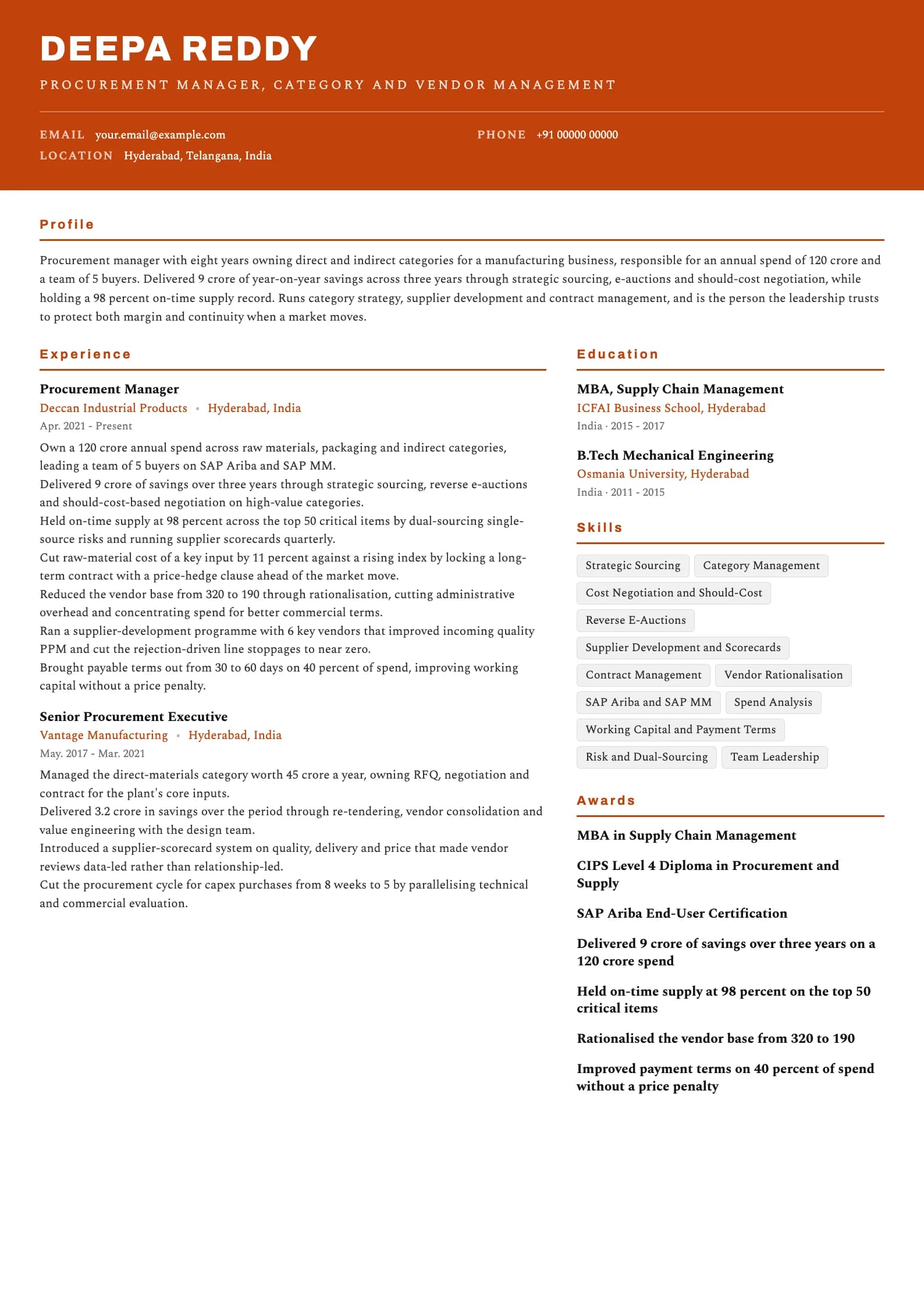
Want this structure with your own details? Build it in the resume builder.
Procurement Manager resume example, Senior Procurement Leader (15 years)
modern template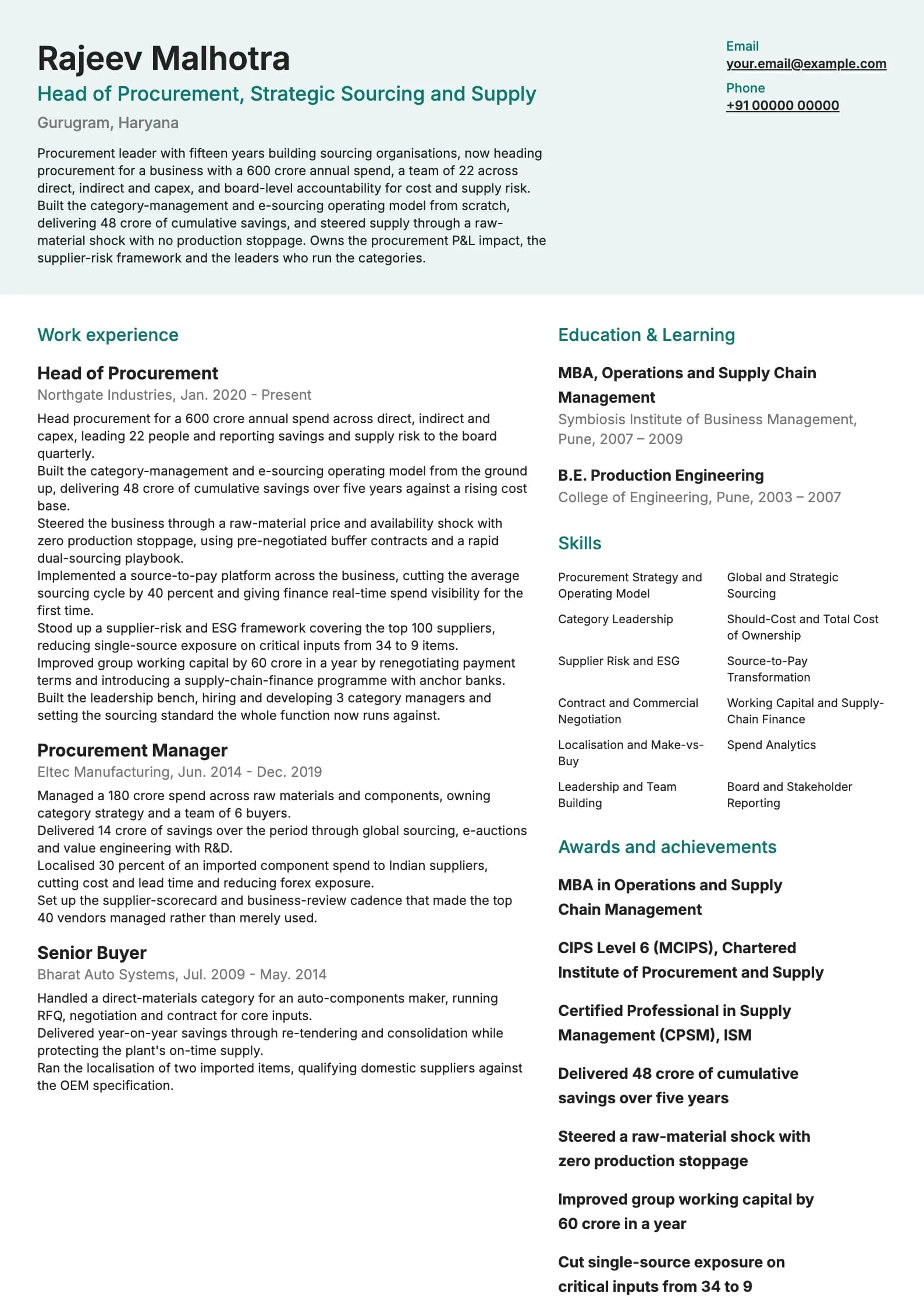
The format that works for procurement manager resumes in India
Reverse chronological is the only layout worth using. Put the most recent role first, work backwards, and let the dates sit in plain view. Functional resumes that group everything under a Skills or Competencies heading and drop the dates read as an attempt to hide a gap or a short stint, and hiring leaders in procurement treat them that way. If you have a gap, one honest line explains it better than a hidden one raises suspicion. Length is decided by scope. One page holds everything a procurement executive and most managers up to roughly eight years have to say. A senior procurement leader owning a large spend, a team and board reporting can run to a second page when it carries real category and transformation work, rather than a longer list of sourcing steps. Four things belong nowhere on this resume: a photograph, date of birth, marital status and father's name. They survive from an older template that circulated through placement offices. Nobody hiring a procurement manager is looking for them, and every line they occupy is a line a savings number could have used. Send a PDF unless the posting asks for DOCX, and name the file with your own name and the target role rather than resume_final_v4. Use a single column all the way down, because two-column layouts parse unpredictably when a sidebar sits beside the experience. The table below sets out the section order.
| Section | Where it goes | Why |
|---|---|---|
| Name and headline | Top, above everything | The headline is the role you want, procurement or purchase manager. Recruiters match on it. |
| Professional summary | Directly under the header | Three lines. Spend owned, years, and the strongest savings or continuity result. |
| Work experience | Next, for anyone with a job | Most recent first. Newest role gets the most bullets. |
| Key achievements | Optional band near the top for managers | Savings, on-time supply, working capital. The numbers leadership wants first. |
| Core skills | Below the summary or beside experience | Sourcing, negotiation, category, contract, systems. Grouped, not a wall. |
| Education | Below experience | MBA or engineering, institution, years. |
| Certifications | After education, or beside skills if only one or two | CIPS, CPSM, SAP Ariba. Name, body, year. |
Listing negotiation is not the same as proving a saving
The single most common procurement manager resume failure is a page of process that could belong to anyone with the same title: responsible for sourcing, vendor management, negotiation, RFQ, contract management, ensuring on-time delivery. A parser sees the keywords, but a procurement leader reads the wall and cannot tell a strong buyer from a weak one, because both wrote the same process. The fix is to attach a rupee number to the work. Procurement is one of the few functions with a direct, defensible line to the bottom line, so use it. Savings in absolute value and as a percentage of the base spend, spend owned, on-time supply, vendor count rationalised, payment-term improvement, working-capital impact, and cost avoidance against a rising index. Every bullet in the samples ends in one of these. Be careful to show savings and continuity together. A resume that is all savings reads as someone who squeezes suppliers until the line stops, which is a real fear for the person hiring you. Pairing a savings number with an on-time-supply number, as the manager sample does, proves you protect margin and continuity at once, which is the whole job. Name the lever, not just the outcome. Should-cost, reverse e-auction, vendor consolidation, dual-sourcing, value engineering, localisation, payment terms. The senior sample names several because a mature buyer has more than one tool, and naming them shows you think in total cost of ownership, not sticker price.
For every sourcing activity on your resume, ask: how many rupees did it save or protect, and did supply stay intact. If you cannot answer both, the line is a process description, not an achievement.
Writing a summary a hiring leader actually reads
The block under your name is the part you can be reasonably sure gets read, so it should carry three facts: the spend you steward, how long you have done procurement, and the strongest number that came out of it, ideally one savings figure and one continuity figure. Three or four lines, no adjectives that cannot be checked. The old objective line, seeking a challenging position in a reputed organisation to utilise your procurement and negotiation skills, tells the reader nothing they did not assume from the application. Replace it with a summary. An objective describes what you want, a summary describes the spend you have already managed and the money you saved, and only one is evidence. Executives stepping up often undersell themselves. Look at the executive sample: it names the spend, the saving, and the cycle-time cut. That is a genuine summary built from three years and one category. What it avoids is "dynamic and result-oriented professional", a phrase so common on procurement resumes it now carries no information. A practical test: read your summary and ask whether the buyer at the next company could paste it onto their resume unchanged. If they could, it describes the job title, not you. Add the specific spend, the specific saving and the specific continuity number until it stops being transferable.
Professional summary, procurement manager
Weak
Dynamic and result-oriented procurement professional with 8+ years of experience in sourcing, vendor management and negotiation seeking a challenging role in a reputed organisation.
Strong
Procurement manager with eight years owning a 120 crore spend across three categories and a team of 5. Delivered 9 crore of savings over three years while holding on-time supply at 98 percent on critical items.
The rewrite trades a keyword list and self-praise for a stated spend, a savings number and the continuity figure that proves the savings did not break supply.
Experience bullets: verb, sourcing action, rupee consequence
Every strong bullet in the samples follows the same shape. It opens with an action verb, names the specific sourcing action or contract you drove, and closes with what measurably moved, usually in money. The verb establishes that you did it. The action tells a reviewer whether the work matches their categories. The number does the persuading. Start with the outcome and work backwards. Buyers usually write the activity first, then struggle to attach a number, which produces bullets like "handled negotiation with vendors to reduce costs". Instead ask what was different after you acted: a spend dropped by a percentage, a saving of a certain value landed, on-time supply held, a vendor base shrank, payment terms extended, single-source risk fell. Then write the sentence that ends in that fact. Vary the metric. Five savings percentages in a row read as one trick repeated, and worse, as someone who only cuts price. Across a real role you can honestly reach for absolute savings, percentage savings, spend owned, on-time supply, vendor count, payment terms, working capital and risk items reduced. The manager and senior samples use several, which reads as a buyer who manages total cost, not just rate. Where a saving is hard to isolate, give scope: how large the spend, how many vendors, how many categories, how many buyers you lead, how long a cycle took. "Own a 120 crore annual spend across three categories, leading a team of 5" carries weight before a single saving. Allocate bullets by recency. Current role gets six or seven, the previous role four or five, anything older two or three.
| Level | What bullets must prove | Typical metric |
|---|---|---|
| Executive | You run the buying process cleanly and save | Savings percent, PO cycle time, spot buys cut, recovery |
| Procurement manager | You own a category and its total cost | Absolute savings, on-time supply, vendor rationalisation, terms |
| Senior leader | You build the function and steer risk | Cumulative savings, working capital, source-to-pay, risk reduced |
| Any level | Savings did not break supply | On-time supply, dual-sourcing, zero stoppage, PPM |
Experience bullet, negotiation
Weak
Handled negotiation with vendors and suppliers to reduce the overall procurement cost of the company.
Strong
Delivered a 6 percent saving on a 4 crore packaging spend by consolidating from 7 vendors to 3 and re-tendering the annual contract.
"Handled negotiation" describes the activity; the rewrite names the saving, the base spend and the two levers that produced it.
Experience bullet, supply continuity
Weak
Responsible for ensuring timely availability of materials and managing supplier relationships.
Strong
Held on-time supply at 98 percent across the top 50 critical items by dual-sourcing single-source risks and running supplier scorecards quarterly.
Names the continuity metric, the item scope and the two mechanisms, so a reviewer can ask a real follow-up instead of nodding at a vague claim.
If a bullet would read identically on the resume of the buyer at the next company, it is describing the title, not you. Rewrite it until it names your spend, your saving and the supply you protected.
The skills section: grouped, honest, and short enough to defend
A procurement manager resume's skills section has two audiences with opposite preferences. The parser wants literal terms it can match, strategic sourcing and SAP Ariba and category management. A hiring leader wants a short, organised list that signals what kind of buyer you are. Grouping satisfies both. Group by function rather than one long line. Sourcing and negotiation, category and contract, supplier and risk, and systems is a grouping that works for almost every procurement manager. The exact headings matter less than the fact that structure exists. Write names the way the industry writes them: SAP Ariba not Ariba SAP, TCO or total cost of ownership spelled out once, CIPS correctly. A parser matches on strings. Twelve to sixteen skills is the working range. Below eight the section looks thin. Above twenty it stops being a signal. A procurement resume is especially prone to listing every synonym for the same idea, sourcing and procurement and purchasing and buying as four items, when they are one. The list is a contract: every item is a question you have agreed to answer in the interview. Do not include a proficiency bar. Star ratings invite an argument you cannot win, and nobody agrees what four stars in negotiation means. Let the savings numbers in your experience prove the depth instead.
| Group | What goes in it | How many |
|---|---|---|
| Sourcing and negotiation | Strategic sourcing, RFQ, e-auctions, should-cost, negotiation | 3 to 5 |
| Category and contract | Category management, contract management, spend analysis, TCO | 3 to 4 |
| Supplier and risk | Supplier development, scorecards, dual-sourcing, risk, rationalisation | 3 to 4 |
| Systems | SAP Ariba, SAP MM, Coupa, Excel, spend analytics | 2 to 3 |
| Commercial (senior) | Working capital, payment terms, localisation, make-vs-buy | 1 to 3 |
Skills section
Weak
Skills: Procurement, Purchasing, Sourcing, Buying, Vendor management, Supplier management, Negotiation, Cost saving, Cost reduction, Cost cutting, Communication, Leadership, Hard working, MS Office, MS Excel
Strong
Sourcing: strategic sourcing, RFQ, reverse e-auctions, should-cost negotiation. Category and contract: category management, contract management, spend analysis. Supplier and risk: supplier development, scorecards, dual-sourcing. Systems: SAP Ariba, SAP MM, Excel.
Cuts the four-way synonyms and vague traits, keeps the terms a procurement recruiter actually searches, and groups the rest so a human reads it in one pass.
Savings projects and transformations: what to include and how to describe it
A procurement manager rarely has a projects section in the software sense, but the equivalent is powerful: the specific sourcing project or transformation you led. A category re-tender, an e-auction, a vendor-rationalisation drive, a localisation, a source-to-pay rollout. These are the entries that show you do not just process purchase orders, you change the cost base. The common failure is describing the activity instead of the outcome. "Worked on a cost-reduction project for the procurement department" tells a reviewer nothing, because thousands of resumes carry that line. Describe the category, the lever, the saving in rupees and the base it came off. The packaging consolidation in the executive sample is a stronger entry than a grander-sounding one, because it names the vendor count before and after, the spend and the percentage saved. For an executive or manager, one or two well-quantified sourcing projects are worth more than a longer duty list, because they are the clearest proof of impact. For a senior leader, the transformations, a category-management model, a source-to-pay platform, a supplier-risk framework, belong in the experience bullets as the highest-scope work you have done. Show the risk you managed, not only the money you saved. A localisation that cut cost is stronger when you also say it held the OEM specification and did not disrupt supply. A procurement reviewer reads a saving delivered without a supply scare as the mark of a mature buyer.
Savings project description
Weak
Led a cost-reduction project that helped the company achieve significant savings in procurement.
Strong
Localised 30 percent of an imported component spend to qualified Indian suppliers, cutting cost and lead time and reducing forex exposure while holding the OEM specification.
Swaps vague significant savings for the exact scope, the lever, the three benefits and the specification the localisation protected.
Where education and certifications belong
Education goes below experience for anyone with a job. Degree, institution, years. An MBA in operations or supply chain is worth naming clearly, because it is a common and valued background for procurement leadership, and an engineering degree helps in technical and direct-materials sourcing where understanding the product matters. Both still sit under the work that proves you save money. Percentage or CGPA is worth keeping only while you are early in your career and it is strong. Once you have delivered savings you can name, a college mark from years ago competes for space with numbers that are far more predictive, so drop it. For this field, procurement-specific certifications carry unusual weight. CIPS, from the Chartered Institute of Procurement and Supply, is the most recognised globally and increasingly valued in Indian hiring, with levels from a diploma up to the chartered MCIPS. CPSM, from ISM, is the leading US-origin equivalent. Either signals you know the discipline formally, not only by habit. Certifications sit just below education, or beside skills if you hold only one or two. Write the full name, the issuing body and the year. SAP Ariba or Coupa end-user training is worth naming because e-sourcing platforms are now standard in mid-sized and large firms. An expired or in-progress certification should be labelled honestly as such, because claiming a completed MCIPS you have not finished is easy to check and ends the process.
Getting through the applicant tracking system
An applicant tracking system is a parser and a search index, not a judge. It reads your file, tries to break it into name, dates, employers, titles and skills, and stores the result so a recruiter can search across candidates. Almost every ATS problem is a parsing problem, and parsing problems come from layout, not wording. The layout rules are short. One column. Standard section headings, so use Work Experience rather than My Journey, and Core Skills rather than My Toolbox. No text inside images, because a logo strip reads as empty space. No critical information in the header or footer region, which some parsers drop. Avoid text boxes and nested tables in the resume body. On wording, mirror the language of the job description where it is honest. If the posting says strategic sourcing, write strategic sourcing. If it says P2P or procure-to-pay, write it out. Include the expansion alongside an acronym at least once, for example "TCO (total cost of ownership)" and "RFQ (request for quotation)", so both searches find you. Keyword stuffing does not work, and procurement resumes are a common offender with a block of every sourcing synonym in white text. Recruiters find it quickly, and the outcome is worse than being filtered. Write real bullets that naturally contain the right terms, because a bullet describing a category re-tender contains the words sourcing and negotiation in a context that survives human review too. Save as PDF from a tool that embeds real text, then open the file and confirm you can select and copy a sentence. If you cannot select the text, neither can the parser.
Section heading
Weak
My Procurement Journey
Strong
Work Experience
Parsers look for standard headings; a creative one can push the entire block into an unclassified bucket the recruiter never searches.
Test your own file before you send it. Copy the text out of the PDF into a plain text editor. Whatever you can read there is roughly what the parser sees, and anything scrambled is a real risk.
What gets procurement manager resumes rejected
Most rejections at the resume stage are not close calls. They come from a small set of recurring problems, and all of them are fixable in an afternoon. The list below covers what reviewers of Indian procurement manager resumes see most often, in rough order of how much damage each one does.
- A page of process with no rupee numbers. Savings, spend owned, working capital and cost avoidance are the currency of this function. Use them.
- Savings shown without continuity, reading as a buyer who squeezes suppliers until the line stops. Always pair a saving with an on-time-supply number.
- No stated spend or category scope. Annual spend, number of categories, vendor count and team size are how a leader sizes the job you ran.
- Four-way synonyms padding the skills line, sourcing and procurement and purchasing and buying as separate items when they are one.
- A system listed but never proven. If SAP Ariba is on the skills line, a bullet must show a sourcing event or spend analysis you ran on it.
- Vague savings claims like significant cost reduction with no base spend, no percentage and no lever named.
- A photo, date of birth, marital status or father's name. None of it belongs on this resume, and it takes a savings number's space.
- A generic objective line. Replace it with a summary that states spend, years and one savings and one continuity result.
- Inflated titles, spend figures or savings that do not match your appraisal letters. Procurement references and background checks are thorough, and a mismatch ends the process.
- Claiming a completed CIPS or MCIPS that is only in progress, which is easy to verify and reads as dishonesty in a role built on trust.
Read your resume aloud once before sending it. Any savings figure you could not defend with the base spend and the lever behind it is a line to fix or cut.
Skills to put on a procurement manager resume
Technical
- Strategic Sourcing
- Category Management
- Cost Negotiation and Should-Cost
- Reverse E-Auctions
- Contract Management
- Spend Analysis
- Supplier Development and Scorecards
- Total Cost of Ownership
- Vendor Rationalisation
- Risk and Dual-Sourcing
- Working Capital and Payment Terms
- Localisation and Make-vs-Buy
Tools and platforms
- SAP Ariba
- SAP MM
- Coupa
- Oracle Procurement
- MS Excel (advanced)
- Power BI
- GEM (Government e-Marketplace)
- Spend Analytics
Working skills
- Commercial negotiation
- Stakeholder management
- Cross-functional collaboration
- Team leadership
- Supplier relationship management
- Analytical decision making
- Influencing and persuasion
- Ethics and compliance
Certifications worth listing as a procurement manager
| Certification | Full name | Worth it for |
|---|---|---|
| CIPS | CIPS Diploma to MCIPS, Chartered Institute of Procurement and Supply | The most globally recognised procurement qualification and increasingly valued in Indian hiring, with levels from a Level 4 diploma up to the chartered MCIPS. Worth it for anyone serious about a procurement career, and a genuine differentiator for manager and leadership roles. Label your exact level honestly, since claiming MCIPS you have not completed is easy to verify. |
| CPSM | Certified Professional in Supply Management, ISM | The leading US-origin procurement and supply certification, valued in multinationals and firms with US links. A strong alternative or complement to CIPS for a procurement manager who wants a formal supply-management credential. Most useful at the manager and senior level rather than for a first-year executive. |
| SAP Ariba | SAP Ariba End-User Certification | Worth naming because e-sourcing and procure-to-pay platforms are now standard in mid-sized and large Indian firms, and Ariba is among the most common. Most valuable when a bullet shows a real sourcing event or spend analysis you ran on it. Pairs naturally with SAP MM experience on the stores and purchasing side. |
| MBA SCM | MBA in Operations and Supply Chain Management | A common and valued background for procurement leadership in India, giving the commercial and supply-chain grounding the role needs. Most useful as you move from executive to manager, where category strategy and cost thinking matter. Once you have a strong savings track record, the MBA supports the page rather than leading it. |
| Six Sigma Green Belt | Lean Six Sigma Green Belt Certification | Useful for procurement professionals who drive supplier-quality improvement and process efficiency, since so much of the role is reducing waste and variation in the supply base. A helpful complement to a procurement credential rather than a substitute for one. Most relevant where your role touches supplier development and quality. |
Keywords an ATS scans for in a procurement manager resume
These are the literal terms a parser matches against the job description. Use the ones that are true of you, in the sentences where you did the work, not as a list at the bottom.
- procurement manager
- purchase manager
- strategic sourcing
- category management
- vendor management
- cost savings
- negotiation
- SAP Ariba
- SAP MM
- RFQ
- contract management
- supplier development
- spend analysis
- procure-to-pay
- e-auction
- total cost of ownership
- supply chain
- purchase order
- vendor rationalisation
- CIPS
Procurement Manager resume FAQ
What salary can a procurement manager expect in India?
A procurement executive stepping up typically earns around 4 to 8 LPA. A procurement manager owning a category and a team usually sits in the 10 to 22 LPA band, higher in large manufacturing, pharma and auto firms. Senior procurement leaders and heads of procurement with twelve years and above commonly earn 30 to 60 LPA and more, with the top of the range driven by the spend they steward, a CIPS or CPSM credential, and a demonstrable savings track record.
How long should a procurement manager resume be?
One page up to about eight years, two pages after that only when the second page carries real category and transformation work rather than a longer list of sourcing steps. Nobody has been rejected for a resume that was too easy to read. If you are struggling to fit one page, cut the oldest role to a single line, remove college percentages, and keep only the savings and continuity numbers that matter.
What metrics should a procurement manager put on a resume?
Lead with money and continuity together. Savings in absolute rupees and as a percentage of the base spend, the annual spend you own, on-time supply on critical items, vendor base rationalised, payment-term and working-capital improvement, and cost avoidance against a rising index. Pairing a savings figure with an on-time-supply figure is the single strongest move, because it proves you cut cost without breaking supply.
Do procurement certifications like CIPS or CPSM help?
Yes, more than in many fields. CIPS is the most globally recognised procurement qualification and increasingly valued in Indian hiring, and CPSM is the leading US-origin equivalent. They signal you know the discipline formally, not only by habit, and they are a genuine differentiator for manager and leadership roles. Label your exact level honestly, because claiming a chartered MCIPS you have not completed is easy to verify and ends the process.
How do I show savings on my resume without breaking confidentiality?
Use percentages and ratios where absolute figures are sensitive, for example a 6 percent saving on a packaging category rather than the exact contract value, or savings as a share of the spend you own. Round figures and ranges are fine. What matters to a reviewer is that a saving is real, tied to a lever you can name, and did not damage supply. You can always give the precise numbers in the interview once an NDA context is clear.
What is the difference between a procurement executive and a procurement manager resume?
A procurement executive resume proves you run the buying process cleanly, RFQ, three-quote comparison, PO release, follow-up, measured in cycle time, small savings and recoveries. A procurement manager resume proves you own a category and its total cost, with absolute savings, on-time supply, vendor strategy and a team. If you are applying for manager roles, lead with spend owned and savings delivered, not with the transactional steps.
Should I put both direct and indirect procurement experience on my resume?
Yes, and label them clearly, because they are different disciplines and recruiters search for both. Direct procurement is the raw materials and components that go into the product, where technical understanding and supplier development matter. Indirect is everything else the business buys, from packaging to services to capex. Showing range across both is an asset, but if a role is clearly one or the other, lead with the matching experience.
Do I need a photo on a procurement manager resume in India?
No. Procurement recruiters do not expect one, and it takes space a savings number should occupy. The same goes for date of birth, marital status, father's name, nationality and a declaration paragraph. These come from an older template that spread through placement offices and add nothing to a commercial screen. The only exception is a role that explicitly asks for a photograph in the posting.
Related resume examples and guides
Build your own in any of these formats
Start from a blank resume or upload the one you have. Goodspace renders it in 24 templates and flags the sourcing, negotiation and savings keywords an applicant tracking system will look for, and the padding it will not credit.
Build my resume