Network Administrator Resume Format, with 3 Full Samples
A network administrator is hired on evidence of uptime held, incidents cut short, and a network that stays secure and documented rather than held together by tribal knowledge. Most resumes list routers, switches and protocols and forget the uptime number, the mean time to repair and the users kept online. Below are three complete resumes, one for a CCNA-certified fresher out of an internship, one for a network administrator with five years running a multi-site enterprise LAN and WAN, and one for a senior administrator owning network architecture and security across a campus. After the samples come the format rules, the difference between listing OSPF and proving it, the terms a parser matches literally, and the mistakes that end a screen before a human reads the page.
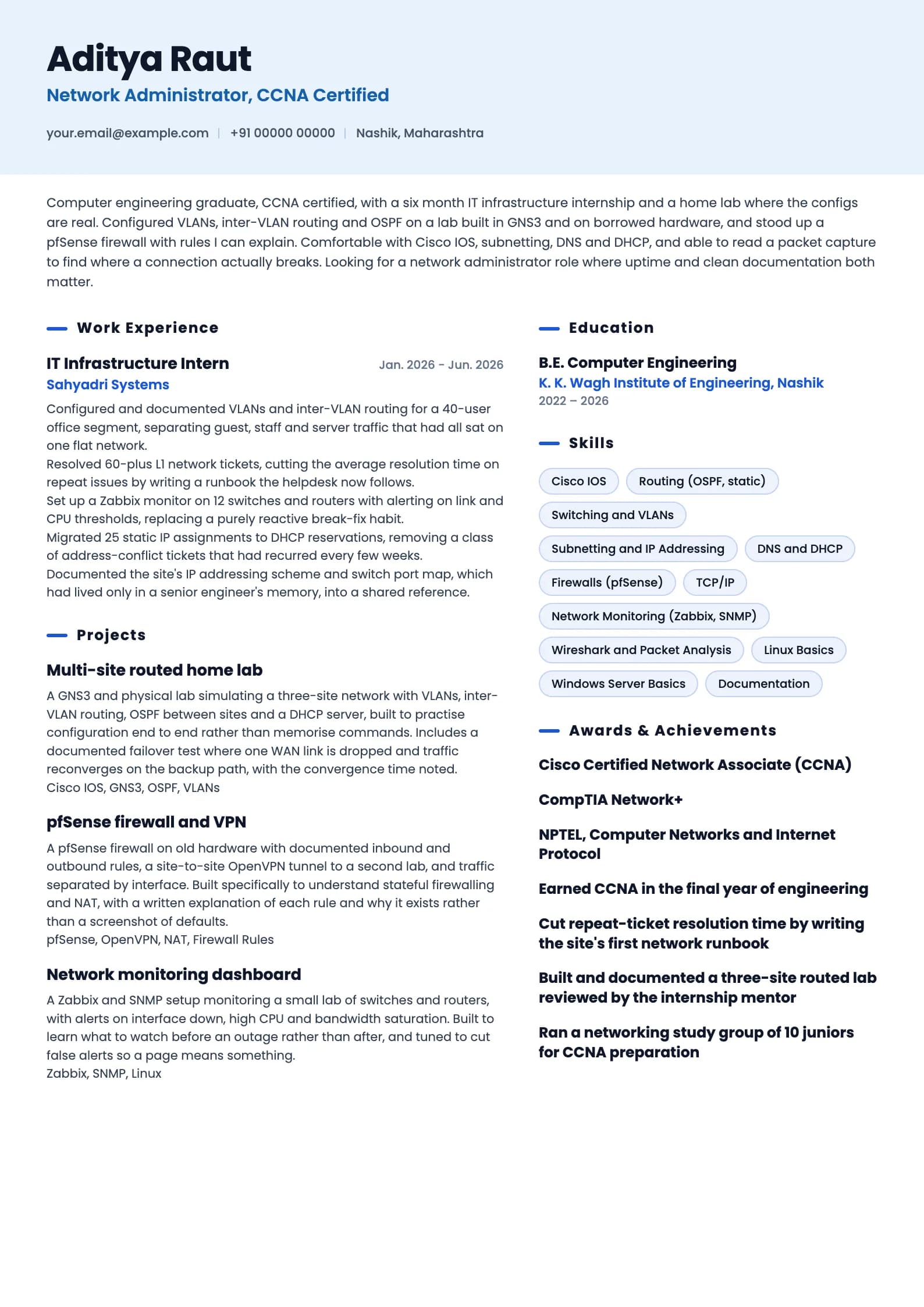
Build my resumeNetwork Administrator resume example, Fresher (0 to 1 year)
ai-era templateIs your resume good enough?
Upload the resume you have now and see what an applicant tracking system reads before a network administrator recruiter ever does.
Free to run. Sign in with your mobile number to see your score.
Network Administrator resume example, Mid-level (5 years)
professional template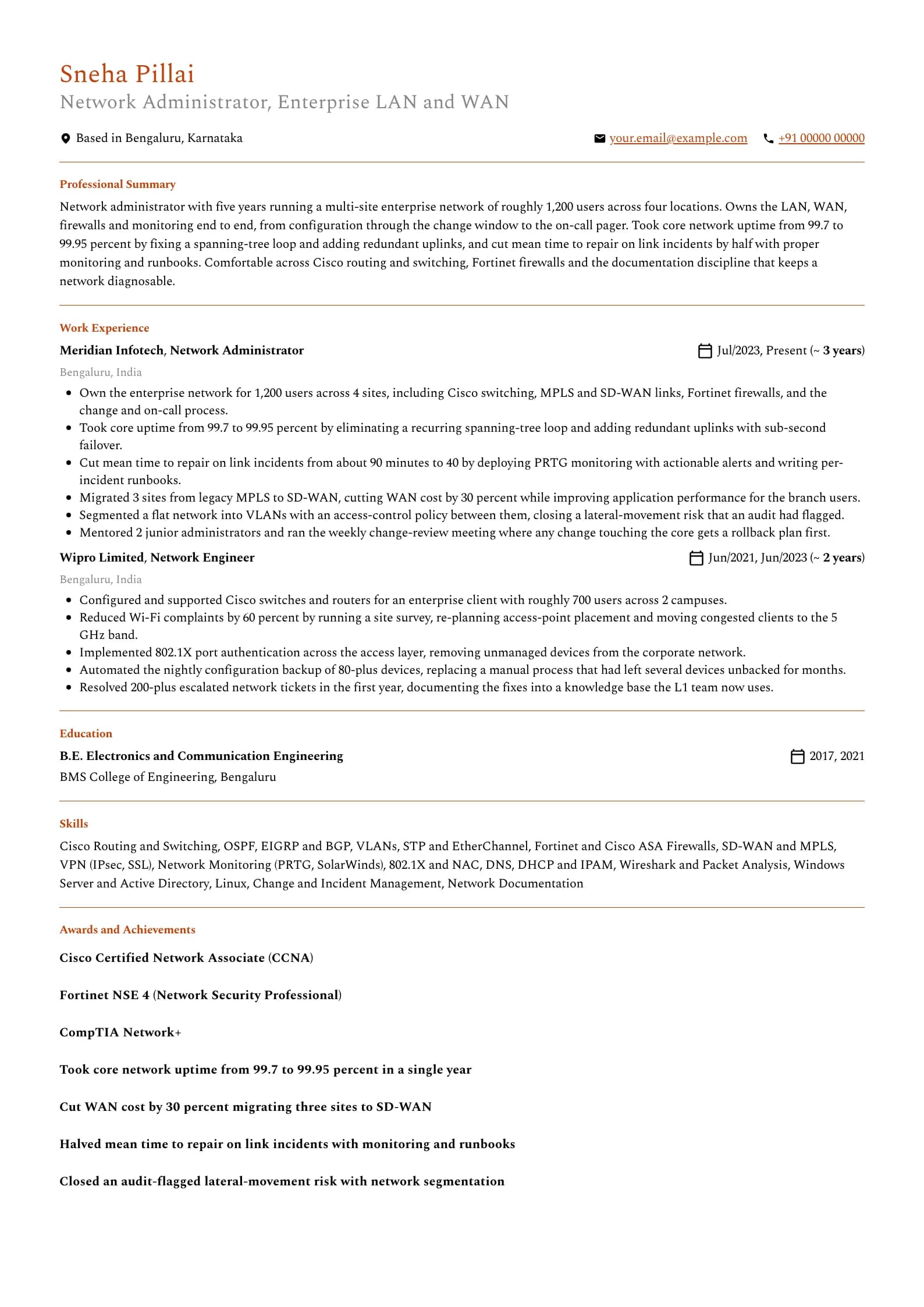
Want this structure with your own details? Build it in the resume builder.
Network Administrator resume example, Senior (10 years)
header-band template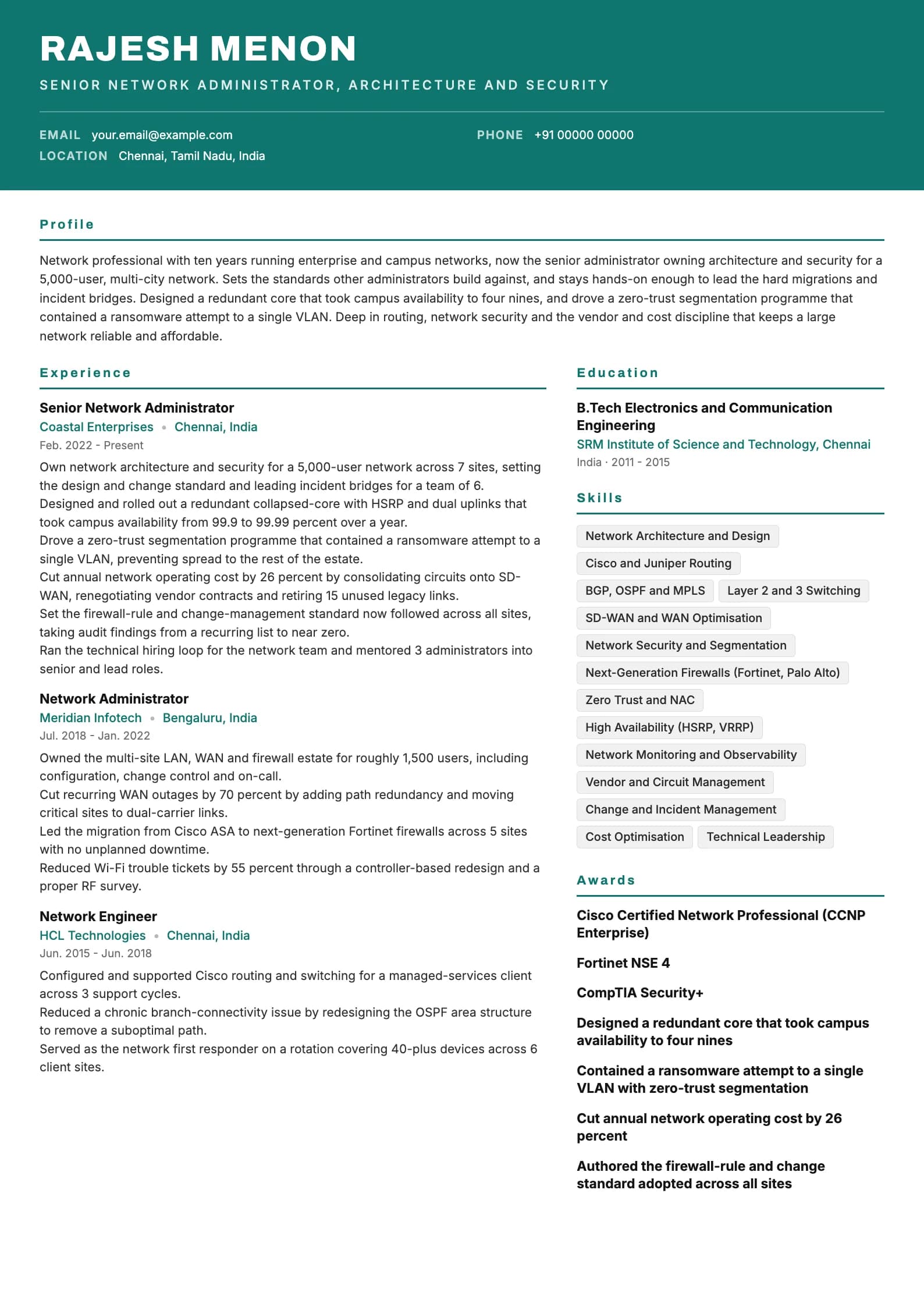
The format that works for network administrator resumes in India
Reverse chronological is the only layout worth using. Put the most recent role first, work backwards, and keep the dates in plain view. Functional resumes that group everything under Technical Skills and drop the dates read as an attempt to hide a gap, and reviewers treat them that way. A gap is better explained in one honest line than buried under a protocol list. Length follows evidence. One page holds everything a fresher and most administrators up to roughly six years have to say. Past that, a second page is fine when it carries real design and migration work rather than a longer list of every protocol you have heard of. A page two built from a declaration paragraph and a hobbies line is a padded one-page resume. Four things belong nowhere on a technical resume here: a photograph, date of birth, marital status and father's name. They survive from an older campus-placement template. Nobody screening a network administrator is looking for them, and every line they occupy is a line an uptime number or a project could have used. Send a PDF unless the posting asks for DOCX, and name the file with your own name and the target role rather than resume_final_v2. Use a single column all the way down, because two-column layouts parse unpredictably when a sidebar sits beside the experience. The table below sets out the section order.
| Section | Where it goes | Why |
|---|---|---|
| Name and headline | Top, above everything | The headline is the role you want, network administrator or engineer. Recruiters match on it. |
| Professional summary | Directly under the header | Three lines. Scope of network, years, and the strongest uptime or security result. |
| Work experience | Next, for anyone with a job | Most recent first. Newest role gets the most bullets. |
| Certifications | High for freshers, near skills otherwise | CCNA and its family are a hard filter in this field, so they sit prominently. |
| Skills | Below experience | Grouped: routing, switching, security, tools. Not a 40-protocol wall. |
| Projects or labs | Above experience for freshers | For a fresher a documented home lab is the evidence you can configure. |
| Education | Bottom, unless you are a fresher | Degree, institution, years. Drop the percentage after your first job. |
Listing OSPF is not the same as proving it
The most common network resume failure is a skills line that reads OSPF, EIGRP, BGP, RIP, STP, RSTP, VTP, HSRP, VRRP, GLBP, MPLS, VPN, IPsec, GRE, NAT, ACL, QoS, 802.1X with no bullet anywhere that shows any of it configured on a real network. A parser matches those terms, but a human interviewer reads the wall and assumes it is exam vocabulary, then goes looking for the one protocol you have actually run in production. The fix is to let the experience prove the stack. If you write BGP on the skills line, at least one bullet should describe the peering or the WAN design where you ran it. If you write STP, a bullet should mention the loop you fixed with it. The mid-level sample lists OSPF, SD-WAN and 802.1X precisely because the bullets show a spanning-tree loop eliminated, three sites moved to SD-WAN and port authentication rolled out. The skills line and the experience agree, which is what makes both believable. Attach scale to the work. A network of 1,200 users across four sites is a different job from a 30-user single office, and a reviewer cannot tell which you have run unless you say. User counts, site counts, device counts, uptime and mean time to repair are the vocabulary of the role. A network resume with no scale and no uptime anywhere reads as help-desk experience dressed up. Do not list protocols you only saw in a CCNA exam and never configured. Listing RIP, GLBP and Frame Relay on a modern enterprise resume signals you are reciting the syllabus rather than describing your network.
For every protocol on your skills line, ask: is there a bullet where I configured it on a real network. If not, either add the bullet or move it to a clearly-labelled certification-knowledge line. A wall of unproven protocols reads as exam prep.
Writing a summary a hiring manager actually reads
The block under your name is the part you can be reasonably sure gets read, so it should carry three facts: the scale of network you run, how long you have run it, and the strongest thing that happened because of your work, ideally an uptime, cost or security number. Three or four lines, no adjectives that cannot be checked. The old objective line, seeking a challenging position in a reputed organisation to utilise your networking skills, tells the reader nothing they did not assume from the application. Replace it with a summary. An objective describes what you want, a summary describes what you have already run, and only one is evidence. Freshers often believe they have nothing to summarise. Look at the fresher sample: it names the stack, states the internship, and points at a documented lab with OSPF, VLANs and a tested failover. That is a genuine summary built from a certification, one internship and a real home lab. What it avoids is "passionate about networking", a phrase so common on graduate resumes it now carries no information. A practical test: read your summary and ask whether a classmate with the same CCNA could paste it onto their resume unchanged. If they could, it describes the certification, not you. Add the specific network scale, the specific number and the specific ownership until it stops being transferable.
Professional summary, mid-level administrator
Weak
Hardworking and dedicated network administrator with 5+ years of experience in routing, switching, firewalls and troubleshooting seeking a challenging role in a reputed organisation.
Strong
Network administrator with five years running a 1,200-user network across four sites, owning LAN, WAN, firewalls and on-call. Took core uptime from 99.7 to 99.95 percent and cut WAN cost by 30 percent with SD-WAN.
The rewrite trades a keyword list and self-description for the network scale, an ownership scope and two verifiable results.
Experience bullets: verb, change, scale, consequence
Every strong bullet in the samples follows the same shape. It opens with an action verb, names the specific change you made, states the scale, and closes with what measurably moved. The verb establishes that you did it. The change and scale tell a reviewer whether the work is at your claimed level. The number does the persuading. Start with the outcome and work backwards. Administrators usually write the task first, then struggle to attach a number, which produces bullets like "handled network troubleshooting and maintenance of the LAN". Instead ask what was different after you shipped: uptime rose, an outage class stopped recurring, time to repair fell, a cost dropped, a security risk closed, tickets fell. Then write the sentence that ends in that fact. Vary the metric. A network administrator has more numbers available than ticket count: uptime and availability, mean time to repair, user and site count, cost, Wi-Fi complaint reduction, devices under monitoring, and outage frequency. The mid-level sample uses several metric types across its bullets, which reads as range. Where you lack a number, give scope: how many sites, how many users, how many devices, how long a migration took. "Migrated 3 sites from legacy MPLS to SD-WAN" carries weight without inventing a percentage. Allocate bullets by recency. Current role gets five or six, the previous role four or five, anything older two or three.
| Level | What bullets must prove | Typical metric |
|---|---|---|
| Fresher | You can configure a device and document it | Devices configured, tickets resolved, users supported, lab scope |
| 1 to 3 years | You support a live network without supervision | Tickets resolved, uptime held, Wi-Fi complaints cut, backups automated |
| 4 to 6 years | You own a multi-site network including change and on-call | Uptime, MTTR, WAN cost, security risks closed, sites migrated |
| 7 years and up | You set architecture and standards across sites | Availability in nines, operating cost, incidents contained, standards set |
Experience bullet, operations role
Weak
Responsible for maintenance and troubleshooting of the company network including routers, switches and firewalls.
Strong
Took core uptime from 99.7 to 99.95 percent by eliminating a recurring spanning-tree loop and adding redundant uplinks with sub-second failover.
"Responsible for" describes a job description; the rewrite names the change made and the uptime it bought.
Experience bullet, security work
Weak
Worked on network security to improve the overall security posture of the organisation.
Strong
Segmented a flat network into VLANs with an access-control policy between them, closing a lateral-movement risk that an audit had flagged.
Names the concrete change and the specific risk it closed, so a reviewer can ask a real follow-up instead of nodding at a vague claim.
If a bullet would read identically on a teammate's resume, it is describing the team, not you. Rewrite it until it only fits the network you actually ran, with its real scale.
The skills section: grouped, honest, and short enough to defend
A network resume's skills section has two audiences with opposite preferences. The parser wants literal terms it can match, OSPF and BGP and Fortinet. A human wants a short, organised list that signals what kind of administrator you are. Grouping satisfies both. Group by function rather than one long line. Routing, switching, security and firewalls, monitoring and tools, and platforms is a grouping that works for almost every network administrator. The exact headings matter less than the fact that structure exists. Write names the way the industry writes them: Cisco IOS not Cisco Ios, Fortinet not FortiNet, 802.1X not 802.1x. A parser matches on strings. Twelve to sixteen skills is the working range. Below eight the section looks thin. Above twenty it stops being a signal, and a network resume is especially prone to protocol padding: listing OSPF, EIGRP, BGP, RIP, IS-IS, STP, RSTP, VTP, HSRP and VRRP as ten items when you have run three of them. The list is a contract: every item is a question you have agreed to answer. Do not include a proficiency bar. Star ratings invite an argument you cannot win, and nobody agrees on what four stars in BGP means. Let the experience prove the depth instead.
| Group | What goes in it | How many |
|---|---|---|
| Routing | OSPF, BGP, EIGRP, MPLS, static routing | 2 to 4 |
| Switching | VLANs, STP, EtherChannel, 802.1X, HSRP | 2 to 4 |
| Security and firewalls | Fortinet, Cisco ASA, Palo Alto, IPsec VPN, NAC | 2 to 4 |
| Monitoring and tools | PRTG, SolarWinds, Zabbix, Wireshark, SNMP | 2 to 4 |
| Platforms | Windows Server, Active Directory, Linux, DNS, DHCP | 2 to 4 |
Skills section
Weak
Skills: OSPF, EIGRP, BGP, RIP, IS-IS, STP, RSTP, PVST, VTP, HSRP, VRRP, GLBP, MPLS, VPN, IPsec, GRE, NAT, PAT, ACL, QoS, 802.1X, TCP/IP, DNS, DHCP, FTP, Telnet, SSH, MS Office
Strong
Routing: OSPF, BGP, MPLS. Switching: VLANs, STP, 802.1X, HSRP. Security: Fortinet, Cisco ASA, IPsec VPN. Monitoring: PRTG, Wireshark, SNMP. Platforms: Windows Server, Active Directory, Linux.
Cuts the exam-only protocols, keeps what you can defend on a real network, and groups the rest so a human reads it in one pass.
Labs, projects and certifications: showing you can configure
For a fresher, a documented home lab is the equivalent of a project portfolio, and it belongs above experience. It is where a reviewer decides whether you can actually configure a network or only pass a written exam about it. For an experienced administrator, a lab is unnecessary, because production work speaks louder, though a personal automation project can still add colour. The common failure is claiming a lab without evidence. "Configured a network in GNS3" tells a reviewer nothing, because the phrase costs nothing to write. Describe the topology, the protocols you actually ran, and one thing you tested or broke and fixed. The three-site routed lab in the fresher sample is a stronger entry than a longer feature list would be, because it names a tested failover with a convergence time, which only someone who built it would include. Pick lab work that shows range rather than one flat topology. One routed multi-site design, one firewall and VPN setup you can explain rule by rule, and one monitoring setup tuned to reduce false alerts is a stronger set than a screenshot of a default configuration. Depth of one topology you understand beats breadth of five you copied. Certifications carry unusual weight in networking, more than in most software fields, so treat them as a first-class section rather than a footnote. CCNA is close to a hard requirement for many junior roles, CCNP marks the mid-to-senior jump, and a security certification such as Fortinet NSE or CompTIA Security+ signals you think about the network as an attack surface, not just a set of links.
Lab description, fresher resume
Weak
Home Lab: configured various networking scenarios in GNS3 including routing and switching for practice.
Strong
Multi-site routed home lab: a three-site GNS3 and physical topology running OSPF, VLANs and DHCP, with a documented failover test where a dropped WAN link reconverges on the backup path and the convergence time is noted.
Swaps "various scenarios" for a named topology, the protocols actually run, and a tested failure case only the builder would describe.
Where education and certifications belong
Education goes at the bottom for anyone with a full-time job, and near the top for a fresher, who has nothing stronger to lead with. Degree, institution, years. That is the whole entry for most people. CGPA or percentage is worth keeping while you are a fresher and it is good, roughly 7.5 out of 10 and above, because campus and early-career screening still filters on it. Once you have your first full-time role, drop it. A number from four years ago competes for space with networks you have actually run. Certifications are the exception to the education-goes-last rule. In networking they are a genuine filter, so a fresher should give CCNA prominence near the top, not bury it at the foot of the page. Write the full name, the issuing body and the certification status, and never list an expired certification as current, because it is trivial to verify a CCNA date and a lapsed one caught in an interview costs you the credibility of the whole resume. Name the family accurately. CCNA is associate level, CCNP is professional, and inflating one to the other is an easy catch. If you passed the CCNA exam but let it lapse, say CCNA, expired 2024 rather than implying it is live. Honesty here is cheap and the alternative is expensive.
Getting through the applicant tracking system
An applicant tracking system is a parser and a search index, not a judge. It reads your file, tries to break it into name, dates, employers, titles and skills, and stores the result so a recruiter can search across candidates. Almost every ATS problem is a parsing problem, and parsing problems come from layout, not wording. The layout rules are short. One column. Standard section headings, so use Work Experience rather than My Career Path, and Skills rather than My Toolbox. No text inside images, because a certification-badge strip reads as empty space. No critical information in the header or footer region, which some parsers drop. Avoid text boxes and nested tables in the resume body. On wording, mirror the language of the job description where it is honest. If the posting says network administrator, use that exact title rather than only network engineer. If it says CCNA, make sure the letters CCNA appear as text, not only inside a logo. Include the expansion alongside an acronym at least once, for example "NAC (network access control)", so both searches find you. Keyword stuffing does not work, and network resumes are a common offender with a hidden block of every protocol acronym in white text. Recruiters find it quickly, and the outcome is worse than being filtered. Write real bullets that naturally contain the right terms, because a bullet describing the SD-WAN migration you ran contains the term SD-WAN in a context that survives human review too. Save as PDF from a tool that embeds real text, then open the file and confirm you can select and copy a sentence. If you cannot select the text, neither can the parser.
Section heading
Weak
My Networking Journey
Strong
Work Experience
Parsers look for standard headings; a creative one can push the entire block into an unclassified bucket the recruiter never searches.
Test your own file before you send it. Copy the text out of the PDF into a plain text editor. Whatever you can read there is roughly what the parser sees, and anything scrambled is a real risk.
What gets network administrator resumes rejected
Most rejections at the resume stage are not close calls. They come from a small set of recurring problems, and all of them are fixable in an afternoon. The list below covers what reviewers of Indian network administrator resumes see most often, in rough order of how much damage each one does.
- A wall of protocol acronyms with no bullet proving any of it on a real network. It reads as exam vocabulary, not experience.
- No uptime or MTTR anywhere. Availability and time to repair are the two numbers a network role is judged on, and their absence is glaring.
- No network scale. A resume that never states users, sites or devices cannot show whether you ran a small office or a campus.
- Job duties copied from the job description instead of what you changed. "Responsible for maintenance and troubleshooting" is the tell.
- Claiming CCNP or a live CCNA when it has lapsed. Certification dates are trivial to verify and a mismatch ends the process.
- A photo, date of birth, marital status or father's name. None of it belongs on a technical resume, and it takes a project's space.
- Listing exam-only protocols like RIP and Frame Relay front and centre for a modern enterprise role.
- A generic objective line. Replace it with a summary that states network scale, years and one result.
- Confusing help-desk work with network administration. Resetting passwords and imaging laptops is IT support, not running the network; be honest about which you did.
- Typos in the technologies you claim to know. Writing "Fortinet" as "Fortinent" or "EtherChannel" as "EthernetChannel" undoes an otherwise strong page.
Read your resume aloud once before sending it. Anything you would be embarrassed to say to an interviewer's face is a line to cut or rewrite.
Skills to put on a network administrator resume
Technical
- Cisco Routing and Switching
- OSPF, EIGRP and BGP
- VLANs, STP and EtherChannel
- MPLS and SD-WAN
- Firewalls (Fortinet, Cisco ASA, Palo Alto)
- VPN (IPsec, SSL)
- 802.1X and Network Access Control
- TCP/IP and Subnetting
- DNS, DHCP and IPAM
- High Availability (HSRP, VRRP)
- Network Security and Segmentation
- Wireless (controller-based Wi-Fi)
- Windows Server and Active Directory
- Linux
Tools and platforms
- Cisco IOS
- Fortinet FortiGate
- PRTG
- SolarWinds
- Zabbix
- Wireshark
- SNMP
- GNS3 and Packet Tracer
- pfSense
- Nmap
- PuTTY
- Git
Working skills
- Incident response
- Change management
- Network documentation
- On-call ownership
- Cross-team collaboration
- Vendor coordination
- Runbook writing
- Calm under outage pressure
- User communication
Certifications worth listing as a network administrator
| Certification | Full name | Worth it for |
|---|---|---|
| CCNA | Cisco Certified Network Associate | Close to a hard requirement for junior network roles in India and the single clearest entry credential for a fresher. Product and enterprise employers both filter on it. It stays relevant into the mid level, and only fades once you hold CCNP or have years of production network work to point at. |
| CCNP | Cisco Certified Network Professional (Enterprise) | The professional-level Cisco credential that marks the mid-to-senior jump, worth it for administrators moving toward design and complex routing. Carries real weight with enterprises and managed-service providers. Keep it current, as an expired CCNP claimed as live is easy to catch. |
| Network+ | CompTIA Network+ | A vendor-neutral fundamentals certification, useful for a fresher or a career switcher who wants to prove networking basics alongside or before CCNA. Less differentiating once you hold CCNA, since that is the credential Indian recruiters look for first. |
| NSE 4 | Fortinet Network Security Expert 4 (Network Security Professional) | Worth it for administrators who run Fortinet firewalls, which many Indian enterprises do, since it certifies the platform rather than generic theory. Signals you treat the network as an attack surface. Pick the vendor certification that matches the firewall your target employers actually run. |
| Security+ | CompTIA Security+ | A vendor-neutral security fundamentals certification, valuable for network administrators who want to show security awareness beyond firewall rules. Pairs well with a network certification for roles that blend administration and security. Most useful when the job description mentions security responsibilities. |
| AZ-104 | Microsoft Certified: Azure Administrator Associate | Increasingly relevant as networks extend into the cloud, worth it for administrators whose employers run workloads in Azure and expect virtual-network and connectivity skills. Pick the cloud certification matching your target employers' platform, and skip it if your work is entirely on-premises. |
Keywords an ATS scans for in a network administrator resume
These are the literal terms a parser matches against the job description. Use the ones that are true of you, in the sentences where you did the work, not as a list at the bottom.
- network administrator
- network engineer
- CCNA
- routing and switching
- OSPF
- BGP
- VLAN
- firewall
- fortinet
- SD-WAN
- VPN
- TCP/IP
- DNS
- DHCP
- network security
- active directory
- network monitoring
- wireshark
- MTTR
- high availability
Network Administrator resume FAQ
What salary can a network administrator expect in India?
A fresher with CCNA typically starts around 2.5 to 4.5 LPA, higher in product companies and large enterprises. A network administrator with four to six years running a multi-site network usually sits in the 6 to 12 LPA band. Senior administrators and network architects with ten years and above commonly earn 15 to 30 LPA and more where security and design skills are strong. A CCNP, a firewall vendor certification and demonstrable uptime and cost results push the top of every band upward.
How long should a network administrator resume be?
One page up to about six years of experience, two pages after that only if the second page carries real design and migration work rather than a longer protocol list. Nobody has been rejected for a resume that was too easy to read. If you are struggling to fit one page, cut the oldest role to a single line, remove exam-only protocols, and delete any technology you would not want to be interviewed on.
Is CCNA necessary to get a network administrator job?
It is not legally required, but in practice CCNA is close to a hard filter for junior network roles in India, and many postings list it as mandatory. It is the clearest signal a fresher can offer that they understand routing and switching beyond theory. If you are serious about a network career, earning CCNA early removes a barrier that would otherwise keep your resume out of the shortlist entirely.
How do I show experience if all I did was help-desk tickets?
Separate the network work from the general IT support honestly, and lead with whatever touched the network itself: VLANs configured, DHCP scopes managed, switch ports troubleshot, monitoring set up. Resetting passwords and imaging laptops is IT support, not network administration, and claiming otherwise gets caught in the interview. If your network exposure was thin, strengthen it with a documented home lab, which reviewers accept as evidence you can configure devices.
Should a fresher put a home lab on the resume?
Yes, and it belongs above experience. With no production network to point at, a documented lab is the strongest evidence you can configure and troubleshoot. Describe the topology, the protocols you actually ran, and one thing you tested or broke and fixed, such as a failover with a measured convergence time. A GNS3 or Packet Tracer lab described in that detail beats a certification listed with no practical work behind it.
Do certifications matter more than a degree here?
In networking, often yes, more than in most technical fields. Employers filter heavily on CCNA and CCNP because they map directly to the skills the job needs, whereas a degree is a general signal. A strong certification stack with a modest degree frequently beats a strong degree with no certifications for network roles. Give certifications a prominent section rather than a footnote, and keep them current.
Does an ATS reject resumes with two columns?
It does not reject them outright, but some parsers read multi-column layouts out of order, which interleaves your sidebar with your experience and produces nonsense in the recruiter's view. A single-column layout removes the risk, which is why all three samples above use one. Test your own file by copying the text out of the PDF into a plain text editor, and if it reads in order there it will most likely parse correctly.
What numbers should a network administrator put on a resume?
The most persuasive are uptime and availability, mean time to repair, and the scale of the network in users, sites and devices. Beyond those, cost saved on circuits or WAN, Wi-Fi complaints reduced, tickets resolved, outages eliminated and security risks closed all read well. Pick whichever are honest for your work, and vary them, because a page of nothing but ticket counts reads thinner than one that mixes uptime, cost and security results.
Related resume examples and guides
Build your own in any of these formats
Start from a blank resume or upload the one you have. Goodspace renders it in 24 templates and flags the routing, firewall and uptime keywords an applicant tracking system will look for, and the exam-only protocol padding it will not credit.
Build my resume