Medical Transcriptionist Resume Format, with 3 Full Samples
A medical transcriptionist is hired on two numbers an account watches daily: accuracy, because a wrong drug or dosage in a report is a patient-safety event, and turnaround time, because a report that misses its window holds up a clinic. Most resumes for the role list specialties and software and forget the accuracy percentage and the lines-a-day that actually get someone hired. Below are three complete resumes, one for a fresher out of a medical transcription course, one for an MT with five years across multiple specialties and speech recognition editing, and one for a senior QA editor who proofs, mentors and owns turnaround. After the samples come the format rules, the difference between listing multispecialty and proving it, the terms an ATS matches, and the mistakes that get an MT resume filtered.
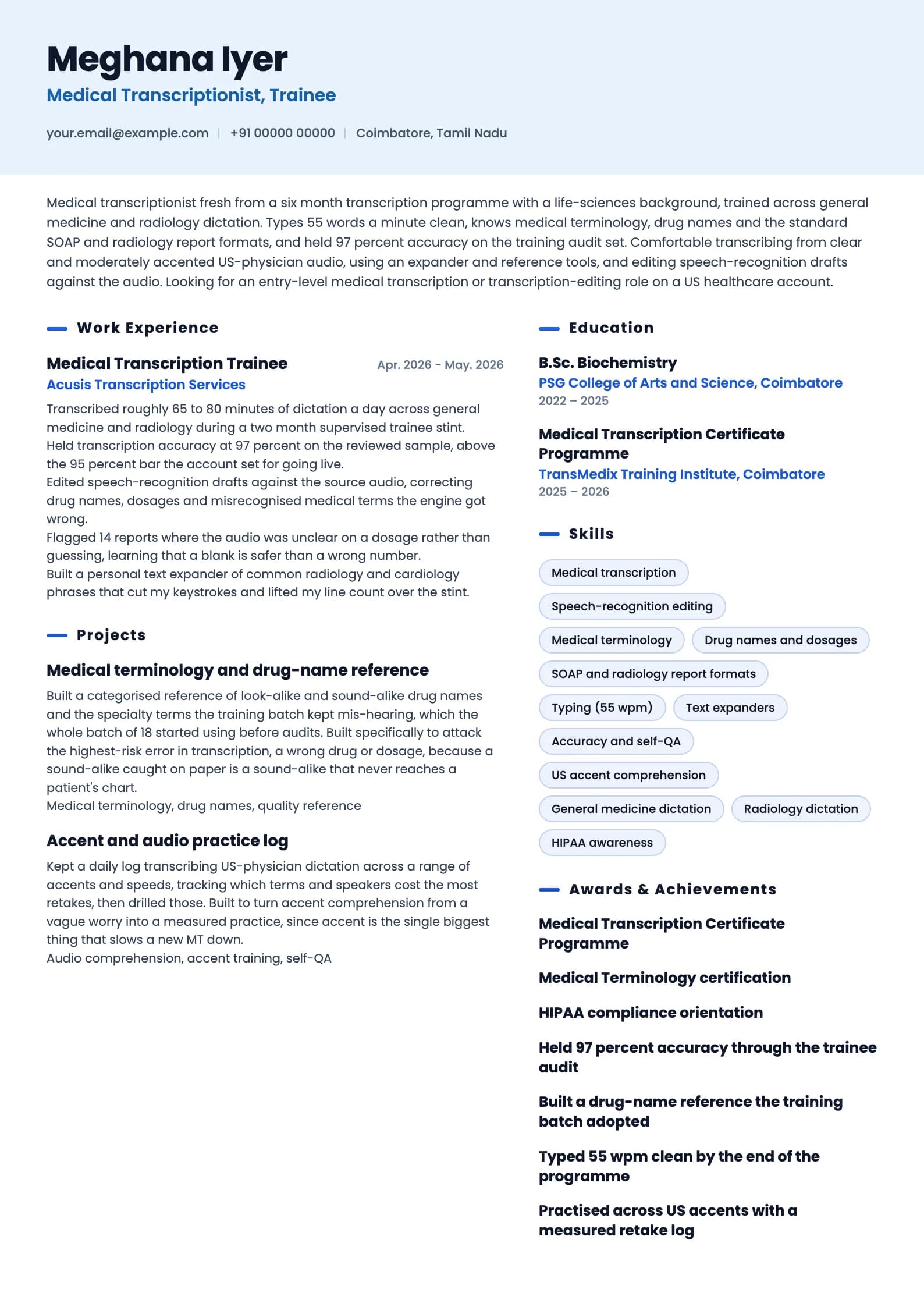
Build my resumeMedical Transcriptionist resume example, Fresher (0 years)
ai-era templateIs your resume good enough?
Upload the resume you have now and see what an applicant tracking system reads before a medical transcriptionist recruiter ever does.
Free to run. Sign in with your mobile number to see your score.
Medical Transcriptionist resume example, Experienced MT (5 years)
professional template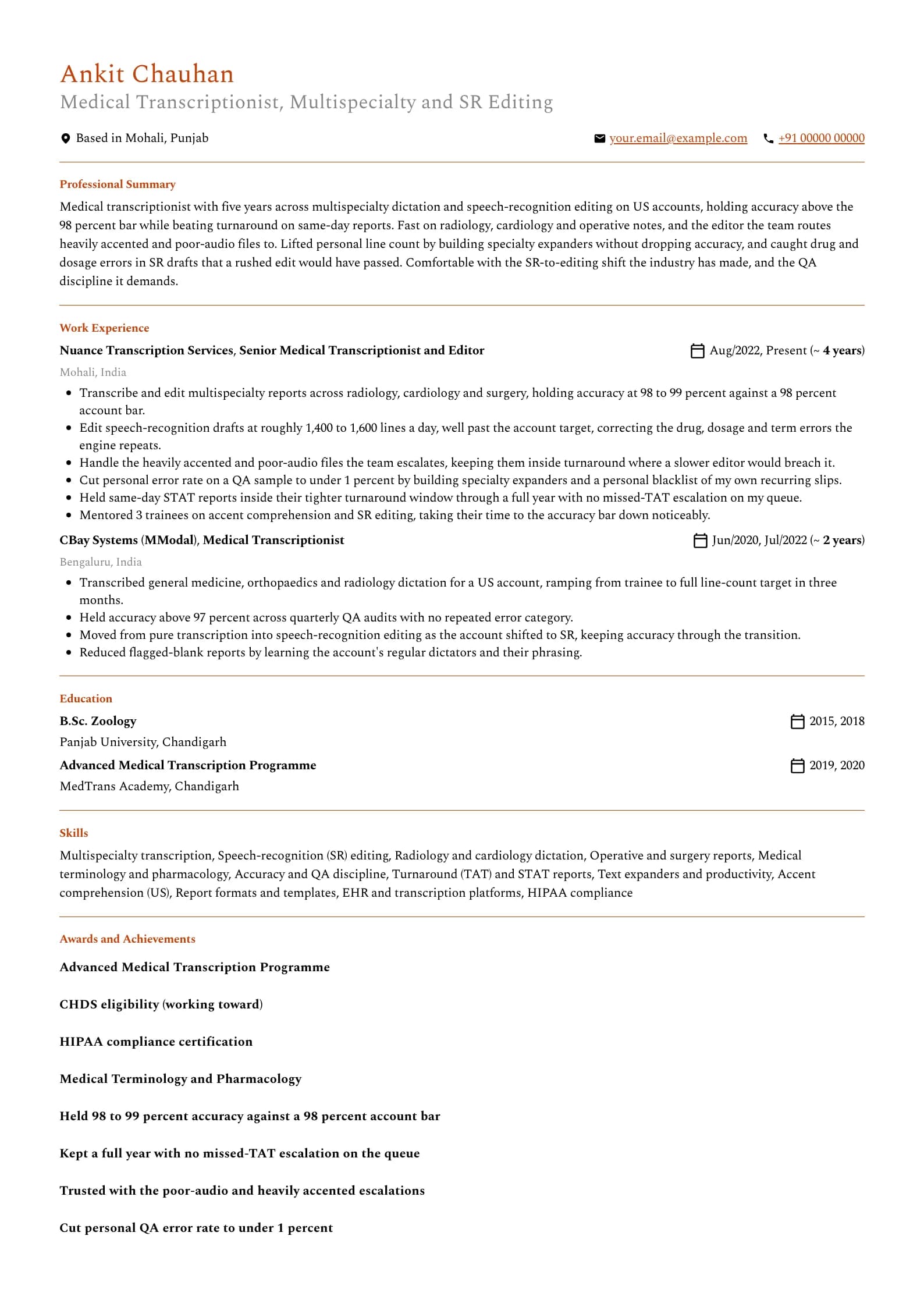
Want this structure with your own details? Build it in the resume builder.
Medical Transcriptionist resume example, Senior QA editor (9 years)
header-band template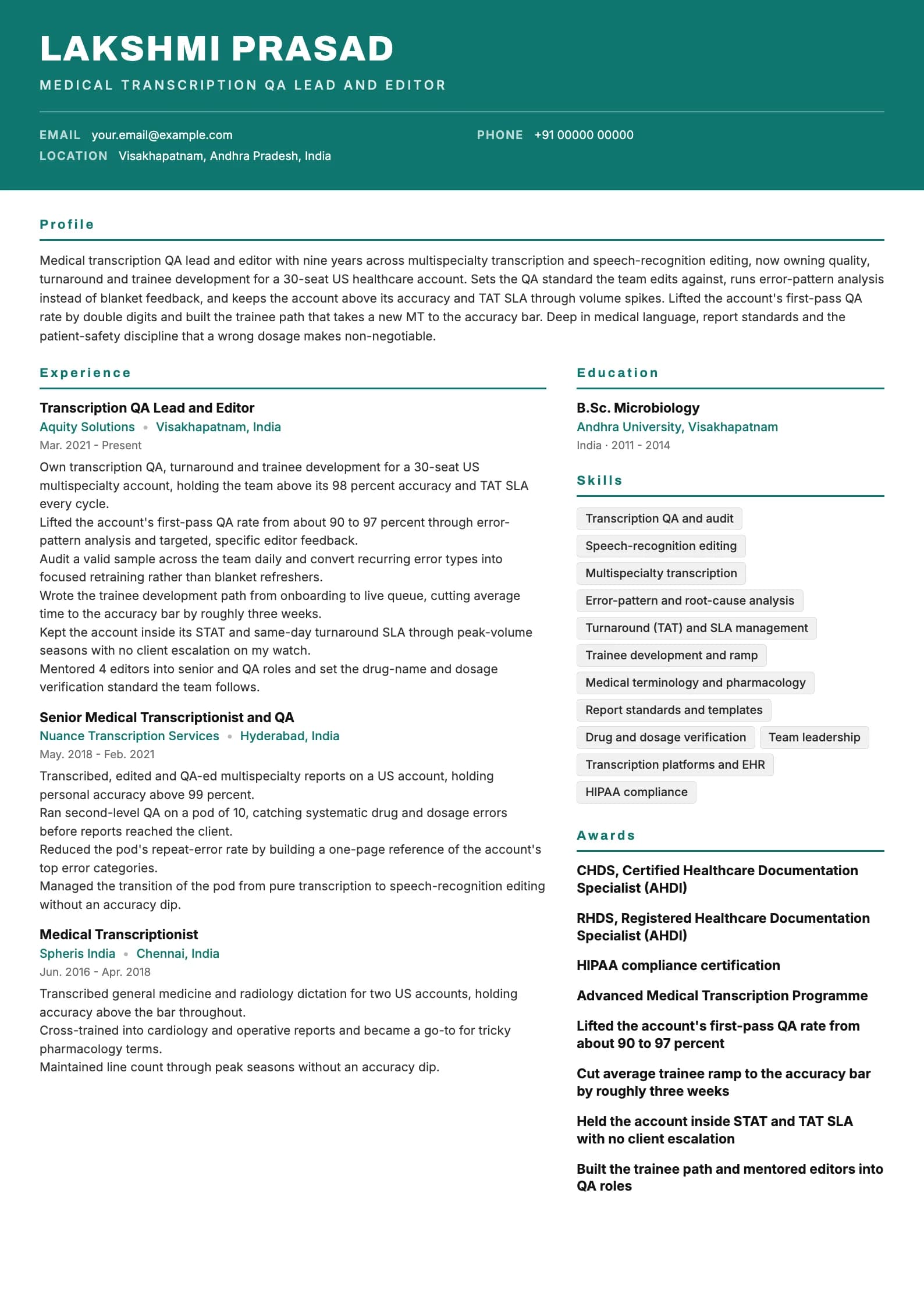
The format that works for medical transcriptionist resumes in India
Reverse chronological is the layout to use. Put your most recent account first, work backwards, and keep the dates visible. A functional resume that groups everything under Skills and drops the dates reads as though you are hiding a gap or a short stint, and transcription-account managers are alert to it. A short honest line beats a layout that looks evasive. One page holds everything a fresher and most transcriptionists up to about six years have to say. Past that, a QA lead or senior editor with real audit, turnaround and training scope can justify a second page. What does not justify one is a longer list of specialties and platforms. The account cares about your accuracy, your line count and your turnaround record, and those fit on a page. Four things belong nowhere on a transcription resume: a photograph, date of birth, marital status and father's name. They come from an older campus template and add nothing to a screen for a US healthcare account, where the reviewer wants your accuracy percentage, your specialties and your typing and turnaround record. Every line they take is a line a metric could have used. Lead with your accuracy number and put your line count and turnaround record where a reviewer sees them fast. Send a PDF unless the account asks for DOCX, name the file with your name and medical transcriptionist, and use a single column throughout, because these accounts run resumes through an ATS that can read a two-column sidebar out of order. The table below sets out the section order.
| Section | Where it goes | Why |
|---|---|---|
| Name and headline | Top, above everything | Headline names the role, e.g. Medical Transcriptionist, Multispecialty. Accounts match on it. |
| Professional summary | Directly under the header | Three lines. Years, specialties, and your accuracy and turnaround record. |
| Work experience | Next, for anyone with an account | Most recent account first. Accuracy, line count and TAT in the bullets. |
| Skills | Below experience | Grouped: transcription and editing, specialties, QA and tools. Not a 30-item wall. |
| Certifications | After skills, or high for a QA lead | CHDS, RHDS, HIPAA. These carry weight, and CHDS is close to a senior gate. |
| Education | Below certifications | Degree, institution, years. A life-sciences degree is an asset here, so keep it visible. |
| Projects or training | For freshers, above experience | For a fresher this is the evidence of accuracy and accent skill before a live account. |
Listing multispecialty is not the same as proving it
The most common transcriptionist resume failure is a skills line that reads multispecialty, radiology, cardiology, orthopaedics, operative, discharge summaries, SOAP, SR editing, with no bullet anywhere that shows a real accuracy number, a line count or a turnaround record. Every transcription resume carries those words. A reviewer reads the wall and cannot tell a trainee who studied the formats from an MT who has held 99 percent accuracy on live radiology. The fix is to let the experience prove the specialties and, above all, prove the accuracy and turnaround. If you write radiology, a bullet should show the radiology volume you edit and the accuracy you hold on it. If you write STAT reports, a bullet should name your record on tight turnaround windows. The mid-level sample lists SR editing and STAT reports precisely because the bullets show 1,400 to 1,600 lines a day edited and a full year with no missed TAT. The skills line and the experience agree. Name your accuracy, your line count and your turnaround as numbers. Accuracy at 98 to 99 percent against a 98 percent bar, 1,500 lines a day, no missed-TAT escalation for a year, these are the facts a transcription account screens on, and a resume that omits them forces the reviewer to guess low. State the bar you were held to, because 98 percent means one thing against a 95 percent SLA and another against a 98 percent one. And name the shift the industry has made. Most transcription work today is speech-recognition editing, not typing from scratch. An MT resume that only says transcription and never mentions SR editing reads as someone who stopped a decade ago, so if you edit SR drafts, say so and show the accuracy you hold while doing it.
For every specialty on your skills line, ask: is there a bullet with an accuracy number, a line count or a turnaround record behind it. If not, add it. A transcription resume without accuracy and turnaround is missing the two figures the account hires on.
Writing a summary an account manager actually reads
The block under your name is the part you can be reasonably sure gets read on a busy account, so it should carry four facts: how long you have transcribed, your specialties, your accuracy, and your turnaround or line-count record. Three or four lines, no adjectives a QA audit cannot check. The old objective line, seeking a challenging medical transcription position in a reputed organisation to utilise my skills, tells the manager nothing they did not assume. Replace it with a summary. An objective states what you want; a summary states the accuracy you hold and the specialties you transcribe, which is what an account can act on. Freshers often think they have nothing to summarise. Look at the fresher sample: it names the programme, the specialties trained, the typing speed and, crucially, the 97 percent accuracy on the audit set. That is a real summary built from a course and a trainee stint. What it avoids is hardworking and passionate about healthcare documentation, phrases so common that a QA lead skips straight past them. A practical test: read your summary and ask whether a classmate from the same course could paste it onto their resume unchanged. If they could, it describes the training, not you. Add your specific accuracy number, your specialties and your turnaround or line-count record until it stops being transferable.
Professional summary, experienced MT
Weak
Hardworking and dedicated medical transcriptionist with 5+ years of experience in medical transcription seeking a challenging position in a reputed healthcare organisation.
Strong
Medical transcriptionist with five years across multispecialty dictation and speech-recognition editing, holding accuracy at 98 to 99 percent against a 98 percent bar. Held a full year with no missed-TAT escalation on my queue.
The rewrite trades self-description for the accuracy and turnaround record a transcription account actually screens on.
Experience bullets: action, report, accuracy or turnaround
Every strong bullet in the samples follows the same shape. It opens with an action, names the specialty or workflow, and closes with an accuracy number, a line count or a turnaround record. The action shows you did it. The specialty tells the account whether the work is relevant. The number does the persuading, and for an MT the number is almost always accuracy, line count or turnaround. Start with the metric and work backwards. Transcriptionists usually write the task first, then leave off the number, which produces bullets like transcribed medical reports accurately and on time. Instead ask what the account could measure about your work: your accuracy against the SLA, your lines a day, your turnaround record, your QA error rate, a training result. Then write the sentence that ends in that fact. Vary the metric. Accuracy percentage, lines a day, turnaround record, QA error rate, trainees mentored. A resume that repeats accuracy in every bullet reads as one number stretched; a resume that shows accuracy, then a line count, then a clean-TAT year reads as range. Where you lack a clean percentage, give scope: how many specialties, how many lines a day, which report types, which escalations you take. Handle the poor-audio and heavily accented files the team escalates carries weight without inventing a figure. Allocate bullets by recency. Current account gets five or six, the previous one four or five, anything older two or three.
| Level | What bullets must prove | Typical metric |
|---|---|---|
| Fresher | You can transcribe accurately under review | Accuracy on the audit set, minutes or lines a day, typing speed |
| 1 to 3 years | You hold accuracy at full line count, unsupervised | Accuracy vs SLA, lines a day, specialties, SR editing |
| 4 to 6 years | You take hard audio and hold turnaround | Accuracy, line count, TAT record, escalations, QA error rate |
| 7 years and up | You own QA, turnaround and the account's quality rate | First-pass QA rate, SLA held, ramp cut, team size |
Experience bullet, transcription role
Weak
Responsible for transcribing medical reports accurately and maintaining turnaround time as per client requirements.
Strong
Transcribe and edit multispecialty reports across radiology, cardiology and surgery, holding accuracy at 98 to 99 percent against a 98 percent account bar.
"Responsible for" and "accurately" claim quality without proving it; the rewrite names the specialties and the accuracy against the actual bar.
Experience bullet, turnaround
Weak
Ensured all reports were completed on time and met the required deadlines set by the client.
Strong
Held same-day STAT reports inside their tighter turnaround window through a full year with no missed-TAT escalation on my queue.
Names the report type, the window and a measurable clean-TAT record, so a manager can trust the claim instead of nodding at a vague deadline line.
If a bullet has no accuracy, line count or turnaround number in it, it is describing the job, not your work. A transcription account measures all three, so at least one belongs in most of your bullets.
The skills section: grouped, honest, and short enough to defend
A medical transcriptionist's skills section has two audiences. The ATS that a healthcare account runs wants literal terms it can match, medical transcription and SR editing and radiology. The account manager reading it wants a short, organised list that signals which report types you can handle. Grouping satisfies both. Group by function rather than one long line. Transcription and editing, specialties, quality and turnaround, tools and compliance is a grouping that works for almost every MT. The exact headings matter less than the fact that structure exists. Write the terms as the industry writes them: speech-recognition editing not voice typing, turnaround time (TAT) not deadline management, and spell the specialties and drug classes correctly, because a misspelling on a precision-language resume is a red flag. Twelve to sixteen skills is the working range. Below eight it looks thin. Above twenty it reads as everything you have heard named on an account. The list is a contract: every specialty on it is a report type a QA lead can hand you in the interview, and every skill is something they may test. Do not include a proficiency bar or lead with generic office software. Star ratings on cardiology invite an argument, and MS Word as a top skill wastes a line on a resume where accuracy and turnaround are the real signals. Let the numbers carry the depth.
| Group | What goes in it | How many |
|---|---|---|
| Transcription and editing | Medical transcription, SR editing, typing speed, expanders | 3 to 4 |
| Specialties | Radiology, cardiology, operative, and the ones you transcribe | 2 to 4 |
| Quality and turnaround | Accuracy, QA, TAT, STAT reports, drug and dosage verification | 2 to 4 |
| Tools | Transcription platform, EHR, foot pedal, reference tools | 1 to 3 |
| Compliance | HIPAA, medical terminology, pharmacology | 1 to 2 |
Skills section
Weak
Skills: Medical transcription, typing, listening, MS Word, MS Office, internet, radiology, cardiology, hard working, punctual, team player, good English, fast learner
Strong
Transcription and editing: medical transcription, SR editing, 65 wpm, text expanders. Specialties: radiology, cardiology, operative. Quality: accuracy, QA, TAT, drug and dosage verification. Compliance: HIPAA, pharmacology.
Cuts the office software and personality adjectives, names the SR-editing shift and the real specialties, and groups the rest so a manager reads it in one pass.
Training, practice and what a fresher shows instead of accounts
A medical transcriptionist fresher has no live account to point to, so the training, the trainee stint and the practice work stand in for it, and they belong above education where a job would go. The evidence a reviewer wants is the same as for an experienced MT, just at smaller scale: proof you can transcribe accurately, keep up a line count and handle accent. The common failure is writing completed a medical transcription course and leaving it there. That tells an account nothing beyond attendance. Describe the specialties you trained on, the accuracy you held on the audit set, your typing speed, and the volume you reached in a trainee stint. The fresher sample names 97 percent accuracy and 65 to 80 minutes of dictation a day, which is a genuine work sample even from training. Projects that attack the real risks help a fresher stand out. The drug-name reference and the accent log in the sample target the two things that actually sink new MTs: sound-alike drug errors and accent comprehension. A self-built reference the training batch actually used reads as initiative and genuine command of the material, which is exactly what separates someone who passed a course from someone who can hold accuracy on a live queue. Be honest about supervision and the safe-blank instinct. Under review and flagged the unclear audio rather than guessing are normal, accurate fresher phrases that read as maturity, not weakness. In transcription, knowing that a flagged blank is safer than a wrong dosage is exactly the judgement an account is screening for.
Training description, fresher resume
Weak
Completed a medical transcription course and learned to transcribe medical reports and about medical terminology.
Strong
Transcribed 65 to 80 minutes of dictation a day across general medicine and radiology during a two month trainee stint, holding 97 percent accuracy on the reviewed sample, above the account's 95 percent go-live bar.
Swaps course attendance for a real volume, the accuracy held and the bar it beat, which is the evidence an account screens on.
Where education and certifications belong
Education sits below certifications for an experienced MT and near the top for a fresher, but like coding, a transcriptionist's education carries a useful twist: a life-sciences or clinical background is a genuine asset, so keep it visible rather than buried. A B.Sc. in biochemistry, zoology, microbiology or a nursing or pharmacy background helps you understand medical terminology, drug names and anatomy, and account managers value it. Degree, institution, years. Marks matter while you are a fresher and they are decent, because training institutes and early screening still look at them. Once you have live-account experience with an accuracy number to show, the degree percentage matters far less than the reports you have transcribed, so let it shrink to a line. Certifications carry real weight, and CHDS is close to a senior gate, which is why the samples place it high for the QA lead. The AHDI credentials, RHDS for early career and CHDS for experienced documentation specialists, are the recognised marks in the field, and HIPAA compliance is expected on any US account. Write the full name, the issuing body and, where it matters, that the credential is current. Name the training programme you did, because a structured medical transcription programme is itself a signal for a role where terminology and format precision are the job. If you are working toward CHDS, it is honest and useful to say so, since it shows you are investing in the recognised path rather than staying still.
Getting through the applicant tracking system
Healthcare transcription accounts and their staffing partners run applications through an applicant tracking system, because they hire in volume. The ATS is a parser and a search index, not a judge, and it filters on specialties, SR-editing experience and accuracy language. Almost every ATS problem here is a layout or a keyword problem, not a wording one. The layout rules are short. One column, because a two-column sidebar can read out of order and interleave your specialties with your experience. Standard section headings, so use Work Experience and Skills rather than My Career and My Toolkit. No text inside images, because a decorative header reads as empty space. Keep important information out of the header and footer region, which some parsers drop. On wording, mirror the posting where it is honest. If it asks for speech-recognition editing, write speech-recognition (SR) editing, not just transcription. If it names radiology, cardiology, operative reports or turnaround time, use those exact terms. Include the expansion beside an acronym at least once, for example SR (speech recognition), TAT (turnaround time) and MT (medical transcriptionist), so both searches find you. Many accounts specifically search for SR-editing experience now, so make sure it appears if you have it. Keyword stuffing does not work. A hidden block of every specialty in white text is caught quickly, and a manager reads it worse than an honest resume. Write real bullets that carry the terms naturally, because a bullet about the radiology reports you edit contains radiology in a context that survives a human read. Save as a PDF that embeds real text, then open it and confirm you can select and copy your accuracy line and specialties. If you cannot select the text, neither can the parser, and an MT whose SR-editing experience does not parse is one the search never returns.
Describing current work
Weak
Transcription of medical reports for a US healthcare client
Strong
Speech-recognition (SR) editing and transcription of multispecialty reports for a US healthcare account, radiology and cardiology
Accounts now search specifically for SR-editing experience and named specialties; a resume that only says transcription can be filtered out of a search it should have matched.
Test your own file before you send it. Copy the text out of the PDF into a plain text editor and confirm your accuracy, specialties and SR-editing experience read cleanly. Whatever scrambles there is roughly what the parser drops.
What gets medical transcriptionist resumes rejected
Most rejections at the resume stage are not close calls. They come from a small set of recurring problems, and all of them are fixable in an afternoon. The list below covers what account managers and healthcare-BPO recruiters see most often on Indian medical transcriptionist resumes, in rough order of how much damage each does.
- No accuracy percentage anywhere. It is a number a transcription account hires on, and its absence forces the reviewer to guess low.
- No mention of speech-recognition editing, which reads as an MT who stopped a decade ago when the work is now mostly SR editing.
- No line count or turnaround record, so the account cannot tell your productivity from a trainee's.
- A wall of specialties with no accuracy, volume or turnaround behind any of them.
- Duties copied from the posting instead of your work. "Responsible for accurate transcription" claims quality without proving it.
- Claiming specialties you have only trained on, which a single audio file in a test exposes.
- A photo, date of birth, marital status or father's name taking space an accuracy or turnaround number could have used.
- Generic office software, MS Word and typing, listed as headline transcription skills.
- A lapsed certification listed as current, careless in a role where precision is the whole job.
- Typos in medical terms or drug names on the resume itself, which is disqualifying evidence in a role that is entirely about getting those right.
Before you send it, check that your accuracy and your SR-editing experience are both on the first screen, and proofread every medical term twice. A transcription resume with a misspelled drug name argues against you more loudly than any bullet argues for you.
Skills to put on a medical transcriptionist resume
Technical
- Medical transcription
- Speech-recognition (SR) editing
- Multispecialty transcription
- Radiology and cardiology dictation
- Operative and discharge reports
- Medical terminology and pharmacology
- Drug and dosage verification
- Report formats and templates
- Accuracy and QA discipline
- Turnaround (TAT) and STAT reports
- Text expanders and productivity
- US accent comprehension
Tools and platforms
- Transcription platforms (Nuance, MModal)
- Speech-recognition editing tools
- EHR and EMR systems
- Foot pedal and audio players
- Text expander software
- Medical reference and drug databases
- MS Word
- QA and audit tracking tools
Working skills
- Accuracy and attention to detail
- Listening and comprehension
- Productivity and line-count management
- Working to turnaround and SLA
- Sound judgement (safe-blank instinct)
- Trainee mentoring
- Compliance discipline
- Continuous learning
- Clear written English
Certifications worth listing as a medical transcriptionist
| Certification | Full name | Worth it for |
|---|---|---|
| CHDS | Certified Healthcare Documentation Specialist (AHDI) | The recognised senior credential in healthcare documentation, worth it for experienced MTs and QA editors and close to a gate for a quality-lead role. It signals command of medical language, editing and standards beyond entry level, so it belongs high on the page once you hold it. |
| RHDS | Registered Healthcare Documentation Specialist (AHDI) | The early-career AHDI credential, the recognised step before CHDS. Worth it for a fresher or an MT in their first couple of years who wants a credential the industry actually reads, and it shows you are on the recognised path rather than self-taught only. |
| Medical Transcription Programme | Structured Medical Transcription Certificate or Diploma | The training that gets a fresher onto an account, worth naming with the institute. It is a real signal for a role where terminology and format precision are the job, and for a fresher with no live account it stands in as the core qualification the resume leads with. |
| HIPAA | HIPAA compliance certification | Expected on any US healthcare account, because transcriptionists handle protected health information directly. Worth completing and naming at every level; its absence can raise a flag on a US account, and its presence is a small, easy reassurance. |
| Medical Terminology | Medical Terminology and Pharmacology certification | A useful supporting credential, especially for a fresher or a career switcher without a clinical degree, since it proves the language foundation the role is built on. Redundant once you have years of live transcription and a CHDS to point to, so treat it as an entry signal. |
Keywords an ATS scans for in a medical transcriptionist resume
These are the literal terms a parser matches against the job description. Use the ones that are true of you, in the sentences where you did the work, not as a list at the bottom.
- medical transcriptionist
- medical transcription
- speech recognition editing
- SR editing
- medical terminology
- turnaround time
- TAT
- accuracy
- radiology transcription
- cardiology transcription
- operative reports
- discharge summary
- multispecialty
- HIPAA
- pharmacology
- drug names
- STAT reports
- QA
- typing speed
- healthcare documentation
Medical Transcriptionist resume FAQ
What salary can a medical transcriptionist expect in India?
A fresher typically starts around 1.8 to 3 LPA on a US healthcare account, often quoted monthly and rising with line count as productivity builds. An experienced MT or SR editor with five to seven years usually sits in the 3.5 to 6 LPA band, with strong line count and multispecialty depth at the higher end. Senior QA editors and quality leads with nine years and above commonly earn 6 to 12 LPA and higher. Speech-recognition editing skill, a CHDS credential, and a clean accuracy and turnaround record all push the top of each band upward, and much MT pay is partly production-linked, so speed at a held accuracy matters.
How long should a medical transcriptionist resume be?
One page up to about six years of experience, two pages only for a QA lead or senior editor with real audit, turnaround and training scope to show. A longer list of specialties and platforms does not justify a second page, because the account screens on your accuracy, line count and turnaround record, and those fit on a page. If you are struggling to fit, cut the oldest account to a line and drop generic office software.
Is medical transcription still a good career with speech recognition and AI?
The work has shifted rather than disappeared: most transcription today is speech-recognition editing, where you correct and verify an engine's draft against the audio, and drug, dosage and term errors still need a trained human eye because a mistake is a patient-safety event. The resume implication is direct: show speech-recognition editing experience, not just typing from scratch, and prove you hold accuracy while doing it. An MT who has made the SR-editing shift and can show the accuracy is very much employable; one whose resume reads like it stopped at pure typing is the one that struggles.
How does a fresher write a medical transcriptionist resume with no experience?
Lead with your training and trainee stint, then education, then skills. Treat the training like a job: name the specialties you transcribed, the accuracy you held on the audit set, your typing speed and the volume you reached. A 97 percent accuracy on a training audit is real evidence. Add a life-sciences degree prominently, since it helps with terminology, and include any self-built reference, like a drug-name or accent log, that shows you understand the two real risks in the work: sound-alike errors and accent comprehension.
What accuracy percentage should I put on a transcription resume?
State the accuracy you genuinely held and the bar you were held to, because 98 percent means one thing against a 95 percent SLA and another against a 98 percent one. Accounts hire on accuracy first, since a wrong drug or dosage in a report is a patient-safety event, so a resume without a percentage forces the reviewer to guess low. Never inflate it, because a QA test in the first weeks will expose a claimed 99 percent that is really 95. Pair it with your line count and turnaround record so the reviewer sees all the numbers an account measures.
Should I mention speech-recognition editing on my resume?
Yes, prominently, if you have done it. Most transcription work today is speech-recognition editing rather than typing from scratch, and many accounts search specifically for SR-editing experience. A resume that only says transcription can be filtered out of a search it should have matched, and it reads as an MT who has not kept up. Write speech-recognition (SR) editing with the expansion once, and back it with a bullet showing the accuracy you hold while editing, since the skill is real only if the accuracy comes with it.
Do I need a certification to be a medical transcriptionist?
It is not strictly mandatory to start, but it helps at every stage. A structured medical transcription programme is what gets most freshers onto an account, and the AHDI credentials, RHDS early on and CHDS for experienced documentation specialists, are the recognised marks in the field and close to a gate for a QA-lead role. HIPAA compliance is expected on any US account. Name the credentials with the issuing body and keep them current, and if you are working toward CHDS, it is honest and useful to say so.
Does an ATS reject transcription resumes with two columns?
Healthcare accounts hire in volume and run resumes through an applicant tracking system that filters on specialties, SR-editing experience and accuracy language. A two-column layout can read out of order and scramble your specialties, so use a single column, which is why all three samples do. Mirror the posting's exact terms where honest, include the expansion beside each acronym once, make sure SR editing and your accuracy appear in plain text, and test the file by copying its text into a plain editor to confirm it reads in order before you send it.
Related resume examples and guides
Build your own in any of these formats
Start from a blank resume or upload the one you have. Goodspace renders it in 24 templates and flags the accuracy, SR-editing and turnaround keywords a US healthcare transcription account will look for, and the filler it will not credit.
Build my resume