Maintenance Engineer Resume Format, with 3 Full Samples
A maintenance engineer is hired on evidence of uptime protected, breakdowns cut and equipment life extended at a controlled cost, yet most resumes list machines and forget what those machines did after the engineer touched them. Below are three complete resumes, one for a diploma-and-degree fresher off a plant internship, one for a maintenance engineer with five years running preventive and breakdown maintenance in manufacturing, and one for a senior reliability engineer owning plant maintenance and a maintenance budget end to end. After the samples come the format rules, the difference between naming a machine and proving you improved its availability, the terms an applicant tracking system matches literally, and the mistakes that end a screening before a plant head sees the page.
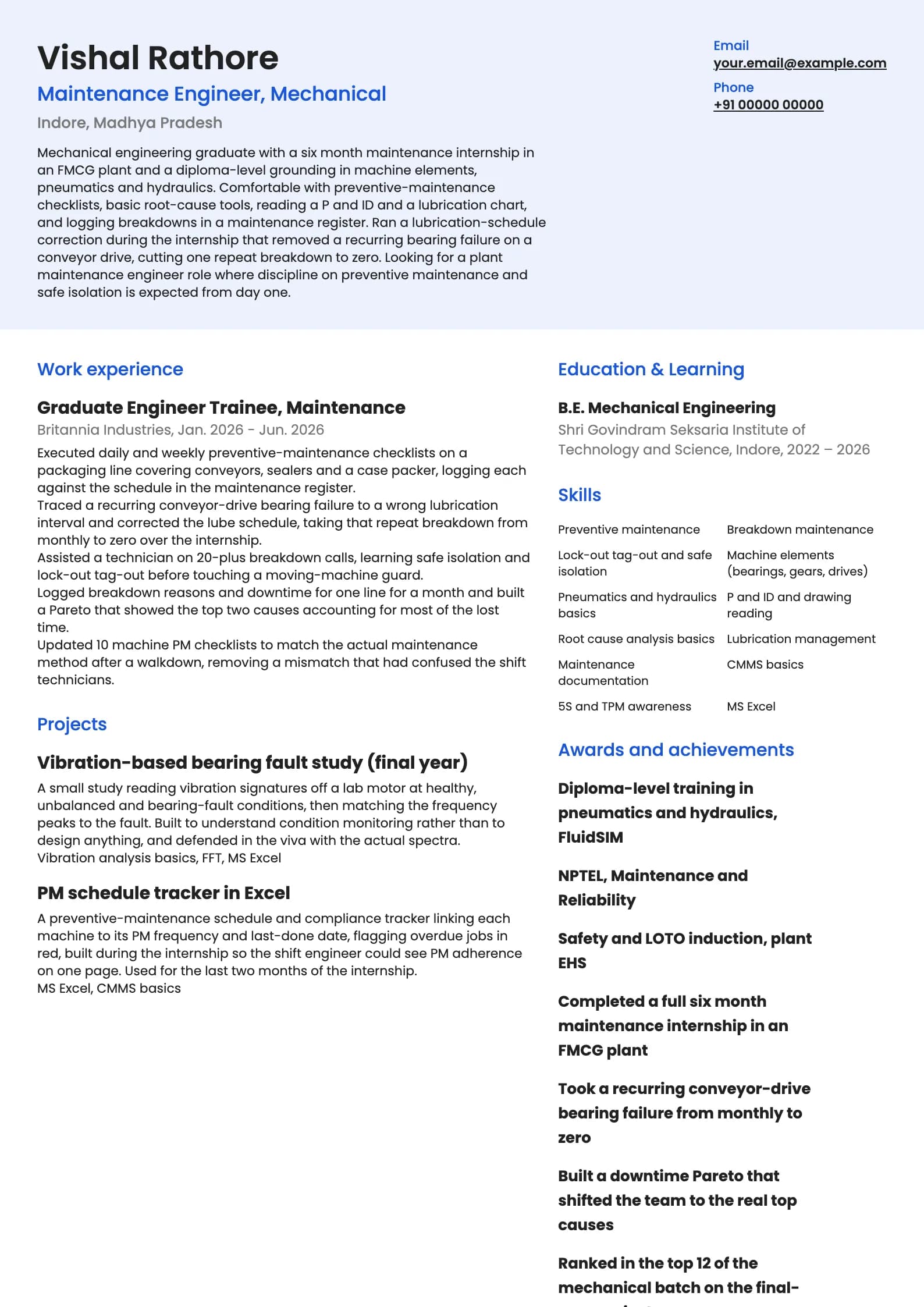
Build my resumeMaintenance Engineer resume example, Fresher (0 years)
modern templateIs your resume good enough?
Upload the resume you have now and see what an applicant tracking system reads before a maintenance engineer recruiter ever does.
Free to run. Sign in with your mobile number to see your score.
Maintenance Engineer resume example, Mid-level (5 years)
professional template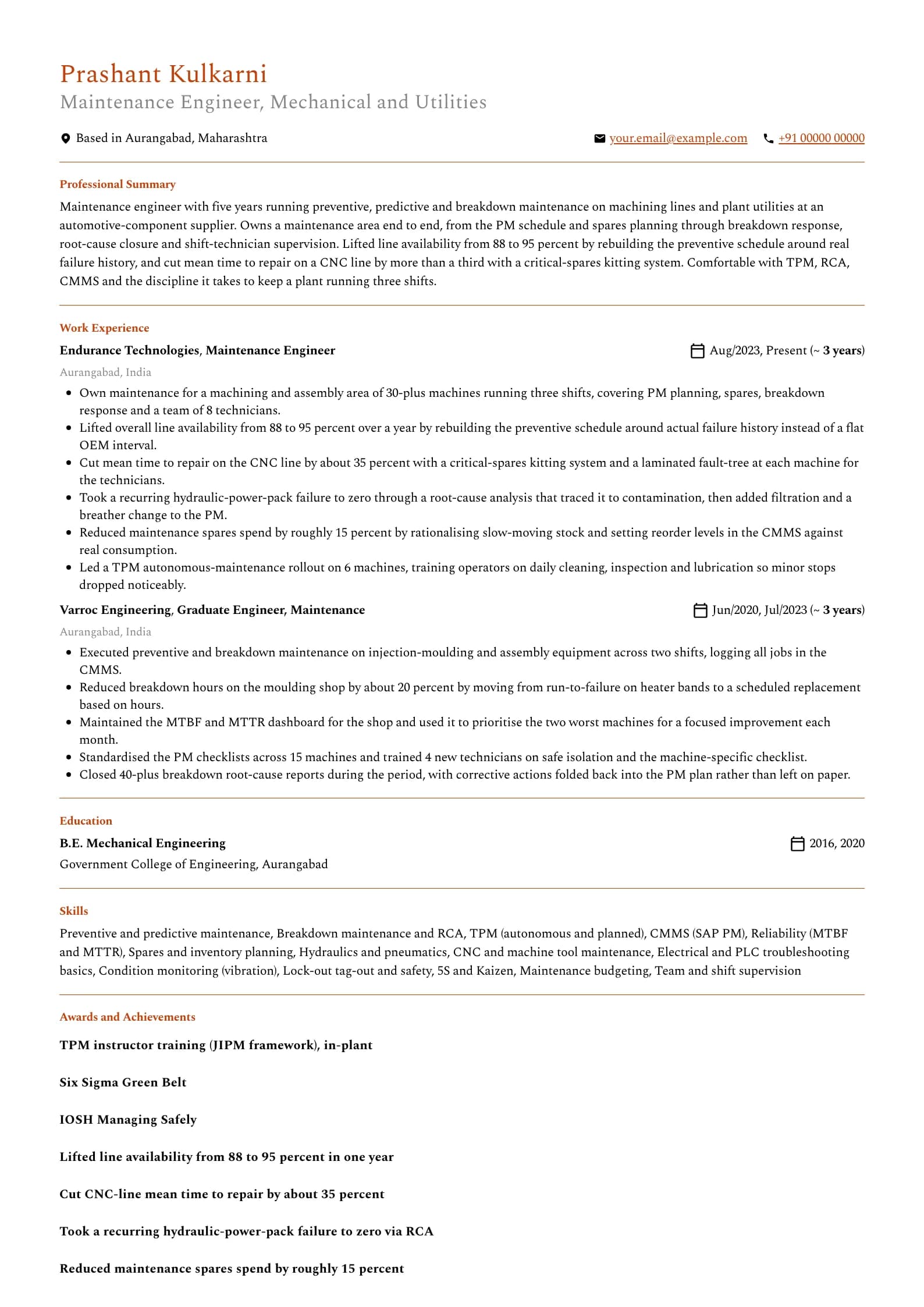
Want this structure with your own details? Build it in the resume builder.
Maintenance Engineer resume example, Senior (11 years)
header-band template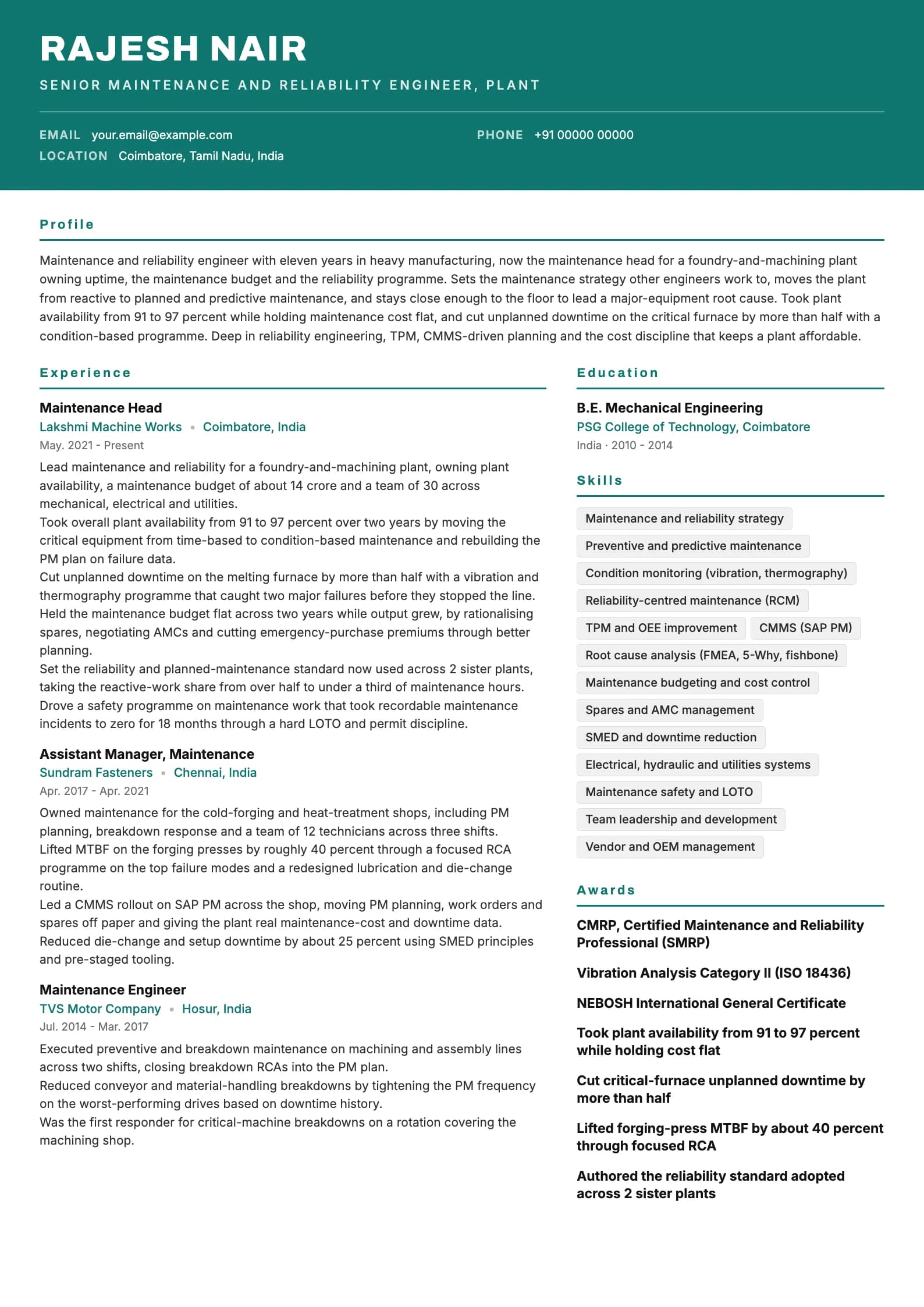
The format that works for maintenance engineer resumes in India
Reverse chronological is the layout to use. Put the most recent role first, work backwards, and keep the dates in plain view. A functional resume that groups everything under Maintenance Skills and drops the timeline reads as an attempt to hide a gap or a run of short jobs, and plant hiring managers treat it that way. A genuine gap is better explained in one honest line than buried. Length is set by evidence. One page holds a fresher and most engineers up to roughly five or six years. Past that, a second page is fine when it carries real reliability results, availability moved, MTBF improved, cost controlled, rather than a longer list of machines. A page two built from a hobbies line and a declaration is a padded one-page resume. Four things belong nowhere on a technical resume here: a photograph, date of birth, marital status and father's name. They survive from an older campus template. Nobody screening a maintenance engineer is looking for them, and every line they take is a line a reliability result could have used. Many strong maintenance engineers come up through a diploma before a degree, and that route is respected on the plant floor, so show the diploma. If you hold a specific machine or OEM competence, a particular CNC control, a press make, a boiler category, name it, because a plant running that equipment searches for it. Send a PDF unless the posting asks for DOCX, name the file with your own name and the target role, and keep a single column so the layout parses cleanly. The table below sets out the section order.
| Section | Where it goes | Why |
|---|---|---|
| Name and headline | Top, above everything | The headline is the role and discipline, maintenance engineer, mechanical or reliability. Recruiters match on it. |
| Professional summary | Directly under the header | Three lines. Domain, years, and the single strongest availability or reliability result. |
| Work experience | Next, most recent first | Achievements per role. Newest role gets the most bullets. |
| Skills | Below experience | Grouped: maintenance type, systems, CMMS and tools, methods. Not a 40-item wall. |
| Projects or improvements | Above experience for freshers, below it after that | Kaizen, TPM and reliability projects with a measurable result. |
| Education | Bottom, unless you are a fresher | Degree, diploma, institution, years. Drop the percentage after your first job. |
| Certifications | After education, or beside skills if only one or two | CMRP, vibration analysis, NEBOSH earn their place. Name, body, year. |
Naming a machine is not the same as proving you improved it
The most common maintenance-engineer resume failure is an inventory of equipment with no outcome attached: handled maintenance of CNC machines, hydraulic presses, conveyors, compressors, DG sets, HVAC, boilers, cooling towers. A list of machines tells a reviewer what you stood next to, not what you did to it. Two engineers can maintain the same press and one keeps it running while the other watches it fail; the machine list does not separate them. The fix is to attach a reliability result to the equipment. What happened to that machine after you owned it: availability rose, breakdowns fell, MTBF improved, a repeat failure went to zero, a repair got faster, a spare cost dropped. The mid-level sample does not say handled hydraulic power packs, it says took a recurring power-pack failure to zero through an RCA that traced it to contamination. Same machine, but now the reader knows the engineer changed its behaviour. Use the language of reliability, because it is how maintenance work is measured. Availability, MTBF (mean time between failures), MTTR (mean time to repair), OEE, breakdown hours, and unplanned versus planned split are the numbers a plant head reads. A resume that reaches for them reads as an engineer who thinks in reliability, not just repairs. Be clear about preventive versus reactive. The whole direction of a maintenance career is moving a plant from run-to-failure towards planned and predictive maintenance. A resume that shows that shift, a PM plan rebuilt on failure data, a condition-monitoring programme added, is far stronger than one that only lists breakdowns attended.
For every machine on your resume, ask what changed about it because you were there. Availability up, breakdowns down, MTBF improved, a repeat failure killed. If nothing changed, you have listed an asset register, not your work.
Writing a summary a plant head actually reads
The block under your name is the part you can be reasonably sure gets read, so it should carry your domain, your years, the kind of plant you have run, and the single strongest availability or reliability result. Three or four lines, no adjectives that cannot be checked. The old objective line, seeking a challenging position to utilise your maintenance skills in a reputed manufacturing organisation, tells the reader nothing they did not assume from the application. Replace it with a summary. An objective describes what you want, a summary describes what you have already kept running, and only one is evidence. Freshers often believe they have nothing to summarise. Look at the fresher sample: it names the plant type, states the internship length, and points at the lubrication fix that killed a repeat breakdown. That is a real summary built from one plant internship and coursework. What it avoids is "hardworking engineer with good technical knowledge", a phrase so common it now carries no information. A practical test: read your summary and ask whether another engineer from the same shop could paste it onto their resume unchanged. If they could, it describes the plant, not you. Add your specific area, your specific number and your specific ownership until it stops being transferable.
Professional summary, mid-level maintenance engineer
Weak
Hardworking maintenance engineer with 5+ years of experience in preventive and breakdown maintenance of various machines seeking a challenging role in a reputed manufacturing company.
Strong
Maintenance engineer with five years running preventive, predictive and breakdown maintenance on machining lines, owning an area from PM planning to RCA closure. Lifted line availability from 88 to 95 percent and cut CNC-line mean time to repair by about a third.
The rewrite trades a duty list and self-description for a plant type, an ownership scope and two verifiable reliability results.
Experience bullets: verb, system, reliability result
Every strong bullet in the samples follows the same shape. It opens with an action verb, names the specific machine or system you worked on, and closes with what measurably improved. The verb establishes that you did it. The system tells a plant engineer whether the work is relevant. The number does the persuading. Start with the outcome and work backwards. Maintenance engineers usually write the activity first, then struggle to attach a result, which produces bullets like "carried out preventive and breakdown maintenance of plant machinery". Instead ask what was different in the plant after you acted: availability rose, a breakdown stopped recurring, a repair got faster, a spare cost dropped, MTBF improved. Then write the sentence that ends in that fact. Vary the metric. Ten uptime lines in a row read as one trick repeated. Across a real role you can honestly reach for availability, MTBF, MTTR, breakdown hours, unplanned-downtime share, spares spend, minor stops and OEE. The mid-level sample uses several of these, which reads as range. Where you lack a clean number, give scope: how many machines, how many technicians, how many shifts, how many RCAs closed. "Own maintenance for an area of 30-plus machines running three shifts" carries weight without inventing a percentage. Allocate bullets by recency. Current role gets five or six, the previous role four or five, anything older two or three.
| Level | What bullets must prove | Typical metric |
|---|---|---|
| Fresher | You can follow a PM plan and isolate a machine safely | Repeat breakdown removed, checklists corrected, downtime logged |
| 2 to 4 years | You run breakdowns and PM for an area alone | Breakdown hours, MTBF, RCAs closed, PM adherence |
| 5 to 8 years | You own availability, spares and a technician team | Availability, MTTR, spares spend, minor stops, TPM rollout |
| 9 years and up | You set maintenance strategy and control the budget | Plant availability, reactive-to-planned shift, cost, standards set |
Experience bullet, plant maintenance
Weak
Responsible for preventive and breakdown maintenance of CNC machines, hydraulic presses, conveyors and utilities as per the maintenance plan.
Strong
Cut mean time to repair on the CNC line by about 35 percent with a critical-spares kitting system and a laminated fault-tree at each machine for the technicians.
"Responsible for" plus a machine list describes a job description; the rewrite names the change made and the repair-time it removed.
Experience bullet, reliability work
Weak
Worked on improving the availability of the plant machinery which resulted in better production output.
Strong
Lifted overall line availability from 88 to 95 percent over a year by rebuilding the preventive schedule around actual failure history instead of a flat OEM interval.
Names the before and after and the technique, so a plant head can ask a real follow-up instead of nodding at a vague claim.
If a bullet would read identically on a teammate's resume from the same shop, it is describing the plant, not you. Rewrite it until it only fits the area you actually owned.
The skills section: grouped, honest, and short enough to defend
A maintenance engineer's skills section has two audiences with opposite preferences. The parser wants literal terms it can match, preventive maintenance and TPM and SAP PM. A human wants a short, organised list that signals what kind of engineer you are. Grouping satisfies both. Group by function rather than one long line. Maintenance type, systems and equipment, CMMS and tools, and methods is a grouping that works for almost every maintenance engineer. The exact headings matter less than the fact that structure exists. Write names the way the industry writes them: MTBF not M.T.B.F., SAP PM not SAP-PM, RCA not R.C.A. A parser matches on strings. Twelve to sixteen skills is the working range. Below eight the section looks thin. Above twenty it stops being a signal. A maintenance resume is especially prone to two kinds of padding: listing every machine type in the plant as a separate skill, and listing generic phrases like troubleshooting and teamwork. Keep the equipment to the systems you can actually diagnose, and let the experience prove the soft skills. Do not include a proficiency bar. Star ratings invite an argument you cannot win, and nobody agrees on what four stars in hydraulics means. Let the reliability results prove the depth instead.
| Group | What goes in it | How many |
|---|---|---|
| Maintenance type | Preventive, predictive, breakdown, TPM, RCM | 3 to 5 |
| Systems and equipment | Hydraulics, pneumatics, CNC, drives, utilities, PLC basics | 3 to 5 |
| CMMS and tools | SAP PM, condition-monitoring tools, MS Excel | 2 to 3 |
| Methods | RCA, FMEA, 5-Why, SMED, 5S, Kaizen | 2 to 4 |
| Reliability metrics | MTBF, MTTR, OEE, availability | 1 to 2 |
Skills section
Weak
Skills: CNC, VMC, hydraulic press, pneumatic press, conveyor, compressor, chiller, DG set, boiler, cooling tower, HVAC, crane, welding machine, troubleshooting, teamwork, hard working, MS Office
Strong
Maintenance: preventive, predictive, breakdown, TPM. Systems: hydraulics, pneumatics, CNC, drives, utilities. CMMS: SAP PM. Methods: RCA, FMEA, SMED, 5S.
Cuts the machine-by-machine inventory and the soft-phrase filler, and groups what is left so a human reads it in one pass and the parser still matches the real terms.
Improvement projects: TPM, Kaizen and RCA on the page
Maintenance is a role where improvement projects, Kaizen, TPM circles, focused RCA campaigns, reliability initiatives, are strong resume material, because they show an engineer who moves the plant forward rather than only responding to breakdowns. For a fresher they can sit above experience; for an experienced engineer they belong inside the relevant role as achievement bullets or in a short projects block. The common failure is describing the activity instead of the result. "Participated in a TPM implementation across the shop" tells a reviewer nothing, because attendance is not achievement. Describe what the project changed: minor stops fell, a chronic loss was closed, autonomous maintenance freed technician hours, OEE rose. The senior sample does not say ran a reliability programme, it names the shift from over half reactive work to under a third, which is the actual outcome. Pick improvements that show range rather than three versions of the same Kaizen. One reliability improvement with an availability or MTBF number, one cost improvement on spares or AMC, and one that shows a method such as SMED or condition monitoring is a stronger set than three cleaning drives. A named, measured improvement beats five listed by title. If you led a CMMS rollout or a move from paper to SAP PM, say so, because that is exactly the kind of systems work maintenance managers look for. Be honest about your role: leading a rollout and helping with one are different, and an interviewer will ask.
Improvement project, experienced engineer
Weak
Involved in TPM activities and various Kaizen projects in the plant which improved the overall maintenance and productivity.
Strong
Led a TPM autonomous-maintenance rollout on 6 machines, training operators on daily cleaning, inspection and lubrication, which dropped minor stops noticeably and freed technician hours for planned work.
Swaps "involved in" and "various" for a named rollout, a scope, and the specific losses it moved.
Where education, safety training and certifications belong
Education goes at the bottom for anyone with a full-time role, and near the top for a fresher, who has nothing stronger to lead with. Degree, institution, years. A diploma before the degree is worth showing, because diploma-plus-degree is a common and respected route into plant maintenance, and some employers actively value the extra hands-on grounding. CGPA or percentage is worth keeping while you are a fresher and it is reasonable, because campus and trainee screening still filters on it. Once you have your first maintenance role behind you, drop it. A number from four years ago competes for space with reliability results that are far more predictive. Safety training is a screening item on maintenance resumes, not a bonus, because maintenance work is where most plant injuries happen. Lock-out tag-out competence, IOSH Managing Safely, NEBOSH and any statutory certification such as a boiler-operation or crane-operation licence belong on the page. If you have held a maintenance-incident-free record, put that number in your experience. Certifications sit just below education, or beside skills if you hold only one or two. Write the full name, the issuing body and the year. For maintenance and reliability, CMRP, vibration analysis category certifications and a Six Sigma belt carry real weight; a wall of ten short online certificates does not. An expired safety or statutory certificate listed as current is easy to catch and worse than not listing it, so renew it or remove it.
Getting through the applicant tracking system
An applicant tracking system is a parser and a search index, not a judge. It reads your file, tries to break it into name, dates, employers, titles and skills, and stores the result so a recruiter can search across candidates. Almost every ATS problem is a parsing problem, and parsing problems come from layout, not wording. The layout rules are short. One column. Standard section headings, so use Work Experience rather than My Journey, and Skills rather than My Toolkit. No text inside images, because a machine-photo strip or a scanned certificate reads as empty space. No critical information in the header or footer region, which some parsers drop. Avoid text boxes and nested tables in the resume body. On wording, mirror the language of the job description where it is honest. If the posting says preventive maintenance, write preventive maintenance. If it says TPM, write TPM. If it names a CMMS such as SAP PM or Maximo, use the exact name. Include the expansion alongside an acronym at least once, for example "MTBF (mean time between failures)", so both searches find you. Keyword stuffing does not work. A hidden block of every machine and method in white text is found quickly, and the outcome is worse than being filtered. Write real bullets that naturally contain the right terms, because a bullet describing an RCA on a hydraulic power pack contains those words in a context that survives human review too. Save as PDF from a tool that embeds real text, then open the file and confirm you can select and copy a sentence. If you cannot select the text, neither can the parser.
Section heading
Weak
My Technical Expertise Zone
Strong
Skills
Parsers look for standard headings; a creative one can push the entire block into an unclassified bucket the recruiter never searches for skills.
Test your own file before you send it. Copy the text out of the PDF into a plain text editor. Whatever you can read there is roughly what the parser sees, and anything scrambled is a real risk.
What gets maintenance engineer resumes rejected
Most rejections at the resume stage are not close calls. They come from a small set of recurring problems, and all of them are fixable in an afternoon. The list below covers what reviewers of Indian maintenance engineer resumes see most often, in rough order of how much damage each one does.
- A machine inventory with no reliability result. A list of equipment shows what you stood next to, not what you changed about it.
- No reliability metric anywhere. Availability, MTBF, MTTR, breakdown hours, OEE. Without them every maintenance engineer reads the same.
- Only breakdowns, no planned or predictive work. It reads as a firefighter, not an engineer moving the plant towards reliability.
- No safety line. LOTO competence and a maintenance-incident record are screening items, because maintenance work is where plant injuries happen.
- Generic phrases as skills: troubleshooting, teamwork, hard working. They are unverifiable filler; let the reliability results prove them.
- A wall of every machine type in the plant listed as separate skills to pad the section, which an interviewer sees through immediately.
- A generic objective line. Replace it with a summary that states domain, years and one availability or reliability result.
- A photo, date of birth, marital status or father's name. None of it belongs on a technical resume, and it takes a reliability result's space.
- Inflated titles or dates that do not match your offer letters and experience certificates. Background verification is standard and a mismatch ends the process.
- Typos in the systems you claim: hydraulic as hydrolic, pneumatic as pnematic. It undoes an otherwise credible page.
Read your resume aloud once before sending it. Anything you would be embarrassed to say to a plant head's face is a line to cut or rewrite.
Skills to put on a maintenance engineer resume
Technical
- Preventive maintenance
- Predictive and condition-based maintenance
- Breakdown maintenance and RCA
- TPM and OEE improvement
- Reliability (MTBF and MTTR)
- Hydraulics and pneumatics
- CNC and machine tool maintenance
- Electrical and PLC troubleshooting
- Utilities (compressors, chillers, DG, boilers)
- Vibration and thermography monitoring
- Spares and inventory planning
- Maintenance budgeting
Tools and platforms
- SAP PM
- CMMS (Maximo, in-house)
- Vibration analysers
- Thermal imaging cameras
- FluidSIM
- MS Excel
- AutoCAD basics
- MS Office
Working skills
- Shift and team supervision
- Root cause thinking
- Cross-functional coordination
- Vendor and OEM management
- Problem solving under pressure
- Safety leadership
- Training and mentoring
- Planning and prioritisation
- Documentation discipline
Certifications worth listing as a maintenance engineer
| Certification | Full name | Worth it for |
|---|---|---|
| CMRP | Certified Maintenance and Reliability Professional (SMRP) | The most respected reliability credential internationally, worth it for maintenance engineers moving towards reliability engineering and maintenance management. Signals you think in reliability and cost, not just repairs. Lands best from around five years, once you have real availability and MTBF work to back it in an interview. |
| Vibration CAT II | Vibration Analysis Category II (ISO 18436) | A practical condition-monitoring credential for engineers running predictive maintenance on rotating equipment. Worth it if your plant has motors, pumps, fans and gearboxes you monitor rather than run to failure. Category I is a lighter entry point; Category II is where you can diagnose, not just collect data. |
| TPM | Total Productive Maintenance (JIPM framework) | Valuable for maintenance engineers in automotive and FMCG plants where TPM is the operating system of the shop floor. In-plant or JIPM-aligned training plus a real autonomous or planned-maintenance rollout on your resume is a strong combination for these employers. |
| Six Sigma GB | Six Sigma Green Belt | Useful for maintenance engineers whose work includes chronic-loss reduction, RCA and cost projects. Signals a structured, data-led approach to eliminating failures and waste. Most credible when a resume bullet shows a real breakdown, downtime or spares number you actually moved. |
| NEBOSH IGC | NEBOSH International General Certificate | The safety credential many process and heavy-industrial plants expect for maintenance roles, since maintenance is where most plant injuries occur. Worth it for engineers on hydrocarbon, power and heavy-manufacturing sites. IOSH Managing Safely is a lighter first step if you are early in your career. |
| BOE | Boiler Operation Engineer / Proficiency (state board) | A statutory certification worth it for maintenance engineers in plants running high-pressure boilers, where it can be a legal requirement for certain roles and a clear salary lever. State-specific and exam-based. Only pursue it if your plant type actually needs a certified boiler operator. |
Keywords an ATS scans for in a maintenance engineer resume
These are the literal terms a parser matches against the job description. Use the ones that are true of you, in the sentences where you did the work, not as a list at the bottom.
- maintenance engineer
- preventive maintenance
- predictive maintenance
- breakdown maintenance
- TPM
- MTBF
- MTTR
- OEE
- root cause analysis
- CMMS
- SAP PM
- reliability
- hydraulics
- pneumatics
- PLC
- condition monitoring
- spares planning
- lock-out tag-out
- 5S
- kaizen
Maintenance Engineer resume FAQ
What salary can a maintenance engineer expect in India?
A fresher typically starts around 2.5 to 4.5 LPA in manufacturing, higher with a strong campus or a core-sector employer. A maintenance engineer with five to eight years running an area usually sits in the 6 to 14 LPA band, with shift and plant allowances on top. Senior maintenance and reliability engineers and maintenance heads with ten years and above commonly earn 18 to 35 LPA and more in large or process plants. A CMRP, condition-monitoring skill and a track record of moved availability push the top of every band upward.
How long should a maintenance engineer resume be?
One page up to about five or six years, two pages after that only if the second page carries real reliability results rather than a longer machine list. Nobody has been rejected for a resume that was too easy to read. If you are struggling to fit one page, cut the oldest role to a line, drop coursework, and remove any machine or method you would not want to be interviewed on.
Should I list all the machines I have worked on?
List the systems you can actually diagnose, grouped by type, not every asset in the plant as a separate skill. A machine-by-machine inventory pads the page and tells a reviewer what you stood next to, not what you changed. Far stronger is naming a machine inside an achievement bullet: what its availability, breakdown rate or MTBF did after you owned it. The equipment matters most when it is attached to a result.
Which reliability metrics should I put on my resume?
Availability is the headline a plant head reads first, so lead with it where you have moved it. Back it with MTBF and MTTR, and reach for breakdown hours, unplanned-downtime share, OEE and spares spend across your bullets so the page does not read as one lever repeated. Spell out an acronym once, for example MTBF (mean time between failures), so both an ATS search and a human reader are covered.
How do I show I do more than breakdown maintenance?
Put your planned and predictive work front and centre, because the direction of a maintenance career is moving a plant from run-to-failure towards reliability. Show a PM plan you rebuilt on failure data, a condition-monitoring programme you added, a TPM or Kaizen improvement with a number, or a reactive-to-planned shift you drove. A resume that only lists breakdowns attended reads as a firefighter; one that shows the plant getting more reliable reads as an engineer.
Does safety training belong on a maintenance engineer resume?
Yes, and prominently. Maintenance work is where most plant injuries happen, so lock-out tag-out competence, IOSH Managing Safely or NEBOSH, and any statutory licence such as boiler operation belong on the page. Many plants gate maintenance work on this competence. If you have held a maintenance-incident-free record on your area, put that number in your experience, because on these jobs safety is a delivery metric.
How do I write a maintenance engineer resume as a fresher?
Lead with your plant internship if you have one, then education, then skills. Treat the internship like a job: the machine or line you worked on, the PM or breakdown task, and what went right, a repeat failure removed, a checklist corrected, downtime logged into a Pareto. A diploma before your degree is worth showing for the hands-on grounding. Keep the machine list to systems you actually understand rather than the whole plant, because verifiable facts carry more weight than a padded inventory.
Do certifications like CMRP or vibration analysis help?
They help most once you have reliability work to back them, and are strongest for engineers moving towards reliability engineering and maintenance management. CMRP signals you think in reliability and cost; a vibration analysis category certificate proves you can run predictive maintenance on rotating equipment. For automotive and FMCG plants, TPM training carries weight. Keep the list to credentials that fit your plant type rather than a wall of short online certificates.
Related resume examples and guides
Build your own in any of these formats
Start from a blank resume or upload the one you have. Goodspace renders it in 24 templates and flags the preventive maintenance, TPM and reliability keywords an applicant tracking system will look for, and the machine-list padding it will not credit.
Build my resume