Lineman Resume Format, with 3 Full Samples
A lineman is hired on proof of lines strung, faults cleared and a safety record that holds, not on a paragraph about being hardworking. Yet most lineman resumes list ITI, wiring and cabling and stop there, leaving out the voltage they worked, the outages they restored and the fact that they went home whole every shift. Below are three complete resumes, one for an ITI-qualified fresher out of apprenticeship, one for a skilled lineman with four years on LT and HT distribution, and one for a line inspector supervising a gang across a division. After the samples come the format rules, the difference between listing a skill and proving it on live lines, the terms a hiring cell scans for, and the mistakes that get a lineman resume set aside before a call.
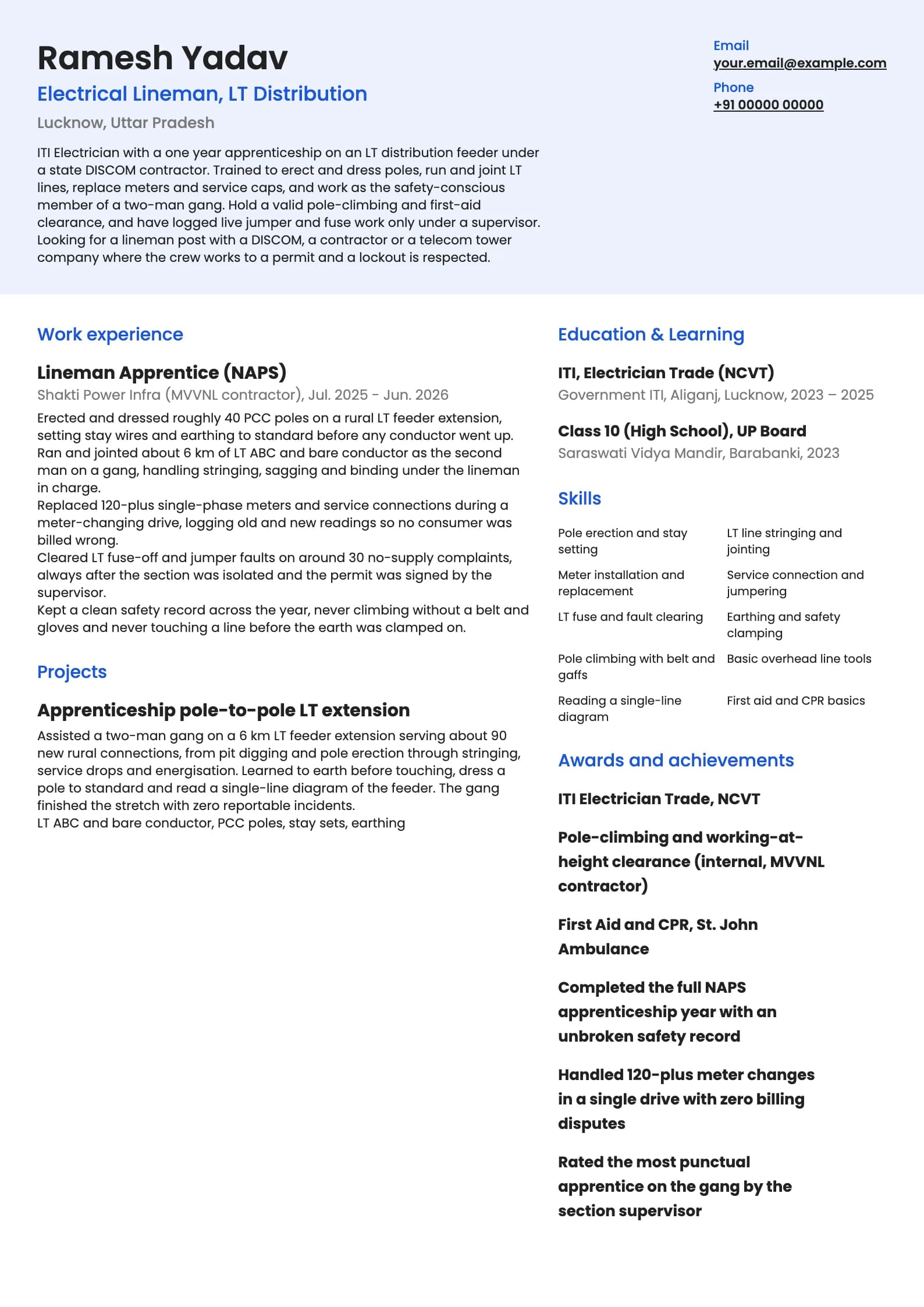
Build my resumeLineman resume example, Fresher / Apprentice (0 to 1 year)
modern templateIs your resume good enough?
Upload the resume you have now and see what an applicant tracking system reads before a lineman recruiter ever does.
Free to run. Sign in with your mobile number to see your score.
Lineman resume example, Skilled Lineman (4 years)
professional template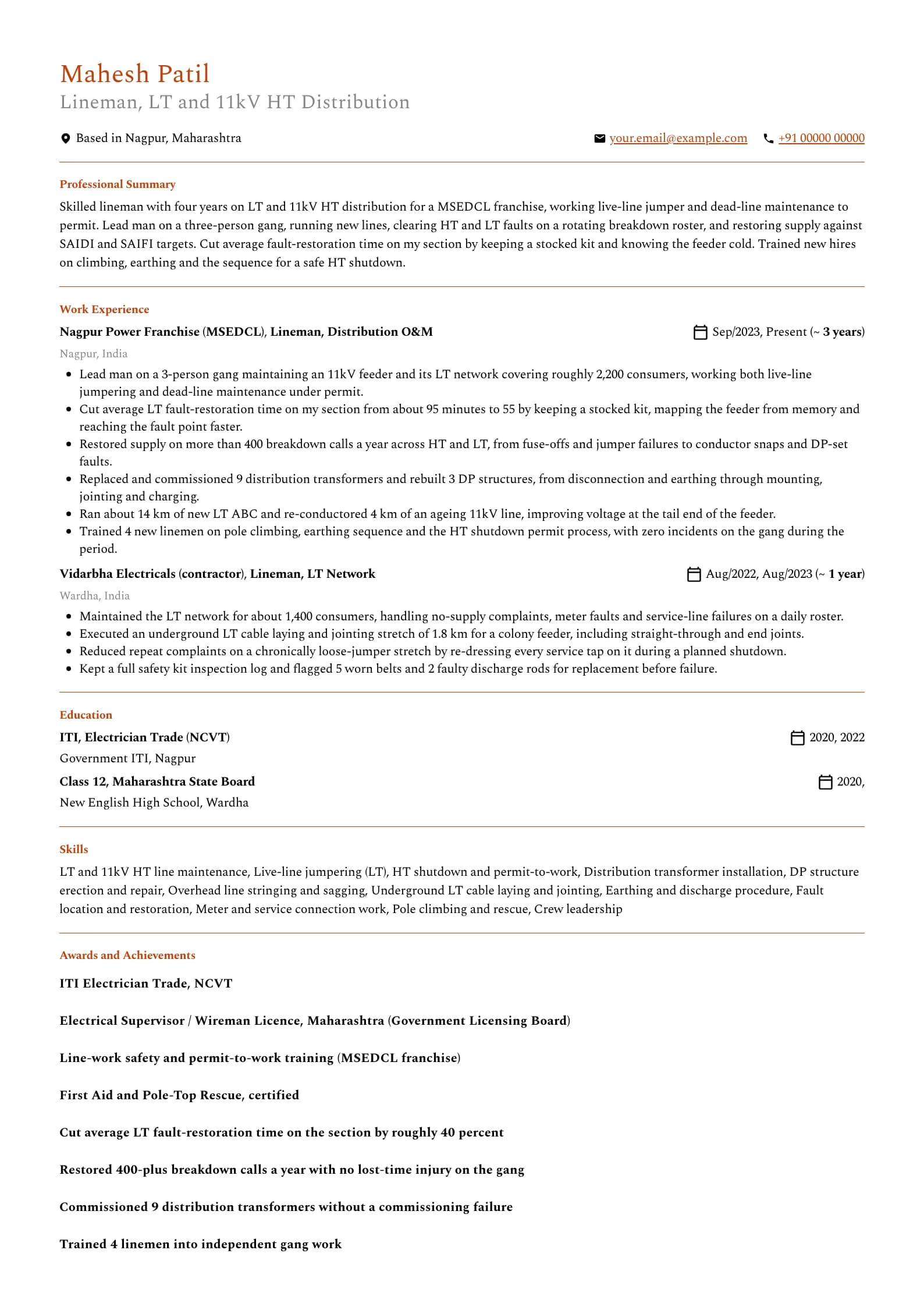
Want this structure with your own details? Build it in the resume builder.
Lineman resume example, Line Inspector / Senior Lineman (12 years)
header-band template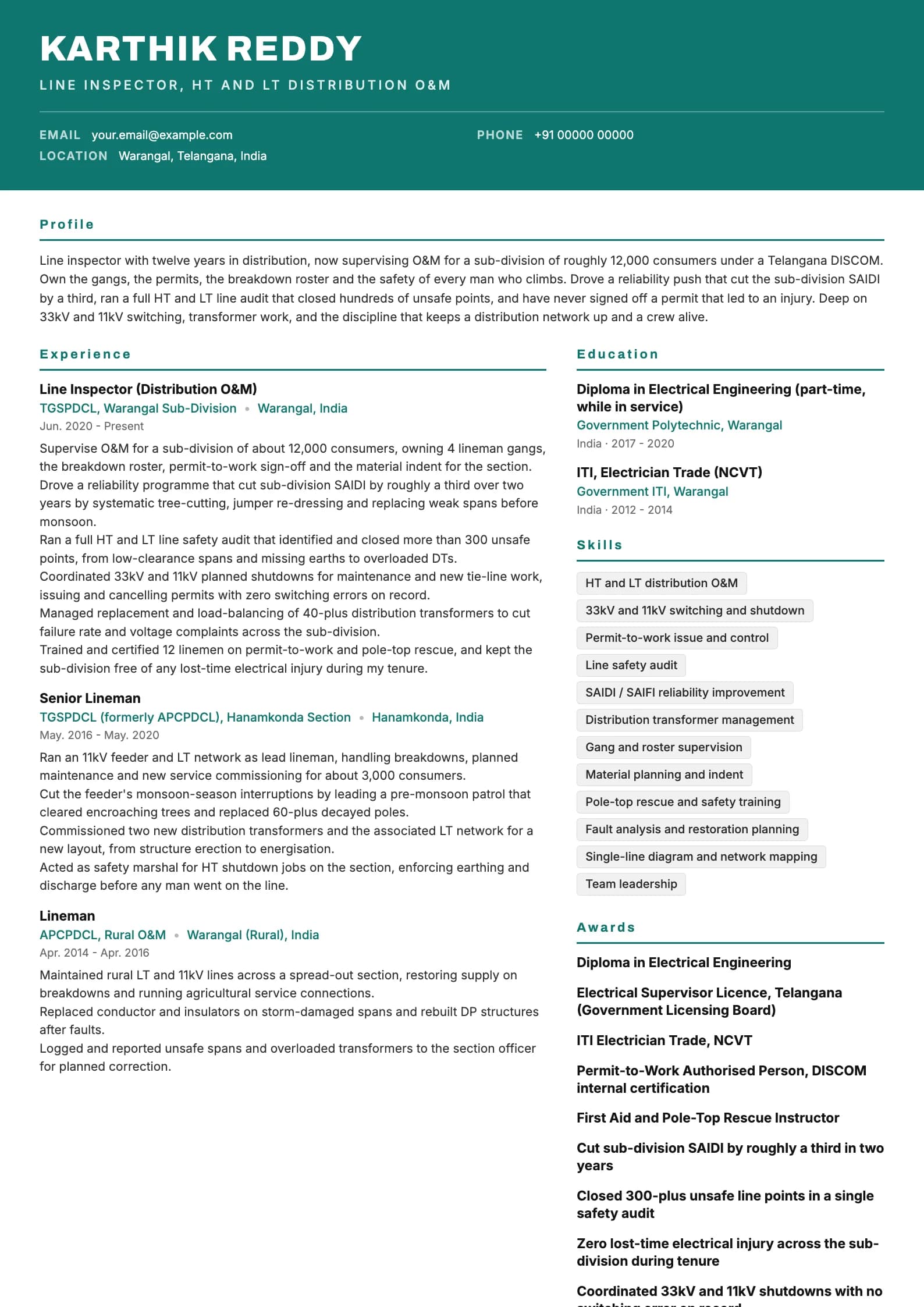
The format that works for lineman resumes in India
Reverse chronological is the layout to use. Put your current or most recent posting first, work backwards, and keep the dates in plain view. DISCOM and contractor hiring cells, and the ITI placement officers who forward your resume, read many of these a day and expect the standard shape. A resume that hides the dates under a skills heading reads as if a gap is being covered, and gaps in line work are better explained in one honest line. Keep it to one page. A lineman almost never needs two. What a hiring cell wants is your trade qualification, your licence, the voltage class you have worked, your safety record and the last two or three postings. That fits on a single page with room to spare, and a second page padded with a declaration and a hobbies line only weakens the first. State the voltage class early, because it decides which jobs you are called for. LT-only, LT and 11kV HT, or up to 33kV are different pay bands and different risk levels, and a hiring cell should not have to guess. The senior sample names 33kV, 11kV and LT in the summary for exactly this reason. Leave off the photograph, date of birth, marital status and father's name. They come from an old campus-placement template and add nothing to a line-work screen. Save the file as a PDF, name it with your own name and the word lineman, and send that unless the posting asks for a printed form. The table below sets out the section order.
| Section | Where it goes | Why |
|---|---|---|
| Name and headline | Top, above everything | Headline names the post and the voltage: Lineman, LT and 11kV HT. Hiring cells match on it. |
| Summary | Directly under the header | Three lines: trade, years, voltage class and the safety or reliability point that matters most. |
| Licence and trade | High, near the summary | ITI trade and the Electrical Supervisor or Wireman licence are hard filters. Do not bury them. |
| Work experience | Next, for anyone with a posting | Most recent first. Name the DISCOM or contractor, the voltage and the consumer count. |
| Skills | Below experience | Grouped: line work, safety, equipment. Not a 30-item wall. |
| Certifications and safety | Below skills, or beside the trade line | Pole-top rescue, first aid, permit-to-work authorisation. These carry real weight here. |
| Education | Bottom | ITI, any diploma, Class 10 or 12 board. Short. |
Why safety belongs at the top of a lineman resume
Line work is one of the few trades where a hiring decision turns on whether the applicant is likely to get hurt. A lineman who cuts corners costs a supervisor a fatality inquiry, a compensation claim and a shutdown of the section. So the first thing a good hiring cell looks for is evidence that you respect the permit, the earth and the lockout. That evidence should be on the page, not left for the interview. Say it in plain, specific terms. "Never climb without a belt and gloves and never touch a line before the earth is clamped" tells a supervisor exactly how you work. A clean, stated safety record over a number of years is worth more than any adjective. If you hold a pole-top rescue and first-aid certificate, name it, because a lineman who can bring a colleague down and start CPR is a different hire from one who cannot. Avoid the empty version of this. "Safety conscious and follows all safety norms" is on every resume and means nothing, because everyone writes it. Replace it with the actual discipline: earthing before work, discharge rods used, permit signed before an HT job, kit inspected and worn belts flagged. The skilled sample flags worn belts and faulty discharge rods for replacement, which is a far stronger safety signal than the word safety. Be honest about live-line work. If you have only ever worked dead lines under a permit, say so, because claiming live-line HT experience you do not have is the kind of gap that becomes obvious and dangerous on day one.
Safety line, skilled lineman
Weak
Hardworking and safety conscious lineman, always follows all safety rules and regulations at the work site.
Strong
Four years on LT and 11kV to permit with no lost-time injury on the gang: earth clamped before any work, discharge rods used, and worn belts flagged and replaced before they fail.
Trades a phrase everyone writes for the specific habits and the clean record a supervisor is actually screening for.
A hiring cell reads a lineman resume asking one question first: is this person likely to get hurt or hurt someone. Answer it on the page with your record and your habits, not with the word safety.
Listing a skill is not the same as proving it on live lines
The most common lineman resume names a row of skills, wiring, cabling, jointing, HT, LT, transformer, with no posting anywhere that shows the voltage, the network or the result. A hiring cell reads that row and cannot tell an apprentice who watched from an experienced hand who ran a feeder, so it assumes the lower of the two. The fix is to let the postings carry the skills. If you write 11kV HT on your skills line, a bullet should describe an HT job you did: a shutdown you worked to permit, a transformer you commissioned, a jumper you re-dressed. If you write underground cable jointing, a bullet should name the stretch you laid and the joints you made. The skilled sample lists HT maintenance and transformer work precisely because the bullets show a feeder run, transformers commissioned and shutdowns worked. The skills line and the experience agree, which is what makes both believable. Name the numbers that a distribution job is judged on. Consumers on the feeder, breakdown calls restored, restoration time, poles erected, kilometres strung, transformers commissioned, SAIDI or SAIFI moved. These are not vanity metrics, they are the exact figures a section officer tracks, so a resume that speaks in them reads as written by someone who has done the work. Do not pad with skills you cannot defend. Writing 33kV or 132kV substation work when you have only done 11kV distribution is the kind of claim that collapses in the first technical question, and a lineman who overstates voltage class is a safety risk, so it costs you more than it gains.
For every voltage class and technique on your skills line, ask: is there a bullet that proves I worked it. If not, add the bullet or cut the claim. On live lines an overstated skill is a danger, not just a fib.
Experience bullets: verb, line, result
Every strong bullet in the samples has the same shape. It opens with an action verb, names the specific line, transformer or fault, and closes with what changed: supply restored, time cut, poles up, kilometres strung, an injury-free record held. The verb says you did it. The line tells a section officer whether the work is relevant. The number does the convincing. Start from what was different after your shift and work backwards. Linemen tend to write the task first, then cannot attach a result, which gives lines like "did LT and HT line maintenance work". Instead ask what changed in the field: a feeder that was down came back, a fault point was reached faster, a weak span was replaced before it failed, a transformer was commissioned without a return trip. Then write the sentence that ends in that fact. Vary what you count. Restoration time on every line reads as one trick. Across a real posting you can honestly reach for breakdown calls restored, consumers served, poles erected, kilometres of conductor, transformers commissioned, repeat complaints cut, and safety incidents avoided. The skilled sample moves across several of these, which reads as range. Where there is no clean number, give scale: how many consumers on the feeder, how many gangs, how long a stretch, how many poles. "Ran about 14 km of new LT ABC and re-conductored 4 km of an ageing 11kV line" carries weight without a made-up percentage. Give the current posting five or six bullets, the previous one four, anything older two or three.
| Level | What bullets must prove | Typical measure |
|---|---|---|
| Fresher / apprentice | You can work safely as the second man on a gang | Poles erected, km strung, meters changed, faults cleared, clean record |
| 1 to 3 years | You handle LT breakdowns and service work on your own | Complaints restored, restoration time, service connections, cable jointed |
| 4 to 8 years | You lead a gang and work HT to permit | Consumers served, HT jobs, transformers commissioned, repeat faults cut |
| 8 years and up | You supervise gangs, permits and network reliability | SAIDI / SAIFI moved, unsafe points closed, gangs run, injury-free record |
Experience bullet, distribution lineman
Weak
Responsible for maintenance of LT and HT lines and attending to breakdown complaints in the section.
Strong
Cut average LT fault-restoration time on my section from about 95 minutes to 55 by keeping a stocked kit and knowing the feeder cold, across 400-plus breakdown calls a year.
"Responsible for" is a duty list; the rewrite names the section, the before and after time and the volume behind it.
Experience bullet, new-line work
Weak
Did pole erection and line stringing work for new electrical connections in rural areas.
Strong
Erected and dressed roughly 40 PCC poles and strung about 6 km of LT ABC to standard, earthing and staying each pole before conductor went up, for 90 new rural connections.
Puts a number on the poles, the span and the connections, and shows the safe sequence a supervisor cares about.
If a bullet would fit any lineman in the state, it is describing the trade, not you. Add the voltage, the feeder, the consumer count or the number until it only fits the line you actually worked.
The skills section: grouped, honest, short enough to defend
A lineman's skills section has two readers. A hiring cell scanning many resumes wants to see the voltage class, the licence and a few core techniques fast. A section officer wants a short, organised list that says what kind of lineman you are. Grouping serves both. Group by function rather than one long row. Line work, safety, and equipment is a grouping that fits almost every lineman. The headings matter less than the fact that there is structure. Write terms the way the trade writes them: 11kV not 11 KV, distribution transformer not DTR alone, ABC for aerial bunched conductor. If a form or portal searches your resume, it matches on the exact string. Ten to sixteen skills is the working range. Below eight the section looks thin. Above twenty it stops signalling anything. A lineman resume is especially prone to listing every hand tool as a separate skill, which pads the list without adding information. The list is a promise: every item is something an interviewer can ask you to demonstrate or explain. Do not add star ratings or percentage bars against skills. Nobody agrees what four stars in jointing means, and it invites an argument you cannot win. Let the postings show the depth. Keep the safety skills, pole-top rescue, first aid, permit-to-work, in their own small group, because for this trade they are not soft extras, they are part of the core.
| Group | What goes in it | How many |
|---|---|---|
| Line work | LT / HT maintenance, stringing, jointing, transformer, cable laying | 4 to 7 |
| Safety | Earthing and discharge, permit-to-work, pole-top rescue, first aid | 3 to 4 |
| Equipment | Climbing kit, crimping and jointing tools, tester, earth rod, discharge rod | 2 to 4 |
| Reading / planning | Single-line diagram, network mapping, fault location, material indent | 1 to 3 |
| Leadership (for seniors) | Gang supervision, roster, training, permit control | 1 to 3 |
Skills section
Weak
Skills: Wiring, Cabling, Electrical, Lineman work, Hard working, Screwdriver, Plier, Tester, Hammer, Ladder, Fitting, Maintenance, HT, LT, Transformer, Honest, Punctual
Strong
Line work: LT and 11kV HT maintenance, stringing and jointing, DT installation, LT cable jointing. Safety: earthing and discharge, permit-to-work, pole-top rescue, first aid. Equipment: climbing kit, crimping tools, line tester, earth and discharge rods.
Cuts the hand-tool padding and the personality words, states the voltage class, and groups the rest so a hiring cell reads it in one pass.
Licences, trade and certifications: where they belong
For a lineman, the trade qualification and the licence are not a footnote, they are a hard filter, so they sit high, near the summary, not buried at the bottom with the school details. Many DISCOM and contractor posts will not shortlist without the ITI Electrician trade and, above a certain level, an Electrical Supervisor or Wireman licence from the state licensing board. Name the exact certificate, the issuing body and the year. List the safety certifications with the same seriousness as the trade. Pole-top rescue and first aid are the two that a supervisor most wants to see, because they decide whether a colleague survives a shock on the pole. Permit-to-work authorisation, where a DISCOM has formally certified you to hold a permit, is a genuine seniority signal and belongs on the page. A diploma in electrical engineering earned part-time while in service is worth its own line, because it is the credential that moves a senior lineman into a line inspector, JLM or junior engineer track. The senior sample lists exactly this. Do not hide it among the ITI and school entries. Keep the education entry itself short: ITI trade and board, any diploma, Class 10 or 12. Drop the percentage once you have a few years of postings behind you, because a mark from an ITI years ago competes for space with the feeders you have actually run. An expired licence listed as current is easy to catch and reads as dishonest, so renew it or mark it clearly.
Getting past the form, the portal and the first filter
Many lineman jobs still come through a physical form at a DISCOM office, an ITI placement cell or a contractor, and there the reader is a human, so a clean, standard one-page resume that states trade, licence, voltage and safety record is what wins. But telecom tower companies, EPC contractors, solar and metro firms, and the larger staffing agencies increasingly take applications through a portal that parses your file, so both readers are worth writing for. Where a portal is involved, keep the layout simple. One column. Standard headings, Work Experience not My Journey, Skills not My Toolbox. No text inside an image, because a logo strip reads as blank space. Nothing important in the header or footer region, which some parsers drop. Save a PDF that holds real text and confirm you can select and copy a sentence out of it, because whatever you cannot select, the parser cannot read either. On wording, use the terms the posting uses, where they are honest. If it says overhead line, write overhead line. If it says 11kV distribution, write 11kV distribution and not just line work. Spell out an abbreviation once alongside its short form, for example DT (distribution transformer) and ABC (aerial bunched conductor), so a search on either finds you. Do not stuff. Repeating HT, LT, HT, LT across the page does not fool a human reader and looks worse than a clean list. Write real bullets that naturally carry the right words, because a bullet describing an 11kV shutdown contains 11kV in a context that survives a human read too.
Section heading
Weak
My Work Journey in Electrical Field
Strong
Work Experience
A portal looks for standard headings; a creative one can push the whole block into a bucket the recruiter never searches, and a human reader gains nothing from it.
Before you send a file, copy the text out of your PDF into a plain notes app. Whatever reads cleanly there is roughly what a portal sees, and anything scrambled is a real risk. For a walk-in form, a neat, correctly spelled one-pager does the same job.
What gets lineman resumes set aside
Most lineman resumes are set aside for a small set of recurring reasons, and every one is fixable in an afternoon. The list below covers what DISCOM cells, contractors and placement officers see most often on Indian lineman resumes, in rough order of how much each one hurts.
- No voltage class stated, so a hiring cell cannot tell whether you have worked LT only, 11kV HT or 33kV, and moves to a resume that says.
- The word safety with no substance behind it. Name the actual habits: earthing before work, discharge rods, permit signed, kit inspected, and your clean record.
- The licence and ITI trade buried at the bottom or left off, when for many posts they are a hard filter.
- A skills row of hand tools and personality words, plier, tester, hammer, honest, punctual, instead of real line work and safety skills.
- No numbers anywhere. Consumers served, breakdown calls restored, poles erected, km strung, transformers commissioned. Pick whichever is honest.
- Duties copied from a job description, "responsible for maintenance of lines", instead of the lines you actually worked and what changed.
- A photo, date of birth, marital status or father's name, none of which belong on a line-work resume and all of which take a posting's space.
- Overstated voltage or live-line experience you cannot defend, which is dangerous as well as dishonest on this trade and collapses in the first question.
- Dates and employers that do not match your experience or Provident Fund record, since verification is standard and a mismatch ends the process.
- Spelling errors in the terms of the trade, writing transformer as "transfarmer" or 11kV as "11 KB", which undoes an otherwise solid page.
Read your resume once as if you were the section officer who would put you on a live feeder. Anything that would make you doubt whether this person is safe and skilled is a line to fix before you send it.
Skills to put on a lineman resume
Technical
- LT line maintenance
- 11kV HT line maintenance
- 33kV switching and shutdown (senior)
- Overhead line stringing and jointing
- Distribution transformer installation
- DP structure erection and repair
- Underground LT cable laying and jointing
- Fault location and restoration
- Meter and service connection work
- Pole erection, staying and earthing
- Live-line jumpering (LT)
- Single-line diagram reading
Tools and platforms
- Pole-climbing belt and gaffs
- Crimping and jointing tools
- Line tester and multimeter
- Earth rod and discharge rod
- Torque wrench and spanner set
- Insulated hand tools
- Come-along and stringing tackle
- Meter and service kit
Working skills
- Safety discipline
- Permit-to-work adherence
- Crew leadership
- Working at height
- Physical stamina and reliability
- Clear field communication
- Composure in outages
- Punctuality on roster
Certifications worth listing as a lineman
| Certification | Full name | Worth it for |
|---|---|---|
| ITI Electrician (NCVT) | Industrial Training Institute, Electrician Trade, National Council for Vocational Training | The base trade qualification for a lineman, and a hard filter for most DISCOM and contractor posts. Essential for a fresher and worth keeping on the page throughout your career, since it is the certificate that says you were formally trained rather than picked it up on site. |
| Electrical Supervisor Licence | State Electrical Supervisor / Wireman Licence, Government Licensing Board | The state-issued licence that authorises supervisory electrical work, needed to move from lineman into senior lineman, line inspector and permit-holding roles. Worth pursuing once you have a few years of line experience, because it opens the higher pay bands and is checked at shortlisting. |
| Pole-Top Rescue | Pole-Top and Aerial Rescue Certification | The safety credential that says you can bring an injured colleague down from a pole and start resuscitation. Genuinely valued by supervisors for any live-line trade, and a strong differentiator for a lineman since so few resumes carry it. Pair it with a current first-aid certificate. |
| First Aid and CPR | First Aid and Cardiopulmonary Resuscitation (St. John Ambulance or Red Cross) | A short, cheap certificate that carries real weight in a shock-risk trade, since the first minutes after an electrical injury decide the outcome. Worth it at every level, from apprentice to line inspector, and easy to keep current. |
| Permit-to-Work Authorisation | DISCOM Permit-to-Work Authorised Person certification | An internal DISCOM certification that formally allows you to hold and control a permit for HT and LT work. A clear seniority signal for a senior lineman or line inspector, since it means the utility trusts you to keep a gang safe during a shutdown. |
| Diploma in Electrical Engineering | Diploma in Electrical Engineering (Polytechnic) | Not a certificate but a qualification worth naming, especially when earned part-time while in service. It is the credential that moves a senior lineman toward a line inspector, JLM or junior engineer track, so it belongs high on the page for those aiming that way. |
Keywords an ATS scans for in a lineman resume
These are the literal terms a parser matches against the job description. Use the ones that are true of you, in the sentences where you did the work, not as a list at the bottom.
- lineman
- electrical lineman
- LT line
- HT line
- 11kV
- 33kV
- distribution transformer
- overhead line
- line stringing
- cable jointing
- fault restoration
- permit to work
- pole erection
- earthing
- SAIDI
- SAIFI
- ITI electrician
- electrical supervisor licence
- pole-top rescue
- distribution O&M
Lineman resume FAQ
What salary can a lineman expect in India?
A fresher or apprentice lineman on a contractor typically earns around 1.2 to 2.4 LPA, roughly 10,000 to 20,000 a month, often on a daily or NAPS stipend to start. A skilled lineman with four to eight years on LT and HT usually sits in the 2.4 to 4.2 LPA band with a contractor, and higher on a DISCOM regular or outsourced roll with allowances. A senior lineman or line inspector in a government DISCOM, on a regular pay scale with dearness allowance and other benefits, commonly earns 4.5 to 8 LPA and more with seniority. HT and switching experience, a supervisor licence and a diploma push the top of every band upward, and telecom tower, metro and solar EPC roles often pay above the state DISCOM rate.
How long should a lineman resume be?
One page. A lineman almost never needs two. A hiring cell wants your trade and licence, the voltage class you have worked, your safety record and your last two or three postings, and all of that fits on a single page. If you are struggling to fit it, cut the oldest posting to one line, drop the ITI percentage once you have field experience, and remove any declaration or hobbies section, which add nothing.
Do I need ITI and a licence to get a lineman job?
For most formal DISCOM and contractor posts, the ITI Electrician trade is a hard filter, and above the basic lineman level an Electrical Supervisor or Wireman licence from the state board is expected. Some rural and small-contractor jobs still hire on experience alone, but the ITI plus licence combination opens the regular rolls and the higher pay bands, so it is worth completing. List both high on the page, near the summary, not buried at the bottom.
How does a fresher lineman write a resume with no experience?
Lead with your ITI trade and any apprenticeship, then projects or training work, then skills. Treat the apprenticeship like a job: name the feeder, the voltage, the poles you helped erect, the meters you changed and the faults the gang cleared, and state that you kept a clean safety record. A NAPS or on-site apprenticeship, pole-climbing and first-aid clearances, and even trade-test marks all count, because a hiring cell for a shock-risk trade trusts checkable facts over adjectives.
Should I mention the voltage class I have worked?
Yes, always, and near the top. LT only, LT and 11kV HT, or up to 33kV are different pay bands, different risk levels and different jobs, and a hiring cell should not have to guess which you are. Name it in your headline and summary and back it with bullets: an HT shutdown you worked, a transformer you commissioned, a feeder you ran. Never claim a voltage class you have not worked, because on live lines an overstated skill is a danger, not just a fib, and it collapses in the first technical question.
How important is safety on a lineman resume?
It is the single most-checked thing, because line work is a trade where a hiring decision turns on whether the applicant is likely to get hurt or hurt someone. Do not write the empty version, safety conscious, follows all norms. Write the actual discipline: earthing before work, discharge rods used, the permit signed before an HT job, the kit inspected, and a stated clean record over your years on the line. A pole-top rescue and first-aid certificate is worth naming, because it separates you from most other resumes.
Do certifications like pole-top rescue or first aid help?
Yes, more than most applicants think. For a shock-risk trade, a supervisor genuinely values a lineman who can bring an injured colleague down and start CPR, and very few resumes carry those certificates, so they stand out. Permit-to-work authorisation from a DISCOM is a seniority signal that matters at the senior lineman and line inspector level. Name each one with the issuing body, keep them current, and list them with the same seriousness as your trade.
Can a lineman move up to line inspector or junior engineer?
Yes, and the resume should show the path. Leading a gang, holding a permit, running shutdowns and training new hires are the mid-career signals, and a part-time diploma in electrical engineering earned while in service is the qualification that moves a senior lineman into a line inspector, JLM or junior engineer track. If you are aiming that way, put the diploma high on the page and let your bullets show supervision, permit control and network-level reliability work rather than only field tasks.
Do I need a photo on a lineman resume in India?
No. A photograph, date of birth, marital status and father's name come from an old campus-placement template and add nothing to a line-work screen, while they take space a posting or a safety certificate could use. Leave them off unless a specific posting or a government form explicitly asks for a photograph, in which case follow the form.
Related resume examples and guides
Build your own lineman resume in any of these formats
Start from a blank resume or upload the one you have. Goodspace renders it in 24 templates and flags the voltage-class, safety and licence keywords a DISCOM or contractor hiring cell looks for, and the hand-tool padding it will not credit.
Build my resume