Gynecologist Resume Format, with 3 Full Samples
An obstetrician and gynecologist is hired on delivery and surgical volume, the range of cases they manage unsupervised, and whether their outcomes and safety record hold up. Most OBGYN CVs list procedures and forget the numbers behind them. Below are three complete resumes, one for a fresh MS Obstetrics and Gynaecology graduate, one for a consultant with seven years across obstetrics and gynae surgery, and one for a senior consultant who leads a high-risk obstetrics and endoscopy unit. After the samples come the format rules, the difference between naming laparoscopy and proving your surgical volume, the terms a hospital HR parser scans for, and the mistakes that get an OBGYN CV set aside before the medical director sees it.
Build my resumeGynecologist resume example, Fresher (MS/DNB, 0 years)
ai-era templateIs your resume good enough?
Upload the resume you have now and see what an applicant tracking system reads before a gynecologist recruiter ever does.
Free to run. Sign in with your mobile number to see your score.
Gynecologist resume example, Consultant (7 years)
professional template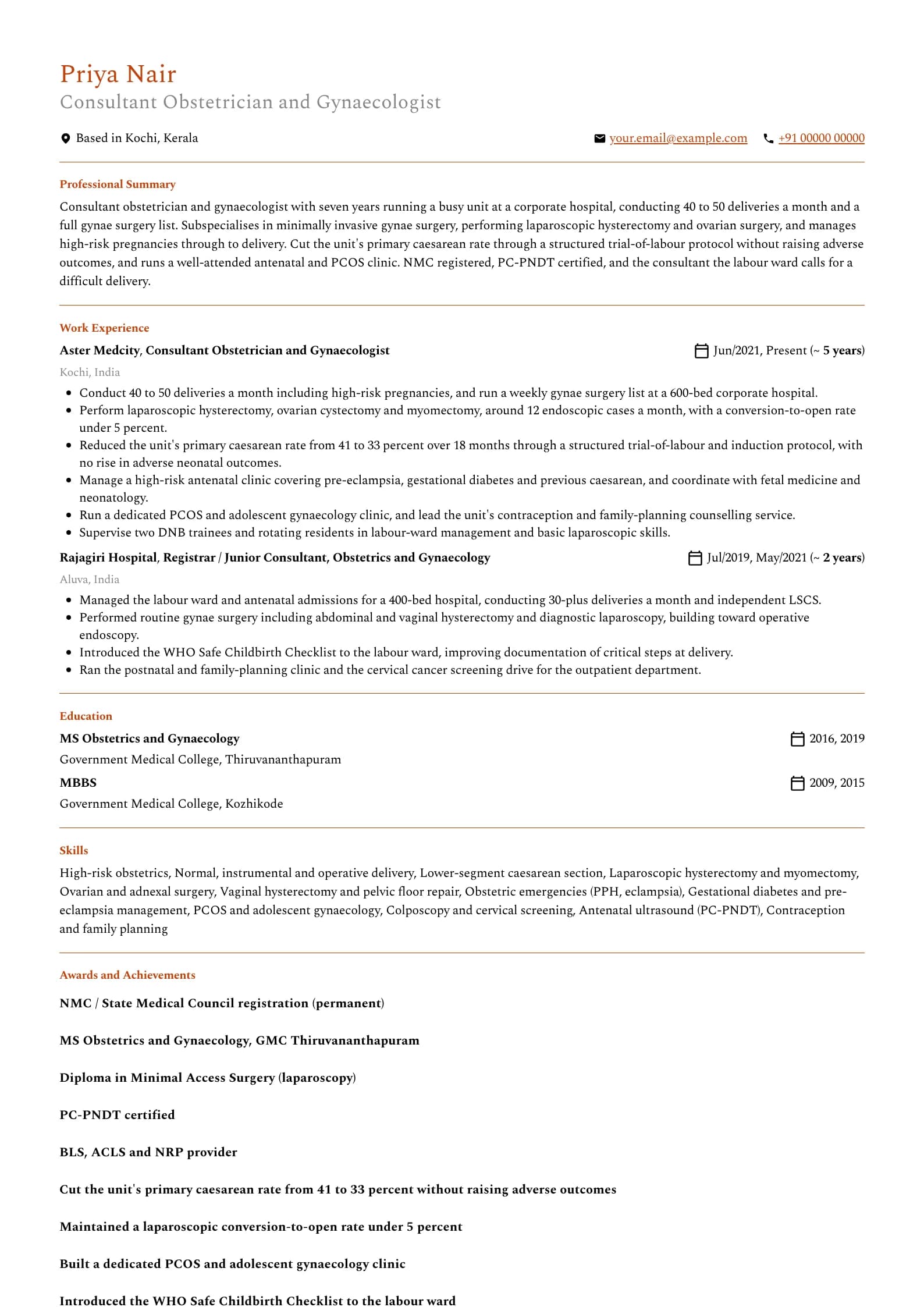
Want this structure with your own details? Build it in the resume builder.
Gynecologist resume example, Senior (13 years)
header-band template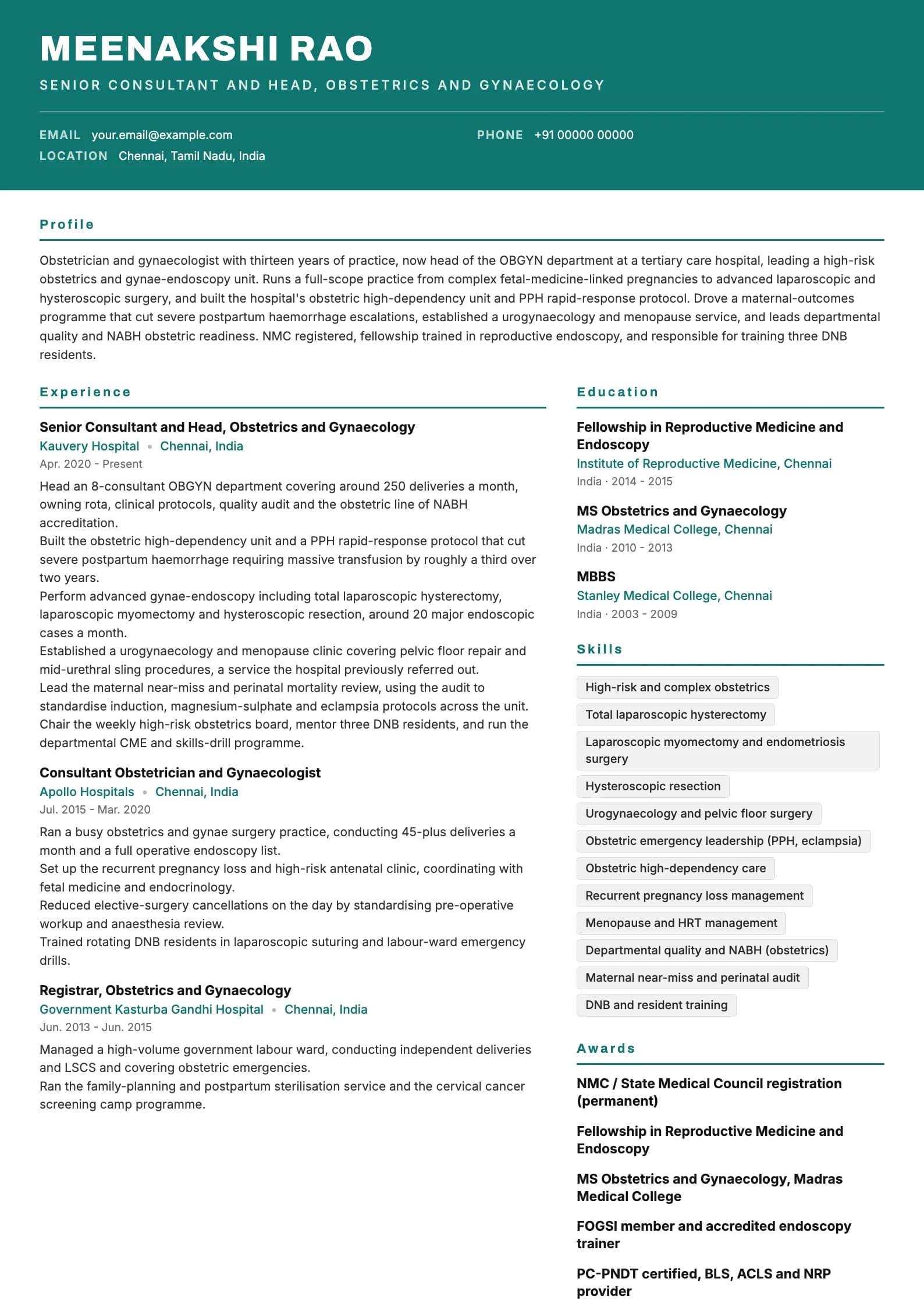
The format that works for gynecologist resumes in India
Reverse chronological is the layout to use. Most recent post first, work backwards, dates in plain view. An OBGYN career reads as a progression through residency, registrar, consultant and then subspecialty or headship, and a reviewer wants to trace that line without hunting. A functional CV that hides dates behind a skills grid reads as an attempt to mask a gap or a short tenure, and medical HR treats it that way. A doctor's CV is allowed to run longer than a corporate resume, but not indefinitely. A fresh MS or DNB graduate fits on one to two pages. A consultant with seven years runs two pages. A department head with a surgical record, publications and committee roles can reach three, and only then because deliveries, procedures and audits are real content, not padding. The test is the same at every level: would you defend this line in front of the medical director. The header carries your name, your qualification string and your intended designation, for example "Consultant Obstetrician and Gynaecologist". Underneath, a placeholder line stands in for contact details, which you fill in your own copy. Do not put a photograph, date of birth, marital status, religion or father's name on a medical CV in India. They come from an older biodata template and add nothing a hospital screening an OBGYN needs. Name your registration, your delivery and surgical volume, and your PC-PNDT status early, because a hospital cannot hire an obstetrician who is not registered or who cannot show labour-ward and surgical competence. Send a PDF unless the posting asks otherwise, use a single column, and name the file with your own name and MS OBG rather than cv_final. The table below sets out the section order.
| Section | Where it goes | Why |
|---|---|---|
| Name and qualification | Top, above everything | Dr Name, MS/DNB OBG, and the designation you want. HR and the medical director both match on it. |
| Professional summary | Directly under the header | Three to four lines. Delivery volume, surgical scope, years and the single strongest result. |
| Registration and licences | High, near the top | NMC or state council number, PC-PNDT. An OBGYN without these cannot be hired. |
| Work experience | Next, for anyone past residency | Most recent post first. Current role carries the most bullets and the volumes. |
| Surgical and delivery record | Its own block for consultants | Deliveries a month, LSCS, and the gynae procedures you perform, with volume. |
| Education and training | Below experience, near top for a fresher | MS/DNB, MBBS, fellowships. Institution and years. Thesis title while it is fresh. |
| Publications and presentations | After experience for senior roles | Papers, FOGSI presentations, audits. Real for academic and senior posts. |
| Certifications and CME | After education | Endoscopy diploma or fellowship, BLS/ACLS/NRP, PC-PNDT. Name, body, year. |
Naming laparoscopy is not the same as proving your surgical volume
The most common OBGYN CV failure is a line that reads "normal delivery, LSCS, hysterectomy, laparoscopy, hysteroscopy, myomectomy, ovarian surgery, infertility" with no bullet anywhere showing how many of any of them you actually do. A hospital HR parser matches the words, but the medical director wants to know your delivery volume a month, your caesarean rate, and how many laparoscopic cases you run and at what conversion rate. The fix is to let the experience carry the procedure. If you write laparoscopic hysterectomy, a bullet should give the monthly volume and a conversion-to-open rate. If you write high-risk obstetrics, a bullet should name what you manage, pre-eclampsia, gestational diabetes, previous caesarean. The consultant sample lists laparoscopic hysterectomy and myomectomy precisely because a bullet shows around 12 endoscopic cases a month with a conversion rate under 5 percent, so the skills line and the work agree. Be specific about surgical level. "Diagnostic laparoscopy" and "total laparoscopic hysterectomy" are very different claims, and a reviewer needs to know which you can do unsupervised. "Operative endoscopy" with a case volume tells them the skill is current. A CV that just says "laparoscopy" leaves the medical director to assume the shallowest reading, which for a surgical hire is a lost opportunity. Do not pad with procedures you assisted once as a resident. Listing advanced endometriosis surgery or a urogynaecology sling when you scrubbed in a handful of times invites an interview question you cannot answer, and one weak surgical claim makes a reviewer doubt the strong ones.
For every procedure on your skills line, ask: is there a bullet that shows my volume and, for surgery, a safety or conversion figure. If not, either add the bullet or move the procedure to a lower-confidence group. A wall of unproven surgeries helps the parser and hurts the interview.
Writing a summary a medical director actually reads
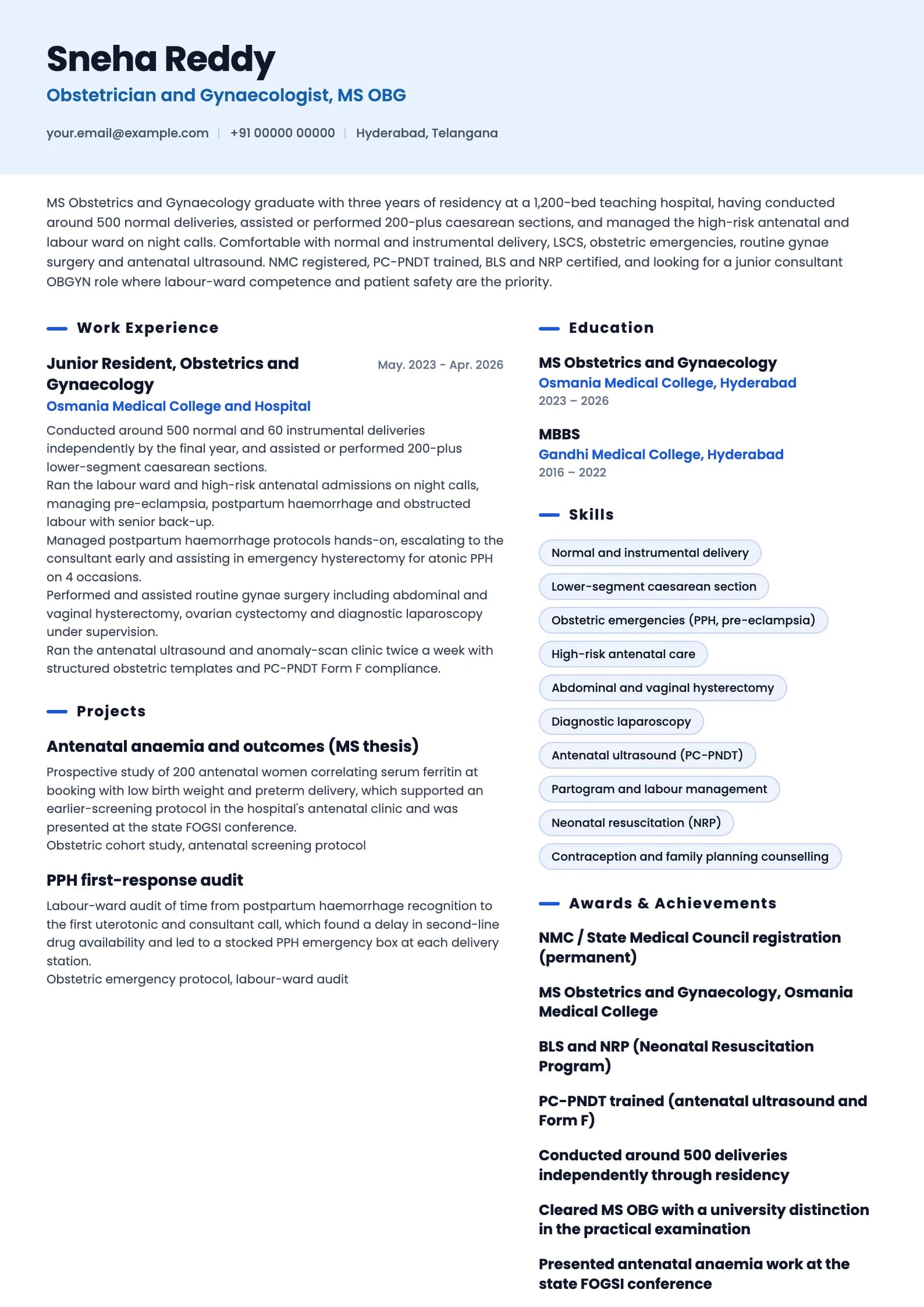
The block under your name is the part that reliably gets read, so it should carry four facts: what you deliver and operate, how long you have practised, roughly your delivery and surgical volume, and the single strongest thing that happened because of your work. Three or four lines, no adjectives a reference check cannot confirm. The old objective line, "seeking a challenging position in a reputed hospital to serve women's health", tells a reader nothing they did not assume from the application. Replace it with a summary. An objective describes what you want, a summary describes what you already do, and only one is evidence a hospital can act on. Freshers often think they have nothing to summarise. Look at the fresher sample: it names the delivery count, the caesarean number, the labour-ward night-call work, the routine surgery, and confirms NMC and PC-PNDT. That is a genuine summary built from three years of residency, not a wish list. What it avoids is "compassionate and dedicated doctor passionate about women's health", a phrase so common it now carries no information. A practical test: read your summary and ask whether a batchmate with the same MS could paste it onto their CV unchanged. If they could, it describes the degree, not you. Add the specific volumes, the specific subspecialty and the specific result until it stops being transferable.
Professional summary, consultant OBGYN
Weak
Compassionate and hardworking obstetrician and gynaecologist with 7+ years of experience in obstetrics, gynae surgery and infertility seeking a challenging consultant role in a reputed hospital.
Strong
Consultant obstetrician and gynaecologist with seven years running a busy unit, conducting 40 to 50 deliveries a month and around 12 laparoscopic cases. Cut the unit's primary caesarean rate from 41 to 33 percent without raising adverse outcomes.
The rewrite trades a procedure list and self-description for real monthly volumes, a named surgical scope and a verifiable quality result.
Experience bullets: action, case, consequence
Every strong bullet in the samples follows the same shape. It opens with an action, names the specific deliveries, surgery or clinic you ran, and closes with what measurably resulted. The action establishes that you did it. The case type tells the reviewer whether the work matches their unit. The number does the persuading. Start with the outcome and work backwards. OBGYN doctors tend to write the task first, then struggle to attach a figure, which produces bullets like "managed obstetrics and gynaecology cases in the hospital". Instead ask what was different because of your work: a caesarean rate fell, a PPH protocol cut severe cases, a conversion-to-open rate stayed low, a service got built, a checklist improved documentation. Then write the sentence that ends in that fact. Vary the metric. Ten delivery-count numbers in a row read as one trick repeated. Across a real OBGYN career you can honestly reach for deliveries a month, caesarean rate, surgical case volume, conversion-to-open rate, PPH or maternal near-miss reduction, clinic attendance and teaching load. The consultant and senior samples move across several of these, which reads as range. Where a number is genuinely not available, give scope: how many deliveries a month the unit handles, how many beds, how many clinics you run, how long a service took to build. "Built the obstetric high-dependency unit" carries weight without inventing a percentage. Allocate bullets by recency. Current post gets five or six, the previous post four or five, anything older two or three.
| Level | What bullets must prove | Typical metric |
|---|---|---|
| Fresher (MS/DNB) | You can run the labour ward and handle an emergency | Deliveries conducted, LSCS performed or assisted, emergencies managed, surgery assisted |
| 1 to 3 years | You deliver and operate unsupervised | Deliveries a month, independent LSCS, routine gynae surgery, clinics run |
| 4 to 8 years | You own a unit and improve its numbers | Delivery volume, caesarean rate, endoscopic case volume, conversion rate, teaching |
| 9 years and up | You build services and run the department | Services built, maternal safety metrics, advanced surgical volume, accreditation, training |
Experience bullet, consultant obstetrics
Weak
Responsible for management of antenatal, labour and postnatal cases and conducting deliveries and caesarean sections as required.
Strong
Conduct 40 to 50 deliveries a month including high-risk pregnancies, and run a weekly gynae surgery list at a 600-bed hospital.
"Responsible for" describes a job description; the rewrite names the monthly volume, the case mix and the surgical scope.
Experience bullet, gynae surgery
Weak
Performed various laparoscopic and open gynaecological surgeries with good surgical outcomes.
Strong
Perform laparoscopic hysterectomy, ovarian cystectomy and myomectomy, around 12 endoscopic cases a month, with a conversion-to-open rate under 5 percent.
Names the procedures, the monthly volume and an audited conversion figure, so a reviewer can ask a real follow-up instead of nodding at a vague claim.
If a bullet would read identically on a co-resident's CV, it is describing the rotation, not you. Rewrite it until it only fits the deliveries and surgery you actually owned.
The skills section: grouped, honest, and short enough to defend
An OBGYN CV's skills section has two audiences with opposite preferences. A hospital HR parser wants literal terms it can match, LSCS and laparoscopy and PPH and PCOS. A medical director wants a short, organised list that signals what kind of gynaecologist you are and what you can be trusted to do alone. Grouping satisfies both. Group by function rather than one long line. Obstetrics, gynae surgery, subspecialty and clinics, and compliance is a grouping that works for almost every OBGYN. The exact headings matter less than the fact that structure exists. Write the terms the way the field writes them: LSCS, PPH, PCOS, TLH spelled correctly, because an abbreviation a gynaecologist uses daily spelled wrong reads as never actually used. Ten to sixteen skills is the working range. Below eight the section looks thin for a doctor. Above twenty it stops being a signal and starts looking like every procedure the department does copied onto your CV. The list is a contract: every item is a delivery type, a surgery or a clinic an interviewer can ask you to talk through. Do not include a proficiency bar or a star rating. Nobody agrees what four stars in laparoscopy means, and a numbered self-rating on a surgical skill invites an argument you cannot win. Let the delivery and surgical volumes prove the depth instead.
| Group | What goes in it | How many |
|---|---|---|
| Obstetrics | Normal/instrumental delivery, LSCS, high-risk care, obstetric emergencies | 3 to 5 |
| Gynae surgery | Abdominal/vaginal hysterectomy, laparoscopy, hysteroscopy, myomectomy | 3 to 5 |
| Subspecialty and clinics | PCOS, infertility, urogynaecology, menopause, colposcopy | 2 to 4 |
| Screening and counselling | Cervical screening, contraception and family planning, antenatal ultrasound | 2 to 3 |
| Compliance | NMC registration, PC-PNDT, NRP and BLS | 2 to 3 |
Skills section
Weak
Skills: Delivery, Caesarean, Hysterectomy, Laparoscopy, Hysteroscopy, Myomectomy, Ovarian surgery, Infertility, IVF, Antenatal, Postnatal, High risk, PCOS, Menopause, Colposcopy, Family planning, Ultrasound, Urogynaecology, Oncology, MS Office
Strong
Obstetrics: high-risk care, LSCS, PPH and eclampsia management. Gynae surgery: laparoscopic hysterectomy, myomectomy, ovarian surgery. Subspecialty: PCOS, urogynaecology, colposcopy. Compliance: NMC, PC-PNDT, NRP.
Cuts the procedures assisted once as a resident and the aspirational IVF line, groups the rest so a medical director reads it in one pass, and keeps only what the experience can defend.
Surgical record, publications and teaching: what to include and how
For a fresher, the surgical and delivery record sits inside the residency experience, where it shows you did more than pass an exam. For a consultant and above it earns its own block, because the deliveries you conduct and the surgery you perform are much of what distinguishes one OBGYN from another at the same seniority. The common failure is listing without describing. "Performed various gynaecological surgeries" and "presented at several conferences" tell a reviewer nothing, because they are true of almost every applicant. Name the procedure and give a volume. Name the conference, at least the topic, ideally FOGSI or the state chapter. The senior sample names TLH, laparoscopic myomectomy and hysteroscopic resection with a monthly figure, which reads as a working surgeon, not a course attendee. For surgery, give a volume and a safety number where you have one. "20 major endoscopic cases a month" plus a low conversion rate says the work is real and audited. A list of technique names with no volume reads as a wish list of things you have watched rather than things you do. Publications and audits matter for academic and senior posts and are often undersold. Give the paper or audit, the journal or FOGSI conference, and your position in the author list. A maternal near-miss audit that changed a protocol is worth naming in full because it is real quality work. If you have a thesis, name its title while it is recent. Be honest about scale: an interviewer who checks reads inflation as a red flag on a clinical CV.
Surgical record, senior OBGYN
Weak
Extensive experience in advanced gynaecological endoscopy and complex obstetric cases.
Strong
Perform advanced gynae-endoscopy including total laparoscopic hysterectomy, laparoscopic myomectomy and hysteroscopic resection, around 20 major endoscopic cases a month.
Swaps "extensive experience" for the actual procedures and a monthly volume, which is the difference between a course attended and a service run.
Where education, registration and certifications belong
Education goes near the top for a fresher, who has nothing stronger to lead with, and below experience once you are a practising consultant. MS or DNB Obstetrics and Gynaecology, then MBBS, with institution and years. A recent thesis title is worth keeping while it is fresh, because it is real work and a fair interview topic. Registration is not optional and should not be buried. Your NMC or state medical council number and your PC-PNDT training for antenatal ultrasound belong high on the page, because a hospital legally cannot let you practise obstetrics or run an ultrasound clinic without them. An OBGYN who makes the reviewer hunt for a registration number creates a doubt that a clear line would have removed. Marks matter only briefly. A strong MBBS or university MS result is worth a line while you are a fresher and the number is good. Once you are a consultant with a delivery and surgical record, drop percentages: a figure from years ago competes for space with the outcomes that actually predict how you will perform. Certifications sit below education. Write the full name, the issuing body and the year. For OBGYN in India, a diploma or fellowship in minimal access surgery or reproductive endoscopy carries real weight, FOGSI membership and accredited-trainer status matter for senior roles, and BLS, ACLS and NRP are expected. An expired certification listed as current is easy to catch on a medical CV, so renew it or remove it. CME points are worth a compact line for senior roles, because they show you have kept current.
Getting through hospital HR screening
Large hospital groups screen CVs with an applicant tracking system before an OBGYN ever reaches the medical director, and recruiters search across a candidate pool by keyword. The system is a parser and a search index, not a judge. It reads your file, tries to break it into name, qualification, registration, employers, procedures and clinics, and stores the result. Almost every screening failure is a parsing problem, and parsing problems come from layout, not wording. The layout rules are short. One column. Standard section headings, so use Work Experience rather than "My Clinical Journey", and Education rather than "Academic Milestones". No text inside images, because a scanned certificate or a logo strip reads as empty space. Keep the registration number and procedures in the body, not in a header or footer region some parsers drop. Avoid text boxes and nested tables in the CV body. On wording, mirror the posting where it is honest. If the role says high-risk obstetrics, write high-risk obstetrics. If it says minimal access surgery, write minimal access surgery. Spell an abbreviation out alongside its short form at least once, for example "LSCS (lower-segment caesarean section)", so both searches find you. Registration terms matter: write NMC and the state council name, and PC-PNDT in full, because compliance filters search for exactly those. Keyword stuffing does not work, and medical CVs sometimes hide a block of every procedure in tiny text. A recruiter finds it quickly and the outcome is worse than being filtered. Write real bullets that naturally contain the right terms, because a bullet describing a laparoscopic hysterectomy contains the phrase in a context that survives human review too. Save as PDF from a tool that embeds real text, then open the file and confirm you can select and copy a sentence. If you cannot select the text, neither can the parser.
Section heading
Weak
My Journey in Women's Health
Strong
Work Experience
Parsers look for standard headings; a creative one can push the whole block into an unclassified bucket the recruiter never searches.
Test your own file before you send it. Copy the text out of the PDF into a plain text editor. Whatever you can read there is roughly what the parser sees, and anything scrambled, especially your registration number, is a real risk.
What gets gynecologist resumes rejected
Most rejections at the CV stage are not close calls. They come from a small set of recurring problems, and all of them are fixable in an afternoon. The list below covers what reviewers of Indian OBGYN CVs see most often, in rough order of how much damage each one does.
- A procedure wall with no volume anywhere. The medical director wants your deliveries a month and your surgical case count, not just a list of operations that exist.
- Missing or buried registration. No NMC or state council number, or no PC-PNDT line for antenatal work, is a hard stop for hospital HR.
- Duties copied from the job description instead of what you delivered and operated. "Responsible for management of cases" is the tell.
- No numbers at all. Deliveries a month, caesarean rate, surgical volume, conversion rate, PPH reduction. Pick whichever is honest for your work.
- Claiming advanced surgery you assisted once as a resident, such as complex endometriosis or a urogynae sling, which invites a question you cannot answer.
- A photo, date of birth, marital status, religion or father's name. None of it belongs on a medical CV and it takes a procedure's space.
- Surgery listed with no volume or conversion figure, which reads as courses attended rather than a service run.
- A generic objective line. Replace it with a summary that states delivery volume, surgical scope, years and one result.
- Ignoring maternal-safety and quality work for a senior role, where PPH protocols and near-miss audits are core, not optional.
- Inflated volumes, titles or authorship that will not survive a reference check. On a medical CV a mismatch ends the process.
Read your CV aloud once before sending it. Any delivery volume, procedure or outcome you would be uncomfortable defending to the medical director's face is a line to cut or correct.
Skills to put on a gynecologist resume
Technical
- High-risk obstetrics
- Normal and instrumental delivery
- Lower-segment caesarean section
- Obstetric emergency management (PPH, eclampsia)
- Laparoscopic hysterectomy and myomectomy
- Abdominal and vaginal hysterectomy
- Hysteroscopy
- Ovarian and adnexal surgery
- Urogynaecology and pelvic floor repair
- Colposcopy and cervical screening
- PCOS and adolescent gynaecology
- Menopause and HRT management
- Antenatal ultrasound (PC-PNDT)
- Contraception and family planning
Tools and platforms
- Laparoscopic surgical system
- Hysteroscope
- Cardiotocograph (CTG) monitoring
- Obstetric ultrasound and Doppler
- Colposcope
- Partogram
- Hospital information system (HIS)
- Electronic medical records
- WHO Safe Childbirth Checklist
- Neonatal resuscitation equipment
Working skills
- Obstetric emergency decision-making
- Patient counselling and consent
- Multidisciplinary coordination
- Labour-ward leadership
- DNB and resident training
- Clinical audit and quality review
- Breaking difficult news
- Working under time pressure
- Team and skills-drill leadership
Certifications worth listing as a gynecologist
| Certification | Full name | Worth it for |
|---|---|---|
| MS OBG | Master of Surgery, Obstetrics and Gynaecology | The core postgraduate qualification for a gynaecologist in India and the single most important line on the CV. Essential for any consultant role. Name it in the header rather than downplaying it, since the whole screening turns on your specialist standing. |
| DNB OBG | Diplomate of National Board, Obstetrics and Gynaecology | The National Board route to the same specialist standing as the MS, often taken in accredited private and corporate hospitals. Widely accepted for consultant posts across the country, so name it exactly, since some smaller employers still ask candidates to spell out the equivalence with the MS. |
| DGO | Diploma in Obstetrics and Gynaecology | The two-year diploma, useful for roles in smaller hospitals, nursing homes and rural or district settings where a full MS is not required. Worth listing if it is your qualification, though for tertiary and corporate consultant posts the MS or DNB is usually expected. |
| Endoscopy Fellowship | Fellowship or Diploma in Minimal Access / Reproductive Endoscopy | The credential that backs an advanced laparoscopic and hysteroscopic surgical claim, valuable for roles running an operative endoscopy list. Worth naming in full with the centre, because gynae-surgery hiring is procedure-driven and the fellowship plus a case volume is what a department screens on. |
| PC-PNDT | Pre-Conception and Pre-Natal Diagnostic Techniques trained | A legal requirement in India for any gynaecologist performing or reporting antenatal ultrasound, tied to Form F record-keeping. Non-negotiable for obstetric roles, and a compliance reassurance worth stating clearly near your registration details. |
| NRP and BLS/ACLS | Neonatal Resuscitation Program and Basic/Advanced Cardiac Life Support | Expected for anyone working a labour ward, since NRP covers resuscitating the newborn and BLS/ACLS the mother. Keep them current and dated; an expired resuscitation certificate on an obstetrics CV is an easy and damaging thing for a reviewer to spot. |
Keywords an ATS scans for in a gynecologist resume
These are the literal terms a parser matches against the job description. Use the ones that are true of you, in the sentences where you did the work, not as a list at the bottom.
- gynecologist
- obstetrician
- ms obstetrics and gynaecology
- consultant obstetrician gynaecologist
- high-risk obstetrics
- caesarean section
- LSCS
- laparoscopic hysterectomy
- hysteroscopy
- PPH
- antenatal care
- gynae surgery
- PCOS
- colposcopy
- NMC registration
- PC-PNDT
- infertility
- menopause
- family planning
- NRP
Gynecologist resume FAQ
What salary can a gynecologist expect in India?
A fresh MS or DNB Obstetrics and Gynaecology graduate joining as a junior consultant typically starts around 12 to 22 LPA in corporate hospitals, with private practice and high-volume centres adding significantly through surgery and delivery-linked earnings. A consultant with five to eight years commonly sits in the 25 to 50 LPA band, and senior consultants and department heads with an advanced surgical and high-risk obstetrics record frequently earn 50 LPA to a crore and above. Surgical subspecialty, delivery volume and a strong outcomes record push every band upward, and many gynaecologists supplement hospital income with private consulting.
How long should a gynecologist resume be?
One to two pages for a fresh MS or DNB graduate, two pages for a consultant with several years, and up to three for a department head whose surgical record, publications and committee roles are real content. A medical CV runs longer than a corporate resume, but every extra line should be a delivery volume, a procedure, a paper or a service you would defend in front of the medical director. If you are padding to fill a third page, cut it back to two.
What delivery and surgical numbers should I include?
For obstetrics, give deliveries a month and, where you have it, your caesarean rate, because a hospital tracks both. For surgery, give your case volume, for example around 12 laparoscopic cases a month, and a conversion-to-open rate or complication figure where you have one. Numbers are the currency of an OBGYN CV: a delivery count and a surgical volume tell the medical director what you can carry, in a way a list of procedure names never does.
Do I need to mention NMC registration and PC-PNDT on my resume?
Yes, and put them high on the page rather than buried at the end. A hospital legally cannot let you practise obstetrics without a valid NMC or state medical council registration, so make the number easy to find. PC-PNDT training is a legal requirement for any antenatal ultrasound work, tied to Form F record-keeping, and stating it clearly removes a compliance worry for the employer before it is even raised.
How do I show laparoscopic and surgical skills convincingly?
Distinguish diagnostic from operative work and give a volume. Writing total laparoscopic hysterectomy with a monthly case count and a conversion-to-open rate under 5 percent is far stronger than listing laparoscopy as a single word. A reviewer needs to know which procedures you do unsupervised and how current the skill is, so back an advanced surgical claim with a fellowship and a case volume rather than leaving it as a bare line on the skills list.
Do certifications like an endoscopy fellowship help?
Yes, especially for surgical roles. A fellowship or diploma in minimal access or reproductive endoscopy backs an advanced laparoscopic claim and is often what a department screens on for an operative-endoscopy post. For a general OBGYN role, the MS or DNB plus a real delivery and surgery volume matters most, and NRP, BLS and PC-PNDT are expected. Keep the list focused and let the case volumes carry the depth, since a badge without a volume behind it does little.
How do I write a gynecologist resume as a fresh MS graduate?
Lead with your residency framed as clinical work: the deliveries you conducted, the caesareans you performed or assisted, the labour-ward emergencies you managed on night calls, and the gynae surgery you did under supervision. Then education with your thesis title, then skills and registration. Name concrete things, an audit you ran, a protocol you introduced, an emergency you managed, because verifiable facts carry more weight than adjectives like compassionate or dedicated on a fresher CV.
Should I list infertility or IVF experience if it is limited?
Only if it is real and you can defend it. Listing IVF or advanced infertility work when you assisted a handful of cycles as a resident invites an interview question you cannot answer, and one weak claim makes a reviewer doubt your strong ones. If your infertility experience is limited to workup and ovulation induction, say that honestly, and reserve a full reproductive-medicine claim for after a dedicated fellowship or a genuine ART caseload.
Do I need a photo on a gynecologist resume in India?
No. Hospital medical HR does not expect one, and it takes space a delivery volume, a procedure or a result should occupy. The same goes for date of birth, marital status, religion, father's name and a declaration paragraph. These come from an older biodata template and add nothing to a clinical screen. Your registration, delivery and surgical record are what a hospital is assessing, so give them the room instead.
Related resume examples and guides
Build your own in any of these formats
Start from a blank CV or upload the one you have. Goodspace renders it in 24 templates and flags the delivery, surgical and compliance keywords a hospital HR system will look for, and the padding it will not credit.
Build my resume