Financial Consultant Resume Format, with 3 Full Samples
A financial consultant is hired on evidence of assets advised, plans a client acted on, and money that stayed under management through a bad year, yet most resumes list mutual funds, insurance and MS Office and forget the client outcome that was actually delivered. Below are three complete resumes, one for a commerce graduate targeting an advisory desk, one for a wealth consultant with five years managing a client book, and one for a senior consultant who leads a team and owns high-net-worth relationships. After the samples come the format rules, the difference between listing a product and proving an outcome, the licences a firm checks for, the terms a parser matches literally, and the mistakes that end a screening before an advisor reads the page.
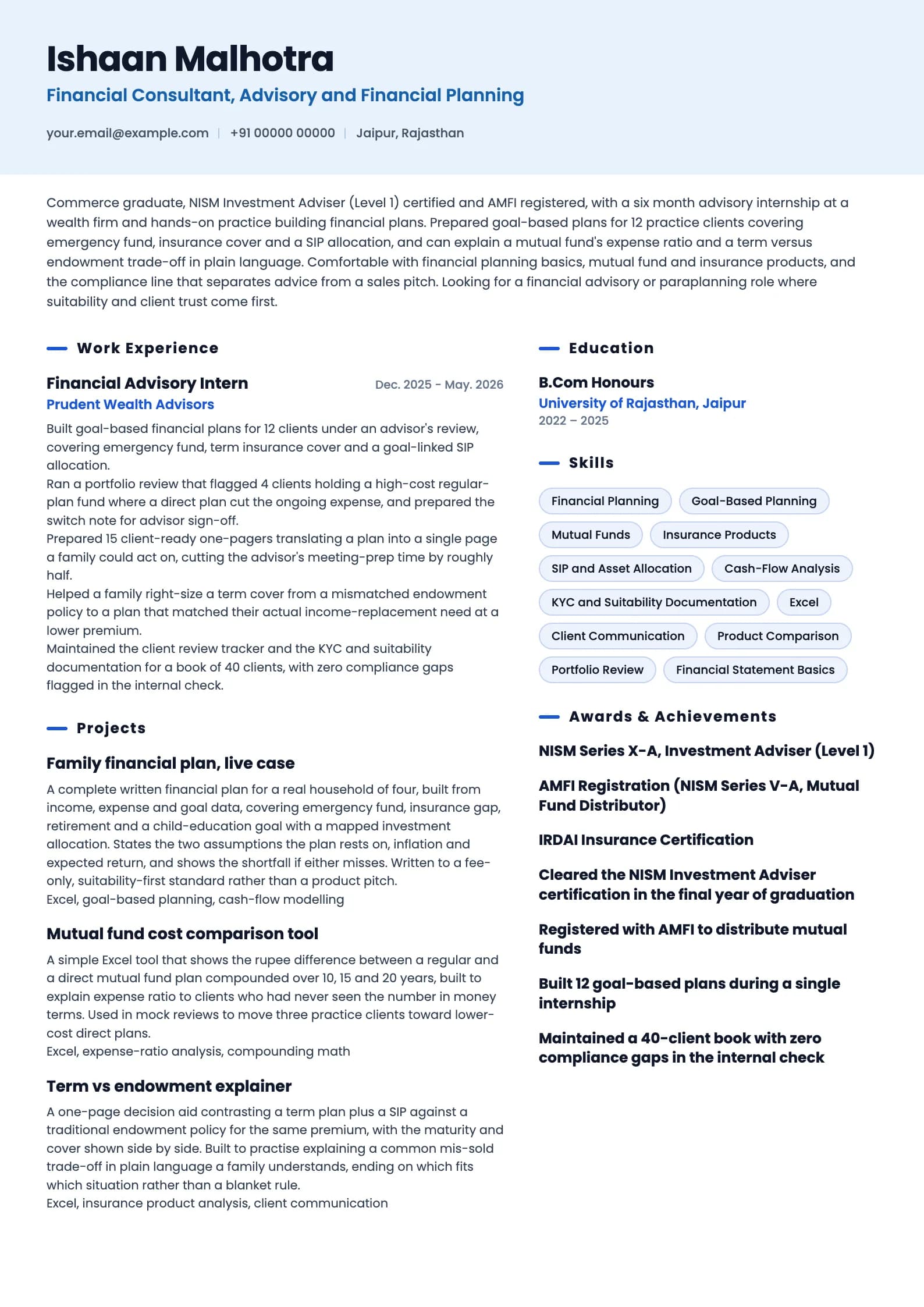
Build my resumeFinancial Consultant resume example, Fresher (0 to 1 year)
ai-era templateIs your resume good enough?
Upload the resume you have now and see what an applicant tracking system reads before a financial consultant recruiter ever does.
Free to run. Sign in with your mobile number to see your score.
Financial Consultant resume example, Mid-level (5 years)
professional template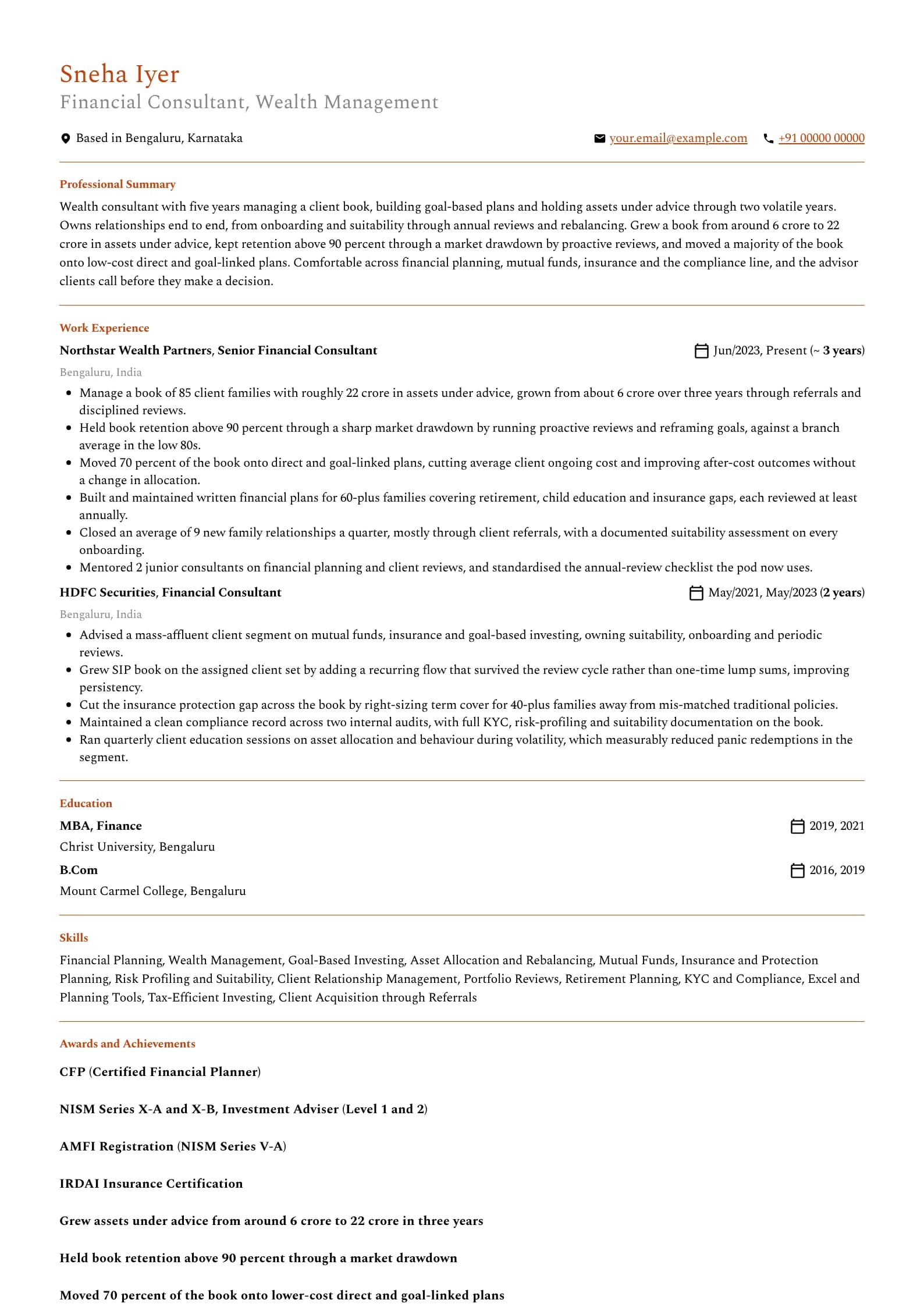
Want this structure with your own details? Build it in the resume builder.
Financial Consultant resume example, Senior (10 years)
header-band template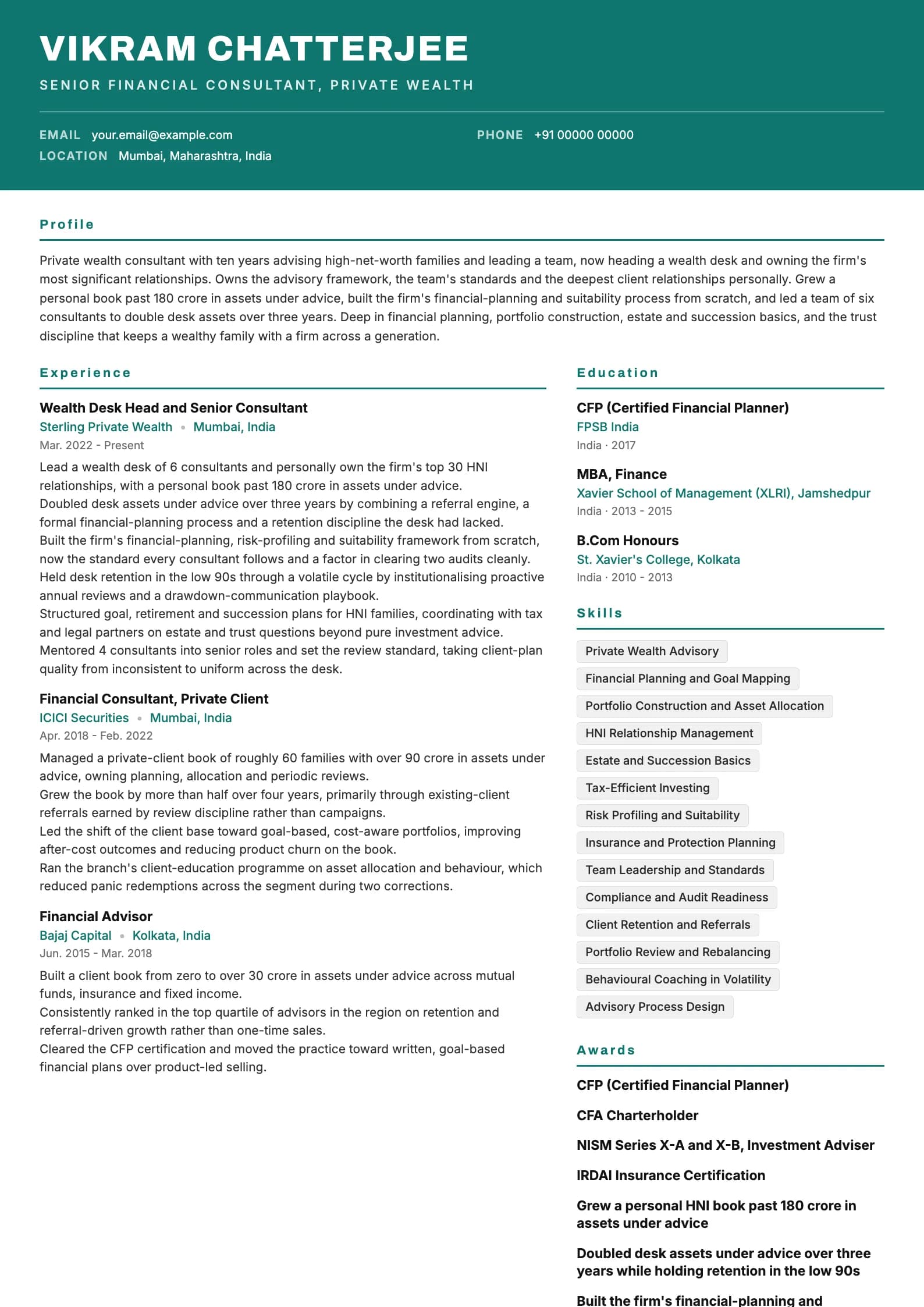
The format that works for financial consultant resumes in India
Reverse chronological is the only layout worth using. Put the most recent role first, work backwards, and let the dates sit in plain view. Functional resumes that group everything under Skills and quietly drop the dates read as an attempt to hide a gap, and hiring firms treat them that way. Advisory is a trust business, and hiding your timeline is the opposite signal. Length is decided by evidence. One page holds everything a fresher and most consultants up to roughly six years have to say. Past that, a second page is fine when it carries a real book, real retention and real relationships rather than a longer product list. A page two built from a declaration paragraph and a hobbies line is a padded one-page resume. Four things belong nowhere on a professional resume here: a photograph, date of birth, marital status and father's name. They survive from an older template that circulated through campus placement cells. Nobody screening a financial consultant is looking for them, and every line they occupy is a line a client outcome or a book number could have used. Send a PDF unless the posting asks for DOCX, and name the file with your own name and the target role rather than resume_final_v4. Use a single column all the way down, because two-column layouts parse unpredictably when a sidebar sits beside the experience. The table below sets out the section order.
| Section | Where it goes | Why |
|---|---|---|
| Name and headline | Top, above everything | The headline is the desk you want, financial consultant, wealth or advisory, and the segment. Recruiters match on it. |
| Professional summary | Directly under the header | Three lines. Domain, years, and the single strongest book or retention result. |
| Work experience | Next, for anyone with a job | Most recent first. Newest role gets the most bullets. |
| Licences and certifications | High for this role, near the top after the summary | NISM, AMFI, IRDAI, CFP. A firm cannot put you in front of clients without the right ones. |
| Projects or plans | Above experience for freshers only | For a fresher a real financial plan is the evidence. Experienced consultants show it inside the book. |
| Skills | Below experience | Grouped: planning, products, relationship, compliance. Not a 40-item wall. |
| Education | Bottom, unless you are a fresher | Degree, institution, years. Keep CGPA only while it is your strongest signal. |
Listing mutual funds is not the same as proving an outcome
The single most common financial consultant resume failure is a skills line that reads mutual funds, insurance, equity, PMS, bonds, fixed deposits, SIP, financial planning, wealth management, with no bullet anywhere that shows any of it producing a client outcome. A parser matches those terms, but a hiring advisor reads the wall and assumes it is a product brochure, then goes looking for the one relationship result you can actually defend. The fix is to let the experience prove the outcome. If you write financial planning on the skills line, at least one bullet should describe a plan a client acted on. If you write retention, a bullet should carry the retention number through a hard period. The mid-level sample lists wealth management and goal-based investing precisely because bullets show a book grown to 22 crore and retention above 90 percent through a drawdown. The skills line and the experience agree, which is what makes both believable. Be specific about the book and the segment. "Manage a book of 85 families with 22 crore under advice" or "advised a mass-affluent segment" tells a reviewer exactly what kind of consultant you are, where "handled clients and investments" tells them nothing. Book size, segment and retention are the three facts a wealth firm screens on first. Do not list every product a distributor can sell as evidence of expertise. A wall of PMS, AIF, structured products, bonds, insurance, real estate and gold reads as a sales sheet, not an advisory practice. Depth in financial planning and suitability beats breadth in product names, because the industry is moving toward advice, not distribution.
For every product and skill on your line, ask: is there a bullet where it produced a plan a client acted on or an outcome you can defend. If not, cut it. A wall of unproven products helps the parser and hurts the interview.
Writing a summary a wealth firm actually reads
The block under your name is the part you can be reasonably sure gets read, so it should carry three facts: who you advise, how long you have been advising them, and the strongest thing that happened because of your work, usually a book number or a retention figure. Three or four lines, no adjectives that cannot be checked. The old objective line, seeking a challenging position in a reputed financial organisation to utilise your skills, tells the reader nothing they did not assume from the application. Replace it with a summary. An objective describes what you want, a summary describes what you have already delivered for clients, and only one is evidence. Freshers often believe they have nothing to summarise. Look at the fresher sample: it names the licences, states the internship length, and points at goal-based plans built for real practice clients with a suitability-first approach. That is a genuine summary built from coursework, one internship and real plans. What it avoids is "passionate about finance and helping people", a phrase so common on graduate resumes it now carries no information. A practical test: read your summary and ask whether another consultant with the same licences could paste it onto their resume unchanged. If they could, it describes the qualification, not you. Add the specific book number, the specific retention figure and the specific segment until it stops being transferable.
Professional summary, mid-level consultant
Weak
Dynamic and result-oriented financial consultant with 5+ years of experience in mutual funds, insurance and wealth management seeking a challenging role in a reputed financial organisation.
Strong
Wealth consultant with five years managing a client book, grown from around 6 crore to 22 crore under advice, with retention held above 90 percent through a market drawdown by proactive reviews and goal-based planning.
The rewrite trades a product list and self-description for a book number, a retention figure and how the retention was actually earned.
Experience bullets: client, action, outcome
Every strong bullet in the samples follows the same shape. It names the client or book, states what you advised or built, and closes with the outcome, a book number, a retention figure, a protection gap closed, a cost reduced. The client establishes scope. The action shows what you actually do. The outcome does the persuading, because advice that changed nothing is not advice. Start with the outcome and work backwards. Consultants usually write the activity first, then struggle to attach a result, which produces bullets like "handled clients and advised them on various investment products". Instead ask what was different for the client or the book after your work: assets grew, retention held, a protection gap closed, cost fell, a goal got funded. Then write the sentence that ends in that fact. Vary the metric. Four book-growth numbers in a row read as one trick repeated. Across a real role you can honestly reach for assets under advice, retention, referral count, protection gap closed, cost reduced, SIP persistency, new relationships and compliance record. The samples use several metric types each, which reads as range. Where an exact number is confidential, give scope or a range: how many families, roughly how much under advice, retention in a band. "Manage a book of 85 families with roughly 22 crore under advice" carries weight without publishing a client's exact figure. Being careful with client numbers is itself a trust signal a wealth firm reads well. Allocate bullets by recency. Current role gets five or six, the previous role four or five, anything older two or three.
| Level | What bullets must prove | Typical metric |
|---|---|---|
| Fresher | You can build a suitable plan and stay on the right side of compliance | Plans built, protection gaps found, cost switches, clean documentation |
| 1 to 3 years | You own a client set and advise without hand-holding | Book size, SIP persistency, retention, suitability record |
| 4 to 6 years | You grow a book and hold it through a hard cycle | Assets under advice, retention through drawdown, referral growth, cost reduction |
| 7 years and up | You own the top relationships and set how the desk advises | HNI book size, desk assets, retention, framework built, consultants mentored |
Experience bullet, wealth consultant
Weak
Handled clients and advised them on various investment products including mutual funds, insurance and other financial instruments.
Strong
Held book retention above 90 percent through a sharp market drawdown by running proactive reviews and reframing goals, against a branch average in the low 80s.
"Handled clients" describes a job description; the rewrite names the outcome, the method and a benchmark to measure it against.
Experience bullet, protection planning
Weak
Sold insurance policies to clients and helped them with their insurance requirements.
Strong
Cut the insurance protection gap across the book by right-sizing term cover for 40-plus families away from mis-matched traditional policies.
"Sold policies" reads as distribution; the rewrite reframes the same work as suitability, which is what an advisory firm values.
If a bullet would read identically on a teammate's resume, it is describing the branch, not you. Rewrite it until it only fits the book you actually advised.
The skills section: grouped, honest, and short enough to defend
A financial consultant's skills section has two audiences with opposite preferences. The parser wants literal terms it can match, financial planning and mutual funds and CFP. A human wants a short, organised list that signals what kind of advisor you are. Grouping satisfies both. Group by function rather than one long line. Planning, products, relationship, and compliance is a grouping that works for almost every financial consultant. The exact headings matter less than the fact that structure exists. Write names the way the industry writes them: SIP not sip, AMFI not amfi, CFP not C.F.P. A parser matches on strings. Twelve to sixteen skills is the working range. Below eight the section looks thin. Above twenty it stops being a signal, and a financial consultant resume is especially prone to product padding: listing every instrument a distributor can sell as if breadth were depth. The list is a contract: every item is a question you have agreed to answer. Do not include a proficiency bar. Star ratings invite an argument you cannot win, and nobody agrees on what four stars in financial planning means. Let the experience and the book prove the depth instead.
| Group | What goes in it | How many |
|---|---|---|
| Planning | Financial planning, goal-based investing, retirement, asset allocation, rebalancing | 3 to 5 |
| Products | Mutual funds, insurance, fixed income, and only what you actually advise on | 2 to 4 |
| Relationship | Client relationship management, retention, referrals, behavioural coaching | 2 to 4 |
| Compliance | KYC, risk profiling, suitability, audit readiness | 2 to 3 |
| Tools | Excel, planning software, CRM | 1 to 3 |
Skills section
Weak
Skills: mutual funds, insurance, equity, PMS, AIF, bonds, FD, NCD, gold, real estate, SIP, ELSS, ULIP, tax planning, financial planning, wealth management, sales, marketing, MS Office, communication
Strong
Planning: financial planning, goal-based investing, asset allocation. Products: mutual funds, insurance, fixed income. Relationship: retention, referrals, behavioural coaching. Compliance: KYC, risk profiling, suitability.
Cuts the product-brochure wall, drops generic sales and MS Office, and groups the rest into what an advisory firm actually screens for.
Plans, cases and projects: what to include and how to describe it
For a fresher, a real financial plan is the resume. A written goal-based plan, a cost comparison a client acted on, a protection-gap case sits above experience, gets the most space, and is where a reviewer decides whether you can actually advise or only recite product features. For an experienced consultant this moves into the book: the plans and outcomes live inside the experience bullets, and a standalone project is kept only if it shows something the client work does not. The common failure is describing the product instead of the advice. "Prepared investment plans for clients using mutual funds and insurance" tells a reviewer nothing, because thousands of resumes carry that line. Describe the goal, what you recommended, the assumptions it rested on, and what the client could do with it. The live family plan in the fresher sample is a stronger entry than a fancier one, because it names the goals, the two assumptions and the shortfall if either misses. Pick cases that show range and judgement rather than three variations of a SIP pitch. One full goal-based plan, one cost or product comparison that changed a decision, and one protection or insurance right-sizing is a stronger set than three product summaries. Two well-argued cases beat five listed by product. Always keep the suitability and compliance line visible. A plan that ignores the client's risk profile or pushes a high-cost product is a red flag to a modern advisory firm, even in a practice case. Showing that you thought about suitability and cost is exactly the judgement the role is hiring for, so make it explicit rather than assumed.
Project description, fresher resume
Weak
Financial Plan: prepared a financial plan for a client recommending mutual funds, insurance and other investment products for their future goals.
Strong
Family financial plan, live case: a written plan for a household of four covering emergency fund, insurance gap, retirement and a child-education goal, stating the inflation and return assumptions and the shortfall if either misses.
Swaps a product-led description for an actual plan with named goals, stated assumptions and an honest shortfall a reviewer can interrogate.
Where education, licences and certifications belong
For most roles education sits at the bottom, but a financial consultant resume is different: the licences and certifications belong high, right after the summary, because a firm literally cannot put you in front of clients without the right ones. Degree, institution and years still go near the bottom for anyone with a job, and near the top for a fresher who has nothing stronger to lead with. The licences come first among credentials. In India, distributing mutual funds needs an AMFI registration through the NISM Series V-A exam, giving investment advice under a registered adviser needs the NISM Investment Adviser certification, and selling insurance needs the IRDAI certification. List exactly which you hold, because a recruiter reads them as a checklist against what the role requires. A consultant who is already licensed can start earning immediately, which is a real advantage. The planning certifications come next. The CFP is the most recognised financial-planning credential in Indian wealth, and the CFA carries weight where the role leans toward investments and portfolio construction. Write the full name, the body and the year or status. Do not overstate: writing CFP when you have only begun the pathway, or CFA when you have cleared one level, is easy to catch and ends the process. CGPA or percentage is worth keeping while you are a fresher and it is good. Once you have a book to point at, drop it. Coursework is for freshers only and only when relevant, such as financial planning, investments, insurance and taxation. Skip school details once you have a degree.
Getting through the applicant tracking system
An applicant tracking system is a parser and a search index, not a judge. It reads your file, tries to break it into name, dates, employers, titles, skills and certifications, and stores the result so a recruiter can search across candidates. Almost every ATS problem is a parsing problem, and parsing problems come from layout, not wording. The layout rules are short. One column. Standard section headings, so use Work Experience rather than My Journey, and Certifications rather than My Credentials. No text inside images, because a logo strip reads as empty space. No critical information in the header or footer region, which some parsers drop. Avoid text boxes and nested tables in the resume body. On wording, mirror the language of the job description where it is honest, and spell out your licences in full so a certification search finds them. Write NISM Investment Adviser, AMFI, IRDAI and CFP as full terms at least once, because recruiters filter hard on licences for this role. Include the expansion alongside an acronym, for example "CFP (Certified Financial Planner)", so both searches match. Keyword stuffing does not work. A hidden block of every product and licence in white text is found quickly, and for a trust-based advisory role the outcome is worse than being filtered. Write real bullets that naturally contain the right terms, because a bullet describing a book grown and retained contains the words wealth, retention and advice in a context that survives human review too. Save as PDF from a tool that embeds real text, then open the file and confirm you can select and copy a sentence. If you cannot select the text, neither can the parser.
Certifications line
Weak
Licensed to sell and various financial certifications completed.
Strong
NISM Investment Adviser (Level 1), AMFI Registered (NISM V-A), IRDAI certified, CFP (Certified Financial Planner).
Vague credential claims fail a certification search; naming each licence in full is exactly what the recruiter's filter looks for.
Test your own file before you send it. Copy the text out of the PDF into a plain text editor. Whatever you can read there is roughly what the parser sees, and any licence that does not appear as plain text is a licence the recruiter's search will miss.
What gets financial consultant resumes rejected
Most rejections at the resume stage are not close calls. They come from a small set of recurring problems, and all of them are fixable in an afternoon. The list below covers what reviewers of Indian financial consultant resumes see most often, in rough order of how much damage each one does.
- A product wall with no bullet showing any of it produced a plan a client acted on or a book that grew. Every item is a question you have agreed to answer.
- No book number or retention figure anywhere, so a firm cannot tell whether you advise 20 families or 200, or keep them or lose them.
- Everything framed as selling rather than advising. "Sold policies" and "achieved targets" read as distribution; the industry screens for suitability and planning.
- Missing or vague licences. NISM, AMFI, IRDAI and CFP are a checklist a recruiter runs, and an unclear credential line fails it.
- Overstated certification status, such as CFP when you are only on the pathway or CFA when you have cleared one level. Verification ends the process.
- Activities copied from the job description instead of client outcomes. "Responsible for handling clients" is the tell.
- A photo, date of birth, marital status or father's name. None of it belongs on a professional resume, and it takes an outcome's space.
- No sign of compliance discipline, when suitability and a clean audit record are exactly what a modern advisory firm is buying.
- A generic objective line. Replace it with a summary that states domain, years and a book or retention result.
- Publishing a specific client's exact holdings or figures, which reads as a confidentiality lapse and worries any firm that would trust you with a book.
Read your resume aloud once before sending it. Any line that sounds like a product pitch rather than a client outcome is a line to reframe around suitability and results.
Skills to put on a financial consultant resume
Technical
- Financial Planning
- Goal-Based Investing
- Asset Allocation and Rebalancing
- Portfolio Construction
- Retirement Planning
- Insurance and Protection Planning
- Risk Profiling and Suitability
- Tax-Efficient Investing
- Cash-Flow and Net-Worth Analysis
- Mutual Fund Analysis
- Estate and Succession Basics
- Product Comparison and Cost Analysis
- KYC and Compliance Documentation
- Client Review and Rebalancing
Tools and platforms
- Excel (advanced)
- Financial Planning Software
- CRM Systems
- Mutual Fund Platforms
- Portfolio Tracking Tools
- Risk-Profiling Questionnaires
- PowerPoint
- Insurance Product Portals
Working skills
- Client relationship building
- Trust and rapport
- Behavioural coaching in volatility
- Clear plain-language explanation
- Referral generation
- Listening and needs discovery
- Ethical and suitability-first advice
- Handling client anxiety
- Team mentoring
Certifications worth listing as a financial consultant
| Certification | Full name | Worth it for |
|---|---|---|
| CFP | Certified Financial Planner (FPSB India) | The most recognised financial-planning credential in Indian wealth management, worth it for any consultant who builds real plans rather than just distributes products. It is a strong differentiator at the mid level and increasingly an expectation at advisory-led firms. Less about investments alone and more about holistic planning, so it fits the advisory track squarely. |
| NISM IA | NISM Series X-A and X-B, Investment Adviser (Level 1 and 2) | The certification required to give investment advice under a registered investment adviser in India, so essential the moment your role crosses from distribution into fee-based advice. List whether you hold Level 1 alone or both. A clean signal for a fresher targeting an advisory desk and a checklist item recruiters filter on hard. |
| AMFI (NISM V-A) | AMFI Registration via NISM Series V-A, Mutual Fund Distributor | The basic licence to distribute mutual funds in India, cleared through the NISM V-A exam. Near-mandatory for any client-facing consultant who recommends funds, and one of the first things a recruiter checks. Cheap and quick to obtain, so a fresher without it looks unprepared for the desk. |
| IRDAI Certification | IRDAI Insurance Certification | The certification to sell and advise on insurance products in India. Worth it for consultants whose role includes protection and insurance planning, which most wealth roles do. Pair it with the framing of suitability rather than selling, since advisory firms value the protection-gap analysis more than the policy count. |
| CFA | Chartered Financial Analyst (CFA Institute) | The strongest investments credential, worth it for consultants whose role leans toward portfolio construction, research-led allocation or a family-office and HNI mandate. It outweighs the CFP where investments dominate and complements it where planning does. List the exact level cleared, since even Level I signals depth to a private-wealth desk. |
| CWM | Chartered Wealth Manager | A wealth-focused credential recognised in Indian private banking and wealth roles, worth it for consultants building an HNI and private-client practice. It signals a wealth specialisation beyond a general planning certificate. Optional if you already hold the CFP or CFA, since those carry broader recognition. |
Keywords an ATS scans for in a financial consultant resume
These are the literal terms a parser matches against the job description. Use the ones that are true of you, in the sentences where you did the work, not as a list at the bottom.
- financial consultant
- financial advisor
- wealth management
- financial planning
- goal-based planning
- mutual funds
- asset allocation
- insurance
- portfolio review
- client relationship management
- assets under advice
- risk profiling
- suitability
- retirement planning
- CFP
- NISM investment adviser
- AMFI
- IRDAI
- KYC
- client retention
Financial Consultant resume FAQ
What salary can a financial consultant expect in India?
A fresher or paraplanner typically starts around 3 to 6 LPA, often with a variable or incentive component tied to the book. A wealth consultant with four to six years and a healthy client book usually earns 8 to 18 LPA in fixed pay, with incentives on top that can materially raise the total. Senior private-wealth consultants and desk heads managing HNI relationships commonly earn 20 to 40 LPA and more, with a large share tied to assets under advice and retention. A CFP or CFA, a portable client book and strong retention push the top of every band upward.
How long should a financial consultant resume be?
One page up to about six years of experience, two pages after that only if the second page carries a real book, real retention and real relationships rather than a longer product list. Nobody has been rejected for a resume that was too easy to read. If you are struggling to fit one page, cut the oldest role to a single line, remove coursework, and delete any product you would not want to be interviewed on.
Which licences and certifications do I actually need?
In India, distributing mutual funds needs an AMFI registration through the NISM Series V-A exam, giving fee-based investment advice needs the NISM Investment Adviser certification, and advising on insurance needs the IRDAI certification. For planning depth, the CFP is the most recognised credential, and the CFA carries weight where the role leans toward investments. List exactly which you hold near the top, because recruiters filter hard on licences for this role and a licensed consultant can start earning immediately.
Should I show my book size and retention numbers?
Yes, because they are the two facts a wealth firm screens on first, but respect confidentiality. Use assets under advice as a rounded figure, retention as a band or percentage, and referral-driven growth as a count. Never publish a specific client's exact holdings, which reads as a confidentiality lapse. "A book of 85 families with roughly 22 crore under advice, retention above 90 percent through a drawdown" is exactly the right level of detail.
How do I make a resume sound advisory and not just sales?
Reframe every product line as a client outcome. "Sold insurance policies" becomes "cut the protection gap by right-sizing term cover for 40-plus families". "Achieved SIP targets" becomes "grew a recurring SIP book that survived the review cycle, improving persistency". Lead with suitability, planning and retention, because the industry and the better firms are moving from distribution toward advice, and the framing signals which side you are on.
Should a fresher put financial plans above work experience?
Yes. With no client book yet, a real written financial plan is the strongest evidence you can offer, so it sits directly under the summary. State the goals, what you recommended, the assumptions it rests on and what the client could do with it, keeping the suitability and cost thinking visible. Pick cases that show range: one full goal-based plan, one cost or product comparison that changed a decision, and one protection right-sizing. An internship still goes in a separate experience section below.
Does an ATS reject resumes with two columns?
It does not reject them outright, but some parsers read multi-column layouts out of order, which interleaves your sidebar with your experience and produces nonsense in the recruiter's view. A single-column layout removes the risk, which is why the samples above use one. Test your own file by copying the text out of the PDF into a plain text editor, and if it reads in order there it will most likely parse correctly.
How do I write a financial consultant resume with no experience?
Lead with your licences and a real plan, then education, then skills. Treat each plan as a job: the goals, what you recommended, what you owned and what the client could act on, keeping suitability visible. A live family plan counts, a cost comparison that moved a practice client counts, a protection right-sizing counts. Add anything checkable, such as the NISM Investment Adviser certification, AMFI registration or a CFP pathway in progress, since verifiable licences carry far more weight than adjectives like dynamic or dedicated.
Do I need a photo on a financial consultant resume in India?
No. Wealth and advisory recruiters do not expect one on the resume, and it takes space a book number or a client outcome should occupy. The same goes for date of birth, marital status, father's name, nationality and a declaration paragraph. These come from an older template that spread through campus placement cells and add nothing to a professional screen. The only exception is a role that explicitly asks for a photograph in the posting.
Related resume examples and guides
Build your own in any of these formats
Start from a blank resume or upload the one you have. Goodspace renders it in 24 templates and flags the financial planning, wealth and licence keywords an applicant tracking system will look for, and the product padding it will not credit.
Build my resume