Investment Banker Resume Format, with 3 Full Samples
An investment banker is hired on evidence of deals closed, models built under pressure and a deal sheet that survives a technical interview, yet most resumes list M&A, DCF, LBO and financial modelling and forget the transactions those skills actually moved. Below are three complete resumes, one for an analyst breaking in from an MBA and an internship, one for an associate with four years across M&A and equity capital markets, and one for a VP who runs live mandates and manages the deal team. After the samples come the format rules, how to build a deal sheet, the difference between listing LBO and proving it, the terms a parser matches literally, and the mistakes that end a screening before a human reads the page.
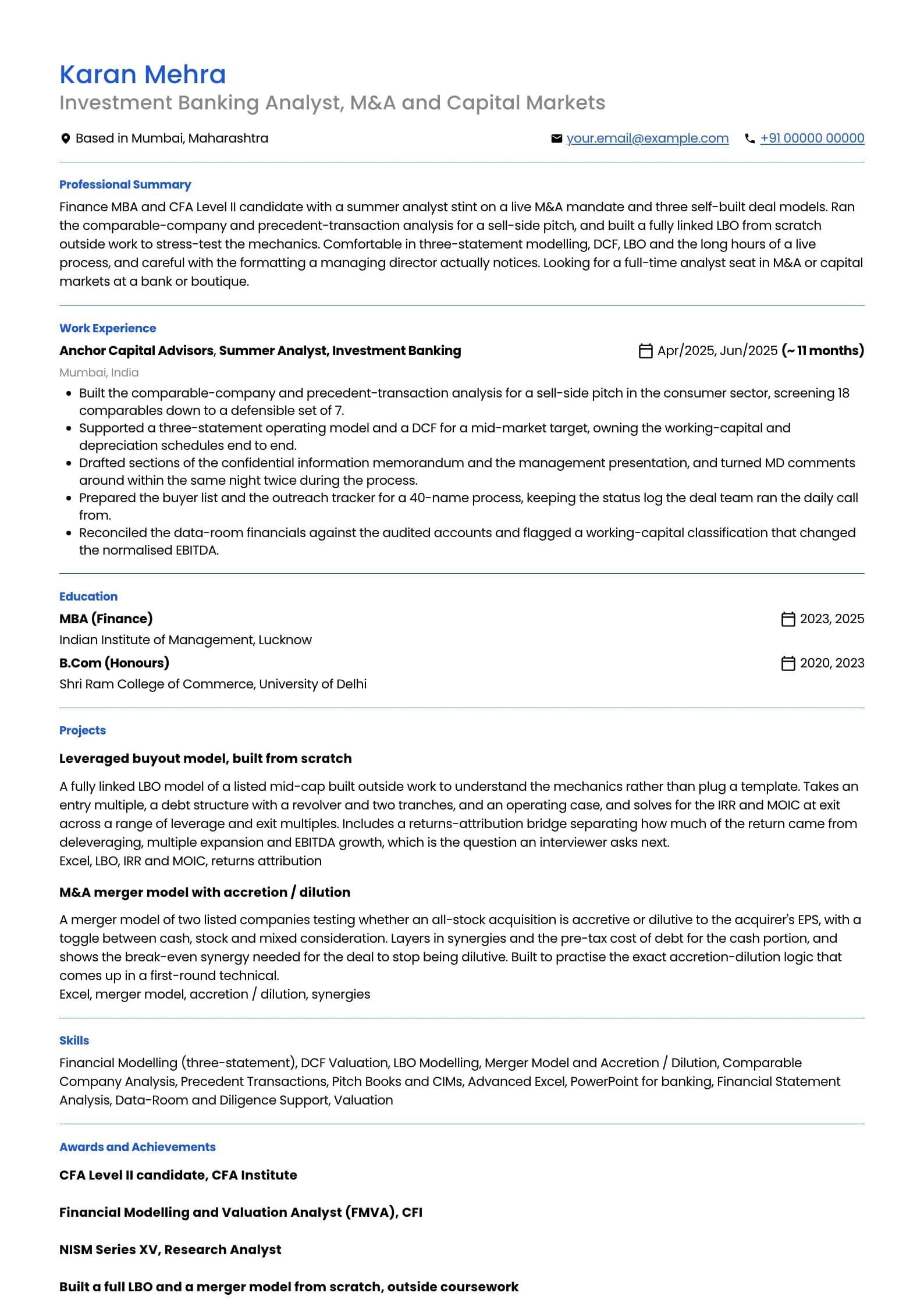
Build my resumeInvestment Banker resume example, Analyst / Entry (0 to 1 year)
minimalist templateIs your resume good enough?
Upload the resume you have now and see what an applicant tracking system reads before a investment banker recruiter ever does.
Free to run. Sign in with your mobile number to see your score.
Investment Banker resume example, Associate (4 years)
modern template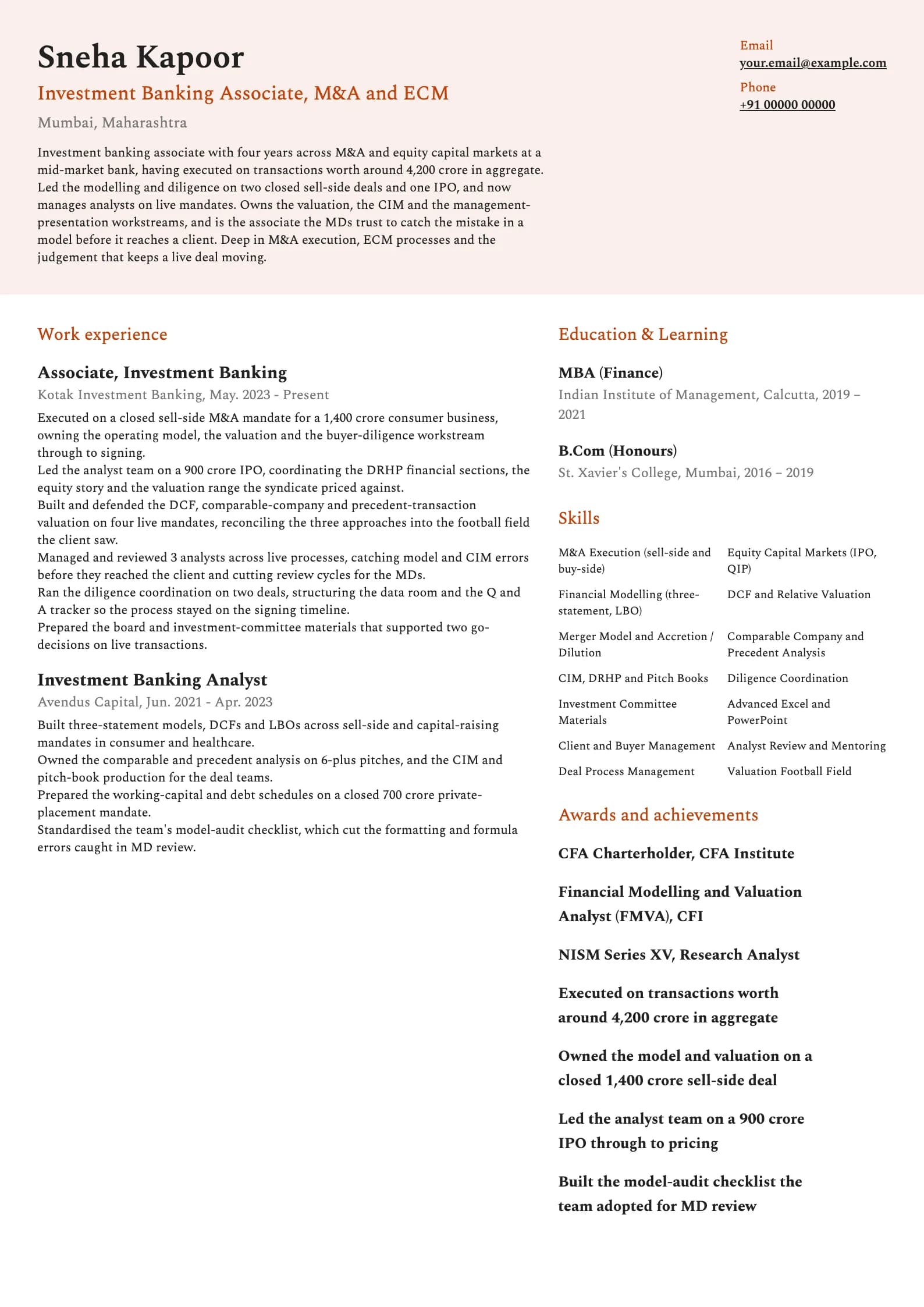
Want this structure with your own details? Build it in the resume builder.
Investment Banker resume example, Vice President (10 years)
header-band template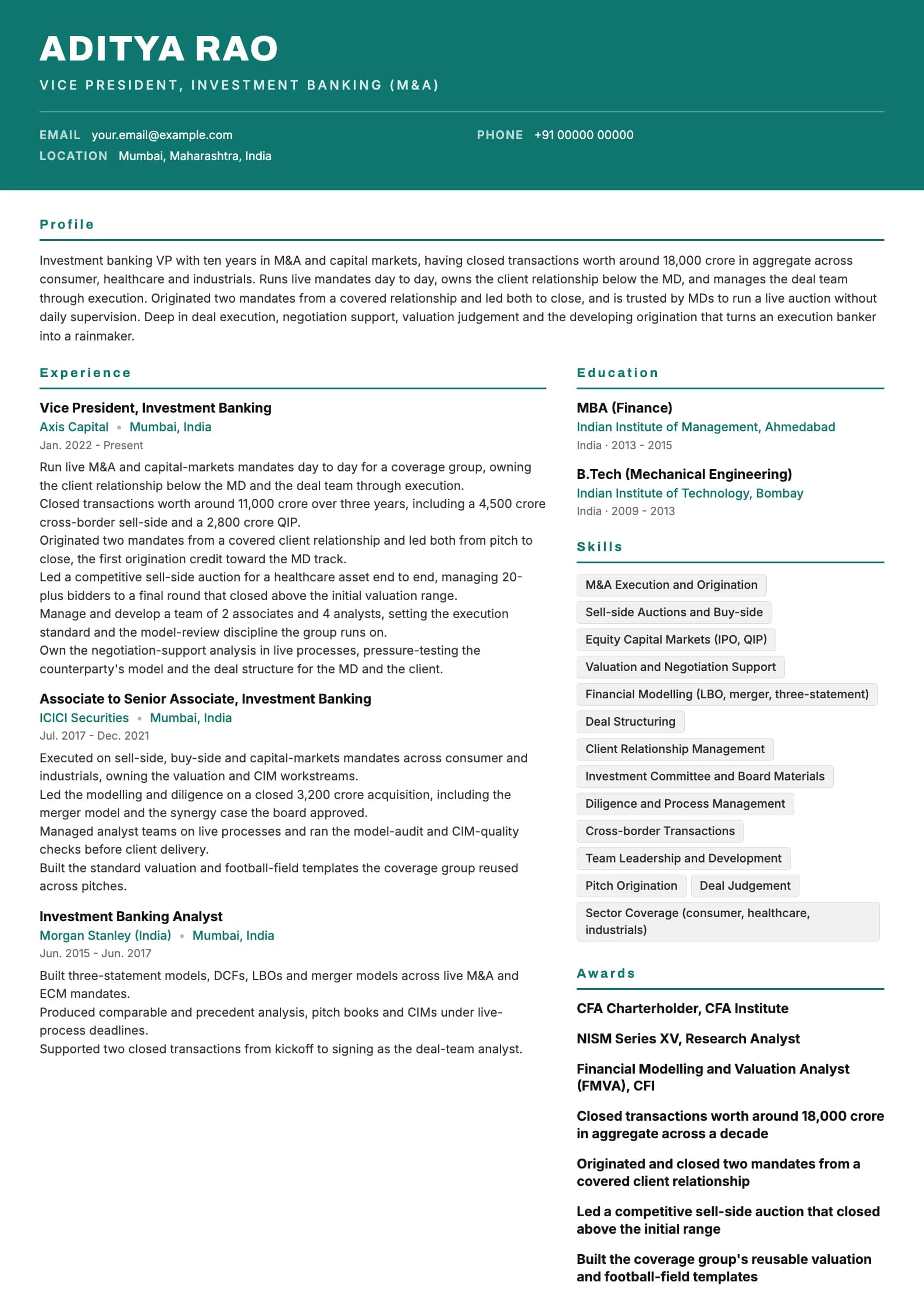
The format that works for investment banking resumes in India
Investment banking screens harder on format than almost any other field, because the resume is itself a work sample: a banker who cannot align a bullet or keep a consistent date format will not be trusted to format a client deck at 3 a.m. Reverse chronological, single column, one page for anyone below VP, and ruthless consistency in fonts, spacing and tense. Put the most recent role first, work backwards, and keep the dates in plain view. One page is close to a rule for analysts and associates. A banking resume that runs to two pages before VP reads as someone who cannot prioritise, which is the opposite of the signal you want. Even at VP, a tight two pages is the ceiling. Length is bought with closed deals and originated mandates, not with a longer list of model types. Four things belong nowhere: a photograph, date of birth, marital status and father's name. They survive from an older campus template, and on a banking resume they read as someone who has not seen a real IB resume. Every line they occupy is a line a deal could have used. The deal experience section is the spine, and for anyone with transactions it doubles as a deal sheet. Lead each bullet or entry with the transaction, its size and your role. Send a PDF, name the file with your own name and the target role, and keep formatting flawless, because in banking the first read is of the layout, not the words. The table below sets out the section order.
| Section | Where it goes | Why |
|---|---|---|
| Name and headline | Top, above everything | Headline names the role and product, for example IB Analyst, M&A. Recruiters match on it. |
| Professional summary | Directly under the header | Two or three lines. Product area, years, and aggregate deal value or the strongest deal. |
| Deal experience | Next, the spine of the resume | Each entry leads with the transaction, its size and your workstream. |
| Deal sheet | Within or just after experience | Named or described transactions, value, your role. The section IB reads first. |
| Skills | Below experience | Grouped: products, modelling, execution. Not a 30-item wall. |
| Education and credential | Near the top for an entrant, lower once executing | MBA, CFA level, degree. Elite programmes carry weight here. |
| Certifications | After education, or beside skills if only one or two | CFA, FMVA, NISM. Name, body, year. |
How to build the deal sheet, the section IB reads first
The deal sheet is the part of a banking resume a reviewer reads before anything else, because it answers the only question that matters at screening: what have you actually worked on. For anyone with transaction experience it is not optional, and getting it right does more than any wording tweak elsewhere on the page. Each deal entry carries four things: what the transaction was, its size, your role, and what you owned. "Sell-side M&A, 1,400 crore consumer business, owned the operating model, valuation and buyer-diligence workstream through to signing" tells a reviewer the deal, the scale and your exact contribution. A vague "worked on various M&A and capital-markets transactions" tells them nothing and reads as someone who watched from the edge. Handle confidentiality without erasing the deal. Where you cannot name the client, describe it: the sector, the deal type and a rounded size, for example "a healthcare asset" or "a 900 crore IPO". Rounding a figure and dropping the name is standard and expected. Inventing a precise value you cannot support is the opposite risk, and a technical interviewer will probe it. Be honest about your role on a deal. On a large team you may have owned one workstream, not the whole transaction, and saying so is more credible than implying you ran it. "Owned the working-capital and debt schedules" is a stronger, safer claim than "led the transaction" when you were the analyst. Interviewers who have staffed those teams know exactly what an analyst owns.
For every deal on your sheet, be ready to walk through the model, the valuation and your specific contribution. A deal you cannot defend in a technical is worse than one you left off, because the follow-up question exposes it.
Writing a summary a managing director actually reads
The block under your name should carry three facts: what product you work in, how long you have done it, and the strongest evidence of scale, usually aggregate deal value or a marquee transaction. Two or three lines, no adjectives a reviewer cannot check. Bankers read fast and skeptically, so the summary earns its place only if every clause is a fact. The old objective line, seeking a challenging role in investment banking to utilise your financial skills, tells the reader nothing and marks you as someone who has not seen a real IB resume. Replace it with a summary built from deals. An objective describes what you want, a summary describes what you have closed, and only one survives a technical screen. Entrants often believe they have nothing to summarise. Look at the analyst sample: it names the MBA and CFA level, a live sell-side internship, and models built from scratch. That is a genuine summary built from one internship and self-directed work. What it avoids is "passionate about finance and dealmaking", a phrase so common on banking-aspirant resumes that it now carries no information at all. A practical test: read your summary and ask whether another analyst from your cohort could paste it onto their resume unchanged. If they could, it describes the programme, not you. Add the specific deal, the specific value and the specific workstream until it stops being transferable.
Professional summary, associate
Weak
Passionate and driven investment banking professional with 4+ years of experience in M&A, valuation and financial modelling seeking a challenging role at a leading bank.
Strong
Investment banking associate with four years across M&A and ECM at a mid-market bank, having executed on transactions worth around 4,200 crore. Led the modelling and diligence on two closed sell-side deals and one IPO, and now manages analysts on live mandates.
The rewrite trades a keyword list and self-description for the product, the aggregate deal value and a concrete execution scope.
Deal bullets: transaction, your workstream, the outcome
Every strong bullet in the samples follows the same shape. It names the transaction and its size, states the workstream you owned, and where possible closes on the outcome, a deal closed, a range beaten, a decision the materials supported. The transaction tells a reviewer the scale. The workstream tells them your real contribution. The outcome does the persuading. Lead with the deal, not the task. Bankers usually write the activity first, which produces bullets like "prepared financial models and pitch books for various transactions". Instead ask which named or described transaction it was, how big it was, and what you specifically owned on it. "Owned the operating model, valuation and buyer-diligence workstream on a closed 1,400 crore sell-side" is a bullet a reviewer can staff you against. Vary what you point to. Every bullet ending in a deal value reads as one number repeated. Across a real track record you can point to deal size, your workstream, the process outcome, the number of bidders managed, the review you owned and, at senior level, origination. The VP sample uses several across its bullets, which reads as range and progression. Where a deal did not close or you cannot cite a value, give scope and role: the workstreams owned, the analysts managed, the processes run. "Managed 3 analysts across live processes and caught model errors before client delivery" carries weight without a rupee figure. And at senior level, origination is the bullet that matters most, because bringing in a mandate is the scarcest thing on a banking resume. Allocate bullets by recency and seniority. Current role gets five or six, the previous role four or five, the earliest analyst role two or three.
| Level | What bullets must prove | Typical signal |
|---|---|---|
| Analyst / entry | You can model and survive a live process | Models built, workstreams owned, MD comments turned, internship deal |
| Analyst (1 to 3 years) | You own a workstream on a live deal | Deal size, model and valuation owned, CIM produced, diligence run |
| Associate (3 to 6 years) | You run execution and manage analysts | Deals closed, aggregate value, analysts managed, deal quality control |
| VP and up | You run mandates and start to originate | Origination, mandates led to close, auctions run, team developed |
Deal bullet, associate
Weak
Prepared financial models, valuations and pitch books for various M&A and capital-markets transactions across sectors.
Strong
Executed on a closed sell-side M&A mandate for a 1,400 crore consumer business, owning the operating model, the valuation and the buyer-diligence workstream through to signing.
Swaps a generic activity list for a named deal type, a size, a specific workstream and the outcome the reviewer can staff you against.
Deal bullet, VP
Weak
Worked on multiple large M&A deals and helped in origination and execution of transactions for clients.
Strong
Originated two mandates from a covered client relationship and led both from pitch to close, the first origination credit toward the MD track.
Names the scarcest banking achievement, origination, and states the outcome and its career meaning instead of a vague helped-with claim.
If a deal bullet would fit any analyst who sat near the process, it is describing the team, not you. Rewrite it until it names the workstream only you owned.
The skills section: products, modelling, and nothing you cannot defend
An investment banker's skills section has two audiences with opposite preferences. The parser wants literal terms it can match, M&A and LBO and DCF. A human wants a short, organised list that signals which products you have actually executed. Grouping satisfies both. Group by function rather than one long line. Products, modelling and valuation, and execution is a grouping that works for almost every banker. The exact headings matter less than the fact that structure exists. Write names the way the industry writes them: M&A not Merger and Acquisition, LBO spelled out at least once, ECM and DRHP expanded on first use. A parser matches on strings. Twelve to sixteen skills is the working range. Below eight the section looks thin. Above twenty it stops being a signal, and a banking resume is especially prone to listing every valuation method and every deal type as separate items to pad. The list is a contract you will be tested on line by line in a technical, so a method you cannot walk through end to end costs you the interview, not just the screen. Do not include a proficiency bar. Star ratings on an IB resume read as junior, and nobody agrees on what four stars in LBO modelling means. The technical interview is the proficiency test; let the deal sheet and the models prove the depth.
| Group | What goes in it | How many |
|---|---|---|
| Products | M&A sell-side and buy-side, ECM (IPO, QIP), private placement | 3 to 5 |
| Modelling and valuation | Three-statement, DCF, LBO, merger model, comparables, precedents | 4 to 6 |
| Execution | CIM, DRHP, pitch books, diligence, process management | 3 to 5 |
| Deal support | Accretion / dilution, synergy analysis, negotiation support | 2 to 3 |
| Senior only | Origination, client management, deal structuring, team leadership | 2 to 4 |
Skills section
Weak
Skills: Finance, M&A, Mergers, Acquisitions, Valuation, DCF, LBO, Modelling, Excel, PowerPoint, Word, Bloomberg, Capital IQ, Accounting, Analysis, Research, Communication, Teamwork, Leadership, Multitasking
Strong
Products: M&A (sell-side, buy-side), ECM (IPO, QIP). Modelling: three-statement, DCF, LBO, merger model. Valuation: comparables, precedent transactions. Execution: CIM, DRHP, diligence, process management.
Cuts the office-software and soft-skill filler, keeps the products and models you can defend in a technical, and groups the rest so a reviewer reads it in one pass.
Models and case work: what to include and how to describe it
For someone breaking in, self-built models are the resume alongside the internship, and they matter more here than in almost any other finance role, because banking tests modelling directly in the first round. They sit above or alongside the internship, get real space, and are where a reviewer decides whether you can build an LBO or only name one. For an executing banker with a deal sheet, they drop away entirely; the deals are the evidence. The common failure is naming the model type instead of what you built into it. "An LBO model made in Excel" tells a reviewer nothing, because every aspirant lists it. Describe the structure and the hard part: the debt tranches, the returns attribution, the accretion-dilution break-even. The LBO in the analyst sample is a stronger entry than a longer list, because it names the returns-attribution bridge, which is exactly the follow-up an interviewer asks. Pick models that show range rather than three DCFs. One LBO with a real capital structure, one merger model with accretion-dilution, and a three-statement model or a valuation football field is a stronger set than three variations of the same thing. Two well-described models beat five listed by name. Build them to be opened. An interviewer may ask you to screen-share the file and change a driver live, so a model with hard-coded outputs or a broken circularity is worse than no model at all. If you list it, you own every cell in it, because in banking the model is not a claim, it is a test you have volunteered for.
Model description, entrant resume
Weak
LBO Model: built a leveraged buyout model in Excel to calculate returns for a company as part of a modelling course.
Strong
LBO model of a listed mid-cap built from scratch, with a revolver and two debt tranches, solving for IRR and MOIC across leverage and exit multiples, and a returns-attribution bridge separating deleveraging, multiple expansion and EBITDA growth.
Swaps a model-type label for the capital structure and the returns attribution an interviewer will ask you to defend.
Where the MBA, CFA and certifications belong
Pedigree is screened hard in Indian investment banking, so the education line does real work. An MBA from a top programme, a strong undergraduate institution, and a CFA level belong high on an entrant's resume and in the header line, because at the analyst stage they are much of what a bank has to go on. Name the programme and the institution plainly. Education sits near the top for an entrant and drops lower once you have a deal sheet. Degree, institution, years. Keep the CGPA while you are breaking in and it is strong, roughly 8 out of 10 and above, because banking screens on it early. Once you have closed transactions to point at, the academic number matters far less than the deals. Certifications sit just below education, or beside skills if you hold only one or two. Write the full name, the issuing body and the year. For a banker, the CFA carries the most weight and pairs naturally with the work, the FMVA is a practical modelling signal useful for entrants, and the NISM Research Analyst certification is a common India-specific marker. State a CFA level honestly, because a technical interviewer will assume you can answer at the level you claim, and implying the charter when you hold one level is easy to expose.
Getting through the applicant tracking system
An applicant tracking system is a parser and a search index, not a judge. It reads your file, tries to break it into name, dates, employers, titles and skills, and stores the result so a recruiter can search across candidates. Almost every ATS problem is a parsing problem, and parsing problems come from layout, not wording. Banking resumes are usually clean single-column pages already, which helps, but the rules still apply. The layout rules are short. One column. Standard section headings, so use Work Experience or Deal Experience rather than My Journey, and Skills rather than My Toolkit. No text inside images. No critical information in the header or footer region, which some parsers drop. Avoid text boxes and nested tables in the resume body. On wording, mirror the language of the posting where it is honest. If it says M&A, write M&A. If it says leveraged buyout, include LBO and the expansion at least once, for example "LBO (leveraged buyout)". Bank recruiters search on product and model terms, so the deal sheet naturally carries them if it is written properly. Keyword stuffing does not work and is beneath the standard of a banking resume anyway. A hidden block of deal types in white text is found quickly and reads as desperate. Write a real deal sheet that naturally contains M&A, DCF, LBO and ECM in context, because a bullet describing a sell-side auction carries the term where a human read survives too. Save as PDF from a tool that embeds real text, then open the file and confirm you can select and copy a sentence. If you cannot select the text, neither can the parser.
Section heading
Weak
My Dealmaking Journey
Strong
Deal Experience
Parsers look for standard headings, and a banking reviewer expects Deal Experience; a creative heading reads as junior and can push the block into an unclassified bucket.
Test your own file before you send it. Copy the text out of the PDF into a plain text editor. Whatever you can read there is roughly what the parser sees, and a banking resume that scrambles is doubly damaging because the layout was supposed to be your strong suit.
What gets investment banking resumes rejected
Most rejections at the resume stage are not close calls. In banking they come from a small set of recurring problems, several of them specific to the field, and all of them are fixable in an afternoon. The list below covers what reviewers of Indian investment banking resumes see most often, in rough order of how much damage each one does.
- A deal you cannot defend in a technical. Every transaction and model on the page is a question you have agreed to answer live.
- Vague deal bullets that hide your role. "Worked on various transactions" reads as someone who sat near the process, not in it.
- Inconsistent formatting, misaligned bullets or mixed date formats. On a banking resume the layout is the first work sample, and sloppiness ends it.
- A resume longer than one page below VP. It reads as an inability to prioritise, the opposite of the required signal.
- Overstating your contribution, claiming to have led a deal you supported as an analyst. Interviewers who have staffed those teams see it instantly.
- A photo, date of birth, marital status or father's name, which mark you as someone who has never seen a real IB resume.
- A generic objective line. Replace it with a summary built from deals and aggregate value.
- Precise deal figures you cannot support, where rounding and describing the deal would have been both safer and expected.
- Overstating a CFA level or implying the charter, which a technical interviewer exposes by asking at the claimed level.
- Listing every model type as a skill with no deal or built model behind it, which the first technical question unravels.
Before you send it, assume the interviewer will point at any line on the page and say "walk me through this". Any deal, model or claim you would not want that question on is a line to fix or cut.
Skills to put on a investment banker resume
Technical
- M&A Execution (sell-side and buy-side)
- Equity Capital Markets (IPO, QIP)
- Financial Modelling (three-statement)
- LBO Modelling
- Merger Model and Accretion / Dilution
- DCF Valuation
- Comparable Company Analysis
- Precedent Transaction Analysis
- Valuation Football Field
- Synergy and Deal-Structure Analysis
- Financial Statement Analysis
- Diligence and Data-Room Management
- Negotiation Support
- Deal Origination
Tools and platforms
- Advanced Excel
- PowerPoint for banking
- Bloomberg Terminal
- Capital IQ
- FactSet
- Refinitiv Eikon
- PitchBook
- VBA (macros)
Working skills
- Working under live-deal pressure
- Attention to detail
- Client and buyer management
- Managing and reviewing analysts
- Prioritisation across mandates
- Written and deck communication
- Judgement on live processes
- Stamina and reliability
Certifications worth listing as a investment banker
| Certification | Full name | Worth it for |
|---|---|---|
| CFA | Chartered Financial Analyst, CFA Institute | The credential most aligned with investment banking in India, valued for valuation and technical depth. Worth it across the analyst-to-VP path, and a common signal on entrant resumes to offset a thinner deal sheet. State the exact level honestly while a candidate; the charter carries weight, though closed deals outrank it once you have them. |
| MBA Finance | Master of Business Administration, Finance (top programme) | The dominant entry route into Indian investment banking, and heavily screened at the analyst stage where pedigree carries much of the weight. Most valuable from an elite programme with a strong finance placement record. Belongs high on an entrant resume and in the header line. |
| FMVA | Financial Modelling and Valuation Analyst, Corporate Finance Institute | A practical, hands-on modelling credential, most useful for someone breaking in who needs to prove LBO and merger-model skill before they have a deal sheet. A structured way to learn the exact models banking tests in the first round. It supplements, and does not replace, the CFA or an elite MBA. |
| NISM Series XV | NISM Research Analyst Certification | The India-specific regulatory certification for research and analysis roles, and a common marker on banking and research resumes here. Quick to earn and expected for some sell-side and research-adjacent seats. Worth listing as a clean India credential; it is a baseline marker rather than a differentiator. |
| CA | Chartered Accountant, ICAI | A strong alternative or complement to the MBA route into Indian banking, valued for accounting depth in M&A and diligence work. Worth naming prominently for CA-route bankers, since it signals rigour on the financials. Often paired with modelling skills to compete with MBA entrants on the technical side. |
Keywords an ATS scans for in a investment banker resume
These are the literal terms a parser matches against the job description. Use the ones that are true of you, in the sentences where you did the work, not as a list at the bottom.
- investment banker
- investment banking
- M&A
- mergers and acquisitions
- equity capital markets
- ECM
- financial modelling
- DCF
- LBO
- leveraged buyout
- merger model
- valuation
- comparable company analysis
- precedent transactions
- pitch book
- CIM
- due diligence
- IPO
- deal execution
- accretion dilution
Investment Banker resume FAQ
What salary can an investment banker expect in India?
An analyst at a bulge-bracket or a strong domestic bank typically starts around 15 to 30 LPA including bonus, with boutiques and mid-market banks lower. An associate with four to six years commonly sits in the 35 to 70 LPA range, heavily bonus-weighted. VPs earn upward of 80 LPA to well over 1 crore in a good year, with the bonus tied to deal flow and origination. Base pay is only part of the picture in banking; the bonus, driven by the fee pool and your deals, moves total compensation the most.
How long should an investment banking resume be?
One page for analysts and associates, without exception in most banks, and a tight two pages at most for VP and above. Banking treats a long resume as an inability to prioritise, which is a real job skill here. If you are struggling to fit one page, cut the oldest role to a line, remove non-deal detail, and let the deal sheet and aggregate value carry the weight rather than a longer list of model types.
What is a deal sheet and do I need one?
A deal sheet is the list of transactions you have worked on, each with the deal type, a rounded size, your role and what you owned. For anyone with transaction experience it is the section a banking reviewer reads first, so yes, you need one. Where you cannot name a client, describe it by sector and rounded value, which is standard. Be ready to walk through any deal on it in a technical, because a transaction you cannot defend is worse than one you left off.
How do I break into IB with no full-time banking experience?
Lead with a top MBA or CFA level, any internship on a live process, and self-built models that prove you can do the technical. An LBO and a merger model built from scratch, described by their structure rather than named, are strong evidence for an entrant. Add a case-competition result or a research project. The first round is a modelling and technical test, so the resume's job is to convince a reviewer you will pass it.
Which keywords matter for an investment banking ATS?
Mirror the posting where it is honest. Common literal terms recruiters search for include investment banking, M&A, ECM, financial modelling, DCF, LBO, merger model, valuation, comparable company analysis, precedent transactions, CIM, due diligence and IPO. Write them inside a real deal sheet and real bullets, because a bullet describing a sell-side auction carries the terms in context. Expand acronyms once, for example LBO and ECM, so both searches find you.
Should I name the clients and deals I worked on?
Name them only where the information is public or you are permitted to. Where it is confidential, describe the deal by sector, type and a rounded size, for example a 900 crore IPO or a healthcare sell-side, which is expected and fully credible. Rounding a figure and dropping the name is normal; inventing a precise value you cannot support is the risk, because a technical interviewer will probe it. Honesty about your specific role on the deal matters as much as the deal itself.
Does the ATS or a two-column layout hurt a banking resume?
A two-column layout can be read out of order by some parsers, and it also reads as non-standard to a banking reviewer who expects a clean single column. Since banking screens hard on formatting, the single-column page is doubly correct here: it parses reliably and it signals you know what an IB resume looks like. Test your own file by copying the text out of the PDF into a plain text editor, and if it reads in order there it will most likely parse correctly.
Do I need a photo on an investment banking resume in India?
No, and including one marks you as someone who has not seen a real IB resume. The same goes for date of birth, marital status, father's name, nationality and a declaration paragraph. Banking resumes are lean and deal-focused by convention, and every non-deal line is space a transaction could have used. Let the deal sheet, the models, the MBA or CFA, and clean formatting carry the page.
Related resume examples and guides
Build your own in any of these formats
Start from a blank resume or upload the one you have. Goodspace renders it in 24 templates and flags the M&A and modelling keywords an applicant tracking system will look for, and the filler a managing director will not credit.
Build my resume