Credit Analyst Resume Format, with 3 Full Samples
A credit analyst is hired on the quality of the calls they make, how fast they make them and how the book performs afterwards, yet most resumes describe the analysis process and never show whether the loans they cleared were repaid. Below are three complete resumes, one for a commerce graduate stepping into a credit role, one for a mid-level analyst underwriting a retail and SME book, and one for a senior analyst owning credit policy and a portfolio at scale. After the samples come the format rules, the difference between naming ratio analysis and proving your judgement held, the terms a lending parser matches literally, and the mistakes that end a screening before a credit head sees the page.
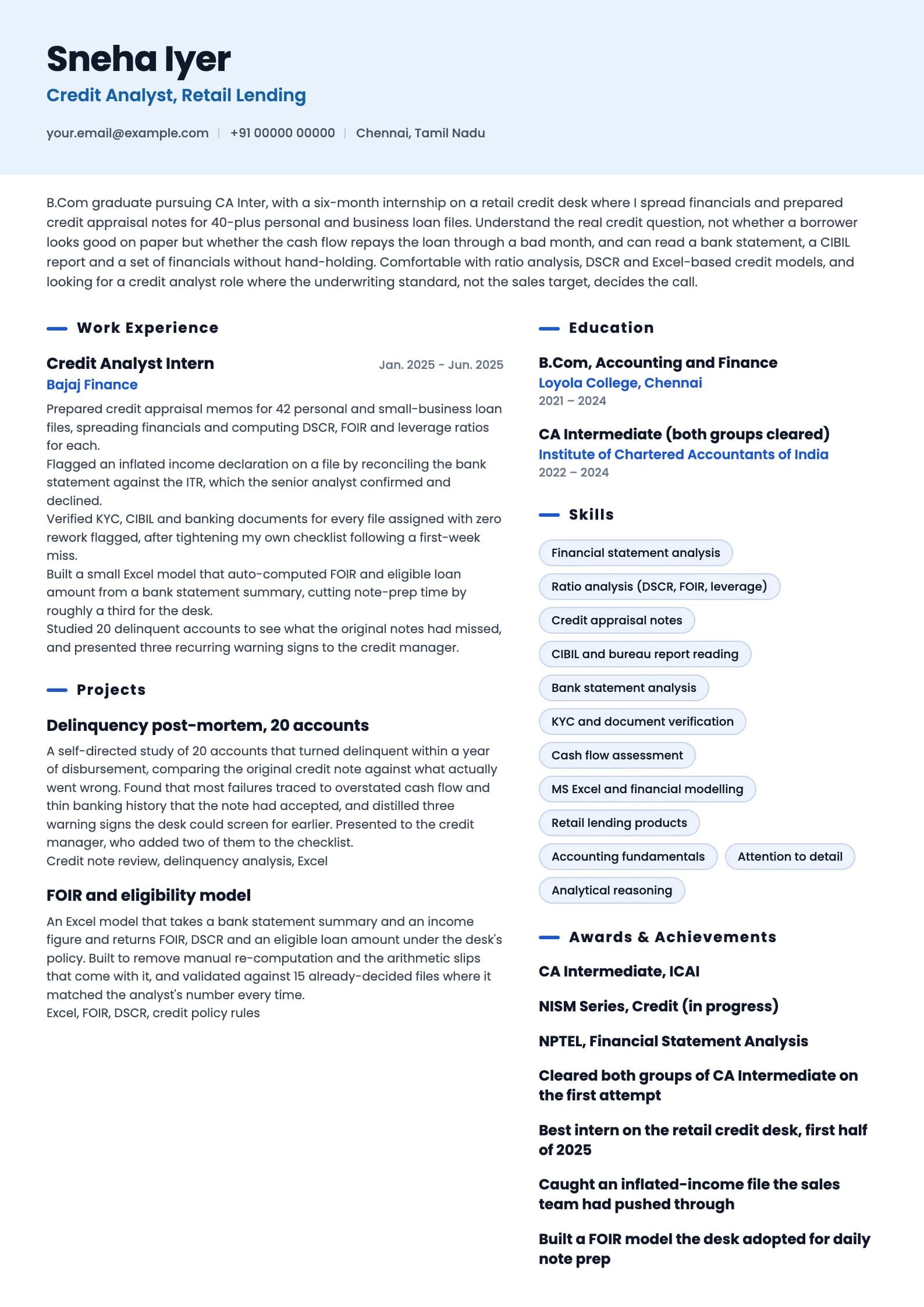
Build my resumeCredit Analyst resume example, Fresher (0 years)
ai-era templateIs your resume good enough?
Upload the resume you have now and see what an applicant tracking system reads before a credit analyst recruiter ever does.
Free to run. Sign in with your mobile number to see your score.
Credit Analyst resume example, Mid-level (5 years)
professional template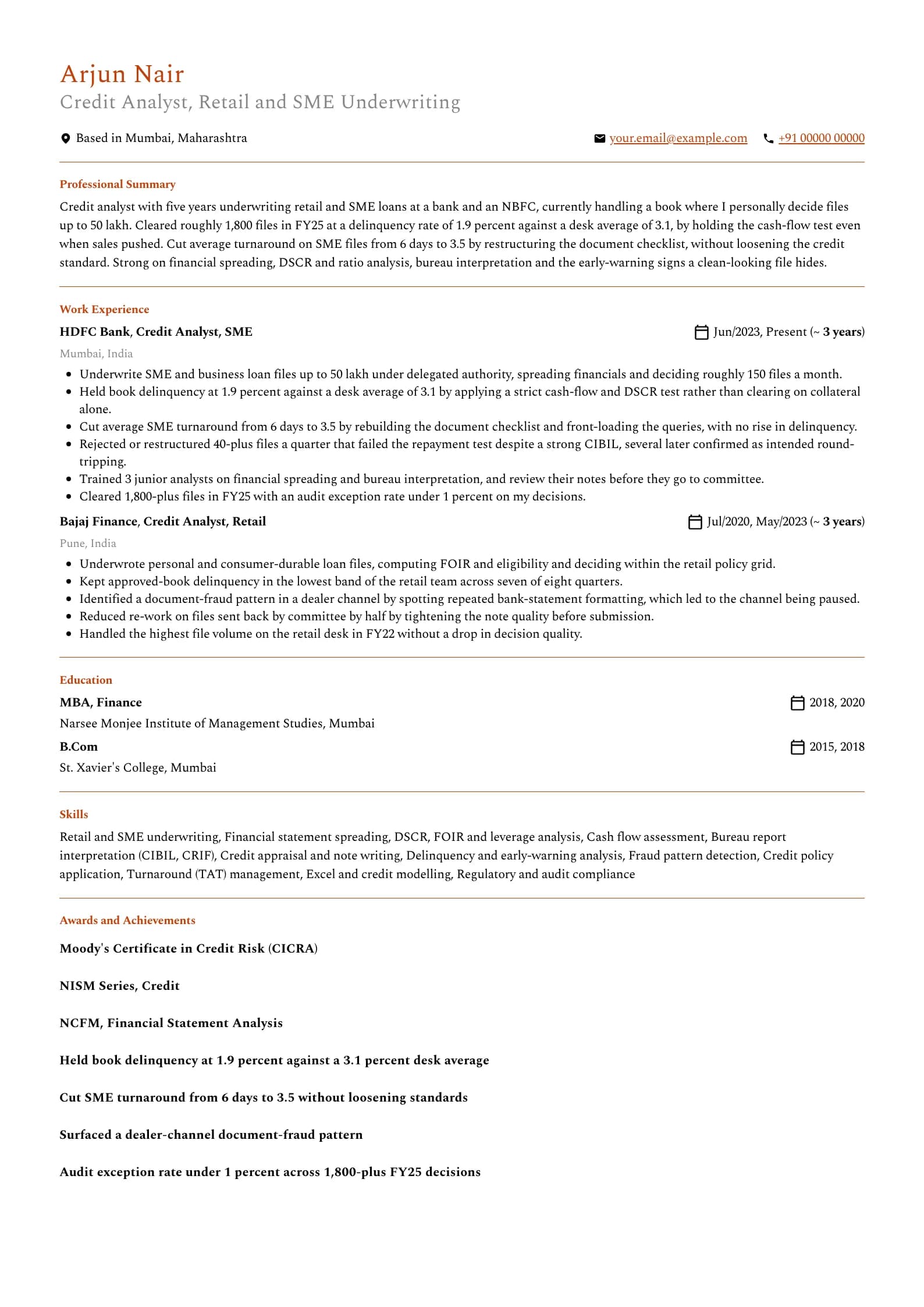
Want this structure with your own details? Build it in the resume builder.
Credit Analyst resume example, Senior (11 years)
minimalist template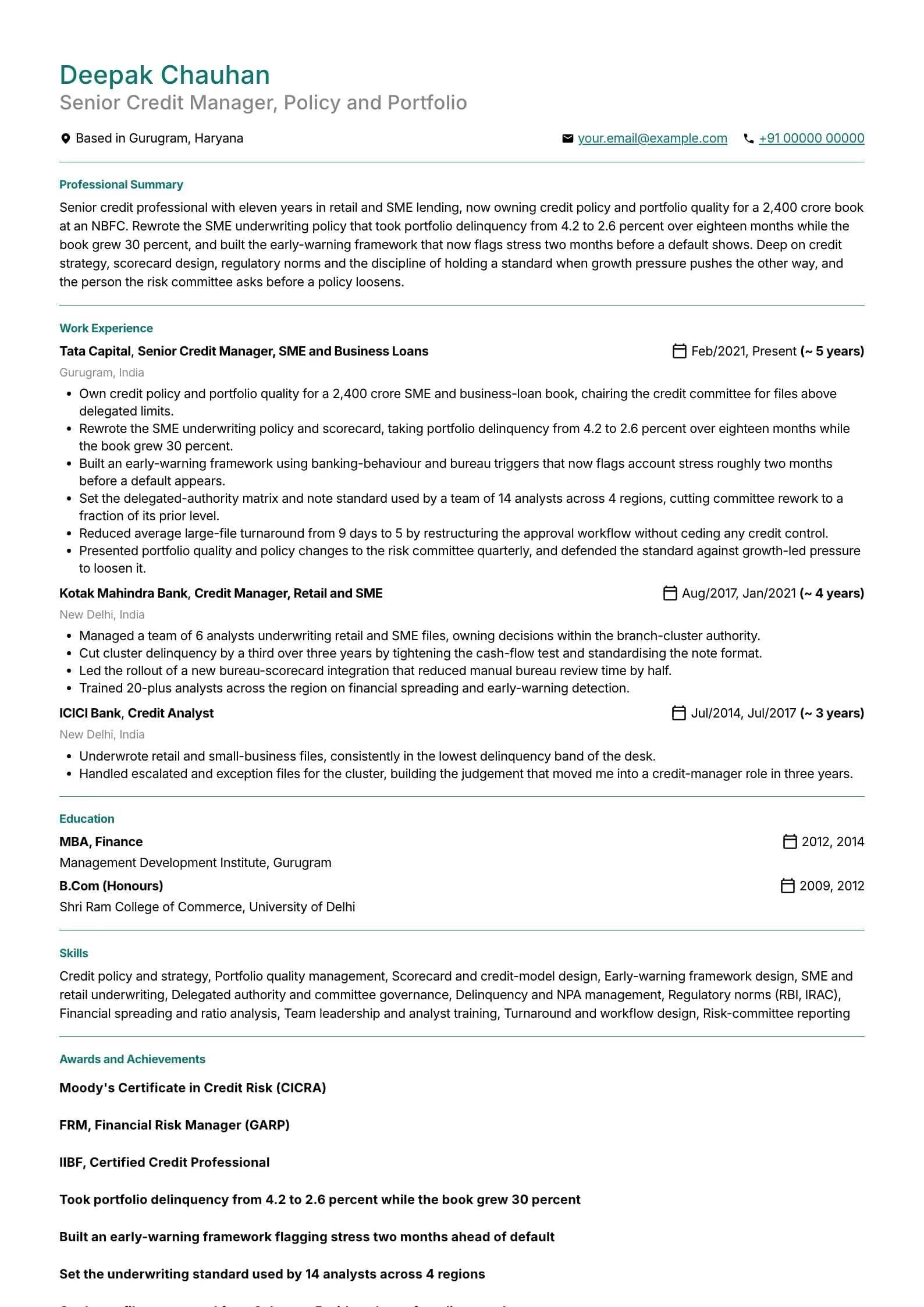
The format that works for credit analyst resumes in India
Reverse chronological is the layout to use. Put the most recent role first, work backwards, and keep the dates in plain view. A functional resume that groups everything under Skills and drops the dates reads to a credit head as an attempt to hide a gap or a short stint, and lending hiring is careful about stability because a credit judgement compounds over time. A short, honest line about a gap beats a hidden one. Length is decided by evidence. One page holds everything a fresher and most analysts up to roughly six years have to say. A senior credit manager can run to a second page, but only if that page carries portfolio and policy numbers rather than a longer software list. A page two built from a declaration and a hobbies line is a padded one-pager. Four things belong nowhere on a professional credit resume: a photograph, date of birth, marital status and father's name. They survive from an older campus template and add nothing to a decision that turns on your book quality and your judgement. Every line they take is a line a delinquency figure or a policy result could have used. Send a PDF unless the posting asks for DOCX, and name the file with your own name and the target role rather than resume_final_v4. Use a single column all the way down, because two-column layouts parse unpredictably when a sidebar sits beside the experience. The table below sets out the section order.
| Section | Where it goes | Why |
|---|---|---|
| Name and headline | Top, above everything | The headline is the role and segment, retail or SME credit analyst. Recruiters and parsers match on it. |
| Professional summary | Directly under the header | Three lines. Book or file volume, years, and the single strongest result, usually delinquency. |
| Work experience | Next, for anyone with a job | Most recent first. Lead each role with authority and volume, then the quality numbers. |
| Key achievements | After experience, or beside the summary | Three or four quantified wins: delinquency, TAT, exception rate, fraud caught. |
| Skills | Below experience | Grouped: analysis, tools, products, compliance. Not a 30-item wall. |
| Certifications | After skills | CA, FRM, Moody's credit, IIBF. Accounting and risk credentials earn their place. |
| Education | Bottom, unless you are a fresher | MBA or B.Com, years. Keep CA status visible; drop the percentage after your first job. |
Naming ratio analysis is not the same as proving your calls held
The most common credit resume failure is a line that reads financial analysis, ratio analysis, DSCR, FOIR, CIBIL, credit appraisal, underwriting, risk assessment with no bullet anywhere that shows whether the loans you cleared were repaid. A parser matches those terms, but a credit head reads the wall and assumes it is a process description, then looks for the one quality number that proves your judgement. The fix is to let the experience prove the calls. The output of a credit analyst is not a note; it is a book that performs. So a strong resume carries the number that shows performance: delinquency rate against a benchmark, audit exception rate, files rejected that later proved right, a fraud pattern caught. The mid-level sample lists underwriting precisely because a bullet shows delinquency of 1.9 percent against a 3.1 desk average. The skills and the outcome agree, which is what makes both believable. Show that you say no. Volume of files cleared proves you are fast; files you rejected or restructured because the repayment did not hold proves you underwrite risk. A resume that only ever approves reads as a rubber stamp, which is the opposite of what a credit desk hires for. Be specific about the segment and the authority. Retail unsecured, SME secured and corporate credit are different jobs with different tools, and delegated authority up to a rupee limit tells a recruiter exactly how much a bank already trusts your judgement.
The output of a credit analyst is a book that repays, not a note that reads well. For every analysis skill you list, ask whether a quality number, a delinquency figure or a rejected file, proves your judgement behind it.
Writing a summary a credit head actually reads
The block under your name is the part you can be reasonably sure gets read, so it should carry three facts: what you underwrite and at what authority, how long you have done it, and the strongest quality number your book produced. Three or four lines, no adjectives a credit head cannot check. The old objective line, a detail-oriented finance professional seeking a challenging role in credit and risk in a reputed organisation, tells the reader nothing they did not already assume. Replace it with a summary. An objective says what you want; a summary says how your book performed, and only one is evidence. Freshers often think they have no book to summarise. Look at the fresher sample: it names the internship, the 42 files spread, and the instinct to test cash flow over paperwork. That is a genuine summary built from one internship and a grasp of what credit actually asks. What it avoids is hardworking and passionate about finance, a phrase so common on graduate resumes it now carries no information. A practical test: read your summary and ask whether a teammate on the same desk could paste it onto their resume unchanged. If they could, it describes the desk, not you. Add the specific authority, the specific delinquency number and the specific segment until it stops being transferable.
Professional summary, mid-level analyst
Weak
Detail-oriented and analytical credit professional with 5+ years of experience in credit analysis, underwriting and risk assessment, seeking a challenging role in a reputed bank or NBFC.
Strong
Credit analyst with five years underwriting SME files up to 50 lakh, deciding about 150 files a month. Held book delinquency at 1.9 percent against a 3.1 desk average and cut SME turnaround from 6 days to 3.5.
The rewrite trades self-description for the authority you hold, the volume you decide, and the two quality numbers that prove your judgement.
Experience bullets: verb, decision, quality
Every strong bullet in the samples follows the same shape. It opens with an action verb, names the credit decision or the change you made, and closes with the quality that resulted. The verb says you did it. The decision tells a credit head the scope. The quality number does the persuading. Start with the outcome and work backwards. Analysts usually write the activity first, then struggle to attach a number, which produces bullets like analysed financial statements and prepared credit appraisal notes. Instead ask what the book did afterwards: delinquency fell, an exception rate held low, a fraud pattern surfaced, a turnaround dropped without quality slipping. Then write the sentence that ends in that fact. Vary the metric. Six delinquency lines in a row read as one trick repeated. Across a real credit role you can honestly reach for delinquency, audit exception rate, turnaround, file volume, files rejected, NPA movement and portfolio growth held at quality. The mid-level sample uses several types across its bullets, which reads as range. Where you lack a clean quality number, give scope: what authority, what segment, what volume, what book size. Deciding files up to 50 lakh at 150 a month carries weight without inventing a percentage. Allocate bullets by recency. Current role gets five or six, the previous role four or five, anything older two or three.
| Level | What bullets must prove | Typical metric |
|---|---|---|
| Fresher | You can spread financials and think about repayment | Files prepared, ratios computed, a bad file caught, TAT saved |
| 1 to 3 years | You can decide files within a policy grid | File volume, FOIR/DSCR discipline, delinquency band, rework cut |
| 4 to 7 years | You underwrite under authority and your book performs | Delinquency vs benchmark, TAT, exception rate, files rejected |
| 8 years and up | You own policy and portfolio quality at scale | Portfolio delinquency, NPA movement, scorecard, standards set |
Experience bullet, SME underwriting
Weak
Responsible for analysing financial statements and preparing credit appraisal notes for loan proposals as per bank policy.
Strong
Held book delinquency at 1.9 percent against a desk average of 3.1 by applying a strict cash-flow and DSCR test rather than clearing on collateral alone.
"Responsible for" describes the process; the rewrite names the quality outcome and the specific test that produced it.
Experience bullet, risk judgement
Weak
Evaluated loan applications and made recommendations based on creditworthiness and risk assessment.
Strong
Rejected or restructured 40-plus files a quarter that failed the repayment test despite a strong CIBIL, several later confirmed as intended round-tripping.
Shows you say no on real grounds and were later proved right, which is the judgement a credit desk actually hires for.
If a bullet would read identically on a teammate's resume, it is describing the desk, not you. Rewrite it until it only fits the decisions you actually made and the book they produced.
The skills section: grouped, honest, and short enough to defend
A credit resume's skills section has two audiences with opposite preferences. The parser wants literal terms it can match, DSCR and financial spreading and CIBIL. A credit head wants a short, organised list that signals the kind of analyst you are. Grouping satisfies both. Group by function rather than one long line. Analysis, tools, products and compliance is a grouping that works for almost every credit analyst. The exact headings matter less than the fact that structure exists. Write names the way the industry writes them: DSCR and FOIR spelt out at least once, CIBIL not Cibil, NPA expanded once as non-performing asset so both searches find you. Ten to fourteen skills is the working range. Below eight the section looks thin. Above eighteen it stops being a signal. A credit resume is prone to listing every ratio and every bureau as a separate skill; group them instead, ratio analysis (DSCR, FOIR, leverage), rather than five lines. The list is a contract: every item is a question you have agreed to answer. Do not include a proficiency bar. Star ratings invite an argument you cannot win, and nobody agrees on what four stars in credit risk means. Let the delinquency and exception numbers prove the depth instead.
| Group | What goes in it | How many |
|---|---|---|
| Analysis | Financial spreading, ratio analysis, cash flow, bureau interpretation | 3 to 5 |
| Products | Retail unsecured, SME, business loans, secured lending | 2 to 3 |
| Risk | Underwriting, delinquency, early-warning, fraud detection | 2 to 4 |
| Compliance | Credit policy, RBI norms, IRAC, KYC, audit | 2 to 3 |
| Tools | Excel, credit models, bureau platforms, LOS/LMS | 2 to 3 |
Skills section
Weak
Skills: Credit Analysis, Financial Analysis, Ratio Analysis, DSCR, FOIR, ICR, DER, Current Ratio, Quick Ratio, CIBIL, CRIF, Equifax, Underwriting, Risk, Banking, Loans, Excel, Word, PowerPoint, Communication, Team Player
Strong
Analysis: financial spreading, ratio analysis (DSCR, FOIR, leverage), cash-flow assessment, bureau interpretation. Products: SME and business loans, secured lending. Risk: underwriting, delinquency and early-warning analysis. Compliance: credit policy, RBI norms. Tools: Excel, LOS.
Collapses the ratio-by-ratio and bureau-by-bureau padding into grouped, defensible items, and cuts the Office and soft-skill filler.
Certifications that carry weight in Indian credit hiring
Credit is one of the few finance roles where a genuine qualification changes how a resume reads, because the daily work is technical and a recruiter can infer real skill from the right credential. This section is worth doing well. A CA or CA Inter is the strongest signal for a credit role, because spreading and interpreting financial statements is the core task and no qualification proves that depth better. An MBA in finance is the common alternative and is well understood. Beyond the degree, the Moody's Certificate in Credit Risk, the GARP FRM for a risk-leaning path, and the IIBF Certified Credit Professional for bank roles all carry weight and tell a recruiter you have studied credit formally, not only picked it up on the desk. Write the full name and the issuing body, ICAI, GARP, Moody's, IIBF, because those are the bodies a lending recruiter searches for. For a senior risk role, the FRM is a strong differentiator; for a bank credit role, the IIBF certifications are directly recognised. Match the certification to the track you are targeting rather than collecting badges. A fresher pursuing CA should show the level cleared honestly, CA Intermediate, both groups, rather than CA (pursuing) with no detail, because the level cleared is exactly what a credit desk wants to know.
For a credit role, a CA or CA Inter usually outranks a certification, because spreading financials is the daily job and nothing proves that depth better. Match any add-on credential, FRM, Moody's, IIBF, to the track you actually want.
Getting through the applicant tracking system
An applicant tracking system is a parser and a search index, not a judge. It reads your file, tries to break it into name, dates, employers, titles and skills, and stores the result so a recruiter can search across candidates. Almost every ATS problem is a parsing problem, and parsing problems come from layout, not wording. The layout rules are short. One column. Standard section headings, so use Work Experience rather than My Credit Journey, and Skills rather than My Expertise. No text inside images. No critical information in the header or footer region, which some parsers drop. Avoid text boxes and nested tables in the body. On wording, mirror the language of the job description where it is honest. If the posting says underwriting, write underwriting. If it says credit appraisal, use it. Include the expansion alongside an acronym at least once, for example DSCR (debt service coverage ratio) and NPA (non-performing asset), so both searches find you. Keyword stuffing does not work. A hidden white-text block listing every ratio and bureau is found quickly, and the outcome is worse than being filtered. Write real bullets that naturally contain the right terms, because a bullet describing your delinquency result contains the words delinquency and underwriting in a context that survives human review too. Save as PDF from a tool that embeds real text, then open the file and confirm you can select and copy a sentence. If you cannot select the text, neither can the parser.
Section heading
Weak
My Expertise in Numbers
Strong
Skills
Parsers look for standard headings; a creative one can push the whole block into an unclassified bucket the recruiter never searches.
Test your own file before you send it. Copy the text out of the PDF into a plain text editor. Whatever you can read there is roughly what the parser sees, and anything scrambled is a real risk.
What gets credit analyst resumes rejected
Most rejections at the resume stage are not close calls. They come from a small set of recurring problems, and all of them are fixable in an afternoon. The list below covers what reviewers of Indian credit analyst resumes see most often, in rough order of how much damage each one does.
- A process description with no quality outcome. Spreading financials and writing notes without a delinquency or exception number proves nothing about your judgement.
- Only ever approving. A resume with volume but no rejected files reads as a rubber stamp, not an underwriter.
- No book or file volume anywhere, so a credit head cannot tell whether you decided 10 files a month or 150 at what authority.
- Job duties copied from the job description instead of the decisions you made. "Responsible for" is the tell.
- Every ratio and every bureau listed as a separate skill to pad the list, which a credit head sees through immediately.
- A photo, date of birth, marital status or father's name. None of it belongs on a credit resume, and it takes a quality number's space.
- Overstated CA or qualification status, like CA when you cleared only CA Inter. This fails verification and reads as dishonest for a role about honesty.
- A generic objective line. Replace it with a summary that states authority, years and one quality result.
- Hiding a short stint or a gap with a functional layout that drops the dates. Credit hiring reads stability closely.
- Weak, vague verbs like assisted, involved in and handled, which never say what you actually decided.
Read your resume aloud once before sending it. Anything you would be embarrassed to defend in front of a credit head is a line to cut or rewrite.
Skills to put on a credit analyst resume
Technical
- Financial statement spreading
- Ratio analysis (DSCR, FOIR, leverage)
- Cash flow assessment
- Credit appraisal and note writing
- Retail and SME underwriting
- Bureau report interpretation (CIBIL, CRIF)
- Delinquency and NPA analysis
- Early-warning and fraud detection
- Credit policy and scorecard
- Working-capital assessment
- Regulatory norms (RBI, IRAC)
- Financial modelling
Tools and platforms
- MS Excel
- Loan origination systems (LOS)
- Loan management systems (LMS)
- CIBIL and CRIF platforms
- Credit scorecard tools
- Perfios and bank-statement analysers
Working skills
- Analytical judgement
- Attention to detail
- Objectivity under sales pressure
- Clear note writing
- Stakeholder communication
- Time and TAT management
- Decision ownership
- Ethical firmness
- Cross-functional coordination
Certifications worth listing as a credit analyst
| Certification | Full name | Worth it for |
|---|---|---|
| CA / CA Inter | Chartered Accountancy (ICAI), including CA Intermediate | The strongest single signal for a credit role, because spreading and interpreting financial statements is the daily task and no qualification proves that depth better. CA Inter alone is a genuine differentiator for a fresher entering credit, and full CA opens senior credit and risk roles quickly. State the exact level cleared. |
| CICRA | Moody's Certificate in Credit Risk and Analysis | A well-regarded, credit-specific certification that signals formal training in spreading, ratio analysis and credit judgement. Useful across the mid-career range for both banks and NBFCs, and a good way for a non-CA analyst to prove technical depth on paper. |
| FRM | Financial Risk Manager (GARP) | The leading risk certification globally, worth it for an analyst moving toward credit risk, portfolio risk or a risk-management track. A serious multi-part commitment, so pursue it when you are targeting policy and risk roles rather than transactional underwriting. |
| IIBF CCP | IIBF Certified Credit Professional | The Indian Institute of Banking and Finance credential recognised directly within banks, worth it for a bank credit officer or someone targeting PSU and private-bank credit roles. Directly relevant to the Indian regulatory and lending context in a way global certifications are not. |
| NISM Credit | NISM Certification in Credit and related modules | A practical entry-level certification for someone building a credit foundation, useful for a fresher or a career switcher who wants a recognised credential before landing the first role. Less differentiating than a CA or FRM but a clean signal of intent early on. |
| CFA | Chartered Financial Analyst (CFA Institute) | Most relevant for a credit analyst leaning toward corporate or wholesale credit, fixed income and investment-grade analysis. A major commitment that pays off in wholesale and capital-markets credit, and is less necessary for retail and SME underwriting where CA depth matters more. |
Keywords an ATS scans for in a credit analyst resume
These are the literal terms a parser matches against the job description. Use the ones that are true of you, in the sentences where you did the work, not as a list at the bottom.
- credit analyst
- credit underwriting
- financial statement analysis
- ratio analysis
- DSCR
- FOIR
- credit appraisal
- CIBIL
- delinquency
- NPA
- risk assessment
- cash flow analysis
- SME lending
- retail lending
- credit policy
- early warning
- loan proposal
- turnaround time
- RBI norms
- portfolio quality
Credit Analyst resume FAQ
What salary can a credit analyst expect in India?
A fresher or entry credit analyst typically starts around 3.5 to 6 LPA, higher for a CA or CA Inter entering a bank or a good NBFC. A mid-level analyst with four to seven years underwriting under delegated authority usually sits in the 7 to 16 LPA band. Senior credit managers who own policy and portfolio, with ten years and above, commonly earn 20 to 40 LPA and more, since they carry direct responsibility for book quality. A CA, an FRM or a strong delinquency track record pushes the top of every band upward.
How long should a credit analyst resume be?
One page up to about six or seven years, two pages after that only if the second page carries portfolio and policy numbers rather than a longer ratio list. A credit head is looking for delinquency, turnaround, authority and volume, and those fit on one page for most analysts. If you are struggling to fit one page, cut the oldest role to a single line, remove coursework and delete any tool you would not want to defend.
What numbers should a credit analyst put on a resume?
Quality numbers first, because the output of the job is a book that repays. Show delinquency against a benchmark, audit or exception rate, turnaround time, file volume and authority limit, files rejected or restructured, and NPA movement or portfolio growth held at quality. These prove your judgement, not just your throughput, and keep them honest because delinquency and exception rates are verified against internal records in the interview.
Do I need a CA to become a credit analyst?
No, but it is the strongest single qualification for the role, because spreading financials is the daily task and CA proves that depth better than anything else. Many strong analysts come in through an MBA in finance or a B.Com plus a credit certification like Moody's or IIBF. If you are pursuing CA, state the exact level cleared, CA Inter both groups for instance, because that level is precisely what a credit desk wants to know.
How do I write a credit analyst resume as a fresher?
Lead with your internship or articleship, then education, then skills. Treat the internship as real work: files spread, ratios computed, a bad file you caught, turnaround you saved. Show that you think about repayment, not just paperwork, because that judgement is exactly what separates a credit analyst from a data-entry role. A CA Inter or a credit certification put high on the page gives a recruiter a concrete, verifiable signal.
Should I show files I rejected, not just approved?
Yes, and it is one of the most underused moves on a credit resume. A resume that only ever approves reads as a rubber stamp. Showing files you rejected or restructured because the repayment did not hold, especially ones later proved right, demonstrates that you underwrite risk rather than process approvals. It is the clearest evidence of the judgement a credit desk actually hires for.
Does an ATS reject resumes with two columns?
It does not reject them outright, but some parsers read multi-column layouts out of order, which interleaves your sidebar with your experience and produces nonsense in the recruiter's view. A single-column layout removes the risk, which is why the samples above use one. Test your own file by copying the text out of the PDF into a plain text editor, and if it reads in order there it will most likely parse correctly.
What is the difference between a credit analyst and a financial analyst resume?
A credit analyst resume centres on lending judgement: underwriting authority, delinquency, DSCR and FOIR discipline, bureau interpretation and portfolio quality. A financial analyst resume centres on valuation, forecasting, budgeting and business analysis. They share ratio analysis and Excel, but the outcome each proves is different, so lead a credit resume with book quality and a financial analyst resume with forecast accuracy or the decisions your analysis drove.
Do I need a photo on a credit analyst resume in India?
No. Lending recruiters do not expect one, and it takes space a quality number should occupy. The same goes for date of birth, marital status, father's name, nationality and a declaration paragraph. These come from an older template that spread through campus placement cells and add nothing to a credit screen, which turns on your judgement and your book. There is no exception that outweighs a stronger delinquency or exception figure in the same space.
Related resume examples and guides
Build your own in any of these formats
Start from a blank resume or upload the one you have. Goodspace renders it in 24 templates and flags the underwriting, delinquency and credit-policy keywords a lending applicant tracking system will look for, and the process padding it will not credit.
Build my resume