Executive Assistant Resume Format, with 3 Full Samples
An executive assistant is hired on evidence of a leader whose calendar never double books, whose travel runs without a hitch, and whose inbox and commitments are managed by someone they can fully trust. Yet most EA resumes in India say handled calendar, managed travel and coordinated meetings without stating whose diary, how many trips, or a single thing that ran better because of them. Below are three complete resumes, one for a junior EA moving up from an admin role, one for an EA supporting a business head, and one for a senior EA to a CEO who also runs board operations. After the samples come the format rules, how to prove calendar and travel ownership rather than list it, the terms a parser matches literally, and the mistakes that end a screening before the executive ever sees the page.
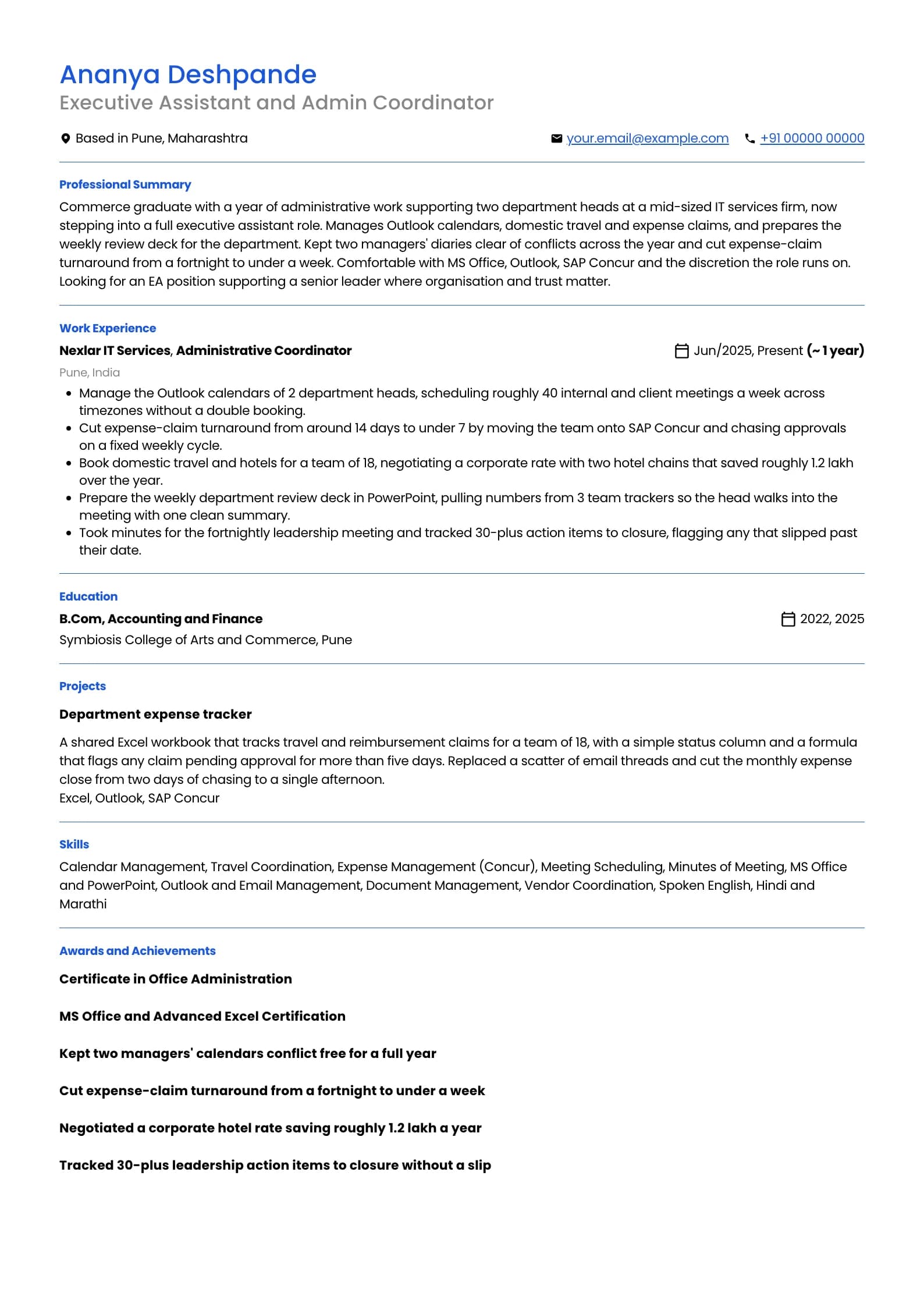
Build my resumeExecutive Assistant resume example, Junior EA (1 year)
minimalist templateIs your resume good enough?
Upload the resume you have now and see what an applicant tracking system reads before a executive assistant recruiter ever does.
Free to run. Sign in with your mobile number to see your score.
Executive Assistant resume example, Mid-level EA (6 years)
professional template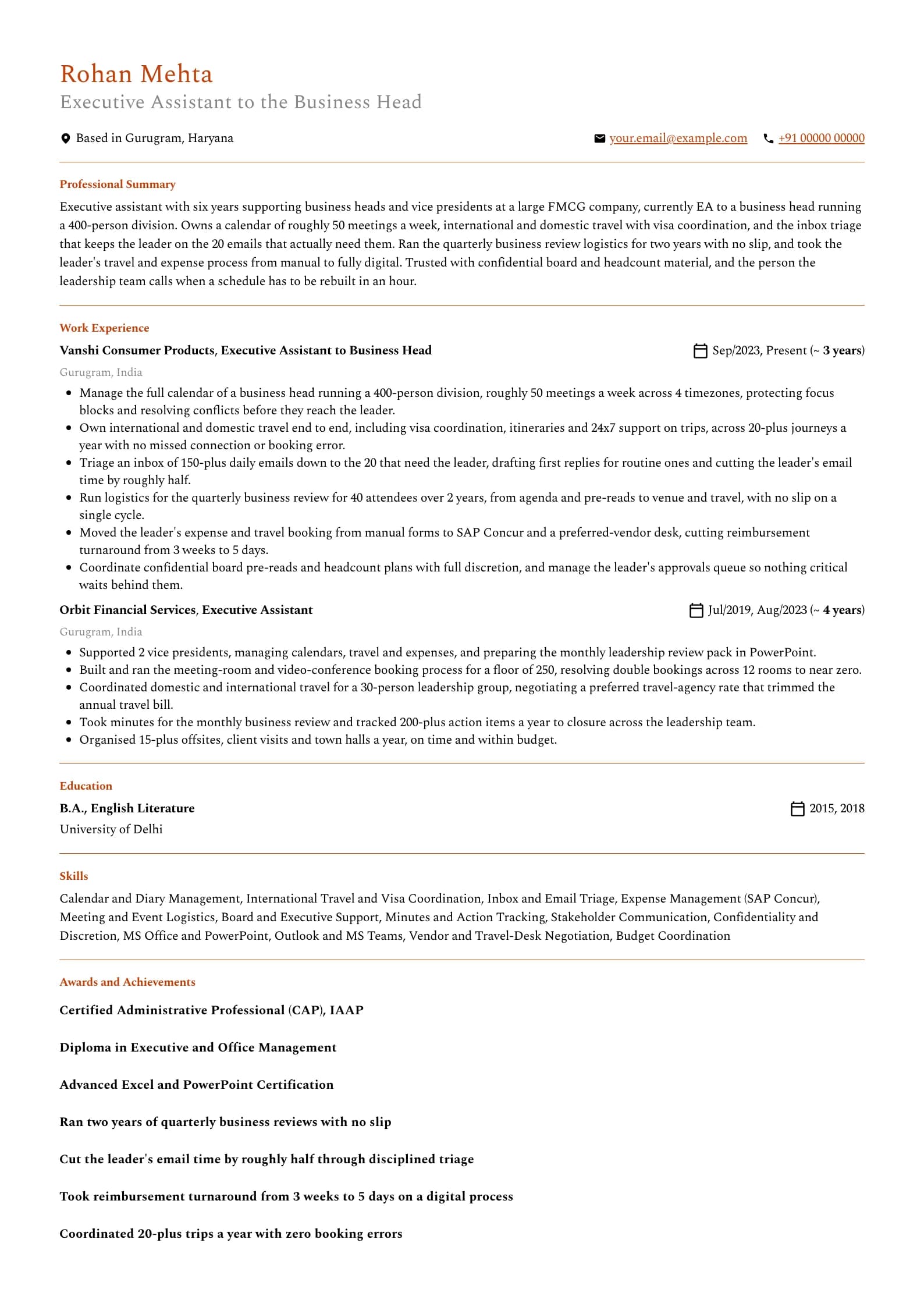
Want this structure with your own details? Build it in the resume builder.
Executive Assistant resume example, Senior EA (12 years)
header-band template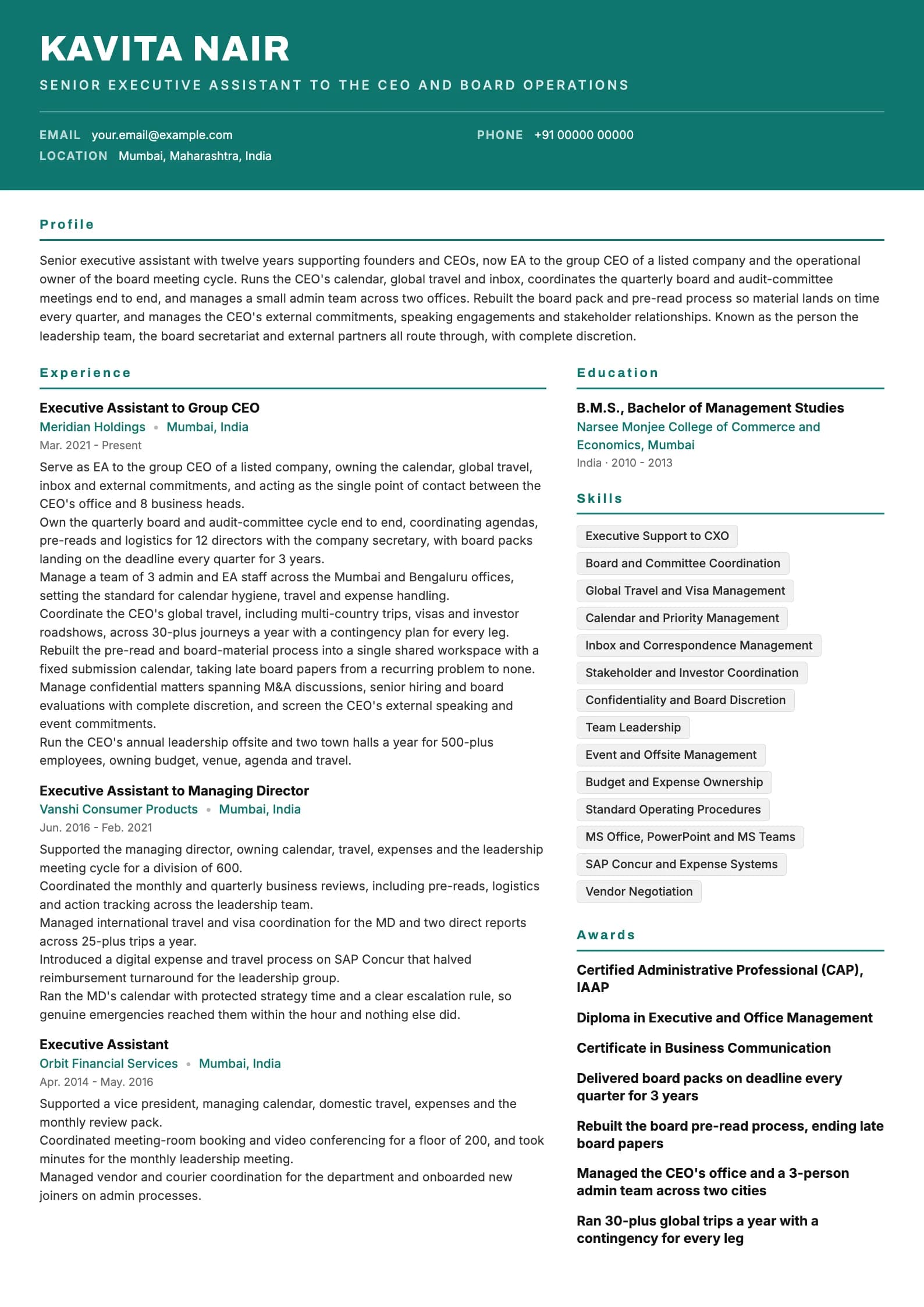
The format that works for executive assistant resumes in India
Reverse chronological is the only layout worth using. Put the most recent role first, work backwards, and keep the dates in plain view. Functional resumes that group everything under Skills and quietly drop the dates read as an attempt to hide a gap, which is a poor signal for a role whose entire value is trust and transparency. What an EA resume must do above all is name who you supported and how senior they were. EA to a business head running a 400-person division tells a hiring manager the seniority, the scope and the pressure in one line, where supported management could mean anything. Lead every role with the level of the leader, then the scope of what you owned: calendar, travel, inbox, board, team. One page holds everything a junior or mid-level EA has to say. A senior EA to a CXO with a decade of history can run to a second page, but only if that page carries real board, team or budget scope rather than a longer software list. Keep it clean and understated, because an EA resume is itself a sample of your organisation and judgement. Four things belong nowhere on the resume: date of birth, marital status, father's name and a full postal address. Send a PDF unless the posting asks for DOCX, name the file with your name and target role, and use a single column so an applicant tracking system reads it in order. The table below sets the section order.
| Section | Where it goes | Why |
|---|---|---|
| Name and headline | Top, above everything | The headline names the role and the level you support: EA to CEO, EA to business head. |
| Professional summary | Directly under the header | Three or four lines. Who you support, how long, and what you own end to end. |
| Work experience | Next, for anyone with a job | Most recent first. Lead with the seniority of the leader you supported. |
| Skills | Below experience | Grouped: executive support, tools, coordination. Not a 30-item wall. |
| Certifications | After skills, or beside it if only one or two | CAP, executive management and business communication earn their place. |
| Education | Bottom, unless a fresher | Degree, institution, years. Drop the percentage after your first job. |
| Languages | Near skills | Useful where the leader travels or the office is multilingual. |
Writing a summary the hiring executive actually reads
The block under your name is the part you can be reasonably sure gets read, and for an EA it must carry three facts: who you support, how long you have done it, and what you own end to end. Three or four lines, no adjectives that cannot be checked. The old objective line, a dedicated and organised professional seeking an executive assistant position in a reputed organisation, tells the reader nothing they did not assume from the application. Replace it with a summary. An objective describes what you want, a summary describes the leader you have already kept on track, and only one is evidence. Junior EAs often think they have nothing to summarise. Look at the junior sample: it names the two managers supported, the systems run, and one real process improvement in expense turnaround. That is a genuine summary built from one admin role. What it avoids is dedicated, hardworking and multitasker, phrases so common on EA resumes they now carry no information. A practical test for a senior EA: does your summary name the level of the leader, CEO, MD or VP, and one process you own, such as the board cycle or global travel. If it could describe an EA at any level, it is describing the job title, not you. Add the seniority and the specific ownership until it stops being transferable.
Professional summary, mid-level EA
Weak
A dedicated, hardworking and highly organised professional with 6+ years of experience in calendar management, travel and administration seeking a challenging executive assistant role in a reputed organisation.
Strong
Executive assistant with six years supporting business heads and VPs, currently EA to a business head running a 400-person division. Owns a 50-meeting-a-week calendar, international travel with visa coordination, and the inbox triage that keeps the leader on the emails that matter.
The rewrite trades self-description and a keyword list for the seniority of the leader supported, the scope owned, and a concrete measure of the calendar.
Experience bullets: the leader, the scope, the result
Every strong bullet in the samples follows the same shape. It opens with an action verb, names what you owned and at what scale, and closes with the result where one exists. Manage, own, coordinate, cut, rebuilt. The scope tells a hiring manager the size of the operation you ran, and the result proves you improved it rather than only staffed it. Start with what was different because you were there. EAs tend to write the duty first, managed the calendar, and then cannot attach a result, which produces bullets that fit every EA who ever lived. Instead ask what your leader could do because of you: they never double booked, their email time halved, board packs landed on time, a trip ran without a hitch. Then write the sentence that ends in that fact. Vary the measure. Not everything is a number of meetings. Across a real EA role you can honestly reach for calendar volume, travel count, email reduction, reimbursement turnaround, action items closed, events run, cost saved on vendors and team size. A senior EA should show board cadence and team scope, not just a busy diary. Where you lack a number, give scope: how many leaders supported, how many attendees at the review you ran, how many rooms or trips coordinated, the size of the division behind the leader. EA to a business head running a 400-person division carries weight without inventing a percentage. Allocate bullets by recency and seniority. Current role gets five or six, the previous role four or five, anything older two or three.
| Level | What bullets must prove | Typical measure |
|---|---|---|
| Junior EA | You keep a leader organised without being told | Calendars managed, meetings a week, expense turnaround, action items closed |
| 2 to 5 years | You own calendar, travel and inbox for a senior leader | Meeting volume, trips a year, email triage, review logistics run |
| 6 to 9 years | You are the leader's operational right hand | Division size behind the leader, board or review cadence, cost saved, discretion scope |
| 10 years and up | You run the CXO office and a governance process | Board cycle delivered, admin team led, global travel, offsites and budget owned |
Experience bullet, calendar work
Weak
Responsible for managing the calendar and scheduling meetings for the manager and other administrative duties as required.
Strong
Manage the full calendar of a business head running a 400-person division, roughly 50 meetings a week across 4 timezones, resolving conflicts before they reach the leader.
"Responsible for" describes a job posting; the rewrite names the seniority of the leader, the scale of the calendar and the judgement of protecting them from conflicts.
Experience bullet, travel and expenses
Weak
Handled travel arrangements and expense reports for the leadership team in a timely and efficient manner.
Strong
Moved the leader's expense and travel booking from manual forms to SAP Concur and a preferred-vendor desk, cutting reimbursement turnaround from 3 weeks to 5 days.
Names the change made and the before and after, so a reviewer can ask a real follow-up instead of nodding at timely and efficient.
If a bullet would read identically on any EA's resume, it is describing the job title, not you. Name the leader's level, the scale you handled and what ran better, until it only fits the office you actually ran.
Proving calendar, travel and inbox ownership, not just listing it
The single most common EA resume failure is a skills line that reads calendar management, travel management, email management, meeting coordination, MS Office with no bullet anywhere that shows any of it at scale. A parser matches those terms, but a hiring manager reads the line and assumes it is the generic EA template, then goes looking for whether you have actually protected a busy leader under real pressure. The fix is to let the experience prove each claim. If you write calendar management, a bullet should state how many meetings a week and across how many timezones, and that you resolved conflicts before they reached the leader. If you write travel, name the number of trips a year, whether it included international and visa work, and that nothing was missed. If you write email management, quantify the triage: 150 emails down to the 20 that matter. The mid-level sample lists exactly these because the bullets prove each one at scale. Be specific about the level you support. Supporting a VP, a business head and a group CEO are three different jobs, and the resume should say which. A CEO's EA coordinates board material and investor travel, which a first-time EA does not, so naming the level is what tells a recruiter whether you fit the role they are hiring for. Name the systems by their real names. Outlook, SAP Concur, MS Teams, Google Workspace, a named travel desk. Software you cannot back with a bullet reads as filler, but the specific tools an EA posting lists are exactly what a parser scans for and what a hiring manager wants to see you already run.
For every EA skill on your line, ask: is there a bullet that shows it at scale. Calendar management with 50 meetings a week behind it is a claim. Calendar management on its own is a word every EA writes.
The skills section: grouped, honest, and short enough to defend
An EA resume's skills section has two audiences with opposite preferences. The parser wants literal terms it can match, calendar management, travel coordination, SAP Concur. A hiring manager wants a short, organised list that signals the level and range of support you can provide. Grouping satisfies both. Group by function rather than one long line. Executive support, tools, and coordination is a grouping that works for almost every EA. Executive support covers calendar, travel, inbox, board and minutes. Tools covers the exact systems, Outlook, MS Teams, SAP Concur, PowerPoint and any expense or travel platform. Coordination covers events, vendors, meeting logistics and budget. Write the names the way the industry writes them: SAP Concur, MS Teams, PowerPoint, so a parser matches the string. Twelve to sixteen skills is the working range. Below eight the section looks thin. Above twenty it stops being a signal, and an EA resume is especially prone to soft-skill padding, listing organised, detail-oriented, proactive, multitasker, team player as five items when a hiring manager wants to see the systems and scope. The list is a contract: every item is a question you have agreed to answer, so an EA who lists board coordination should be ready to describe a board cycle they ran. Do include the genuinely core soft skills, discretion, communication and composure, because for an EA these are the job rather than filler. They land far better, though, when a bullet above already proves them, for example handling confidential board material with no leak. Skip star ratings, which invite an argument nobody wins.
| Group | What goes in it | How many |
|---|---|---|
| Executive support | Calendar, travel, inbox, board coordination, minutes | 4 to 6 |
| Tools | Outlook, MS Teams, SAP Concur, PowerPoint, Google Workspace | 3 to 5 |
| Coordination | Event logistics, vendor and travel-desk negotiation, budget, offsites | 2 to 4 |
| Core soft skills | Discretion, stakeholder communication, composure under pressure | 2 to 3 |
Skills section
Weak
Skills: Organised, Detail-oriented, Proactive, Multitasker, Team player, Good communication, Hardworking, Punctual, MS Office, Calendar management, Travel, Positive attitude, Quick learner
Strong
Executive support: calendar and travel management, inbox triage, board coordination, minutes. Tools: Outlook, SAP Concur, MS Teams, PowerPoint. Coordination: event logistics, vendor negotiation, budget. Core: discretion, stakeholder communication.
Cuts the unprovable traits, adds the exact executive-support tasks and systems an ATS searches, and keeps only the soft skills the role actually runs on.
Where education and certifications belong
Education goes at the bottom for anyone with a full-time job, and near the top for a junior EA who has little else to lead with. Degree, institution, years. That is the whole entry for most people. Any graduation is fine for an EA role, since the job is judged on organisation and judgement rather than a specific discipline, though commerce, arts and management degrees are common. CGPA or percentage is worth keeping while you are early-career and it is good, roughly 65 percent and above, because early screening still filters on it. Once you have your first EA role behind you, drop it. A number from years ago competes for space with the leaders you have kept on track, which is far more predictive. Certifications sit just below skills, or beside them if you hold only one or two. Write the full name, the issuing body and the year. For an EA, the Certified Administrative Professional from IAAP is the recognised international credential, and a diploma in executive or office management, or a business communication certificate, add weight, especially early on. These matter most when you have little experience, and less once you can point at a CEO whose office you ran. An expired certification listed as current is a small dishonesty that is easy to catch, so renew it or remove it. Drop school details once you have a degree, and skip coursework lines entirely for an EA, since no employer is screening an executive assistant on which electives they took.
Getting through the applicant tracking system
An applicant tracking system is a parser and a search index, not a judge. It reads your file, tries to break it into name, dates, employers, titles and skills, and stores the result so a recruiter can search across candidates. Almost every ATS problem is a parsing problem, and parsing problems come from layout, not wording. The layout rules are short. One column. Standard section headings, so use Work Experience rather than My Journey, and Skills rather than My Strengths. No text inside images, because a logo strip reads as empty space. No critical information in the header or footer region, which some parsers drop. Avoid text boxes and nested tables in the resume body. On wording, mirror the language of the posting where it is honest. If the role says executive assistant, use executive assistant in your headline rather than EA alone, then use EA elsewhere so both searches find you. If it names SAP Concur or Outlook, name the same. Spell an acronym out once, for example EA (executive assistant) or CAP (Certified Administrative Professional), so both the short and long forms match. Keyword stuffing does not work, and EA resumes are a common offender with a hidden block of every admin duty in white text. Recruiters find it quickly, and the outcome is worse than being filtered. Write real bullets that naturally contain the right terms, because a bullet describing the board cycle you ran contains board, agenda and pre-read in a context that survives human review too. Save as PDF from a tool that embeds real text, then open the file and confirm you can select and copy a sentence. If you cannot select the text, neither can the parser.
Section heading
Weak
A Snapshot of My Professional Journey
Strong
Work Experience
Parsers look for standard headings; a creative one can push the entire block into an unclassified bucket the recruiter never searches.
Test your own file before you send it. Copy the text out of the PDF into a plain text editor. Whatever you can read there is roughly what the parser sees, and anything scrambled is a real risk.
What gets executive assistant resumes rejected
Most rejections at the resume stage are not close calls. They come from a small set of recurring problems, and all of them are fixable in an afternoon. The list below covers what recruiters of Indian EA resumes see most often, in rough order of how much damage each one does.
- Not naming the level of the leader supported. EA to the CEO and EA to a junior manager are different jobs, and the resume must say which.
- Pure duty bullets with no scale. Managed calendar and travel tells a hiring manager nothing about how busy or senior the office was.
- A wall of soft skills, organised, proactive, multitasker, as the whole skills section, where the systems and scope should be.
- No numbers anywhere. Meetings a week, trips a year, email triage, action items, cost saved. Pick whichever is honest for the work.
- No tools named. Outlook, SAP Concur, MS Teams and a travel desk are exactly what an EA posting lists and a parser scans.
- A generic objective line. Replace it with a summary that names the leader, the tenure and what you own end to end.
- Selling discretion with adjectives instead of showing it. Name the confidential scope you handled, board or M&A material, as a plain fact.
- Date of birth, marital status, father's name and a full home address, none of which belongs on the resume.
- The same resume sent for an EA to a CEO and an EA to a mid-level manager without changing the emphasis at the top.
- Typos and inconsistent formatting, which for a role whose whole value is organisation and attention to detail, undermine the entire application.
For an EA role the resume is itself a work sample: neat, precise and error free is part of what you are selling, so proofread it twice before it goes out.
Skills to put on a executive assistant resume
Technical
- Calendar and Diary Management
- International and Domestic Travel Coordination
- Visa and Itinerary Management
- Inbox and Email Triage
- Expense and Reimbursement Management
- Meeting and Event Logistics
- Board and Committee Coordination
- Minutes of Meeting and Action Tracking
- Document and Records Management
- Budget Coordination
- Standard Operating Procedures
- Presentation and Report Preparation
Tools and platforms
- Microsoft Outlook
- MS Teams
- SAP Concur
- MS Office and PowerPoint
- Google Workspace
- Zoom and Video Conferencing
- Excel (Advanced)
- Travel and Expense Platforms
Working skills
- Discretion and Confidentiality
- Stakeholder Communication
- Composure Under Pressure
- Anticipation and Proactivity
- Prioritisation and Judgement
- Time Management
- Professional Presentation
- Cross-functional Coordination
- Attention to Detail
Certifications worth listing as a executive assistant
| Certification | Full name | Worth it for |
|---|---|---|
| CAP | Certified Administrative Professional, IAAP | The most recognised international credential for executive and administrative professionals, worth it for EAs who want a portable, named certification on the page. Most valuable for those with a few years of experience aiming at senior EA roles; a strong record supporting a CXO eventually outweighs it, but it never hurts. |
| Executive Management Diploma | Diploma in Executive and Office Management | A solid credential for candidates moving from general admin into a dedicated EA role, since it covers calendar, travel, communication and office coordination formally. Most useful in the early years; assumed rather than checked once you have run a senior leader's office. |
| Business Communication | Certificate in Business Communication | Worth it for EAs in corporate and client-facing settings where email etiquette, minute-taking and professional spoken communication are daily work. Most valuable for candidates whose written and spoken English is a selling point they want to evidence on the page. |
| Advanced Excel and PowerPoint | Advanced Excel and PowerPoint Certification | A practical credential for EAs who build the review decks and expense trackers their leader relies on. Useful for junior and mid-level EAs to show they can produce clean reporting; carries less weight for senior EAs whose value is judgement and discretion rather than deck-building. |
| MS Office | Microsoft Office Certification | A reasonable baseline credential for a junior EA to demonstrate readiness on Word, Excel, Outlook and PowerPoint, the daily tools of the role. Carries little weight on its own for experienced EAs, who are assumed to use these constantly and should point at what they ran instead. |
Keywords an ATS scans for in a executive assistant resume
These are the literal terms a parser matches against the job description. Use the ones that are true of you, in the sentences where you did the work, not as a list at the bottom.
- executive assistant
- EA
- calendar management
- diary management
- travel coordination
- visa coordination
- expense management
- SAP Concur
- inbox management
- email triage
- board coordination
- minutes of meeting
- stakeholder management
- meeting logistics
- MS Office
- outlook
- MS Teams
- confidentiality
- administrative support
- office management
Executive Assistant resume FAQ
What salary can an executive assistant expect in India?
A junior EA or admin coordinator typically starts around 3 to 5 LPA. An EA with four to eight years supporting a business head or VP usually sits in the 6 to 12 LPA band, more in large corporates and financial services. A senior EA to a CXO or founder, especially one who also runs board operations, commonly earns 12 to 25 LPA and beyond at large listed companies. Board and committee coordination, global travel management and genuine discretion at the top level push the upper end of every band, and a chief-of-staff crossover higher still.
How long should an executive assistant resume be?
One page up to about eight years of experience, two pages only for a senior EA whose second page carries real board, team or budget scope rather than a longer software list. The role is judged on organisation and judgement, so a clean, well-structured page that names the leaders you supported and what you owned is stronger than two padded pages. If you are struggling to fit one page, cut the oldest role to a single line and remove any generic soft-skill list.
How do I show the seniority of the executive I supported?
Name the level directly in the role title and the summary: EA to the group CEO, EA to a business head running a 400-person division, EA to a VP. Then add the scope behind them, the size of the division, the number of business heads you interfaced with, whether you coordinated board or investor material. Supporting a CEO and supporting a junior manager are genuinely different jobs, and a recruiter is screening for whether your level of support matches the role they are hiring, so make it unmissable.
How does a fresher or junior candidate write an EA resume?
Lead with any admin, coordinator or internship work, then education, then skills. Treat each experience as evidence you can keep a leader organised: how many calendars you managed, meetings a week, expense turnaround, action items tracked to closure. Coordinator roles, front-office cover and internship admin work all count, because each shows you handling real scheduling, travel and reporting rather than only listing qualities. Add any checkable credential such as a CAP or an office-management diploma, since verifiable facts carry more weight than adjectives.
Do certifications like CAP help an executive assistant?
They help most when you have little experience or are moving from general admin into a dedicated EA role, and least once you can point at a senior leader whose office you ran. The Certified Administrative Professional from IAAP is the recognised international credential, and an executive-management diploma or business-communication certificate adds early-career weight. For senior EA roles, a record of running a CEO's office and board cycle matters far more than any certificate, so keep the list short and let the work be the credential.
Should I mention confidentiality and discretion on an EA resume?
Yes, but show it rather than decorate it. Instead of writing highly discreet and trustworthy, name the confidential scope you actually handled: board pre-reads, headcount plans, M&A discussions, senior hiring, all managed with no leak. Discretion is the core of the EA role, so a plain factual statement of the sensitive material you were trusted with reads as far more credible than an adjective, and it tells a hiring executive exactly the kind of trust they can place in you.
What tools should an executive assistant list on a resume?
The exact systems you run, named the way the industry writes them: Microsoft Outlook and MS Teams for calendar and communication, SAP Concur or a similar platform for expenses and travel, PowerPoint and advanced Excel for decks and trackers, and Google Workspace or Zoom where relevant. Name a travel desk or booking platform if you use one. These are precisely what an EA posting lists and what a parser scans for, so a skills line with the real tools on it reads ahead of one built from generic soft skills.
Does an ATS reject resumes with two columns?
It does not reject them outright, but some parsers read multi-column layouts out of order, which interleaves your sidebar with your experience and produces nonsense in the recruiter's view. A single-column layout removes the risk, which is why all three samples above use one. Test your own file by copying the text out of the PDF into a plain text editor, and if it reads in order there it will most likely parse correctly.
What is the difference between an EA and a personal assistant on a resume?
An executive assistant supports a leader's professional life, calendar, travel, inbox, meetings and board work, and is judged on how well the business function around that leader runs. A personal assistant often blends professional support with personal and household coordination for one individual, and discretion across their private life is central. If you have done both, name it, but pitch the resume at the role you are applying for and lead with the scope that role values most.
Related resume examples and guides
Build your own in any of these formats
Start from a blank resume or upload the one you have. Goodspace renders it in 24 templates and flags the calendar, travel and board-support keywords an applicant tracking system will look for, and the generic soft-skill padding it will not credit.
Build my resume