Business Consultant Resume Format, with 3 Full Samples
A business consultant is hired on evidence of a client problem understood, a process or system changed, and a number that improved because of the recommendation, yet most resumes list the engagements and the methodologies and forget the result the client actually banked. Below are three complete resumes, one for a fresher moving into advisory from a business-analyst foundation, one for a mid-level consultant working across process improvement and ERP-enabled change, and one for a senior consultant owning advisory delivery and the client relationship. After the samples come the format rules, the difference between naming a project and proving its value, the terms a parser and a client both read, and the mistakes that end a screening before the conversation.
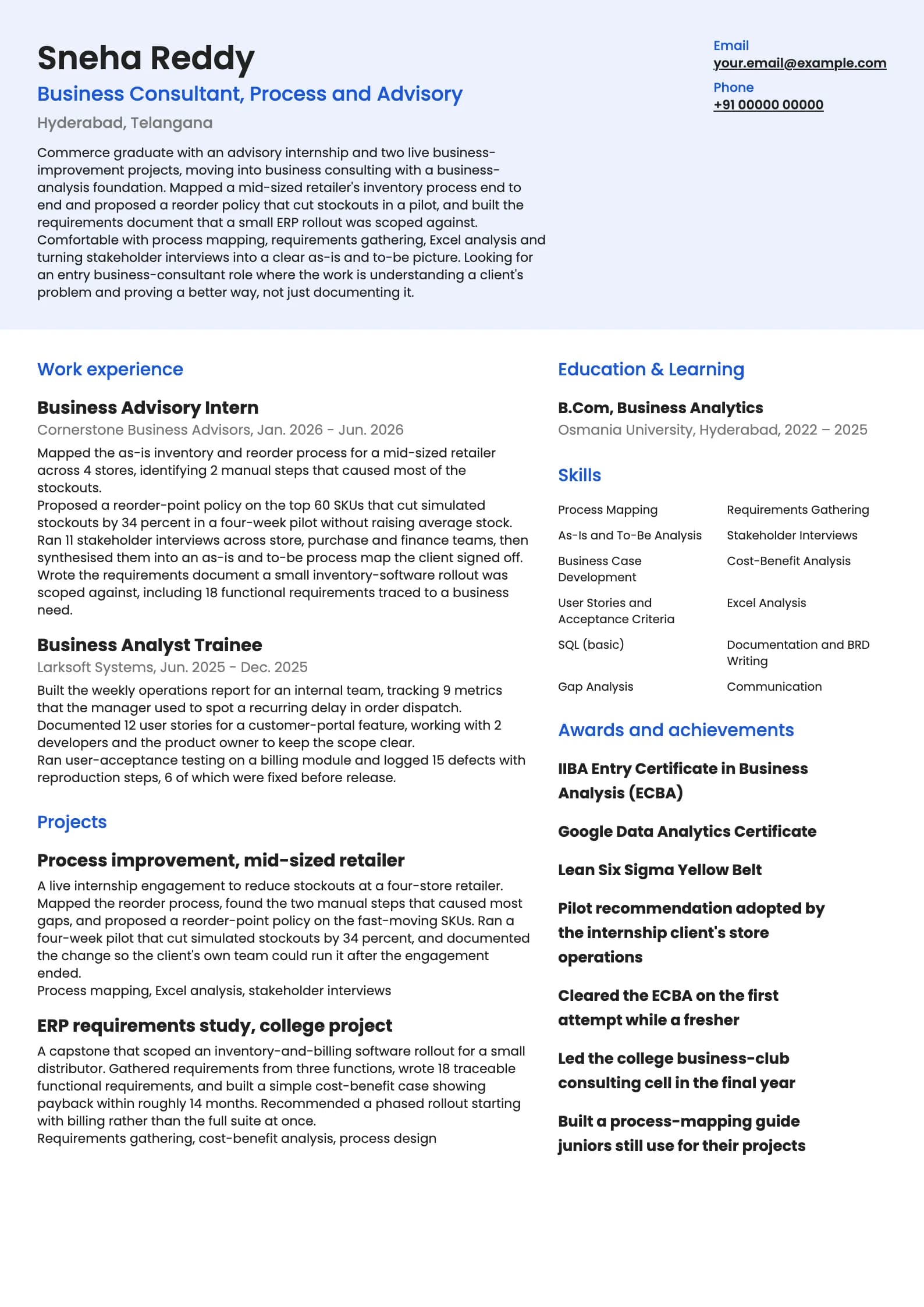
Build my resumeBusiness Consultant resume example, Fresher (0 to 1 year)
modern templateIs your resume good enough?
Upload the resume you have now and see what an applicant tracking system reads before a business consultant recruiter ever does.
Free to run. Sign in with your mobile number to see your score.
Business Consultant resume example, Business Consultant (5 years)
professional template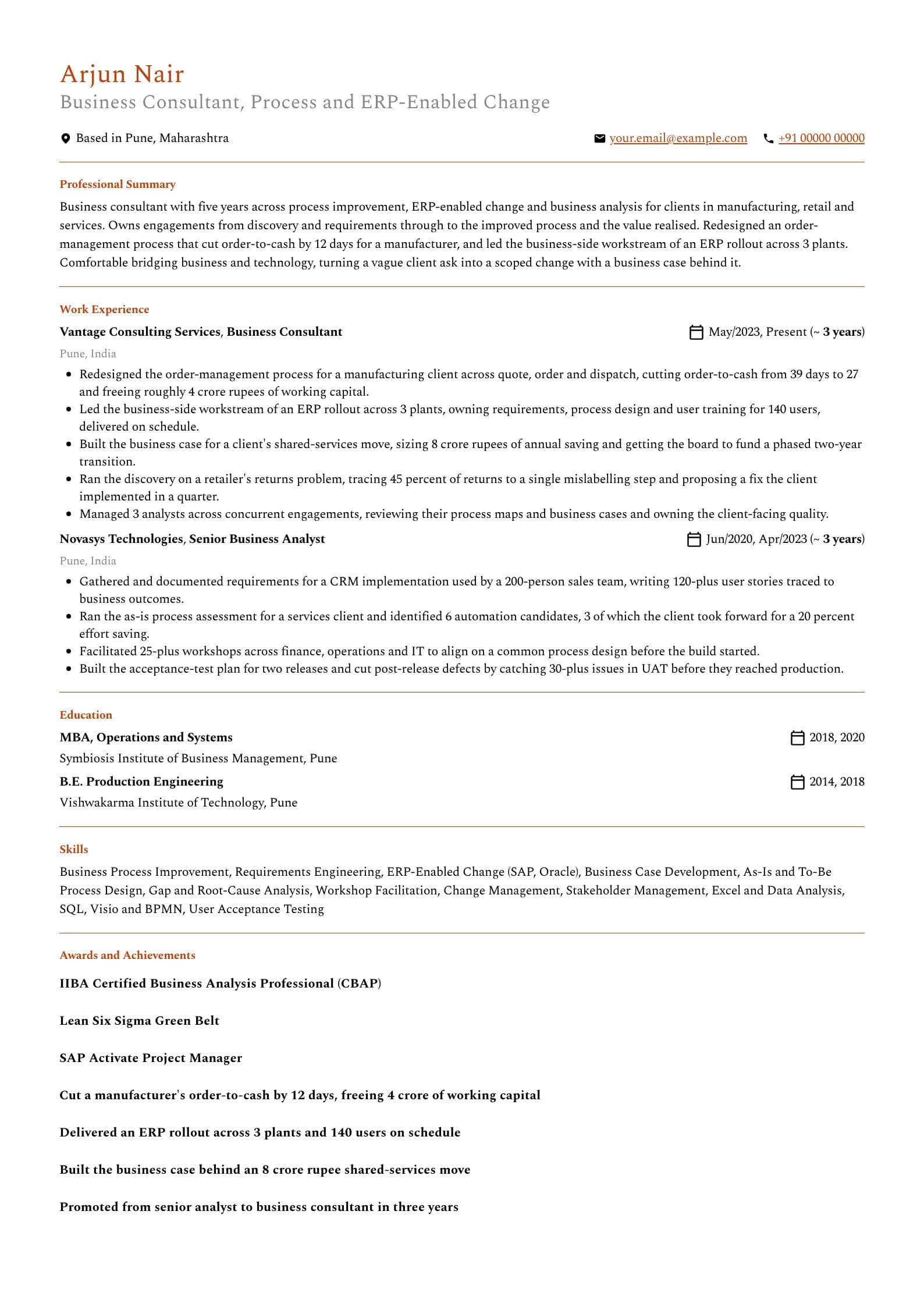
Want this structure with your own details? Build it in the resume builder.
Business Consultant resume example, Senior Consultant / Advisory Lead (11 years)
header-band template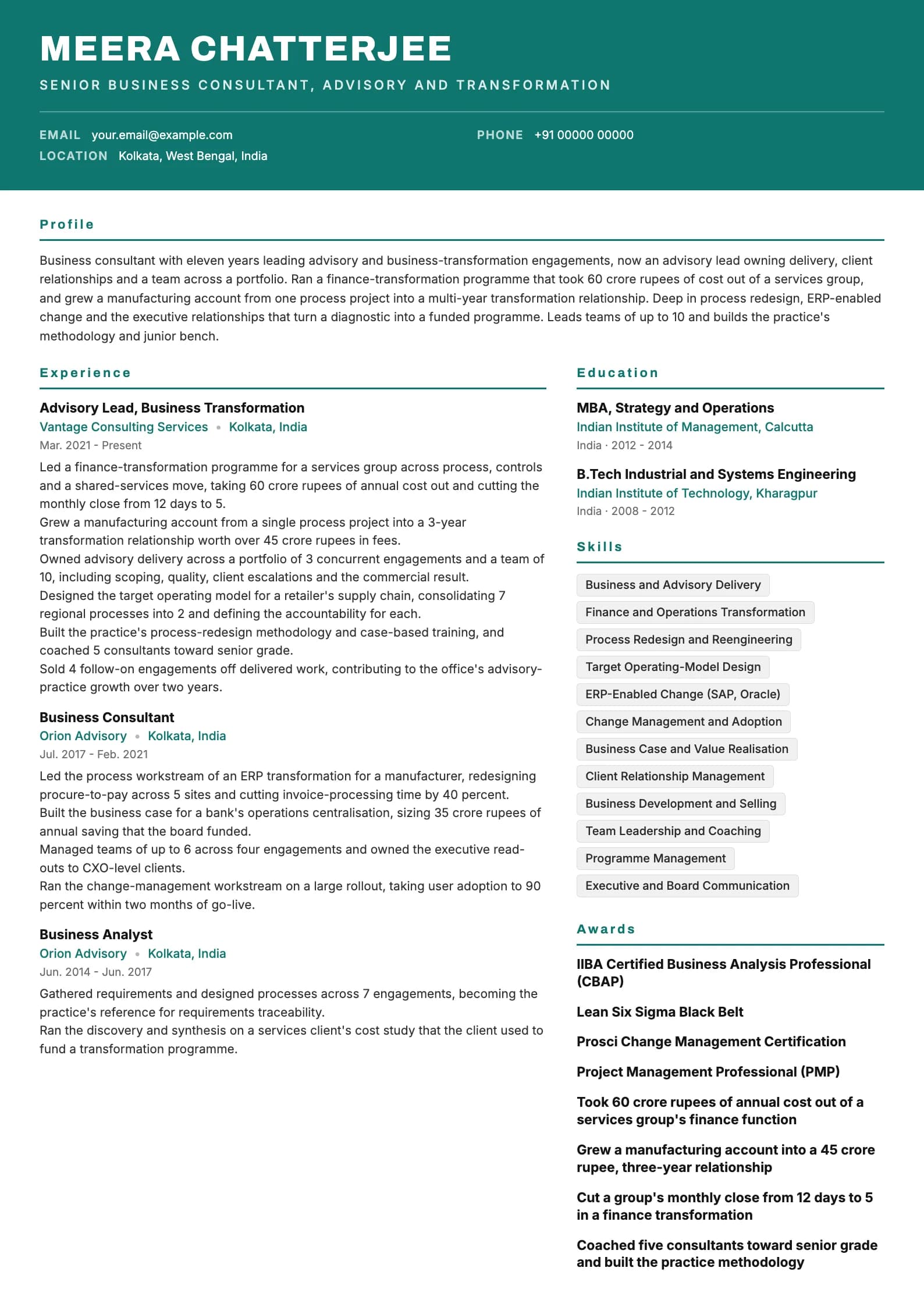
The format that works for business consultant resumes in India
Reverse chronological is the layout advisory recruiters and clients expect. Most recent role first, work backwards, dates in plain view. A functional resume that groups everything under Skills and drops the dates reads as an attempt to hide a gap or a short stint, and consulting screening is alert to both. If you have a gap, explain it in one honest line rather than hiding it. Length is set by evidence, not seniority alone. One page holds everything a fresher and most consultants up to roughly six years have to say. Beyond that, a second page is fine only when it carries engagements with real client value rather than a longer list of tools and methodologies. Advisory reviewers read fast and value a page that gets to the outcome, so a padded second page works against you. Four things belong nowhere on a business consultant resume here: a photograph, date of birth, marital status and father's name. They survive from an older campus template and add nothing to a screen looking for problem understanding and value delivered. Every line they take is a line an engagement result could have used. Send a PDF unless the posting asks for DOCX, and name the file with your own name and the target role rather than resume_final. Use a single column throughout, because two-column layouts parse unpredictably and advisory firms often screen through an applicant tracking system first. The table below sets the section order.
| Section | Where it goes | Why |
|---|---|---|
| Name and headline | Top, above everything | The headline is the role you want, business consultant or advisory. Recruiters match on it. |
| Professional summary | Directly under the header | Three or four lines. Domains, years, and the single strongest quantified result. |
| Work experience | Next, for anyone with a job | Most recent first. Newest role gets the most bullets, framed as engagements with value. |
| Projects or engagements | Above experience for freshers, folded into experience after that | For a fresher, internships and capstones are the evidence. Later they live inside the role. |
| Skills | Below experience | Grouped: analysis, functional domains, change, tools. Not a 30-item wall. |
| Education | Bottom, unless you are a fresher | MBA and undergraduate degree, institution, years. The MBA brand helps in advisory hiring. |
| Certifications | After education, or beside skills if only one or two | CBAP, Six Sigma, Prosci, PMP. Name, body, year. |
Naming a project is not the same as proving the value
The most common business consultant resume failure is a line that names the client and the topic but never the value: "worked on a process-improvement project for a manufacturing client". A reviewer reads that as a role you were staffed on, not a result you produced, and every candidate at your grade has three of them. The value of an advisory resume is in what improved for the client because of your work. The fix is the value line: the process or system you changed, the number that moved, and where honest the value the client actually realised. The mid-level sample writes "cut order-to-cash from 39 days to 27 and freed roughly 4 crore of working capital" because it names both the operational change and the money behind it, which is the language a client sponsor understands. A process map with no outcome attached is treated as documentation, not consulting. Be specific about your role on the engagement. "Led the business-side workstream" is a claim a reviewer can test; "was part of the team" is not. Advisory work is delivered in teams, and inflating a team result into a solo one is the fastest way to get caught in an interview, so name the workstream you owned rather than the whole programme. Do not describe methodology for its own sake. Listing that you used BPMN, a RACI and a fishbone diagram tells a reviewer nothing about the client's problem or your answer. The methods are how you got there; the resume is for what you got, so name the diagnostic finding and the change rather than the technique.
For every engagement on your resume, ask: what improved for the client, and can I name the number. If you cannot, either find the honest figure or reframe the line around the decision your work enabled. A project with no value is a project the reviewer skips.
Writing a summary a client-facing recruiter actually reads
The block under your name is the part you can be reasonably sure gets read, so it should carry three facts: the domains you consult in, how long you have been doing it, and the single strongest thing that improved for a client because of your work. Three or four lines, no adjectives a reviewer cannot check. The old objective line, seeking a challenging business consultant role in a reputed firm to utilise your analytical and communication skills, tells the reader nothing they did not assume from the application. Replace it with a summary. An objective describes what you want; a summary describes the client results you have already produced, and only one of those is evidence a shortlist is built on. Freshers often believe they have nothing to summarise. Look at the fresher sample: it names the process and advisory focus, the business-analysis foundation, and points at an internship where a specific number moved. That is a genuine summary built from coursework, one internship and live projects. What it avoids is "passionate about helping businesses grow", a phrase so common on graduate resumes it now carries no information. A practical test: read your summary and ask whether a batchmate with the same background could paste it onto their resume unchanged. If they could, it describes the qualification, not you. Add the specific engagement, the specific number and the specific domain until it stops being transferable.
Professional summary, mid-level consultant
Weak
Result-oriented business consultant with 5+ years of experience in process improvement and business analysis, seeking a challenging role in a reputed firm to utilise strong analytical and communication skills.
Strong
Business consultant with five years across process improvement, ERP-enabled change and business analysis in manufacturing and retail, owning engagements from discovery to value realised. Cut a manufacturer's order-to-cash by 12 days and led an ERP rollout across 3 plants on schedule.
The rewrite trades self-description and a wish for named domains, an ownership scope and two verifiable client results.
Engagement bullets: role, change, quantified value
Every strong bullet in the samples follows the same shape. It opens with your role on the engagement, names the process or system you changed, and closes with the value that moved for the client. The role establishes you did it. The change tells a reviewer whether the work is relevant. The number does the persuading. Start with the outcome and work backwards. Consultants tend to write the activity first, then struggle to attach a result, which produces lines like "conducted process analysis to identify improvement areas". Instead ask what improved for the client after your work: a cycle time cut, a cost taken out, working capital freed, adoption reached, a defect class removed. Then write the sentence that ends in that fact. Vary the metric. A column of cost-saving figures reads as one engagement repeated. Across a real portfolio you can honestly reach for cycle time, cost saved, working capital, adoption rate, defect reduction, effort saved, accounts grown and fees. The mid-level sample uses several types across its bullets, which reads as range across problems rather than one trick. Where a hard number is confidential or unavailable, give scope and the decision: how many sites, how many users, how many requirements, and what the client committed to. "Led the business-side workstream of an ERP rollout across 3 plants for 140 users, delivered on schedule" carries weight without a fabricated percentage. Allocate bullets by recency. Current role gets five or six, the previous role four or five, anything older two or three.
| Level | What bullets must prove | Typical metric |
|---|---|---|
| Fresher | You can understand a process and propose a defensible change | Cycle or stockout cut, requirements written, effort saved in a pilot |
| 1 to 3 years | You own requirements and turn analysis into a scoped change | User stories, automation candidates, defects caught, workshops led |
| 4 to 6 years | You own an engagement end to end and realise value | Cycle time, cost saved, working capital, adoption, analysts managed |
| 7 years and up | You own delivery, the client relationship and the commercials | Value realised, account grown, fees, team led, follow-on sold |
Engagement bullet, process work
Weak
Worked on a process-improvement project for a manufacturing client and helped streamline various operations to improve efficiency.
Strong
Redesigned the order-management process across quote, order and dispatch, cutting order-to-cash from 39 days to 27 and freeing roughly 4 crore rupees of working capital.
Names the specific process changed, the before and after, and the money the change freed, instead of a vague efficiency claim.
Engagement bullet, discovery work
Weak
Analysed the client's returns process and provided recommendations to reduce the number of returns.
Strong
Ran the discovery on a retailer's returns problem, tracing 45 percent of returns to a single mislabelling step and proposing a fix the client implemented in a quarter.
Replaces a generic analysis claim with the specific root cause found and the change the client actually made.
If a bullet would read identically on a teammate's resume, it is describing the engagement type, not you. Rewrite it until it only fits the workstream you owned and the value you moved.
The skills section: grouped, honest, and short enough to defend
A business consultant resume's skills section has two audiences with opposite preferences. The parser wants literal terms it can match, business process improvement and requirements engineering and change management. A human wants a short, organised list that signals what kind of consultant you are. Grouping satisfies both. Group by function rather than one long line. Analysis and discovery, functional domains, change and delivery, and tools is a grouping that works for almost every business consultant. The exact headings matter less than the fact that structure exists. Write terms the way the industry writes them: business process reengineering, target operating model, requirements traceability, not vague words like synergy or optimisation as if they were skills. Twelve to sixteen skills is the working range. Below eight the section looks thin. Above twenty it stops being a signal, and advisory resumes are prone to listing every methodology and framework as a separate skill. The list is a contract: every item is a question you have agreed to answer in the interview or the client conversation. Do not include a proficiency bar. Star ratings invite an argument you cannot win, and nobody agrees on what four stars in change management means. Let the engagement bullets prove the depth instead. Keep soft skills to the few a consultant is genuinely hired for, such as stakeholder management and executive communication, rather than a generic list every applicant claims.
| Group | What goes in it | How many |
|---|---|---|
| Analysis and discovery | Process mapping, requirements engineering, gap and root-cause analysis | 3 to 4 |
| Functional domains | Process improvement, operating model, finance and operations transformation | 3 to 4 |
| Change and delivery | Change management, adoption, business case, programme management | 2 to 4 |
| Systems | ERP-enabled change (SAP, Oracle), CRM, workflow tools | 1 to 3 |
| Tools | Excel, Visio or BPMN, SQL, Power BI, Jira | 3 to 4 |
Skills section
Weak
Skills: Business, Consulting, Analysis, Strategy, Process, Improvement, Optimisation, Synergy, Communication, Teamwork, Leadership, Excel, PowerPoint, Documentation, Management, Client Handling, Problem Solving, BPMN, RACI, Frameworks
Strong
Analysis: process mapping, requirements engineering, root-cause analysis. Domains: process improvement, operating-model design, finance transformation. Change: change management, adoption, business case. Systems: ERP-enabled change (SAP). Tools: Excel, Visio, SQL, Power BI.
Cuts the buzzwords and method name-drops, keeps terms a recruiter searches on, and groups the rest so a human reads it in one pass.
Engagements and internships: what to include and how to describe it
For a fresher, internships and capstones are the resume. They sit above or in place of full-time experience, they get the most space, and they are where a reviewer decides whether you can actually understand a client's process and propose a better one or only document it. For an experienced consultant, engagements are the experience itself, described inside each role rather than in a separate projects block. The common failure is describing the topic instead of the outcome. "A process-improvement project for a retailer" tells a reviewer nothing, because every graduate resume carries a line like it. Describe the problem, what you changed, the recommendation and what the client did with it. The retailer engagement in the fresher sample is a strong entry because it names the reorder policy, the pilot and the 34 percent fewer stockouts. Pick engagements that show range rather than three process maps. One process or operations problem, one systems or requirements problem, and one with a genuinely hard piece of analysis or a business case is a stronger set than three variations of the same documentation exercise. Two well-described engagements beat five listed by client name and topic. Client confidentiality is real, so describe the client by sector and size rather than by name where the engagement was under NDA. "A mid-sized manufacturer" is specific enough to be credible and safe to write. Never name a client the firm would not want named, and never quote a figure you are contractually bound to keep private.
Internship description, fresher resume
Weak
Process Improvement Internship: worked with a retail client to improve their inventory process and reduce stockouts through various recommendations.
Strong
Process improvement, mid-sized retailer: mapped the reorder process across 4 stores, found the two manual steps causing most stockouts, and piloted a reorder-point policy that cut simulated stockouts by 34 percent without raising average stock.
Swaps a topic and vague recommendations for the specific change, the pilot and the number it moved.
Where education and certifications belong
Education goes at the bottom for anyone with full-time advisory experience, and near the top for a fresher, who has nothing stronger to lead with. In advisory hiring the MBA and undergraduate institutions carry weight, so name them clearly: degree, specialisation, institution, years. CGPA or percentage is worth keeping while you are a fresher and it is good, roughly 7.5 out of 10 or 75 percent and above, because campus and early-career screening still filters on academic record. Once you have delivered a few engagements, the number competes for space with client results that are far more predictive, so drop it. Coursework and academic honours are for freshers only, and only when relevant. Operations management, business analytics and process design are worth naming for an advisory role; unrelated electives are not. A live-project or case-competition result genuinely signals structured thinking, which is worth a line early on. Certifications sit just below education, or beside skills if you hold only one or two. Write the full name, the issuing body and the year. For business consulting, the IIBA CBAP or ECBA carries weight on analysis-heavy work, Lean Six Sigma on process and operations engagements, Prosci on change-led programmes, and PMP on delivery. They support rather than replace the engagement record, so keep the list short and let the client results be the real credential.
Getting through the applicant tracking system
Most advisory firms and the corporates that hire ex-consultants screen through an applicant tracking system before a human reads the page. It is a parser and a search index, not a judge. It reads your file, tries to break it into name, dates, employers, titles and skills, and stores the result so a recruiter can search across candidates. Almost every ATS problem is a parsing problem, and parsing problems come from layout, not wording. The layout rules are short. One column. Standard section headings, so use Work Experience rather than My Advisory Journey, and Skills rather than My Toolkit. No text inside images or a logo strip, because it reads as empty space. No critical information in the header or footer region, which some parsers drop. Avoid text boxes and nested tables in the body. On wording, mirror the language of the job description where it is honest. If the posting says business process improvement, write business process improvement. If it says stakeholder management, use that phrase rather than a private synonym. Include the expansion alongside an acronym at least once, for example "BRD (business requirements document)", so both searches find you. Keyword stuffing does not work. A hidden block of every methodology in white text is found quickly, and the outcome is worse than being filtered. Write real engagement bullets that naturally contain the right terms, because a bullet describing a process redesign contains the phrase in a context that survives human review too. Save as PDF from a tool that embeds real text, then open the file and confirm you can select and copy a sentence. If you cannot select the text, neither can the parser.
Section heading
Weak
My Consulting Story
Strong
Work Experience
Parsers look for standard headings; a creative one can push the entire block into an unclassified bucket the recruiter never searches.
Test your own file before you send it. Copy the text out of the PDF into a plain text editor. Whatever you can read there is roughly what the parser sees, and anything scrambled is a real risk.
What gets business consultant resumes rejected
Most rejections at the resume stage are not close calls. They come from a small set of recurring problems, and all of them are fixable in an afternoon. The list below covers what advisory recruiters and staffing partners in India see most often, in rough order of how much damage each one does.
- Projects named but no value attached. "Worked on a process project" is a staffing line, not an outcome. Name what improved for the client.
- Claiming a whole programme's result when you owned one workstream. It falls apart in an interview, where they probe exactly what you did.
- No numbers anywhere. Cycle time, cost, working capital, adoption, effort. Pick whichever is honest, and separate proposed from realised.
- Methodology name-dropping. BPMN, RACI and fishbone as if they were achievements. They are how you worked, not what you produced.
- A wall of buzzwords on the skills line, synergy and optimisation and strategy, with no engagement proving any of it.
- A photo, date of birth, marital status or father's name. None of it belongs on an advisory resume and it takes an engagement's space.
- A generic objective line. Replace it with a summary that states domains, years and one client result.
- Naming a confidential client or quoting a figure under NDA. Describe the client by sector and size instead, and keep protected numbers off the page.
- Inflated titles or dates that do not match your relieving letters. Background verification is standard and a mismatch ends the process.
- A second page padded with a longer methodology list and a hobbies line rather than more client value.
Read your resume aloud once before sending it. Anything you would be uncomfortable defending to a client sponsor is a line to cut or rewrite.
Skills to put on a business consultant resume
Technical
- Business Process Improvement
- Requirements Engineering
- As-Is and To-Be Process Design
- Gap and Root-Cause Analysis
- Business Case Development
- Target Operating-Model Design
- ERP-Enabled Change (SAP, Oracle)
- Change Management
- Value Realisation
- Data Analysis
- User Acceptance Testing
- Business Requirements Documentation
Tools and platforms
- Excel
- Visio and BPMN
- PowerPoint
- SQL
- Power BI
- Tableau
- Jira and Confluence
- SAP
Working skills
- Stakeholder Management
- Executive Communication
- Workshop Facilitation
- Client Relationship Management
- Team Leadership
- Coaching and Mentoring
- Negotiation and Influence
- Storytelling and Presentation
- Working under Ambiguity
Certifications worth listing as a business consultant
| Certification | Full name | Worth it for |
|---|---|---|
| CBAP | IIBA Certified Business Analysis Professional | The senior business-analysis credential, worth it for business consultants whose work is heavy on requirements, process design and stakeholder analysis. Signals depth to advisory and product-facing clients and needs documented BA hours to earn. Most valuable in the three-to-eight-year range; beyond that a delivery record outranks it. |
| ECBA | IIBA Entry Certificate in Business Analysis | The entry-level IIBA certificate, useful for a fresher or a career switcher who needs to prove business-analysis fundamentals on paper before they have engagement hours. A clean early signal for campus and junior advisory hiring. Redundant once you hold the CBAP or have shipped real client work. |
| LSS Green Belt | Lean Six Sigma Green Belt | Carries weight for business consultants working on process improvement and operations, since it certifies the structured-improvement toolkit those engagements use. Most useful in the one-to-five-year range and for anyone positioning toward operations advisory. A Black Belt or a strong delivery record adds more beyond that. |
| Prosci | Prosci Change Management Certification | The most recognised change-management credential in Indian advisory hiring, worth it for consultants who lead adoption and organisational-change workstreams on transformation and ERP programmes. Directly relevant where the risk is people, not technology. Optional for pure analysis or strategy roles. |
| PMP | Project Management Professional | Useful for business consultants moving toward large programme and transformation delivery, where clients want proof you can run a multi-workstream effort to plan and budget. Most valuable at the senior grade and for implementation-led firms. Optional for early-career analysis work, where problem understanding matters more than a delivery certificate. |
Keywords an ATS scans for in a business consultant resume
These are the literal terms a parser matches against the job description. Use the ones that are true of you, in the sentences where you did the work, not as a list at the bottom.
- business consultant
- business analyst
- business process improvement
- requirements engineering
- process mapping
- change management
- business case
- operating model
- ERP
- stakeholder management
- gap analysis
- root-cause analysis
- value realisation
- workshop facilitation
- excel
- visio
- sql
- user acceptance testing
- BRD
- transformation
Business Consultant resume FAQ
What salary can a business consultant expect in India?
A fresher joining an advisory or business-consulting practice typically starts around 5 to 12 LPA, with the Big Four and top consulting firms at the higher end and boutique advisory lower. A business consultant with four to six years usually sits in the 12 to 25 LPA band including variable pay, and often higher with ERP or transformation depth. Senior consultants and advisory leads with ten years and above commonly earn 30 to 60 LPA and more, weighted toward delivery and client outcomes. Domain depth, an MBA brand and a track record of realised client value push the top of every band upward.
What is the difference between a business consultant and a business analyst?
A business analyst usually works inside one organisation or project, focused on requirements, documentation and helping a build team deliver. A business consultant is client-facing and advisory: they diagnose the problem, design the change, build the business case and often own the value realised, across multiple clients. The two overlap heavily early in a career, which is why the fresher sample above leans on a business-analysis foundation and reframes it for the advisory reader. On a resume, lead with the problem you framed and the value you moved, not just the requirements you wrote.
How long should a business consultant resume be?
One page up to about six years of experience, and most advisory firms prefer a single page even for laterals because they read fast and value a resume that gets to the value delivered. A second page is justified only after that, and only if it carries real client outcomes rather than a longer methodology list. If you are struggling to fit one page, cut the oldest role to a line, remove early detail that no longer earns its space, and delete any tool you would not want probed in an interview.
How do I show value if my client work was confidential?
Describe the client by sector and size rather than by name, for example a mid-sized manufacturer, which is specific enough to be credible and safe to write. For numbers under NDA, either state the metric as a percentage or a band rather than an absolute figure, or reframe the line around the decision your work enabled, such as a programme the board funded. Never quote a figure you are contractually bound to keep private, and never name a client the firm would not want named.
Do certifications like CBAP or Six Sigma help a business consultant?
They help most when they match the kind of consulting you do. The IIBA CBAP or ECBA carries weight on analysis-heavy work, Lean Six Sigma on process and operations engagements, Prosci on change-led programmes, and PMP on delivery-heavy roles. They support the engagement record rather than replace it, so hold two or three that fit your practice and let the client results be the real credential. Early in a career they carry more weight, since you have fewer engagements to point at.
How do freshers write a business consultant resume with no experience?
Lead with internships and capstones, then education, then skills. Treat each project as a real engagement: the client's problem, what you owned, the change you proposed and what improved. A process-mapping internship counts, an ERP requirements capstone counts, and a live business-club project counts. Add anything checkable such as an ECBA, a Lean Six Sigma belt or a case-competition result, since verifiable facts carry more weight than adjectives like passionate or result-oriented.
Does an ATS reject resumes with two columns?
It does not reject them outright, but some parsers read multi-column layouts out of order, which interleaves your sidebar with your experience and produces nonsense in the recruiter's view. Since most advisory and corporate roles screen through an applicant tracking system first, a single-column layout removes the risk, which is why all three samples above use one. Test your own file by copying the text out of the PDF into a plain text editor, and if it reads in order there it will most likely parse correctly.
Should I list the methodologies I use, like BPMN and RACI?
Not as achievements. Methodologies are how you got to the answer, not what you produced, and listing them as accomplishments signals that you have confused method with result. A reviewer assumes any competent business consultant maps processes and structures analysis, so the space is better spent on the client's problem and the value you moved. One or two can sit in the skills section as tools; keep the experience for the outcome.
Related resume examples and guides
Build your own in any of these formats
Start from a blank resume or upload the one you have. Goodspace renders it in 24 templates and flags the process improvement, change management and value-realised keywords a business-advisory applicant tracking system will look for, and the methodology name-drops it will not credit.
Build my resume