Ayurvedic Doctor Resume Format, with 3 Full Samples
An Ayurvedic doctor is hired on evidence of patients managed, panchakarma done correctly and outcomes that hold, yet most BAMS resumes list a degree, a Sanskrit shloka of principles and stop there. Below are three complete resumes, one for a fresh BAMS graduate out of the compulsory internship, one for a panchakarma and OPD clinician with five years across a wellness hospital, and one for a senior Ayurvedic consultant running a department and a therapy team. After the samples come the format rules, where the state council and AYUSH registration line belongs, the difference between quoting classical principles and proving clinical results, the terms a parser matches literally, and the mistakes that get a BAMS resume set aside.
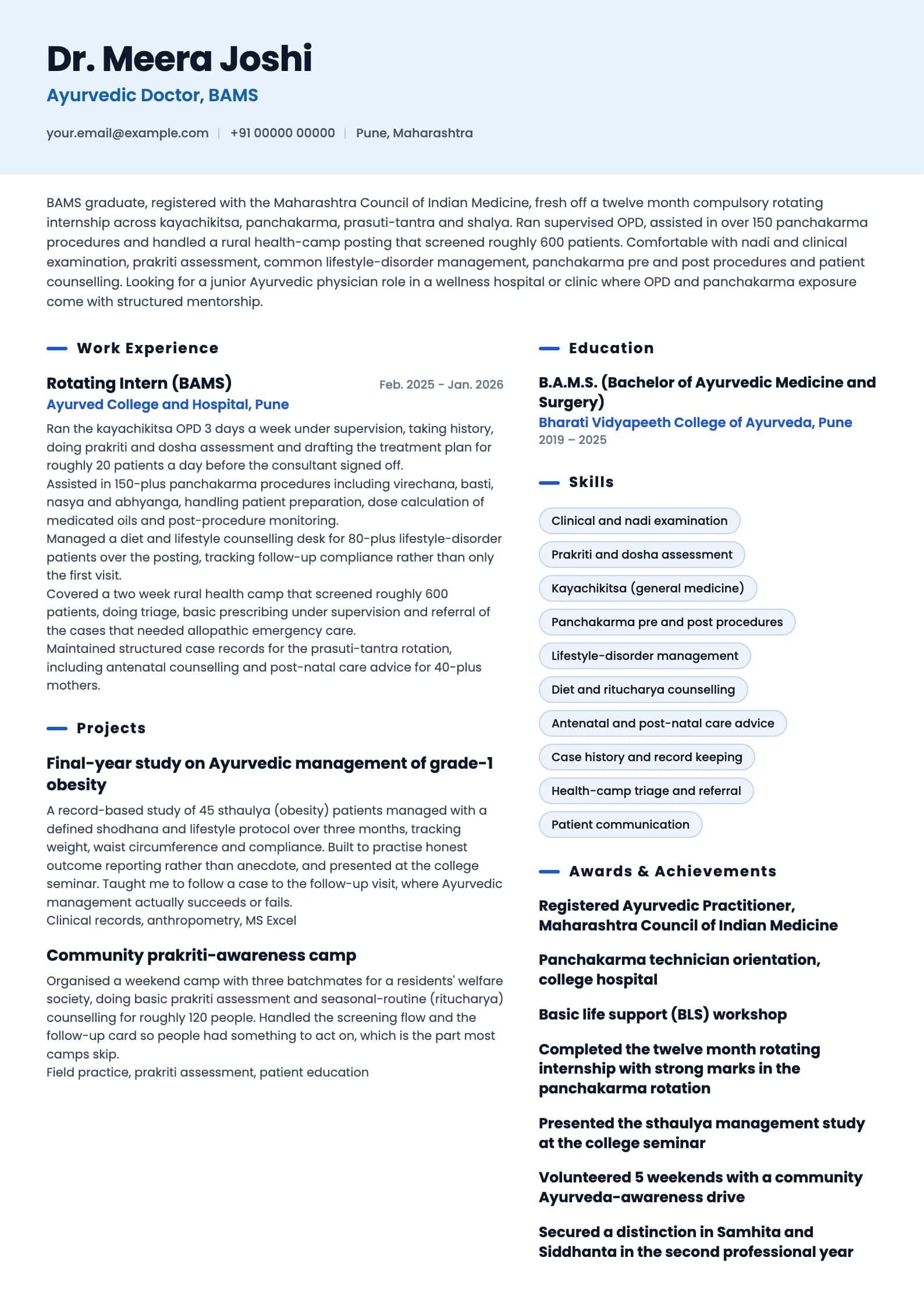
Build my resumeAyurvedic Doctor resume example, Fresher (0 years)
ai-era templateIs your resume good enough?
Upload the resume you have now and see what an applicant tracking system reads before a ayurvedic doctor recruiter ever does.
Free to run. Sign in with your mobile number to see your score.
Ayurvedic Doctor resume example, Mid-level (5 years)
professional template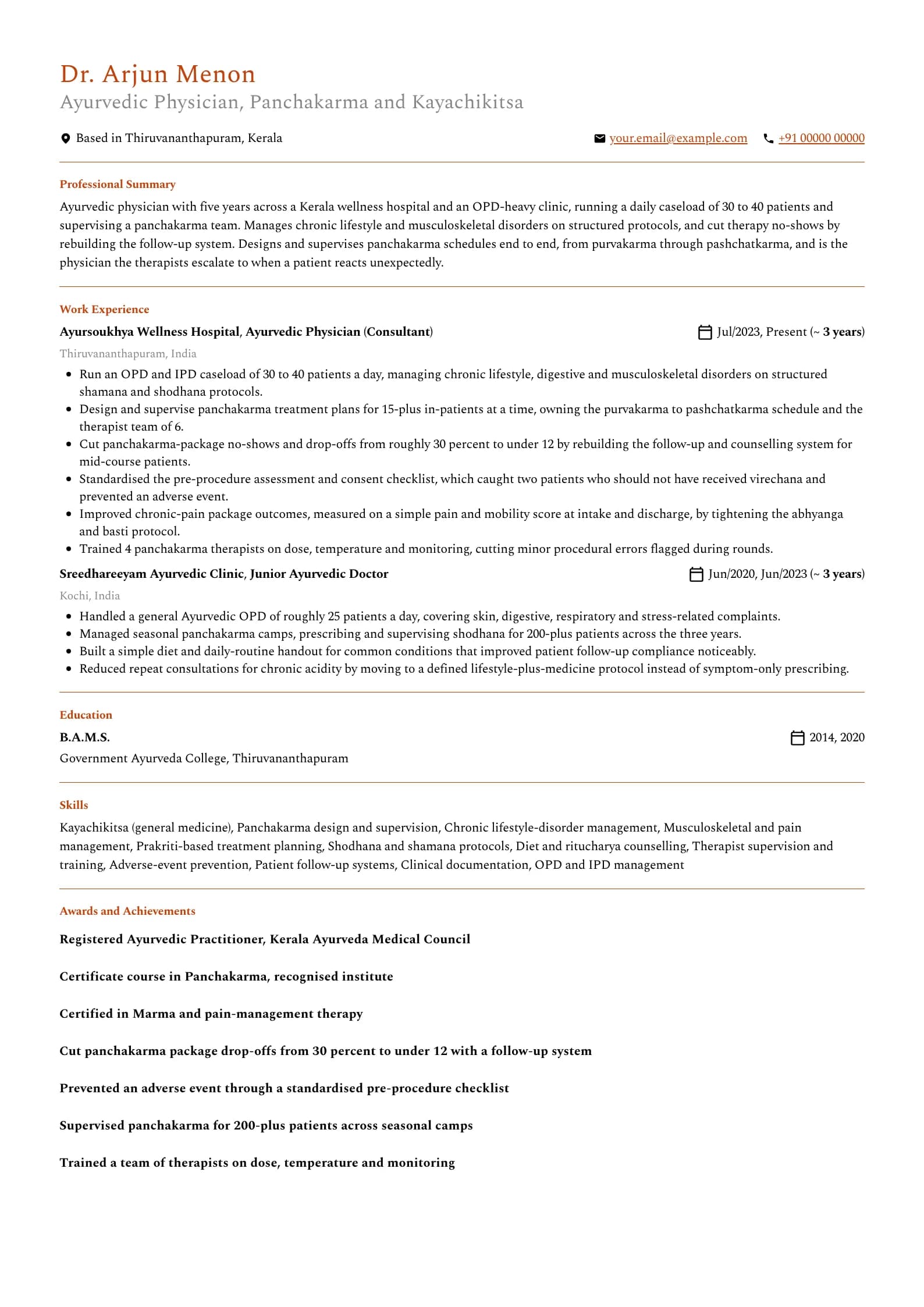
Want this structure with your own details? Build it in the resume builder.
Ayurvedic Doctor resume example, Senior (11 years)
header-band template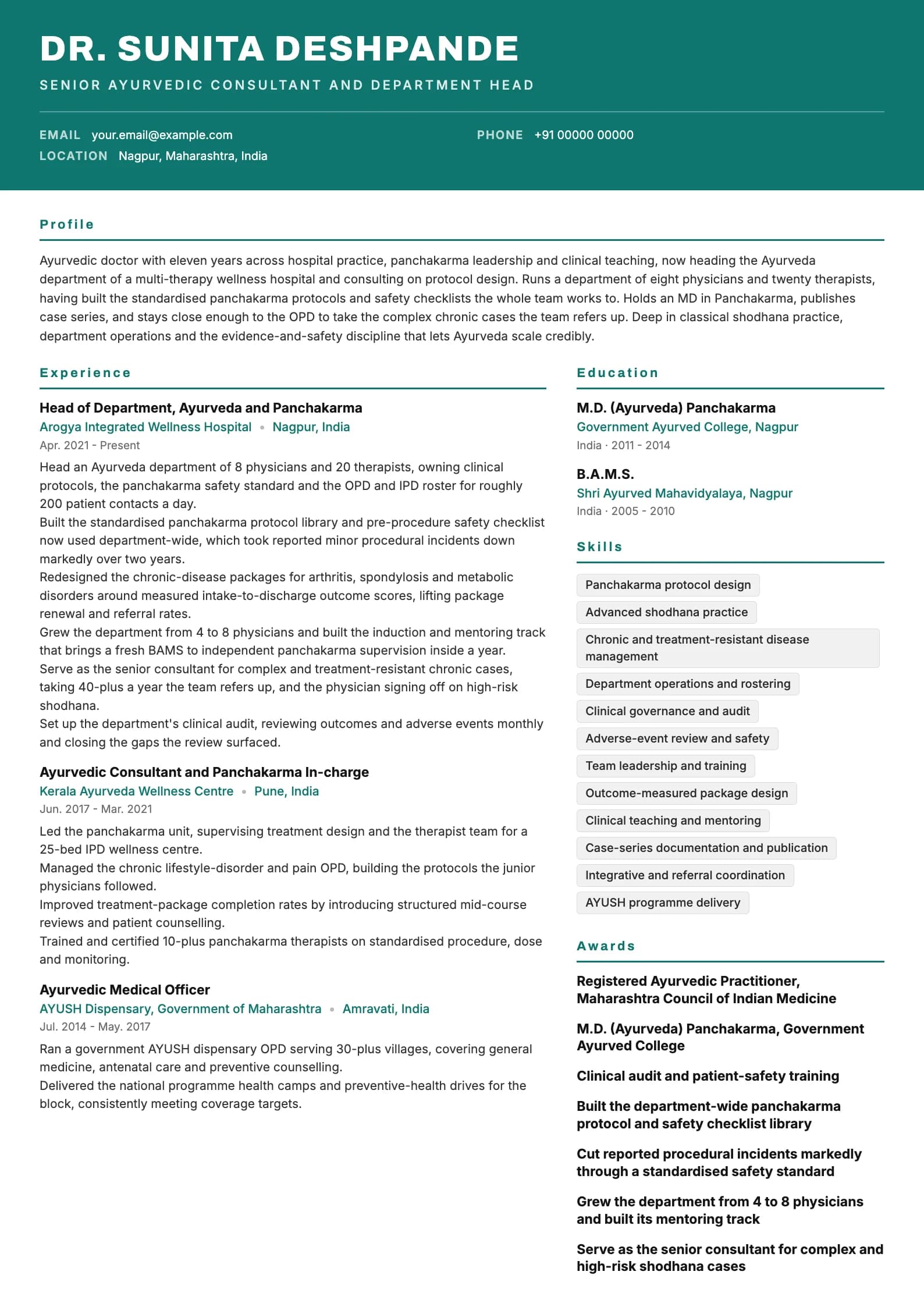
The format that works for Ayurvedic doctor resumes in India
Reverse chronological is the layout to use. Put the most recent role first, work backwards, and keep the dates visible. The thing an Ayurvedic resume must surface above everything else is your registration: whether you are registered with a State Council of Indian Medicine or Board of Ayurvedic and Unani Systems, and your registration number. A hospital, a wellness chain or a government AYUSH recruiter cannot let you see a patient without it, so it belongs in the summary line and again in a licence block, not buried on page two. Length follows evidence. One page holds a fresher and most physicians up to roughly six or seven years. A senior consultant with an MD, a case-series list and a decade of department work can justify two, provided the second page carries real clinical and leadership work and not a longer paragraph of classical principles. A page built from a shloka and a hobbies line is padding either way. Four things do not belong on a clinical resume here: a photograph, date of birth, marital status and father's name. They survive from an older campus template. Nobody screening an Ayurvedic physician needs them, and each line they take is a line a caseload number or a package outcome could have used. The exception is a client-facing wellness-brand role whose posting explicitly asks for a photo. Send a PDF unless the posting asks otherwise, name the file with your own name and BAMS or Ayurvedic Doctor, and keep to a single column so a parser reads it in order. The table below sets out the section order.
| Section | Where it goes | Why |
|---|---|---|
| Name and headline | Top, above everything | Headline is the role you want: Ayurvedic physician, panchakarma consultant, AYUSH medical officer. |
| Registration line | In the summary and again in a licence block | State Council of Indian Medicine registration and number. Without it you cannot legally practise. |
| Professional summary | Directly under the header | Three lines. Clinical focus, years, and the single strongest result. |
| Clinical experience | Next, for anyone who has practised | Most recent first. Name caseload, panchakarma work and outcomes. |
| Skills and therapies | Below experience | Grouped: medicine, panchakarma, counselling, department skills. Not a wall of Sanskrit terms. |
| Education | Bottom, unless you are a fresher | BAMS, MD (Ayurveda), institution, years. Freshers keep it near the top with marks. |
| Certifications and CME | After education, or beside skills | Panchakarma, marma, BLS, safety courses. Name the issuing body. |
The registration line is the first thing a BAMS resume is screened on
An Ayurvedic doctor in India must be registered with a State Council of Indian Medicine, or the relevant state Board of Ayurvedic and Unani Systems, to practise. The recruiter or HR screener reads for that line before they read anything clinical. If it is missing they cannot tell whether you are eligible, and an eligible candidate with a weaker resume beats a strong resume that never confirmed the licence. Put it where it cannot be missed. Write it plainly: Registered Ayurvedic Practitioner, Maharashtra Council of Indian Medicine, with the registration number if you are comfortable including it. Fresh graduates who have applied but not yet received the number should write registration in process rather than leave it ambiguous, because a recruiter reads silence as not registered. If you hold an MD or MS in Ayurveda, name the speciality, because it changes what you can be hired for. An MD in Panchakarma, Kayachikitsa or Prasuti-Tantra is a different hire from a general BAMS physician, and the resume should make that legible in the headline, not leave it for the reader to infer from the degree line at the bottom. For government AYUSH roles, the same rules apply with more weight: state the council, the number and any national-programme or camp-delivery experience, since departmental screening checks these against a list. Do not decorate the licence with adjectives. It is a fact, and its value is that it is verifiable.
Before you polish a single bullet, confirm your resume states your State Council of Indian Medicine registration where a screener will see it in three seconds. A strong clinical resume that never confirms the licence gets filtered by someone who is not a clinician.
Writing a summary a hiring consultant actually reads
The block under your name is the part you can be reasonably sure gets read, so it should carry four facts: what you treat, how long you have treated it, your registration, and the strongest thing that happened because of your work. Three or four lines, no adjectives a reviewer cannot check, and no opening shloka. The old objective line, seeking a challenging position to serve humanity through the ancient science of Ayurveda, tells the reader nothing they did not assume. Replace it with a summary. An objective describes what you want; a summary describes what you have already done, and only one is evidence a hiring consultant can weigh. Freshers often think they have nothing to summarise. Look at the fresher sample: it names the internship rotations, the registration, 150-plus panchakarma procedures assisted and a 600-patient camp. That is a genuine summary built from a compulsory internship, which is real supervised clinical work. What it avoids is "passionate about holistic healing", a phrase on nearly every BAMS graduate resume that carries no information. A practical test: read your summary and ask whether a batchmate with the same BAMS could paste it onto their resume unchanged. If they could, it describes the degree, not you. Add the specific caseload, the panchakarma work you supervise and the specific outcome until it stops being transferable.
Professional summary, mid-level physician
Weak
Passionate and dedicated Ayurvedic doctor with 5+ years of experience committed to serving humanity through the ancient holistic science of Ayurveda, seeking a challenging role in a reputed wellness hospital.
Strong
Ayurvedic physician, five years across a Kerala wellness hospital, registered with the Kerala Ayurveda Medical Council. Run a 30 to 40 patient daily caseload, design and supervise full panchakarma schedules, and cut therapy-package drop-offs from 30 percent to under 12 with a follow-up system.
The rewrite trades devotion language for a clinical focus, the licence, a panchakarma-ownership claim and one verifiable outcome.
Experience bullets: therapy, caseload, outcome
Every strong bullet in the samples follows the same shape. It opens with an action verb, names the specific clinical work or panchakarma programme you ran, and closes with what measurably moved. The verb establishes that you did it. The clinical detail tells a hiring consultant whether the work is relevant. The number does the persuading. Start with the outcome and work backwards. BAMS doctors usually write the duty first, then struggle to attach a number, which produces bullets like "treated patients with various diseases through Ayurvedic medicines and panchakarma". Instead ask what was different after you were there: a package drop-off fell, an adverse event was prevented, an outcome score improved, follow-up compliance rose. Then write the sentence that ends in that fact. Vary the metric. Do not report only patient counts. Across a real Ayurvedic role you can honestly reach for daily caseload, panchakarma volume, package completion and renewal rates, adverse-event and incident counts, intake-to-discharge outcome scores, therapist team size and camp coverage. The mid-level sample mixes several, which reads as range. Where you lack a number, give scope: how many in-patients supervised at once, how many therapists trained, how many villages a camp reached. "Supervise panchakarma for 15-plus in-patients at a time" carries weight without inventing a percentage. Be honest about what you did versus assisted. "Assisted in" is right for an intern; "design and supervise" is a claim a consultant must defend. In a wellness hospital, package retention and patient safety are what the employer is buying, so make sure at least one bullet speaks to each.
| Level | What bullets must prove | Typical metric |
|---|---|---|
| Fresher / intern | You have real supervised clinical exposure | Panchakarma procedures assisted, OPD cases seen, patients screened |
| 1 to 4 years | You run an OPD and supervise therapies | Daily caseload, panchakarma volume, package completion, counselling |
| 5 to 8 years | You own outcomes and design protocols | Package drop-off, adverse events prevented, outcome scores, team trained |
| 8 years and up | You run a department and set the standard | Protocol library, incident rate, renewal rate, physicians and therapists led |
Experience bullet, panchakarma role
Weak
Responsible for treating patients with various diseases through Ayurvedic medicines and panchakarma therapies as per hospital protocol.
Strong
Cut panchakarma-package no-shows and drop-offs from roughly 30 percent to under 12 by rebuilding the follow-up and counselling system for mid-course patients.
"Responsible for" reads as a job description; the rewrite names the change made and the drop-off rate it moved.
Experience bullet, safety
Weak
Ensured proper procedure and safety during panchakarma treatments given to all the patients.
Strong
Standardised the pre-procedure assessment and consent checklist, which caught two patients who should not have received virechana and prevented an adverse event.
Names the specific process built and the concrete harm it prevented, so a reviewer can weigh a real safety contribution instead of a generic assurance.
If a bullet would read identically on a batchmate's resume, it is describing the degree, not you. Rewrite it until it only fits the caseload and the panchakarma work you actually ran.
The skills and therapies section: grouped, honest, defensible
An Ayurvedic resume's skills section has two audiences. A parser or HR screener wants literal terms it can match, panchakarma, kayachikitsa, shodhana. A hiring consultant wants a short, organised list that signals what kind of physician you are and what you can be handed unsupervised. Grouping satisfies both. Group by function rather than one long line. Medicine, panchakarma and therapies, counselling, and department or operations is a grouping that works for almost every Ayurvedic doctor. The exact headings matter less than the fact that structure exists. Separate what you supervise and design from what you assist with, because a hiring consultant reads a flat list of therapies as claims of independent competence. Write Sanskrit clinical terms with their common English gloss at least once, for example panchakarma (bio-purification) and kayachikitsa (general medicine), because HR screeners and non-Ayurveda hospital administrators search on both. A resume that is only Sanskrit clinical terms filters out at the non-clinical screening stage, which is often the first one. Do not include a proficiency bar or a wall of every classical term you can recall. Ten to sixteen grouped, defensible skills is the working range. Every item is a question you have agreed to answer, and in Ayurveda that answer often comes in a practical or a case discussion, so list only what you can stand behind.
| Group | What goes in it | How many |
|---|---|---|
| Medicine | Kayachikitsa, lifestyle-disorder management, pain and musculoskeletal, respiratory and digestive | 3 to 5 |
| Panchakarma | Vamana, virechana, basti, nasya, abhyanga (design and supervise, or assist) | 2 to 4 |
| Assessment | Nadi and clinical examination, prakriti and dosha assessment | 1 to 3 |
| Counselling | Diet, ritucharya and daily-routine advice, patient education | 1 to 2 |
| Practice / department | Protocol design, therapist supervision, audit, documentation | 2 to 3 |
Skills section
Weak
Skills: Ayurveda, panchakarma, all diseases treatment, nadi pariksha, ashtavidha pariksha, dashavidha pariksha, samhita knowledge, dravyaguna, rasashastra, kayachikitsa, communication, MS Office, dedicated, hardworking.
Strong
Medicine: kayachikitsa (general medicine), lifestyle-disorder and pain management. Panchakarma: virechana, basti and nasya (design and supervise). Assessment: nadi and prakriti examination. Counselling: diet and ritucharya. Practice: protocol design, therapist supervision, clinical documentation.
Cuts filler traits and the vague "all diseases", glosses the Sanskrit terms so a non-clinical screener can search them, and separates supervised from assisted panchakarma.
Wellness hospital, OPD clinic, AYUSH post or industry: naming what you are
Ayurvedic practice in India splits into settings that want very different resumes, and the common mistake is one generic resume for all of them. A panchakarma-led wellness hospital, an OPD-heavy urban clinic, a government AYUSH dispensary, an Ayurvedic pharmaceutical or nutraceutical company and a wellness-resort or medical-tourism centre each read a resume looking for different evidence. For a wellness hospital, lead with panchakarma design, package outcomes, patient retention and safety, because the business runs on treatment packages and repeat patients. For an OPD clinic, lead with caseload, chronic-disease management and consultation volume, since the clinic hires on your ability to run a busy consult room and keep patients coming back. For a government AYUSH medical officer post, foreground registration, national-programme and camp delivery, antenatal and preventive work, since departmental screening checks these against a list. For industry, in Ayurvedic pharma, formulation or nutraceuticals, the resume shifts toward product knowledge, formulation understanding, medical detailing or R and D, and it reads closer to a technical or field role than a clinical one. A physician moving into industry should translate the clinical work into that language rather than assume the reader will. Medical-tourism and resort roles add languages, cross-cultural patient handling and international-guest experience to the mix. If you genuinely span settings, as the senior sample does, say so with evidence on both sides rather than claiming to do everything, because "experienced in all fields of Ayurveda" has no evidence in it.
Where education, internship and certifications belong
Education goes near the top for a fresher, who has nothing stronger to lead with, and at the bottom for anyone with clinical experience. The core entries are your BAMS with institution and years, and any MD or MS in Ayurveda with its speciality, because the postgraduate speciality changes what you can be hired for and belongs in the headline as well as the education block. The compulsory rotating internship is clinical experience, not education, so a fresher should give it its own experience entry with real bullets, as the fresher sample does, rather than fold it into a degree line. It is the strongest evidence a new graduate has, and burying it wastes it. Aggregate percentage is worth keeping while you are a fresher and it is respectable, since campus and early-career screening still filters on it. Once you have a few years of practice, drop it. A marks number from years ago competes for space with caseload and panchakarma outcomes that predict far more. Continuing education sits just below education, or beside skills if you hold only one or two. A dedicated panchakarma certificate course, marma and pain-management training, basic life support, and any patient-safety or clinical-audit training are worth naming with the issuing body and year, because they signal you keep current and take safety seriously, which is exactly the concern a modern wellness hospital screens for. List only what you actually hold, because a practical or case interview exposes an overclaim quickly.
Getting an Ayurvedic doctor resume through the applicant tracking system
Wellness hospital chains, integrative-medicine startups, Ayurvedic pharma companies and larger clinic groups run applications through an applicant tracking system before a human sees them. An ATS is a parser and a search index, not a judge. It reads your file, tries to break it into name, dates, employers, titles and skills, and stores the result so a recruiter can search. Almost every ATS problem is a parsing problem, and parsing problems come from layout, not wording. The layout rules are short. One column. Standard section headings, so use Work Experience rather than My Healing Journey, and Skills rather than My Expertise. No text inside images, because a clinic-logo strip reads as empty space. Keep the registration line in the body, not only in a header or footer that some parsers drop. Avoid text boxes and nested tables in the body. On wording, mirror the language of the posting where it is honest, and gloss the Sanskrit. If the posting says panchakarma, write panchakarma; if it says lifestyle-disorder management, use that phrase. Include the English expansion alongside a clinical Sanskrit term at least once, for example panchakarma (bio-purification therapy) and kayachikitsa (general medicine), so a non-clinical HR screener's search also finds you, and spell out BAMS in full once. Keyword stuffing does not work. A hidden block of every classical term in white text is caught quickly, and the outcome is worse than being filtered. Write real bullets that naturally contain the right terms. Save as a text-based PDF, open it, and confirm you can select and copy a sentence, including the registration line. If you cannot select the text, neither can the parser.
Section heading
Weak
My Journey in the Science of Life
Strong
Clinical Experience
Parsers look for standard headings; a poetic one can push the whole block into an unclassified bucket the recruiter never searches.
Test your own file before you send it. Copy the text out of the PDF into a plain text editor. Whatever you can read there is roughly what the parser sees, and anything scrambled, especially your registration line, is a real risk.
What gets Ayurvedic doctor resumes rejected
Most rejections at the resume stage are not close calls. They come from a small set of recurring problems, and all of them are fixable in an afternoon. The list below covers what recruiters and hiring consultants see most often on Indian BAMS resumes, in rough order of how much damage each one does.
- No State Council of Indian Medicine registration line, or it is buried on page two. It is the first thing screened, so put it in the summary.
- An opening shloka or a paragraph of classical principles instead of a summary of what you have actually done and achieved.
- "Treatment of all diseases through Ayurveda" instead of naming your clinical focus, which reads as a physician who has not decided what they are.
- Overclaiming panchakarma you have only assisted. A practical or case interview follows and exposes it.
- Duties copied from the hospital routine instead of outcomes. "Responsible for treating patients" is the tell.
- No numbers anywhere. Caseload, package completion, adverse events prevented, outcome scores. Pick whichever is honest.
- Only Sanskrit clinical terms with no English gloss, so a non-clinical HR screener's search never finds you.
- One generic resume sent to a wellness hospital, a government AYUSH post and a pharma role, when each reads for different evidence.
- A photo, date of birth, marital status or father's name from an old campus template, taking space an outcome could use.
- Inflated titles or dates that do not match your registration record and payslips. Verification is standard and a mismatch ends the process.
Read your resume aloud once before sending it. Any therapy you would not be comfortable being handed to supervise on your first day is a line to soften from "design and supervise" to the truth.
Skills to put on a ayurvedic doctor resume
Technical
- Kayachikitsa (general medicine)
- Panchakarma design and supervision
- Shodhana and shamana protocols
- Nadi and clinical examination
- Prakriti and dosha assessment
- Chronic lifestyle-disorder management
- Musculoskeletal and pain management
- Prasuti and antenatal care
- Adverse-event prevention and safety
- Diet and ritucharya counselling
- Outcome-measured package design
- Clinical documentation
- Clinical audit
- Health-camp triage and referral
Tools and platforms
- Panchakarma therapy equipment
- Medicated oils and formulations
- Vital-signs and monitoring devices
- Anthropometry tools
- Electronic medical records
- Clinic-management software
- Pre-procedure safety checklists
- Patient follow-up systems
Working skills
- Patient counselling and education
- Empathetic communication
- Clinical decision-making
- Therapist supervision and training
- Team leadership
- Case documentation
- Cross-team and referral coordination
- Ethical and safety judgement
Certifications worth listing as a ayurvedic doctor
| Certification | Full name | Worth it for |
|---|---|---|
| State Council Registration | Registered Ayurvedic Practitioner, State Council of Indian Medicine / Board of Ayurvedic Systems | Mandatory for anyone who intends to practise as an Ayurvedic doctor in India. It is the first line a recruiter or government AYUSH screener reads, so every practising BAMS doctor must carry it. Freshers who have applied but not yet received the number should state registration in process rather than leave it blank. |
| MD / MS (Ayurveda) | Doctor of Medicine / Master of Surgery in Ayurveda (Panchakarma, Kayachikitsa, Prasuti-Tantra and allied) | Worth naming in the headline for those who hold it, because the speciality changes what you can be hired for. Most valuable for consultant, department-head, teaching and senior wellness-hospital tracks. A general BAMS physician without it is not disadvantaged for routine OPD and junior roles. |
| Panchakarma Certificate | Certificate / diploma course in Panchakarma (recognised institute) | A practical signal for clinicians in panchakarma-led wellness hospitals, where treatment packages are the core business. Worth it for a BAMS graduate who wants to specialise in therapy design and supervision. Less relevant for a purely OPD or government preventive-care role. |
| Marma and Pain Therapy | Certified course in Marma and Ayurvedic pain-management therapy | Useful for physicians focused on musculoskeletal and chronic-pain packages, which are a large share of wellness-hospital demand. Signals a defined therapeutic niche. Most valuable in the one-to-eight-year clinical range. |
| BLS | Basic Life Support certification | Worth holding for any clinician in an IPD or wellness-hospital setting where a patient can deteriorate during a procedure. Signals you can manage the first minutes of an emergency and know when to refer to allopathic care. Increasingly expected by integrative and corporate wellness employers. |
| Patient Safety / Clinical Audit | Clinical audit and patient-safety training | A differentiator for senior and department-head candidates at hospitals that answer to a board or accreditation. Signals you bring measurement and safety discipline to Ayurvedic practice, which is exactly what lets it scale credibly. Not expected at fresher level. |
Keywords an ATS scans for in a ayurvedic doctor resume
These are the literal terms a parser matches against the job description. Use the ones that are true of you, in the sentences where you did the work, not as a list at the bottom.
- ayurvedic doctor
- bams
- ayurvedic physician
- state council of indian medicine registration
- panchakarma
- kayachikitsa
- shodhana
- virechana
- basti
- nasya
- prakriti assessment
- lifestyle disorder management
- ayush medical officer
- wellness hospital
- opd
- patient counselling
- chronic disease management
- clinical documentation
- md ayurveda
- ritucharya
Ayurvedic Doctor resume FAQ
What salary can an Ayurvedic doctor expect in India?
A fresh BAMS graduate typically starts around 2.5 to 5 LPA in clinics and wellness hospitals, with corporate wellness chains and medical-tourism centres at the higher end. A physician with five to eight years running an OPD and supervising panchakarma usually sits in the 5 to 12 LPA band, more in a metro or as a package-driven consultant. Senior consultants, department heads and MD (Ayurveda) specialists commonly earn 10 to 22 LPA and above, while government AYUSH medical officer posts carry the relevant state pay scale plus allowances and strong job security. An MD speciality, panchakarma leadership and medical-tourism languages push the top of every band upward.
How long should an Ayurvedic doctor resume be?
One page for a fresher and most physicians up to about six or seven years. A senior consultant with an MD, case series and a decade of department work can justify two pages, provided the second page carries real clinical and leadership work and not a longer paragraph of classical principles. Nobody has been rejected for a resume that was too easy to read. If you cannot fit one page, cut the oldest role to a line, drop coursework, and remove any therapy you would not want tested in a case discussion.
Where do I put my council registration on the resume?
In two places: one line inside the professional summary, and again in a licence or certifications block. It is the first thing a recruiter or a government AYUSH screener reads, because you cannot legally practise without it, so it must be visible in the first few seconds. Write it as Registered Ayurvedic Practitioner with your State Council of Indian Medicine and, if you are comfortable, the registration number. Freshers who have applied but not received the number should write registration in process rather than leave it ambiguous.
How does a BAMS fresher write a resume with no job experience?
Your compulsory rotating internship is real supervised clinical experience, so give it its own experience section with quantified bullets: panchakarma procedures assisted, OPD cases seen, patients screened at camps, rotations covered. Then education with marks, then skills and any short courses. Add anything checkable, such as your council registration or a research presentation. Verifiable facts carry more weight than "passionate about holistic healing", which every BAMS graduate writes and which tells a reviewer nothing.
Should I open the resume with a Sanskrit shloka or classical principles?
No. The block under your name is prime space that a hiring consultant reads first, and it should carry what you treat, your years, your registration and one real result, not a quotation. Your grounding in the classical texts is assumed from the BAMS. Spend the space proving you can run a caseload and supervise panchakarma safely, because that is what the employer is deciding on.
Should I write clinical terms in Sanskrit or English?
Both. Write the Sanskrit clinical term with its common English gloss at least once, for example panchakarma (bio-purification) and kayachikitsa (general medicine). Clinical reviewers search on the Sanskrit, but the first screener is often a non-clinical HR person or an applicant tracking system searching on the English, and a resume that is only Sanskrit filters out at that stage. Glossing satisfies both readers.
Do certifications like a panchakarma course or an MD help?
They help when they match the setting. A dedicated panchakarma certificate matters for wellness hospitals; an MD (Ayurveda) speciality matters for consultant, teaching and department-head roles and belongs in your headline, not just the education block. Patient-safety and BLS training increasingly reassure integrative and corporate employers. Name the issuing body and the year, and list only what you actually hold, because a practical or case interview checks it.
Do I need a photo on an Ayurvedic doctor resume in India?
No. Hiring hospitals and clinics do not expect one, and it takes space a caseload number or a package outcome should occupy. The same goes for date of birth, marital status, father's name and a declaration paragraph, all of which come from an older campus template. The only exception is a client-facing wellness-brand or resort role whose posting explicitly asks for a photograph.
Should I use the same resume for a wellness hospital, a government post and a pharma role?
No. A wellness hospital reads for panchakarma design, package outcomes and safety; a government AYUSH medical officer post reads for registration, national-programme and camp delivery; and an Ayurvedic pharma or nutraceutical role reads more like a technical or medical-detailing resume with product and formulation knowledge. Keep one master resume and tailor the summary, the skills order and the emphasis of the bullets to whichever setting you are applying to.
Related resume examples and guides
Build your Ayurvedic doctor resume in any of these formats
Start from a blank resume or upload the one you have. Goodspace renders it in 24 templates and flags the registration line, panchakarma work and clinical keywords an applicant tracking system will look for, and the classical padding it will not credit.
Build my resume