Strategy Analyst Resume Format, with 3 Full Samples
A strategy analyst is hired on evidence of a recommendation leadership acted on and a number that moved because of it, yet most resumes list frameworks, Excel and PowerPoint and forget the decision the analysis actually drove. Below are three complete resumes, one for an MBA graduate targeting a corporate strategy team, one for a strategy analyst with four years building the cases that went to leadership, and one for a senior analyst who owns a strategic agenda and mentors a team. After the samples come the format rules, the difference between naming a framework and proving a decision, the terms a parser matches literally, and the mistakes that end a screening before a leader reads the page.
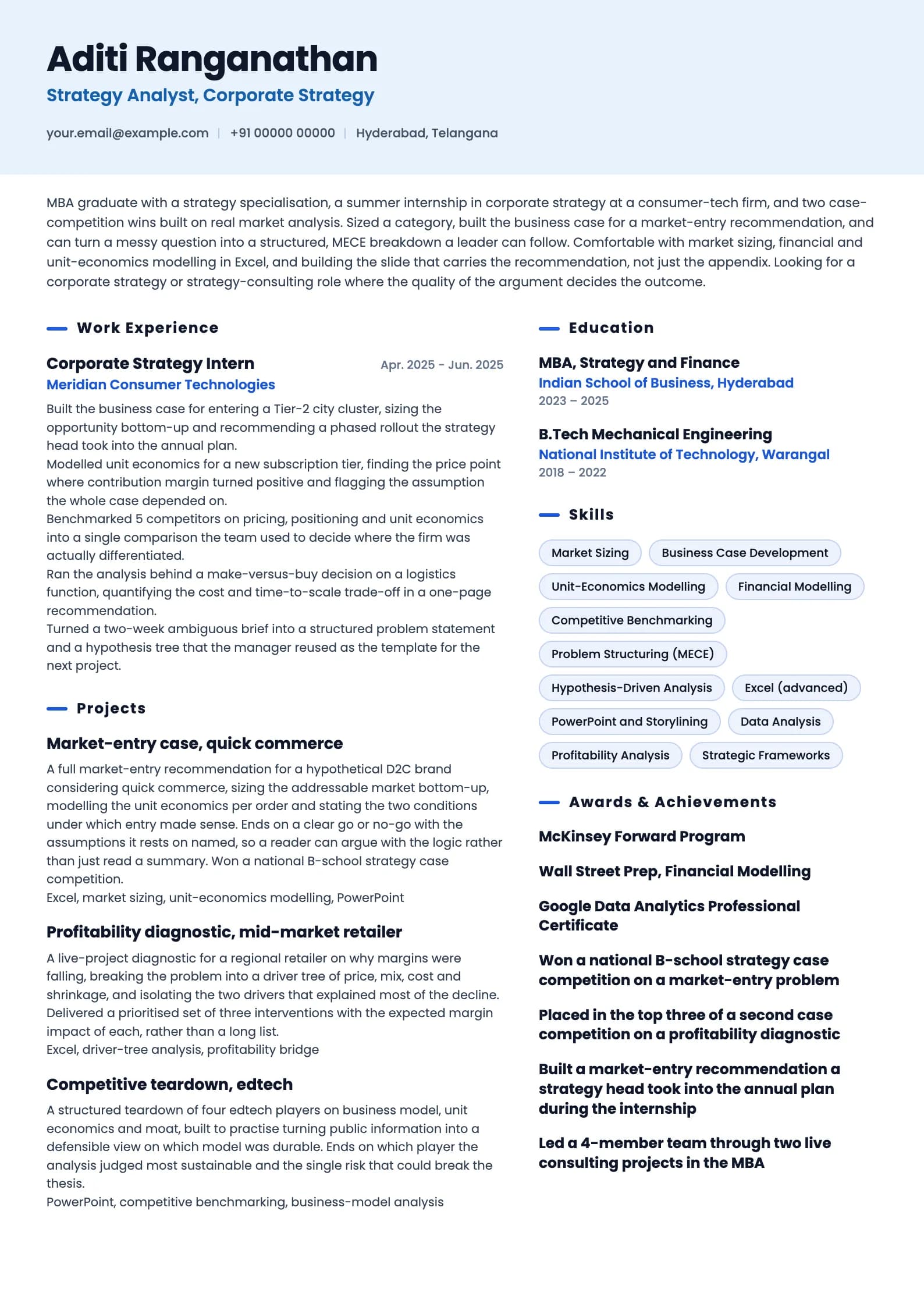
Build my resumeStrategy Analyst resume example, Fresher (0 to 1 year)
ai-era templateIs your resume good enough?
Upload the resume you have now and see what an applicant tracking system reads before a strategy analyst recruiter ever does.
Free to run. Sign in with your mobile number to see your score.
Strategy Analyst resume example, Mid-level (4 years)
professional template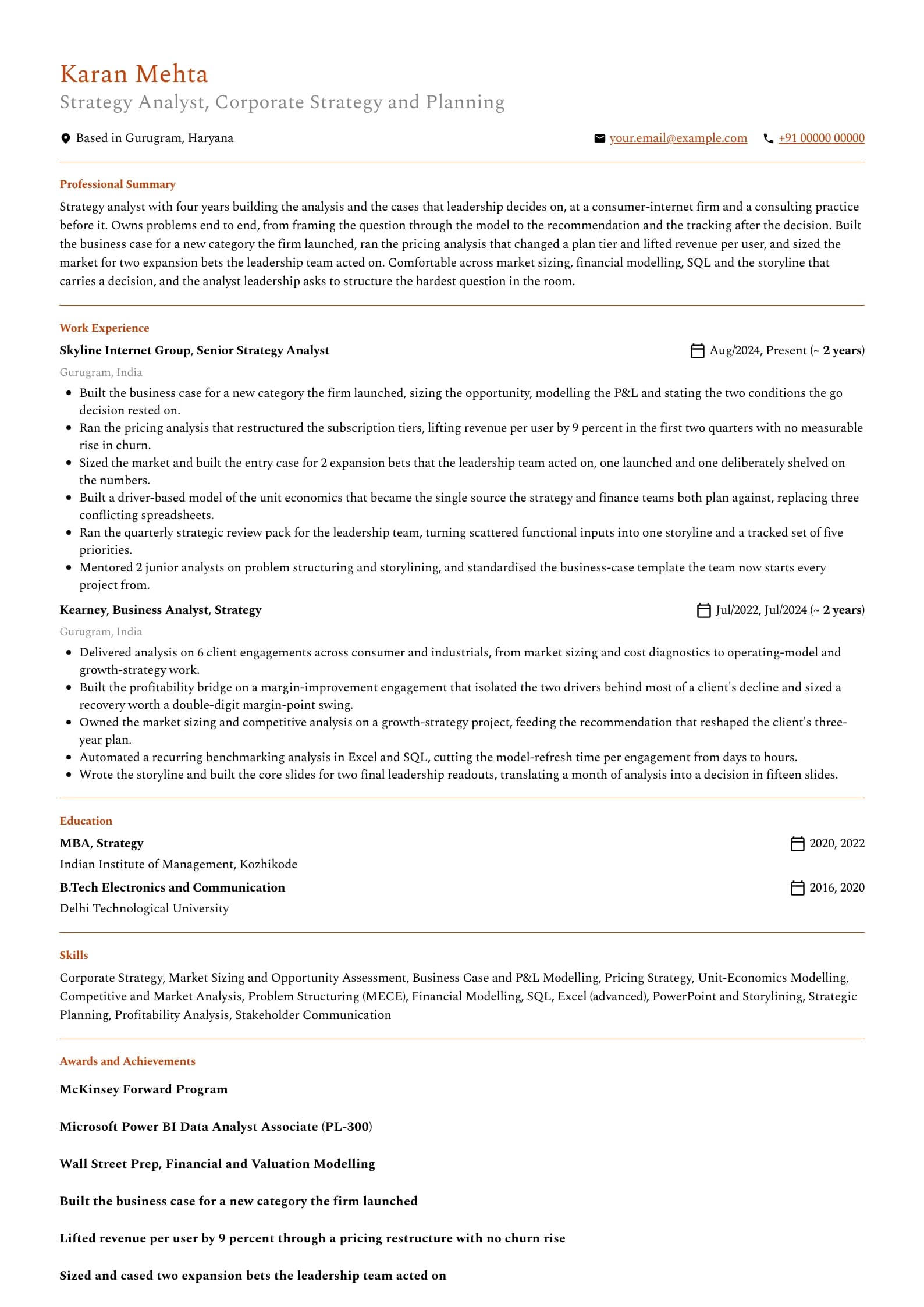
Want this structure with your own details? Build it in the resume builder.
Strategy Analyst resume example, Senior (9 years)
header-band template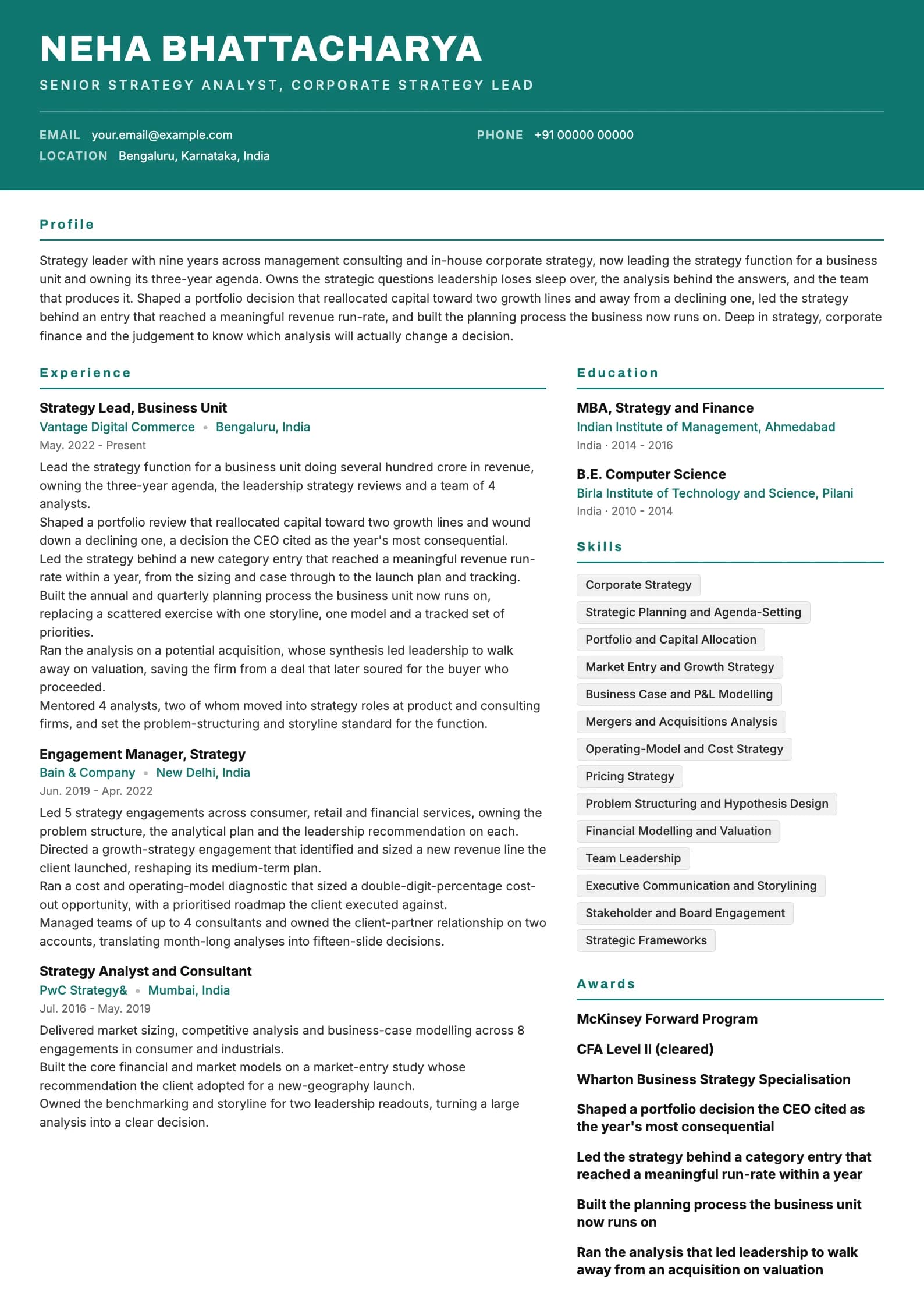
The format that works for strategy analyst resumes in India
Reverse chronological is the only layout worth using. Put the most recent role first, work backwards, and let the dates sit in plain view. Functional resumes that group everything under Skills and quietly drop the dates read as an attempt to hide a gap, and strategy teams treat them that way. Structuring information cleanly is the job, so a resume that hides its own structure is a poor sample of the work. Length is decided by evidence. One page holds everything a fresher and most analysts up to roughly six years have to say. Past that, a second page is fine when it carries real engagements, real recommendations and real decisions rather than a longer framework list. A page two built from a declaration paragraph and a hobbies line is a padded one-page resume. Four things belong nowhere on a professional resume here: a photograph, date of birth, marital status and father's name. They survive from an older template that circulated through campus placement cells. Nobody screening a strategy analyst is looking for them, and every line they occupy is a line a recommendation or a result could have used. Send a PDF unless the posting asks for DOCX, and name the file with your own name and the target role rather than resume_final_v4. Use a single column all the way down, because two-column layouts parse unpredictably when a sidebar sits beside the experience. The table below sets out the section order.
| Section | Where it goes | Why |
|---|---|---|
| Name and headline | Top, above everything | The headline is the role you want, strategy analyst, corporate strategy or strategy consulting. Recruiters match on it. |
| Professional summary | Directly under the header | Three lines. Domain, years, and the single strongest decision your analysis drove. |
| Work experience | Next, for anyone with a job | Most recent first. Newest role gets the most bullets. |
| Projects or case work | Above experience for freshers, below it after that | For a fresher a case competition or live project is the evidence. Experienced analysts show it inside engagements. |
| Skills | Below experience | Grouped: strategy method, analysis, tools, communication. Not a 40-item wall. |
| Education | Bottom for experienced, high for a fresher | The MBA and undergraduate degree. A strong programme is a real signal for entry strategy roles. |
| Certifications | After education, or beside skills if only one or two | Modelling, analytics and strategy programmes. Name, body, year. |
Naming a framework is not the same as proving a decision
The single most common strategy resume failure is a skills line that reads Porter's Five Forces, SWOT, PESTLE, BCG matrix, Ansoff, value chain, McKinsey 7S, blue ocean, with no bullet anywhere that shows any of it producing a decision. A parser matches those terms, but a hiring lead reads the wall and assumes it is an MBA syllabus, then goes looking for the one recommendation you can actually defend. Frameworks are tools, not achievements, and listing them as skills signals someone who has read about strategy rather than done it. The fix is to let the experience prove the thinking. Do not write SWOT on the skills line at all: write market sizing, business-case modelling, pricing strategy, the things you actually did, and let a bullet show the decision each one drove. The mid-level sample lists pricing strategy precisely because a bullet shows a tier restructure that lifted revenue per user. The skills line and the experience agree, which is what makes both believable. Be specific about the decision and the number. "Ran the pricing analysis that lifted revenue per user by 9 percent" or "sized two expansion bets the leadership team acted on" tells a reviewer exactly what kind of analyst you are, where "performed strategic analysis using various frameworks" tells them nothing. The decision your analysis drove is the single fact a strategy team screens on first. Do not confuse activity with impact. "Prepared reports and presentations for management" is activity. "Built the business case for a category the firm launched" is impact. Strategy work is judged by what leadership did next, so write the resume around decisions, not deliverables.
Cut the framework list entirely and replace it with the work: market sizing, business-case modelling, pricing, and the decision each drove. A recruiter wants the recommendation that landed, not the MBA reading list.
Writing a summary a strategy leader actually reads
The block under your name is the part you can be reasonably sure gets read, so it should carry three facts: what strategic problems you work on, how long you have been working on them, and the strongest decision that happened because of your analysis. Three or four lines, no adjectives that cannot be checked. The old objective line, seeking a challenging position in a reputed organisation to utilise your analytical and strategic skills, tells the reader nothing they did not assume from the application. Replace it with a summary. An objective describes what you want, a summary describes the decision you have already driven, and only one is evidence. Freshers often believe they have nothing to summarise. Look at the fresher sample: it names the internship, points at a case win built on real analysis, and states the core skill of turning an ambiguous question into a structure. That is a genuine summary built from an MBA, one internship and case competitions. What it avoids is "passionate about strategy and problem-solving", a phrase so common on graduate resumes it now carries no information. A practical test: read your summary and ask whether a classmate from the same MBA could paste it onto their resume unchanged. If they could, it describes the degree, not you. Add the specific decision, the specific number and the specific problem until it stops being transferable.
Professional summary, mid-level analyst
Weak
Highly analytical and strategic thinker with 4+ years of experience in corporate strategy, business analysis and problem-solving using various frameworks, seeking a challenging role in a reputed organisation.
Strong
Strategy analyst with four years building the cases leadership decides on. Built the business case for a category the firm launched, ran the pricing analysis that lifted revenue per user by 9 percent, and sized two expansion bets the leadership team acted on.
The rewrite trades framework name-dropping and self-description for three specific decisions the analysis actually drove.
Experience bullets: question, analysis, decision
Every strong bullet in the samples follows the same shape. It names the strategic question, states the analysis you ran, and closes with the decision it drove or the number it moved. The question establishes what was at stake. The analysis shows rigour. The decision does the persuading, because strategy that changed no decision is just a slide deck. Start with the decision and work backwards. Analysts usually write the activity first, then struggle to attach an outcome, which produces bullets like "conducted market analysis and prepared strategic recommendations". Instead ask what leadership did after your work: a category launched, capital moved, a price changed, a bet was shelved, a deal was walked away from. Then write the sentence that ends in that fact. A bet deliberately not taken counts, because preventing a bad decision is real strategy impact. Vary the metric. Four revenue numbers in a row read as one trick repeated. Across a real role you can honestly reach for revenue impact, margin points, cost-out, revenue per user, opportunity sized, engagements delivered, and decisions influenced. The samples use several metric types each, which reads as range. Where you lack a hard number, give scope: how many engagements, how large the market sized, how many priorities tracked, how many analysts led. "Delivered analysis on 6 client engagements across consumer and industrials" carries weight without inventing a percentage. For strategy work, being precise about your role in a team decision is more credible than claiming a whole outcome alone. Allocate bullets by recency. Current role gets five or six, the previous role four or five, anything older two or three.
| Level | What bullets must prove | Typical metric |
|---|---|---|
| Fresher | You can structure a problem and reach a defensible recommendation | Cases won, opportunity sized, recommendation adopted, projects led |
| 1 to 3 years | You own the analysis behind a decision without hand-holding | Engagements delivered, model built, opportunity or cost sized, storyline owned |
| 4 to 6 years | Your analysis drives a real leadership decision | Revenue or margin impact, price change, bets cased, launches |
| 7 years and up | You own a strategic agenda and how the organisation decides | Capital reallocated, category run-rate, planning process built, team led |
Experience bullet, corporate strategy
Weak
Conducted market research and competitive analysis and prepared strategic recommendations and presentations for the management team.
Strong
Ran the pricing analysis that restructured the subscription tiers, lifting revenue per user by 9 percent in the first two quarters with no measurable rise in churn.
"Conducted and prepared" describes activity; the rewrite names the analysis, the decision it drove and the number that moved, with a guardrail on churn.
Experience bullet, strategy consulting
Weak
Worked on a growth strategy project and helped the client identify new opportunities for revenue growth.
Strong
Owned the market sizing and competitive analysis on a growth-strategy project, feeding the recommendation that reshaped the client's three-year plan.
"Worked on and helped" hides your contribution; the rewrite states exactly what you owned and the decision it fed.
If a bullet would read identically on a teammate's resume, it is describing the project, not you. Rewrite it until it names the piece you actually owned and the decision it drove.
The skills section: grouped, honest, and short enough to defend
A strategy resume's skills section has two audiences with opposite preferences. The parser wants literal terms it can match, market sizing and financial modelling and SQL. A human wants a short, organised list that signals what kind of analyst you are. Grouping satisfies both. Group by function rather than one long line. Strategy method, analysis and modelling, tools, and communication is a grouping that works for almost every strategy analyst. The exact headings matter less than the fact that structure exists, and for a strategy role the structure of your own resume is itself a work sample. Write names the way the industry writes them: PowerPoint not power point, Power BI not PowerBI, SQL not Sql. A parser matches on strings. Twelve to sixteen skills is the working range. Below eight the section looks thin. Above twenty it stops being a signal, and a strategy resume is especially prone to framework padding: listing eight named frameworks as if they were skills. Drop them. List what you can do, market sizing, business-case modelling, pricing, not the frameworks you were taught. The list is a contract: every item is a question you have agreed to answer. Do not include a proficiency bar. Star ratings invite an argument you cannot win, and nobody agrees on what four stars in strategy means. Let the decisions your analysis drove prove the depth instead.
| Group | What goes in it | How many |
|---|---|---|
| Strategy method | Market sizing, business-case development, market entry, problem structuring | 3 to 5 |
| Analysis and modelling | Financial modelling, unit economics, pricing, profitability, competitive analysis | 3 to 5 |
| Tools | Excel, PowerPoint, SQL, Power BI or Tableau where real | 3 to 4 |
| Communication | Storylining, executive communication, stakeholder engagement | 2 to 3 |
| Domain | The sectors you know, e.g. consumer, retail, financial services | 1 to 3 |
Skills section
Weak
Skills: SWOT analysis, PESTLE, Porter's Five Forces, BCG matrix, Ansoff matrix, value chain, McKinsey 7S, blue ocean strategy, business strategy, corporate strategy, analytical skills, problem-solving, MS Office, communication, leadership, teamwork
Strong
Method: market sizing, business-case development, market entry. Analysis: financial modelling, unit economics, pricing, competitive analysis. Tools: Excel, PowerPoint, SQL. Communication: storylining, executive communication.
Cuts the framework and soft-skill wall, and replaces it with what you can actually do and be interviewed on.
Case work and projects: what to include and how to describe it
For a fresher, case work is the resume. A case-competition win, a live consulting project, an internship recommendation sits above experience, gets the most space, and is where a reviewer decides whether you can actually structure a problem and reach a decision or only recite frameworks. For an experienced analyst this moves into the engagement section, and a standalone project is kept only if it shows a capability the day job does not. The common failure is describing the topic instead of the recommendation. "A strategy project on market entry for a company" tells a reviewer nothing, because thousands of resumes carry that line. Describe the question, how you structured it, what you concluded, and what it rested on. The market-entry case in the fresher sample is a stronger entry than a longer one, because it ends on a go or no-go with the two conditions the call depended on named. Pick cases that show range and judgement rather than three market-entry decks. One market-sizing or entry case, one profitability or cost diagnostic, and one competitive or business-model teardown is a stronger set than three variations of the same problem. Two well-argued cases that reach a clear recommendation beat five listed by title. Always make the structure and the recommendation visible. A strategy reviewer is reading your project as a sample of how you think, so a project that ends in a neutral summary rather than a defensible view is a missed signal. Show the driver tree, the two assumptions, the go or no-go. The structure is the point, because structuring ambiguity is the core of the job.
Project description, fresher resume
Weak
Market Entry Project: worked on a strategy project analysing whether a company should enter a new market using various strategic frameworks.
Strong
Market-entry case, quick commerce: sized the addressable market bottom-up, modelled unit economics per order, and reached a clear go decision under two named conditions. Won a national B-school strategy case competition.
Swaps a topic and a framework mention for a structured analysis that ends on a real recommendation and its conditions.
Where education and certifications belong
Education carries more weight on a strategy resume than on most, because corporate strategy and consulting recruit heavily from specific MBA and undergraduate programmes. For a fresher it goes near the top, and a strong MBA is often the single biggest entry signal, so name the programme and specialisation clearly. For an experienced analyst it moves toward the bottom, below the engagements and decisions that now predict more than a degree does. List the MBA and the undergraduate degree with institution and years. A relevant specialisation, strategy, finance or a quantitative undergraduate degree, is worth naming because it maps to the work. CGPA or percentage is worth keeping while you are a fresher and it is good, roughly the top of your class or a strong number, because early strategy screening filters on academic signal. Once you have decisions to point at, drop it. Case competitions and live projects sit with education or as their own projects block for a fresher, and they matter: a national case win is a direct sample of the exact skill the role needs. Name the competition, the problem and the result. Certifications sit below education. Strategy has no single licensing exam, so the useful ones are specific: a financial-modelling programme, a data-analytics or BI certificate, and structured strategy programmes such as the McKinsey Forward Program or a university business-strategy specialisation. A CFA level carries weight where the role leans financial. Write the full name, the body and the year. Do not pad with generic online courses that any candidate can click through, because they signal effort without capability.
Getting through the applicant tracking system
An applicant tracking system is a parser and a search index, not a judge. It reads your file, tries to break it into name, dates, employers, titles and skills, and stores the result so a recruiter can search across candidates. Almost every ATS problem is a parsing problem, and parsing problems come from layout, not wording. The layout rules are short. One column. Standard section headings, so use Work Experience rather than My Journey, and Skills rather than My Toolkit. No text inside images, because a framework diagram or logo strip reads as empty space. No critical information in the header or footer region, which some parsers drop. Avoid text boxes and nested tables in the resume body, which is a real temptation for strategy candidates who want their resume to look like a consulting slide. On wording, mirror the language of the job description where it is honest. If the posting says corporate strategy, write corporate strategy. If it says market sizing, use that exact term. Include the expansion alongside an acronym at least once, for example "P&L (profit and loss)", so both searches find you. Keyword stuffing does not work. A hidden block of every framework in white text is found quickly, and the outcome is worse than being filtered. Write real bullets that naturally contain the right terms, because a bullet describing a business case you built contains the words business case and market sizing in a context that survives human review too. Save as PDF from a tool that embeds real text, then open the file and confirm you can select and copy a sentence. If you cannot select the text, neither can the parser. Strategy candidates who design a heavily formatted resume in a presentation tool are especially at risk here, so test the file.
Section heading
Weak
My Strategic Journey
Strong
Work Experience
Parsers look for standard headings; a creative one can push the entire block into an unclassified bucket the recruiter never searches.
Test your own file before you send it. Copy the text out of the PDF into a plain text editor. Whatever you can read there is roughly what the parser sees, and a resume designed to look like a slide often scrambles here.
What gets strategy analyst resumes rejected
Most rejections at the resume stage are not close calls. They come from a small set of recurring problems, and all of them are fixable in an afternoon. The list below covers what reviewers of Indian strategy analyst resumes see most often, in rough order of how much damage each one does.
- A framework wall, SWOT, PESTLE, Porter, BCG, listed as skills. It reads as an MBA syllabus, not evidence of doing strategy.
- No decision anywhere. Analysis that changed no leadership decision reads as a document. Name the launch, the price change, the capital moved, the bet shelved.
- Activity described instead of impact. "Conducted analysis and prepared presentations" is the tell; strategy is judged by what leadership did next.
- Vague ownership on team work. "Worked on" and "helped with" hide your contribution; name the piece you owned.
- No structure visible, when structuring ambiguity is the core skill. A project that ends in a neutral summary misses the whole signal.
- A photo, date of birth, marital status or father's name. None of it belongs on a professional resume, and it takes a recommendation's space.
- An over-designed resume built in a presentation tool that looks like a slide and parses like noise in an ATS.
- A generic objective line. Replace it with a summary that states domain, years and a decision your analysis drove.
- Padding with generic online courses that any candidate can click through, which signal effort without capability.
- Inflated impact claims that credit a whole company outcome to your slide, which an interviewer unpicks in the first probing question.
Read your resume aloud once before sending it. Any line that names a framework instead of a decision is a line to rewrite around what leadership did next.
Skills to put on a strategy analyst resume
Technical
- Market Sizing and Opportunity Assessment
- Business Case and P&L Modelling
- Market Entry and Growth Strategy
- Pricing Strategy
- Unit-Economics Modelling
- Competitive and Market Analysis
- Problem Structuring (MECE)
- Hypothesis-Driven Analysis
- Financial Modelling and Valuation
- Profitability and Cost Analysis
- Portfolio and Capital Allocation
- Operating-Model Analysis
- Strategic Planning
- Data Analysis
Tools and platforms
- Excel (advanced)
- PowerPoint
- SQL
- Power BI
- Tableau
- Financial Modelling Tools
- Think-Cell
- Market and Industry Databases
Working skills
- Storylining and structured communication
- Executive presence
- Stakeholder engagement
- Comfort with ambiguity
- Prioritisation and judgement
- Cross-functional collaboration
- Persuasion and influence
- Team leadership and mentoring
- Working to leadership deadlines
Certifications worth listing as a strategy analyst
| Certification | Full name | Worth it for |
|---|---|---|
| McKinsey Forward | McKinsey Forward Program | A structured, recognised programme in problem-solving, communication and adaptability, worth it for freshers and early-career analysts who want a credible signal of consulting-style thinking without an offer from a firm. It is respected because it teaches the actual method rather than a menu of frameworks. Less relevant once you have real engagements to point at. |
| Financial Modelling | Wall Street Prep or CFI Financial and Valuation Modelling | A practical certificate for strategy analysts who build business cases, P&L models and valuations, which is most of them. Worth it for freshers and mid-level analysts to prove modelling depth beyond an MBA course. The work outranks the badge once you have shipped models leadership decided on, so let it fall down the page over time. |
| PL-300 | Microsoft Power BI Data Analyst Associate | A useful signal for strategy analysts whose work increasingly involves self-serve dashboards and large datasets rather than static decks. Worth it if your role sits close to analytics and data. For a pure consulting-style strategy role built on Excel and PowerPoint, it is optional and secondary to modelling depth. |
| CFA | Chartered Financial Analyst (CFA Institute) | Worth it for strategy analysts whose work leans toward corporate finance, valuation, portfolio decisions or M&A, and for those eyeing a move toward investing or corporate development. List the exact level cleared, since even a level or two signals financial depth. Less essential for growth, operations or market-strategy roles where modelling and structuring matter more. |
| Business Strategy Specialisation | University Business or Corporate Strategy Specialisation (e.g. Wharton, Darden on an online platform) | A reasonable supporting credential for a fresher or career switcher building a strategy foundation outside a top MBA, or for a professional moving into strategy from an adjacent function. Name the university-backed programme specifically, and skip generic click-through courses, since recruiters distinguish a rigorous specialisation from filler. |
Keywords an ATS scans for in a strategy analyst resume
These are the literal terms a parser matches against the job description. Use the ones that are true of you, in the sentences where you did the work, not as a list at the bottom.
- strategy analyst
- corporate strategy
- business strategy
- market sizing
- business case
- financial modelling
- market entry
- pricing strategy
- unit economics
- competitive analysis
- strategic planning
- problem structuring
- profitability analysis
- growth strategy
- SQL
- excel
- powerpoint
- storylining
- stakeholder management
- portfolio strategy
Strategy Analyst resume FAQ
What salary can a strategy analyst expect in India?
It depends heavily on whether you are in-house or in consulting and on the calibre of the firm. An entry strategy analyst or associate from a strong MBA typically starts around 12 to 25 LPA at top consulting firms and product companies, and less at smaller in-house teams. A strategy analyst with four to six years commonly earns 20 to 40 LPA, and a strategy lead or manager with senior scope can cross 40 LPA to well beyond, especially at consulting firms and large product companies. A top-tier MBA, a consulting pedigree and a record of decisions your analysis drove push the top of every band upward.
How long should a strategy analyst resume be?
One page up to about six years of experience, two pages after that only if the second page carries real engagements, real recommendations and real decisions rather than a longer framework list. Consulting recruiters in particular prize a tight one-pager, since concision is part of the job. If you are struggling to fit one page, cut the oldest role to a single line, remove coursework, and delete any framework or tool you would not want to be interviewed on.
Should I list strategy frameworks like SWOT and Porter as skills?
No. A list of named frameworks reads as an MBA syllabus, not evidence that you have done strategy, and it is one of the fastest ways to look junior. List what you can actually do, market sizing, business-case modelling, pricing, competitive analysis, and let the bullets show the decisions those skills drove. Use a framework silently inside your thinking if it helps, but sell the recommendation it produced, not the framework itself.
How important is the MBA for a strategy analyst role?
It matters more here than in most fields, because corporate strategy and consulting recruit heavily from specific MBA and strong undergraduate programmes, and for a fresher the programme is often the single biggest entry signal. Name it clearly with the specialisation. That said, it is a door-opener, not a career, and once you have decisions your analysis drove, those outrank the degree. Candidates without a top MBA can compete on case wins, a consulting-style credential and a demonstrable record of structured problem-solving.
Should a fresher put case competitions and projects above experience?
Yes. With no full-time strategy role, a case-competition win or a live consulting project is the strongest evidence you can offer, so it sits directly under the summary. Describe the question, how you structured it, what you concluded and what it rested on, ending on a clear recommendation. Pick cases that show range: one market-sizing or entry case, one profitability diagnostic, and one competitive teardown. An internship still goes in a separate experience section below the projects.
How do I show impact when the decision was a team's, not just mine?
Name the piece you owned and the decision it fed, rather than claiming the whole outcome. "Owned the market sizing and competitive analysis that fed the recommendation which reshaped the client's plan" is credible and precise, where "drove the client's three-year strategy" invites a probing question you cannot answer. Strategy reviewers are experienced at unpicking inflated claims, so precise attribution of your contribution reads as more senior, not less.
Does an ATS reject resumes with two columns or heavy design?
It does not reject them outright, but strategy candidates are especially prone to building a slide-like, multi-column, heavily formatted resume that parses out of order or as noise. Some parsers read multi-column layouts wrong and interleave your sections. A clean single-column layout removes the risk, which is why the samples above use one. Test your own file by copying the text out of the PDF into a plain text editor, and if it reads in order there it will most likely parse correctly.
How do I write a strategy analyst resume with no experience?
Lead with case work and the MBA, then skills. Treat each case or project as a job: the question, how you structured it, what you owned and the recommendation you reached. A case-competition win counts, a live consulting project counts, an internship recommendation a leader acted on counts. Show the structure and the decision, since structuring ambiguity is the core skill. Add anything checkable, such as a national case result or a modelling certificate, since verifiable facts carry more weight than adjectives like strategic or analytical.
Do I need a photo on a strategy analyst resume in India?
No. Strategy and consulting recruiters do not expect one, and it takes space a recommendation or a result should occupy. The same goes for date of birth, marital status, father's name, nationality and a declaration paragraph. These come from an older template that spread through campus placement cells and add nothing to a professional screen. The only exception is a role that explicitly asks for a photograph in the posting.
Related resume examples and guides
Build your own in any of these formats
Start from a blank resume or upload the one you have. Goodspace renders it in 24 templates and flags the strategy, market-sizing and business-case keywords an applicant tracking system will look for, and the framework padding it will not credit.
Build my resume