Salesforce Developer Resume Format, with 3 Full Samples
A Salesforce developer is hired on evidence of Apex and Lightning Web Components that survive a governor limit, integrations that hold under real data volume, and orgs kept clean enough to deploy without fear. Most Salesforce resumes instead list every cloud and certification and forget the one trigger framework that stopped a recursion bug from corrupting records. Below are three complete resumes, one for a certified fresher fresh off Trailhead and a first project, one for a developer with four years across Apex, LWC and integrations, and one for a senior developer owning architecture and CI on a large multi-org estate. After the samples come the format rules, the difference between listing certifications and proving code, the terms a parser matches literally, and the mistakes that end a screening before a human sees your Trailhead badges.
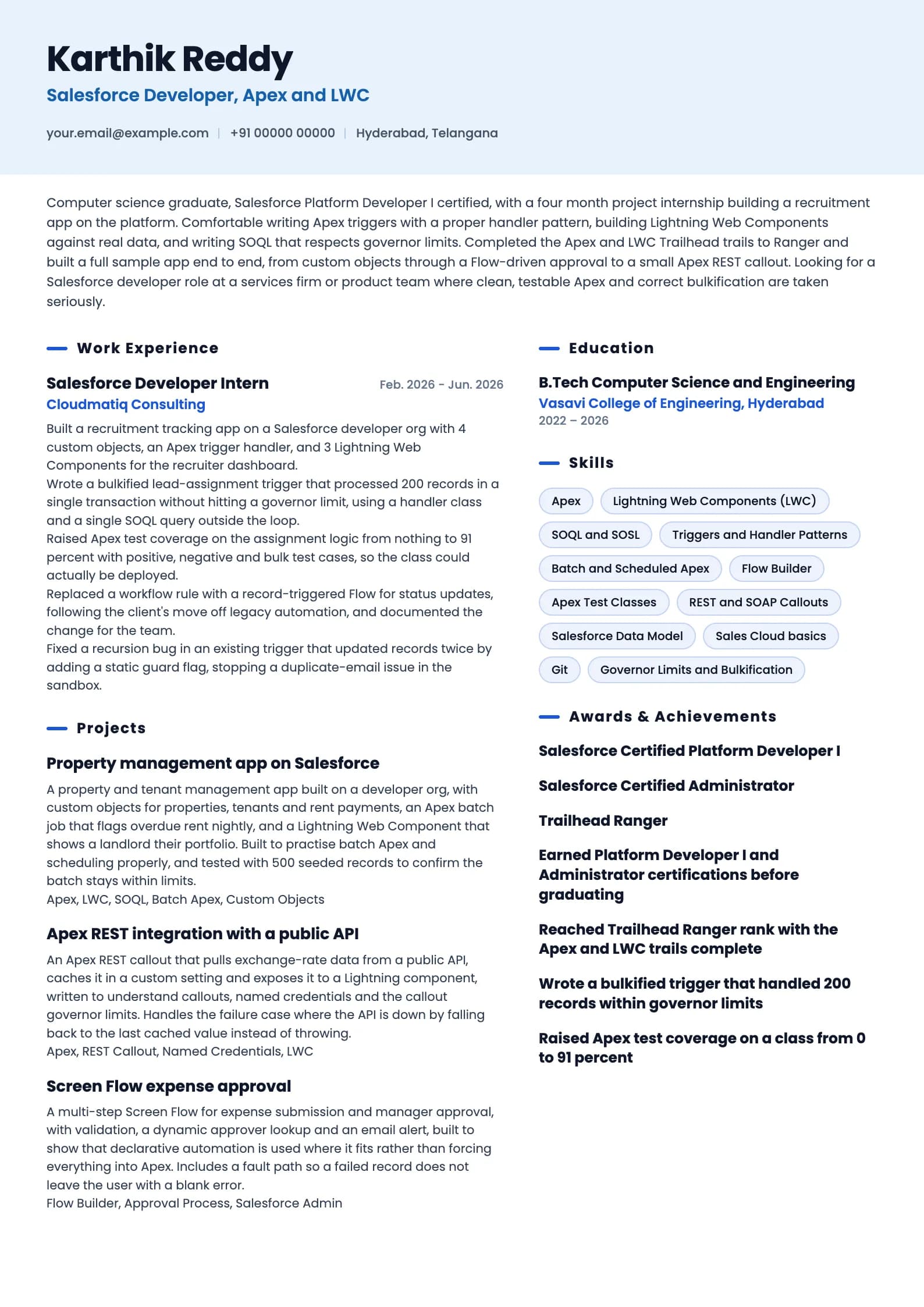
Build my resumeSalesforce Developer resume example, Fresher (0 to 1 year)
ai-era templateIs your resume good enough?
Upload the resume you have now and see what an applicant tracking system reads before a salesforce developer recruiter ever does.
Free to run. Sign in with your mobile number to see your score.
Salesforce Developer resume example, Mid-level (4 years)
professional template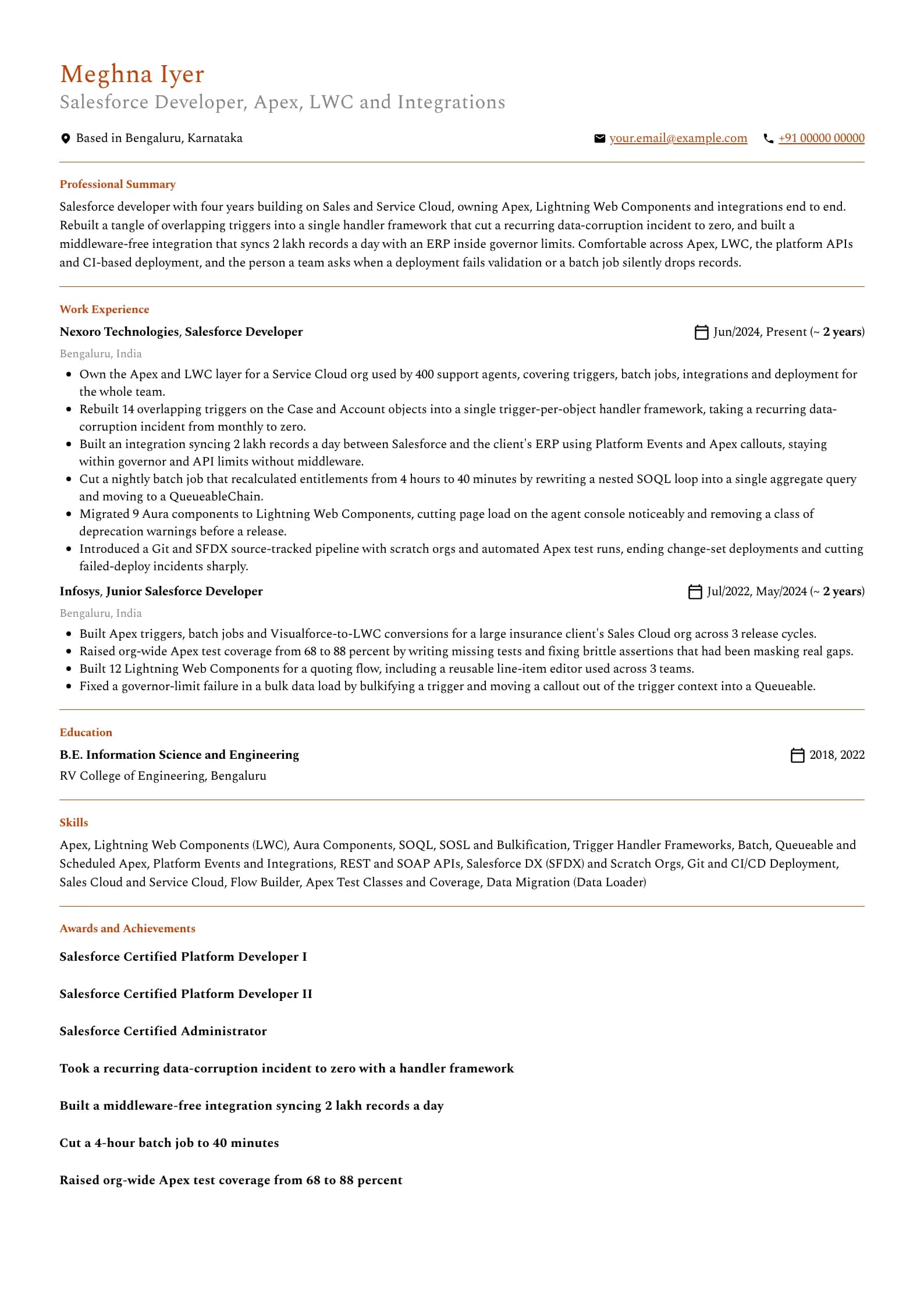
Want this structure with your own details? Build it in the resume builder.
Salesforce Developer resume example, Senior (9 years)
header-band template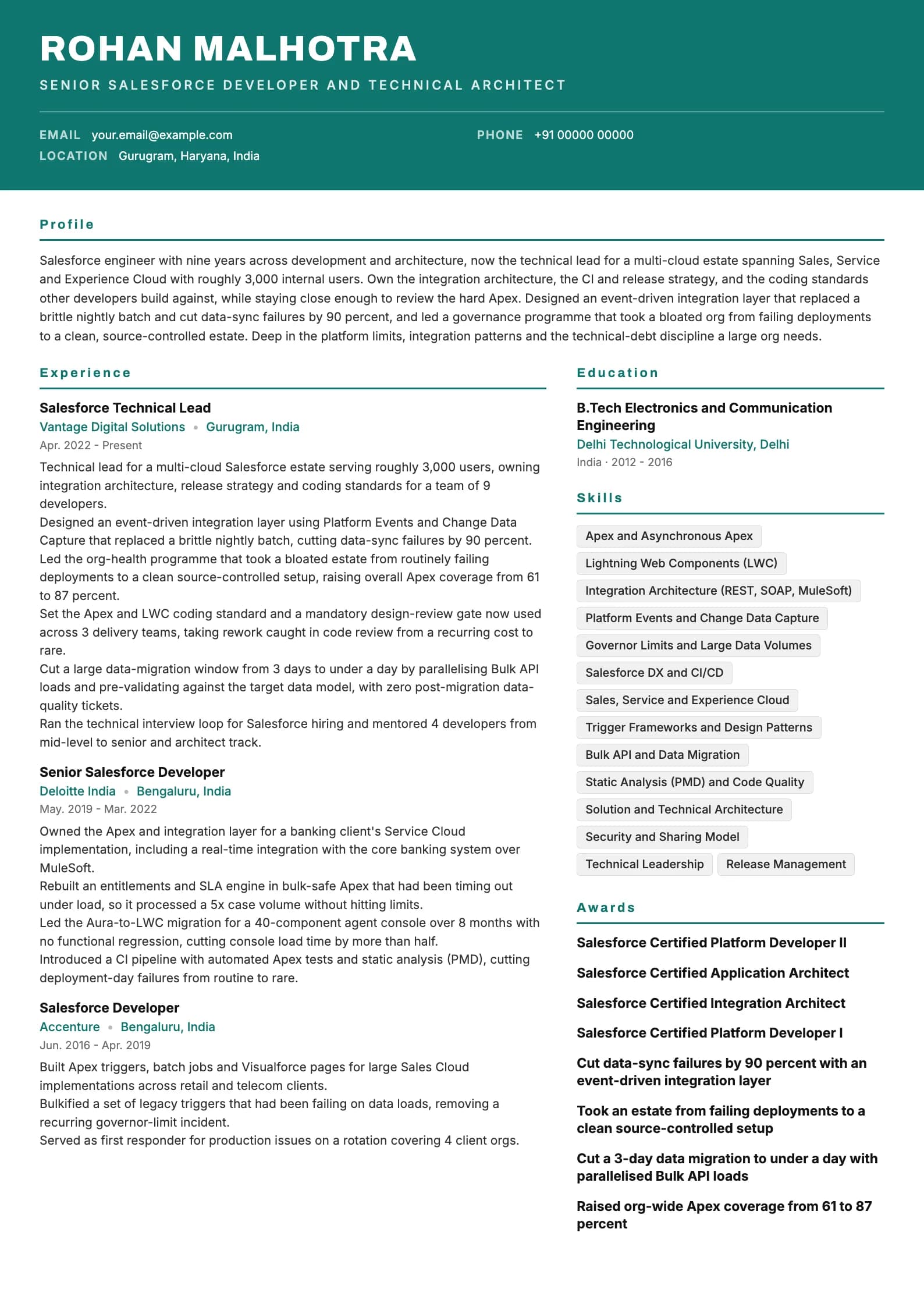
The format that works for Salesforce developer resumes in India
Reverse chronological is the layout to use. Most recent role first, work backwards, dates in plain view. Functional resumes that group everything under Skills and Certifications and drop the dates read as an attempt to hide a gap, and reviewers treat them that way. A gap is better explained in one honest line than buried. Length follows evidence. One page holds a fresher and most developers up to roughly six years. Past that, a second page is fine when it carries real architecture, integration or org-health work rather than a longer certification list. A page two built from a Trailhead badge dump and a declaration paragraph is a padded one-page resume. Four things belong nowhere on a Salesforce developer resume: a photograph, date of birth, marital status and father's name. They survive from an older campus template and add nothing to a technical screen. Every line they occupy is a line a shipped integration or a coverage number could have used. Name your certifications and, if you have one, your Trailhead rank, but keep them proportionate. A fresher may lead with Platform Developer I because it is the strongest signal they have. A senior developer with nine years should let the architecture work lead and list the architect certifications lower down, because at that level the org they fixed matters more than the badge. Send a PDF unless the posting asks otherwise, name the file with your own name and the role, and keep to a single column so a parser does not read a sidebar of certifications into the middle of your experience. The table below sets out the section order.
| Section | Where it goes | Why |
|---|---|---|
| Name and headline | Top, above everything | The headline is the role you want, Salesforce developer. Recruiters match on it. |
| Certifications | In the header for freshers, lower down for seniors | Platform Developer I and II are strong keywords. For a fresher they lead; for a senior they support. |
| Professional summary | Directly under the header | Three lines. Clouds, years, and the single strongest result. |
| Work experience | Next, for anyone with a job | Most recent first. Newest role gets the most bullets. |
| Projects | Above experience for freshers, below it after that | For a fresher this is the evidence. Show Apex, LWC and a real integration, not just Trailhead modules. |
| Skills | Below experience | Grouped: development, integration, clouds, tooling. Not a 40-item wall. |
| Education | Bottom, unless you are a fresher | Degree, institution, years. Drop the percentage after your first job. |
Certifications and Trailhead badges are not the same as proving code
The single most common Salesforce resume failure is a page dense with certifications and Trailhead badges and thin on anything that shows you can write Apex that holds under load. A parser matches Platform Developer I, Administrator, Ranger, and a human sees a candidate who has passed exams but may never have shipped a bulk-safe trigger. Salesforce hiring managers are wary of exactly this, because the platform is unusually easy to certify on and unusually unforgiving in production. The fix is to let the experience prove the code. For every certification you list, there should be a bullet showing the corresponding skill in real work. Platform Developer I is backed by a bulkified trigger and real test coverage. An integration certification is backed by a bullet naming the system you integrated and the volume it handled. The mid-level sample lists Platform Developer II and then shows a trigger-handler framework and a 2-lakh-record-a-day integration, so the badge and the work agree. Be specific about the platform's hard problems. Governor limits, bulkification, trigger recursion, test coverage, and the SOQL-inside-a-loop trap are the things that separate a Salesforce developer from someone who wrote a bit of Apex. A resume that mentions bulkification, a handler pattern and a Queueable is far stronger than one that lists ten certifications and never names a limit. Do not lean the resume on declarative work alone. Admin skills, Flow and configuration are worth listing, but a developer resume that is all clicks and no code reads as an admin applying for a developer role, and it will lose to a candidate who can show Apex and LWC.
For every certification on your page, ask: is there a bullet that proves I can do the thing it certifies. A resume that is heavy on badges and light on shipped Apex reads as exam-passing, not engineering, and Salesforce interviewers probe exactly that gap.
Writing a summary a hiring manager actually reads
The block under your name is the part you can be reasonably sure gets read, so it should carry three facts: what you build on the platform, how long you have been building it, and the strongest thing that happened because of your work. Three or four lines, no adjectives that cannot be checked. The old objective line, seeking a challenging Salesforce position in a reputed organisation to utilise my skills, tells the reader nothing they did not assume. Replace it with a summary. An objective describes what you want, a summary describes what you have already shipped, and only one is evidence. Freshers often think they have nothing to summarise. Look at the fresher sample: it names the certification, the internship project, the bulkified trigger and the Trailhead rank. That is a genuine summary built from one project and Trailhead. What it avoids is "passionate about Salesforce", a phrase so common on graduate resumes it now carries no information. A practical test: read your summary and ask whether anyone with the same Platform Developer I could paste it onto their resume unchanged. If they could, it describes the certification, not you. Add the specific org, the specific number and the specific integration until it stops being transferable.
Professional summary, mid-level developer
Weak
Certified and passionate Salesforce developer with 4+ years of experience in Apex, LWC, Sales Cloud and Service Cloud seeking a challenging role in a reputed organisation.
Strong
Salesforce developer with four years on Sales and Service Cloud, owning Apex, LWC and integrations end to end. Rebuilt 14 triggers into one handler framework that took a data-corruption incident to zero, and built an integration syncing 2 lakh records a day within governor limits.
The rewrite trades a cloud list and self-description for an ownership scope and two verifiable results that name the platform's real problems.
Experience bullets: verb, object, consequence
Every strong bullet in the samples follows the same shape. It opens with an action verb, names the specific object, integration or component you built, and closes with what measurably moved. The verb establishes that you did it. The object tells a Salesforce reviewer whether the work is relevant. The number does the persuading. Start with the outcome and work backwards. Salesforce developers usually write the task first, then struggle to attach a number, which produces bullets like "worked on Apex triggers and LWC components as per client requirements". Instead ask what was different in the org after you shipped: a batch is faster, a governor-limit failure stopped, an integration held under volume, coverage rose, a deployment stopped failing. Then write the sentence that ends in that fact. Vary the metric. Salesforce work has honest numbers beyond coverage: records processed per transaction or per day, batch runtime, governor-limit incidents removed, API-call reduction, deployment failure rate, users on the org, migration window. Coverage matters, but three coverage numbers in a row read as one trick, so reach across the set. Where you lack a number, give scope: how many objects, how many components, how large the org, how many triggers consolidated. "Rebuilt 14 overlapping triggers into one handler framework" carries weight without inventing a percentage. Allocate bullets by recency. Current role gets five or six, the previous role four or five, anything older two or three.
| Level | What bullets must prove | Typical metric |
|---|---|---|
| Fresher | You can write bulk-safe Apex and a working LWC | Coverage added, records handled in one transaction, a limit respected |
| 1 to 3 years | You own components and triggers without supervision | Coverage, components shipped, a governor-limit failure fixed |
| 4 to 6 years | You own the code layer including integrations and deployment | Records synced, batch runtime, incidents to zero, deploy reliability |
| 7 years and up | You set architecture, integration patterns and standards | Data-sync reliability, org coverage, migration window, standards set |
Experience bullet, developer role
Weak
Responsible for developing Apex triggers and Lightning components as per client requirements and fixing issues raised by the QA team.
Strong
Rebuilt 14 overlapping triggers on the Case and Account objects into a single trigger-per-object handler framework, taking a recurring data-corruption incident from monthly to zero.
"Responsible for" describes a job posting; the rewrite names the objects, the refactor and the incident it removed.
Experience bullet, integration work
Weak
Worked on integration between Salesforce and external systems using REST API which improved the data flow.
Strong
Built an integration syncing 2 lakh records a day between Salesforce and the client's ERP using Platform Events and Apex callouts, staying within governor and API limits without middleware.
Names the volume, the mechanism and the constraint respected, so a reviewer can ask a real follow-up instead of nodding at a vague claim.
If a bullet would read identically on any Salesforce developer's resume, it is describing the platform, not you. Rewrite it until it only fits the org and the integration you actually built.
The skills section: grouped, honest, and short enough to defend
A Salesforce resume's skills section has two audiences with opposite preferences. The parser wants literal terms it can match, Apex and LWC and SOQL. A human wants a short, organised list that signals whether you are a developer, an admin or a bit of both. Grouping satisfies both. Group by function rather than one long line. Development, integration, clouds, and tooling is a grouping that works for almost every Salesforce developer. The exact headings matter less than the fact that structure exists. Write names the way the ecosystem writes them: Lightning Web Components or LWC, Apex not APEX, SOQL not SQL, Salesforce DX or SFDX. A parser matches on strings. Twelve to sixteen skills is the working range. Below eight the section looks thin. Above twenty it stops being a signal. Salesforce resumes pad in two directions: every cloud (Sales, Service, Marketing, Experience, Commerce, Health, Financial Services) listed when you have shipped in two, and every declarative feature (Workflow, Process Builder, Flow, Approval Process, Validation Rules) listed as separate skills. List the clouds you have actually worked in and let the code skills lead, because a developer role filters on Apex and LWC first. Do not include a proficiency bar. Star ratings invite an argument you cannot win, and nobody agrees on what four stars in Apex means. Let the experience prove the depth instead.
| Group | What goes in it | How many |
|---|---|---|
| Development | Apex, LWC, Aura, SOQL, triggers, asynchronous Apex, test classes | 5 to 7 |
| Integration | REST, SOAP, Platform Events, Change Data Capture, MuleSoft | 2 to 4 |
| Clouds | Sales Cloud, Service Cloud, Experience Cloud (only what you have shipped) | 1 to 3 |
| Automation | Flow Builder, Approval Process, validation rules | 1 to 3 |
| Tooling | Salesforce DX, Git, CI/CD, Data Loader, VS Code, PMD | 2 to 4 |
Skills section
Weak
Skills: Salesforce, Apex, Visualforce, Lightning, LWC, Aura, SOQL, SOSL, Sales Cloud, Service Cloud, Marketing Cloud, Commerce Cloud, Experience Cloud, Health Cloud, Workflow, Process Builder, Flow, Approval Process, Validation Rules, Reports, Dashboards, MS Office
Strong
Development: Apex, LWC, Aura, SOQL, triggers, asynchronous Apex, test classes. Integration: REST, Platform Events, MuleSoft. Clouds: Sales Cloud, Service Cloud. Automation: Flow Builder, approval processes. Tooling: Salesforce DX, Git, CI/CD, Data Loader.
Cuts the clouds you have not shipped and the declarative-feature padding, promotes the actual code skills, and groups the rest so a human reads a developer, not a badge collector.
Projects and Trailhead: what to include and how to describe it
For a fresher, projects are the resume. They sit above experience, they get the most space, and they are where a reviewer decides whether you can actually build on the platform or only complete Trailhead modules. For an experienced developer they move below experience and shrink to one or two entries, kept only if they show something the day job does not. The common failure is describing the platform instead of the software. "An app built on Salesforce using Apex and LWC" tells a reviewer nothing, because thousands of resumes carry that line. Describe what the app does, what data model it uses, and what platform problem you had to solve. The property-management app in the fresher sample is a stronger entry than a prettier one, because it names batch Apex, scheduling and a governor-limit test with seeded records, which are the things that actually go wrong on the platform. Pick projects that show range rather than three record-and-report apps. One with real Apex and a handler pattern, one that proves an integration or a callout, and one that shows sensible declarative work such as a Flow, is a stronger set than three variations of a Trailhead superbadge. Two well-described projects beat five listed by name. Trailhead is worth naming, but as a supporting signal, not the main event. A Ranger rank and the relevant superbadges (Apex Specialist, Lightning Web Components Specialist) show sustained hands-on practice and are a genuine positive for a fresher. For an experienced developer they matter far less than shipped orgs, so mention the rank in a line and move on.
Project description, fresher resume
Weak
Recruitment App: an application built on Salesforce using Apex, LWC and custom objects for managing recruitment.
Strong
Recruitment tracking app: 4 custom objects with a bulkified lead-assignment trigger handling 200 records in one transaction within governor limits, 3 LWC dashboards and 91 percent Apex test coverage.
Swaps a platform mention for a data model, the one hard platform problem (bulkification within limits) and real coverage, which is what marks a developer rather than a Trailhead completer.
Where education and certifications belong
Education goes at the bottom for anyone with a full-time job, and near the top for a fresher, who has nothing stronger to lead with. Degree, institution, years. That is the whole entry for most people. Salesforce hires a fair number of non-computer-science graduates and career switchers through Trailhead, so if your degree is unrelated, do not over-explain it. The certifications and projects carry the technical proof. CGPA or percentage is worth keeping while you are a fresher and it is good, roughly 7.5 out of 10 and above, because early-career screening still filters on it. Once you have your first full-time role, drop it. A number from four years ago competes for space with orgs you have shipped, which are far more predictive. Certifications carry unusual weight in the Salesforce ecosystem, more than in most stacks, because the platform's whole hiring culture is built around them. Write the full name and keep the list ordered by relevance to the role. Platform Developer I and II are the core developer credentials. The Administrator certification is a useful pairing. The architect-track certifications (Application Architect, Integration Architect) matter for senior and lead roles and are wasted space on a fresher resume. An expired or superseded certification listed as current is easy to catch, since Salesforce maintenance and versioning are public, so keep the list accurate.
Getting through the applicant tracking system
An applicant tracking system is a parser and a search index, not a judge. It reads your file, tries to break it into name, dates, employers, titles and skills, and stores the result so a recruiter can search across candidates. Almost every ATS problem is a parsing problem, and parsing problems come from layout, not wording. The layout rules are short. One column. Standard section headings, so use Work Experience rather than My Journey, and Certifications rather than My Badges. No text inside images, so a strip of certification logos reads as empty space to a parser, which is a real risk on Salesforce resumes that lead with badge graphics. Put the certification names in plain text. No critical information in the header or footer region, which some parsers drop. Avoid text boxes and nested tables in the resume body. On wording, mirror the language of the job description where it is honest. If the posting says Lightning Web Components, write both LWC and Lightning Web Components at least once. If it says Sales Cloud, write Sales Cloud rather than only Salesforce. Include the expansion alongside an acronym, for example "CDC (Change Data Capture)", so both searches find you. Keyword stuffing does not work, and Salesforce resumes offend with a hidden block of every cloud and certification in white text. Recruiters find it quickly, and the outcome is worse than being filtered. Write real bullets that naturally contain the right terms, because a bullet describing a Platform Events integration contains the phrase in a context that survives human review too. Save as PDF from a tool that embeds real text, then open the file and confirm you can select and copy a sentence, including your certification names. If you cannot select the text, neither can the parser.
Certifications rendered as logos
Weak
A row of Salesforce certification badge images with no text labels.
Strong
Certifications: Salesforce Certified Platform Developer I, Platform Developer II, Administrator (plain text).
A parser cannot read text inside an image, so a badge-graphic row can drop your strongest keywords entirely; plain text guarantees the recruiter's search finds them.
Test your own file before you send it. Copy the text out of the PDF into a plain text editor and confirm your certification names come through as words, not blanks where badge images sat. Whatever you can read there is roughly what the parser sees.
What gets Salesforce developer resumes rejected
Most rejections at the resume stage are not close calls. They come from a small set of recurring problems, and all of them are fixable in an afternoon. The list below covers what reviewers of Indian Salesforce developer resumes see most often, in rough order of how much damage each one does.
- A wall of certifications and Trailhead badges with no bullet proving shipped Apex, which reads as exam-passing rather than engineering.
- No mention of governor limits, bulkification or test coverage, so a reviewer cannot tell whether your Apex would survive production.
- Job duties copied from the posting instead of what you built. "Responsible for developing Apex and LWC" is the tell.
- No numbers anywhere. Records processed, coverage, batch runtime, incidents removed, deploy reliability. Pick whichever is honest.
- Listing every cloud (Marketing, Commerce, Health) when you have only shipped in Sales and Service, which an interviewer exposes in one question.
- A photo, date of birth, marital status or father's name, none of which belongs on a technical resume and each of which takes a project's space.
- Certifications rendered only as badge images, so a parser drops your strongest keywords and the recruiter's search never finds you.
- A generic objective line. Replace it with a summary that states clouds, years and one result.
- An admin-heavy, code-light resume applying for a developer role, which loses to a candidate who can show real Apex and LWC.
- Typos in platform terms. Writing "Apex" as "Apax" or "SOQL" as "SQOL" undoes an otherwise strong page.
Read your resume aloud once before sending it. If every certification you list would prompt an interview question you could not answer with a shipped example, either add the example or cut the claim.
Skills to put on a salesforce developer resume
Technical
- Apex
- Lightning Web Components (LWC)
- Aura Components
- SOQL and SOSL
- Triggers and Handler Frameworks
- Batch, Queueable and Scheduled Apex
- Platform Events and Change Data Capture
- REST and SOAP Integrations
- Governor Limits and Bulkification
- Apex Test Classes and Coverage
- Flow Builder
- Salesforce Security and Sharing Model
- Bulk API and Data Migration
- Sales, Service and Experience Cloud
Tools and platforms
- Salesforce DX (SFDX)
- VS Code
- Git
- CI/CD (Copado, Gearset, Jenkins)
- Data Loader
- Workbench
- PMD Static Analysis
- Scratch Orgs and Sandboxes
- Postman
- MuleSoft Anypoint
- Change Sets
- Salesforce Inspector
Working skills
- Requirement analysis
- Solution design
- Code review
- Client communication
- Technical documentation
- Mentoring
- Debugging under limits
- Cross-functional collaboration
- Agile delivery
Certifications worth listing as a salesforce developer
| Certification | Full name | Worth it for |
|---|---|---|
| PD I | Salesforce Certified Platform Developer I | The core developer credential and the single strongest signal on a Salesforce fresher or early-career resume. Certifies Apex, LWC and the data model. Close to expected for any Salesforce developer role in India, so treat it as a baseline rather than a differentiator once you have a couple of years in. |
| PD II | Salesforce Certified Platform Developer II | The advanced developer credential, worth it for developers with real Apex depth who want to prove asynchronous processing, integration and advanced patterns. A genuine differentiator in the two-to-six-year range. Requires superbadges plus an exam, so it signals sustained hands-on work rather than a weekend of cramming. |
| Administrator | Salesforce Certified Administrator | A useful pairing for a developer, since understanding the declarative side makes you a better engineer and covers roles that expect both. Often the first certification a career switcher earns. Valuable early, and a sensible complement to the developer credentials rather than a replacement for them. |
| App Architect | Salesforce Certified Application Architect | A designation earned by stacking several architect-track certifications, worth it for senior developers and technical leads moving toward architecture. Signals you can design on the platform, not only code on it. Wasted space on a fresher resume, so pursue it once you own solution decisions. |
| Integration Architect | Salesforce Certified Integration Architect | Worth it for senior Salesforce developers whose work centres on connecting Salesforce to other systems, which is where much of the platform's hard engineering lives. Pairs naturally with a resume that already shows Platform Events, callouts and middleware work. Overkill for anyone whose day is mostly declarative or single-org. |
| JavaScript Developer I | Salesforce Certified JavaScript Developer I | Worth it for developers who do heavy Lightning Web Component work and want to prove core JavaScript beyond the LWC framework. A good differentiator for front-end-leaning Salesforce developers. Less relevant if your work is mostly Apex and integration rather than rich client-side components. |
Keywords an ATS scans for in a salesforce developer resume
These are the literal terms a parser matches against the job description. Use the ones that are true of you, in the sentences where you did the work, not as a list at the bottom.
- salesforce developer
- apex
- lightning web components
- LWC
- soql
- triggers
- batch apex
- governor limits
- bulkification
- platform events
- REST API
- integration
- sales cloud
- service cloud
- salesforce dx
- sfdx
- test coverage
- flow
- data migration
- ci/cd
Salesforce Developer resume FAQ
What salary can a Salesforce developer expect in India?
A certified fresher typically starts around 4 to 7 LPA, with product companies and specialist consultancies paying more than large IT services firms. A Salesforce developer with four to six years across Apex, LWC and integrations usually sits in the 10 to 20 LPA band. Senior developers and technical architects with nine years and above commonly earn 24 to 45 LPA and more, and the architect-track certifications plus integration depth push the top of every band upward. Salesforce is one of the better-paid ecosystems in Indian tech, and strong integration and architecture skills are the biggest lever on pay.
How long should a Salesforce developer resume be?
One page up to about six years of experience, two pages after that only if the second page carries real architecture, integration or org-health work rather than a longer certification list. Nobody has been rejected for a resume that was too easy to read. If you are struggling to fit one page, cut the oldest role to a single line, trim clouds you have not shipped in, and move Trailhead badges to a single summary line.
How many certifications should I have as a Salesforce developer?
Enough to signal your level, not a wall. For a fresher, Platform Developer I and the Administrator certification are a strong, credible pair. For a mid-level developer, add Platform Developer II. For senior and architect roles, the architect-track certifications matter. What hurts you is a long badge list with no shipped Apex behind it, because Salesforce interviewers are specifically wary of candidates who certify well and cannot bulkify a trigger. Certifications open the door; shipped code keeps you in the room.
Should a fresher put projects above work experience?
Yes. With no full-time roles, your projects and internship work are the strongest evidence you can offer, so they sit under the summary and certifications. Describe each as real software: the data model, the Apex or LWC you wrote, and the platform problem you solved, such as staying within a governor limit or reaching deployable test coverage. Pick projects that show range: one with real Apex, one with an integration, and one with sensible declarative automation. Trailhead superbadges support this but do not replace it.
Do Trailhead rank and superbadges help on a resume?
They help most for freshers and career switchers, where a Ranger rank and the Apex or LWC superbadges show sustained hands-on practice and back up your certifications. Name the rank and the relevant superbadges in a line. For experienced developers they matter far less than shipped orgs, so keep them to a single supporting mention rather than a badge dump. What a hiring manager wants to see is that the practice turned into production code you can describe.
Should I list every Salesforce cloud I have touched?
No. List the clouds you have actually shipped in, usually Sales Cloud and Service Cloud for most developers, and drop the ones you have only read about. Claiming Marketing, Commerce and Health Cloud when you have worked in two is padding that an interviewer exposes with a single specific question. Depth in two clouds you can defend beats a list of seven you cannot, and it reads as honest rather than inflated.
How do I show that my Apex actually works in production?
Name the platform's real problems and how you handled them. Mention bulkification, staying within governor limits, a trigger-handler framework rather than logic in the trigger, and real Apex test coverage above the 75 percent deployment floor. A bullet that says you processed 200 records in a single transaction within limits, or took coverage from 68 to 88 percent, tells a reviewer you understand what breaks on the platform. That is far more convincing than listing certifications, because it is the exact gap Salesforce interviews probe.
Does an ATS reject resumes where certifications are images?
It cannot read them, which is worse than rejection in this ecosystem because your certifications are your strongest keywords. Many Salesforce resumes lead with a row of badge graphics, and a parser sees empty space where Platform Developer I should be. Always write your certification names in plain text as well. Test your file by copying the text out of the PDF into a plain editor, and confirm the certification names come through as words, not blanks.
How do I write a Salesforce resume with no work experience?
Lead with your certifications, then projects, then education and skills. Treat each project as a job: the data model, the Apex or LWC you wrote, what you owned, and the platform constraint you respected. A recruitment app with a bulkified trigger and real coverage counts, an integration with a callout and a fallback counts, and a Screen Flow with a fault path counts. Add anything checkable, such as Platform Developer I, a Trailhead Ranger rank or a public repository, since verifiable work carries more weight than adjectives.
Related resume examples and guides
Build your own in any of these formats
Start from a blank resume or upload the one you have. Goodspace renders it in 24 templates and flags the Apex, LWC and integration keywords an applicant tracking system will look for, and the certification-and-badge padding it will not credit.
Build my resume