MBA Fresher Resume Format, with 3 Full Samples
An MBA fresher is hired on the strength of one summer internship, a handful of live projects and case competitions, and the story that ties them to a specialisation. Most campus resumes bury that story under a wall of certifications and a generic objective. Below are three complete one-page resumes, one for a marketing MBA with a brand internship, one for a finance MBA who worked on a real valuation, and one for an HR MBA who ran a hiring project end to end. After the samples come the format rules a campus placement cell expects, how to turn a two-month internship into evidence, the terms an applicant tracking system matches, and the mistakes that get a fresher filtered before a recruiter reads a line.
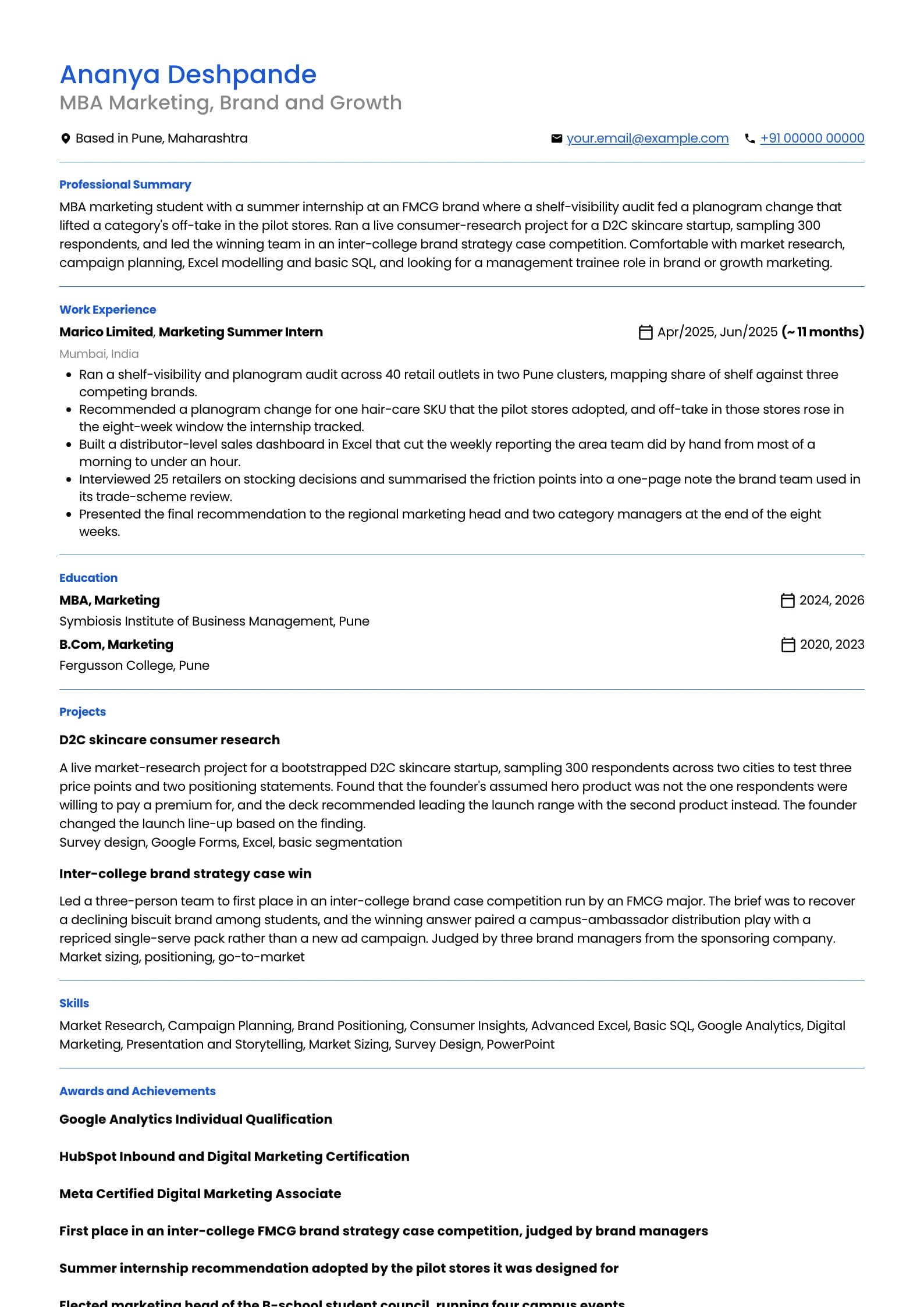
Build my resumeMBA Fresher resume example, Marketing specialisation
professional templateIs your resume good enough?
Upload the resume you have now and see what an applicant tracking system reads before a mba fresher recruiter ever does.
Free to run. Sign in with your mobile number to see your score.
MBA Fresher resume example, Finance specialisation
header-band template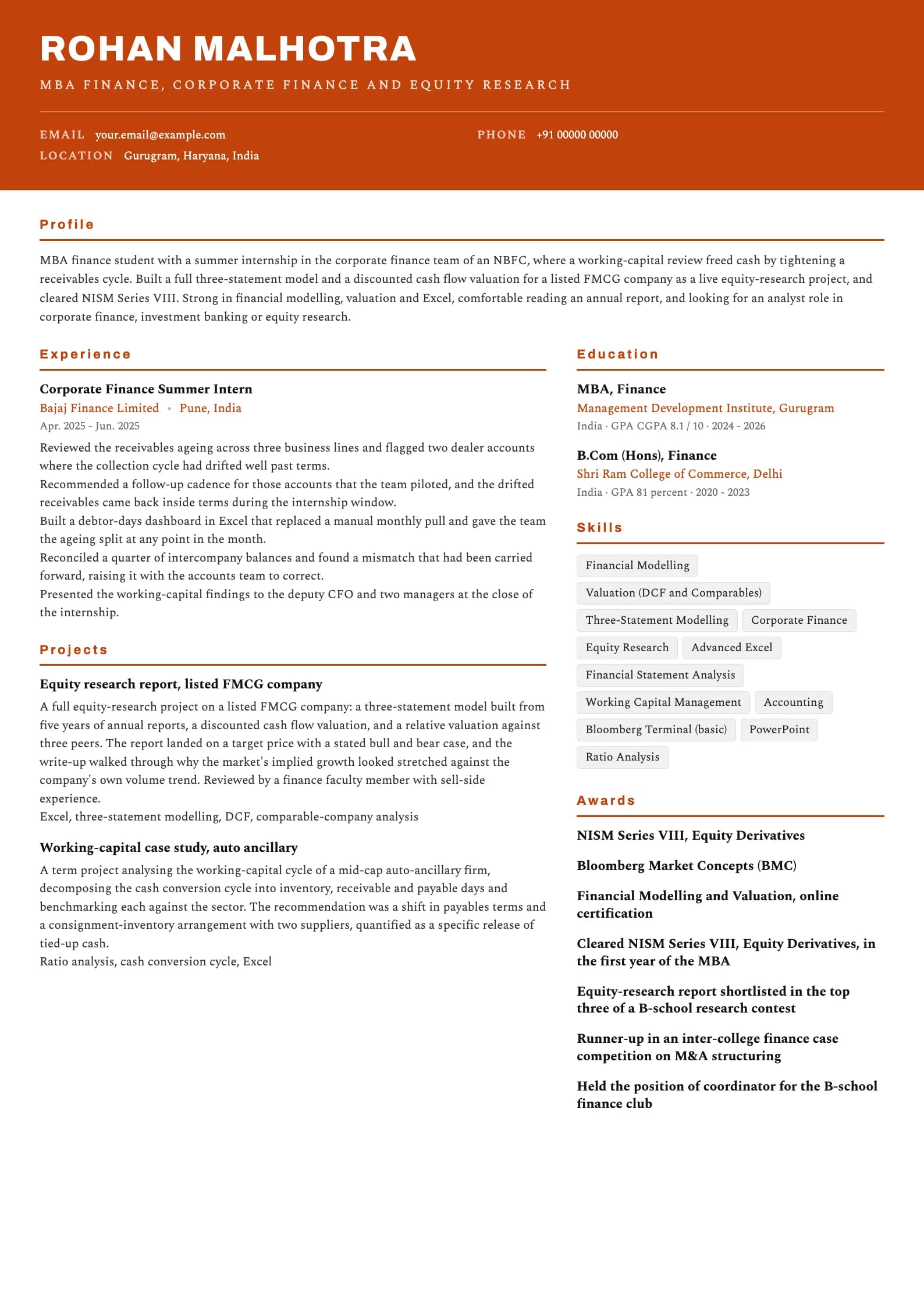
Want this structure with your own details? Build it in the resume builder.
MBA Fresher resume example, HR specialisation
modern template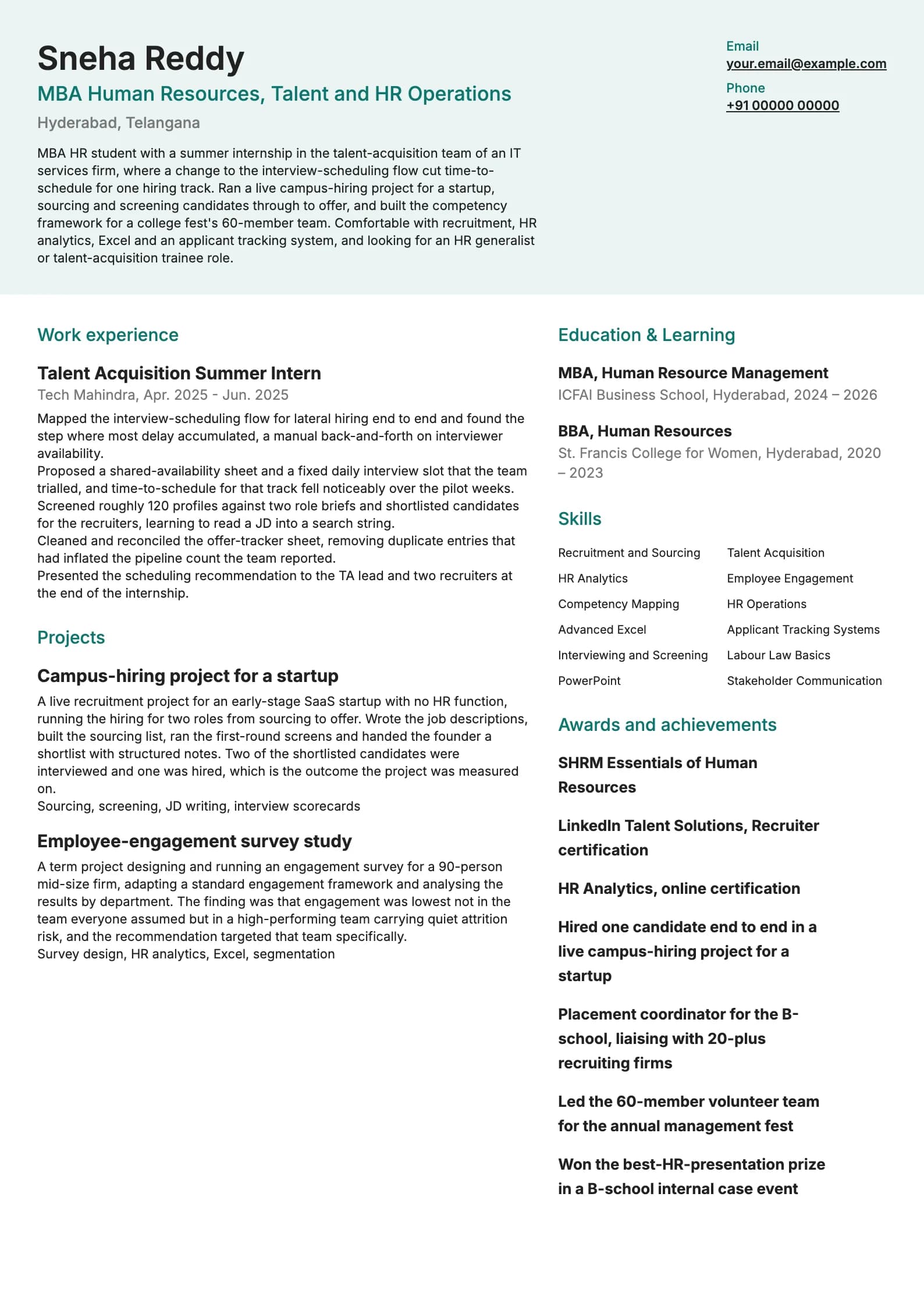
The format a campus placement cell expects
An MBA fresher resume is one page, reverse chronological, and single column. Most B-schools issue a placement-cell resume template, and where they do, use it, because recruiters at that campus are used to reading it and a deviation stands out for the wrong reason. Where you have a free hand, the order below is the one that works. One page is not a suggestion for a fresher, it is the rule. You have one internship, a degree, projects and positions of responsibility, and all of it fits on a page when you cut the padding. A second page on an MBA fresher resume signals that you could not tell your strong evidence from your weak evidence. Four things belong nowhere on the page: a photograph, date of birth, marital status and father's name. They come from an older campus template and add nothing a recruiter screening for a management trainee wants. Every line they take is a line a live project or an internship result could have used. Lead with your specialisation in the headline, because recruiters shortlist by track. A marketing recruiter should not have to infer from your electives that you are a marketing candidate. Send a PDF named with your own name and the role, not resume_final. The table below sets the section order for a fresher.
| Section | Where it goes | Why |
|---|---|---|
| Name and headline | Top, above everything | The headline names your specialisation. Recruiters shortlist by track first. |
| Professional summary | Directly under the header | Three lines. Specialisation, the internship, and the one strongest result. |
| Summer internship | Next, as its own experience block | This is your only real work exposure. Frame it as a shipped recommendation. |
| Live projects and case wins | Below the internship | The bulk of a fresher's evidence. Each ends in a decision someone made. |
| Skills | Below projects | Grouped by function. Tools you can defend, not a wall of buzzwords. |
| Education | Near the bottom, with the MBA first | MBA, then the undergrad degree. Keep CGPA while it is strong. |
| Positions and achievements | Bottom | Placement coordinator, club roles, competition wins. Leadership evidence. |
Turning a two-month internship into evidence
The summer internship is the single most scrutinised block on an MBA fresher resume, because it is the only place you have done real work for a real organisation. The mistake almost every fresher makes is describing what they were assigned rather than what changed because of them. "Worked on a market research project under the marketing team" tells a recruiter nothing, because every intern on the campus can write it. Frame the internship as a shipped recommendation. What was the problem you were pointed at, what did you find, what did you recommend, and did anyone act on it. The three samples all follow this shape: an audit that led to a planogram the store adopted, a receivables review that brought cash back inside terms, a scheduling change the team trialled. The verb, the finding and the consequence are the whole bullet. A two-month project rarely produces a clean before-and-after number, and that is fine. Where you cannot honestly claim a percentage, claim scope and adoption: 40 outlets audited, 120 profiles screened, a recommendation the team piloted. "The pilot stores adopted the planogram" is more credible than an invented lift figure, and a recruiter who has run internships knows the difference. Be honest about the reach of your work. You were an intern for eight weeks, so a claim that you "increased category sales by 30 percent" reads as either a misunderstanding or a fabrication, and an interviewer will pull the thread. Claim the recommendation and the pilot, which is what you actually owned, and let it be strong on its own terms.
Summer internship bullet, marketing
Weak
Worked on a market research and shelf audit project under the marketing team and gave a presentation to the managers at the end.
Strong
Ran a shelf-visibility audit across 40 outlets and recommended a planogram change for one hair-care SKU that the pilot stores adopted, with off-take rising in the eight-week window.
Trades "worked on" and "gave a presentation" for the scope of the audit, the specific recommendation, and the fact that the store acted on it.
Ask of your internship bullet: did anyone do anything differently because I was there. If the honest answer is a recommendation someone piloted, say exactly that. It beats a task list and an invented percentage.
Writing a summary instead of an objective
The block under your name is the part a campus recruiter is most likely to actually read, so it must carry three facts: your specialisation, your internship in one clause, and the single strongest thing that came out of your work. Three lines, no adjectives a recruiter cannot check. The career objective, seeking a challenging role in a reputed organisation to apply my management skills and grow with the company, is the default line on thousands of MBA fresher resumes, and it says nothing an application does not already imply. Replace it with a summary. An objective describes what you want, a summary describes what you have already done, and a recruiter with 300 resumes to screen reads only the second as evidence. The test is transferability. Read your summary and ask whether a batchmate in the same specialisation could paste it onto their resume without changing a word. If they could, it describes the MBA, not you. The samples pass the test because each names a specific internship result, a specific company and a specific project, none of which transfers. Do not open with "a highly motivated and dynamic MBA graduate". Motivated and dynamic are claims every fresher makes and none can prove, so they read as filler. Open with the specialisation and the internship, because those are facts, and let the recruiter conclude you are motivated from the evidence.
Professional summary, finance MBA
Weak
A highly motivated and dynamic MBA finance graduate seeking a challenging role in a reputed organisation to utilise my financial and analytical skills and contribute to organisational growth.
Strong
MBA finance student with a corporate-finance internship at an NBFC where a receivables review brought drifted collections back inside terms, and a full DCF valuation built for a listed FMCG company as a live research project.
Swaps self-description and a wish for a specialisation, a concrete internship result, and a named project a recruiter can probe.
Live projects, case competitions and where they sit
For an MBA fresher, projects and case competitions are the second pillar after the internship, and often the more interesting one, because they are where you chose the problem and owned the answer. They sit directly below the internship and carry real weight, so describe them as decisions rather than deliverables. The common failure is describing the method instead of the outcome. "Conducted a market research survey of 300 respondents" is a method. "Found the founder's assumed hero product was not the one respondents would pay a premium for, and the launch line-up changed" is an outcome. A recruiter remembers the outcome, because it shows judgement, not just effort. Pick projects that show range and judgement rather than three variations of the same coursework. One live project with a real client, one that ends in a counter-intuitive finding, and one competition where you were judged against other teams is a stronger set than five term papers listed by title. Two well-described projects beat five named ones. Case-competition results are worth naming precisely, including who judged them. "First place in an inter-college brand case, judged by three brand managers from the sponsoring FMCG major" is verifiable and carries the weight of an external panel. A competition you merely participated in can go under achievements as a single line, but do not inflate participation into a placement.
| Project type | What it should prove | How to describe it |
|---|---|---|
| Live client project | You can work with a real organisation | The client, the problem, and the decision they made from your work |
| Research project | You can turn data into a recommendation | The sample, the counter-intuitive finding, the recommendation |
| Case competition | You perform against other teams | The rank, the brief, and who judged it |
| Term or capstone project | You can apply a framework rigorously | The framework, the company, the quantified conclusion |
The skills section: grouped, honest, and defendable
An MBA fresher skills section has two readers with opposite tastes. An applicant tracking system wants literal terms it can match, financial modelling and market research and SQL. A human recruiter wants a short, organised list that signals what kind of trainee you are. Grouping by function serves both. Group rather than listing one long line. For a marketing candidate: research and insight, planning and strategy, tools, and analytics. For finance: modelling and valuation, analysis, tools. For HR: talent, operations, analytics, tools. The exact headings matter less than the fact that structure exists and a recruiter can read the section in one pass. Ten to fourteen skills is the working range for a fresher. Below eight it looks thin, above eighteen it stops being a signal. Every item is a contract: it is a question you have agreed to answer, so "financial modelling" on the line means you can be asked to walk through a model. Do not list a skill you cannot defend in a five-minute conversation. Be specific and correct with tool names, because a parser matches strings and an interviewer notices sloppiness. Write Advanced Excel, not "MS Excel expert". Write SQL if you can actually write a join, not because it looks technical. And skip the star ratings and proficiency bars: nobody agrees what four stars in Excel means, and they invite an argument you cannot win.
| Track | Core groups | Example skills |
|---|---|---|
| Marketing | Research, strategy, analytics, tools | Market research, brand positioning, Google Analytics, Excel |
| Finance | Modelling, analysis, tools | Financial modelling, DCF valuation, ratio analysis, Excel |
| HR | Talent, operations, analytics, tools | Recruitment, HR analytics, competency mapping, ATS |
| Operations | Process, analysis, tools | Process mapping, supply chain, six sigma basics, Excel |
Positions of responsibility and why they matter
Positions of responsibility, the placement coordinator role, the club office, the fest team you led, are not filler on an MBA fresher resume, they are the closest thing you have to management evidence. A recruiter hiring a management trainee is asking whether you can organise people and deliver under a deadline, and a well-described leadership role answers that better than another certification. Describe the position as a job, not a title. "Placement coordinator" is a title. "Placement coordinator liaising with 20-plus recruiting firms and scheduling the campus process for a batch of 180" is a job with a scope. The scope is what turns a line on the page into evidence a recruiter can weigh. Quantify the scale wherever it is honest: the size of the team you led, the number of firms you handled, the budget of the event, the footfall of the fest. A 60-member volunteer team and 20 recruiting firms are concrete numbers that show the size of what you managed, and they cost nothing to state accurately. Do not list ten positions. Two or three real ones, described with scope, beat a list of every committee you were nominally on. A recruiter reads a wall of positions as padding, the same way they read a wall of certifications, so keep the ones where you actually owned something and cut the rest.
Position of responsibility
Weak
Member of the placement committee and various other committees during the MBA programme.
Strong
Placement coordinator, liaising with 20-plus recruiting firms and scheduling the campus process for a batch of 180 students across the season.
Replaces "member" and "various committees" with the number of firms, the batch size, and the actual responsibility owned.
Where education and certifications belong
For an MBA fresher, education sits near the bottom but stays substantial, because your degree and your CGPA are still current screening signals in a way they will not be once you have two years of work behind you. List the MBA first, then the undergraduate degree, with the institution and the years. Keep the CGPA or percentage while it is strong, roughly 7.5 out of 10 and above, because campus and early-career shortlisting still filters on it and a good number helps you. If your MBA CGPA is modest but your undergraduate record or your tenth and twelfth marks are strong, you can carry the strong numbers and let the modest one sit without comment. Do not omit the CGPA entirely if it is good, that is leaving evidence on the table. Certifications sit just below education or beside skills if you hold one or two. Name the certification, the issuing body and the year. For an MBA fresher the certifications that carry real weight are track-specific: NISM and Bloomberg Market Concepts for finance, Google Analytics and HubSpot for marketing, SHRM Essentials for HR. A generic "advanced Excel certificate" from an unknown provider adds little. Resist the certification wall. A page of ten online course certificates reads as someone collecting badges rather than building a specialisation, and it crowds out the projects and the internship that actually carry you. Three relevant, named certifications is the ceiling for a fresher, and each should map cleanly to the track in your headline.
Getting an MBA fresher resume through the ATS
Large recruiters who hire MBA freshers in volume run every resume through an applicant tracking system before a human sees it. The system is a parser and a search index, not a judge: it breaks your file into name, education, employers, titles and skills, then lets a recruiter search across the batch. Almost every ATS problem is a parsing problem, and parsing problems come from layout, not from wording. The layout rules are short. One column, because two-column campus templates with a sidebar are read out of order by some parsers and interleave your skills with your education. Standard headings, so use Work Experience or Internship rather than My Journey, and Skills rather than My Toolkit. No text inside images, because a logo strip reads as blank space. Keep nothing critical in the header or footer region, which some parsers drop. On wording, mirror the job description where it is honest. If the role posting says financial modelling, write financial modelling, not just "good with numbers". If it says talent acquisition, use that phrase rather than only "recruitment". Include an acronym with its expansion once, for example "DCF (discounted cash flow)", so both searches find you. Keyword stuffing does not work and is easy to catch. A hidden block of every finance term in white text is worse than being filtered, because a recruiter who spots it stops trusting the whole page. Write real bullets that naturally contain the right terms, then test the file: copy the text out of your PDF into a plain editor, and if it reads in order there, the parser sees roughly the same.
Before you upload, copy the text out of your PDF into a plain text editor. Whatever you can read there in order is roughly what the ATS sees. If your skills and education are scrambled together, your two-column template is the problem.
What gets MBA fresher resumes rejected
Most rejections at the resume stage are not close calls, and for MBA freshers they cluster around a handful of recurring problems, all fixable in an afternoon. The list below is what campus recruiters and early-career screeners see most often, in rough order of how much damage each does.
- A generic career objective instead of a summary. "Seeking a challenging role in a reputed organisation" is on thousands of resumes and says nothing.
- The internship written as a task list. "Worked on a project under the team" instead of the recommendation you shipped and whether anyone acted on it.
- No specialisation in the headline, forcing a recruiter to infer your track from your electives. Marketing recruiters shortlist marketing candidates.
- A wall of ten online certifications that crowds out the projects and internship, reading as badge-collecting rather than a built specialisation.
- Inflated internship claims, such as an intern taking credit for a 30 percent sales increase over eight weeks, which an interviewer pulls apart in one question.
- A photo, date of birth, marital status or father's name from an old campus template, taking space a live project should occupy.
- Two columns and a decorative sidebar that parses out of order in an ATS, scrambling skills into education.
- Positions of responsibility listed as bare titles with no scope, so "placement committee member" carries no weight.
- Spilling onto a second page. A fresher with one internship on two pages signals they cannot tell strong evidence from weak.
- Typos in the terms you claim, writing "Bloomberg" or "HubSpot" wrong, which undoes an otherwise careful page.
Read your resume aloud once before sending it. If a line would embarrass you to say to a recruiter's face, an inflated internship claim or an empty objective, it is a line to cut or rewrite.
Skills to put on a mba fresher resume
Technical
- Financial Modelling
- Valuation (DCF and Comparables)
- Market Research
- HR Analytics
- Advanced Excel
- Financial Statement Analysis
- Consumer Insights
- Campaign Planning
- Basic SQL
- Google Analytics
- Ratio Analysis
- Competency Mapping
Tools and platforms
- Microsoft Excel
- PowerPoint
- Google Analytics
- Bloomberg Terminal (basic)
- SPSS (basic)
- Applicant Tracking Systems
- HubSpot
- Tableau (basic)
- Google Forms
- SQL
Working skills
- Presentation and storytelling
- Stakeholder communication
- Team leadership
- Structured problem solving
- Time management
- Negotiation basics
- Cross-functional collaboration
- Business writing
- Adaptability
Certifications worth listing as a mba fresher
| Certification | Full name | Worth it for |
|---|---|---|
| NISM Series VIII | NISM Series VIII, Equity Derivatives Certification | The regulator-mandated certification for anyone working in Indian equity markets, and a clean signal for a finance MBA fresher targeting broking, equity research or capital markets. Worth doing before placements, because it is checkable and directly relevant. Less useful for a corporate-finance or FP&A track. |
| BMC | Bloomberg Market Concepts | A short self-paced certification covering the Bloomberg terminal and core market concepts, worth it for a finance MBA fresher who wants a recognised markets credential. Names a specific tool recruiters know. Most valuable for equity research and markets roles, less so for HR or general management tracks. |
| Google Analytics (GAIQ) | Google Analytics Individual Qualification | The standard digital-analytics badge for a marketing MBA fresher, worth it if you are targeting brand, growth or digital marketing where measurement matters. Directly relevant and free to earn. Skip it for a pure sales or trade-marketing track where the tool is not used. |
| HubSpot | HubSpot Inbound and Digital Marketing Certification | A widely recognised marketing certification covering inbound and content marketing, useful for a marketing MBA fresher aiming at digital or growth roles. Quick to earn and keyword-friendly for an ATS. A supporting credential, not a substitute for a real live project. |
| SHRM Essentials | SHRM Essentials of Human Resources | A foundational HR certification from a globally recognised body, worth it for an HR MBA fresher who wants a credible credential beyond the degree. Signals seriousness about the function. Most useful for generalist and HR-operations tracks, and complements a live recruitment project rather than replacing it. |
| Financial Modelling | Financial Modelling and Valuation Certification (online) | A skills certification for a finance MBA fresher who wants to prove modelling ability on paper. Only worth listing if you can actually build a three-statement model and a DCF, because an interviewer will ask you to. Pair it with a project that shows the work, or the badge rings hollow. |
Keywords an ATS scans for in a mba fresher resume
These are the literal terms a parser matches against the job description. Use the ones that are true of you, in the sentences where you did the work, not as a list at the bottom.
- mba fresher
- management trainee
- marketing
- finance
- human resources
- financial modelling
- valuation
- market research
- talent acquisition
- hr analytics
- advanced excel
- summer internship
- consumer insights
- campaign planning
- recruitment
- SQL
- business analysis
- stakeholder management
- case competition
- powerpoint
MBA Fresher resume FAQ
What salary can an MBA fresher expect in India?
It varies more by the tier of the B-school than by anything on the resume. A fresher from a top IIM or ISB commonly sees an offer in the 18 to 30 LPA band and higher for consulting and investment banking roles. A strong tier-1 private school, an NMIMS, SPJIMR, MDI or FMS, typically sits in the 10 to 22 LPA range. Tier-2 and tier-3 schools more often place in the 4 to 8 LPA band, with the specialisation and the recruiter mattering. A strong internship and a clear specialisation help you compete at the top of your school's band rather than the bottom.
How long should an MBA fresher resume be?
One page, without exception. You have one summer internship, a degree, projects and positions of responsibility, and all of it fits on a single page once the padding is gone. A campus recruiter reading 300 resumes reads a two-page fresher resume as an inability to tell strong evidence from weak. If you are struggling to fit one page, cut the certification list to three, remove the objective, and describe two projects well instead of five badly.
Should I make a different resume for each specialisation?
You should tailor the headline, the summary and the ordering of your skills to the role you are applying for, but you do not need a completely separate resume per company. Keep one strong base resume for your primary specialisation, and adjust the headline and the top skills when you apply to an adjacent track. What must always match the role is the specialisation stated in the headline, because recruiters shortlist by track before they read anything else.
How do I write the summer internship if it was only two months?
Frame it as a shipped recommendation, not a task list. State the problem you were pointed at, what you found, what you recommended, and whether anyone acted on it. A two-month internship rarely produces a clean before-and-after number, so claim scope and adoption instead: the number of outlets you audited, the profiles you screened, the recommendation the team piloted. "The pilot stores adopted the planogram" is more credible than an invented sales lift, and interviewers know the difference.
Do certifications like NISM, GAIQ or SHRM help a fresher?
They help most when they are track-specific and checkable. NISM and Bloomberg Market Concepts carry weight for a finance fresher, Google Analytics and HubSpot for marketing, SHRM Essentials for HR. Name the certification, the body and the year. What does not help is a wall of ten generic online course certificates, which reads as badge-collecting and crowds out the projects and internship that actually carry you. Three relevant, named certifications is the ceiling.
Should I include my tenth and twelfth marks?
Yes if they are strong, as a compact line in the education section, because many campus recruiters still apply an academic cut-off that looks across your full record, not just the MBA. If your MBA CGPA is modest but your school and undergraduate marks are strong, carrying the strong numbers helps you. Once you have two years of work experience, drop the school marks, but as a fresher they are still a current screening signal.
Do positions of responsibility actually matter?
They matter more than most freshers think, because they are the closest thing you have to management evidence. A recruiter hiring a management trainee wants to know you can organise people and deliver under a deadline, and a placement-coordinator or fest-lead role described with scope answers that. Describe the position as a job with a number: the size of the team, the count of firms, the footfall of the event. Two or three real roles beat a list of every committee you were on.
Does an ATS reject two-column campus resume templates?
It does not reject them outright, but some parsers read a two-column layout out of order and interleave your sidebar with your main content, so your skills land in the middle of your education in the recruiter's view. A single-column layout removes the risk, which is why all three samples use one. Test your own file by copying the text out of the PDF into a plain text editor: if it reads in order there, it will most likely parse correctly.
Do I need a photo on an MBA fresher resume in India?
No. Corporate recruiters hiring management trainees do not expect one, and it takes space a live project or an internship result should occupy. The same goes for date of birth, marital status, father's name, nationality and a declaration paragraph. These come from an older campus template and add nothing to a management screen. The only exception is where the posting or the placement cell explicitly asks for a photograph.
Related resume examples and guides
Build your MBA fresher resume in any of these formats
Start from a blank resume or upload the draft you have. Goodspace renders it in 24 one-page templates and flags the specialisation keywords a campus recruiter's applicant tracking system will look for, and the padding it will not credit.
Build my resume