Insurance Agent Resume Format, with 3 Full Samples
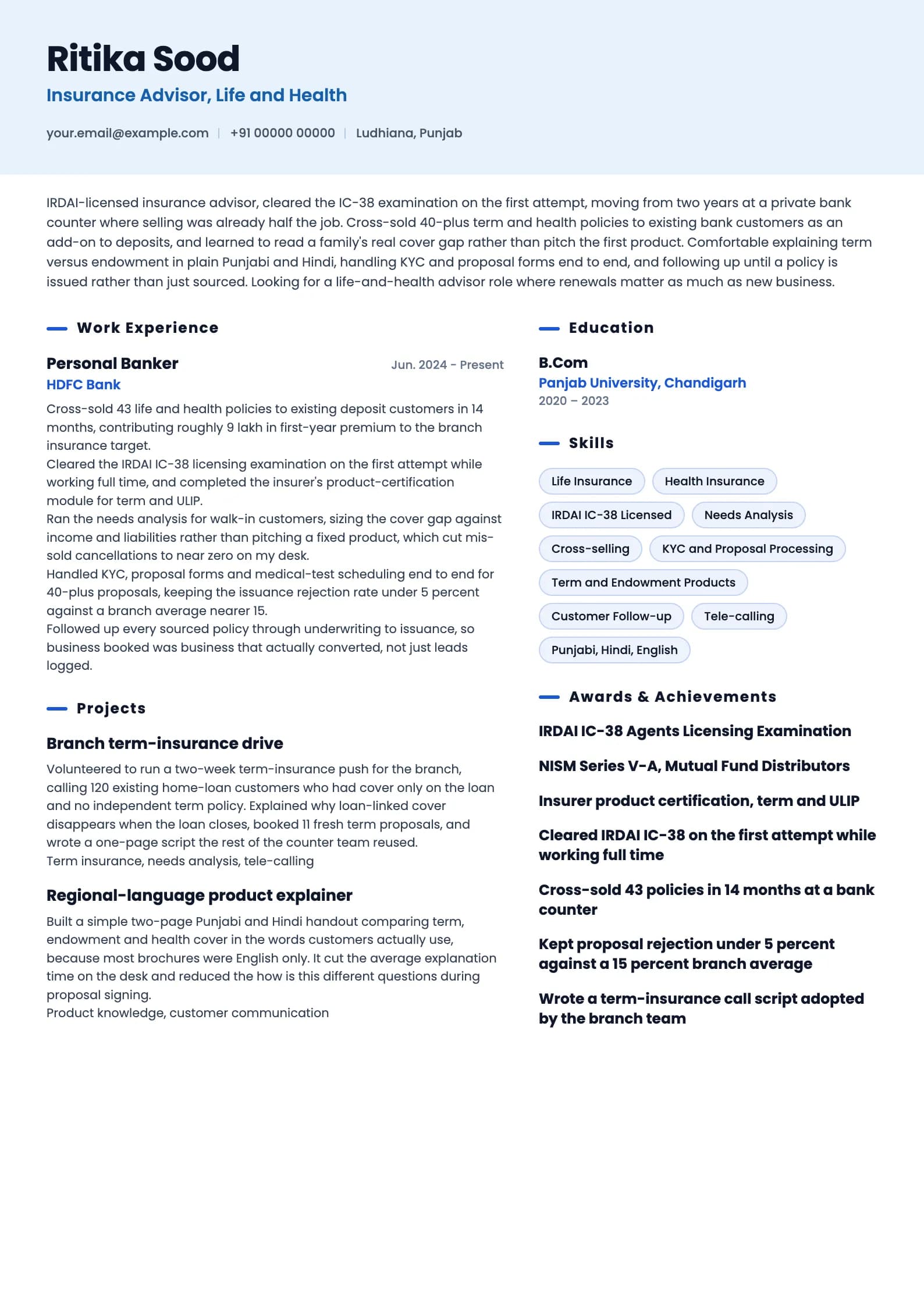
An insurance agent is hired on evidence of premium written, policies persisting past year one and a book that renews without chasing, yet most resumes list soft phrases like hardworking and customer-focused and forget the number that closes the interview. Below are three complete resumes, one for an IRDAI-licensed fresher moving from a bank counter, one for an insurance advisor with five years across life and health, and one for an agency manager running a team of agents. After the samples come the format rules, the difference between claiming targets and proving persistency, the terms a parser matches literally, and the mistakes that end a screening before a human sees the page.
Build my resumeInsurance Agent resume example, Fresher (0 to 1 year)
ai-era templateIs your resume good enough?
Upload the resume you have now and see what an applicant tracking system reads before a insurance agent recruiter ever does.
Free to run. Sign in with your mobile number to see your score.
Insurance Agent resume example, Mid-level (5 years)
professional template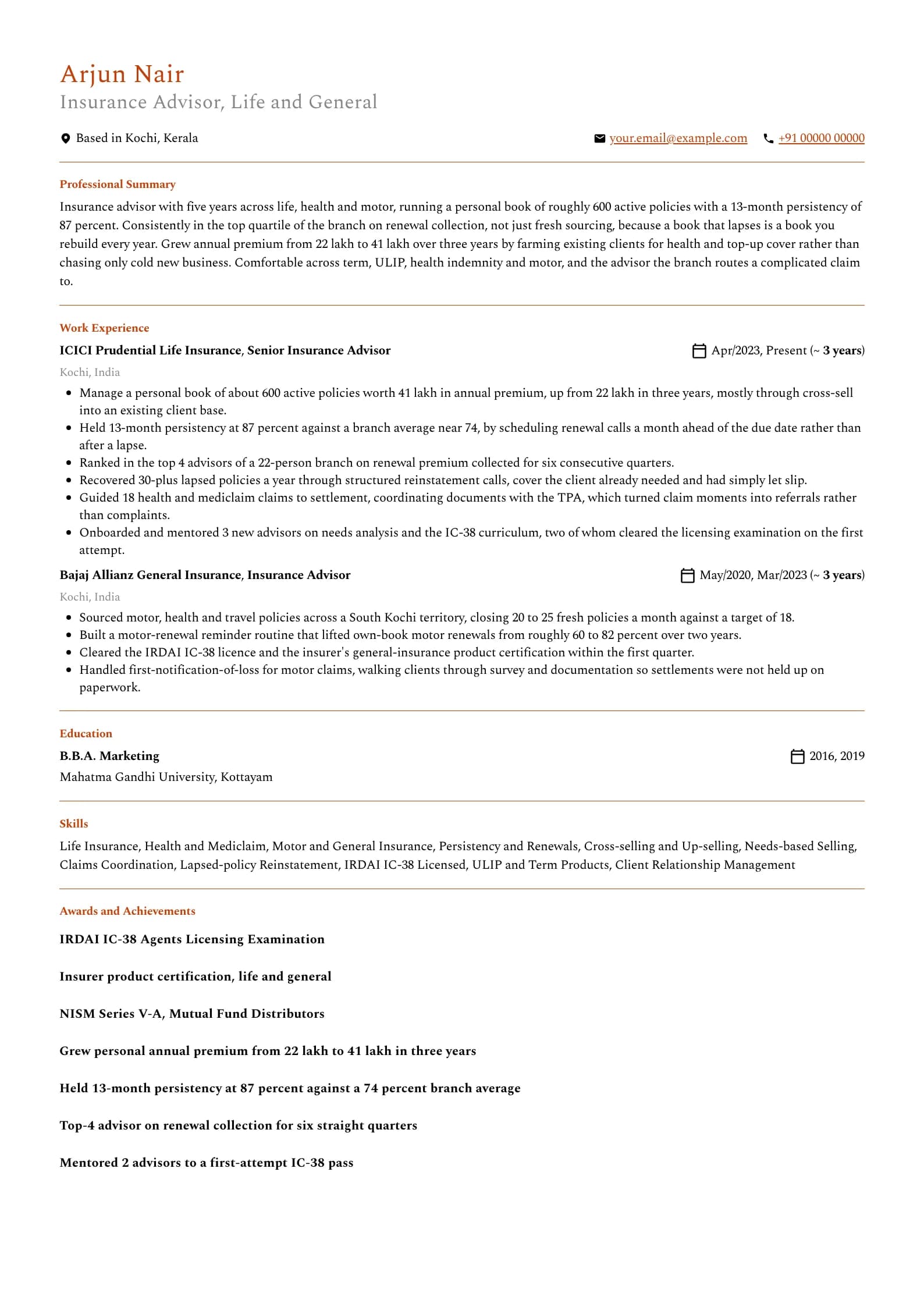
Want this structure with your own details? Build it in the resume builder.
Insurance Agent resume example, Agency Manager (10 years)
header-band template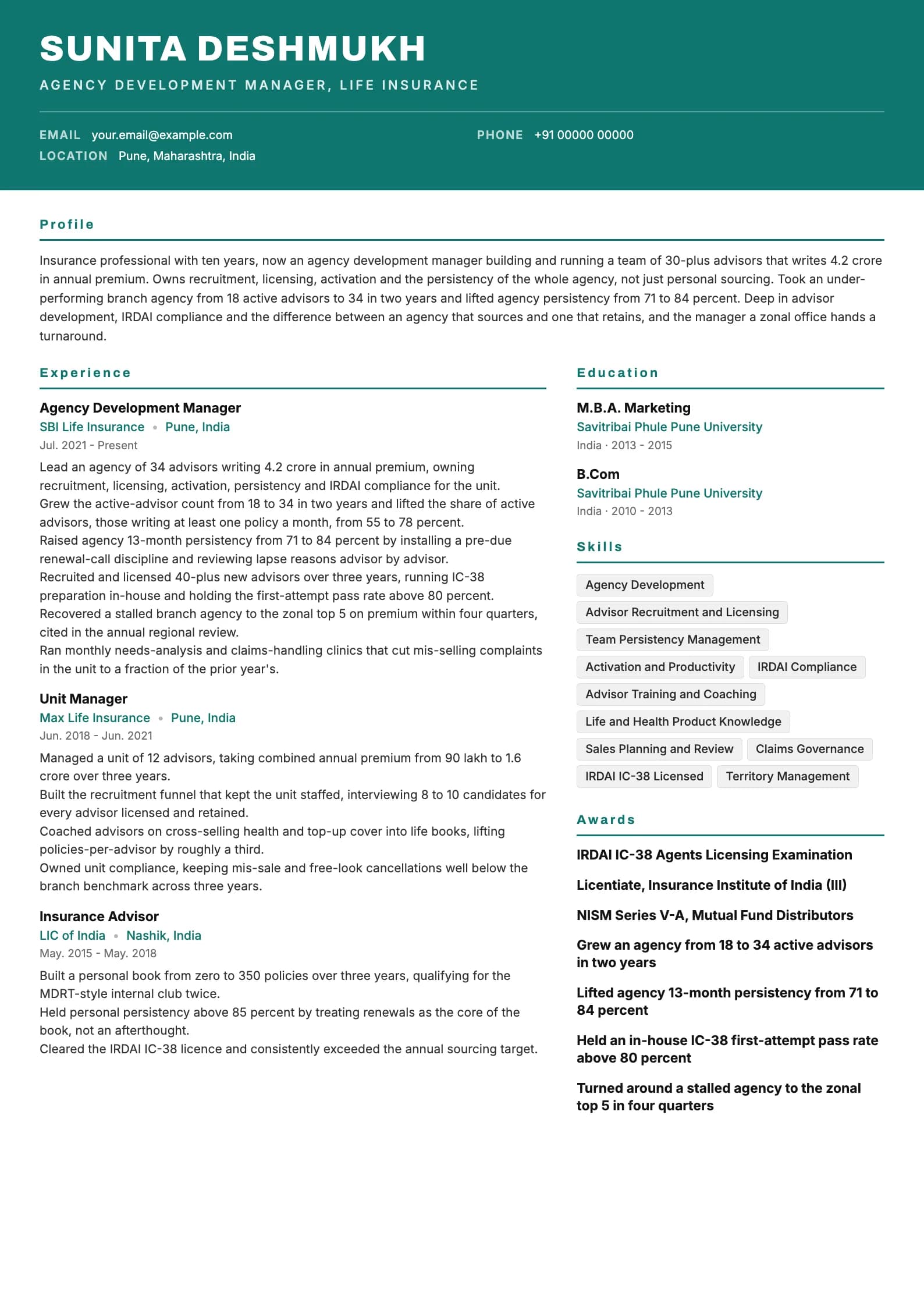
The format that works for insurance agent resumes in India
Reverse chronological is the layout to use. Put your most recent role first, work backwards, and let the dates sit in plain view. A functional resume that groups everything under Achievements and hides the timeline reads as an attempt to cover a gap or a string of short stints, and in a churn-heavy industry recruiters are especially alert to it. If you have moved between insurers, one honest line beats a hidden timeline. Length is decided by your book. One page holds everything a fresher and most advisors up to six or seven years have to say. An agency or branch manager running a team can justify a second page, but only if it carries team numbers, recruitment and persistency, not a longer list of product names. Lead with your IRDAI licence. Unlike most jobs, this one has a legal gate: without an IC-38 licence you cannot be appointed, so the licence status belongs near the top where a screener sees it in the first five seconds. Follow it with the metrics an insurer actually pays on, premium, persistency and activation, not adjectives. Four things belong nowhere on this resume: a photograph, date of birth, marital status and father's name. They survive from an older template and add nothing to a sales screen. Send a PDF unless the posting asks for DOCX, use a single column so the file parses cleanly, and name it with your own name and the role. The table below sets out the section order.
| Section | Where it goes | Why |
|---|---|---|
| Name and headline | Top, above everything | Headline is the role you want: insurance advisor, agency manager. Recruiters match on it. |
| Licence and summary | Directly under the header | IC-38 status plus three lines: products, years, and your strongest premium or persistency number. |
| Work experience | Next, for anyone with a role | Most recent first. Lead each with premium, persistency and activation numbers. |
| Skills | Below experience | Grouped: products, sales, service, compliance. Not a wall of insurer product names. |
| Certifications and licences | After skills, or beside it if few | IC-38 always. III Licentiate or Associate, NISM if you sell mutual funds too. |
| Education | Bottom, unless you are a fresher | Degree, institution, years. Drop the percentage after your first insurance role. |
| Languages | Near the bottom | Genuinely load-bearing here: the languages a territory buys in are a real qualification. |
Claiming a target is not the same as proving persistency
The single most common insurance resume failure is a line that reads achieved sales targets consistently and exceeded expectations, with no premium figure, no persistency percentage and no activation number anywhere. It tells a hiring manager nothing, because every rejected applicant wrote the same sentence. An insurer does not hire on the claim that you hit target, it hires on the numbers that show what kind of book you build. Learn the three numbers this industry judges you on. Premium, first-year and renewal, is how much business you write. Persistency, usually quoted at 13 months and 61 months, is how much of it stays. Activation, the share of months you sourced at least one policy, is how consistent you are. A resume that carries all three reads as someone who understands the business, not just someone who sells. Persistency is the one most agents leave off, and it is the one that separates a real advisor from a churner. Anyone can source a policy that lapses in month three. Writing held 13-month persistency at 87 percent against a branch average near 74 is the strongest line on a life-insurance resume, because it proves the book renews without being rebuilt every year. If your persistency is strong, it should be near the top. Be honest and specific. Roughly 600 active policies, 41 lakh in annual premium, 30 lapsed policies recovered a year. Vague superlatives like top performer are worth less than a mid-range number you can defend, because the interview will test whichever you write.
Experience bullet, life advisor
Weak
Achieved and consistently exceeded monthly sales targets and maintained good relationships with all customers.
Strong
Grew a personal book to 41 lakh in annual premium at 87 percent 13-month persistency, in the branch top 4 on renewal collection for six straight quarters.
Trades an unverifiable claim for the three numbers an insurer actually judges a book on: premium, persistency and consistency.
For every claim on your resume, ask whether there is a number behind it an interviewer could ask about. Achieved targets is not a number. 41 lakh in annual premium at 87 percent persistency is. Write the second kind.
Writing a summary a branch manager actually reads
The block under your name is the part you can be reasonably sure gets read, so it should carry three facts: what you sell, how long you have sold it, and the strongest thing your book proves. Three or four lines, no adjectives that cannot be checked. The old objective line, seeking a challenging position in a reputed insurance company to utilise my sales skills, tells the reader nothing they did not already assume. Replace it with a summary. An objective describes what you want, a summary describes the book you have already built, and only one is evidence. Freshers and career switchers often think they have nothing to summarise. Look at the fresher sample: it names the licence, the product knowledge, and a real cross-sell number from a bank counter. A career switcher from banking, teaching or retail has usually been selling all along, and the summary is where that becomes relevant experience rather than an unrelated past. A practical test: read your summary and ask whether another advisor at your branch could paste it onto their resume unchanged. If they could, it describes the job, not you. Add your specific premium figure, your persistency, your product mix and your territory until it stops being transferable.
Professional summary, mid-level advisor
Weak
Hardworking and target-oriented insurance advisor with 5 years of experience seeking a growth-oriented role in a reputed insurance company.
Strong
Insurance advisor with five years across life, health and motor, running about 600 active policies at 87 percent persistency and 41 lakh in annual premium, top-4 in the branch on renewals.
The rewrite swaps self-description for a product mix, a book size and the persistency and premium numbers that make it verifiable.
Experience bullets: verb, book, result
Every strong bullet in the samples follows the same shape. It opens with an action verb, names what you built or managed, and closes with what measurably moved. The verb establishes that you did it. The specifics tell a manager whether the work is relevant. The number does the persuading. Start with the outcome and work backwards. Advisors usually write the activity first, then cannot attach a number, which produces lines like handled customers and sold policies. Instead ask what was different in the book after a period of your work: premium grew, persistency held, lapses were recovered, a claim settled, an advisor got licensed. Then write the sentence that ends in that fact. Vary the metric. Five premium figures in a row read as one trick. Across a real role you can honestly reach for annual premium, 13-month persistency, activation, policies sourced per month, lapsed policies recovered, claims settled and, for a manager, advisors recruited and licensed. The mid-level sample moves across several, which reads as range. Where you lack a clean number, give scope: how many active policies, how large a territory, how many advisors on the team. Guided 18 health claims to settlement carries weight without inventing a percentage. Allocate bullets by recency. Current role gets five or six, the previous role four, anything older two or three.
| Level | What bullets must prove | Typical metric |
|---|---|---|
| Fresher / switcher | You can source and get a proposal issued | Policies sold, first-year premium, issuance rate, licence cleared |
| 1 to 4 years | You build a book that renews, not just sources | Annual premium, 13-month persistency, monthly activation |
| 5 to 8 years | You grow and retain a book and handle claims | Premium growth, persistency vs branch, lapses recovered, claims settled |
| Agency / branch manager | You build a team that writes and retains | Team premium, active advisors, agency persistency, advisors licensed |
Experience bullet, agency manager
Weak
Responsible for managing a team of advisors and ensuring achievement of branch business targets.
Strong
Grew the agency from 18 to 34 active advisors in two years and lifted 13-month persistency from 71 to 84 percent.
Responsible for describes a job title; the rewrite names the team growth and the persistency lift the manager actually delivered.
If a bullet would read identically on another advisor's resume, it is describing the job, not you. Rewrite it until it only fits the book or team you actually ran.
The skills section: products, sales, service and compliance
An insurance resume's skills section has two audiences with opposite preferences. The parser wants literal terms it can match, life insurance and health insurance and persistency. A human wants a short, organised list that signals what kind of advisor you are. Grouping satisfies both. Group by function rather than one long line. Products, sales, service and compliance is a grouping that works for almost every agent. Under products name the lines you have actually sold, life, health, motor, ULIP, term. Under sales put needs analysis, cross-selling and renewals. Under service put claims coordination and reinstatement. Under compliance put your licence and KYC. Write names the way the industry writes them: IRDAI not IRDA, persistency not persistence. Ten to sixteen skills is the working range. Below eight the section looks thin. Above twenty it stops being a signal, and insurance resumes are especially prone to listing every product a company sells as a separate skill, which pads without proving. The list is a contract: every item is a question you have agreed to answer in the interview. Do not include a proficiency bar. Nobody agrees on what four stars in claims handling means, and it invites an argument you cannot win. Let the experience prove the depth instead.
| Group | What goes in it | How many |
|---|---|---|
| Products | Life, health, motor, ULIP, term, the lines you have sold | 3 to 5 |
| Sales | Needs analysis, cross-selling, renewals, prospecting | 3 to 4 |
| Service | Claims coordination, reinstatement, KYC, grievance handling | 2 to 4 |
| Compliance | IRDAI IC-38 licence, product certification, mis-sale control | 1 to 2 |
| For managers | Recruitment, activation, team persistency, advisor training | 2 to 4 |
Licences and certifications that carry weight
This is one of the few jobs where a certification is not optional garnish, it is the legal permission to work. The IRDAI IC-38 agents licensing examination is mandatory to be appointed as an agent, so it always goes on the resume, near the top, with the status: cleared, and on the first attempt if that is true. Beyond the licence, the Insurance Institute of India (III) qualifications, the Licentiate, Associate and Fellowship, are the recognised professional ladder. A Licentiate signals commitment beyond the minimum licence and is worth naming for anyone serious about a career in insurance rather than a stint. Associate and Fellowship matter more for underwriting, claims and management tracks than for pure sales. If you also distribute mutual funds or investment-linked products, the NISM Series V-A certification is worth listing, because ULIP and investment conversations sit next to insurance conversations in most Indian households. Do not list a certification you cannot briefly explain, and never list an expired or lapsed licence as current, because appointment triggers a licence check and the mismatch surfaces immediately. Write the full name, the issuing body and the year for each. IC-38 is IRDAI. The Licentiate is the Insurance Institute of India. Precision here signals someone who knows the regulatory landscape, which is itself part of the job.
Getting through the applicant tracking system
Larger insurers and staffing agencies run resumes through an applicant tracking system before a human sees them. It is a parser and a search index, not a judge. It reads your file, tries to break it into name, dates, employers, titles and skills, and stores the result so a recruiter can search across candidates. Almost every ATS problem is a parsing problem, and parsing problems come from layout, not wording. The layout rules are short. One column. Standard section headings, so use Work Experience rather than My Journey, and Skills rather than My Strengths. No text inside images. No critical information in the header or footer region, which some parsers drop. Avoid text boxes and nested tables in the body. On wording, mirror the language of the posting where it is honest. If it says persistency, write persistency. If it says IRDAI licensed, write IRDAI IC-38 licensed rather than just certified. Include the expansion alongside an acronym at least once, for example IC-38 (IRDAI agents licensing), so both searches find you. Insurers search on very specific terms, life, health, motor, ULIP, persistency, so the product lines you have sold should appear as words in your bullets. Keyword stuffing does not work. A hidden block of every product name in white text is found quickly and read as dishonesty, which is worse than being filtered. Write real bullets that naturally contain the right terms, then save as a PDF that embeds real text and confirm you can select and copy a sentence. If you cannot select the text, neither can the parser.
Section heading
Weak
What I Bring To The Table
Strong
Key Skills
Parsers look for standard headings; a creative one can push the whole block into an unclassified bucket the recruiter never searches.
Test your own file before you send it. Copy the text out of the PDF into a plain text editor. Whatever you can read there is roughly what the parser sees, and anything scrambled is a real risk.
What gets insurance agent resumes rejected
Most rejections at the resume stage are not close calls. They come from a small set of recurring problems, and all of them are fixable in an afternoon. The list below covers what recruiters of Indian insurance agent resumes see most often, in rough order of how much damage each one does.
- No premium or persistency numbers, only claims like achieved targets. The numbers are the whole point of a sales resume.
- Leaving persistency off entirely. A book that sources well but lapses is worth little, and its absence reads as a book that churns.
- Not stating IC-38 licence status, so a screener cannot tell whether you can even be appointed without asking.
- A generic objective line about a challenging position in a reputed company. Replace it with a summary that leads on premium and persistency.
- Listing every product an employer sells as a separate skill, padding the list with lines you never actually wrote.
- A photo, date of birth, marital status or father's name. None of it belongs on a sales resume and it takes a metric's space.
- Job duties copied from a job description instead of your own book. Responsible for handling customers is the tell.
- Unexplained short stints across many insurers with the timeline hidden by a functional layout, which reads as churn you are covering up.
- Inflated premium or rank figures that will not survive an interview or a reference call, ending the process on a trust failure.
- Leaving languages off when the territory needs them, since the regional languages you sell in are a real qualification here.
Read your resume aloud once before sending it. Anything you would not be able to defend to a branch manager's follow-up question is a line to cut or make honest.
Skills to put on a insurance agent resume
Technical
- Life Insurance
- Health and Mediclaim
- Motor and General Insurance
- ULIP and Term Products
- Needs-based Selling
- Persistency and Renewal Management
- Cross-selling and Up-selling
- Claims Coordination
- Lapsed-policy Reinstatement
- KYC and Underwriting Support
- IRDAI Compliance
- Territory and Book Management
Tools and platforms
- Insurer agent portals
- CRM (Salesforce, in-house)
- Proposal and e-KYC systems
- Premium calculators
- MS Excel
- WhatsApp Business
- Digital payment collection
- TPA claim portals
Working skills
- Relationship building
- Consultative selling
- Objection handling
- Follow-up discipline
- Regional-language communication
- Trust and integrity
- Persuasion
- Time and territory planning
- Team coaching (for managers)
Certifications worth listing as a insurance agent
| Certification | Full name | Worth it for |
|---|---|---|
| IRDAI IC-38 | IRDAI Agents Licensing Examination (IC-38) | Mandatory. You cannot be appointed as an insurance agent in India without it, so it belongs on every insurance resume near the top, with the status. Stating a first-attempt pass is a small extra signal for a fresher with no book to point to yet. |
| III Licentiate | Licentiate, Insurance Institute of India | The first rung of the recognised professional ladder above the basic licence. Worth it for anyone treating insurance as a career rather than a stint, and a useful signal of seriousness for advisors moving into senior sales or supervisory roles. |
| III Associate | Associateship, Insurance Institute of India | A deeper III qualification that matters most for underwriting, claims and management tracks rather than pure agency sales. Worth it if you are moving off the field into branch management, product or operations, less critical for a working advisor. |
| NISM V-A | NISM Series V-A, Mutual Fund Distributors Certification | Worth it for advisors who also distribute mutual funds or investment-linked products, which sit next to insurance in most Indian households. Adds the investment keyword and lets you serve a client's savings and protection needs together. |
| III Fellowship | Fellowship, Insurance Institute of India | The senior professional qualification, most relevant for insurance managers, underwriters and technical specialists. Overkill for a working field advisor, but a strong differentiator for anyone building a long-term management or technical career in the industry. |
Keywords an ATS scans for in a insurance agent resume
These are the literal terms a parser matches against the job description. Use the ones that are true of you, in the sentences where you did the work, not as a list at the bottom.
- insurance agent
- insurance advisor
- life insurance
- health insurance
- IRDAI IC-38
- persistency
- annual premium
- cross-selling
- needs analysis
- ULIP
- term insurance
- motor insurance
- claims
- renewals
- KYC
- agency development
- advisor recruitment
- activation
- customer relationship
- sales target
Insurance Agent resume FAQ
What salary can an insurance agent expect in India?
Pure agency income is largely commission, so it varies widely with the book. A salaried insurance advisor at a bank or insurer typically starts around 2.5 to 4 LPA fixed plus incentives, with a productive advisor of four to six years commonly earning 5 to 10 LPA including commission and renewals. Agency and branch managers on a fixed-plus-variable structure often sit in the 8 to 18 LPA band, higher with a large, persistent agency. Strong persistency matters as much as fresh premium here, because renewal commission is what makes the income compound year on year.
How long should an insurance agent resume be?
One page up to about six or seven years as an advisor. An agency or branch manager running a team can use two pages, but only if the second carries team premium, recruitment and persistency numbers rather than a longer list of product names. Nobody was rejected for a resume that was too easy to read. If you are struggling to fit one page, cut the oldest role to a single line and remove any product you would not want to be interviewed on.
Do I need to mention my IRDAI licence on the resume?
Yes, prominently. The IRDAI IC-38 licence is the legal requirement to be appointed as an agent, so a hiring manager checks for it before anything else. State that you are IC-38 licensed near the top, and note a first-attempt pass if it applies. If you also hold an Insurance Institute of India qualification such as the Licentiate, list it too, because it signals a career rather than a short stint.
What is the single most important number to put on the resume?
Persistency, quoted at 13 months, for anyone selling life insurance. It measures how much of the business you write actually stays on the books, and it separates a real advisor from someone who sources policies that lapse in month three. A line like held 13-month persistency at 87 percent against a branch average near 74 is the strongest sentence on most insurance resumes. Pair it with your annual premium figure, which shows the size of the book.
How does a fresher or career switcher write this resume?
Lead with your licence status, then treat any prior selling as evidence. Someone from banking, retail, teaching or telecalling has usually persuaded people for a living, and the summary is where that becomes relevant. Quantify whatever you can: policies cross-sold, first-year premium contributed, proposals processed. Add the IC-38 licence and any product certification, because verifiable facts carry more weight than adjectives like hardworking, which every graduate resume already claims.
Should I list every insurance product I have sold?
List the lines you have genuinely sold and can discuss, life, health, motor, ULIP, term, grouped under products. Do not pad the skills section with every micro-product an employer's catalogue contains, because an interviewer sees through it and each item is a question you have agreed to answer. Two or three product lines proved by a real bullet, plus a persistency and premium number, beat a wall of product names with nothing behind them.
Does an ATS reject insurance resumes with two columns?
It does not reject them outright, but some parsers read multi-column layouts out of order, interleaving your sidebar with your experience and producing nonsense in the recruiter's view. A single-column layout removes the risk, which is why all three samples above use one. Test your file by copying the text out of the PDF into a plain text editor, and if it reads in order there, it will most likely parse correctly.
Should I put my sales targets or my actuals on the resume?
Your actuals, always. A target is what you were asked to do, an actual is what you did, and only the second is evidence. Write the real figure, whether it was above or comfortably at target, because a defensible mid-range number beats an inflated one that collapses under a single interview question. If you exceeded target, state both, for example wrote 41 lakh against a 30 lakh annual target, which shows the actual and the bar in one line.
Do I need a photo on an insurance agent resume in India?
No. A photograph adds nothing to a sales screen and takes space a premium or persistency number should occupy. The same goes for date of birth, marital status, father's name and a declaration paragraph, all of which come from an older template. What genuinely helps instead is your languages section, because the regional languages you can sell in are a real qualification for a territory.
Related resume examples and guides
Build your own in any of these formats
Start from a blank resume or upload the one you have. Goodspace renders it in 24 templates and flags the premium, persistency and IRDAI keywords an insurer's applicant tracking system will look for, and the padding it will not credit.
Build my resume