Blockchain Developer Resume Format, with 3 Full Samples
A blockchain developer is hired on evidence of contracts that hold value under adversarial conditions, not on a list of chains and buzzwords. Most Web3 resumes read like a token launch announcement and forget that the job is careful, auditable code that cannot be redeployed after a bug. Below are three complete resumes, one for a fresher who has shipped a verified contract to testnet, one for a mid-level Solidity developer who has audited and gas-optimised production contracts, and one for a senior engineer owning protocol architecture and security. After the samples come the format rules, why proving a contract is not the same as naming a chain, the terms a parser matches literally, and the mistakes that get a Web3 resume filtered before an interview.
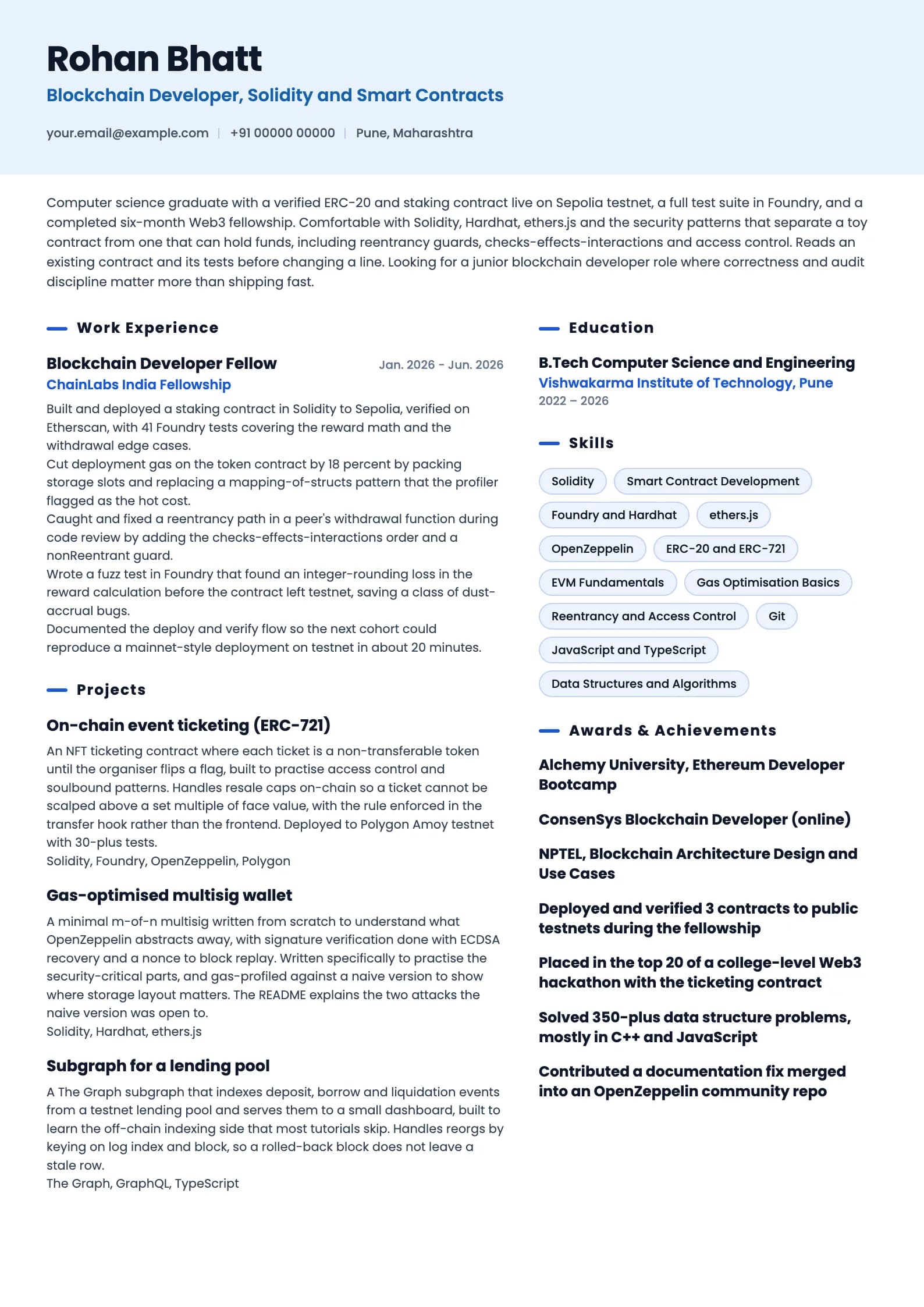
Build my resumeBlockchain Developer resume example, Fresher (0 years)
ai-era templateIs your resume good enough?
Upload the resume you have now and see what an applicant tracking system reads before a blockchain developer recruiter ever does.
Free to run. Sign in with your mobile number to see your score.
Blockchain Developer resume example, Mid-level (4 years)
professional template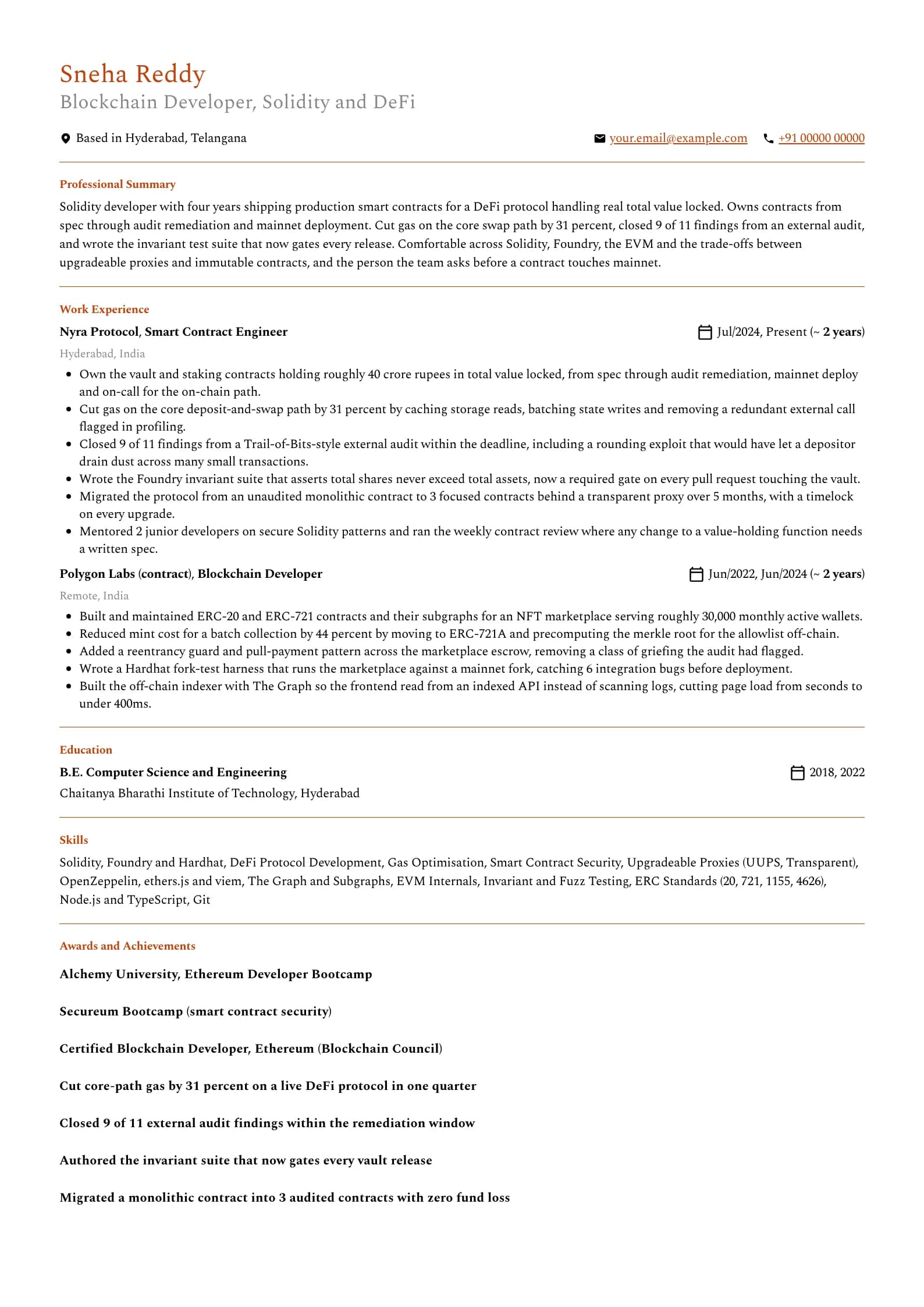
Want this structure with your own details? Build it in the resume builder.
Blockchain Developer resume example, Senior (8 years)
header-band template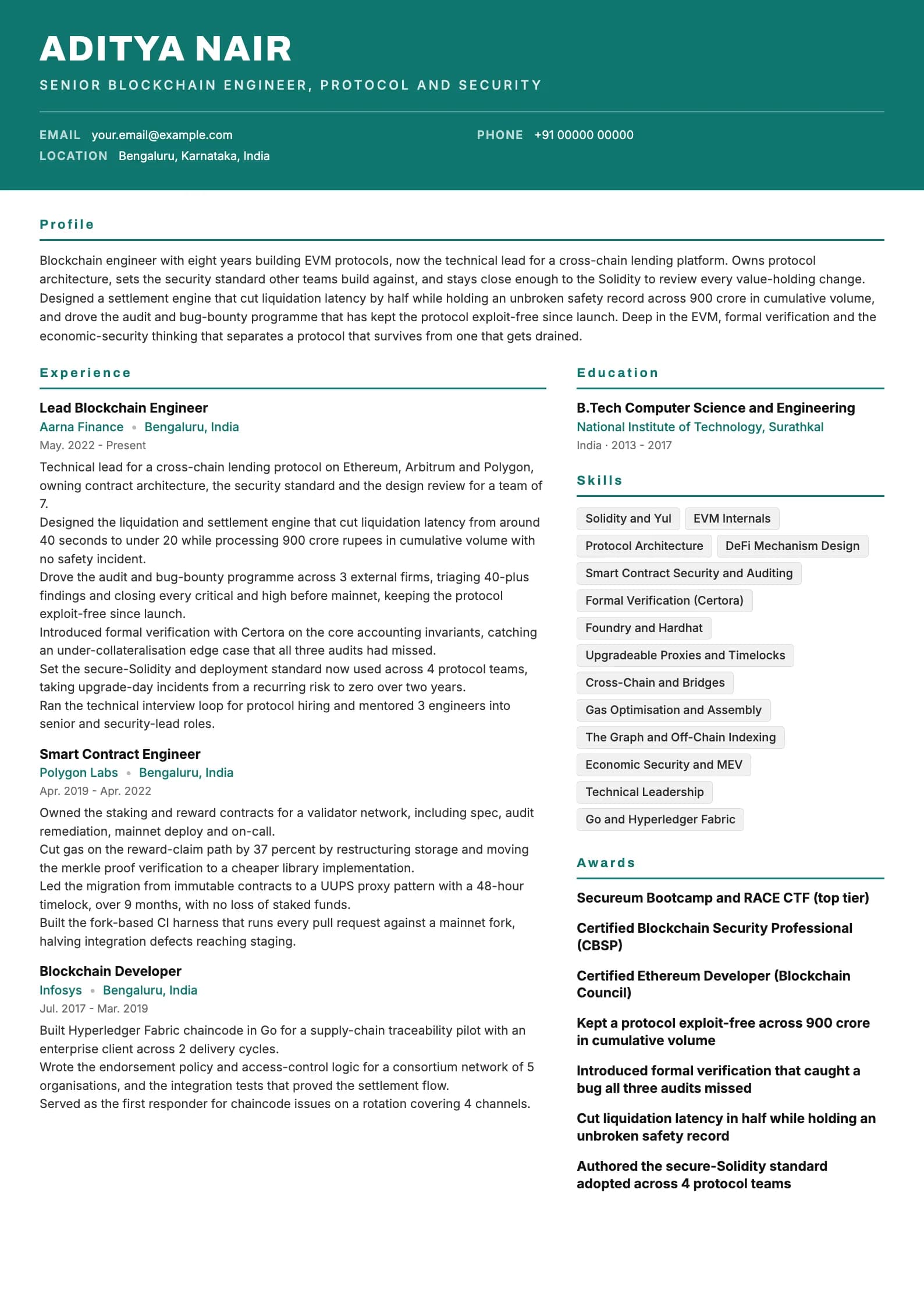
The format that works for blockchain developer resumes in India
Reverse chronological is the layout to use. Put the most recent role first, work backwards, and keep the dates visible. Functional resumes that group everything under a skills heading and drop the dates read as an attempt to hide a gap or a very short stint, and Web3 hiring is small enough that reviewers are already suspicious of inflated timelines. One honest line about a gap beats a hidden one. Length follows evidence. One page holds everything a fresher and most developers up to roughly six years need. Past that a second page is fine when it carries real protocol work rather than a longer chain list. A page two built from a list of every blockchain you have read about is a padded one-page resume. Web3 has its own version of resume clutter: a wall of chain logos, token tickers and a link to a personal wallet. None of it belongs on the page. A photograph, date of birth, marital status and father's name survive from older campus templates and add nothing to a technical screen. Every line they take is a contract or an audit result they push off the page. Link what is checkable in plain text. A verified contract on Etherscan, a GitHub with real commit history, an audit report you contributed to. These are worth more than any adjective, because a reviewer can open them. Send a PDF unless the posting asks otherwise, name the file with your own name and target role, and keep to a single column so a parser does not read a sidebar out of order. The table below sets the section order.
| Section | Where it goes | Why |
|---|---|---|
| Name and headline | Top, above everything | Headline is the role you want, blockchain or Solidity developer. Recruiters match on it. |
| Professional summary | Directly under the header | Three lines. Chains and stack, years, and the single strongest result. |
| Work experience | Next, for anyone with a job | Most recent first. Newest role gets the most bullets. |
| Projects and contracts | Above experience for freshers, below it after that | For a fresher these are the evidence. Link verified contracts and repos. |
| Skills | Below experience | Grouped: language, frameworks, security, tools. Not a chain-logo wall. |
| Education | Bottom, unless you are a fresher | Degree, institution, years. Drop the percentage after your first job. |
| Certifications | After education, or beside skills if only one or two | Name, issuing body, year. Secureum and audit credentials earn their place. |
Naming a chain is not the same as proving you shipped on it
The most common blockchain resume failure is a skills line that reads Ethereum, Solana, Polygon, Avalanche, Cosmos, Near, Aptos, Sui, Bitcoin, Solidity, Rust, Move with no bullet anywhere showing a single contract shipped to any of them. A parser matches the tickers, but a Web3 interviewer reads the wall and assumes it is aspirational, then asks which chain you have actually deployed a value-holding contract to. The fix is to let the experience prove the stack. If you write Solidity, a bullet should describe a contract you built and what it holds. If you write The Graph, a bullet should mention the subgraph you shipped and why. The mid-level sample lists Foundry, invariant testing and UUPS proxies precisely because the bullets show an invariant suite gating releases and a proxy migration with a timelock. The skills line and the experience agree, which is what makes both believable. Be honest about depth per chain. Most Indian blockchain roles are EVM and Solidity, so lead with that if it is your real strength. Listing Rust and Move because Solana and Aptos are fashionable, when you have never shipped to either, invites the one interview question you cannot answer. It is stronger to be deep on Ethereum than shallow on six chains. Security vocabulary is part of the stack here in a way it is not for most backend roles. Reentrancy, checks-effects-interactions, access control, integer overflow, front-running and MEV are the terms that tell a reviewer you understand that a deployed contract is adversarial and often immutable. Use them where they are true, because they are the difference between a Web3 developer and a web developer who has read about tokens.
For every chain and tool on your skills line, ask: is there a bullet that proves I shipped on it. If not, either add the bullet or cut the item. A logo wall helps no one and invites the question you cannot answer.
Writing a summary a Web3 hiring manager actually reads
The block under your name is the part most likely to be read, so it should carry three facts: what you build and on which chains, how long you have been building it, and the strongest thing that happened because of your work. In blockchain the strongest thing is often a security or value number: total value locked handled, an exploit prevented, an audit finding closed, gas cut. Three or four lines, no adjectives that cannot be checked. The old objective line, seeking a challenging role in a reputed Web3 company to utilise blockchain skills, tells the reader nothing they did not assume. Replace it with a summary. An objective describes what you want, a summary describes what you have already shipped, and only one is evidence when the code is public. Freshers often believe they have nothing to summarise. Look at the fresher sample: it names a verified testnet contract, a test count, and the security patterns learned. That is a genuine summary built from a fellowship and side projects. What it avoids is "passionate about the future of decentralisation", a phrase so common on Web3 resumes it now carries no information and often reads as someone who owns tokens rather than writes contracts. A practical test: read your summary and ask whether anyone who watched the same YouTube course could paste it onto their resume unchanged. If they could, it describes the trend, not you. Add the specific contract, the specific value or gas number, and the specific ownership until it stops being transferable.
Professional summary, mid-level developer
Weak
Passionate blockchain enthusiast with 4+ years of experience in Ethereum, Solana, Polygon and Web3 seeking a challenging role in a fast-growing decentralised organisation.
Strong
Solidity developer with four years shipping production contracts for a DeFi protocol, owning them from spec to mainnet. Cut core-path gas by 31 percent and closed 9 of 11 external audit findings including a rounding exploit.
The rewrite trades a chain list and self-description for a domain, an ownership scope and two verifiable security and performance results.
Experience bullets: verb, contract, consequence
Every strong bullet in the samples follows the same shape. It opens with an action verb, names the specific contract or protocol change you built, and closes with what measurably moved. The verb establishes that you did it. The contract tells a reviewer whether the work is relevant. The number, whether gas, value locked or a closed finding, does the persuading. Start with the outcome and work backwards. Developers usually write the task first, then struggle to attach a number, which produces bullets like "worked on smart contracts using Solidity and improved efficiency". Instead ask what was different on-chain after you shipped: gas dropped, an exploit class was closed, an invariant now holds, a migration completed with no fund loss, an audit finding was remediated. Then write the sentence that ends in that fact. Vary the metric. In Web3 the honest metrics are richer than gas alone: total value locked, transactions or volume processed, audit findings closed, invariants added, deployment cost, indexer latency and monthly active wallets. Six gas numbers in a row read as one trick, so reach for the range a real role gives you. Where you lack a number, give scope: how many contracts, how many chains, how large a migration, how many audit findings. "Migrated a monolithic contract into 3 audited contracts behind a proxy over 5 months with zero fund loss" carries weight without inventing a percentage. Allocate bullets by recency. Current role gets five or six, the previous role four or five, anything older two or three.
| Level | What bullets must prove | Typical metric |
|---|---|---|
| Fresher | You can ship a correct, tested contract to testnet | Tests written, gas cut, verified deploys, fuzz bugs found |
| 1 to 3 years | You own a contract on mainnet without supervision | Gas cut, findings closed, subgraph latency, wallets served |
| 4 to 6 years | You own value-holding contracts end to end, including audit | TVL handled, audit findings closed, invariants added, volume |
| 7 years and up | You set protocol architecture and the security standard | Safety record, cumulative volume, verification introduced, standards set |
Experience bullet, smart contract role
Weak
Responsible for developing smart contracts using Solidity and fixing issues raised during audits.
Strong
Closed 9 of 11 external audit findings within the deadline, including a rounding exploit that would have let a depositor drain dust across many small transactions.
"Responsible for" describes a job description; the rewrite names the findings closed and the exploit class removed.
Experience bullet, optimisation work
Weak
Worked on gas optimisation of the contracts which improved the efficiency significantly.
Strong
Cut gas on the core deposit-and-swap path by 31 percent by caching storage reads, batching state writes and removing a redundant external call flagged in profiling.
Names the before and after and the three techniques, so a reviewer can ask a real follow-up instead of nodding at a vague claim.
If a bullet would read identically on any bootcamp graduate's resume, it is describing the course, not you. Rewrite it until it only fits the contract you actually shipped.
The skills section: grouped, honest, and short enough to defend
A blockchain resume's skills section has two audiences with opposite preferences. The parser wants literal terms it can match, Solidity and Foundry and ERC-721. A human wants a short, organised list that signals what kind of developer you are and, crucially, whether you take security seriously. Grouping satisfies both. Group by function rather than one long line. Language, frameworks, security, chains and tools is a grouping that works for almost every EVM developer. The exact headings matter less than the fact that structure exists. Write names the way the industry writes them: Solidity not solidity, Foundry not foundry, OpenZeppelin not open zeppelin. A parser matches on strings. Twelve to sixteen skills is the working range. Below eight the section looks thin. Above twenty it stops being a signal, and blockchain resumes are especially prone to chain padding: listing ten networks when you have deployed to two. The list is a contract: every item is a question you have agreed to answer, and in a Web3 interview those questions get sharp. Give security its own group or make sure it is visible. A skills section that names reentrancy protection, access control and testing frameworks tells a reviewer you know a deployed contract is adversarial. One that lists only chains and tokens reads as a trader who learned to compile. Do not include a proficiency bar. Star ratings invite an argument, and nobody agrees on what four stars in Solidity means. Let the experience prove the depth.
| Group | What goes in it | How many |
|---|---|---|
| Language | Solidity, and Yul or Rust where you have really shipped | 1 to 3 |
| Frameworks | Foundry, Hardhat, ethers.js, viem, OpenZeppelin | 3 to 5 |
| Security | Reentrancy, access control, invariant and fuzz testing, auditing | 2 to 4 |
| Chains and standards | Ethereum, Polygon, Arbitrum, ERC-20, ERC-721, ERC-4626 | 2 to 4 |
| Tools | Git, The Graph, Foundry CI, Tenderly, Slither, Node.js | 3 to 5 |
Skills section
Weak
Skills: Blockchain, Solidity, Rust, Move, Ethereum, Solana, Polygon, Avalanche, Cosmos, Near, Aptos, Sui, Bitcoin, Web3, DeFi, NFT, DAO, Metaverse, Crypto, Smart Contracts, DApps, HTML, CSS, JavaScript, MS Office
Strong
Language: Solidity, Yul. Frameworks: Foundry, Hardhat, ethers.js, OpenZeppelin. Security: reentrancy protection, access control, invariant and fuzz testing. Chains: Ethereum, Polygon, Arbitrum. Standards: ERC-20, ERC-721, ERC-4626. Tools: The Graph, Slither, Git.
Cuts the chains you never shipped to and the buzzwords, keeps only what you can defend, and groups the rest so a human reads it in one pass and sees the security focus.
Projects and on-chain work: what to include and how to describe it
For a fresher, contracts are the resume. They sit above experience, they get the most space, and they are where a reviewer decides whether you can actually write safe Solidity or only pass quizzes about it. For an experienced developer they move below experience and shrink to one or two entries, kept only if they show something the day job does not, such as a chain or a pattern you have not shipped at work. The common failure is describing the buzzword instead of the software. "A DeFi DApp built using Solidity and Web3" tells a reviewer nothing, because thousands of resumes carry that line. Describe what the contract does, what it holds, and what was genuinely hard or dangerous about it. The ticketing contract in the fresher sample is a strong entry because it names one real problem, enforcing a resale cap on-chain in the transfer hook, that a frontend cannot solve. Pick projects that show range and security awareness rather than three token clones. One with a verified deploy and a public test suite, one that demonstrates a security pattern such as a reentrancy-safe withdrawal or a multisig, and one that touches the off-chain side such as a subgraph is a stronger set than three copies of the same ERC-20 tutorial. Two well-described contracts beat five named tokens. If the code is public, say so in plain text and make sure it is verified on the block explorer. An interviewer who opens your contract and finds it unverified, untested and copied wholesale from a tutorial reads that as your real work sample. A clean repo with a test suite and a verified address is one of the strongest things a fresher can put on the page.
Project description, fresher resume
Weak
DeFi DApp: a decentralised application built using Solidity, Web3 and React with staking and reward features.
Strong
Staking contract on Sepolia, verified on Etherscan, with 41 Foundry tests covering the reward math and withdrawal edge cases, including a fuzz test that caught an integer-rounding loss before deploy.
Swaps a buzzword list for a verified deploy, a real test count, and the specific correctness problem the tests caught.
Where education and certifications belong
Education goes at the bottom for anyone with a full-time job, and near the top for a fresher, who has nothing stronger to lead with. Degree, institution, years. That is the whole entry for most people. Blockchain hiring cares less about the exact degree than most fields, because so many strong Web3 developers are self-taught or came from other engineering, so do not over-invest in the education block if your contracts are strong. CGPA or percentage is worth keeping while you are a fresher and it is good, roughly 7.5 out of 10 and above, because campus and early-career screening still filters on it. Once you have your first full-time role, drop it in favour of shipped contracts, which are far more predictive. Certifications sit just below education, or beside skills if you hold only one or two. Blockchain has a split here. The paid certificate mills, which promise a Certified Blockchain Expert badge after a short course, carry little weight with serious Web3 teams. What carries weight is Secureum, which is a genuine security bootcamp with a competitive CTF, and a demonstrated finish in the RACE CTF or a public audit contest such as Code4rena or Sherlock. If you have placed in a real audit contest, that belongs near the top of the page, not in the certifications footer, because it is a work sample, not a certificate.
Getting through the applicant tracking system
An applicant tracking system is a parser and a search index, not a judge. It reads your file, tries to break it into name, dates, employers, titles and skills, and stores the result so a recruiter can search across candidates. Almost every ATS problem is a parsing problem, and parsing problems come from layout, not wording. Web3 is a smaller market, and many roles are screened by a technical founder rather than a big-company ATS, but the same rules keep your resume readable either way. The layout rules are short. One column. Standard section headings, so use Work Experience rather than My Web3 Journey, and Skills rather than My Stack. No text inside images, so a strip of chain logos reads as empty space and loses you the very keywords you meant to show. No critical information in the header or footer region, which some parsers drop. Avoid text boxes and nested tables in the resume body. On wording, mirror the language of the job description where it is honest. If the posting says Solidity, write Solidity. If it says smart contract security, write smart contract security. Spell out an acronym alongside its short form at least once, for example "TVL (total value locked)", so both searches find you. Keyword stuffing does not work. A hidden white-text block of every chain and token fools nobody in a market this small, and a founder who spots it filters you faster than an ATS would. Write real bullets that naturally contain the right terms, because a bullet describing the invariant suite you wrote contains the word invariant in a context that survives a human read too. Save as PDF from a tool that embeds real text, then open the file and confirm you can select and copy a sentence. If you cannot select the text, neither can the parser.
Section heading
Weak
My Journey Into Decentralisation
Strong
Work Experience
Parsers look for standard headings; a creative one can push the whole block into an unclassified bucket the recruiter never searches.
Test your own file before you send it. Copy the text out of the PDF into a plain text editor. Whatever you can read there is roughly what the parser sees, and a logo strip that reads as blank space is a real loss.
What gets blockchain developer resumes rejected
Most rejections at the resume stage are not close calls. They come from a small set of recurring problems, and all of them are fixable in an afternoon. The list below covers what reviewers of Indian blockchain and Web3 resumes see most often, in rough order of how much damage each one does.
- A chain-logo wall with no bullet proving a single shipped contract. Every network you list is a question you have agreed to answer.
- Trader vocabulary instead of builder vocabulary. Talking about tokens you hold, market caps and price rather than contracts you wrote reads as an investor, not an engineer.
- No security language anywhere. Reentrancy, access control and testing are the words that separate a Web3 developer from a web developer, and their absence is noticed.
- No numbers on-chain. Gas cut, TVL handled, audit findings closed, invariants added, volume processed. Pick whichever is honest for the work.
- Unverified or copied contracts linked as your own. An interviewer opens the address, sees it is unverified or lifted from a tutorial, and reads that as your real work.
- Job duties copied from the posting instead of what you shipped. "Responsible for" is the tell.
- A photo, date of birth, marital status or father's name. None of it belongs on a technical resume, and it takes a contract's space.
- Listing Rust and Move because Solana and Aptos are fashionable, when you have shipped neither, which invites the one interview question you cannot answer.
- Inflated titles or dates that do not match your record. Web3 is a small market where founders talk to each other, so a mismatch surfaces fast.
- Typos in the technologies you claim to know. Writing "Solidty" or "Etherium" undoes an otherwise strong page instantly in this field.
Before you send it, open every contract link on your resume as if you were the interviewer. An unverified address or an empty test folder is worse than not linking it at all.
Skills to put on a blockchain developer resume
Technical
- Solidity
- Smart Contract Development
- EVM Internals
- Gas Optimisation
- DeFi Protocol Design
- Smart Contract Security
- Reentrancy and Access Control
- Upgradeable Proxies (UUPS, Transparent)
- ERC Standards (20, 721, 1155, 4626)
- Invariant and Fuzz Testing
- Cross-Chain and Bridges
- Off-Chain Indexing (The Graph)
- Yul and Assembly
- TypeScript
Tools and platforms
- Foundry
- Hardhat
- OpenZeppelin
- ethers.js and viem
- The Graph
- Slither
- Tenderly
- Certora
- Etherscan
- Git
- Node.js
- MetaMask
Working skills
- Security-first thinking
- Code review
- Technical documentation
- Audit remediation
- Cross-functional collaboration
- Mentoring
- Incident response
- Design communication
- Threat modelling
Certifications worth listing as a blockchain developer
| Certification | Full name | Worth it for |
|---|---|---|
| Secureum | Secureum Bootcamp and RACE CTF | The credential that carries real weight with serious Web3 teams, because it is a competitive smart-contract-security bootcamp with a hard CTF rather than a paid badge. Worth it for any developer serious about audit or protocol work, and a strong finish belongs near the top of the page as a work sample, not in the footer. |
| Code4rena / Sherlock | Public audit contest placements (Code4rena, Sherlock, Cantina) | Not a certification but the strongest security signal a blockchain developer can carry. A placement in a public audit contest is a verifiable work sample. Worth pursuing for anyone aiming at security or senior protocol roles, and worth listing with the contest and rank. |
| Alchemy University | Alchemy University, Ethereum Developer Bootcamp | A solid free bootcamp for freshers and career switchers proving Ethereum and Solidity fundamentals. Useful as an entry signal alongside a verified testnet contract, and redundant once you have shipped production contracts to point at. |
| CED | Certified Ethereum Developer (Blockchain Council) | A paid certificate that offers a keyword and a structured curriculum for a fresher. Recognised in some Indian enterprise and consulting contexts, but light with product Web3 teams, who weight a verified contract and an audit-contest finish far higher. Treat it as a supplement, not a substitute for shipped code. |
| CBSP | Certified Blockchain Security Professional | Worth considering for developers moving toward the security and audit side who want a structured credential on the page. Most valuable in enterprise and consortium-chain contexts. For product DeFi security work, a Secureum finish or a contest placement outweighs it. |
Keywords an ATS scans for in a blockchain developer resume
These are the literal terms a parser matches against the job description. Use the ones that are true of you, in the sentences where you did the work, not as a list at the bottom.
- blockchain developer
- solidity developer
- smart contract
- web3
- ethereum
- EVM
- defi
- gas optimisation
- foundry
- hardhat
- ERC-20
- ERC-721
- smart contract security
- reentrancy
- audit
- openzeppelin
- the graph
- upgradeable proxy
- invariant testing
- cross-chain
Blockchain Developer resume FAQ
What salary can a blockchain developer expect in India?
Blockchain pay runs above general backend at every level because the supply of proven Solidity engineers is thin. A fresher with verified contracts typically starts around 6 to 12 LPA, higher at funded Web3 startups. A mid-level Solidity developer with four to six years usually sits in the 18 to 35 LPA band, and often more when the work is DeFi and security-heavy. Senior protocol engineers and leads with strong audit records commonly earn 40 to 80 LPA and above, and some remote roles pay in stablecoins at global rates. A public audit-contest record and formal-verification skill push the top of every band sharply upward.
How long should a blockchain developer resume be?
One page up to about six years of experience, two pages after that only if the second page carries real protocol and security work rather than a longer chain list. Nobody has been rejected for a resume that was too easy to read. If you are struggling to fit one page, cut the oldest role to a line, remove any chain you have not shipped to, and delete tutorial-level projects in favour of one verified contract.
Do I need to know more than one blockchain?
No, and pretending to is a trap. Most Indian blockchain roles are EVM and Solidity, so being genuinely deep on Ethereum and one or two L2s such as Polygon or Arbitrum is stronger than being shallow on six chains. Listing Rust and Move because Solana and Aptos are fashionable, when you have shipped to neither, invites the one interview question you cannot answer. Add a second ecosystem only after you have shipped a real contract on it.
How does a fresher get a blockchain job with no experience?
Lead with contracts, then education, then skills. Deploy a real contract to a public testnet, verify it on the block explorer, and back it with a public test suite in Foundry or Hardhat. Treat each contract as a job: what it does, what it holds, what security concern it handles. A verified staking or NFT contract with tests, plus a documentation contribution to OpenZeppelin or a hackathon finish, beats any certificate. Participating in a beginner audit contest, even without a payout, is a strong differentiator.
Do blockchain certifications actually help?
It depends heavily on which one. The paid Certified Blockchain Expert style badges carry little weight with serious Web3 teams. What genuinely helps is Secureum and a placement in a public audit contest such as Code4rena or Sherlock, because those are competitive and verifiable rather than pay-to-pass. For a fresher, a free bootcamp like Alchemy University plus a verified contract is worth more than an expensive certificate with no code behind it.
Should I put my GitHub and contract addresses on the resume?
Yes, in plain text, and make sure they hold up. A verified contract on Etherscan and a GitHub with real commit history are the strongest evidence you can offer, because an interviewer can open them. The risk runs the other way: an unverified contract, an empty test folder or a repo that is a single tutorial copy reads as your real work sample and hurts you. Clean up what you link before you link it.
How important is security knowledge on a blockchain resume?
It is the single biggest differentiator. A deployed contract is adversarial and usually immutable, so a resume that names reentrancy protection, access control, integer-overflow safety, invariant testing and audit experience signals that you understand the stakes. A resume that lists only chains and tokens reads as someone who learned to compile, not to secure value. Even at fresher level, showing you know the checks-effects-interactions order and why it matters sets you apart.
Does an ATS reject blockchain resumes with two columns or logos?
It does not reject them outright, but some parsers read multi-column layouts out of order and read text inside images as blank space, so a two-column resume with a strip of chain logos can lose you the exact keywords you meant to show. A single-column layout with the chains written as text removes both risks, which is why all three samples above use one. Copy the text out of your PDF into a plain editor to check what the parser sees.
Should freshers list projects above work experience?
Yes. With no full-time roles, contracts and projects are the strongest evidence you can offer, so they sit directly under the summary. State what each contract does, what it holds, and the security concern it handles, not just the stack. Pick projects that show range: one verified on-chain with tests, one that demonstrates a security pattern, and one that touches the off-chain side such as a subgraph. A fellowship or internship still goes in a separate experience section below projects.
Related resume examples and guides
Build your own in any of these formats
Start from a blank resume or upload the one you have. Goodspace renders it in 24 templates and flags the Solidity, security and smart-contract keywords an applicant tracking system will look for, and the chain-logo padding it will not credit.
Build my resume