Aeronautical Engineer Resume Format, with 3 Full Samples
An aeronautical engineer is hired on evidence of designs that cleared analysis, weight taken out of a structure, and parts that passed inspection to an airworthiness standard, yet most resumes list CATIA and ANSYS and forget what they proved. Below are three complete resumes, one for a fresher fresh out of a B.Tech in Aeronautical Engineering, one for a stress and design engineer with five years across CFD and structural analysis, and one for a senior engineer leading a design group at an aerospace tier-one. After the samples come the format rules, the split between design, analysis and MRO careers, the software and codes a parser matches literally, and the mistakes that end a screening before a human reads the page.
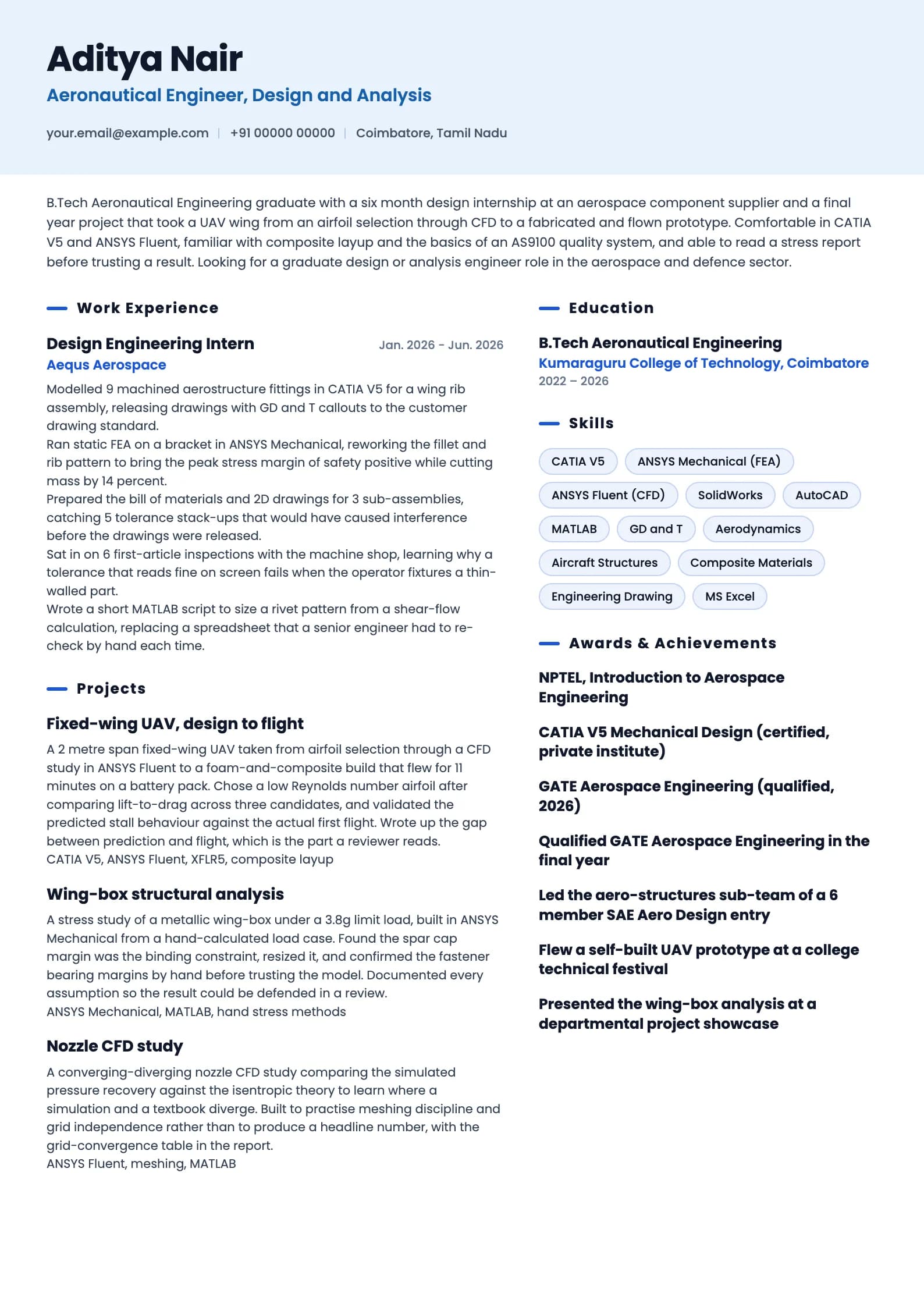
Build my resumeAeronautical Engineer resume example, Fresher (0 years)
ai-era templateIs your resume good enough?
Upload the resume you have now and see what an applicant tracking system reads before a aeronautical engineer recruiter ever does.
Free to run. Sign in with your mobile number to see your score.
Aeronautical Engineer resume example, Mid-level (5 years)
professional template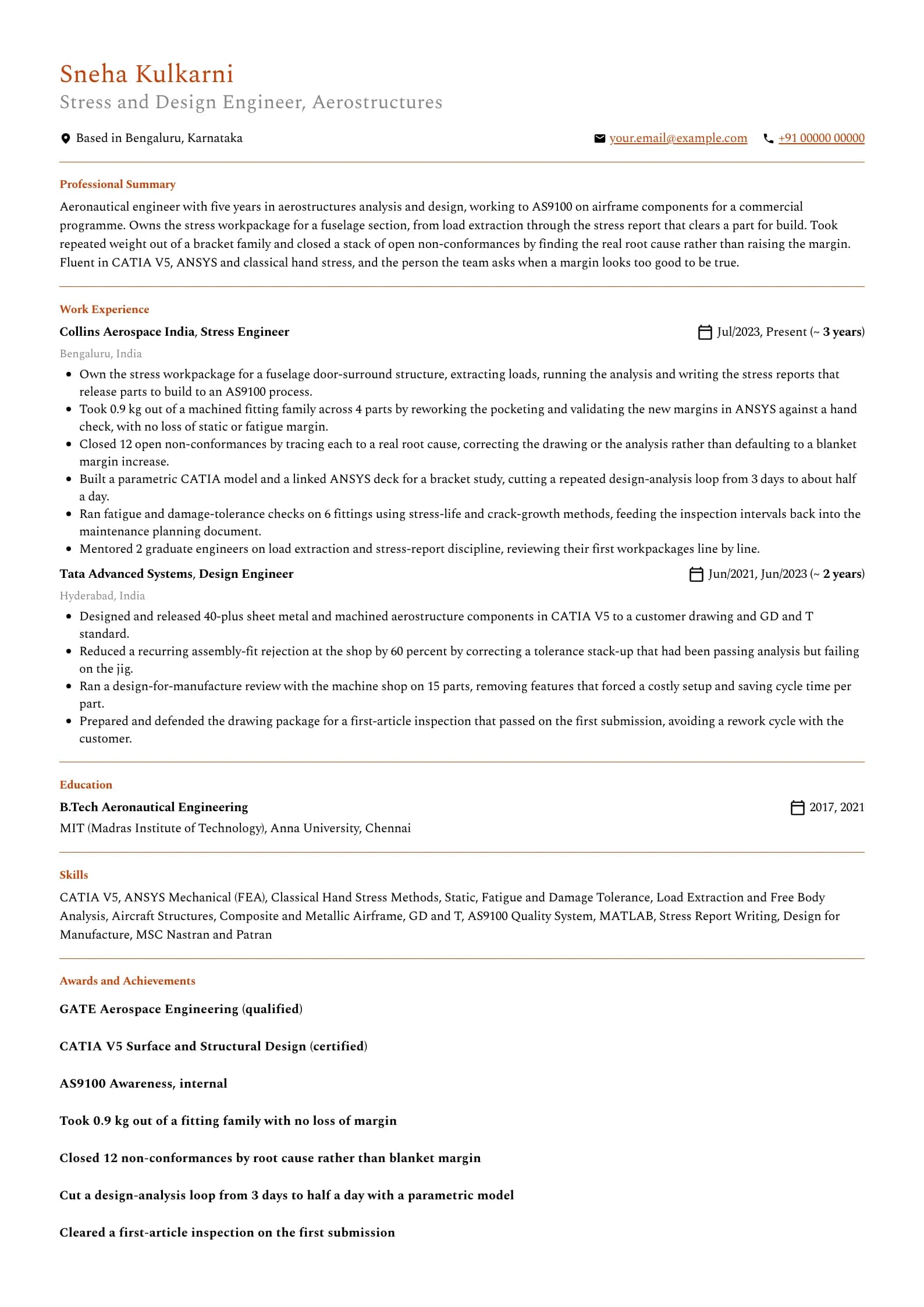
Want this structure with your own details? Build it in the resume builder.
Aeronautical Engineer resume example, Senior (11 years)
header-band template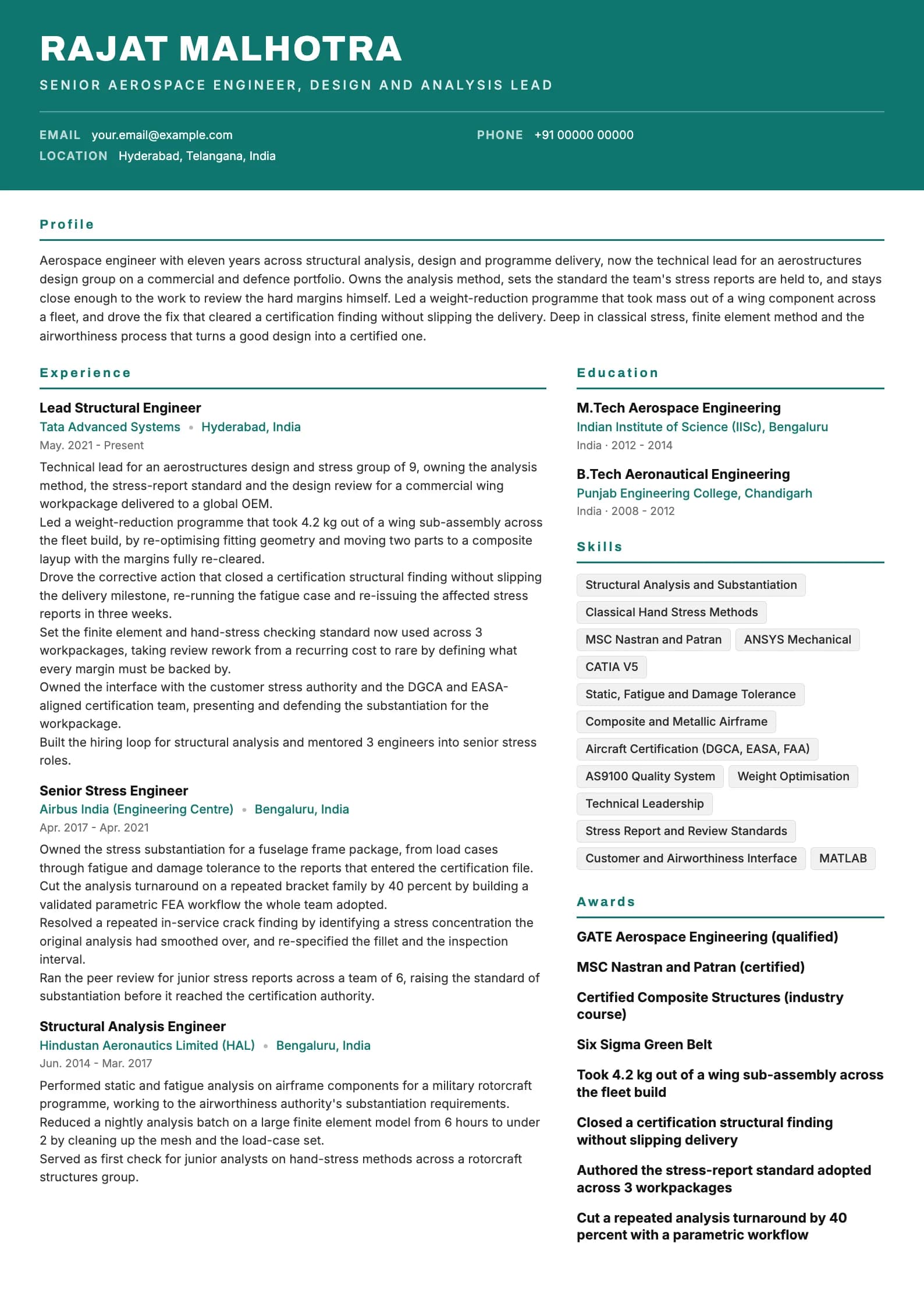
The format that works for aeronautical engineer resumes in India
Reverse chronological is the only layout worth using. Put the most recent role first, work backwards, and let the dates sit in plain view. Functional resumes that group everything under Software and Skills and quietly drop the dates read as an attempt to hide a gap, and a certification-heavy field like aerospace is one where reviewers look hard at continuity. A gap explained in one honest line is better than one buried. Length is decided by evidence. One page holds everything a fresher and most engineers up to roughly six years have to say. Past that a second page is fine when it carries real programme and analysis work rather than a longer software list. A page two built from a declaration paragraph and a hobbies line is a padded one-page resume. Four things belong nowhere on an aerospace technical resume: a photograph, date of birth, marital status and father's name. They survive from an older template that circulated through campus placement cells. Nobody screening a stress or design engineer is looking for them, and every line they occupy is a line a project or a margin could have used. Name your file with your own name and the target role rather than resume_final_v4, and send a PDF unless the posting asks for DOCX. Use a single column all the way down, because two-column layouts parse unpredictably when a sidebar sits beside the experience. The table below sets out the section order.
| Section | Where it goes | Why |
|---|---|---|
| Name and headline | Top, above everything | The headline is the role you want: stress engineer, design engineer, CFD analyst. Recruiters match on it. |
| Professional summary | Directly under the header | Three lines. Discipline, years, and the single strongest weight or margin result. |
| Work experience | Next, for anyone with a job | Most recent first. Newest role gets the most bullets. |
| Projects | Above experience for freshers, below it after that | For a fresher the UAV or analysis project is the evidence. For an experienced engineer it is supporting material. |
| Skills | Below experience | Grouped: CAD, analysis software, methods, domain. Not a 30-item wall. |
| Education | Bottom, unless you are a fresher | Degree, institution, years. GATE score near the top while it is fresh. |
| Certifications | After education, or beside skills if only one or two | GATE, CATIA, Nastran, an AME licence. Name, body, year. |
Design, analysis or MRO: name the track before you write
Aeronautical is not one job, and a resume that tries to cover all of it reads as unfocused. There are three broad tracks in the Indian market and the resume changes depending on which one you are chasing. Design and structures, at HAL, Tata Advanced Systems, Collins, Airbus and the tier-ones, wants CATIA, GD and T, drawing release, weight and manufacturability. The bullets are about parts modelled, drawings released and rejections cut. Analysis, CFD and stress wants ANSYS, Nastran and Patran, classical hand methods, load extraction, and the margins and reports that clear a part. The bullets are about margins, weight taken out, fatigue and damage-tolerance cases run and non-conformances closed. This is where the mid-level and senior samples sit. Maintenance, repair and overhaul, at Air India Engineering, IndiGo, GMR and the MRO shops, is a different world governed by a DGCA licence. Here the resume leads with the aircraft types and the AME licence category, the maintenance tasks signed off, the airworthiness directives actioned and the turnaround times, not CATIA. If you hold a DGCA AME licence, it is the single most important line on the page and it goes at the top. Pick the track that matches the posting and lead with the evidence that track values. A design resume sent to an MRO opening, or an MRO resume sent to a stress opening, both read as the wrong person no matter how strong the underlying work is.
Read the job posting and decide: is this design, analysis or MRO. Then reorder your resume so the first thing a reviewer sees is the evidence that track cares about. Same career, three different front pages.
Writing a summary a hiring manager actually reads
The block under your name is the part you can be reasonably sure gets read, so it should carry three facts: what you design or analyse, how long you have been doing it, and the strongest thing that happened because of your work. Three or four lines, no adjectives that cannot be checked. The old objective line, seeking a challenging position in a reputed aerospace organisation to utilise my engineering skills, tells the reader nothing they did not assume from the application. Replace it with a summary. An objective describes what you want, a summary describes what you have already done, and only one is evidence. Freshers often believe they have nothing to summarise. Look at the fresher sample: it names the tools, states the internship length, and points at a UAV project that actually flew and a stress study with a defended result. That is a genuine summary built from coursework, one internship and real projects. What it avoids is "passionate about aviation since childhood", a phrase so common on aerospace graduate resumes it now carries no information. A practical test: read your summary and ask whether a classmate with the same degree could paste it onto their resume unchanged. If they could, it describes the syllabus, not you. Add the specific component, the specific weight or margin and the specific ownership until it stops being transferable.
Professional summary, mid-level engineer
Weak
Passionate and hardworking aeronautical engineer with 5+ years of experience in CATIA, ANSYS and stress analysis seeking a challenging role in a reputed aerospace organisation.
Strong
Aeronautical engineer with five years in aerostructures analysis, owning the stress workpackage for a fuselage section from load extraction to the report that releases a part. Took 0.9 kg out of a fitting family with no loss of margin.
The rewrite trades a software list and self-description for an ownership scope and a verifiable weight-and-margin result.
Experience bullets: verb, part or analysis, consequence
Every strong bullet in the samples follows the same shape. It opens with an action verb, names the specific component or analysis you did, and closes with what measurably moved. The verb establishes you did it. The part or the study tells a technical reviewer whether the work is relevant. The number does the persuading. Start with the outcome and work backwards. Engineers usually write the task first, then struggle to attach a number, which produces bullets like "worked on structural analysis using ANSYS and improved the design". Instead ask what was different after you finished: weight came out, a margin turned positive, a rejection dropped, a non-conformance closed, an analysis loop got shorter, a first-article passed. Then write the sentence that ends in that fact. Vary the metric. Aerospace has a natural language of numbers: mass in kilograms or grams, margin of safety, rejection rate, cycle time, analysis turnaround, non-conformance count, load factor. Weight is the headline metric of the whole field, so if you took mass out of anything, that bullet leads. Where you lack a number, give scope: how many parts modelled, how many stress reports issued, how many load cases run, how long a substantiation took. "Owned the stress substantiation for a fuselage frame package from load cases through fatigue to the certification file" carries weight without inventing a percentage. Allocate bullets by recency. Current role gets five or six, the previous role four or five, anything older two or three.
| Level | What bullets must prove | Typical metric |
|---|---|---|
| Fresher | You can finish an analysis or a design and defend it | Weight cut, margin cleared, parts modelled, project flight time |
| 1 to 4 years | You own parts or a small analysis package | Rejections cut, drawings released, load cases run, margins closed |
| 5 to 8 years | You own a workpackage end to end, including the report | Weight out, non-conformances closed, turnaround, fatigue cases |
| 8 years and up | You set method and clear the hard certification findings | Fleet weight, certification findings closed, standards set, delivery held |
Experience bullet, stress role
Weak
Responsible for structural analysis of aircraft components using ANSYS and Nastran and preparing reports for the team.
Strong
Closed 12 open non-conformances by tracing each to a real root cause, correcting the drawing or the analysis rather than defaulting to a blanket margin increase.
"Responsible for" describes a job description; the rewrite names the change made and the way it was solved.
Experience bullet, weight work
Weak
Worked on weight optimisation of the structure which reduced the weight significantly.
Strong
Took 0.9 kg out of a machined fitting family across 4 parts by reworking the pocketing and validating the new margins in ANSYS against a hand check, with no loss of static or fatigue margin.
Names the mass, the parts, the method and the constraint held, so a reviewer can ask a real follow-up instead of nodding at a vague claim.
If a bullet would read identically on a teammate's resume, it is describing the programme, not you. Rewrite it until it only fits the parts and margins you actually owned.
The skills section: grouped, honest, and short enough to defend
An aerospace resume's skills section has two audiences with opposite preferences. The parser wants literal terms it can match, CATIA and ANSYS and Nastran and GD and T. A human wants a short, organised list that signals what kind of engineer you are. Grouping satisfies both. Group by function rather than one long line. CAD, analysis software, methods and domain is a grouping that works for almost every aeronautical engineer. Write names the way the industry writes them: CATIA V5 not Catia, MSC Nastran not Nastron, ANSYS Fluent for the CFD tool and ANSYS Mechanical for the structural one, because they are different skills and a knowing reviewer notices when a candidate blurs them. Twelve to sixteen skills is the working range. Below eight the section looks thin. Above twenty it stops being a signal. Aerospace resumes are especially prone to listing every software a candidate opened once during a project, which invites a question you cannot answer. The list is a contract: every item is a question you have agreed to sit for in the interview. Separate the tool from the method. Listing ANSYS proves you clicked buttons. Listing classical hand stress methods, fatigue and damage tolerance, or load extraction proves you understand what the tool is doing, and that is what separates an engineer from an operator. Include the methods, not just the software. Do not include a proficiency bar. Star ratings invite an argument you cannot win, and nobody agrees on what four stars in Nastran means. Let the experience prove the depth instead.
| Group | What goes in it | How many |
|---|---|---|
| CAD | CATIA V5, SolidWorks, NX, AutoCAD | 1 to 3 |
| Analysis software | ANSYS Mechanical, ANSYS Fluent, MSC Nastran, Patran, HyperMesh | 2 to 4 |
| Methods | Classical hand stress, fatigue, damage tolerance, CFD, load extraction | 3 to 5 |
| Domain | Aircraft structures, aerodynamics, composites, propulsion | 2 to 3 |
| Quality and standards | GD and T, AS9100, DGCA or EASA process, MATLAB | 2 to 4 |
Skills section
Weak
Skills: CATIA, ANSYS, Nastran, Patran, SolidWorks, AutoCAD, MATLAB, CFD, FEA, Fluent, HyperMesh, Abaqus, Creo, NX, StarCCM, OpenFOAM, MS Office, Python, C, GD&T
Strong
CAD: CATIA V5, SolidWorks. Analysis: ANSYS Mechanical, MSC Nastran and Patran. Methods: classical hand stress, fatigue and damage tolerance, load extraction. Domain: aircraft structures, composites. Standards: GD and T, AS9100.
Cuts the tools touched once, separates CFD from structural work honestly, and groups the rest so a human reads it in one pass and every item is defendable.
Projects and academic work: what to include and how to describe it
For a fresher, projects are the resume. They sit above experience, they get the most space, and they are where a reviewer decides whether you can actually engineer an airframe problem or only pass exams about it. For an experienced engineer they move below experience and shrink to one or two entries, kept only if they show something the day job does not. The common failure is describing the software instead of the engineering. "A UAV designed using CATIA and analysed in ANSYS" tells a reviewer nothing, because thousands of aerospace resumes carry that exact line. Describe what the thing does, what the hard decision was, and what happened when you tested it against reality. The design-to-flight UAV in the fresher sample is a stronger entry than a more ambitious paper project, because it actually flew and the write-up compares prediction to the real first flight. Pick projects that show range rather than three variations of the same simulation. One that was built and tested, one structural analysis defended to a real load case, and one CFD study run with proper grid independence is a stronger set than three CFD colour-plots. The colour plot is the least persuasive artefact in aerospace: everyone has a pretty pressure contour, and a reviewer wants to know if you checked the mesh. SAE Aero Design, a UAV team, a rocketry club or a hovercraft build all count and are often undersold. Name your role, the sub-system you owned and what it did, and be honest about the team size. "Led the aero-structures sub-team of a 6 member SAE Aero Design entry" is a real leadership signal for a fresher.
Project description, fresher resume
Weak
UAV Project: designed a fixed-wing UAV using CATIA and performed CFD analysis in ANSYS Fluent to study the aerodynamics.
Strong
Fixed-wing UAV, design to flight: a 2 metre span UAV taken from airfoil selection through a CFD study to a composite build that flew 11 minutes, with the report comparing predicted stall against the actual first flight.
Swaps a software list for a real build, a flight time and the one thing reviewers respect: comparing the simulation against what the aircraft actually did.
Where education, GATE and certifications belong
Education goes at the bottom for anyone with a full-time job, and near the top for a fresher, who has nothing stronger to lead with. Degree, institution, years. That is the whole entry for most people. CGPA or percentage is worth keeping while you are a fresher and it is good, roughly 7.5 out of 10 and above, because campus and PSU screening still filters on it. Once you have your first full-time role, drop it. A number from four years ago competes for space with parts and margins that are far more predictive. A GATE Aerospace score is different. It is the gate to ONGC-style PSU roles, to HAL and DRDO recruitment and to M.Tech admission, so while you are a fresher or early-career it earns a prominent line, often near education. Once you have several years of shipped design or analysis work, it fades to a single line and eventually drops off. Certifications sit just below education, or beside skills if you hold only one or two. Write the full name, the issuing body and the year. A CATIA or Nastran certificate is a useful tool signal early on. The one certification that outranks everything is a DGCA AME licence for maintenance roles, because it is a legal requirement to sign off aircraft work, so if you hold one, it goes at the very top of the page, not buried in a certifications list.
Getting through the applicant tracking system
An applicant tracking system is a parser and a search index, not a judge. It reads your file, tries to break it into name, dates, employers, titles and skills, and stores the result so a recruiter can search across candidates. Almost every ATS problem is a parsing problem, and parsing problems come from layout, not wording. The layout rules are short. One column. Standard section headings, so use Work Experience rather than My Aviation Journey, and Skills rather than My Toolbox. No text inside images, because a logo strip of aircraft OEMs reads as empty space. No critical information in the header or footer region, which some parsers drop. Avoid text boxes and nested tables in the resume body. On wording, mirror the language of the job description where it is honest. If the posting says stress analysis, write stress analysis. If it says CATIA V5, write CATIA V5, not just CAD. Include the expansion alongside an acronym at least once, for example "GD and T (geometric dimensioning and tolerancing)" and "FEA (finite element analysis)", so both searches find you. Keyword stuffing does not work. A hidden block of every aerospace software in white text is found quickly, and the outcome is worse than being filtered. Write real bullets that naturally contain the right terms, because a bullet describing a fatigue analysis contains the word fatigue in a context that survives human review too. Save as PDF from a tool that embeds real text, then open the file and confirm you can select and copy a sentence. If you cannot select the text, neither can the parser.
Test your own file before you send it. Copy the text out of the PDF into a plain text editor. Whatever you can read there is roughly what the parser sees, and anything scrambled is a real risk.
What gets aeronautical engineer resumes rejected
Most rejections at the resume stage are not close calls. They come from a small set of recurring problems, and all of them are fixable in an afternoon. The list below covers what reviewers of Indian aeronautical engineer resumes see most often, in rough order of how much damage each one does.
- A software wall with no bullet proving any of it. Listing ten analysis packages you opened once invites the one question you cannot answer.
- Software instead of method. Naming ANSYS but never a hand-stress or fatigue method reads as an operator, not an engineer who knows what the tool computes.
- No weight or margin anywhere. Aerospace is judged in kilograms and margin of safety, so a resume with no mass and no margin has not spoken the language.
- Wrong track. A design-heavy resume sent to an MRO opening, or an MRO resume to a stress role, reads as the wrong person no matter how good the work is.
- A photo, date of birth, marital status or father's name. None of it belongs on a technical resume, and it takes a project's space.
- A wall of CFD colour plots described but never validated. A pressure contour with no grid-independence check persuades no reviewer who knows CFD.
- A generic objective line. Replace it with a summary that states discipline, years and one weight or margin result.
- Burying a DGCA AME licence in a list. For a maintenance role it is the single most important qualification and belongs at the top.
- Inflated titles or dates that do not match your payslips and offer letters. Background verification is standard in aerospace and defence and a mismatch ends the process.
- Typos in the tools and terms you claim. Writing "Nastron" or "aerofoil" as "airofoil" undoes an otherwise strong page in a precision field.
Read your resume aloud once before sending it. Anything you would be embarrassed to defend in a design review is a line to cut or rewrite.
Skills to put on a aeronautical engineer resume
Technical
- Aircraft Structures
- Aerodynamics
- Structural Analysis (FEA)
- Computational Fluid Dynamics (CFD)
- Classical Hand Stress Methods
- Fatigue and Damage Tolerance
- Load Extraction and Free Body Analysis
- Composite Materials
- Propulsion Fundamentals
- Flight Mechanics
- Weight Optimisation
- GD and T
- Aircraft Certification (DGCA, EASA, FAA)
- Airworthiness and Substantiation
Tools and platforms
- CATIA V5
- SolidWorks
- Siemens NX
- ANSYS Mechanical
- ANSYS Fluent
- MSC Nastran and Patran
- Altair HyperMesh
- MATLAB and Simulink
- XFLR5
- AutoCAD
- MS Excel
- Python
Working skills
- Stress report writing
- Design review
- Root cause analysis
- Cross-functional collaboration
- Mentoring
- Customer and airworthiness interface
- Documentation discipline
- Attention to detail
- Working to a quality system
Certifications worth listing as a aeronautical engineer
| Certification | Full name | Worth it for |
|---|---|---|
| GATE Aerospace | Graduate Aptitude Test in Engineering, Aerospace Engineering | The single most useful qualification for an aerospace fresher in India. A good GATE Aerospace score opens PSU recruitment at HAL, DRDO, ISRO and BEL, and M.Tech admission at the IITs and IISc. Worth a prominent line while you are early-career, and it fades once you have several years of shipped design or analysis work to point at. |
| DGCA AME | DGCA Aircraft Maintenance Engineer Licence | A legal requirement to certify maintenance work on aircraft in India, so for anyone chasing MRO and airline engineering roles it is the most valuable line on the page and belongs at the top. Category and aircraft-type ratings matter as much as the licence itself. Not relevant for pure design or analysis careers, which do not need it. |
| CATIA V5 Certified | Dassault Systemes CATIA V5 Certification | A clean tool signal for a design or structures fresher, since CATIA V5 is the CAD standard across most Indian aerospace tier-ones. Most valuable in the zero-to-three-year range as proof you can model to a drawing standard. Beyond that, released drawings and shipped parts outrank the certificate. |
| MSC Nastran | MSC Nastran and Patran Certified Professional | Worth it for engineers moving into structural analysis who want to prove finite element competence on the tool much of the industry actually uses. Useful early and mid-career. Once you have owned a stress workpackage end to end, the substantiation you have delivered is the stronger credential. |
| AS9100 | AS9100 Aerospace Quality Management System (awareness or auditor) | The quality standard that governs aerospace manufacturing and design in India. Awareness-level training is a useful keyword for anyone working to the standard; the lead-auditor version matters most for quality-focused roles. Signals that you understand the process discipline aerospace work is held to, not just the engineering. |
| NDT Level II | Non-Destructive Testing Level II (per ASNT or ISO 9712) | A hands-on credential for engineers in inspection, quality and MRO who need to interpret radiographic, ultrasonic or dye-penetrant results on aircraft parts. Worth it if your work touches inspection and airworthiness sign-off; skip it if you are purely in design or CFD and never handle physical inspection. |
Keywords an ATS scans for in a aeronautical engineer resume
These are the literal terms a parser matches against the job description. Use the ones that are true of you, in the sentences where you did the work, not as a list at the bottom.
- aeronautical engineer
- aerospace engineer
- stress analysis
- structural analysis
- CATIA V5
- ANSYS
- CFD
- FEA
- Nastran
- Patran
- aircraft structures
- fatigue and damage tolerance
- GD and T
- composite materials
- weight optimisation
- AS9100
- DGCA
- airworthiness
- aerodynamics
- load extraction
Aeronautical Engineer resume FAQ
What salary can an aeronautical engineer expect in India?
A fresher typically starts around 3 to 6 LPA in private aerospace firms, with PSU roles at HAL, ISRO and DRDO reached through GATE paying a structured government scale that is often higher and more secure. An engineer with four to six years in stress, design or CFD usually sits in the 8 to 16 LPA band at the tier-ones and global engineering centres. Senior engineers and design leads with ten years and above commonly earn 20 to 40 LPA, more at the strongest OEMs and captive centres. A DGCA AME licence changes the picture for MRO careers, where licensed engineers earn well above unlicensed technicians.
How long should an aeronautical engineer resume be?
One page up to about six years of experience, two pages after that only if the second page carries real programme, analysis or certification work rather than a longer software list. Nobody has been rejected for a resume that was too easy to read. If you are struggling to fit one page, cut the oldest role to a single line, remove coursework, and delete any software you would not want to be interviewed on.
Is there a difference between aeronautical and aerospace engineering on a resume?
In the Indian job market the terms are used almost interchangeably, and most postings will accept either degree title. Aeronautical traditionally means atmospheric flight, aircraft and helicopters, while aerospace also covers spacecraft and launch vehicles, but recruiters rarely filter on that distinction. Write the exact title of your degree as it appears on your certificate, and mirror the wording of the posting in your headline so both searches find you.
Should a fresher put projects above work experience?
Yes. With no full-time roles, projects are the strongest evidence you can offer, so they sit directly under the summary. State what the project does, the one hard decision you made, and what happened when you tested it against reality, not just the software. Pick projects that show range: one that was built and flown or tested, one structural analysis defended to a real load case, and one CFD study run with proper grid independence. An internship still goes in a separate experience section below projects.
Do certifications like GATE, CATIA or Nastran help?
They help most when you have little professional experience. A GATE Aerospace score is the biggest lever for a fresher, opening PSU recruitment and M.Tech admission. A CATIA or Nastran certificate is a clean tool signal early on. For senior roles, shipped parts, closed certification findings and owned workpackages matter far more than any certificate, so keep the list short and let the work be the credential. The one exception is a DGCA AME licence, which is a legal requirement for maintenance sign-off and stays load-bearing for the whole career.
Which software should I put on an aeronautical engineer resume?
List the tools you have genuinely used, grouped by function: CAD such as CATIA V5, analysis software such as ANSYS or MSC Nastran, and the methods behind them. The mistake is listing every package you opened once, which invites a question you cannot answer. Separate the tool from the method: naming ANSYS shows you clicked buttons, while naming classical hand stress or fatigue and damage tolerance shows you understand what the tool computes, and that is what a good reviewer looks for.
Does an ATS reject resumes with two columns?
It does not reject them outright, but some parsers read multi-column layouts out of order, which interleaves your sidebar with your experience and produces nonsense in the recruiter's view. A single-column layout removes the risk, which is why all three samples above use one. Test your own file by copying the text out of the PDF into a plain text editor, and if it reads in order there it will most likely parse correctly.
How do I write an aeronautical resume with no work experience?
Lead with projects, then education and GATE, then skills. Treat each project as a job: what it does, the hard decision you made, what you owned and what happened when you tested it. A UAV that flew counts, a structural analysis defended to a real load case counts, and a SAE Aero Design or rocketry team role counts. Add anything checkable, such as a GATE score, a CATIA certificate or a competition placing, since verifiable facts carry more weight than adjectives like passionate about aviation.
Do I need a photo on an aeronautical engineer resume in India?
No. Aerospace recruiters do not expect one, and it takes space a project or a margin should occupy. The same goes for date of birth, marital status, father's name, nationality and a declaration paragraph. These come from an older template that spread through campus placement cells and add nothing to a technical screen. The only exception is a role that explicitly asks for a photograph in the posting.
Related resume examples and guides
Build your own in any of these formats
Start from a blank resume or upload the one you have. Goodspace renders it in 24 templates and flags the CATIA, CFD and stress-analysis keywords an applicant tracking system will look for, and the software padding it will not credit.
Build my resume