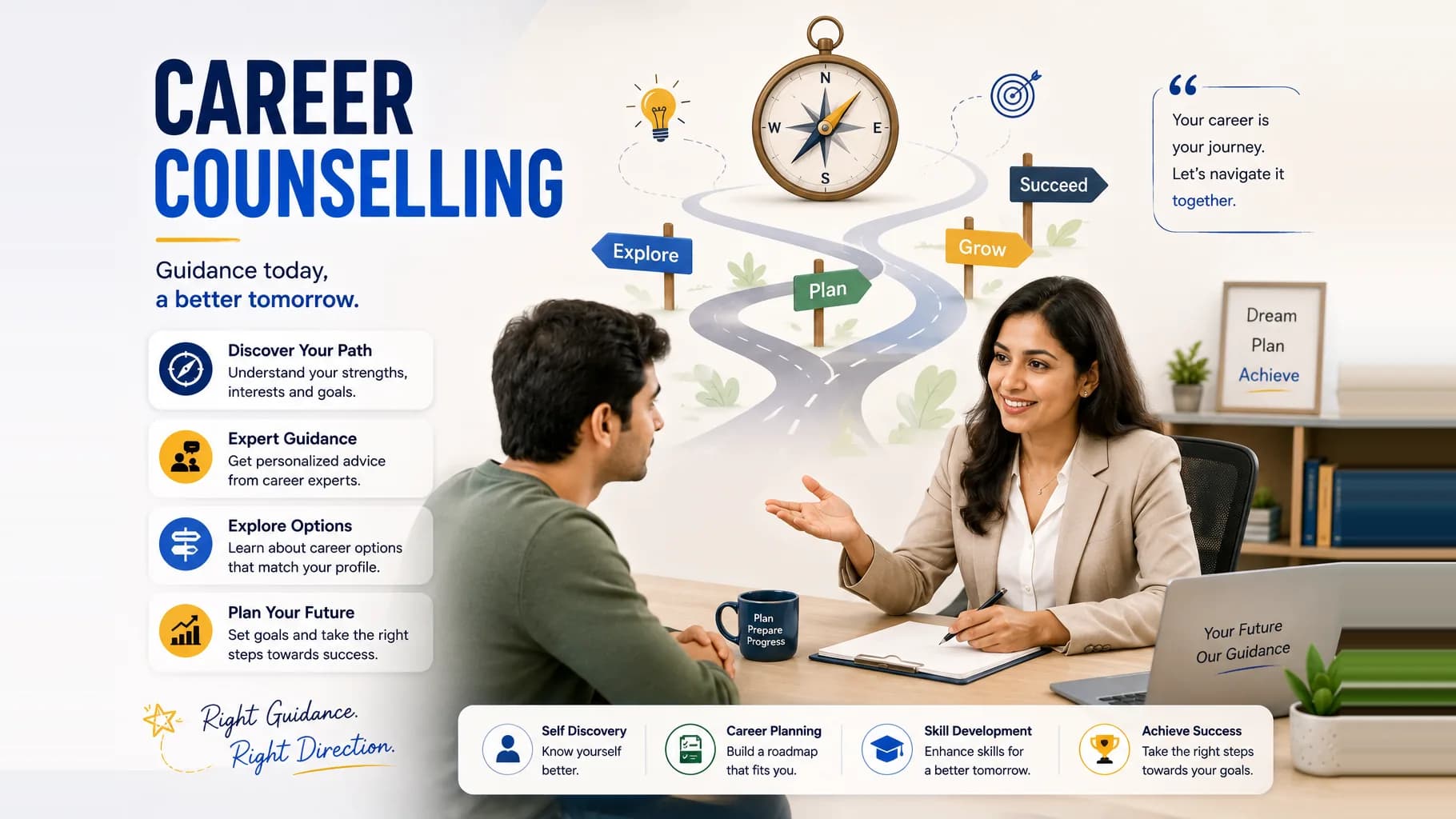
Career counselling is one of the most quietly powerful decisions a student or professional can make, and yet most people in India reach for it only after they are already stuck. If you have ever stared at a stream selection form after Class 10, second-guessed your degree in the final year of college, or sat at a desk wondering whether this job is really the one, then this guide is for you. Career counselling, also written as counselling for career, is a structured process that helps you understand your own aptitude, interests, personality, and options so you can make a decision you will not regret two years later. This 2026 guide explains what it actually is, who needs it, what happens in a session, how much it costs in India, and how to tell a genuinely useful counsellor from a sales pitch.
Most of the pages you land on when you search for career counselling are booking pages. They want you to fill a form and pay for a session. That is fine, and many of those services are good, but very few of them explain the thing itself. This guide is written to give you the understanding first, so that whether you book a counsellor, use an AI-assisted tool, or work through the self-assessment exercises below on your own, you go in informed.
What Is Career Counselling?
Career counselling is a professional, structured process in which a trained counsellor helps you evaluate your strengths, interests, values, and constraints, and then maps those against realistic education and career options. It is not fortune-telling and it is not someone handing you a single answer. A good counsellor does not tell you what to become. They give you clarity, evidence, and a framework so that you can decide with confidence.
The process usually combines three ingredients. First, assessment, often through psychometric or aptitude tests that measure reasoning ability, personality traits, and interest orientation. Second, conversation, a one-on-one discussion that puts the test results in the context of your real life, your family situation, your finances, and your ambitions. Third, planning, a concrete roadmap of streams, courses, entrance exams, skills, or job moves that fit you.
In the Indian context, career counselling carries extra weight because our education system asks students to specialise very early. The choice between Science, Commerce, and Arts after Class 10 can shape a decade of a person's life, often before they have any real exposure to what those paths involve. Career counselling exists to reduce the number of decisions made out of fear, peer pressure, or incomplete information.
Who Needs Career Counselling?
The honest answer is that almost everyone benefits from it at least once, but some moments in life make it far more valuable than others.
Students after Class 10
This is the classic stream selection crossroads. Science, Commerce, or Arts, and within Science, whether to keep both Maths and Biology open. Many students pick Science simply because it is seen as the safe, prestigious default, then struggle for two years. Counselling at this stage focuses on aptitude and interest so the stream fits the student rather than the neighbourhood's expectations.
Students after Class 12
Here the questions multiply. Which degree, which entrance exams, which colleges, and increasingly, whether a traditional degree is even the right move versus a skill-based or vocational path. A student who scored well in boards but has no idea what to study is a very common counselling client, and a completely normal one.
Graduates and final-year students
Plenty of graduates finish a degree and realise it does not point to a job they want, or any job at all. Career counselling here is about translating a qualification into a direction, identifying which roles suit them, what skills to add, and how to position themselves for a first job.
Working professionals
A few years into a career, many people plateau. They are competent but unmotivated, or they see peers moving ahead and wonder if they are in the wrong function. Counselling for working professionals is less about aptitude tests and more about values, strengths, and strategic next moves.
Career changers
Someone in a bank who wants to move into product, or an engineer who wants to shift into design or data. Career changers need a clear-eyed look at transferable skills, the real cost of switching, and a realistic sequence of steps. This is where good guidance saves years.
Women returning to work
After a career break, whether for family, caregiving, or relocation, returning to work can feel like starting from zero. Counselling helps women returners rebuild confidence, update their skills map, decide between resuming an old track or pivoting, and craft a story that turns the break into a non-issue for employers. This group is often underserved and gains the most from structured guidance.
Types of Career Counselling
Career counselling is not one fixed format. The right type depends on your age, your question, and how much depth you need.
Aptitude and psychometric assessment
This is the data-driven backbone of most counselling, especially for students. Psychometric tests measure things you cannot easily judge about yourself, such as logical reasoning, numerical and verbal ability, spatial thinking, personality orientation, and where your interests genuinely lie. A well-designed assessment does not label you. It surfaces patterns, for example a strong preference for working with ideas over people, or a high aptitude for structured analytical work. Those patterns then become the raw material for a real conversation.
A word of caution: the test is a tool, not a verdict. A report that claims to tell a 15-year-old their exact future job should be treated with healthy scepticism. The value is in interpretation, not in the number.
One-on-one counselling
The core of the process. A counsellor sits with you, walks through your results, asks about your life, your constraints, and your ambitions, and helps you reason through options. This is where a good counsellor earns their fee, because the human context is everything. Two students with identical test scores can need completely different advice based on finances, family, location, and temperament.
Online and AI-assisted career guidance
Online counselling, over video, has become mainstream and is generally just as effective as in-person for most people, with the bonus that you are no longer limited to counsellors in your own city. Alongside human video sessions, a newer category has emerged: AI-assisted and structured digital career guidance, where intelligent tools help you assess yourself, explore roles, and build a plan at your own pace, often for free or at low cost. These are excellent for exploration and for anyone who wants to do the groundwork before, or instead of, a paid human session. Tools like Goodspace Accelerate sit in this space, offering AI-assisted career guidance and a structured way to move from confusion to a concrete plan.
What Happens in a Career Counselling Session?
If you have never done it, the process can feel opaque. Here is what a typical, well-run engagement looks like.
It usually spans two main sittings over one to two weeks. The first is the assessment, which can take anywhere from 45 minutes to two hours depending on how comprehensive the battery of tests is. You answer questions about preferences, solve reasoning problems, and complete personality and interest inventories. There is no pass or fail, and trying to game the answers only produces a report that describes a person who is not you.
The second sitting is the counselling session itself, usually 60 to 90 minutes. The counsellor presents your report, explains what the patterns mean in plain language, and then, crucially, connects them to real options. Expect to be asked questions rather than just handed answers. Good counsellors probe: What subjects do you lose track of time in? What does your family expect, and how do you feel about that? What would you attempt if failure were not a concern? What are your financial realities?
By the end, you should walk away with three things: a clearer picture of your own strengths and interests, a shortlist of suitable directions with reasons, and a concrete next-step roadmap, whether that is specific streams, courses, entrance exams, skills, or job roles. Many services also include a follow-up session or a written report you can revisit.
Benefits of Career Counselling
The benefits go well beyond simply picking a course.
Clarity is the obvious one. You replace a fog of options with a focused, reasoned shortlist. That alone reduces enormous anxiety.
Better decisions are the second. Decisions grounded in your actual aptitude and interests hold up far better than those made under peer pressure or based on which career is trending this year.
Avoiding costly mistakes is the underrated benefit. Switching a degree, dropping out, or changing careers late costs years and money. A few hours of good counselling early is cheap insurance against that.
Confidence matters too. When you understand why a path suits you, you pursue it with conviction, which improves how you perform and how you present yourself to colleges and employers.
Finally, counselling widens your map. Most people only know the ten or fifteen careers they have seen around them. A good counsellor or a good guidance tool exposes you to roles you did not know existed, which is often where the best fit hides.
How to Choose a Good Career Counsellor
This is where careful judgement matters, because the field is uneven. Here is how to separate signal from noise.
What to check
Look for genuine qualifications. A counsellor with a background in psychology, education, or a recognised career counselling certification is a stronger bet than someone who simply resells a test. Ask what assessment they use and who interprets it, because the interpretation is the real work. Check whether they offer a proper one-on-one conversation or just email you a report. Ask for their experience with your specific situation, since counselling a Class 10 student and advising a mid-career professional are different skills. Reviews and word of mouth help, but ask what actually happened in the session, not just whether the person was nice.
Red flags
Be wary of anyone who guarantees a specific outcome, promises a single perfect career, or pushes you toward one expensive coaching institute or study-abroad package that happens to pay them a commission. Be cautious of a report-only service with no human conversation, especially for younger students. High-pressure sales tactics, urgency, and vague answers about methodology are all warning signs. If the entire pitch is about the test and not about you, walk away.
Cost expectations in India
Prices vary widely, so calibrate your expectations. A single session with a basic assessment typically runs from around 2,000 rupees. Online sessions can start lower, in the 1,000 to 2,500 rupee range. A full psychometric-based package usually falls between 3,000 and 5,000 rupees. Comprehensive, multi-session premium packages with advanced testing, a detailed roadmap, and follow-up support can range from roughly 8,000 to 25,000 rupees. Free or low-cost AI-assisted tools and government platforms exist too, and are a sensible starting point before you commit money. Higher price does not automatically mean better guidance, so judge on methodology and the quality of the human conversation, not the invoice.
Career Counselling vs Mentoring vs Coaching
These three words get used interchangeably, but they are different tools for different jobs.
| Dimension | Career Counselling | Career Coaching | Mentoring |
|---|---|---|---|
| Core purpose | Discover the right direction and options | Improve performance toward a defined goal | Share experience and guidance from someone ahead of you |
| Best for | People who are unsure what to do | People who know the goal but need to get there | People who want an experienced guide in a specific field |
| Time horizon | Often a short, focused engagement | Medium term, goal-linked | Long term, relationship-based |
| Based on | Assessments, psychology, structured process | Action plans, accountability, skill-building | Personal experience of the mentor |
| Typical provider | Trained counsellor or psychologist | Professional coach | Senior person in your field |
| Example question | Which stream or career suits me? | How do I ace my interviews this year? | What was your path into product management? |
In short, counselling helps you decide where to go, coaching helps you get there faster, and mentoring gives you a personal guide who has walked the road. Many people need all three at different stages, and the smartest thing is to know which one your current problem calls for.
DIY Career Clarity Exercises You Can Do Right Now
You do not have to wait for an appointment to start. Career clarity begins with honest self-assessment, and these exercises are the same starting points a good counsellor uses. Take a notebook and actually write the answers, because thinking is fuzzy and writing forces precision.
Start with the interest audit. List the last five times you lost track of time. What were you doing? Patterns here point to genuine interest, not the interest you think you should have.
Do the strengths inventory. Ask three people who know you well what they think you are naturally good at. Then write your own list. The overlap and the surprises are both useful data.
Try the subject and task test. Separate school subjects or work tasks into three buckets: energising, neutral, and draining. Careers built on draining tasks rarely last, however prestigious they look.
Run the values check. Rank what matters most to you: money, stability, creativity, impact, flexibility, status, learning. A career that clashes with your top values will feel wrong even when it looks right on paper.
Ask the fear question. Write down the careers you have dismissed because of fear of failure, family opinion, or money. Are any of them worth a second look with proper information?
Do the future-day exercise. Describe an ordinary Tuesday in your ideal working life ten years from now, in concrete detail. Where are you, what are you doing, who is around you? This often reveals more than any list of job titles.
Finally, the reality map. For any career you are drawn to, write down what it actually requires: the education, the entrance exams, the skills, the money, and the years. Excitement should survive contact with reality, and if it does not, that is useful to learn now.
These exercises will not hand you a final answer, but they will surface the raw material. If you then work with a counsellor or a structured tool, you arrive far better prepared, and the guidance goes much deeper.
When Online and AI-Assisted Career Guidance Helps
Not every career question needs a paid human session, and not every person has easy access to a good local counsellor. This is where online and AI-assisted guidance genuinely helps.
It helps when you are in the exploration phase and want to understand your options before committing money. It helps when you live outside a metro and the strong counsellors are all elsewhere, since online removes geography entirely. It helps when cost is a barrier, because many digital tools are free or inexpensive. It helps when you want to move at your own pace, revisiting your assessment and plan whenever you like rather than in a single ninety-minute window. And it helps working professionals and career changers who need structured, on-demand guidance that fits around a job.
AI-assisted guidance is particularly strong at the structured groundwork: helping you assess yourself, surfacing roles you had not considered, mapping the skills a target role needs, and turning vague ambition into a concrete sequence of steps. Structured platforms such as Goodspace Accelerate are built for exactly this, giving you AI-assisted career guidance and a step-by-step way to accelerate from uncertainty to a real plan, either as a complete path in itself or as preparation before a human session.
The honest guidance is to combine formats. Use free self-assessment and AI-assisted tools to do the groundwork and narrow your options, then, if your decision is high-stakes or you feel stuck, invest in a session with a qualified human counsellor who can interpret the nuance. The two are not rivals. Used together, they give you both the breadth of technology and the judgement of experience.
Frequently Asked Questions
At what age or stage should career counselling begin?
The most valuable first point is around Class 9 or 10, before stream selection, because that decision shapes everything after it. That said, counselling helps at every stage, including after Class 12, during college, and well into a working career. It is never too early to explore and rarely too late to correct course.
Is online career counselling as effective as in-person?
For most people, yes. Research and practitioner experience suggest online video counselling works just as well as face-to-face for the majority of situations, and it gives you access to a much wider pool of counsellors regardless of where you live. In-person can still be preferable for very young students or those who simply focus better across a table.
How much does career counselling cost in India?
It ranges widely. Basic single sessions start around 2,000 rupees, online sessions can begin lower, full psychometric packages typically run 3,000 to 5,000 rupees, and comprehensive premium packages can reach 8,000 to 25,000 rupees. Free and low-cost AI-assisted and government options also exist. Price is not a reliable guide to quality, so judge the methodology and the counsellor.
Are psychometric tests accurate?
A well-designed psychometric test is a reliable indicator of patterns in your reasoning, personality, and interests, but it is not a crystal ball. Its accuracy depends heavily on honest answers and, more importantly, on skilled interpretation. Treat the report as one input to a decision, never as the decision itself.
Can career counselling help someone changing careers mid-life?
Absolutely. For career changers and working professionals, counselling shifts focus from raw aptitude to strengths, values, transferable skills, and a realistic transition plan. It is one of the best ways to make a mid-career pivot with a clear head rather than on impulse.
Will a counsellor just tell me what to become?
A good one will not. Their job is to give you clarity, evidence, and a framework so you can decide with confidence. If a counsellor hands you a single answer with no reasoning and no conversation about your life, that is a warning sign, not good service.
Can I get useful career guidance without paying for a session?
Yes. The self-assessment exercises in this guide, government career platforms, and free or low-cost AI-assisted tools can take you a long way, especially in the exploration stage. Many people do the groundwork this way and only pay for a human session when the decision is genuinely high-stakes.
Final Thought
Career counselling, at its best, is not about someone else deciding your future. It is about understanding yourself well enough to decide it wisely. Whether you begin with the self-assessment exercises above, an AI-assisted tool, or a qualified human counsellor, the goal is the same: to replace fear and guesswork with clarity and a plan. The earlier you start, the more options you keep open.