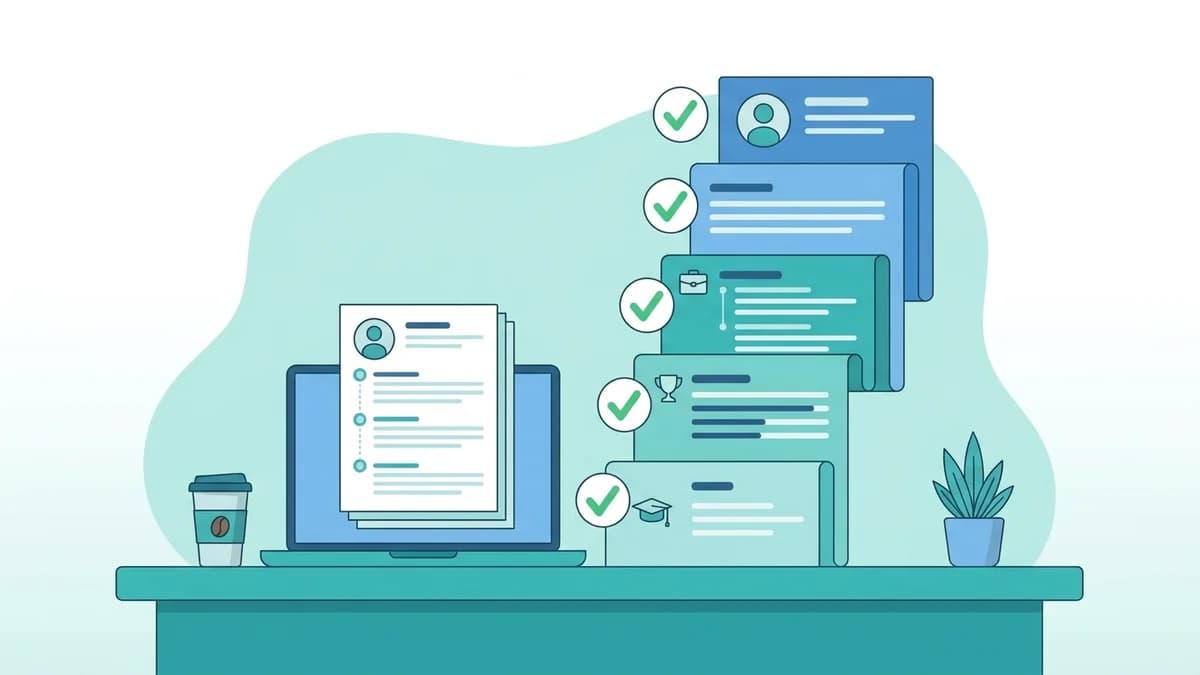
The best resume format for freshers in 2026 is a one-page, reverse-chronological layout in a single-column, plain-text-friendly design. List your contact details and a 2-3 line summary up top, then Education, Skills, Projects, Internships, and Certifications. Skip photos, tables, columns, and graphics so applicant tracking systems (ATS) can read every line.
Here is the exact section order to copy:
- Header — Full name, phone, professional email, city, LinkedIn URL
- Summary / Objective — 2-3 lines on who you are and what role you want
- Education — Degree, college, university, year, CGPA/percentage
- Technical & Soft Skills — Grouped, keyword-rich
- Projects — 2-4 academic or personal projects with impact
- Internships / Experience — If any, with bullet achievements
- Certifications & Achievements — Courses, awards, positions of responsibility
That structure works whether you are applying through campus placements at TCS or Infosys, sending your CV on Naukri, or pinging a startup founder on LinkedIn. The rest of this guide breaks down each piece, gives you a comparison of the three resume formats, and shows you a full sample layout you can adapt in 20 minutes.
What Recruiters and ATS Actually Look For
Before formatting, understand who reads your resume. In India, most mid-to-large companies (and even many funded startups) run your CV through an Applicant Tracking System first. The ATS parses your resume into a database, scores it against the job description, and only then does a human recruiter see the shortlisted ones.
For a single fresher opening at a service company like TCS, Wipro, or Cognizant, a recruiter may receive 500 to 2,000 applications. They physically cannot read each one. So two filters decide your fate:
- The machine (ATS): Can it cleanly extract your name, contact, education, and skills? Does your resume contain the keywords from the job post (e.g. "Java", "SQL", "data structures", "communication")?
- The human (recruiter): Spends roughly 6-8 seconds on the first scan. They look for relevance, a readable layout, and proof you can do the job.
Your resume format has one job: make it effortless for both to say yes. Fancy designs feel impressive but routinely break ATS parsing, which is why a clean, structured layout beats a "creative" one for 95% of fresher roles in India.
The 3 Resume Formats (and Which One Freshers Should Use)
There are three standard resume formats. Choosing the right one is the single biggest decision you'll make, so here's how they compare:
| Format | How it works | Best for | ATS-friendly? |
|---|---|---|---|
| Reverse-Chronological | Lists education and experience newest-first. Most familiar to recruiters. | Most freshers, campus placements, anyone with projects/internships to show in order. | Yes — the gold standard |
| Functional (Skills-based) | Leads with skills and groups achievements by capability, hiding the timeline. | Career-gappers or career-changers. Rarely ideal for freshers. | Risky — ATS often misreads it |
| Combination (Hybrid) | A strong skills section up top, followed by chronological education/experience. | Freshers with a few internships or strong projects who want skills front-and-centre. | Yes — if kept single-column |
Verdict for freshers: Use the reverse-chronological format. If you have notable projects or internships and want them noticed faster, a combination format (skills section near the top) also works well. Avoid the pure functional format — ATS systems struggle to parse it, and recruiters in India tend to distrust resumes that hide dates.
Section-by-Section Structure for a Fresher Resume
1. Header (Contact Details)
Keep it to 3-4 lines at the very top. No "Resume" or "Curriculum Vitae" title — it wastes space and the document is obviously a resume.
- Full name in a slightly larger font (16-18pt).
- Phone: One 10-digit Indian mobile number, written as
+91 98XXX XXXXXso it works for recruiters who call or WhatsApp. - Email: A professional address like
firstname.lastname@gmail.com. Retirecool_rahul_007@style IDs — they cost you credibility instantly. - City & state: e.g. "Pune, Maharashtra". Full address and pin code are no longer needed.
- LinkedIn URL: Customise it to
linkedin.com/in/yourname. Add a GitHub link if you're in tech.
Do not add a photo, date of birth, marital status, father's name, or religion. These are common on old Indian resume templates but add zero value, eat space, and can break ATS parsing or invite bias.
2. Summary or Objective
A 2-3 line pitch that sits right under your header. As a fresher, frame it around what you bring and the role you want, not just "seeking a challenging position to grow my career" (a cliché recruiters ignore).
Weak: "To obtain a challenging position in a reputed organisation where I can utilise my skills."
Strong: "Final-year B.Tech (Computer Science) student skilled in Java, SQL, and React, with two academic projects and a 2-month internship at a fintech startup. Seeking an entry-level software developer role to build scalable web applications."
The strong version names your degree, three concrete skills, proof points, and the target role — instantly relevant to both ATS and recruiter.
3. Education
For freshers, education is your headline credential, so place it high. List newest qualification first:
- Degree and specialisation (e.g. "B.Tech, Electronics & Communication Engineering")
- College name and university (e.g. "VIT Vellore")
- Year of completion (or "Expected 2026" if ongoing)
- CGPA or percentage — mention it if it's 7.5+ CGPA or 75%+; if lower, lead with projects/skills instead
Include Class 12 and Class 10 (board, school, percentage) on a single line each. Drop them later in your career, but for a first job they help, especially for companies with eligibility cut-offs (many service firms require 60% throughout 10th, 12th, and graduation with no active backlogs).
4. Skills
This is the section ATS scans hardest. Mirror the language of the job description. Group skills so they're scannable:
- Technical Skills: Java, Python, SQL, HTML/CSS, Git, MS Excel
- Tools & Frameworks: React, Node.js, Figma, Tableau
- Soft Skills: Communication, teamwork, problem-solving, time management
Be honest — if you list "Python" you should be able to write a basic program in an interview. Avoid rating bars or star ratings ("Java ★★★★☆"); ATS can't read them and they invite scepticism.
5. Projects
For a fresher with little work experience, projects are your proof of skill and often the most important section. List 2-4, each with a one-line description and 1-2 bullets on what you built and the outcome:
- E-commerce Web App (React, Node.js, MongoDB) — Built a full-stack shopping site with cart, login, and Razorpay payment integration; deployed on Vercel with 50+ test users.
- Sales Dashboard (Python, Pandas, Tableau) — Analysed 10,000 rows of retail data and built a dashboard that surfaced the top 3 revenue-driving categories.
Quantify wherever you can ("50+ users", "10,000 rows", "reduced load time by 30%"). Numbers make projects believable and memorable. Add a GitHub or live link if available.
6. Internships / Work Experience
If you've done internships (even unpaid or virtual ones), list them like jobs: role, company, dates, and 2-3 bullet points starting with action verbs (Built, Analysed, Automated, Coordinated). Focus on results, not duties.
Duty-focused (weak): "Responsible for testing the website."
Result-focused (strong): "Tested 40+ web pages and logged 60 bugs, cutting post-release defects by 25%."
No internships? That's fine — many freshers have none. Strengthen Projects, Certifications, and positions of responsibility instead.
7. Certifications & Achievements
This section closes the gap between you and candidates with experience. Include:
- Certifications: NPTEL, Coursera, Google, AWS, HackerRank — name the issuer and year.
- Achievements: Hackathon ranks, coding-contest ratings, scholarships, paper publications.
- Positions of responsibility: "Technical Lead, College Coding Club (managed a team of 12)" — these signal leadership and ownership.
ATS-Friendly Formatting Rules
You can have brilliant content and still get auto-rejected if the file confuses the ATS. Follow these formatting rules so your resume parses cleanly every time:
- Use a single-column layout. Two-column "designer" templates frequently scramble in ATS — your skills end up mixed into your education.
- Stick to standard fonts: Calibri, Arial, Times New Roman, or Garamond, sized 10-12pt for body text.
- Use standard section headings: "Education", "Work Experience", "Skills" — not clever labels like "My Journey" or "What I Bring". ATS looks for the standard words.
- Avoid tables, text boxes, headers/footers, and images. Many ATS engines skip text inside these elements entirely. (Ironically, that includes putting your phone number in the document header.)
- No graphics, logos, icons, or charts. They're invisible to the parser.
- Save and send as PDF (unless the application explicitly asks for .docx). Name the file clearly:
Rahul_Sharma_Resume.pdf, neverresume_final_v3.pdf. - Use simple bullet points (round or square), left-aligned. Avoid special characters and emojis.
- Match keywords from the job description. If the posting says "data structures and algorithms", use that exact phrase, not just "DSA".
- Keep it to one page. As a fresher you rarely have enough to justify two — and recruiters prefer one.
Before you apply: run your resume through GoodSpace's free ATS Resume Checker to see your ATS score and the exact keywords you're missing — in 30 seconds, no signup for the first scan. It's the fastest way to catch a parsing error or a missing keyword before a recruiter's software does.
Common Resume Mistakes Freshers Make
These are the errors that quietly sink fresher applications across India:
- Using a flashy multi-column template downloaded from a design site — looks great, fails ATS.
- Spelling and grammar errors. A single typo signals carelessness. Proofread, and have a friend check too.
- Unprofessional email IDs or missing the country code on the phone number.
- Listing duties instead of achievements. "Worked on a project" tells nothing; "Built X that did Y" tells everything.
- One generic resume for every job. Tailor your summary and skills to each role's keywords — even small edits lift your ATS match score.
- Adding irrelevant personal details (photo, age, marital status, hobbies like "watching movies").
- Lying or exaggerating. Inflated skills collapse in interviews and can get offers rescinded.
- Going over one page with padding, large fonts, or wide margins to fill space.
- Forgetting to update the resume after each new project or certification.
Sample Fresher Resume Layout
Here's a complete, ATS-friendly skeleton you can fill in. Keep it single-column and plain:
- RAHUL SHARMA
+91 98765 43210 | rahul.sharma@gmail.com | Pune, Maharashtra
linkedin.com/in/rahulsharma | github.com/rahulsharma
SUMMARY
Final-year B.Tech (Computer Science) student skilled in Java, SQL, and React. Built two full-stack projects and completed a 2-month internship at a Pune-based fintech startup. Seeking an entry-level software developer role.
EDUCATION
- B.Tech, Computer Science & Engineering — MIT World Peace University, Pune — 2026 — CGPA: 8.4/10
- Class 12 (CBSE) — Delhi Public School, Pune — 2022 — 88%
- Class 10 (CBSE) — Delhi Public School, Pune — 2020 — 91%
TECHNICAL SKILLS
Languages: Java, Python, JavaScript, SQL | Web: React, Node.js, HTML/CSS | Tools: Git, MongoDB, MS Excel
PROJECTS
- E-Commerce Web App (React, Node.js, MongoDB) — Full-stack store with cart, login, and Razorpay payments; deployed on Vercel, tested with 50+ users.
- Student Attendance System (Python, MySQL) — Automated attendance with face recognition, cutting manual marking time by 80%.
INTERNSHIP
- Software Development Intern, FinEdge Technologies, Pune (May-Jun 2025) — Built 5 reusable React components and fixed 30+ UI bugs, improving page load speed by 20%.
CERTIFICATIONS & ACHIEVEMENTS
- NPTEL — Programming in Java (Elite + Silver), 2024
- Coursera — Google Data Analytics Professional Certificate, 2025
- Finalist, Smart India Hackathon (team of 6), 2025
- Technical Lead, College Coding Club (managed a team of 12)
Notice there's no photo, no objective cliché, no tables, and every line earns its place. That's the format that clears both the software and the recruiter.
Final Checklist Before You Hit Apply
- One page, single column, standard font
- Professional email + 10-digit number with +91
- Skills and summary tailored to the job's keywords
- Projects quantified with real numbers
- Zero spelling errors (read it aloud once)
- Saved as a clearly named PDF
One last step: paste your final resume into GoodSpace's free ATS Resume Checker and the job description side by side. You'll get an instant ATS score and a list of missing keywords, so you walk into the application knowing your resume will actually be read — not silently filtered out.
Frequently Asked Questions
What is the best resume format for freshers in India?
The reverse-chronological format is best for most Indian freshers. It lists your education and any experience newest-first, is the most familiar to recruiters at companies like TCS, Infosys, and startups, and parses cleanly through ATS software. If you want your skills noticed first, a combination (hybrid) format also works — just keep it single-column.
Should a fresher's resume be one page or two?
One page. As a fresher you rarely have enough relevant experience to justify two pages, and recruiters strongly prefer a tight, one-page resume they can scan in seconds. Use a second page only if you have substantial internships, publications, or projects that genuinely add value.
Should I add a photo on my resume?
No. For roles in India (and most countries), a photo adds no value, takes up space, can break ATS parsing, and may introduce bias. Skip the photo, date of birth, marital status, and father's name. Use that space for skills, projects, and achievements instead.
What do I write in the objective if I have no experience?
Replace the generic "seeking a challenging role" objective with a 2-3 line summary that names your degree, 2-3 concrete skills, any projects or internships, and the specific role you want. For example: "B.Com graduate skilled in Tally, Excel, and GST filing, seeking an entry-level accounts executive role." Specificity beats clichés.
How do I make my resume ATS-friendly?
Use a single-column layout, standard fonts (Arial, Calibri, Times New Roman), and standard headings like "Education" and "Skills". Avoid tables, text boxes, images, columns, and graphics, since many ATS engines can't read them. Mirror the keywords from the job description, save as a PDF, and run it through an ATS checker before applying.
Do I need a different resume for each job application?
You don't need to rewrite it from scratch, but you should tailor it. Adjust your summary and reorder/relabel your skills to match each job's keywords. Even small tweaks meaningfully raise your ATS match score and your relevance to the recruiter, which is why one generic resume sent everywhere underperforms.