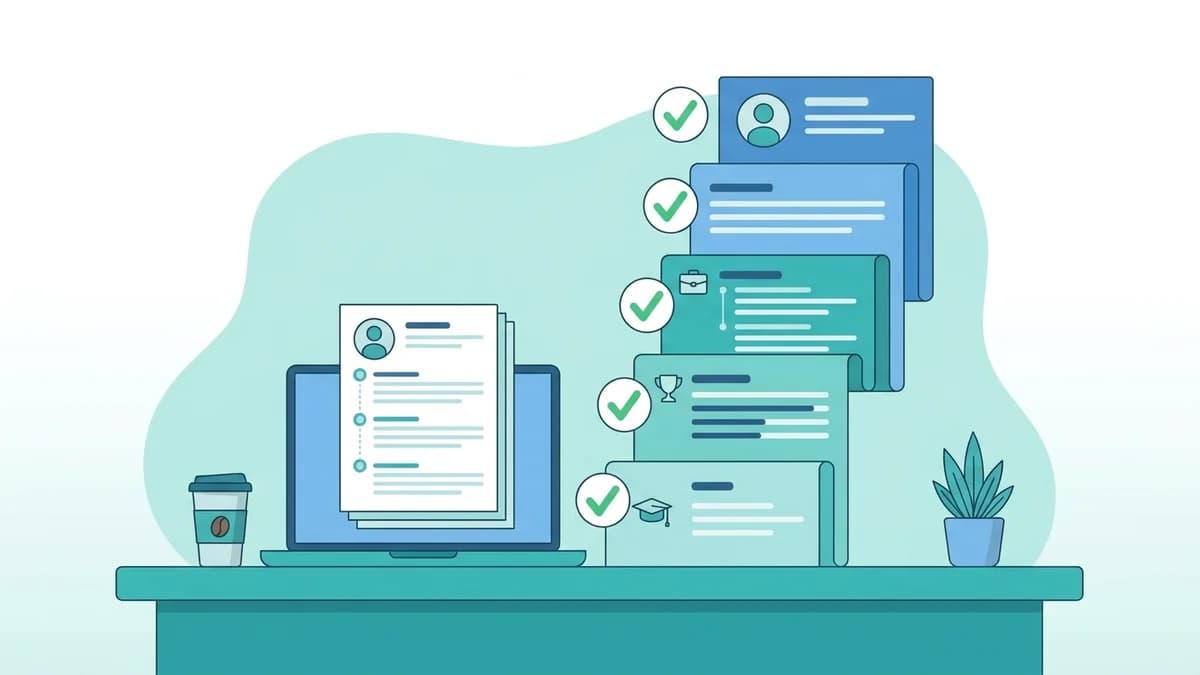
To make a resume for a job, list your contact details, a short professional summary, your work experience or internships, education, and skills on a single clean page, then tailor every section to the job you are applying for and run it through an ATS checker before you send it. A strong resume is not a life story—it is a one-page marketing document that gets you shortlisted for an interview.
Here is the complete process in nine steps. The rest of this guide explains each one in detail, with India-specific examples for both freshers and experienced professionals.
- Choose the right resume format (reverse-chronological for most people).
- Add your contact information correctly at the top.
- Write a professional summary or career objective.
- List your work experience or internships with measurable results.
- Add your education in the right place for your career stage.
- List your skills—both technical and soft skills.
- Include projects, certifications, and achievements.
- Tailor the resume to each job description.
- Proofread and check your ATS score before submitting.
Step 1: Choose the Right Resume Format
Before you write a single word, decide on a structure. The format determines how recruiters and Applicant Tracking Systems (ATS) read your resume. In India, most companies—from TCS and Infosys to startups and MNCs—expect a clean, text-based resume, not a heavily designed graphic.
The three main resume formats
- Reverse-chronological: Lists your most recent job first, working backwards. This is the safest and most widely accepted format in India. Use it if you have a steady work history or are a fresher with internships.
- Functional (skills-based): Groups your skills together and downplays dates. Useful if you have employment gaps or are switching careers, but be cautious—many recruiters and ATS tools distrust this format.
- Combination (hybrid): Leads with a skills summary, then lists experience chronologically. Good for senior professionals with 8+ years of experience or specialised technical roles.
Length and design rules for India
- Freshers and candidates with under 7 years of experience: stick to one page.
- Experienced professionals (7+ years): two pages are acceptable, never more.
- Use a standard font—Calibri, Arial, Helvetica, or Georgia—at 10.5 to 12 pt.
- Keep margins at 0.5 to 1 inch and use plenty of white space.
- Save and send as a PDF unless the job posting specifically asks for a Word (.docx) file.
- Avoid photos, tables for layout, columns, text boxes, and logos—these confuse ATS software. (A photo is only expected for specific roles like aviation, hospitality, or modelling.)
Step 2: Add Your Contact Information
Your contact details go at the very top. Recruiters spend an average of 6–8 seconds on a first scan, so make it effortless for them to reach you.
What to include
- Full name (slightly larger font, bold).
- Phone number with the +91 country code.
- Professional email—use firstname.lastname@gmail.com, never an old nickname like coolrahul99@.
- City and state (e.g., Bengaluru, Karnataka). You do not need your full home address.
- LinkedIn profile URL (customise it: linkedin.com/in/yourname).
- Portfolio or GitHub link if relevant to your field.
What to leave out
Indian resumes traditionally included personal details that are now considered outdated and even risky. Do not add your date of birth, marital status, father's name, religion, gender, passport-size photo, or full residential address unless a specific employer or government form requires it. These take up space and can introduce hiring bias.
Step 3: Write a Professional Summary or Career Objective
This is a 2–4 line paragraph right below your contact details. It is the first thing a recruiter reads, so it must be sharp and tailored.
Summary vs. objective: which one?
- Use a professional summary if you have work experience. Highlight your years of experience, key skills, and one or two achievements.
- Use a career objective if you are a fresher or career changer. State what you bring and what role you are targeting.
Examples
Experienced (summary): "Results-driven digital marketing specialist with 5 years of experience managing performance campaigns across Google and Meta Ads. Reduced cost-per-lead by 32% and managed monthly budgets of up to ₹15 lakh for D2C brands. Skilled in SEO, analytics, and team leadership."
Fresher (objective): "Computer Science graduate (B.Tech, 2025) seeking an entry-level software developer role. Proficient in Java, Python, and SQL, with hands-on project experience building two full-stack web applications. Eager to apply problem-solving skills in a collaborative engineering team."
Tips
- Front-load it with the exact job title you are targeting.
- Quantify wherever possible (numbers, percentages, ₹ figures).
- Avoid clichés like "hardworking team player seeking a challenging position in a reputed organisation." Recruiters skip these.
Step 4: List Your Work Experience or Internships
This is the most important section for experienced candidates and a crucial one for freshers too. List roles in reverse-chronological order.
How to format each entry
For every role, include the job title, company name, location, and dates (month and year). Then add 3–5 bullet points describing your impact—not just your duties.
Use the formula: Action verb + task + result
Weak: "Responsible for handling customer queries."
Strong: "Resolved 50+ daily customer queries via call and email, improving the team's CSAT score from 78% to 91% in six months."
Start each bullet with a strong action verb: Led, Built, Increased, Reduced, Launched, Automated, Negotiated, Managed, Designed, Streamlined. Quantify results with numbers, percentages, timeframes, or rupee amounts wherever you can.
For freshers with no full-time job
Internships, freelance work, college fest organising, NGO volunteering, and part-time gigs all count. Frame them with the same action-verb-plus-result formula. For example: "Organised the annual technical fest for 1,200+ attendees, securing ₹2 lakh in sponsorships across four companies."
Step 5: Add Your Education
Where this section goes depends on your career stage.
Placement and detail
- Freshers: place Education near the top, right after your objective, since it is your strongest credential. Include your degree, college/university, graduation year, and CGPA or percentage (if above ~70% or 7.5 CGPA).
- Experienced professionals: move Education below Work Experience. List only your highest and most relevant qualifications; you can drop 10th and 12th marks once you have a few years of experience.
What to include
- Degree name and specialisation (e.g., B.Com, Honours in Finance).
- Institution name and city.
- Year of completion (or "Expected 2026" if ongoing).
- Relevant coursework, academic projects, or honours—only if you are a fresher and they add value.
Step 6: List Your Skills
Recruiters and ATS software both scan for specific skills. Create a dedicated "Skills" section and split it into categories for easy reading.
Technical (hard) skills
These are measurable, role-specific abilities—programming languages, tools, and software. Examples: Python, Excel, SQL, Tableau, AutoCAD, Tally, SAP, Figma, Google Ads, Salesforce.
Soft skills
These describe how you work—communication, leadership, problem-solving, time management, adaptability. Do not just list them; ideally prove them in your experience bullets.
Match the job description
Read the job posting and mirror the exact keywords it uses. If a role asks for "data visualisation" and you wrote "data viz," the ATS may not match it. Only list skills you can genuinely back up in an interview.
Step 7: Include Projects, Certifications, and Achievements
These optional sections can set you apart, especially for freshers and tech roles where they prove practical ability.
Projects
Describe 2–3 relevant projects with the problem, your role, the tools used, and the outcome. Add a GitHub or live demo link. Example: "Built an e-commerce price-tracker using Python and BeautifulSoup that scraped 5 sites and sent price-drop alerts; 200+ active users."
Certifications
List credentials relevant to the role—Google Data Analytics, AWS Certified Cloud Practitioner, NPTEL courses, CFA Level 1, PMP, or Digital Marketing certifications. Include the issuing body and year.
Achievements and extras
Awards, scholarships, publications, hackathon wins, and languages spoken (e.g., English, Hindi, Tamil) can all go here when they are relevant.
Resume sections at a glance
| Section | What to include | Example |
|---|---|---|
| Contact Info | Name, +91 phone, professional email, city, LinkedIn | Priya Sharma • +91 98765 43210 • priya.sharma@gmail.com • Pune |
| Summary / Objective | 2–4 lines: role, experience, top skills, one achievement | "HR generalist with 4 years' experience reducing attrition by 18%..." |
| Work Experience | Title, company, dates, 3–5 result-focused bullets | "Increased monthly sales by 25% by launching a referral programme." |
| Education | Degree, institution, year, CGPA/percentage | B.Tech (CSE), VIT Vellore, 2025, 8.4 CGPA |
| Skills | Technical + soft skills, matched to the job | Python, SQL, Power BI, Stakeholder Management |
| Projects / Certifications | Relevant work, tools, outcomes, issuing body | "AWS Certified Cloud Practitioner (2025)" |
Step 8: Tailor the Resume to the Job
The single biggest mistake job-seekers make is sending the same resume to 50 companies. A tailored resume can dramatically increase your shortlisting rate.
How to tailor in five minutes
- Read the job description carefully and highlight the repeated keywords, skills, and responsibilities.
- Mirror that language in your summary, experience bullets, and skills section—truthfully.
- Reorder your bullets so the most relevant achievements appear first.
- Adjust your headline/objective to match the exact job title (e.g., "Backend Developer" vs. "Software Engineer").
Optimise for Naukri and LinkedIn
On Naukri.com, recruiters search by keywords, so your resume headline and key skills must contain the terms they search for. Keep your Naukri profile and resume consistent. On LinkedIn, make sure your headline, About section, and Experience mirror your resume; many Indian recruiters cross-check both before calling you. Set your LinkedIn to "Open to Work" for relevant roles and locations.
Step 9: Proofread and Check Your ATS Score
Before you hit send, do two final checks: proofread for errors, and verify your resume can actually pass the automated filters most large Indian companies use.
Proofread thoroughly
- Run a spell-check, then read it aloud to catch awkward phrasing.
- Check for consistent tense—past tense for old jobs, present for your current role.
- Verify dates, company names, and contact details are correct.
- Ask a friend or mentor to review it; a fresh pair of eyes catches mistakes you have stopped seeing.
- Use consistent formatting—same bullet style, font size, and date format throughout.
Why ATS matters in India
Most mid-to-large employers—IT services firms, banks, consultancies, and MNCs—use an Applicant Tracking System to filter resumes before a human ever sees them. If your resume uses unusual fonts, images, columns, or the wrong keywords, the ATS may reject it automatically, no matter how qualified you are. That is why a clean, keyword-matched, single-column layout is essential.
Step: check your ATS score. Paste your resume into GoodSpace's free ATS Resume Checker — it scores your resume against the same filters recruiters use and tells you exactly what to fix.
ATS-friendly checklist
- Use standard section headings (Work Experience, Education, Skills).
- Submit a text-based PDF or .docx—not a scanned image or a designer's PNG.
- Avoid headers/footers for critical info, text boxes, and graphics.
- Spell out abbreviations at least once (e.g., "Search Engine Optimisation (SEO)").
- Match keywords from the job description without keyword-stuffing.
Once your draft is ready, do not guess whether it will pass. Run it through GoodSpace's free ATS Resume Checker to get an instant score and a fix-list, then apply with confidence on GoodSpace and other platforms.
Frequently Asked Questions
How long should a resume be in India?
For freshers and anyone with under 7 years of experience, keep it to one page. Experienced professionals with 7+ years can use two pages, but never more. Recruiters prefer concise, scannable resumes over long ones.
Should I include a photo on my resume?
No, in most cases. Modern Indian resumes for IT, finance, marketing, and corporate roles do not include a photo, as it can introduce bias and confuse ATS software. Add a photo only for roles that specifically require it, such as aviation, hospitality, media, or modelling.
What is the best resume format for freshers?
The reverse-chronological format works best for most freshers. Lead with your career objective and education, then highlight internships, academic projects, certifications, and relevant skills. This shows recruiters your potential even without full-time experience.
How do I make my resume pass ATS filters?
Use a clean single-column layout, standard fonts, and standard section headings; save it as a text-based PDF; and include keywords from the job description. Avoid images, tables for layout, and graphics. Then verify it by running it through a free ATS checker before applying.
Should I mention my expected salary on my resume?
No. Never put your expected or current salary (in ₹) on the resume itself. Salary is discussed during the interview or application form stage. Including it on the resume can prematurely screen you out or weaken your negotiating position.
Is a PDF or Word document better for sending my resume?
A PDF is best because it preserves your formatting across all devices and is readable by most modern ATS tools. Only send a Word (.docx) file if the job posting or recruiter specifically requests it.