You spent hours crafting the perfect resume. You hit "Apply." And then — silence. No call, no email, not even a rejection. Sound familiar?
Here's what most job seekers in India don't realise: over 75% of resumes are rejected before a human ever reads them. The gatekeeper? An Applicant Tracking System (ATS). And the metric that decides your fate? Your ATS score.
Whether you're a fresher applying to TCS or a senior professional targeting Amazon India, understanding what ATS score means and how to optimise for it is no longer optional — it's essential. This guide breaks down everything you need to know about ATS in 2026.
Table of Contents
- What is ATS? (Applicant Tracking System Explained)
- How Does an ATS Work?
- What is an ATS Score?
- How ATS Scores Your Resume
- What is a Good ATS Score?
- Popular ATS Software Used in India
- Which Companies Use ATS in India?
- ATS Score vs Impact Score
- How to Check Your ATS Score
- 10 Ways to Improve Your ATS Score
- ATS Myths Debunked
- Frequently Asked Questions
What is ATS? (Applicant Tracking System Explained Simply)
An Applicant Tracking System (ATS) is software that companies use to manage their entire hiring process — from posting a job to onboarding a new employee. Think of it as an HR department's operating system.
So what is ATS in recruitment, exactly? At its core, an ATS does three things:
- Collects — It gathers all incoming resumes from job portals (Naukri, LinkedIn, Indeed), career pages, and email submissions into one centralised database.
- Filters — It automatically scans and ranks resumes based on how well they match the job description, using keyword matching, skill extraction, and formatting analysis.
- Organises — It tracks each candidate through every stage of the hiring pipeline — applied, screened, interviewed, offered, hired, or rejected.
Before ATS existed, recruiters manually sifted through hundreds (sometimes thousands) of resumes for a single opening. In India, where a single Naukri job posting can attract 500–2,000 applications, that's simply not feasible. ATS automates the first layer of screening so recruiters can focus their time on candidates who actually match.
Here's the reality: 99% of Fortune 500 companies and nearly every mid-to-large Indian company now uses some form of ATS. If you've applied to Infosys, Flipkart, Zomato, or any company with more than 50 employees, your resume has almost certainly been processed by an ATS.
How Does an ATS Work? (Step-by-Step Breakdown)
Understanding how ATS works gives you a massive advantage over other applicants. Here's the complete journey your resume takes from the moment you click "Apply":
| Step | What Happens | Time Taken |
|---|---|---|
| 1. Job Posting | Recruiter creates a job listing with required skills, qualifications, and keywords. The ATS distributes it to job boards. | — |
| 2. Resume Upload | You submit your resume through a portal or career page. The ATS stores it in the candidate database. | Instant |
| 3. Parsing | The ATS extracts text from your resume — name, email, phone, education, work experience, skills — and structures it into data fields. | 1–3 seconds |
| 4. Keyword Matching | Your resume content is compared against the job description. The system looks for matching skills, job titles, certifications, and industry terms. | 1–2 seconds |
| 5. Scoring | Based on keyword match percentage, formatting quality, section completeness, and relevance, the ATS assigns your resume a compatibility score. | 1–2 seconds |
| 6. Ranking | All applicants are ranked from highest to lowest score. Resumes that meet the threshold move forward. | Instant |
| 7. Shortlist | The recruiter reviews the top-ranked resumes (typically top 10–20%). The rest are archived or rejected automatically. | Manual review |
The entire automated process — from upload to scoring — takes under 10 seconds. That's how fast the decision happens. Your resume doesn't get a thoughtful 5-minute read. It gets a 6-second algorithm pass.
What the ATS Parser Actually Reads
Modern ATS parsers are sophisticated but not infallible. They extract:
- Contact information — Name, email, phone number, LinkedIn URL
- Work experience — Job titles, company names, employment dates, bullet points
- Education — Degrees, institutions, graduation years
- Skills — Both hard skills (Python, SQL, Salesforce) and certifications (PMP, AWS, CFA)
- Section headers — "Experience," "Education," "Skills," "Projects"
What it struggles with: text embedded in images, graphics-heavy layouts, unusual fonts, and tables with merged cells. This is why formatting matters as much as content.
What is an ATS Score?
Your ATS score is a numerical rating — typically on a 0 to 100 scale — that represents how well your resume matches a specific job description. It's essentially a compatibility percentage between what the employer is looking for and what your resume contains.
Think of it like a compatibility score on a dating app. A higher score means the ATS sees you as a strong match. A lower score means there are significant gaps between what the job requires and what your resume communicates.
Here's what's important to understand: your ATS score is not fixed. The same resume can score 85 for one job and 40 for another. The score is always relative to the specific job description you're applying to. This is why sending the same generic resume to every job is one of the biggest mistakes Indian job seekers make.
What Does an ATS Score Measure?
An ATS score is a composite of several factors:
- Keyword relevance — Do your skills and experience match the job's required and preferred qualifications?
- Section completeness — Does your resume have all the standard sections (contact info, summary, experience, education, skills)?
- Formatting compatibility — Can the parser successfully extract and structure your information?
- Experience alignment — Do your job titles and years of experience match what the role demands?
- File type and structure — Is your resume in a format the ATS can read cleanly?
Most recruiters set a minimum threshold score (often 60–70%) below which resumes are automatically filtered out. If your resume scores below this threshold, it won't reach a human reviewer — no matter how qualified you actually are.
How ATS Scores Your Resume: The 4 Pillars
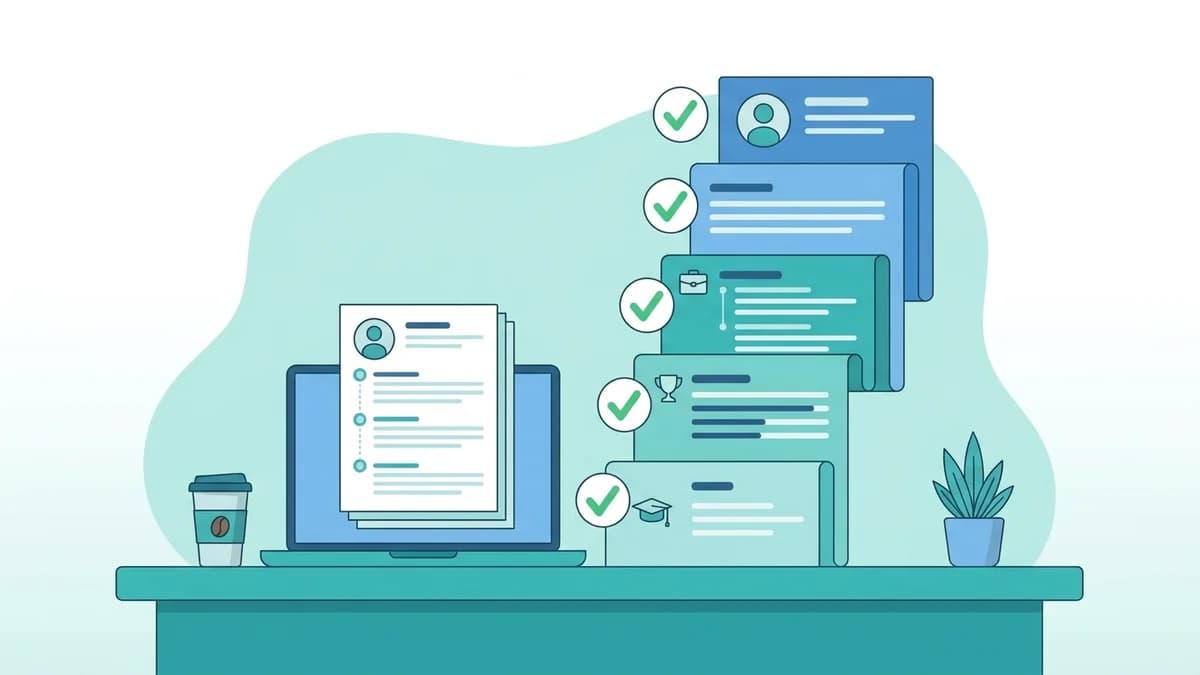
Now that you know what an ATS score is, let's break down exactly how the scoring algorithm evaluates your resume. There are four main pillars:
1. Keyword Match (40–50% of Score)
This is the single biggest factor. The ATS compares the words and phrases in your resume against the job description. It looks for:
- Exact keyword matches — If the JD says "React.js," your resume should say "React.js," not just "React" or "frontend development"
- Skill synonyms — Advanced ATS systems recognise that "ML" and "Machine Learning" are the same thing, but not all do
- Keyword frequency — Mentioning a critical skill once is good; mentioning it in context across multiple sections is better
- Keyword placement — Skills mentioned in your summary and experience sections carry more weight than those buried in a skills list
2. Formatting and Parsability (20–25% of Score)
Even if your content is perfect, poor formatting can tank your score. The ATS evaluates:
- File type — PDF and DOCX are universally accepted. PDFs created from Word documents parse well; image-based PDFs (scanned documents) don't.
- Standard section headers — Use "Work Experience," not "My Professional Journey." Use "Education," not "Academic Credentials."
- Clean layout — Avoid multi-column layouts with complex tables, text boxes, headers/footers with critical info, or graphics replacing text.
- Font readability — Stick to standard fonts like Arial, Calibri, Times New Roman, or Garamond.
3. Section Completeness (15–20% of Score)
The ATS checks whether your resume has all expected sections:
- Contact information (name, email, phone — surprisingly, many resumes miss the phone number)
- Professional summary or objective
- Work experience with dates
- Education with degree and institution
- Skills section
Missing any of these sections can cost you 10–15 points immediately.
4. Experience and Qualification Alignment (10–15% of Score)
Some ATS systems evaluate whether your years of experience, education level, and job titles align with the role's requirements. If a job requires "5+ years of experience in digital marketing" and your resume shows 2 years, the score adjusts accordingly.
What is a Good ATS Score?
Reality check on India: across 33,000+ Indian resumes GoodSpace analyzed, only 0.04% scored above 80. The median was significantly lower than most career advice assumes.
Not all scores are created equal. Here's a general framework for interpreting your ATS score:
| ATS Score Range | Rating | What It Means | Action Required |
|---|---|---|---|
| 80–100 | 🟢 Excellent | Strong keyword match, clean formatting, complete sections. Your resume will very likely reach the recruiter. | Apply with confidence. Fine-tune for perfection. |
| 60–79 | 🟡 Needs Work | Decent match but missing some keywords or has formatting issues. May or may not pass the threshold. | Add missing keywords from the JD. Fix formatting issues. Re-scan. |
| Below 60 | 🔴 Critical | Significant gaps in keywords, broken formatting, or missing sections. Almost certainly rejected by the ATS. | Major overhaul needed. Rewrite with the specific JD in mind. |
Aim for 80+ on every application. In India's competitive job market — where a single opening at Google Bangalore might receive 3,000+ applications — the difference between a 72 and an 85 can be the difference between getting an interview call and never hearing back.
The good news? You can check and improve your score before applying. Tools like GoodSpace's free ATS Score Checker let you scan your resume against any job description and see exactly where you stand.
Popular ATS Software Used in India
Different companies use different ATS platforms, and each has slightly different parsing engines. Here are the most widely used systems in the Indian market:
| ATS Software | Used By | Key Feature |
|---|---|---|
| Workday | Amazon, Deloitte, Accenture, PwC | Enterprise-grade, integrated with HR suite |
| Taleo (Oracle) | TCS, Wipro, HCL, L&T | Legacy system, still dominant in large Indian IT firms |
| Greenhouse | Flipkart, Swiggy, Razorpay, CRED | Popular with Indian startups, strong analytics |
| Lever | Zomato, Freshworks, Ola | CRM-style candidate relationship management |
| iCIMS | Cognizant, Tech Mahindra | High-volume hiring, campus recruitment features |
| Naukri RMS | Mid-size Indian companies | Built on India's largest job database, deep Naukri integration |
| Zoho Recruit | Indian SMEs, recruitment agencies | Affordable, integrates with Zoho ecosystem |
| SAP SuccessFactors | Infosys, Reliance, Tata Group | Full HCM suite with ATS module |
The key takeaway: there is no single ATS format that works everywhere. However, the core principles of clean formatting, relevant keywords, and complete sections work across all these platforms. Optimising for one effectively optimises for all.
Need to hire fast? GoodSpace's AI-powered recruitment delivers screened candidates in hours, not weeks. 7% CTC, no upfront cost.
Which Companies Use ATS in India?
If you're applying to any of these companies, your resume is going through an ATS — guaranteed:
IT Services & Consulting
- TCS (Taleo) — India's largest IT employer, 600,000+ employees
- Infosys (SAP SuccessFactors) — Processes 2M+ applications annually
- Wipro (Taleo) — Automated screening for all lateral hires
- HCL Technologies (Taleo/Custom)
- Cognizant (iCIMS)
- Tech Mahindra (iCIMS)
- Accenture India (Workday)
- Deloitte India (Workday)
Product & Tech Companies
- Google India (Internal ATS — Google Hire successor)
- Amazon India (Workday)
- Microsoft India (Workday)
- Flipkart (Greenhouse)
- Swiggy (Greenhouse)
- Zomato (Lever)
- Razorpay (Greenhouse)
- PhonePe, Paytm, CRED (Various)
Banks & Financial Institutions
- HDFC Bank, ICICI Bank, Kotak Mahindra
- Goldman Sachs India, JP Morgan India
- Bajaj Finance, Axis Bank
Manufacturing & Conglomerates
- Tata Group (SAP SuccessFactors)
- Reliance Industries (SAP SuccessFactors)
- Mahindra & Mahindra, L&T
The pattern is clear: any company hiring at scale in India uses an ATS. Even startups with 50+ employees typically adopt one. If you're sending resumes in 2026 without checking your ATS score first, you're essentially applying blind.
ATS Score vs Impact Score: What's the Difference?
Here's something most ATS guides won't tell you: passing the ATS is necessary but not sufficient. Getting past the algorithm is step one. Impressing the human recruiter who reads your resume is step two. That's where the Impact Score comes in.
| Factor | ATS Score | Impact Score |
|---|---|---|
| What it measures | Technical compatibility with the ATS parser and job description | Human appeal — how compelling your resume is to a recruiter |
| Evaluated by | Algorithm / Software | Human recruiter / Hiring manager |
| Key factors | Keywords, formatting, file type, section headers | Quantified achievements, storytelling, visual hierarchy, clarity |
| Example | "Resume contains 14/18 required keywords" → Score: 78 | "Grew revenue by 340% in 6 months" → Recruiter is impressed |
| When it matters | Before a human sees your resume | After your resume passes ATS screening |
The best resumes score high on both. You need keywords to pass the ATS, but you need quantified impact ("Reduced deployment time by 60%," "Managed ₹2.5 Cr annual budget," "Led a team of 12 engineers") to impress the human.
Pro tip: GoodSpace's resume scanner evaluates both your ATS score and Impact Score simultaneously. This way you can optimise for the machine AND the human in one go.
How to Check Your ATS Score (Step-by-Step)
Wondering how to check ATS score of resume before you apply? Here's how to do it using GoodSpace's free tool — it takes under 2 minutes:
Step 1: Go to the ATS Score Checker
Visit GoodSpace's ATS Score Checker. No sign-up required for a basic scan.
Step 2: Upload Your Resume
Upload your resume in PDF or DOCX format. The tool accepts resumes up to 5 MB in size.
Step 3: Paste the Job Description (Optional but Recommended)
For the most accurate score, paste the exact job description you're applying to. This lets the tool compare your resume against the specific requirements of that role. Without a JD, you'll get a general ATS compatibility score based on formatting and completeness.
Step 4: Get Your Score
Within seconds, you'll receive:
- Your ATS Score (0–100) — overall compatibility rating
- Your Impact Score — how compelling your resume is to human readers
- Missing keywords — specific skills and terms from the JD that your resume lacks
- Formatting issues — any structural problems that could hurt parsing
- Section-by-section feedback — detailed analysis of each resume section
Step 5: Fix and Re-scan
Make the recommended changes, then scan again. Repeat until you hit 80+. Most candidates see a 15–25 point improvement after their first round of optimisation.
It's that simple. Never apply blind again. Always check your ATS score before submitting your application.
10 Proven Ways to Improve Your ATS Score
Here's your actionable playbook for maximising your ATS score on every application:
1. Tailor Your Resume for Every Job
This is the number one rule. Read the job description carefully and mirror its language. If the JD says "stakeholder management," use "stakeholder management" — not "client handling" or "relationship building." The ATS is looking for specific words.
2. Use Standard Section Headers
Stick with universally recognised headers: Summary, Work Experience, Education, Skills, Certifications, Projects. Creative headers like "What I Bring to the Table" or "My Superpowers" confuse parsers.
3. Include a Dedicated Skills Section
List your technical skills, tools, and certifications in a dedicated section. This gives the ATS a clean keyword-rich area to parse. Format it as a simple comma-separated list or a clean bulleted list.
4. Spell Out Acronyms (At Least Once)
Write "Search Engine Optimisation (SEO)" the first time, then use "SEO" after. Some ATS systems search for the full term, others for the acronym. Cover both bases.
5. Use a Clean, Single-Column Layout
While some modern ATS systems can handle multi-column layouts, a single-column format is the safest bet. Avoid text boxes, graphics, charts, and tables for your main content. Keep it simple.
6. Save in the Right Format
PDF (generated from a word processor, not scanned) or DOCX are universally safe. Avoid image-based PDFs, .pages files, or heavily designed templates from Canva that export as flattened images.
7. Quantify Your Achievements
Numbers and metrics boost both your ATS score (they signal relevant experience) and your Impact Score. Instead of "Managed social media," write "Managed social media strategy across 4 platforms, growing engagement by 180% and follower base from 12K to 85K in 8 months."
8. Match Job Title Variations
If you were a "Business Development Executive" but the JD says "Sales Executive," include both terms naturally. You can use the JD's phrasing in your summary while keeping your actual title in the experience section.
9. Don't Keyword Stuff
ATS systems in 2026 are smart enough to detect unnatural keyword cramming. White text on white background, hidden keyword lists, and repeating skills 10 times will get you flagged and rejected. Use keywords naturally in context.
10. Keep It to 1–2 Pages
For most Indian professionals with under 10 years of experience, one page is ideal. Senior professionals can go to two pages. Anything longer dilutes your keyword density and frustrates human reviewers.
Need help building an ATS-optimised resume from scratch? Try the GoodSpace Resume Builder — it creates clean, ATS-compatible resumes with proper formatting baked in.
And if you want to make a strong first impression alongside your resume, the AI Headshot Generator can create a polished professional photo in seconds.
ATS Myths Debunked: What Actually Matters in 2026
There's a lot of bad advice floating around on LinkedIn and YouTube about ATS systems. Let's set the record straight:
Myth 1: "PDFs don't work with ATS"
Reality: This hasn't been true since 2018. Modern ATS systems parse PDFs just fine — as long as the PDF contains selectable text (i.e., it was exported from Word, Google Docs, or a similar tool). The only PDFs that cause problems are scanned images of paper documents. If you can select and copy text in your PDF, it will parse correctly.
Myth 2: "You must use a single-column layout or the ATS won't read it"
Reality: Most modern ATS platforms (Greenhouse, Lever, Workday) handle two-column layouts reasonably well. That said, single-column is still safer if you're applying to companies using older systems like Taleo. When in doubt, go single-column — but don't panic if your current resume has a sidebar.
Myth 3: "ATS can't read graphics or icons"
Reality: This one is actually true — but it's nuanced. The ATS ignores images, so skill bars, rating stars, or icons conveying information are invisible to the parser. However, decorative elements (like a subtle header line or your professional headshot) won't negatively affect parsing. The rule: never convey critical information through graphics alone.
Myth 4: "You need to use the exact same words from the job description"
Reality: Advanced ATS systems in 2026 use semantic matching. They understand that "revenue growth" and "business development" are related concepts. That said, exact keyword matches still score higher than semantic matches in most systems. Use exact terms where possible, but don't force unnatural phrasing.
Myth 5: "There's a secret format that beats every ATS"
Reality: No magic template exists. Different ATS platforms have different parsers. What works universally is: clean formatting, relevant keywords, standard sections, and a text-based file format. Focus on these fundamentals rather than searching for a "hack."
Myth 6: "Once rejected by ATS, you're blacklisted forever"
Reality: ATS systems don't blacklist candidates. If your resume was rejected for one role, you can absolutely apply again — to the same company, even the same role — with an improved resume. Each application is evaluated independently.
Myth 7: "ATS replaces human decision-making"
Reality: ATS is a filter, not a decision-maker. It narrows the pool from 2,000 applicants to 200 (or from 200 to 20). The final hiring decision is always made by humans — the recruiter, hiring manager, and interview panel. The ATS just ensures your resume reaches those humans.
Frequently Asked Questions About ATS Scores
What is a good ATS score for my resume?
A score of 80 or above is considered excellent and means your resume is well-optimised for the specific job. Scores between 60–79 are decent but need improvement. Anything below 60 means significant changes are needed before applying.
Is ATS score the same for every job I apply to?
No. Your ATS score changes based on the job description. The same resume might score 90 for a role that matches your exact skills and 45 for a role in a different domain. Always tailor your resume for each application.
Can I check my ATS score for free?
Yes. GoodSpace offers a free ATS score checker that scans your resume and provides a detailed breakdown of your score, missing keywords, and formatting issues.
Do Indian companies really use ATS?
Absolutely. Every major Indian employer — TCS, Infosys, Wipro, Flipkart, Zomato, Amazon India, Google India, and all Big 4 consulting firms — uses an ATS. Even mid-size companies with 50+ employees increasingly rely on ATS software for hiring efficiency.
Should I use PDF or DOCX for ATS?
Both work fine with modern ATS systems. PDF is generally preferred because it preserves formatting across devices. Just make sure your PDF is text-based (exported from Word or Google Docs), not a scanned image. When a job posting specifically requests DOCX, use DOCX.
How often should I check my ATS score?
Ideally, before every job application. Since your ATS score is relative to each job description, checking once and assuming you're good for all jobs is a mistake. Make it part of your application routine: find job → tailor resume → check ATS score → apply.
Check Your ATS Score Now — Free
Don't let an algorithm reject your next opportunity. Scan your resume in under 2 minutes and find out exactly where you stand.
- ✅ Instant ATS Score (0–100)
- ✅ Missing keyword analysis
- ✅ Formatting issue detection
- ✅ Impact Score for human appeal
- ✅ Section-by-section feedback
Join 10 lakh+ professionals who've already optimised their resumes with GoodSpace.
Check Your ATS Score →